MENTAL
HEALTH
CARE ACT
2017PRESENTED BY:
SOUMYA RANJAN PARIDA
SALIENT FEATURES
 Importance of mental health.
 Description of mental healthcare Act,2017.
 Landmarks of the act.
 Limitations of the Act.
 Suggestions for the Act.
INTRODUCTION
• India has more than 70 million mental health patient.
• Less than 4000 psychiatrist are there and they are
concentrated in cities.
• There are 9.5-102 persons affected in 1000 of population.
• About 800,000 people commit suicide worldwide every
year, of these 135,000 (17%) are residents of India, a nation
with 17.5% of world population.
So there is a need for looking towards mental health.
MENTAL HEALTHCARE ACT,2017
Chapter-I
It contains only basic definitions.
Special Features:
It defines clearly the mental illness.
It includes the POST GRADUATE AYUSH doctors
as mental health professional.
CHAPTER-II
Mental illness and capacity to make mental healthcare and
treatment decisions without any discrimination.
CHAPTER-III
It deals with the Advance directives.
Features:
 Every person except minor has right to take advance directive
by writing
 It empowers the patient to choose his/her treatment and appoint
a representative to take decision on behalf of patient.
 If patient is minor, his/ her parent or care giver will act as
representative.
 It will not be applicable At the time of emergency.
 It is the duty of every psychiatrist to plan treatment
,keeping advance directive in mind.
 If any one from psychiatrist or care giver are unsatisfied
can approach to the concerned board.
CHAPTER-IV
Guidelines of choosing Nominated Representative.
CHAPTER-V
It consists of Various Rights of mentally ill person.
 The appropriate government should make provisions of Mental
health institutions on every district.
 Mental ill person should not travel long distance for treatment.
 It made provisions for the mentally ill person to live with
dignity.
 Woman with child should be separated for the safety of the
child and it should be reviewed in every 15 days.
 Rights of confidentiality.
CHAPTER- VI
It gives direction to the government to implement the
programme.
CHAPTER-VII
Gives provisions of forming Central Mental health authority.
CHAPTER-VIII
Gives provisions of forming State Mental health authority.
CHAPTER IX
Finance, accounts and audit.
CHAPTER X
Mental health establishments
 Every mental healthcare institution should be registered .
 Establishment of new improvised institutions.
CHAPTER-XI
Constitution of Mental Health Review Boards.
Every state has to form a review board which is consist of:
 A district judge as chair person of board.
 two members of whom one shall be a psychiatrist and the
other shall be a medical practitioner.
 two members who shall be persons with mental illness or care-
givers or persons representing organizations of persons with
mental illness
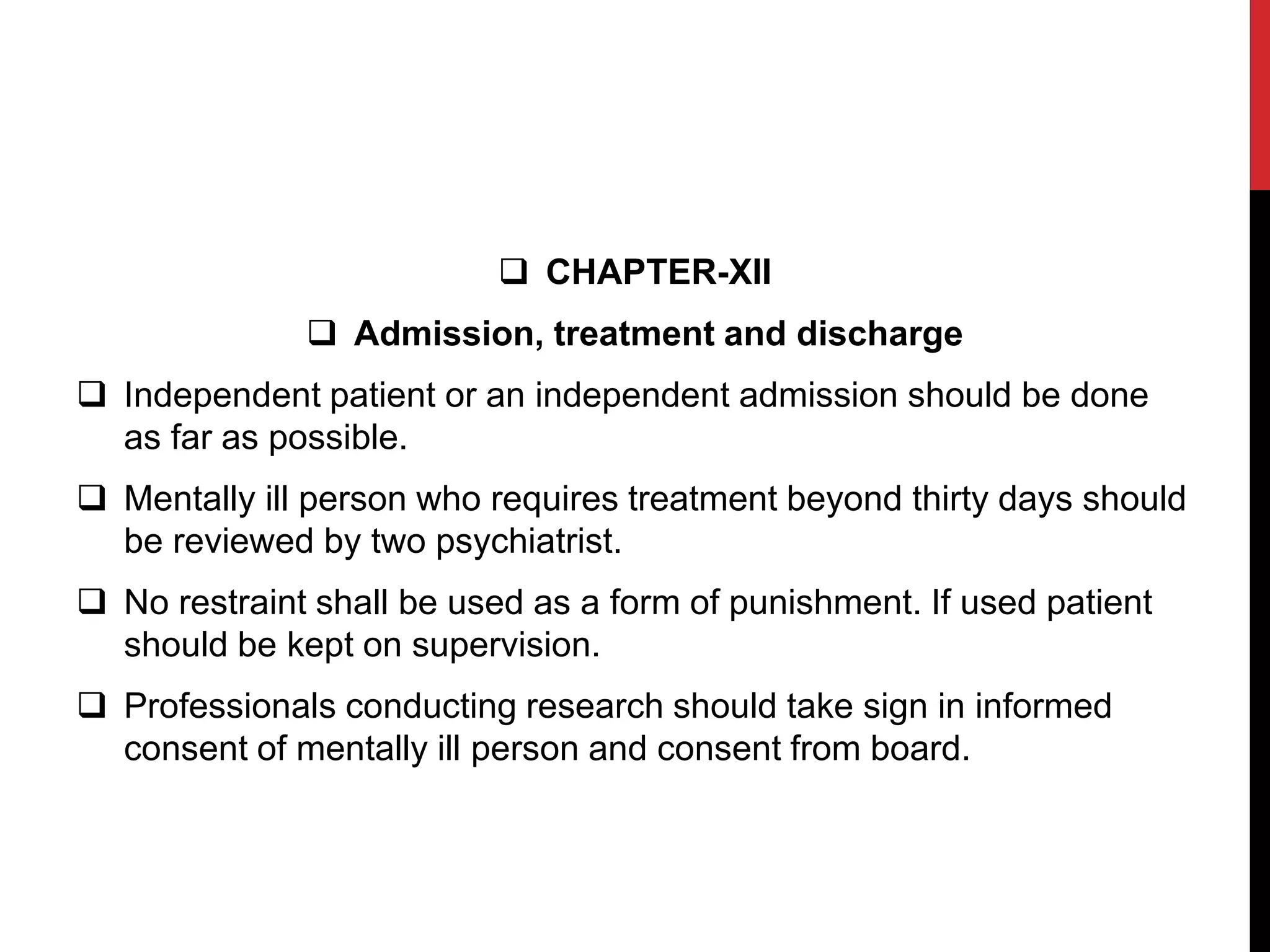
 CHAPTER-XII
 Admission, treatment and discharge
 Independent patient or an independent admission should be done
as far as possible.
 Mentally ill person who requires treatment beyond thirty days should
be reviewed by two psychiatrist.
 No restraint shall be used as a form of punishment. If used patient
should be kept on supervision.
 Professionals conducting research should take sign in informed
consent of mentally ill person and consent from board.
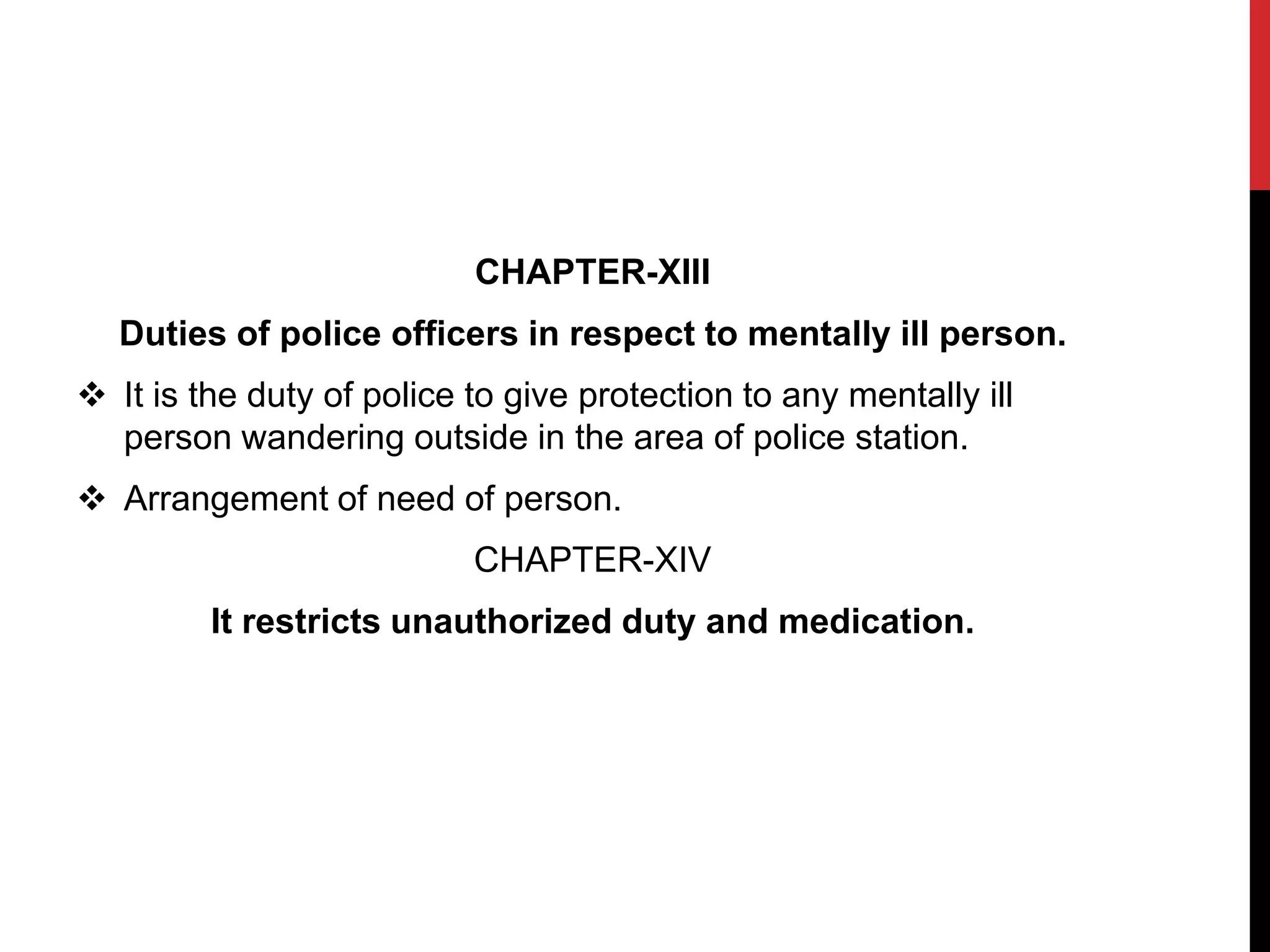
CHAPTER-XIII
Duties of police officers in respect to mentally ill person.
 It is the duty of police to give protection to any mentally ill
person wandering outside in the area of police station.
 Arrangement of need of person.
CHAPTER-XIV
It restricts unauthorized duty and medication.
CHAPTER-XV
It deals with penalty and punishment.
 Unauthorized institutions will be punished 5000-50000for 1st time, upto 2
lakhs for 2nd time.
 Any person who do the work against the Act, are liable to give upto ten
thousand rupees or six months of jail or both.
CHAPTER-XVI
MISCELLANEOUS
o Power of Central Government to issue directions.
o Special provisions for States in north-east and hill States
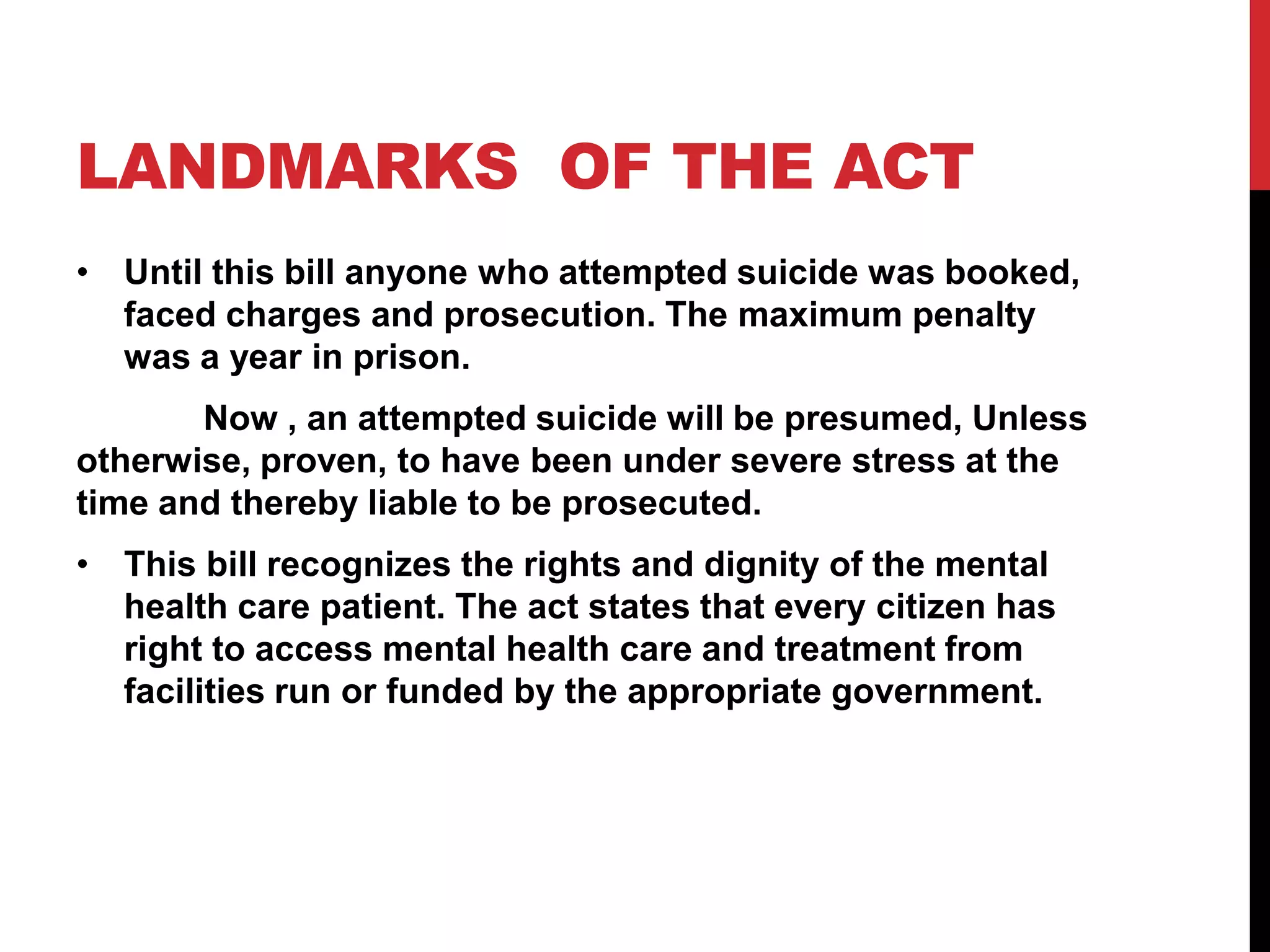
LANDMARKS OF THE ACT
• Until this bill anyone who attempted suicide was booked,
faced charges and prosecution. The maximum penalty
was a year in prison.
Now , an attempted suicide will be presumed, Unless
otherwise, proven, to have been under severe stress at the
time and thereby liable to be prosecuted.
• This bill recognizes the rights and dignity of the mental
health care patient. The act states that every citizen has
right to access mental health care and treatment from
facilities run or funded by the appropriate government.
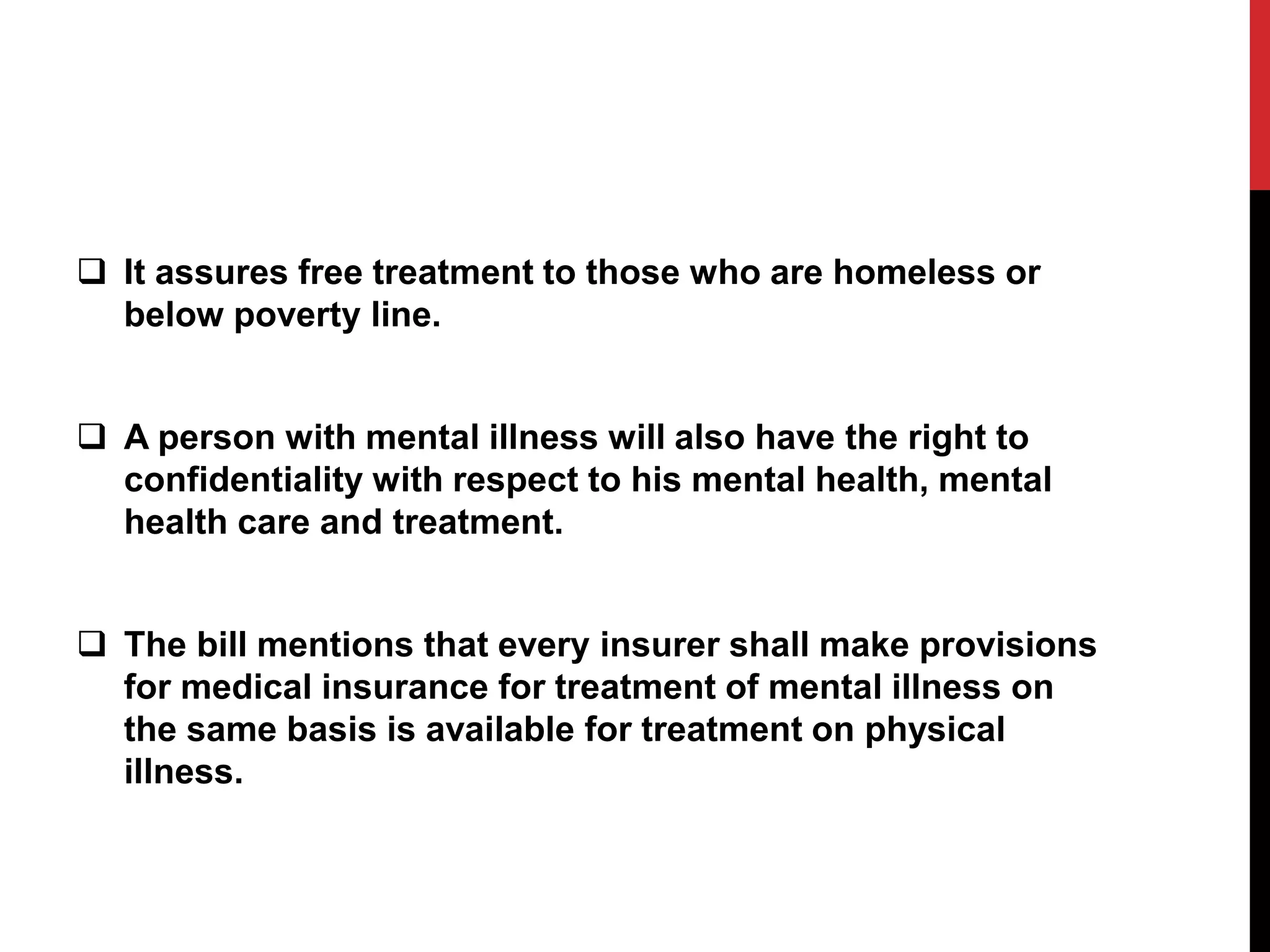
 It assures free treatment to those who are homeless or
below poverty line.
 A person with mental illness will also have the right to
confidentiality with respect to his mental health, mental
health care and treatment.
 The bill mentions that every insurer shall make provisions
for medical insurance for treatment of mental illness on
the same basis is available for treatment on physical
illness.
 This act abolished the ECT for children and made
provisions for giving modified ECT.
 It also empowers the mentally ill person to choose the
treatment and appoint individual as nominated
representatives who can take decisions on behalf of them.
LIMITATIONS
 The act mentions that a six member mental review board formed
by the states will take decisions on what treatments to offer at
government facilities.
“While the idea of board is good, to have only one psychiatrist to
take decision is not sufficient.”
 Some psychiatrists are also concerned that giving all patients to
choose forms of treatment could hamper the process.
 As this act provides advance directives it increases the work of
psychiatrist whose number is very less in our country.
 The Provision of ECT is not scientific based.
 This act mentioned establishing new improvised institutions
without concerning about reforming already established
institutions.
 “Harm” term is not defined clearly . Even during day to day
life individual fight back to protest, that individual can not be
considered as mentally ill person.
 It included AYUSH doctors but did not included mental health
nurse, psychologist as mental health professionals.
SUGGESTION
 It has been found that most of the student age between 12-
19 are committing suicide due to pressure of study. There
should be a qualified councellor in every institution.
 Most of the veterans in later stage are suffering from
mental illness due to working under extreme stress for
several years, so there should be a provision of
appointment of a psychiatry professionals in army who
will look after the mental health of army personnel.
CONCLUSION
REFERENCES
1. www.prsindia.org/.../Mental%20Health/Mental%20Healthcare%20Act,
2. lawmin.nic.in/ld/P-ACT/2017/A2017
3. www.thehindu.com/news/national/all...to...mental-
healthcare.../article17662163.ece
4. https://en.wikipedia.org/wiki/Mental_Health_Care_Act,_2017
5. https://www.ncbi.nlm.nih.gov/pmc/articles/PMC5563026
6. http://www.firstpost.com/india/mental-healthcare-bill-despite-the-
positive-reform-a-lot-more-needs-to-be-done-for-the-mentally-ill-
3373156.html
7. https://timesofindia.indiatimes.com/city/bengaluru/psychiatrists-
mental-health-bill-lacks-focus-on-community-
care/articleshow/57925979.cms
8. http://www.business-standard.com/article/economy-policy/too-
soon-to-celebrate-mental-healthcare-act-117062400734_1.html
Mental health care act 2017

Mental health care act 2017

  • 1.
  • 2.
    SALIENT FEATURES  Importanceof mental health.  Description of mental healthcare Act,2017.  Landmarks of the act.  Limitations of the Act.  Suggestions for the Act.
  • 3.
    INTRODUCTION • India hasmore than 70 million mental health patient. • Less than 4000 psychiatrist are there and they are concentrated in cities. • There are 9.5-102 persons affected in 1000 of population. • About 800,000 people commit suicide worldwide every year, of these 135,000 (17%) are residents of India, a nation with 17.5% of world population. So there is a need for looking towards mental health.
  • 4.
    MENTAL HEALTHCARE ACT,2017 Chapter-I Itcontains only basic definitions. Special Features: It defines clearly the mental illness. It includes the POST GRADUATE AYUSH doctors as mental health professional.
  • 5.
    CHAPTER-II Mental illness andcapacity to make mental healthcare and treatment decisions without any discrimination. CHAPTER-III It deals with the Advance directives. Features:  Every person except minor has right to take advance directive by writing  It empowers the patient to choose his/her treatment and appoint a representative to take decision on behalf of patient.  If patient is minor, his/ her parent or care giver will act as representative.
  • 6.
     It willnot be applicable At the time of emergency.  It is the duty of every psychiatrist to plan treatment ,keeping advance directive in mind.  If any one from psychiatrist or care giver are unsatisfied can approach to the concerned board. CHAPTER-IV Guidelines of choosing Nominated Representative.
  • 7.
    CHAPTER-V It consists ofVarious Rights of mentally ill person.  The appropriate government should make provisions of Mental health institutions on every district.  Mental ill person should not travel long distance for treatment.  It made provisions for the mentally ill person to live with dignity.  Woman with child should be separated for the safety of the child and it should be reviewed in every 15 days.  Rights of confidentiality.
  • 8.
    CHAPTER- VI It givesdirection to the government to implement the programme. CHAPTER-VII Gives provisions of forming Central Mental health authority. CHAPTER-VIII Gives provisions of forming State Mental health authority.
  • 9.
    CHAPTER IX Finance, accountsand audit. CHAPTER X Mental health establishments  Every mental healthcare institution should be registered .  Establishment of new improvised institutions.
  • 10.
    CHAPTER-XI Constitution of MentalHealth Review Boards. Every state has to form a review board which is consist of:  A district judge as chair person of board.  two members of whom one shall be a psychiatrist and the other shall be a medical practitioner.  two members who shall be persons with mental illness or care- givers or persons representing organizations of persons with mental illness
  • 11.
     CHAPTER-XII  Admission,treatment and discharge  Independent patient or an independent admission should be done as far as possible.  Mentally ill person who requires treatment beyond thirty days should be reviewed by two psychiatrist.  No restraint shall be used as a form of punishment. If used patient should be kept on supervision.  Professionals conducting research should take sign in informed consent of mentally ill person and consent from board.
  • 12.
    CHAPTER-XIII Duties of policeofficers in respect to mentally ill person.  It is the duty of police to give protection to any mentally ill person wandering outside in the area of police station.  Arrangement of need of person. CHAPTER-XIV It restricts unauthorized duty and medication.
  • 13.
    CHAPTER-XV It deals withpenalty and punishment.  Unauthorized institutions will be punished 5000-50000for 1st time, upto 2 lakhs for 2nd time.  Any person who do the work against the Act, are liable to give upto ten thousand rupees or six months of jail or both. CHAPTER-XVI MISCELLANEOUS o Power of Central Government to issue directions. o Special provisions for States in north-east and hill States
  • 14.
    LANDMARKS OF THEACT • Until this bill anyone who attempted suicide was booked, faced charges and prosecution. The maximum penalty was a year in prison. Now , an attempted suicide will be presumed, Unless otherwise, proven, to have been under severe stress at the time and thereby liable to be prosecuted. • This bill recognizes the rights and dignity of the mental health care patient. The act states that every citizen has right to access mental health care and treatment from facilities run or funded by the appropriate government.
  • 15.
     It assuresfree treatment to those who are homeless or below poverty line.  A person with mental illness will also have the right to confidentiality with respect to his mental health, mental health care and treatment.  The bill mentions that every insurer shall make provisions for medical insurance for treatment of mental illness on the same basis is available for treatment on physical illness.
  • 16.
     This actabolished the ECT for children and made provisions for giving modified ECT.  It also empowers the mentally ill person to choose the treatment and appoint individual as nominated representatives who can take decisions on behalf of them.
  • 17.
    LIMITATIONS  The actmentions that a six member mental review board formed by the states will take decisions on what treatments to offer at government facilities. “While the idea of board is good, to have only one psychiatrist to take decision is not sufficient.”  Some psychiatrists are also concerned that giving all patients to choose forms of treatment could hamper the process.  As this act provides advance directives it increases the work of psychiatrist whose number is very less in our country.
  • 18.
     The Provisionof ECT is not scientific based.  This act mentioned establishing new improvised institutions without concerning about reforming already established institutions.  “Harm” term is not defined clearly . Even during day to day life individual fight back to protest, that individual can not be considered as mentally ill person.  It included AYUSH doctors but did not included mental health nurse, psychologist as mental health professionals.
  • 19.
    SUGGESTION  It hasbeen found that most of the student age between 12- 19 are committing suicide due to pressure of study. There should be a qualified councellor in every institution.  Most of the veterans in later stage are suffering from mental illness due to working under extreme stress for several years, so there should be a provision of appointment of a psychiatry professionals in army who will look after the mental health of army personnel.
  • 20.
  • 21.
    REFERENCES 1. www.prsindia.org/.../Mental%20Health/Mental%20Healthcare%20Act, 2. lawmin.nic.in/ld/P-ACT/2017/A2017 3.www.thehindu.com/news/national/all...to...mental- healthcare.../article17662163.ece 4. https://en.wikipedia.org/wiki/Mental_Health_Care_Act,_2017 5. https://www.ncbi.nlm.nih.gov/pmc/articles/PMC5563026 6. http://www.firstpost.com/india/mental-healthcare-bill-despite-the- positive-reform-a-lot-more-needs-to-be-done-for-the-mentally-ill- 3373156.html 7. https://timesofindia.indiatimes.com/city/bengaluru/psychiatrists- mental-health-bill-lacks-focus-on-community- care/articleshow/57925979.cms 8. http://www.business-standard.com/article/economy-policy/too- soon-to-celebrate-mental-healthcare-act-117062400734_1.html