MENOPAUSE
PRESENTED BY- RISHIKA RAWAT
RN/RM
[B.Sc. Nursing]
 Menopause means permanent cessation of
menstruation at the end of reproductive life
due to loss of ovarian follicular activity. It is the
point of time when last and final menstruation
occurs.
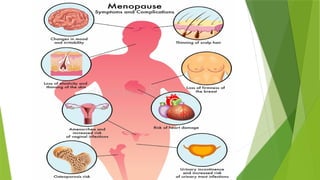
PHYSIOLOGICAL CHANGES
 Increased cholesterol level in the blood
Hyperlipidemia or an increase in the level of cholesterol and lipids in
the blood is common. This led to gradual rise in the risk of heart
disease and stroke after menopause.
 Osteoporosis
Calcium loss from the bone increased in the first five years after the
onset of menopause, resulting in a loss of bone density. The calcium
moves out of the bones, leaving them weak and liable to fracture at
the smallest stress.
 Digestive system
Motor activity of the digestive tract is diminished after menopause.
The intestine tend to be sluggish resulting constipation.
.
 Urinary system
As the estrogen level decreases after menopause, the tissue lining
the urethra and the bladder become drier, thinner and less elastic
This can lead to increased frequency of urination as well as an
increased tendency to develop UTI.
 Uterus
The uterus become small trophy of the muscles after the
menopause. The cervix become smaller and appears to fuse with
vagina. In older women the cervix may be impossible to identify
separately from vagina The vaginal and cervical discharge decreases
in amount and later disappear completely.
 Ovaries
The ovaries become smaller and wrinkle appearance. Completely
cessation of producing any hormone
.
 Vagina
The vaginal mucous membrane becomes thin . Decreased secretion make vagina
dry. Sexual intercourse become painful and difficult due to pain from the dry
vagina.
 Skin
The skin loses its elasticity and becomes t and fine. This is due to the loss of
elastin and collagen from the skin.
 Weight
increase in weight. There is more deposition of fat around hips, waist and
buttocks.
 Hair and voice
Hair become dry and coarse after menopause. There may be hair loss due to the
decreasing level of estrogen. Voice become deeper due to thickening of vocal
cords.
.
 Hot flashes
Hot flashes are incidents where the women in menopause gets a
sudden feeling of warmth and flushing that starts in the face and
quickly spread all over the neck and upper body.
 Night sweats
Night sweats are closely related to flashes. Both usually occur
simultaneously. Sweat can occur any time of the day or night,
they are more common at night. The sudden waking up from
sleep can cause palpitation and sometimes panic attacks.
HORMONE REPLACEMENT THERAPY
 Hormone Replacement Therapy (HRT) is indicated m menopausal
women to overcome the short-term long-term consequences of
estrogen deficiency. HRT can be administered orally (in pill form),
vaginally (as a cream), or transdermal (in patch form) because it
replaces female hormones produced by the ovaries. Hormone
replacement therapy minimize menopause symptoms. It can be used
before, during and after menopause.
INDICATIONS OF HRT
 Relief of menopausal symptoms
 Prevention of osteoporosis
 To maintain the quality of life in menopausal years
 special group of women to whom HRT should be prescribed
• Premature ovarian failure
• Gonadal dysgenesis
• Surgical or radiation menopause
TYPES OF HRT
 Estrogen and progesterone: The most common type HRT involves both
estrogen and progesterone. During this therapy, estrogen is given
regularly while progesterone is added in on a supplementary basis.
 Estrogen only: Estrogen therapy alone is usually given to women who
have lost their uterus due surgical menopause. Because no uterus is
present, the need for progesterone is not as important.
 Progestin only: Progestin-only therapy is not prescribed very often.
Progestin does seem to provide excellent relief for women plagued
with hot flashes.
SURGICAL MENOPAUSE
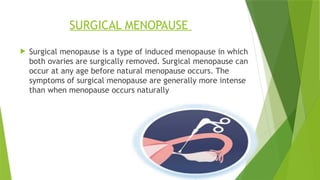
 Surgical menopause is a type of induced menopause in which
both ovaries are surgically removed. Surgical menopause can
occur at any age before natural menopause occurs. The
symptoms of surgical menopause are generally more intense
than when menopause occurs naturally
HEALTH EDUCATION ON MENOPAUSE
 Women at the menopausal stage need to be supported emotionally
they may need counselling to be educated about how to manage
signs and symptoms of menopause.
 This may also help them to overcome the symptoms of anxiety and
depression. Certain life style modification is necessary to prevent the
occurrence or minimize the effects of the associated condition
 Encouraged regular exercise.
 Encourage family members to give emotional support to prevent
depression.
 Encouraged to take healthy and balance diet.
.
 Encourage to practice relaxation techniques and get enough
sleep.
 Instruct to get enough calcium, Vitamin D or minerals and
supplements if recommended by the Doctor.
 Instruct to quit smoking.
 Instruct to wear light and comfortable clothes.