Amenorrhea Zhanghuiying   Department Of Obstetrics & Gynecology Tianjin Medical University General Hospital
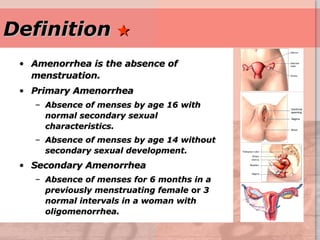
Definition   ★ Amenorrhea is the absence of menstruation. Primary Amenorrhea Absence of menses by age 16 with normal secondary sexual characteristics. Absence of menses by age 14 without secondary sexual development. Secondary Amenorrhea Absence of menses for 6 months in a previously menstruating female  or  3 normal intervals in a woman with oligomenorrhea.
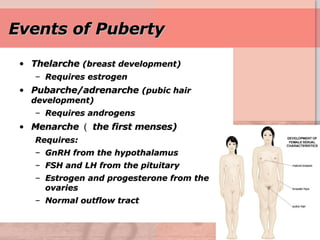
Events of Puberty Thelarche  (breast development) Requires estrogen Pubarche/adrenarche  (pubic hair development) Requires androgens Menarche ( the first menses) Requires: GnRH from the hypothalamus FSH and LH from the pituitary Estrogen and progesterone from the ovaries Normal outflow tract
Possible results of amenorrhea Cannot  conceive Lead to osteoporosis and genital atrophy Increased endometrial hyperplasia which can increase the possibility of endometrial carcinoma from unopposed estrogen secretion Without secondary sexual characteristics may give rise to major social and psychosexual problems.
Classification of amenorrhea hypothalamic amenorrhea pituitary amenorrhea ovarian amenorrhea uterine amenorrhea
Etiology - hypothalamic amenorrhea Psychological stress Anorexia nervosa, weight loss Increased exercise levels Kallmann syndrome -congenital absence of GnRH drug-induced amenorrhea: anti-psychotics, reserpine,  Contracepti ve Space-occupying lesion of CNS
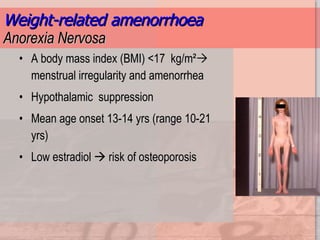
Weight-related amenorrhoea Anorexia Nervosa A body mass index (BMI) <17  kg/m ²   menstrual irregularity and amenorrhea Hypothalamic  suppression  Mean age onset 13-14 yrs (range 10-21 yrs) Low estradiol    risk of osteoporosis
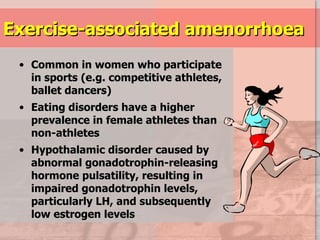
Exercise-associated amenorrhoea Common in women who participate in sports (e.g. competitive athletes,  ballet dancers) Eating disorders have a higher prevalence in female athletes than non-athletes Hypothalamic disorder caused by abnormal gonadotrophin-releasing hormone pulsatility, resulting in impaired gonadotrophin levels, particularly LH, and subsequently low estrogen levels
Contraception related amenorrhea Post-pill amenorrhea is not an entity Depot medroxyprogesterone acetate Up to 80 % of women will have amenorrhea after 1 year of use. It is reversible  (estrogen deficiency) A minority of women taking the progestogen-only pill may have reversible long term amenorrhoea due to complete suppression of ovulation
Etiology - pituitary amenorrhea tumor Empty  sella  syndrome Sheehan syndrome
Sheehan ’s syndrome Pituitary inability to secrete gonadotropins Pituitary necrosis following massive obstetric hemorrhage is most common cause in women Diagnosis : History and    E2,FSH,LH + other pituitary deficiencies  (   TSH  Thyroid Stimulating Hormone  and  ACTH  adrenocorticotropic hormone ) Treatment : Replacement of deficient hormones
Etiology - ovarian amenorrhea ◆ Gonadal dysgenesis Chromosomally incompetent - Classic turner ’s syndrome (45XO) - Turner variants (45XO/46XX),(46X- abnormal  X) - Mixed gonadal  dysgenesis  (45XO/46XY) Chromosomally competent - 46XX (Pure gonadal  dysgenesis ) - 46XY (Swyer’s syndrome) ◆ resistant ovary syndrome ◆ Premature ovarian failure ◆ Polycystic ovary syndrome
Typical features of Turner’s  Syndrome Sexual infantilism and short stature High FSH and LH levels. •  Bilateral streaked gonads. •  Karyotype  - 80 % 45, X0  -  20% mosaic forms (46XX/45X0)
Turner’s syndrome ( Classic 45-XO) Mosaic (46-XX / 45-XO)
Ovarian dysgenesis streak gonad
Premature ovarian failure Manopause occurs before 40 years old. Serum estradiol < 50 pg/ml and FSH > 40 IU/ml on repeated occasions
Etiology uterine amenorrhea Absence of uterus Asherman syndrome anatomic abnormalities of the reproductive tract  Imperforate Hymen
Asherman’s  syndrome History of  pregnancy associated D&C Rarely after CS , myomectomy T.B endometritis,  Diagnosis : HSG or hysterescopy Treatment : lysis of adhesions; D&C or hysterescopy + estrogen therapy Hysterosalpingography Uterine synechiae
Imperforate Hymen
Mayer-Rokitansky-Kuster-Hauser Syndrome   (utero-vaginal agenesis) 15%  of  primary amenorrhea  Normal secondary development  &  external female genitalia Normal female range testosterone level Absent uterus and upper vagina & normal ovaries Karyotype 46-XX 15 ~ 30% renal, skeletal  and  middle ear anomalies
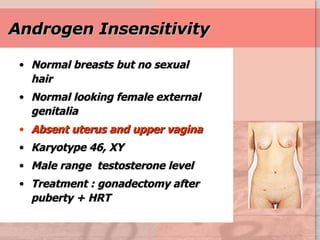
Androgen Insensitivity Normal breasts but no sexual hair Normal looking female external genitalia Absent uterus and upper vagina Karyotype 46, XY Male range  testosterone level Treatment : gonadectomy after puberty + HRT
congenital adrenal hyperplasia Autosomal recessive trait Most common form is due to 21-hydroxylase deficiency Mild forms Closely resemble PCO S Severe forms show Signs of  severe androgen excess High 17-OH-progesterone blood level abn ormal looking female external genitalia Presence of  uterus and upper vagina Treatment : cortisol replacement and Corrective surgery
Other causes of  Secondary Amenorrhea Pituitary disorders Hyperprolactinemia Prolactinoma Medications Renal failure Hypoprolactinemia Pituitary resection Sheehan’s syndrome Thyroid disorders Hyper- or hypothyroidism
Diagnosis of Amenorrhea
Diagnosis History  Physical examination Physical examination begins with vital signs, including height and weight, and with sexual maturity ratings  Laboratory evaluation
Evaluation of Primary Amenorrhea Physical exam to determine presence of uterus FSH Karyotype
Primary Amenorrhea Is there normal development of secondary sexual characteristics? NO Think hypogonadism or hypogonadotropism
Amenorrhea with  Immature  Secondary Characteristics FSH Serum level Low / normal High Hypogonadotropic hypogonadism Gonadal dysgenesis
Hypogonadism (gonadal failure) Gonadal dysgenesis   Chromosomally abnormal -  Classic  T urner ’s syndrome (45XO) - Turner variants (45XO/46XX),(46X-abnormal X) - Mixed gonadal  dysgenesis  (45XO/46XY ) Chromosomally normal -  46XX (Pure gonadal  dysgenesis ) - 46XY (Swyer’s syndrome ) Irradiation Chemotherapy galactosemia Note:  gonadotropins (FSH/LSH) will be high, similar to menopause
Hypogonadotropism Hypothalamic dysfunction Kallmann’s syndrome Anorexia nervosa Space-occupying lesion of CNS Pituitary damage (surgery/radiation) Constitutional delay
Primary Amenorrhea Is there normal development of secondary sexual characteristics? YES Think Pregnancy Mullerian anomaly Androgen insensitivity
Mullerian Anomalies Mullerian agenesis (Mayer-Rokitansky-Kuster-Hauser syndrome) Imperforate hymen Transverse vaginal septum
Evaluation of Secondary Amenorrhea History Nutrition/exercise habits, weight change Sexual/contraceptive practice History of uterine/cervical surgery Physical exam Height/weight Hirsutism Galactorrhea Estrogen status of tissues Laboratory hCG   PRL & TSH    progesterone challenge    FSH    if high   karyotype
Negative Pregnancy.test TSH ,PROLACTIN, Progesterone challenge test withdrawal bleeding   without withdrawal bleeding   hypoestrogenic   compromised outflow tract   +ve.est/progest challenge test -ve.est/progest challenge test FSH>30-40 Normal FSH HSG OR hysteroscopy   Asherman’s FSH low . repeat Repeat+serum estrogen level PreOvFailure hypothalamic-pituitary failure   anovulation  Procedures of Diagnosis Secondary Amenorrhea
Treatment -- Selfstudy treatment varies depending upon the causes of  the amenorrhea.

27.Amenorrhea

  • 1.
    Amenorrhea Zhanghuiying Department Of Obstetrics & Gynecology Tianjin Medical University General Hospital
  • 2.
    Definition ★ Amenorrhea is the absence of menstruation. Primary Amenorrhea Absence of menses by age 16 with normal secondary sexual characteristics. Absence of menses by age 14 without secondary sexual development. Secondary Amenorrhea Absence of menses for 6 months in a previously menstruating female or 3 normal intervals in a woman with oligomenorrhea.
  • 3.
    Events of PubertyThelarche (breast development) Requires estrogen Pubarche/adrenarche (pubic hair development) Requires androgens Menarche ( the first menses) Requires: GnRH from the hypothalamus FSH and LH from the pituitary Estrogen and progesterone from the ovaries Normal outflow tract
  • 4.
    Possible results ofamenorrhea Cannot conceive Lead to osteoporosis and genital atrophy Increased endometrial hyperplasia which can increase the possibility of endometrial carcinoma from unopposed estrogen secretion Without secondary sexual characteristics may give rise to major social and psychosexual problems.
  • 5.
    Classification of amenorrheahypothalamic amenorrhea pituitary amenorrhea ovarian amenorrhea uterine amenorrhea
  • 6.
    Etiology - hypothalamicamenorrhea Psychological stress Anorexia nervosa, weight loss Increased exercise levels Kallmann syndrome -congenital absence of GnRH drug-induced amenorrhea: anti-psychotics, reserpine, Contracepti ve Space-occupying lesion of CNS
  • 7.
    Weight-related amenorrhoea AnorexiaNervosa A body mass index (BMI) <17 kg/m ²  menstrual irregularity and amenorrhea Hypothalamic suppression Mean age onset 13-14 yrs (range 10-21 yrs) Low estradiol  risk of osteoporosis
  • 8.
    Exercise-associated amenorrhoea Commonin women who participate in sports (e.g. competitive athletes, ballet dancers) Eating disorders have a higher prevalence in female athletes than non-athletes Hypothalamic disorder caused by abnormal gonadotrophin-releasing hormone pulsatility, resulting in impaired gonadotrophin levels, particularly LH, and subsequently low estrogen levels
  • 9.
    Contraception related amenorrheaPost-pill amenorrhea is not an entity Depot medroxyprogesterone acetate Up to 80 % of women will have amenorrhea after 1 year of use. It is reversible (estrogen deficiency) A minority of women taking the progestogen-only pill may have reversible long term amenorrhoea due to complete suppression of ovulation
  • 10.
    Etiology - pituitaryamenorrhea tumor Empty sella syndrome Sheehan syndrome
  • 11.
    Sheehan ’s syndromePituitary inability to secrete gonadotropins Pituitary necrosis following massive obstetric hemorrhage is most common cause in women Diagnosis : History and  E2,FSH,LH + other pituitary deficiencies ( TSH Thyroid Stimulating Hormone and ACTH adrenocorticotropic hormone ) Treatment : Replacement of deficient hormones
  • 12.
    Etiology - ovarianamenorrhea ◆ Gonadal dysgenesis Chromosomally incompetent - Classic turner ’s syndrome (45XO) - Turner variants (45XO/46XX),(46X- abnormal X) - Mixed gonadal dysgenesis (45XO/46XY) Chromosomally competent - 46XX (Pure gonadal dysgenesis ) - 46XY (Swyer’s syndrome) ◆ resistant ovary syndrome ◆ Premature ovarian failure ◆ Polycystic ovary syndrome
  • 13.
    Typical features ofTurner’s Syndrome Sexual infantilism and short stature High FSH and LH levels. • Bilateral streaked gonads. • Karyotype - 80 % 45, X0 - 20% mosaic forms (46XX/45X0)
  • 14.
    Turner’s syndrome (Classic 45-XO) Mosaic (46-XX / 45-XO)
  • 15.
  • 16.
    Premature ovarian failureManopause occurs before 40 years old. Serum estradiol < 50 pg/ml and FSH > 40 IU/ml on repeated occasions
  • 17.
    Etiology uterine amenorrheaAbsence of uterus Asherman syndrome anatomic abnormalities of the reproductive tract Imperforate Hymen
  • 18.
    Asherman’s syndromeHistory of pregnancy associated D&C Rarely after CS , myomectomy T.B endometritis, Diagnosis : HSG or hysterescopy Treatment : lysis of adhesions; D&C or hysterescopy + estrogen therapy Hysterosalpingography Uterine synechiae
  • 19.
  • 20.
    Mayer-Rokitansky-Kuster-Hauser Syndrome (utero-vaginal agenesis) 15% of primary amenorrhea Normal secondary development & external female genitalia Normal female range testosterone level Absent uterus and upper vagina & normal ovaries Karyotype 46-XX 15 ~ 30% renal, skeletal and middle ear anomalies
  • 21.
    Androgen Insensitivity Normalbreasts but no sexual hair Normal looking female external genitalia Absent uterus and upper vagina Karyotype 46, XY Male range testosterone level Treatment : gonadectomy after puberty + HRT
  • 22.
    congenital adrenal hyperplasiaAutosomal recessive trait Most common form is due to 21-hydroxylase deficiency Mild forms Closely resemble PCO S Severe forms show Signs of severe androgen excess High 17-OH-progesterone blood level abn ormal looking female external genitalia Presence of uterus and upper vagina Treatment : cortisol replacement and Corrective surgery
  • 23.
    Other causes of Secondary Amenorrhea Pituitary disorders Hyperprolactinemia Prolactinoma Medications Renal failure Hypoprolactinemia Pituitary resection Sheehan’s syndrome Thyroid disorders Hyper- or hypothyroidism
  • 24.
  • 25.
    Diagnosis History Physical examination Physical examination begins with vital signs, including height and weight, and with sexual maturity ratings Laboratory evaluation
  • 26.
    Evaluation of PrimaryAmenorrhea Physical exam to determine presence of uterus FSH Karyotype
  • 27.
    Primary Amenorrhea Isthere normal development of secondary sexual characteristics? NO Think hypogonadism or hypogonadotropism
  • 28.
    Amenorrhea with Immature Secondary Characteristics FSH Serum level Low / normal High Hypogonadotropic hypogonadism Gonadal dysgenesis
  • 29.
    Hypogonadism (gonadal failure)Gonadal dysgenesis Chromosomally abnormal - Classic T urner ’s syndrome (45XO) - Turner variants (45XO/46XX),(46X-abnormal X) - Mixed gonadal dysgenesis (45XO/46XY ) Chromosomally normal - 46XX (Pure gonadal dysgenesis ) - 46XY (Swyer’s syndrome ) Irradiation Chemotherapy galactosemia Note: gonadotropins (FSH/LSH) will be high, similar to menopause
  • 30.
    Hypogonadotropism Hypothalamic dysfunctionKallmann’s syndrome Anorexia nervosa Space-occupying lesion of CNS Pituitary damage (surgery/radiation) Constitutional delay
  • 31.
    Primary Amenorrhea Isthere normal development of secondary sexual characteristics? YES Think Pregnancy Mullerian anomaly Androgen insensitivity
  • 32.
    Mullerian Anomalies Mullerianagenesis (Mayer-Rokitansky-Kuster-Hauser syndrome) Imperforate hymen Transverse vaginal septum
  • 33.
    Evaluation of SecondaryAmenorrhea History Nutrition/exercise habits, weight change Sexual/contraceptive practice History of uterine/cervical surgery Physical exam Height/weight Hirsutism Galactorrhea Estrogen status of tissues Laboratory hCG  PRL & TSH  progesterone challenge  FSH  if high  karyotype
  • 34.
    Negative Pregnancy.test TSH,PROLACTIN, Progesterone challenge test withdrawal bleeding without withdrawal bleeding hypoestrogenic compromised outflow tract +ve.est/progest challenge test -ve.est/progest challenge test FSH>30-40 Normal FSH HSG OR hysteroscopy Asherman’s FSH low . repeat Repeat+serum estrogen level PreOvFailure hypothalamic-pituitary failure anovulation Procedures of Diagnosis Secondary Amenorrhea
  • 35.
    Treatment -- Selfstudytreatment varies depending upon the causes of the amenorrhea.