D A N I E L L E M E L D R U M
WHAT IS PARKINSON'S DISEASE?
Progressive neurological condition
Decline in the production of a brain chemical called
dopamine
Categorised by as a “movement disorder.” However it
doesn’t just affect movement.
Early in the disease, the most obvious are shaking, rigidity,
slowness of movement, and difficulty with walking.
Approximately 70,000 Australians living with Parkinson’s.
30 People diagnosed each day in Australia
IMPAIRMENTS
Rigidity
Bradykinesia
Tremor
 Often disappears with movement, often present at rest
 Usually starts on one side of the body and progresses to the
other side; usually remains asymmetrical.
 20% wont develop a tremor
Postural Instability
Freezing
IS THERE A CURE?
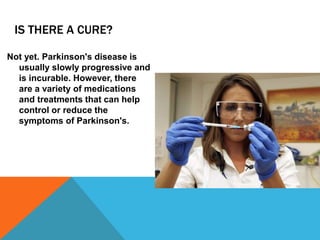
Not yet. Parkinson's disease is
usually slowly progressive and
is incurable. However, there
are a variety of medications
and treatments that can help
control or reduce the
symptoms of Parkinson's.
SO WHAT CAN WE DO?
As OTs and Physios we can
implement types of therapy
which slow down the
progression of the disease.
As a Speech Pathologist you
can implement techniques
from LSVT LOUD to
improve patients speech
As a Dietician you can advise
patients on which foods to
not eat as they interfere
with the absorption of the
medication
PD WARRIOR
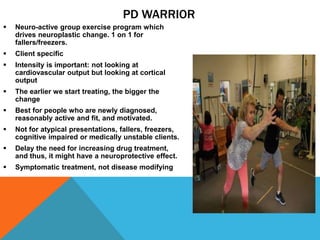
 Neuro-active group exercise program which
drives neuroplastic change. 1 on 1 for
fallers/freezers.
 Client specific
 Intensity is important: not looking at
cardiovascular output but looking at cortical
output
 The earlier we start treating, the bigger the
change
 Best for people who are newly diagnosed,
reasonably active and fit, and motivated.
 Not for atypical presentations, fallers, freezers,
cognitive impaired or medically unstable clients.
 Delay the need for increasing drug treatment,
and thus, it might have a neuroprotective effect.
 Symptomatic treatment, not disease modifying
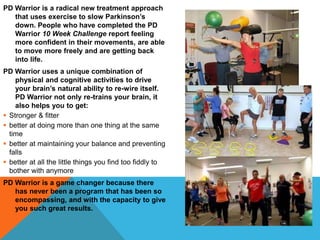
PD Warrior is a radical new treatment approach
that uses exercise to slow Parkinson’s
down. People who have completed the PD
Warrior 10 Week Challenge report feeling
more confident in their movements, are able
to move more freely and are getting back
into life.
PD Warrior uses a unique combination of
physical and cognitive activities to drive
your brain’s natural ability to re-wire itself.
PD Warrior not only re-trains your brain, it
also helps you to get:
 Stronger & fitter
 better at doing more than one thing at the same
time
 better at maintaining your balance and preventing
falls
 better at all the little things you find too fiddly to
bother with anymore
PD Warrior is a game changer because there
has never been a program that has been so
encompassing, and with the capacity to give
you such great results.
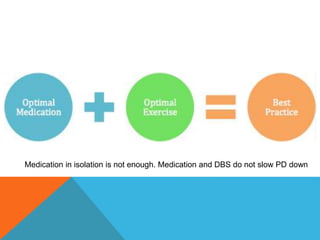
Medication in isolation is not enough. Medication and DBS do not slow PD down
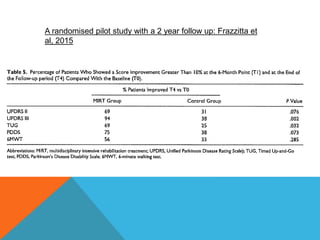
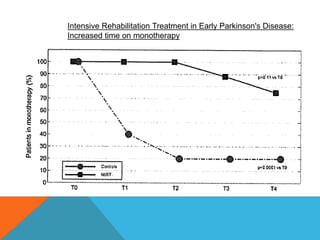
A randomised pilot study with a 2 year follow up: Frazzitta et
al, 2015
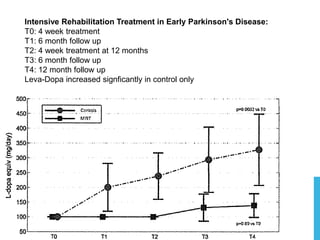
Intensive Rehabilitation Treatment in Early Parkinson's Disease:
T0: 4 week treatment
T1: 6 month follow up
T2: 4 week treatment at 12 months
T3: 6 month follow up
T4: 12 month follow up
Leva-Dopa increased signficantly in control only
Intensive Rehabilitation Treatment in Early Parkinson's Disease:
Increased time on monotherapy
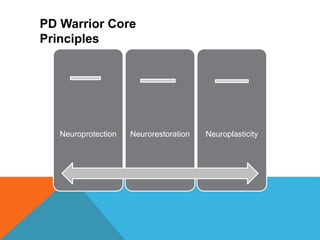
PD Warrior Core
Principles
Neuroprotection Neurorestoration Neuroplasticity
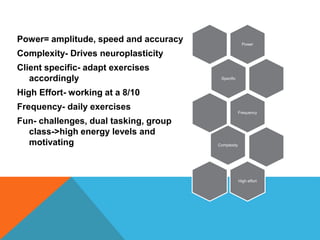
Power= amplitude, speed and accuracy
Complexity- Drives neuroplasticity
Client specific- adapt exercises
accordingly
High Effort- working at a 8/10
Frequency- daily exercises
Fun- challenges, dual tasking, group
class->high energy levels and
motivating
Power
Specific
Frequency
Complexity
High effort
PROTEIN CONSUMPTION AND PARKINSON’S DISEASE
Levodopa is an amino acid, it competes for absorption with
other proteins: Eating a very protein meal would reduce
the likelihood of efficiently absorbing levodopa. That’s
why it is better to eat carbohydrates and vegetables at
lunch and leave meat, cheese and fish for night-time.
Food is absolutely critical to symptoms, good and bad. Food
interacts strongly with the medications too. It simply is
not enough to rely on drugs, and if you have periods
where the "drugs aren't working" it is vital to look to your
diet.
LSVT LOUD
Treatment is administered in 16 sessions over a single
month (four individual 60 minute sessions per week).
This intensive mode of administration is consistent with
theories of motor learning and skill acquisition, as well as
with principles of neural plasticity, and is critical to
attaining optimal results.
The treatment helps individuals with PD recognize that their
voice is too soft, convincing them that the louder voice is
within normal limits, and making them comfortable with
their new louder voice.
LSVT BIG
Exercise program, 1:1, 4 consecutive days a week for 4
weeks.
High effort
Daily homework practice
Target amplitude: largest ROM, performed with the highest
effort, with maximally efficient biomechanics
PUSH the patient, High Effort! Reinforce! Motivate!
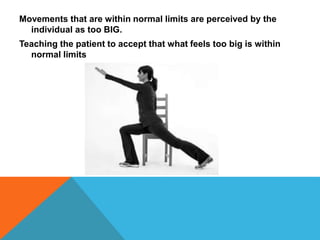
Movements that are within normal limits are perceived by the
individual as too BIG.
Teaching the patient to accept that what feels too big is within
normal limits
Repetitions
CALIBRATION
Presentation1

Presentation1

  • 1.
    D A NI E L L E M E L D R U M
  • 2.
    WHAT IS PARKINSON'SDISEASE? Progressive neurological condition Decline in the production of a brain chemical called dopamine Categorised by as a “movement disorder.” However it doesn’t just affect movement. Early in the disease, the most obvious are shaking, rigidity, slowness of movement, and difficulty with walking. Approximately 70,000 Australians living with Parkinson’s. 30 People diagnosed each day in Australia
  • 3.
    IMPAIRMENTS Rigidity Bradykinesia Tremor  Often disappearswith movement, often present at rest  Usually starts on one side of the body and progresses to the other side; usually remains asymmetrical.  20% wont develop a tremor Postural Instability Freezing
  • 4.
    IS THERE ACURE? Not yet. Parkinson's disease is usually slowly progressive and is incurable. However, there are a variety of medications and treatments that can help control or reduce the symptoms of Parkinson's.
  • 5.
    SO WHAT CANWE DO? As OTs and Physios we can implement types of therapy which slow down the progression of the disease. As a Speech Pathologist you can implement techniques from LSVT LOUD to improve patients speech As a Dietician you can advise patients on which foods to not eat as they interfere with the absorption of the medication
  • 6.
    PD WARRIOR  Neuro-activegroup exercise program which drives neuroplastic change. 1 on 1 for fallers/freezers.  Client specific  Intensity is important: not looking at cardiovascular output but looking at cortical output  The earlier we start treating, the bigger the change  Best for people who are newly diagnosed, reasonably active and fit, and motivated.  Not for atypical presentations, fallers, freezers, cognitive impaired or medically unstable clients.  Delay the need for increasing drug treatment, and thus, it might have a neuroprotective effect.  Symptomatic treatment, not disease modifying
  • 7.
    PD Warrior isa radical new treatment approach that uses exercise to slow Parkinson’s down. People who have completed the PD Warrior 10 Week Challenge report feeling more confident in their movements, are able to move more freely and are getting back into life. PD Warrior uses a unique combination of physical and cognitive activities to drive your brain’s natural ability to re-wire itself. PD Warrior not only re-trains your brain, it also helps you to get:  Stronger & fitter  better at doing more than one thing at the same time  better at maintaining your balance and preventing falls  better at all the little things you find too fiddly to bother with anymore PD Warrior is a game changer because there has never been a program that has been so encompassing, and with the capacity to give you such great results.
  • 8.
    Medication in isolationis not enough. Medication and DBS do not slow PD down
  • 9.
    A randomised pilotstudy with a 2 year follow up: Frazzitta et al, 2015
  • 10.
    Intensive Rehabilitation Treatmentin Early Parkinson's Disease: T0: 4 week treatment T1: 6 month follow up T2: 4 week treatment at 12 months T3: 6 month follow up T4: 12 month follow up Leva-Dopa increased signficantly in control only
  • 11.
    Intensive Rehabilitation Treatmentin Early Parkinson's Disease: Increased time on monotherapy
  • 12.
    PD Warrior Core Principles NeuroprotectionNeurorestoration Neuroplasticity
  • 13.
    Power= amplitude, speedand accuracy Complexity- Drives neuroplasticity Client specific- adapt exercises accordingly High Effort- working at a 8/10 Frequency- daily exercises Fun- challenges, dual tasking, group class->high energy levels and motivating Power Specific Frequency Complexity High effort
  • 16.
    PROTEIN CONSUMPTION ANDPARKINSON’S DISEASE Levodopa is an amino acid, it competes for absorption with other proteins: Eating a very protein meal would reduce the likelihood of efficiently absorbing levodopa. That’s why it is better to eat carbohydrates and vegetables at lunch and leave meat, cheese and fish for night-time. Food is absolutely critical to symptoms, good and bad. Food interacts strongly with the medications too. It simply is not enough to rely on drugs, and if you have periods where the "drugs aren't working" it is vital to look to your diet.
  • 17.
    LSVT LOUD Treatment isadministered in 16 sessions over a single month (four individual 60 minute sessions per week). This intensive mode of administration is consistent with theories of motor learning and skill acquisition, as well as with principles of neural plasticity, and is critical to attaining optimal results. The treatment helps individuals with PD recognize that their voice is too soft, convincing them that the louder voice is within normal limits, and making them comfortable with their new louder voice.
  • 19.
    LSVT BIG Exercise program,1:1, 4 consecutive days a week for 4 weeks. High effort Daily homework practice Target amplitude: largest ROM, performed with the highest effort, with maximally efficient biomechanics PUSH the patient, High Effort! Reinforce! Motivate!
  • 21.
    Movements that arewithin normal limits are perceived by the individual as too BIG. Teaching the patient to accept that what feels too big is within normal limits
  • 22.
  • 23.

Editor's Notes

  • #3 Depression effects 30% Loss of smell in 97% Non-motor symptoms such as apathy, anxiety, constipation, depression and problems with memory and sleep can also occur.
  • #7 Exercise shows the only promise for slowing PD down currently. It’s a complete rehab program designed to improve your function, quality of life and long term exercise behaviour, especially if you have only recently been diagnosed.