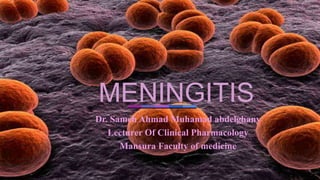

MENINGITIS
Dr. Sameh Ahmad Muhamad abdelghany
Lecturer Of Clinical Pharmacology
Mansura Faculty of medicine
2
CONTENTS
1
4
5
3
2
Diagnosis
PREVENTION
&TREATMENT
INTRODUCTION
TYPES
RISK
FACTORS
3
1 INTRODUCTION
4
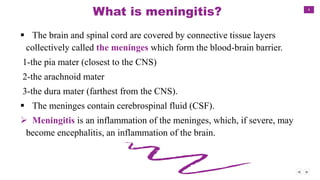
What is meningitis?
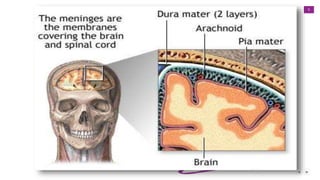
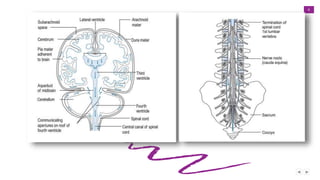
 The brain and spinal cord are covered by connective tissue layers
collectively called the meninges which form the blood-brain barrier.
1-the pia mater (closest to the CNS)
2-the arachnoid mater
3-the dura mater (farthest from the CNS).
 The meninges contain cerebrospinal fluid (CSF).
 Meningitis is an inflammation of the meninges, which, if severe, may
become encephalitis, an inflammation of the brain.
5
6
7
What is meningitis?
 Meningitis can be caused by many different organisms including viruses
and bacteria.
 Meningitis, caused by a bacteria, is life threatening and requires urgent
medical attention and treatment with antibiotics.
 Meningitis caused by a virus is very rarely life threatening but can cause
the body to become very weak.
 When bacteria invade the body they can cause meningitis, septicemia or
meningitis and septicemia together
8
2 TYPES
9
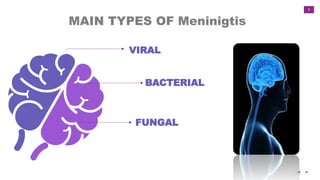
MAIN TYPES OF Meninigtis
VIRAL
FUNGAL
BACTERIAL
10
Causes of Meningitis
1. Viral Infections
2. Bacterial Infections
3. Fungal Infections:
o e.g. Cryptococcus neoformans - Coccidiodes immitus
4. Inflammatory diseases : (SLE)
5. Cancer
6. Trauma to head or spine.
11
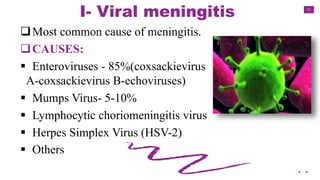
I- Viral meningitis
Most common cause of meningitis.
CAUSES:
 Enteroviruses - 85%(coxsackievirus
A-coxsackievirus B-echoviruses)
 Mumps Virus- 5-10%
 Lymphocytic choriomeningitis virus
 Herpes Simplex Virus (HSV-2)
 Others
12
Viral meningitis
Viruses in the Enterovirus category cause about 10 to
15 million infections per year, but only a small
percentage of people who get infected will develop
meningitis.
Viral meningitis typically goes away without treatment.
13
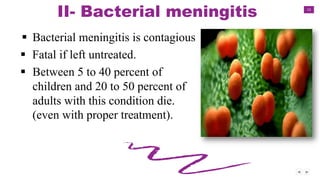
II- Bacterial meningitis
 Bacterial meningitis is contagious
 Fatal if left untreated.
 Between 5 to 40 percent of
children and 20 to 50 percent of
adults with this condition die.
(even with proper treatment).
14
Bacterial meningitis
CAUSES:
 Pneumococcal, Streptococcus pneumoniae (38%)
 Meningococcal, Neisseria meningitidis (14%)
 Haemophilus influenzae (4%)
 Staphylococcal, Staphylococcus aureus (5%)
 Tuberculous, Mycobacterium tuberculosis
15
Common Bacterial Organisms
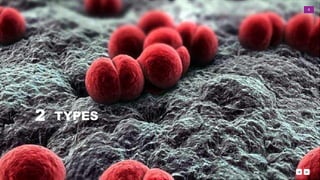
 Streptococcus pneumoniae
 Gram positive diplococci "Pneumococcus"
 Deafness = 31%
 Coma and seizures are more common
 Resistance is becoming a problem
16
Common Bacterial Organisms
 Neisseria meningitides
 Usually occurs winter/spring
 Five main serogroups: A, B, C, Y, and W-135 (A and C--
epidemics; B--individual cases; Y--pneumonia)
 May present with a characteristic immune reaction 10-14
days after infection (fever, arthritis, pericarditis).
17
Common Bacterial Organisms
Neisseria meningitides
 50% die within the first 24 hours
 Coma and seizures are uncommon
 Deafness = 10.5%
 Close contacts are 500-1000x risk
18
Common Bacterial Organisms
 Haemophilus influenzae
 Peak incidence: 6-12 months of age: declines after 24
months of age
 Deafness = 6%
 Coma/seizures common
 Close contacts are 200-1000 x risk
19
3 RISK FACTORS
20
Risk Factors
1) Age
 All ages are at risk for meningitis. However, certain age groups have a
higher risk. Children under the age of 5 are at increased risk of viral
meningitis. Infants are at higher risk of bacterial meningitis.
2) Compromised Immunity
 People with an immune deficiency are more vulnerable to infections.
3) Community Living
 Meningitis is easily spread when people live in close quarters.
21
Risk Factors
4) Pregnancy
 Pregnant women have an increased risk of listeriosis, which is an
infection caused by the Listeria bacteria.
5) Working with Animals
 Farm workers and others who work with animals have an increased risk
of infection with Listeria.
6) Infections
 Respiratory tract infection ,Otitis media
7) Head trauma
22
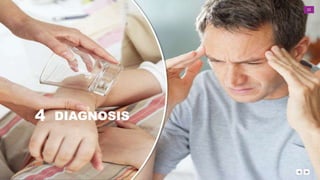
4 DIAGNOSIS
23
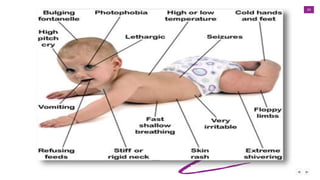
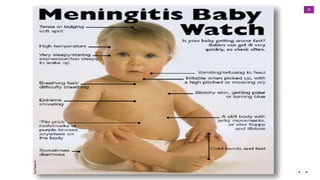
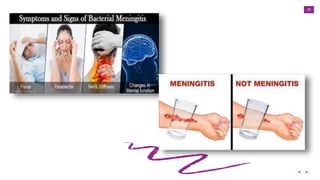
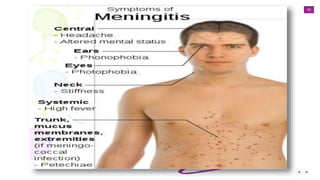
Viral Meningitis Symptoms
 Viral meningitis in infants may cause:
 decreased appetite
 irritability
 sleepiness
 lethargy
 a fever
24
25
26
Viral Meningitis Symptoms
 Viral meningitis in adults may cause:
 headaches
 a fever
 stiff neck
 seizures
 sensitivity to bright light
 sleepiness
 lethargy
 nausea
 decreased appetite
27
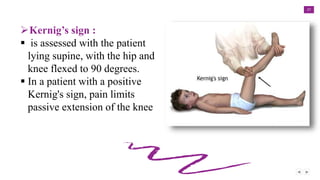
Kernig’s sign :
 is assessed with the patient
lying supine, with the hip and
knee flexed to 90 degrees.
 In a patient with a positive
Kernig's sign, pain limits
passive extension of the knee
28
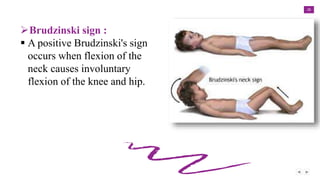
Brudzinski sign :
 A positive Brudzinski's sign
occurs when flexion of the
neck causes involuntary
flexion of the knee and hip.
29
30
31
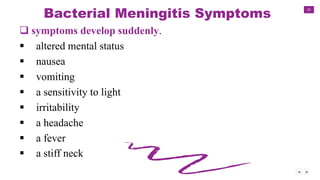
Bacterial Meningitis Symptoms
 symptoms develop suddenly.
 altered mental status
 nausea
 vomiting
 a sensitivity to light
 irritability
 a headache
 a fever
 a stiff neck
32
Complications
 seizures
 hearing loss
 brain damage
 hydrocephalus
 a subdural effusion
33
Laboratory Studies
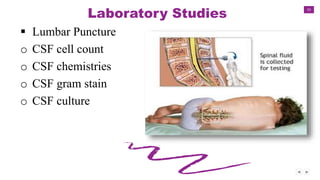
 Lumbar Puncture
o CSF cell count
o CSF chemistries
o CSF gram stain
o CSF culture
34
Laboratory Studies
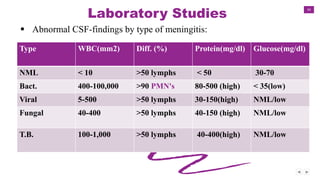
 Abnormal CSF-findings by type of meningitis:
Type WBC(mm2) Diff. (%) Protein(mg/dl) Glucose(mg/dl)
NML < 10 >50 lymphs < 50 30-70
Bact. 400-100,000 >90 PMN's 80-500 (high) < 35(low)
Viral 5-500 >50 lymphs 30-150(high) NML/low
Fungal 40-400 >50 lymphs 40-150 (high) NML/low
T.B. 100-1,000 >50 lymphs 40-400(high) NML/low
35
Laboratory Studies
 Blood cultures identify bacteria in the blood:
 Bacteria can travel from the blood to the brain.
 N. meningitidis and S. pneumoniae can cause both
sepsis and meningitis.
 A complete blood count with differential is a general
index of health.
 count is usually elevated in meningitis.
36
Radiological
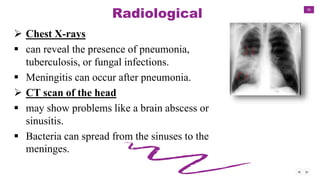
 Chest X-rays
 can reveal the presence of pneumonia,
tuberculosis, or fungal infections.
 Meningitis can occur after pneumonia.
 CT scan of the head
 may show problems like a brain abscess or
sinusitis.
 Bacteria can spread from the sinuses to the
meninges.
37
2 PREVENTION
& TREATMENT
Treatment of Bacterial Meninigitis
38
Treatment of Bacterial Meninigitis
 Treatment is determined by the cause of your meningitis.
 Bacterial meningitis requires immediate hospitalization.
 Early diagnosis and treatment will prevent brain damage and
death.
 Bacterial meningitis is treated with intravenous antibiotics.
 Fungal meningitis is treated with antifungal agents.
 Viral meningitis isn’t treated. It usually resolves on its own.
Symptoms should go away within two weeks. There are no
serious long-term problems associated with viral meningitis.
39
Treatment Viral Meningitis
1. SUPPORTIVE CARE
2. Antibiotics until bacterial meningitis is ruled out
3. Seizure control
4. Symptom control
5. Acyclovir
40
Antibiotic Therapy
 Factors Enhancing Antimicrobial Penetration
1. Small MW
2. Unionized at physiologic pH
3. Lipid soluble
4. Large Free Fraction
 Factors Reduce Antibiotic Activity
1. Low pH of fluid
2. High concentration of protein in fluid
3. High temperature of fluid
41
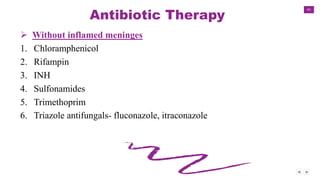
Antibiotic Therapy
 Without inflamed meninges
1. Chloramphenicol
2. Rifampin
3. INH
4. Sulfonamides
5. Trimethoprim
6. Triazole antifungals- fluconazole, itraconazole
42
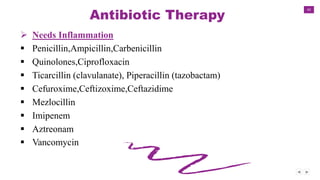
Antibiotic Therapy
 Needs Inflammation
 Penicillin,Ampicillin,Carbenicillin
 Quinolones,Ciprofloxacin
 Ticarcillin (clavulanate), Piperacillin (tazobactam)
 Cefuroxime,Ceftizoxime,Ceftazidime
 Mezlocillin
 Imipenem
 Aztreonam
 Vancomycin
43
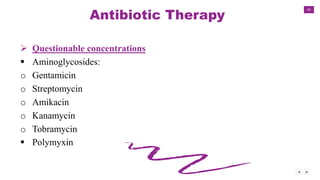
Antibiotic Therapy
 Questionable concentrations
 Aminoglycosides:
o Gentamicin
o Streptomycin
o Amikacin
o Kanamycin
o Tobramycin
 Polymyxin
44
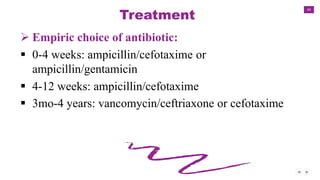
Treatment
 Empiric choice of antibiotic:
 0-4 weeks: ampicillin/cefotaxime or
ampicillin/gentamicin
 4-12 weeks: ampicillin/cefotaxime
 3mo-4 years: vancomycin/ceftriaxone or cefotaxime
45
Treatment
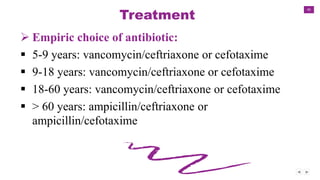
 Empiric choice of antibiotic:
 5-9 years: vancomycin/ceftriaxone or cefotaxime
 9-18 years: vancomycin/ceftriaxone or cefotaxime
 18-60 years: vancomycin/ceftriaxone or cefotaxime
 > 60 years: ampicillin/ceftriaxone or
ampicillin/cefotaxime
46
Treatment
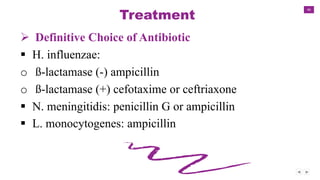
 Definitive Choice of Antibiotic
 H. influenzae:
o ß-lactamase (-) ampicillin
o ß-lactamase (+) cefotaxime or ceftriaxone
 N. meningitidis: penicillin G or ampicillin
 L. monocytogenes: ampicillin
47
Treatment
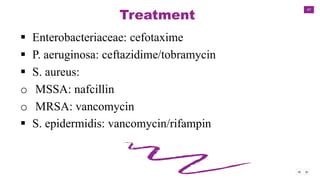
 Enterobacteriaceae: cefotaxime
 P. aeruginosa: ceftazidime/tobramycin
 S. aureus:
o MSSA: nafcillin
o MRSA: vancomycin
 S. epidermidis: vancomycin/rifampin
48
Treatment
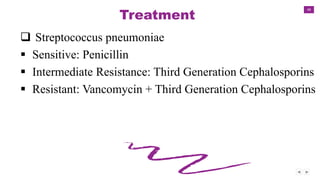
 Streptococcus pneumoniae
 Sensitive: Penicillin
 Intermediate Resistance: Third Generation Cephalosporins
 Resistant: Vancomycin + Third Generation Cephalosporins
49
Treatment
 Dexamethasone
 Blocks TNF alpha and IL-1 release
 Decreases ICP(intracranial pressure), CNS edema, fever
duration, and CSF lactate and protein levels
 Increased CSF glucose level
 Decreases neurologic complications (e.g. ataxia,seizures,
focal deficit) and hearing loss by approximately 50%
Children with H. influenzae type B
50
Treatment
 Dexamethasone
 Indication: > 6 weeks of age, and clinical CSF findings of
H. flu meningitis
 First dose given with/before antibiotics
 Significant reduction of vancomycin/BBB penetration
 Somewhat lower CSF concentrations of ceftriaxone
51
Prevention
 Vaccines
 N. meningitides
 covers serotypes A, C, Y, W-135
 Type B causes 50% of cases
 H. influenza
 all children at 2 months
52
Prevention
 Vaccines
 S. pneumoniae
1. Capsular polysaccharide vaccine
2. Heptavalent Conjugate Vaccine
Thanks
for Coming

Meningitis Mangamant

  • 1.
    MENINGITIS Dr. Sameh AhmadMuhamad abdelghany Lecturer Of Clinical Pharmacology Mansura Faculty of medicine
  • 2.
  • 3.
  • 4.
    4 What is meningitis? The brain and spinal cord are covered by connective tissue layers collectively called the meninges which form the blood-brain barrier. 1-the pia mater (closest to the CNS) 2-the arachnoid mater 3-the dura mater (farthest from the CNS).  The meninges contain cerebrospinal fluid (CSF).  Meningitis is an inflammation of the meninges, which, if severe, may become encephalitis, an inflammation of the brain.
  • 5.
  • 6.
  • 7.
    7 What is meningitis? Meningitis can be caused by many different organisms including viruses and bacteria.  Meningitis, caused by a bacteria, is life threatening and requires urgent medical attention and treatment with antibiotics.  Meningitis caused by a virus is very rarely life threatening but can cause the body to become very weak.  When bacteria invade the body they can cause meningitis, septicemia or meningitis and septicemia together
  • 8.
  • 9.
    9 MAIN TYPES OFMeninigtis VIRAL FUNGAL BACTERIAL
  • 10.
    10 Causes of Meningitis 1.Viral Infections 2. Bacterial Infections 3. Fungal Infections: o e.g. Cryptococcus neoformans - Coccidiodes immitus 4. Inflammatory diseases : (SLE) 5. Cancer 6. Trauma to head or spine.
  • 11.
    11 I- Viral meningitis Mostcommon cause of meningitis. CAUSES:  Enteroviruses - 85%(coxsackievirus A-coxsackievirus B-echoviruses)  Mumps Virus- 5-10%  Lymphocytic choriomeningitis virus  Herpes Simplex Virus (HSV-2)  Others
  • 12.
    12 Viral meningitis Viruses inthe Enterovirus category cause about 10 to 15 million infections per year, but only a small percentage of people who get infected will develop meningitis. Viral meningitis typically goes away without treatment.
  • 13.
    13 II- Bacterial meningitis Bacterial meningitis is contagious  Fatal if left untreated.  Between 5 to 40 percent of children and 20 to 50 percent of adults with this condition die. (even with proper treatment).
  • 14.
    14 Bacterial meningitis CAUSES:  Pneumococcal,Streptococcus pneumoniae (38%)  Meningococcal, Neisseria meningitidis (14%)  Haemophilus influenzae (4%)  Staphylococcal, Staphylococcus aureus (5%)  Tuberculous, Mycobacterium tuberculosis
  • 15.
    15 Common Bacterial Organisms Streptococcus pneumoniae  Gram positive diplococci "Pneumococcus"  Deafness = 31%  Coma and seizures are more common  Resistance is becoming a problem
  • 16.
    16 Common Bacterial Organisms Neisseria meningitides  Usually occurs winter/spring  Five main serogroups: A, B, C, Y, and W-135 (A and C-- epidemics; B--individual cases; Y--pneumonia)  May present with a characteristic immune reaction 10-14 days after infection (fever, arthritis, pericarditis).
  • 17.
    17 Common Bacterial Organisms Neisseriameningitides  50% die within the first 24 hours  Coma and seizures are uncommon  Deafness = 10.5%  Close contacts are 500-1000x risk
  • 18.
    18 Common Bacterial Organisms Haemophilus influenzae  Peak incidence: 6-12 months of age: declines after 24 months of age  Deafness = 6%  Coma/seizures common  Close contacts are 200-1000 x risk
  • 19.
  • 20.
    20 Risk Factors 1) Age All ages are at risk for meningitis. However, certain age groups have a higher risk. Children under the age of 5 are at increased risk of viral meningitis. Infants are at higher risk of bacterial meningitis. 2) Compromised Immunity  People with an immune deficiency are more vulnerable to infections. 3) Community Living  Meningitis is easily spread when people live in close quarters.
  • 21.
    21 Risk Factors 4) Pregnancy Pregnant women have an increased risk of listeriosis, which is an infection caused by the Listeria bacteria. 5) Working with Animals  Farm workers and others who work with animals have an increased risk of infection with Listeria. 6) Infections  Respiratory tract infection ,Otitis media 7) Head trauma
  • 22.
  • 23.
    23 Viral Meningitis Symptoms Viral meningitis in infants may cause:  decreased appetite  irritability  sleepiness  lethargy  a fever
  • 24.
  • 25.
  • 26.
    26 Viral Meningitis Symptoms Viral meningitis in adults may cause:  headaches  a fever  stiff neck  seizures  sensitivity to bright light  sleepiness  lethargy  nausea  decreased appetite
  • 27.
    27 Kernig’s sign : is assessed with the patient lying supine, with the hip and knee flexed to 90 degrees.  In a patient with a positive Kernig's sign, pain limits passive extension of the knee
  • 28.
    28 Brudzinski sign : A positive Brudzinski's sign occurs when flexion of the neck causes involuntary flexion of the knee and hip.
  • 29.
  • 30.
  • 31.
    31 Bacterial Meningitis Symptoms symptoms develop suddenly.  altered mental status  nausea  vomiting  a sensitivity to light  irritability  a headache  a fever  a stiff neck
  • 32.
    32 Complications  seizures  hearingloss  brain damage  hydrocephalus  a subdural effusion
  • 33.
    33 Laboratory Studies  LumbarPuncture o CSF cell count o CSF chemistries o CSF gram stain o CSF culture
  • 34.
    34 Laboratory Studies  AbnormalCSF-findings by type of meningitis: Type WBC(mm2) Diff. (%) Protein(mg/dl) Glucose(mg/dl) NML < 10 >50 lymphs < 50 30-70 Bact. 400-100,000 >90 PMN's 80-500 (high) < 35(low) Viral 5-500 >50 lymphs 30-150(high) NML/low Fungal 40-400 >50 lymphs 40-150 (high) NML/low T.B. 100-1,000 >50 lymphs 40-400(high) NML/low
  • 35.
    35 Laboratory Studies  Bloodcultures identify bacteria in the blood:  Bacteria can travel from the blood to the brain.  N. meningitidis and S. pneumoniae can cause both sepsis and meningitis.  A complete blood count with differential is a general index of health.  count is usually elevated in meningitis.
  • 36.
    36 Radiological  Chest X-rays can reveal the presence of pneumonia, tuberculosis, or fungal infections.  Meningitis can occur after pneumonia.  CT scan of the head  may show problems like a brain abscess or sinusitis.  Bacteria can spread from the sinuses to the meninges.
  • 37.
    37 2 PREVENTION & TREATMENT Treatmentof Bacterial Meninigitis
  • 38.
    38 Treatment of BacterialMeninigitis  Treatment is determined by the cause of your meningitis.  Bacterial meningitis requires immediate hospitalization.  Early diagnosis and treatment will prevent brain damage and death.  Bacterial meningitis is treated with intravenous antibiotics.  Fungal meningitis is treated with antifungal agents.  Viral meningitis isn’t treated. It usually resolves on its own. Symptoms should go away within two weeks. There are no serious long-term problems associated with viral meningitis.
  • 39.
    39 Treatment Viral Meningitis 1.SUPPORTIVE CARE 2. Antibiotics until bacterial meningitis is ruled out 3. Seizure control 4. Symptom control 5. Acyclovir
  • 40.
    40 Antibiotic Therapy  FactorsEnhancing Antimicrobial Penetration 1. Small MW 2. Unionized at physiologic pH 3. Lipid soluble 4. Large Free Fraction  Factors Reduce Antibiotic Activity 1. Low pH of fluid 2. High concentration of protein in fluid 3. High temperature of fluid
  • 41.
    41 Antibiotic Therapy  Withoutinflamed meninges 1. Chloramphenicol 2. Rifampin 3. INH 4. Sulfonamides 5. Trimethoprim 6. Triazole antifungals- fluconazole, itraconazole
  • 42.
    42 Antibiotic Therapy  NeedsInflammation  Penicillin,Ampicillin,Carbenicillin  Quinolones,Ciprofloxacin  Ticarcillin (clavulanate), Piperacillin (tazobactam)  Cefuroxime,Ceftizoxime,Ceftazidime  Mezlocillin  Imipenem  Aztreonam  Vancomycin
  • 43.
    43 Antibiotic Therapy  Questionableconcentrations  Aminoglycosides: o Gentamicin o Streptomycin o Amikacin o Kanamycin o Tobramycin  Polymyxin
  • 44.
    44 Treatment  Empiric choiceof antibiotic:  0-4 weeks: ampicillin/cefotaxime or ampicillin/gentamicin  4-12 weeks: ampicillin/cefotaxime  3mo-4 years: vancomycin/ceftriaxone or cefotaxime
  • 45.
    45 Treatment  Empiric choiceof antibiotic:  5-9 years: vancomycin/ceftriaxone or cefotaxime  9-18 years: vancomycin/ceftriaxone or cefotaxime  18-60 years: vancomycin/ceftriaxone or cefotaxime  > 60 years: ampicillin/ceftriaxone or ampicillin/cefotaxime
  • 46.
    46 Treatment  Definitive Choiceof Antibiotic  H. influenzae: o ß-lactamase (-) ampicillin o ß-lactamase (+) cefotaxime or ceftriaxone  N. meningitidis: penicillin G or ampicillin  L. monocytogenes: ampicillin
  • 47.
    47 Treatment  Enterobacteriaceae: cefotaxime P. aeruginosa: ceftazidime/tobramycin  S. aureus: o MSSA: nafcillin o MRSA: vancomycin  S. epidermidis: vancomycin/rifampin
  • 48.
    48 Treatment  Streptococcus pneumoniae Sensitive: Penicillin  Intermediate Resistance: Third Generation Cephalosporins  Resistant: Vancomycin + Third Generation Cephalosporins
  • 49.
    49 Treatment  Dexamethasone  BlocksTNF alpha and IL-1 release  Decreases ICP(intracranial pressure), CNS edema, fever duration, and CSF lactate and protein levels  Increased CSF glucose level  Decreases neurologic complications (e.g. ataxia,seizures, focal deficit) and hearing loss by approximately 50% Children with H. influenzae type B
  • 50.
    50 Treatment  Dexamethasone  Indication:> 6 weeks of age, and clinical CSF findings of H. flu meningitis  First dose given with/before antibiotics  Significant reduction of vancomycin/BBB penetration  Somewhat lower CSF concentrations of ceftriaxone
  • 51.
    51 Prevention  Vaccines  N.meningitides  covers serotypes A, C, Y, W-135  Type B causes 50% of cases  H. influenza  all children at 2 months
  • 52.
    52 Prevention  Vaccines  S.pneumoniae 1. Capsular polysaccharide vaccine 2. Heptavalent Conjugate Vaccine
  • 53.