Meningitis
1
Introduction
9/5/2013 2
 Meningitis is a disease caused by the inflammation of the
protective membranes covering the brain and spinal cord
known asthe meninges.
 Theinflammation is usually causedby an infection of thefluid
surrounding the brain and spinalcord.
 Meningitis can be life-threatening becauseof the
inflammation's proximity to the brain and spinal cord;
therefore the condition is classified asamedicalemergency.
FACTS
• Although meningitis is a notifiable disease, the exact
incidence rate is unknown.
• In 2010 – 420, 000 deaths
• In 2013 - 303,000 deaths.
• In 2015 - 379,000 deaths.
• In 2017 - 484,000 deaths.
• It can occur as a complication of other disease and
50% is an opportunistic infection.
Meninges
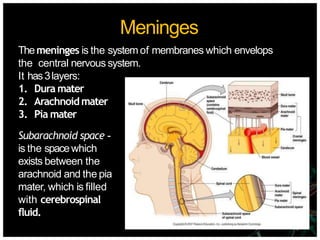
Themeninges is the system of membranes which envelops
the central nervous system.
It has3layers:
1. Dura mater
2. Arachnoidmater
3. Pia mater
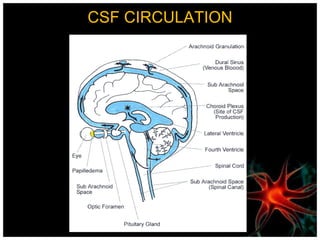
Subarachnoid space -
is the spacewhich
exists between the
arachnoid and the pia
mater, which is filled
with cerebrospinal
fluid.
4
CSF CIRCULATION
DEFINITION
• Meningitis (from Greek méninx, "membrane”) is
an acute inflammation of the meninges.
• Mening= Covering of brain (Dura, Archnoid or pia)
• Itis= Inflammation.
• Means Meningitis is the inflammation of leptomeninges(Archnoid and pia
matter )
• Caused by bacteria, virus or fungi.
Causesof Meningitis
7
- Bacterial
- Viral
- Fungal
- Parasitic/ protozoal
- Physicalinjury
- Cancer
- Skull or Back bone Fractures
(trauma)
- Medical Procedures
- Blood or Lymphatic system
Bacterial
- Haemophilus influenzae
- Listeria
- Meningococcus
- Pneumococcus
- GroupA Streptococcus
- Group B Streptococcus
9/5/2013 8
Premature babies and newborns (< 3 months): group B
streptococci,
Older children: Neisseria meningitidis andStreptococcu
pneumoniae (serotypes 6, 9, 14, 18 and 23) and those
under five by Haemophilus influenzae typeB
Adults: N. meningitidis and S. pneumoniae (80% of all
cases) of bacterial meningitis, with increased risk of L.
monocytogenes (>50yrs)
9/5/2013 9
Bacterial
Haemophilus influenzaeMeningitis
• Occursmostly in children (6 months to4 years).
• Gram-negative aerobic bacteria,
• Prevented by Hib vaccine
10
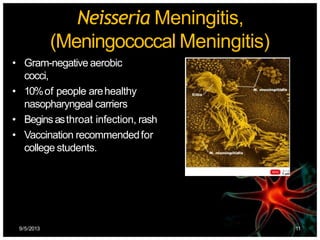
Neisseria Meningitis,
(Meningococcal Meningitis)
• Gram-negative aerobic
cocci,
• 10%of people arehealthy
nasopharyngeal carriers
• Beginsasthroat infection, rash
• Vaccination recommendedfor
college students.
9/5/2013 11
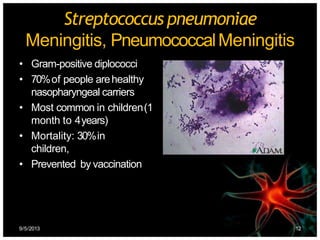
Streptococcus pneumoniae
Meningitis, PneumococcalMeningitis
• Gram-positive diplococci
• 70%of people arehealthy
nasopharyngeal carriers
• Most common in children(1
month to 4years)
• Mortality: 30%in
children,
• Prevented by vaccination
9/5/2013 12
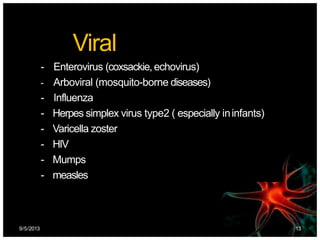
Viral
- Enterovirus (coxsackie,echovirus)
- Arboviral (mosquito-borne diseases)
- Influenza
- Herpes simplex virus type2 ( especially ininfants)
- Varicella zoster
- HIV
- Mumps
- measles
9/5/2013 13
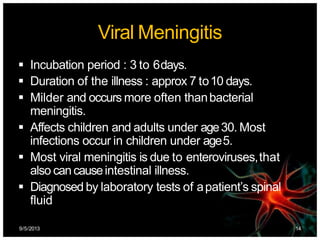
Viral Meningitis
9/5/2013 14
 Incubation period : 3 to 6days.
 Duration of the illness : approx 7 to10 days.
 Milder and occurs more often thanbacterial
meningitis.
 Affects children and adults under age30. Most
infections occur in children under age5.
 Most viral meningitis is due to enteroviruses,that
also cancauseintestinal illness.
 Diagnosed by laboratory tests of apatient’s spinal
fluid
Fungal
9/5/2013 15
Cryptococcus
Coccidiodes
Histoplasma
Mucormycosis
Aspergillus
Candida (yeasts)
Parasitic/protozoal
Angiostrongylus
Toxoplama
Hydatid
Amoeba
Plasmodium
Cysticercosis
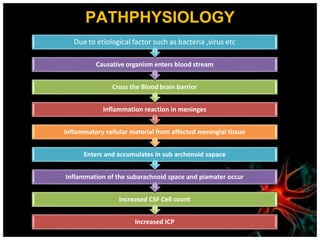
PATHPHYSIOLOGY
Increased ICP
Increased CSF Cell count
Inflammation of the subarachnoid space and piamater occur
Enters and accumulates in sub archenoid sapace
Inflammatory cellular material from affected meningial tissue
Inflammation reaction in meninges
Cross the Blood brain barrior
Causative organism enters blood stream
Due to etiological factor such as bacteria ,virus etc
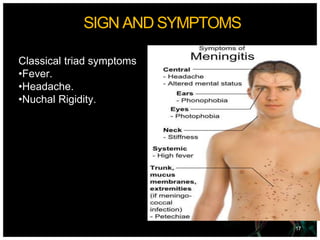
SIGN AND SYMPTOMS
Classical triad symptoms
•Fever.
•Headache.
•Nuchal Rigidity.
17
Kernig’s sign - is assessedwith the patient lying supine, with the hip and knee
flexed to 90 degrees. In a patient with a positive Kernig's sign, pain limits passive
extension of theknee.
Brudzinski signs-Apositive Brudzinski's sign occurswhen flexion of the neck
causesinvoluntary flexion of the knee andhip.
18
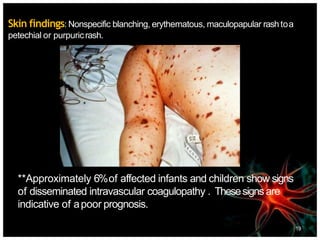
Skin findings: Nonspecific blanching, erythematous, maculopapular rash toa
petechial or purpuricrash.
**Approximately 6%of affected infants and children show signs
of disseminated intravascular coagulopathy . Thesesignsare
indicative of apoor prognosis.
19
Other Sign & Symptoms
•Sinus arrhythmias
•Irritability
•Cerebral oedema
•Papiledema
•Malaise
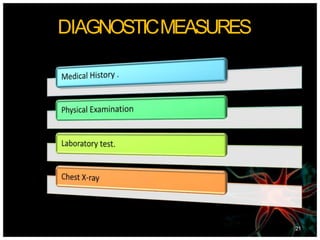
DIAGNOSTICMEASURES
21
DIAGNOSIS(contd..)
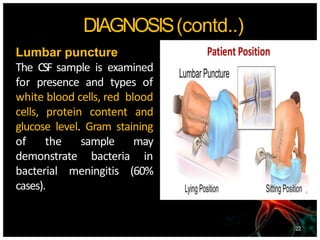
Lumbar puncture
The CSF sample is examined
for presence and types of
white blood cells, red blood
cells, protein content and
glucose level. Gram staining
of the sample may
demonstrate bacteria in
bacterial meningitis (60%
cases).
22
Type of meningitis
9/5/2013 23
CSF findings in different forms of meningitis
Glucose Protein Cells
Acute bacterial low high
PMNs
often > 300/mm³
Acute viral normal normal or high
mononuclear
< 300/mm³
Tuberculous low high
mononuclear and
PMNs, < 300/mm³
Fungal low high < 300/mm³
Malignant low high
usually
mononuclear
DIAGNOSIS(contd..)
CTor MRI
To identify
hydrocephalus or rule
out cerebral hematoma,
hemorrhage or tumor.
• Latexagglutination - Theclumping of cells such as
bacteria or RBCsin the presence of an antibody. The
antibody or other molecule binds multiple particles and
joins them, creating alarge complex. Positive in meningitis
causedby Streptococcus pneumoniae, Neisseria
meningitidis, Haemophilus influenzae, Escherichia
coli and group B streptococci.
• Serotyping - Group of microorganisms classifiedtogether
basedon their cell surfaceantigens
(virulence, lipopolysaccharides in Gram-negative
bacteria), presence of an exotoxin or othercharacteristics
which differentiate two members of thesamespecies.
25
DIAGNOSIS(contd..)
• Limulus amebocyte lysate (LAL): An aqueous
extract of blood cells (amoebocytes) from the
horseshoe crab, (Limulus polyphemus).
 LALreacts with bacterial endotoxin or
lipopolysaccharide (LPS), which is amembrane
component of “Gram negativebacteria”.
• Polymerase chain reaction(PCR)is atechnique
used to amplify small traces ofbacterial DNA
26
DIAGNOSIS(contd..)
MEDICAL MANAGEMENT
9/19/2023
27
Non- pharmacological Management
•Bed rest to prevent increased ICP.
•Prevention of Hyperthermia or decrease metabolic
demands.
•To prevent from infection
•To isolate the client as per causative organism.
•Prevent possible complication.
28
Pharmacological Management
• ANTIBIOTICS- Benzylpenicillin can be used
to initiate treatment in meningococcal and
pneumococcal infections.
• Chloramphenicol should be used in H.
influenzae infections or when gram-negative
organisms are causative in children below
five.
• Many physicians prefer to combine
chloramphenicol (100 rug/kg/day) with either
penicillin (150 mglkglday) or ampicillin (200
rug/kg/day) as the first line of treatment.
Pharmacological Management
•Treatment with an aminoglycoside (gentamycin,
tobramycin) preferably given intrathecally,
combined with a penicillinase-resistant penicillin
(nafcillin),
•Cephalosporins such as cefotaxime and
ceftazimide are very effective against gram-
negative bacilli.
•If seizures develop, these should he treated with
diazepam (5 to 10 mg intravenously) or with
phenytoin.
•Sedation should be avoided because of the risk of
aspiration pneumonia.
SURGICAL MANAGEMENT.
A subdural tap, using a
special needle with a
stylet, performed through
the edge of an open
anterior fontanelle may be
both diagnostic and
therapeutic. Repeated
taps may be required.
9/19/2023
31
SURGICAL MANAGEMENT
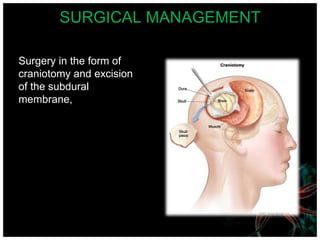
Surgery in the form of
craniotomy and excision
of the subdural
membrane,
SURGICAL MANAGEMENT
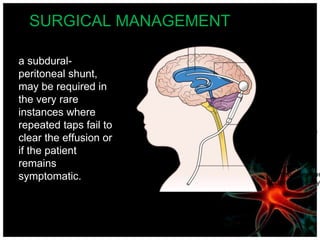
a subdural-
peritoneal shunt,
may be required in
the very rare
instances where
repeated taps fail to
clear the effusion or
if the patient
remains
symptomatic.
PREVENTION
•Bacterial: Vaccines are available to protect us from
the most common– Hib, pneumococcal and most
strains of meningococcal diseases.
•Viral: MMR (measles, mumps and rubella) vaccines
are useful against these infections that can lead to
viral meningitis (in case of measles, encephalitis).
RECENT ADVANCEMENT
In 2000 the 7-valent pneumococcal protein–
polysaccharide conjugate vaccine was introduced and
appeared to prevent invasive infections in young children.
The vaccine may have also reduced the rate of invasive
disease in older adults. Developing quadrivalent conjugate
vaccines (A/C/Y/W-135) for immunoprophylaxis against
meningococcal infection in at-risk groups may provide
more effective and longer-lasting immunity than the
current polysaccharide vaccine.
Another approach to prevent bacterial meningitis will be to
improve food processing and food-safety measures.
Doing so may specifically reduce the incidence of L.
monocytogenes meningitis, which is a growing problem in
the immunocompromised.
Nursing Management
• Admission history and physical exam.
• Baseline vital signs.
• Ongoing assessment for disease
progression is critical.
• The patient is monitored for life- threatening
complications e.g, respiratory failure.
Nursing Diagnosis
• Ineffective gas exchange r/t decreased
tissue perfusion
• Impaired physical mobility r/t paralysis,
fatigue.
• Pain r/t disease condition.
• Altered nutrition less than body requirement
r/t dysphagia ( c. nerve dysfunction).
Contd..
• High risk for injury r/t seizures episodes
• Impaired verbal function r/t cranial nerve
dysfunction.
• Fear and anxiety r/t loss of control and
paralysis.
• Potential for secondary complication
(infections etc)
9/19/2023
39

FINAL MENINGITIS.pptx

  • 1.
  • 2.
    Introduction 9/5/2013 2  Meningitisis a disease caused by the inflammation of the protective membranes covering the brain and spinal cord known asthe meninges.  Theinflammation is usually causedby an infection of thefluid surrounding the brain and spinalcord.  Meningitis can be life-threatening becauseof the inflammation's proximity to the brain and spinal cord; therefore the condition is classified asamedicalemergency.
  • 3.
    FACTS • Although meningitisis a notifiable disease, the exact incidence rate is unknown. • In 2010 – 420, 000 deaths • In 2013 - 303,000 deaths. • In 2015 - 379,000 deaths. • In 2017 - 484,000 deaths. • It can occur as a complication of other disease and 50% is an opportunistic infection.
  • 4.
    Meninges Themeninges is thesystem of membranes which envelops the central nervous system. It has3layers: 1. Dura mater 2. Arachnoidmater 3. Pia mater Subarachnoid space - is the spacewhich exists between the arachnoid and the pia mater, which is filled with cerebrospinal fluid. 4
  • 5.
  • 6.
    DEFINITION • Meningitis (fromGreek méninx, "membrane”) is an acute inflammation of the meninges. • Mening= Covering of brain (Dura, Archnoid or pia) • Itis= Inflammation. • Means Meningitis is the inflammation of leptomeninges(Archnoid and pia matter ) • Caused by bacteria, virus or fungi.
  • 7.
    Causesof Meningitis 7 - Bacterial -Viral - Fungal - Parasitic/ protozoal - Physicalinjury - Cancer - Skull or Back bone Fractures (trauma) - Medical Procedures - Blood or Lymphatic system
  • 8.
    Bacterial - Haemophilus influenzae -Listeria - Meningococcus - Pneumococcus - GroupA Streptococcus - Group B Streptococcus 9/5/2013 8
  • 9.
    Premature babies andnewborns (< 3 months): group B streptococci, Older children: Neisseria meningitidis andStreptococcu pneumoniae (serotypes 6, 9, 14, 18 and 23) and those under five by Haemophilus influenzae typeB Adults: N. meningitidis and S. pneumoniae (80% of all cases) of bacterial meningitis, with increased risk of L. monocytogenes (>50yrs) 9/5/2013 9 Bacterial
  • 10.
    Haemophilus influenzaeMeningitis • Occursmostlyin children (6 months to4 years). • Gram-negative aerobic bacteria, • Prevented by Hib vaccine 10
  • 11.
    Neisseria Meningitis, (Meningococcal Meningitis) •Gram-negative aerobic cocci, • 10%of people arehealthy nasopharyngeal carriers • Beginsasthroat infection, rash • Vaccination recommendedfor college students. 9/5/2013 11
  • 12.
    Streptococcus pneumoniae Meningitis, PneumococcalMeningitis •Gram-positive diplococci • 70%of people arehealthy nasopharyngeal carriers • Most common in children(1 month to 4years) • Mortality: 30%in children, • Prevented by vaccination 9/5/2013 12
  • 13.
    Viral - Enterovirus (coxsackie,echovirus) -Arboviral (mosquito-borne diseases) - Influenza - Herpes simplex virus type2 ( especially ininfants) - Varicella zoster - HIV - Mumps - measles 9/5/2013 13
  • 14.
    Viral Meningitis 9/5/2013 14 Incubation period : 3 to 6days.  Duration of the illness : approx 7 to10 days.  Milder and occurs more often thanbacterial meningitis.  Affects children and adults under age30. Most infections occur in children under age5.  Most viral meningitis is due to enteroviruses,that also cancauseintestinal illness.  Diagnosed by laboratory tests of apatient’s spinal fluid
  • 15.
  • 16.
    PATHPHYSIOLOGY Increased ICP Increased CSFCell count Inflammation of the subarachnoid space and piamater occur Enters and accumulates in sub archenoid sapace Inflammatory cellular material from affected meningial tissue Inflammation reaction in meninges Cross the Blood brain barrior Causative organism enters blood stream Due to etiological factor such as bacteria ,virus etc
  • 17.
    SIGN AND SYMPTOMS Classicaltriad symptoms •Fever. •Headache. •Nuchal Rigidity. 17
  • 18.
    Kernig’s sign -is assessedwith the patient lying supine, with the hip and knee flexed to 90 degrees. In a patient with a positive Kernig's sign, pain limits passive extension of theknee. Brudzinski signs-Apositive Brudzinski's sign occurswhen flexion of the neck causesinvoluntary flexion of the knee andhip. 18
  • 19.
    Skin findings: Nonspecificblanching, erythematous, maculopapular rash toa petechial or purpuricrash. **Approximately 6%of affected infants and children show signs of disseminated intravascular coagulopathy . Thesesignsare indicative of apoor prognosis. 19
  • 20.
    Other Sign &Symptoms •Sinus arrhythmias •Irritability •Cerebral oedema •Papiledema •Malaise
  • 21.
  • 22.
    DIAGNOSIS(contd..) Lumbar puncture The CSFsample is examined for presence and types of white blood cells, red blood cells, protein content and glucose level. Gram staining of the sample may demonstrate bacteria in bacterial meningitis (60% cases). 22
  • 23.
    Type of meningitis 9/5/201323 CSF findings in different forms of meningitis Glucose Protein Cells Acute bacterial low high PMNs often > 300/mm³ Acute viral normal normal or high mononuclear < 300/mm³ Tuberculous low high mononuclear and PMNs, < 300/mm³ Fungal low high < 300/mm³ Malignant low high usually mononuclear
  • 24.
    DIAGNOSIS(contd..) CTor MRI To identify hydrocephalusor rule out cerebral hematoma, hemorrhage or tumor.
  • 25.
    • Latexagglutination -Theclumping of cells such as bacteria or RBCsin the presence of an antibody. The antibody or other molecule binds multiple particles and joins them, creating alarge complex. Positive in meningitis causedby Streptococcus pneumoniae, Neisseria meningitidis, Haemophilus influenzae, Escherichia coli and group B streptococci. • Serotyping - Group of microorganisms classifiedtogether basedon their cell surfaceantigens (virulence, lipopolysaccharides in Gram-negative bacteria), presence of an exotoxin or othercharacteristics which differentiate two members of thesamespecies. 25 DIAGNOSIS(contd..)
  • 26.
    • Limulus amebocytelysate (LAL): An aqueous extract of blood cells (amoebocytes) from the horseshoe crab, (Limulus polyphemus).  LALreacts with bacterial endotoxin or lipopolysaccharide (LPS), which is amembrane component of “Gram negativebacteria”. • Polymerase chain reaction(PCR)is atechnique used to amplify small traces ofbacterial DNA 26 DIAGNOSIS(contd..)
  • 27.
  • 28.
    Non- pharmacological Management •Bedrest to prevent increased ICP. •Prevention of Hyperthermia or decrease metabolic demands. •To prevent from infection •To isolate the client as per causative organism. •Prevent possible complication. 28
  • 29.
    Pharmacological Management • ANTIBIOTICS-Benzylpenicillin can be used to initiate treatment in meningococcal and pneumococcal infections. • Chloramphenicol should be used in H. influenzae infections or when gram-negative organisms are causative in children below five. • Many physicians prefer to combine chloramphenicol (100 rug/kg/day) with either penicillin (150 mglkglday) or ampicillin (200 rug/kg/day) as the first line of treatment.
  • 30.
    Pharmacological Management •Treatment withan aminoglycoside (gentamycin, tobramycin) preferably given intrathecally, combined with a penicillinase-resistant penicillin (nafcillin), •Cephalosporins such as cefotaxime and ceftazimide are very effective against gram- negative bacilli. •If seizures develop, these should he treated with diazepam (5 to 10 mg intravenously) or with phenytoin. •Sedation should be avoided because of the risk of aspiration pneumonia.
  • 31.
    SURGICAL MANAGEMENT. A subduraltap, using a special needle with a stylet, performed through the edge of an open anterior fontanelle may be both diagnostic and therapeutic. Repeated taps may be required. 9/19/2023 31
  • 32.
    SURGICAL MANAGEMENT Surgery inthe form of craniotomy and excision of the subdural membrane,
  • 33.
    SURGICAL MANAGEMENT a subdural- peritonealshunt, may be required in the very rare instances where repeated taps fail to clear the effusion or if the patient remains symptomatic.
  • 34.
    PREVENTION •Bacterial: Vaccines areavailable to protect us from the most common– Hib, pneumococcal and most strains of meningococcal diseases. •Viral: MMR (measles, mumps and rubella) vaccines are useful against these infections that can lead to viral meningitis (in case of measles, encephalitis).
  • 35.
    RECENT ADVANCEMENT In 2000the 7-valent pneumococcal protein– polysaccharide conjugate vaccine was introduced and appeared to prevent invasive infections in young children. The vaccine may have also reduced the rate of invasive disease in older adults. Developing quadrivalent conjugate vaccines (A/C/Y/W-135) for immunoprophylaxis against meningococcal infection in at-risk groups may provide more effective and longer-lasting immunity than the current polysaccharide vaccine. Another approach to prevent bacterial meningitis will be to improve food processing and food-safety measures. Doing so may specifically reduce the incidence of L. monocytogenes meningitis, which is a growing problem in the immunocompromised.
  • 36.
    Nursing Management • Admissionhistory and physical exam. • Baseline vital signs. • Ongoing assessment for disease progression is critical. • The patient is monitored for life- threatening complications e.g, respiratory failure.
  • 37.
    Nursing Diagnosis • Ineffectivegas exchange r/t decreased tissue perfusion • Impaired physical mobility r/t paralysis, fatigue. • Pain r/t disease condition. • Altered nutrition less than body requirement r/t dysphagia ( c. nerve dysfunction).
  • 38.
    Contd.. • High riskfor injury r/t seizures episodes • Impaired verbal function r/t cranial nerve dysfunction. • Fear and anxiety r/t loss of control and paralysis. • Potential for secondary complication (infections etc)
  • 39.