MODULE 2
 B.A Gopika (Roll no:11)
 Darsana Mohanachandran (Roll no:12)
 Devika R.R (Roll no:13)
 Devika Vijayan.S (Roll no:14)
 Divya Venu.S (Roll no:15)
 Haritha.S (Roll no:17)
 Hiba Shahana.S (Roll no:18)
 Janifa.S.Jamal (Roll no:19)
 Jannathshirin N.S (Roll no:20)
1. Sieve analysis
2. Well graded, Poorly graded and gap graded soils
3. Stoke’s law
4. Hydrometer Analysis
5. Relative density
6. Consistency
7. Atterberg Limits and indices
8. Plasticity charts
9. Laboratory tests for Liquid limit, Plastic limit and Shrinkage
limit
10. IS classification of soil
11. Permeability of soils
12. Darcy’s law
13. Factors affecting permeability
14. Laboratory tests : Constant head and falling test
permeability tests
15. Average permeability of stratified deposits
SIEVE ANALYSIS
Sieve Analysis is a procedure used in Civil
Engineering to assess the particle size distribution
of a granular material by allowing the material to
pass through a series of sieves of progressively
smaller mesh size and weighing the amount of
material that is stopped by each sieve as a fraction
of the whole mass.
 Sieves of various sizes ranging from 80 mm to 75
microns are available.
 Sieves are stacked one over the other with
decreasing size from top to the bottom.
 A receiver pan, is placed at the bottom of the
smallest sieve.
 Coarse sieve analysis – for the fraction of soil
retained on 4.75 mm sieve ( gravel fraction).
 Fine sieve analysis – for the fraction of soil is
passing through 4.75 mm sieve (sand fraction).
DRY SIEVE ANALYSIS
 It is suitable for coohesionless soil, with little or
no fines.
PROCEDURE
 The soil sample is taken in a suitable quantity.
 The soil should be oven-dry. It should not contain
any lump.
 The sample is sieved through a 4.75 mm IS sieve.
 The portion retained on the sieve is the gravel
fraction.
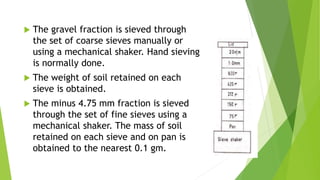
 The gravel fraction is sieved through
the set of coarse sieves manually or
using a mechanical shaker. Hand sieving
is normally done.
 The weight of soil retained on each
sieve is obtained.
 The minus 4.75 mm fraction is sieved
through the set of fine sieves using a
mechanical shaker. The mass of soil
retained on each sieve and on pan is
obtained to the nearest 0.1 gm.
WET SIEVE ANALYSIS
If the soil contains more than 5% of fine particles, a
wet sieve analysis is required.
PROCEDURE
 All lumps are broken into individual particles.
 A representative soil sample in the required quantity
is taken and dried in an oven.
 The dried sample is taken in a tray and soaked with
water.
 The slury is then sieved through a 4.75 mm IS sieve
and washed with a jet of water.
 The gravel fraction is then dried on oven, and
sieved through set of coarse sieves.
 The material passing through 4.75 mm sieve is
sieved through a 75 μ sieve. The material is washed
until the wash water becomes clear.
 The material retained on the 75 sieve is collected
and dried in an oven. It is then sieved through the
set of fine sieves of the size 2 mm ,1 mm, 600 μ,
425 μ , 212 μ ,150 μ and 75 μ.
 The material retained on each sieve is collected
and dried in an oven.
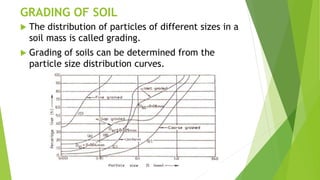
GRADING OF SOIL
 The distribution of particles of different sizes in a
soil mass is called grading.
 Grading of soils can be determined from the
particle size distribution curves.
 A curve with a hump , such as curve A, represents
the soil in which some of the intermediate
particles are missing. Such a soil is called gap-
graded soil.
 A flat S-curve, such as curve B, represents a soil
which contains the particles of different sizes in
good proportion.Such a soil is called well-graded
(or uniformly graded) soil.
 A soil that does not have a good representation of
all sizes of particles is called poorly-graded soil.
Stokes law
o The velocity at which grains settle out of suspension, all the
factors being equal, is dependent upon the shape, weight, and sixe
of grains.
o Coarser particles settles more quickly than the finer ones.
o If a single sphere is allowed to fall freely through a liquid of
infinite extent, its velocity will first increase rapidly under the
action of gravity, but a constant velocity called terminal velocity
is reached within a short time.
According to stoke’s law
Where,
• V = Terminal velocity of soil grain with diameter D(cm/sec)
• VS = Unit weight of soil grains (gm/cc) = G
• Vs = Unit weight of liquid (gm/cc)
• N = viscosity of liquid (gm-sec/cm2)
• U = Viscosity in poise (dyne sec/cm2)
• G = acceleration due to gravity (cm/sec2)
• D = Diameter of grain (cm)
• [ 1 Dyne = 10-5 N = 1/981 gm]
HYDROMETER
 A device which is used to measure the specific gravity of liquids.
 For a soil suspension, the particles start settling down right from the start, and hence
the unit weight of the suspension varies from top to bottom.
 A special type of hydrometer with a long stem (neck) is used. The stem is marked
from top to bottom, generally in the range of 0.995 to 1.030.
 When the sedimentation takes place, the ,larger particles settles more deeper than the
smaller ones.
 Hydrometer measures the specific gravity of suspension at appoint indicated by the
center of the immersed volume
 Hydrometer gives the specific gravity of the suspension at the centre of the bulb
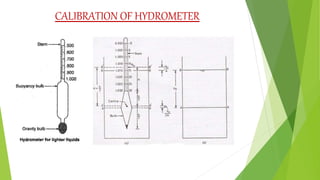
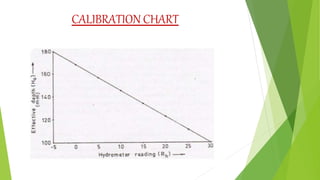
 To establish a relationship between the hydrometer reading (RH) and the effective
depth (He) for a given hydrometer, calibration is done.
CALIBRATION OF HYDROMETER
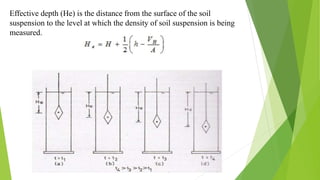
Effective depth (He) is the distance from the surface of the soil
suspension to the level at which the density of soil suspension is being
measured.
CALIBRATION CHART
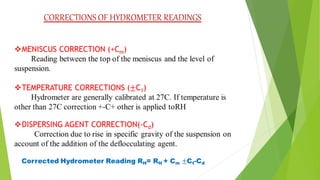
CORRECTIONS OF HYDROMETER READINGS
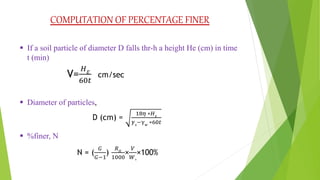
COMPUTATION OF PERCENTAGE FINER
 If a soil particle of diameter D falls thr-h a height He (cm) in time
t (min)
 Diameter of particles,
 %finer, N
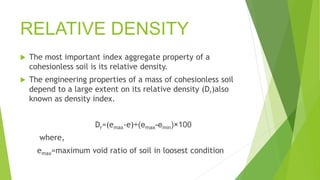
RELATIVE DENSITY
 The most important index aggregate property of a
cohesionless soil is its relative density.
 The engineering properties of a mass of cohesionless soil
depend to a large extent on its relative density (Dr)also
known as density index.
Dr=(emax-e)÷(emax-emin)×100
where,
emax=maximum void ratio of soil in loosest condition
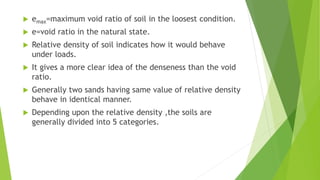
 emax=maximum void ratio of soil in the loosest condition.
 e=void ratio in the natural state.
 Relative density of soil indicates how it would behave
under loads.
 It gives a more clear idea of the denseness than the void
ratio.
 Generally two sands having same value of relative density
behave in identical manner.
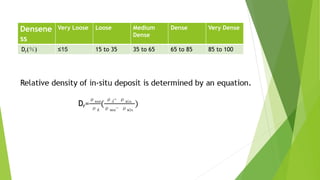
 Depending upon the relative density ,the soils are
generally divided into 5 categories.
Densene
ss
Very Loose Loose Medium
Dense
Dense Very Dense
Dr(%) ≤15 15 to 35 35 to 65 65 to 85 85 to 100
CONSISTENCY LIMITS
 Consistency :- The property of a material which is
manifested by its resistance to flow.
 The resistance offered by it against forces that tend to
deform or rupture the soil aggregate.
 Relative ease with which the soil may be deformed.
 Degree of firmness of a soil and is often directly related
to strength.
 The consistency of a fine graded soil is the physical state
in which it exist.
 It is used to denote degree of firmnes of soil.
 The water content at which soi changes from one state to
the other is known as consistency limit or Atterberg’s
limit.
 Soils with same consistency limit behave in a similar
manner.Thus consistency limit very important index
properties of grained soil.
 A soil containing high water content offers no shearing
resistance and can flow like fluids.As the water content is
reduced the soil becomes stiffer and starts developing
resistance to shear deformation.
 Liquid Limit :- The water content at which soil changes from
liquid state to plastic state.
 Plastic Limit :- The water content at which soil becomes
semi-solid.
 The numerical difference between liquid limit and plastic
limit is known as Plasticity index.
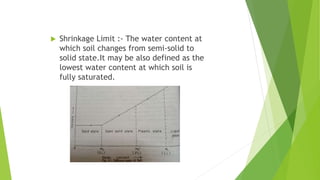
 Shrinkage Limit :- The water content at
which soil changes from semi-solid to
solid state.It may be also defined as the
lowest water content at which soil is
fully saturated.
MEASUREMENT OF CONSISTENCY
 Consistency is conventionally described as very
soft,soft,medium,stiff,very stiff and hard.
 For quantitative measurement of consistency,it is related
to the shear strength or compresive strength.
 The confined compresive strength(qu) of a soil is equal to
the failure load by unit area when a
standard,cylindrical,specimen is tested in an confined
compression testing machine.
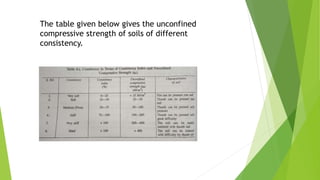
The table given below gives the unconfined
compressive strength of soils of different
consistency.
Uses of Consistency Limit
 It has been found that both the liquid and plastic limit
depend upon type and amount of clay in a soil.
 As particle size decreases,both liquid and plastic limit
increases but the former at a faster rate.
 The study of plasticity index in combination with liquid
limit gives information about the type of clay.
 The toughness index is a measure of the shearing strength
of a soil at the plastic limit.
 When comparing properties of two soils with equal values
of plasticity index,it is found that as liquid limit increases
dry strength and toughness decrease whereas
compressibility and permeability increases.
 When comparing properties of two soils with equal values
of liquid limit,it is found that as plasticity index increases
dry strength and toughness increases whereas
permeability decreases.
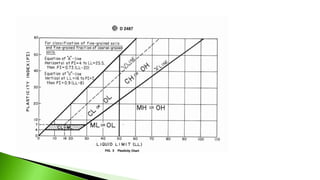
Plasticity chart
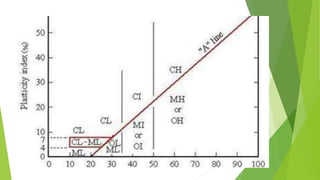
 Casagrande(1932) studied the relationship of
the plasticity index to the liquid limit of a wide
variety natural soils.
 On the basis of the test results, he proposed a
plasticity chart as shown below .This chart was
developed by plotting the results of several
hundred tests.
 The plasticity chart is mainly based on the values
of a liquid limit as well as a plastic limit.
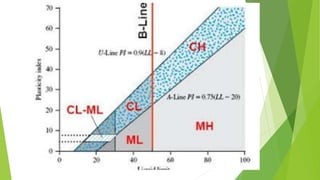
 The A-line in this chart is expressed as
Ip=0.73(Wl-20)
 Depending upon the point in the chart, we can
categorize fine soil into
1. Clay
2. Slit
3. Organic soil
 Plasticity chart is a graph between plasticity
index(Ip) and the liquid limit(Wl)in percentage
which is used for classification of fine-grained
soil as per the India Standard Soil
classification System (ISSCS).
 If more than 50% percent soil passes through
75micron sieve< then it is classified as fine-
grained soil.
 Equation of A-line as represented in the given
chart relates plasticity index and liquid limit
as:
Ip=0.73(Wl-20)
The equation of A-line gives value of plasticity
index from 0 to 58.4 corresponding to values
of liquid limit from 0 to 100%
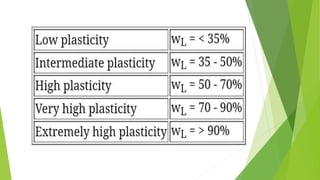
The plasticity characteristic of fine grained
soil based on different liquid limit range is
shown below,
 From the plasticity chart,
CL : Clay with low plasticity
ML : Silt with low plasticity
CH : Clay with high plasticity
MH : Silt with high plasticity
OH : organic soil with high plasticity
CI : Clay with intermediate plasticity
MI : Silt with intermediate plasticity
OI : Organic soil with intermediate plasticity
 The soil above A- line in plasticity chart are
clayey soils and that fall below A-line are
silt and organic soils.
 If plasticity index ranges between 4-7%, soil
represented in dual symbol. That is CL-ML.
Liquid limit:
Laboratory test for liquid limits
 Liquid limit is the water content where the soil starts
to behave as a liquid.
 Liquid limit is measured by placing a clay sample in a
standard cup and making a separation (groove) using
a spatula. The cup is dropped till the separation
vanishes.
 The water content of the soil is obtained from this
sample. The test is performed again by increasing
the water content would yield more blows and soil
with higher content would yield less blows.
 A graph is drawn between number of blows and the
water content
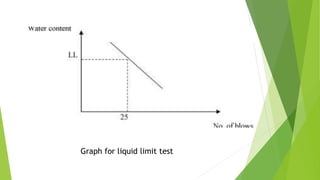
Graph for liquid limit test
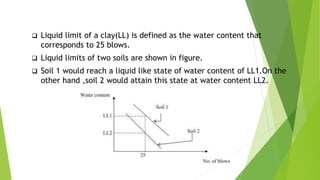
 Liquid limit of a clay(LL) is defined as the water content that
corresponds to 25 blows.
 Liquid limits of two soils are shown in figure.
 Soil 1 would reach a liquid like state of water content of LL1.On the
other hand ,soil 2 would attain this state at water content LL2.
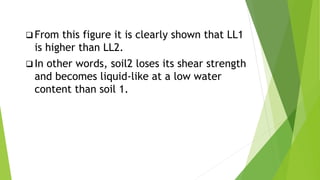
 From this figure it is clearly shown that LL1
is higher than LL2.
 In other words, soil2 loses its shear strength
and becomes liquid-like at a low water
content than soil 1.
Laboratory test for Plastic Limit
 For determination of the plastic limit of a soil,it is air-dried and sieved
through a 425micro IS sieve.About 30gm of the soil is taken in an evapourating
dish.It is mixed thoroughly with distilled water till it becomes plastic and and
can be easily moulded with fingers.
 About 10 g of plastic soil mass is taken in one hand and ball is
formed.The ball is around with fingers on a glass plate to form a soil thread of
uniform diameter.The rate of Rolling is kept about 80 to 90 strokes per
minute.If the diameter of thread becomes smaller than 3mm, without
cracking formation, it shows that the water content is more than the plastic
limit.The soil is kneaded further .
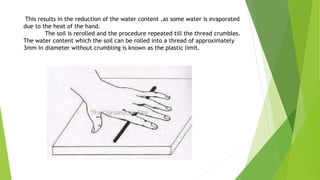
This results in the reduction of the water content ,as some water is evaporated
due to the heat of the hand.
The soil is rerolled and the procedure repeated till the thread crumbles.
The water content which the soil can be rolled into a thread of approximately
3mm in diameter without crumbling is known as the plastic limit.
Laboratory test for Shrinkage Limit
 The test is repeated,taking a fresh sample each time. The plastic limit is
taken as the average of three values, The plastic limit is reported to the
nearest Whole number. The shear strength at the plastic limit is about 100
times that the liquid limit.
 A circular shrinkage dish made of porcelain or stainless steel and having a
diameter 30 to40 mm and a height of 15 m m is taken.The shrinkage dish has
a flat bottom and has its internal corners well-rounded .The capacity of the
shrinkage dish is first determined by fitting it with mercury.The shrinkage
dishe is placed in glass plate firmly over the top of the shrinkage dish. The
mass of mercury is the shrinkage dish is obtained by transferring the mercury
into a mercury weighing dish. The capacity of the shrinkage dish in ml is equal
to the mass of mercury in gm divided by the specific gravity of mercury
The inside surface of the empty shrinkage dish is coated with a thin layer
of Vaseline or silicone grease .The mass of empty shrinkage is obtained accurately.
The soil sample is place in the shrinkage dish about one-third its capacity. The dish
is tapped on a firm surface to ensure that no air is entrapped. More soil is added
and the taping continued till the dish is completely filled with soil. The excess soil
is removed by striking off the top surface with a straight edge.The mass of the
shrinkage dish with the soil is taken to obtain the mass (M1) of the soil .The volume
of the soil V1 is equal to the capacity of the dish.
The soil in the shrinkage dish is allowed to dry in air until the colour of
the soil pat turns light . It is then dried in a oven . The mass of the shrinkage dish
with dry soil is taken to obtain the mass of dry soil M .
For determination of the volume of the dry pat , a glass cup , about 50
mm diameter and 25 mm height , is taken and placed in a large dish . The cup is
filled with mercury . The excess mercury is removed by pressing a glass plate with
three prongs firmly over the top of the cup . Any mercury adhering on the side of
the cup is wiped off , and the cup full of mercury is transferred to another large
dish .
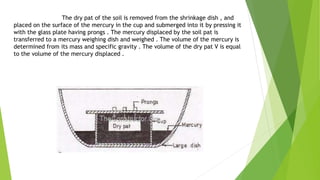
The dry pat of the soil is removed from the shrinkage dish , and
placed on the surface of the mercury in the cup and submerged into it by pressing it
with the glass plate having prongs . The mercury displaced by the soil pat is
transferred to a mercury weighing dish and weighed . The volume of the mercury is
determined from its mass and specific gravity . The volume of the dry pat V is equal
to the volume of the mercury displaced .
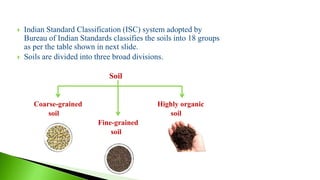
 Indian Standard Classification (ISC) system adopted by
Bureau of Indian Standards classifies the soils into 18 groups
as per the table shown in next slide.
 Soils are divided into three broad divisions.
Soil
Coarse-grained Highly organic
soil soil
Fine-grained
soil
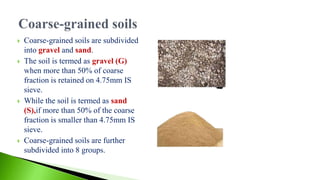
 Coarse-grained soils are subdivided
into gravel and sand.
 The soil is termed as gravel (G)
when more than 50% of coarse
fraction is retained on 4.75mm IS
sieve.
 While the soil is termed as sand
(S),if more than 50% of the coarse
fraction is smaller than 4.75mm IS
sieve.
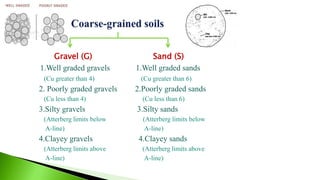
 Coarse-grained soils are further
subdivided into 8 groups.
Gravel (G) Sand (S)
1.Well graded gravels 1.Well graded sands
(Cu greater than 4) (Cu greater than 6)
2. Poorly graded gravels 2.Poorly graded sands
(Cu less than 4) (Cu less than 6)
3.Silty gravels 3.Silty sands
(Atterberg limits below (Atterberg limits below
A-line) A-line)
4.Clayey gravels 4.Clayey sands
(Atterberg limits above (Atterberg limits above
A-line) A-line)
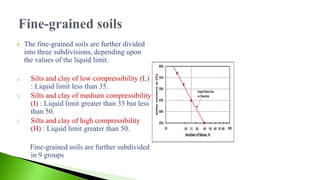
 The fine-grained soils are further divided
into three subdivisions, depending upon
the values of the liquid limit.
a. Silts and clay of low compressibility (L)
: Liquid limit less than 35.
b. Silts and clay of medium compressibility
(I) : Liquid limit greater than 35 but less
than 50.
c. Silts and clay of high compressibility
(H) : Liquid limit greater than 50.
Fine-grained soils are further subdivided
in 9 groups
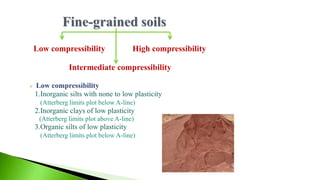
Low compressibility High compressibility
Intermediate compressibility
 Low compressibility
1.Inorganic silts with none to low plasticity
(Atterberg limits plot below A-line)
2.Inorganic clays of low plasticity
(Atterberg limits plot above A-line)
3.Organic silts of low plasticity
(Atterberg limits plot below A-line)
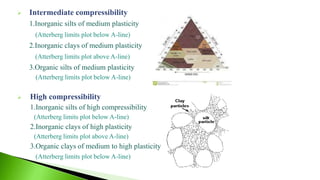
 Intermediate compressibility
1.Inorganic silts of medium plasticity
(Atterberg limits plot below A-line)
2.Inorganic clays of medium plasticity
(Atterberg limits plot above A-line)
3.Organic silts of medium plasticity
(Atterberg limits plot below A-line)
 High compressibility
1.Inorganic silts of high compressibility
(Atterberg limits plot below A-line)
2.Inorganic clays of high plasticity
(Atterberg limits plot above A-line)
3.Organic clays of medium to high plasticity
(Atterberg limits plot below A-line)
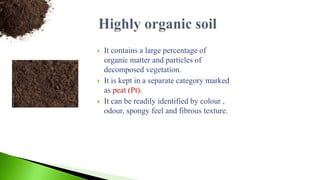
 It contains a large percentage of
organic matter and particles of
decomposed vegetation.
 It is kept in a separate category marked
as peat (Pt).
 It can be readily identified by colour ,
odour, spongy feel and fibrous texture.
Permeability
• The permeability is the property of soil which allows the flow of
water through its interconnected voids
Knowledge of permeability is
essential for:
• Settlement of building
• Yield of wells
• Earth pressure
• Uplit pressure under hydraulic structure
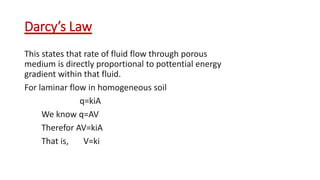
Darcy’s Law
This states that rate of fluid flow through porous
medium is directly proportional to pottential energy
gradient within that fluid.
For laminar flow in homogeneous soil
q=kiA
We know q=AV
Therefor AV=kiA
That is, V=ki
Assumptions of Darcy’s Law
• The soil is saturated
• The flow through soil is laminar
• The flow is continous and steady
• The total cross sectional area of soil mass is considered
• The tenperature at time of testing is 27°C
Velocity of Darcy’s Law
It is valid for laminar flow through soil Reynold’s number<1
Determinatiom of permeability
1.By laboratory method
*constant head permeability test
*variable head permeability test
2.By field method
*pumping out test
*pumping in test
3.By indirect method
*compaction from particle size
*compaction from consolidation test
Factors effecting permeability
• Particle size
• Properties of fluids
• Void ratio of soil
• Shape of particle
• Structure of soil mass
• Degree of saturation
• Absorbed water
• Impurities in water
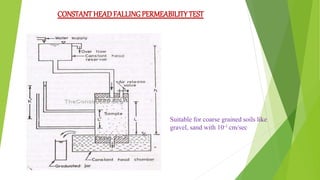
CONSTANT HEADFALLINGPERMEABILITYTEST
Suitable for coarse grained soils like
gravel, sand with 10-1 cm/sec
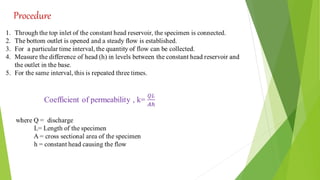
Procedure
Falling head
permeability test
Falling head permeability test?
 The falling head permeability test is a common
laboratory testing method used to determine
the permeability of fine grained soils with intermediate
and low permeability such as silts and clays. This
testing method can be applied to an undisturbed
sample.
Procedure
 The falling head permeability test involves flow of water through a relatively short soil
sample connected to a standpipe which provides the water head and also allows
measuring the volume of water passing through the sample. The diameter of the
standpipe depends on the permeability of the tested soil. The test can be carried out in
a Falling Head permeability cell .
 Before starting the flow measurements, the soil sample is saturated and the standpipes
are filled with de-aired water to a given level. The test then starts by allowing water to
flow through the sample until the water in the standpipe reaches a given lower limit. The
time required for the water in the standpipe to to drop from the upper to the lower level
is recorded. Often, the standpipe is refilled and the test is repeated for couple of times.
The recorded time should be the same for each test within an allowable variation of
about 10% (Head 1982) otherwise the test is failed.
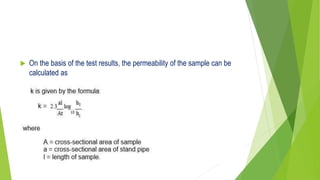
 On the basis of the test results, the permeability of the sample can be
calculated as
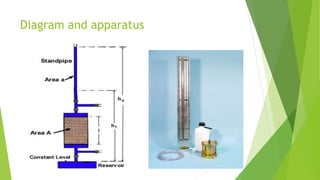
Diagram and apparatus
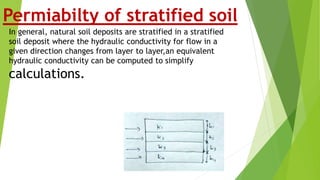
Permiabilty of stratified soil
In general, natural soil deposits are stratified in a stratified
soil deposit where the hydraulic conductivity for flow in a
given direction changes from layer to layer,an equivalent
hydraulic conductivity can be computed to simplify
calculations.
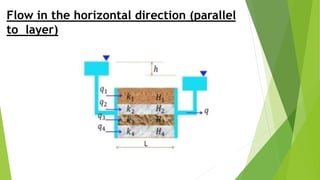
Flow in the horizontal direction (parallel
to layer)
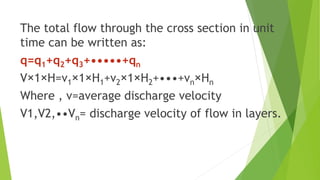
The total flow through the cross section in unit
time can be written as:
q=q1+q2+q3+•••••+qn
V×1×H=v1×1×H1+v2×1×H2+•••+vn×Hn
Where , v=average discharge velocity
V1,V2,••Vn= discharge velocity of flow in layers.
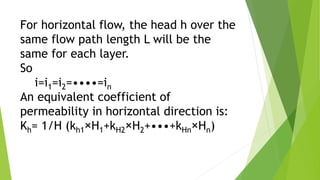
For horizontal flow, the head h over the
same flow path length L will be the
same for each layer.
So
i=i1=i2=••••=in
An equivalent coefficient of
permeability in horizontal direction is:
Kh= 1/H (kh1×H1+kH2×H2+•••+kHn×Hn)
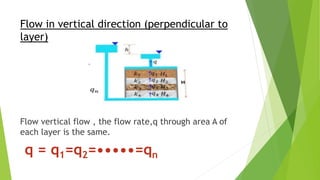
Flow in vertical direction (perpendicular to
layer)
Flow vertical flow , the flow rate,q through area A of
each layer is the same.
q = q1=q2=•••••=qn
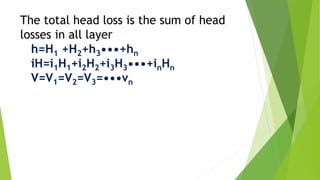
The total head loss is the sum of head
losses in all layer
h=H1 +H2+h3•••+hn
iH=i1H1+i2H2+i3H3•••+inHn
V=V1=V2=V3=•••vn
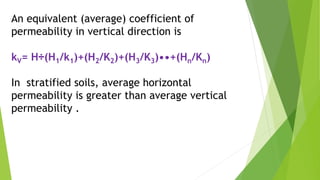
An equivalent (average) coefficient of
permeability in vertical direction is
kV= H÷(H1/k1)+(H2/K2)+(H3/K3)••+(Hn/Kn)
In stratified soils, average horizontal
permeability is greater than average vertical
permeability .

Geotechnical engineering 1-Module 2.pptx

  • 1.
  • 2.
     B.A Gopika(Roll no:11)  Darsana Mohanachandran (Roll no:12)  Devika R.R (Roll no:13)  Devika Vijayan.S (Roll no:14)  Divya Venu.S (Roll no:15)  Haritha.S (Roll no:17)  Hiba Shahana.S (Roll no:18)  Janifa.S.Jamal (Roll no:19)  Jannathshirin N.S (Roll no:20)
  • 3.
    1. Sieve analysis 2.Well graded, Poorly graded and gap graded soils 3. Stoke’s law 4. Hydrometer Analysis 5. Relative density 6. Consistency 7. Atterberg Limits and indices 8. Plasticity charts 9. Laboratory tests for Liquid limit, Plastic limit and Shrinkage limit 10. IS classification of soil
  • 4.
    11. Permeability ofsoils 12. Darcy’s law 13. Factors affecting permeability 14. Laboratory tests : Constant head and falling test permeability tests 15. Average permeability of stratified deposits
  • 5.
    SIEVE ANALYSIS Sieve Analysisis a procedure used in Civil Engineering to assess the particle size distribution of a granular material by allowing the material to pass through a series of sieves of progressively smaller mesh size and weighing the amount of material that is stopped by each sieve as a fraction of the whole mass.  Sieves of various sizes ranging from 80 mm to 75 microns are available.  Sieves are stacked one over the other with decreasing size from top to the bottom.  A receiver pan, is placed at the bottom of the smallest sieve.
  • 6.
     Coarse sieveanalysis – for the fraction of soil retained on 4.75 mm sieve ( gravel fraction).  Fine sieve analysis – for the fraction of soil is passing through 4.75 mm sieve (sand fraction).
  • 7.
    DRY SIEVE ANALYSIS It is suitable for coohesionless soil, with little or no fines. PROCEDURE  The soil sample is taken in a suitable quantity.  The soil should be oven-dry. It should not contain any lump.  The sample is sieved through a 4.75 mm IS sieve.  The portion retained on the sieve is the gravel fraction.
  • 8.
     The gravelfraction is sieved through the set of coarse sieves manually or using a mechanical shaker. Hand sieving is normally done.  The weight of soil retained on each sieve is obtained.  The minus 4.75 mm fraction is sieved through the set of fine sieves using a mechanical shaker. The mass of soil retained on each sieve and on pan is obtained to the nearest 0.1 gm.
  • 9.
    WET SIEVE ANALYSIS Ifthe soil contains more than 5% of fine particles, a wet sieve analysis is required. PROCEDURE  All lumps are broken into individual particles.  A representative soil sample in the required quantity is taken and dried in an oven.  The dried sample is taken in a tray and soaked with water.  The slury is then sieved through a 4.75 mm IS sieve and washed with a jet of water.
  • 10.
     The gravelfraction is then dried on oven, and sieved through set of coarse sieves.  The material passing through 4.75 mm sieve is sieved through a 75 μ sieve. The material is washed until the wash water becomes clear.  The material retained on the 75 sieve is collected and dried in an oven. It is then sieved through the set of fine sieves of the size 2 mm ,1 mm, 600 μ, 425 μ , 212 μ ,150 μ and 75 μ.  The material retained on each sieve is collected and dried in an oven.
  • 11.
    GRADING OF SOIL The distribution of particles of different sizes in a soil mass is called grading.  Grading of soils can be determined from the particle size distribution curves.
  • 12.
     A curvewith a hump , such as curve A, represents the soil in which some of the intermediate particles are missing. Such a soil is called gap- graded soil.  A flat S-curve, such as curve B, represents a soil which contains the particles of different sizes in good proportion.Such a soil is called well-graded (or uniformly graded) soil.  A soil that does not have a good representation of all sizes of particles is called poorly-graded soil.
  • 13.
    Stokes law o Thevelocity at which grains settle out of suspension, all the factors being equal, is dependent upon the shape, weight, and sixe of grains. o Coarser particles settles more quickly than the finer ones. o If a single sphere is allowed to fall freely through a liquid of infinite extent, its velocity will first increase rapidly under the action of gravity, but a constant velocity called terminal velocity is reached within a short time.
  • 14.
    According to stoke’slaw Where, • V = Terminal velocity of soil grain with diameter D(cm/sec) • VS = Unit weight of soil grains (gm/cc) = G • Vs = Unit weight of liquid (gm/cc) • N = viscosity of liquid (gm-sec/cm2) • U = Viscosity in poise (dyne sec/cm2) • G = acceleration due to gravity (cm/sec2) • D = Diameter of grain (cm) • [ 1 Dyne = 10-5 N = 1/981 gm]
  • 15.
    HYDROMETER  A devicewhich is used to measure the specific gravity of liquids.  For a soil suspension, the particles start settling down right from the start, and hence the unit weight of the suspension varies from top to bottom.  A special type of hydrometer with a long stem (neck) is used. The stem is marked from top to bottom, generally in the range of 0.995 to 1.030.  When the sedimentation takes place, the ,larger particles settles more deeper than the smaller ones.  Hydrometer measures the specific gravity of suspension at appoint indicated by the center of the immersed volume  Hydrometer gives the specific gravity of the suspension at the centre of the bulb  To establish a relationship between the hydrometer reading (RH) and the effective depth (He) for a given hydrometer, calibration is done.
  • 16.
  • 17.
    Effective depth (He)is the distance from the surface of the soil suspension to the level at which the density of soil suspension is being measured.
  • 18.
  • 19.
  • 20.
    COMPUTATION OF PERCENTAGEFINER  If a soil particle of diameter D falls thr-h a height He (cm) in time t (min)  Diameter of particles,  %finer, N
  • 21.
    RELATIVE DENSITY  Themost important index aggregate property of a cohesionless soil is its relative density.  The engineering properties of a mass of cohesionless soil depend to a large extent on its relative density (Dr)also known as density index. Dr=(emax-e)÷(emax-emin)×100 where, emax=maximum void ratio of soil in loosest condition
  • 22.
     emax=maximum voidratio of soil in the loosest condition.  e=void ratio in the natural state.  Relative density of soil indicates how it would behave under loads.  It gives a more clear idea of the denseness than the void ratio.  Generally two sands having same value of relative density behave in identical manner.  Depending upon the relative density ,the soils are generally divided into 5 categories.
  • 23.
    Densene ss Very Loose LooseMedium Dense Dense Very Dense Dr(%) ≤15 15 to 35 35 to 65 65 to 85 85 to 100
  • 24.
    CONSISTENCY LIMITS  Consistency:- The property of a material which is manifested by its resistance to flow.  The resistance offered by it against forces that tend to deform or rupture the soil aggregate.  Relative ease with which the soil may be deformed.  Degree of firmness of a soil and is often directly related to strength.
  • 25.
     The consistencyof a fine graded soil is the physical state in which it exist.  It is used to denote degree of firmnes of soil.  The water content at which soi changes from one state to the other is known as consistency limit or Atterberg’s limit.  Soils with same consistency limit behave in a similar manner.Thus consistency limit very important index properties of grained soil.
  • 26.
     A soilcontaining high water content offers no shearing resistance and can flow like fluids.As the water content is reduced the soil becomes stiffer and starts developing resistance to shear deformation.  Liquid Limit :- The water content at which soil changes from liquid state to plastic state.  Plastic Limit :- The water content at which soil becomes semi-solid.  The numerical difference between liquid limit and plastic limit is known as Plasticity index.
  • 27.
     Shrinkage Limit:- The water content at which soil changes from semi-solid to solid state.It may be also defined as the lowest water content at which soil is fully saturated.
  • 28.
    MEASUREMENT OF CONSISTENCY Consistency is conventionally described as very soft,soft,medium,stiff,very stiff and hard.  For quantitative measurement of consistency,it is related to the shear strength or compresive strength.  The confined compresive strength(qu) of a soil is equal to the failure load by unit area when a standard,cylindrical,specimen is tested in an confined compression testing machine.
  • 29.
    The table givenbelow gives the unconfined compressive strength of soils of different consistency.
  • 30.
    Uses of ConsistencyLimit  It has been found that both the liquid and plastic limit depend upon type and amount of clay in a soil.  As particle size decreases,both liquid and plastic limit increases but the former at a faster rate.  The study of plasticity index in combination with liquid limit gives information about the type of clay.  The toughness index is a measure of the shearing strength of a soil at the plastic limit.
  • 31.
     When comparingproperties of two soils with equal values of plasticity index,it is found that as liquid limit increases dry strength and toughness decrease whereas compressibility and permeability increases.  When comparing properties of two soils with equal values of liquid limit,it is found that as plasticity index increases dry strength and toughness increases whereas permeability decreases.
  • 32.
    Plasticity chart  Casagrande(1932)studied the relationship of the plasticity index to the liquid limit of a wide variety natural soils.  On the basis of the test results, he proposed a plasticity chart as shown below .This chart was developed by plotting the results of several hundred tests.
  • 34.
     The plasticitychart is mainly based on the values of a liquid limit as well as a plastic limit.  The A-line in this chart is expressed as Ip=0.73(Wl-20)  Depending upon the point in the chart, we can categorize fine soil into 1. Clay 2. Slit 3. Organic soil
  • 35.
     Plasticity chartis a graph between plasticity index(Ip) and the liquid limit(Wl)in percentage which is used for classification of fine-grained soil as per the India Standard Soil classification System (ISSCS).  If more than 50% percent soil passes through 75micron sieve< then it is classified as fine- grained soil.
  • 37.
     Equation ofA-line as represented in the given chart relates plasticity index and liquid limit as: Ip=0.73(Wl-20) The equation of A-line gives value of plasticity index from 0 to 58.4 corresponding to values of liquid limit from 0 to 100% The plasticity characteristic of fine grained soil based on different liquid limit range is shown below,
  • 39.
     From theplasticity chart, CL : Clay with low plasticity ML : Silt with low plasticity CH : Clay with high plasticity MH : Silt with high plasticity OH : organic soil with high plasticity CI : Clay with intermediate plasticity MI : Silt with intermediate plasticity OI : Organic soil with intermediate plasticity
  • 40.
     The soilabove A- line in plasticity chart are clayey soils and that fall below A-line are silt and organic soils.  If plasticity index ranges between 4-7%, soil represented in dual symbol. That is CL-ML.
  • 41.
  • 42.
     Liquid limitis the water content where the soil starts to behave as a liquid.  Liquid limit is measured by placing a clay sample in a standard cup and making a separation (groove) using a spatula. The cup is dropped till the separation vanishes.  The water content of the soil is obtained from this sample. The test is performed again by increasing the water content would yield more blows and soil with higher content would yield less blows.  A graph is drawn between number of blows and the water content
  • 43.
    Graph for liquidlimit test
  • 44.
     Liquid limitof a clay(LL) is defined as the water content that corresponds to 25 blows.  Liquid limits of two soils are shown in figure.  Soil 1 would reach a liquid like state of water content of LL1.On the other hand ,soil 2 would attain this state at water content LL2.
  • 45.
     From thisfigure it is clearly shown that LL1 is higher than LL2.  In other words, soil2 loses its shear strength and becomes liquid-like at a low water content than soil 1.
  • 46.
    Laboratory test forPlastic Limit  For determination of the plastic limit of a soil,it is air-dried and sieved through a 425micro IS sieve.About 30gm of the soil is taken in an evapourating dish.It is mixed thoroughly with distilled water till it becomes plastic and and can be easily moulded with fingers.  About 10 g of plastic soil mass is taken in one hand and ball is formed.The ball is around with fingers on a glass plate to form a soil thread of uniform diameter.The rate of Rolling is kept about 80 to 90 strokes per minute.If the diameter of thread becomes smaller than 3mm, without cracking formation, it shows that the water content is more than the plastic limit.The soil is kneaded further .
  • 47.
    This results inthe reduction of the water content ,as some water is evaporated due to the heat of the hand. The soil is rerolled and the procedure repeated till the thread crumbles. The water content which the soil can be rolled into a thread of approximately 3mm in diameter without crumbling is known as the plastic limit.
  • 48.
    Laboratory test forShrinkage Limit  The test is repeated,taking a fresh sample each time. The plastic limit is taken as the average of three values, The plastic limit is reported to the nearest Whole number. The shear strength at the plastic limit is about 100 times that the liquid limit.  A circular shrinkage dish made of porcelain or stainless steel and having a diameter 30 to40 mm and a height of 15 m m is taken.The shrinkage dish has a flat bottom and has its internal corners well-rounded .The capacity of the shrinkage dish is first determined by fitting it with mercury.The shrinkage dishe is placed in glass plate firmly over the top of the shrinkage dish. The mass of mercury is the shrinkage dish is obtained by transferring the mercury into a mercury weighing dish. The capacity of the shrinkage dish in ml is equal to the mass of mercury in gm divided by the specific gravity of mercury
  • 49.
    The inside surfaceof the empty shrinkage dish is coated with a thin layer of Vaseline or silicone grease .The mass of empty shrinkage is obtained accurately. The soil sample is place in the shrinkage dish about one-third its capacity. The dish is tapped on a firm surface to ensure that no air is entrapped. More soil is added and the taping continued till the dish is completely filled with soil. The excess soil is removed by striking off the top surface with a straight edge.The mass of the shrinkage dish with the soil is taken to obtain the mass (M1) of the soil .The volume of the soil V1 is equal to the capacity of the dish. The soil in the shrinkage dish is allowed to dry in air until the colour of the soil pat turns light . It is then dried in a oven . The mass of the shrinkage dish with dry soil is taken to obtain the mass of dry soil M . For determination of the volume of the dry pat , a glass cup , about 50 mm diameter and 25 mm height , is taken and placed in a large dish . The cup is filled with mercury . The excess mercury is removed by pressing a glass plate with three prongs firmly over the top of the cup . Any mercury adhering on the side of the cup is wiped off , and the cup full of mercury is transferred to another large dish .
  • 50.
    The dry patof the soil is removed from the shrinkage dish , and placed on the surface of the mercury in the cup and submerged into it by pressing it with the glass plate having prongs . The mercury displaced by the soil pat is transferred to a mercury weighing dish and weighed . The volume of the mercury is determined from its mass and specific gravity . The volume of the dry pat V is equal to the volume of the mercury displaced .
  • 52.
     Indian StandardClassification (ISC) system adopted by Bureau of Indian Standards classifies the soils into 18 groups as per the table shown in next slide.  Soils are divided into three broad divisions. Soil Coarse-grained Highly organic soil soil Fine-grained soil
  • 54.
     Coarse-grained soilsare subdivided into gravel and sand.  The soil is termed as gravel (G) when more than 50% of coarse fraction is retained on 4.75mm IS sieve.  While the soil is termed as sand (S),if more than 50% of the coarse fraction is smaller than 4.75mm IS sieve.  Coarse-grained soils are further subdivided into 8 groups.
  • 55.
    Gravel (G) Sand(S) 1.Well graded gravels 1.Well graded sands (Cu greater than 4) (Cu greater than 6) 2. Poorly graded gravels 2.Poorly graded sands (Cu less than 4) (Cu less than 6) 3.Silty gravels 3.Silty sands (Atterberg limits below (Atterberg limits below A-line) A-line) 4.Clayey gravels 4.Clayey sands (Atterberg limits above (Atterberg limits above A-line) A-line)
  • 56.
     The fine-grainedsoils are further divided into three subdivisions, depending upon the values of the liquid limit. a. Silts and clay of low compressibility (L) : Liquid limit less than 35. b. Silts and clay of medium compressibility (I) : Liquid limit greater than 35 but less than 50. c. Silts and clay of high compressibility (H) : Liquid limit greater than 50. Fine-grained soils are further subdivided in 9 groups
  • 57.
    Low compressibility Highcompressibility Intermediate compressibility  Low compressibility 1.Inorganic silts with none to low plasticity (Atterberg limits plot below A-line) 2.Inorganic clays of low plasticity (Atterberg limits plot above A-line) 3.Organic silts of low plasticity (Atterberg limits plot below A-line)
  • 58.
     Intermediate compressibility 1.Inorganicsilts of medium plasticity (Atterberg limits plot below A-line) 2.Inorganic clays of medium plasticity (Atterberg limits plot above A-line) 3.Organic silts of medium plasticity (Atterberg limits plot below A-line)  High compressibility 1.Inorganic silts of high compressibility (Atterberg limits plot below A-line) 2.Inorganic clays of high plasticity (Atterberg limits plot above A-line) 3.Organic clays of medium to high plasticity (Atterberg limits plot below A-line)
  • 59.
     It containsa large percentage of organic matter and particles of decomposed vegetation.  It is kept in a separate category marked as peat (Pt).  It can be readily identified by colour , odour, spongy feel and fibrous texture.
  • 60.
    Permeability • The permeabilityis the property of soil which allows the flow of water through its interconnected voids
  • 61.
    Knowledge of permeabilityis essential for: • Settlement of building • Yield of wells • Earth pressure • Uplit pressure under hydraulic structure
  • 62.
    Darcy’s Law This statesthat rate of fluid flow through porous medium is directly proportional to pottential energy gradient within that fluid. For laminar flow in homogeneous soil q=kiA We know q=AV Therefor AV=kiA That is, V=ki
  • 63.
    Assumptions of Darcy’sLaw • The soil is saturated • The flow through soil is laminar • The flow is continous and steady • The total cross sectional area of soil mass is considered • The tenperature at time of testing is 27°C
  • 64.
    Velocity of Darcy’sLaw It is valid for laminar flow through soil Reynold’s number<1
  • 65.
    Determinatiom of permeability 1.Bylaboratory method *constant head permeability test *variable head permeability test 2.By field method *pumping out test *pumping in test 3.By indirect method *compaction from particle size *compaction from consolidation test
  • 66.
    Factors effecting permeability •Particle size • Properties of fluids • Void ratio of soil • Shape of particle • Structure of soil mass • Degree of saturation • Absorbed water • Impurities in water
  • 67.
    CONSTANT HEADFALLINGPERMEABILITYTEST Suitable forcoarse grained soils like gravel, sand with 10-1 cm/sec
  • 68.
  • 69.
  • 70.
    Falling head permeabilitytest?  The falling head permeability test is a common laboratory testing method used to determine the permeability of fine grained soils with intermediate and low permeability such as silts and clays. This testing method can be applied to an undisturbed sample.
  • 71.
    Procedure  The fallinghead permeability test involves flow of water through a relatively short soil sample connected to a standpipe which provides the water head and also allows measuring the volume of water passing through the sample. The diameter of the standpipe depends on the permeability of the tested soil. The test can be carried out in a Falling Head permeability cell .  Before starting the flow measurements, the soil sample is saturated and the standpipes are filled with de-aired water to a given level. The test then starts by allowing water to flow through the sample until the water in the standpipe reaches a given lower limit. The time required for the water in the standpipe to to drop from the upper to the lower level is recorded. Often, the standpipe is refilled and the test is repeated for couple of times. The recorded time should be the same for each test within an allowable variation of about 10% (Head 1982) otherwise the test is failed.
  • 72.
     On thebasis of the test results, the permeability of the sample can be calculated as
  • 73.
  • 74.
    Permiabilty of stratifiedsoil In general, natural soil deposits are stratified in a stratified soil deposit where the hydraulic conductivity for flow in a given direction changes from layer to layer,an equivalent hydraulic conductivity can be computed to simplify calculations.
  • 75.
    Flow in thehorizontal direction (parallel to layer)
  • 76.
    The total flowthrough the cross section in unit time can be written as: q=q1+q2+q3+•••••+qn V×1×H=v1×1×H1+v2×1×H2+•••+vn×Hn Where , v=average discharge velocity V1,V2,••Vn= discharge velocity of flow in layers.
  • 77.
    For horizontal flow,the head h over the same flow path length L will be the same for each layer. So i=i1=i2=••••=in An equivalent coefficient of permeability in horizontal direction is: Kh= 1/H (kh1×H1+kH2×H2+•••+kHn×Hn)
  • 78.
    Flow in verticaldirection (perpendicular to layer) Flow vertical flow , the flow rate,q through area A of each layer is the same. q = q1=q2=•••••=qn
  • 79.
    The total headloss is the sum of head losses in all layer h=H1 +H2+h3•••+hn iH=i1H1+i2H2+i3H3•••+inHn V=V1=V2=V3=•••vn
  • 80.
    An equivalent (average)coefficient of permeability in vertical direction is kV= H÷(H1/k1)+(H2/K2)+(H3/K3)••+(Hn/Kn) In stratified soils, average horizontal permeability is greater than average vertical permeability .