Year 10
Ms Gibellini
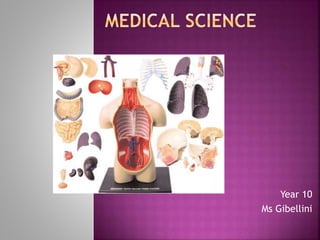
 Complete the Pin the Organ on the Student
Activity
 How well do you know your own body?
 How many of the following bones, muscles and organs
can you label?
 Do you know what they do?
 Complete the Prior Knowledge online Quiz for
this topic
 Identify the major bones of the skeleton and describe its
function
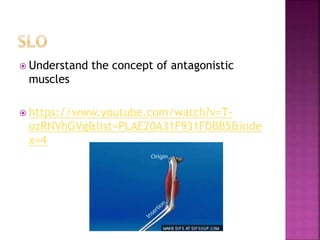
 Understand the concept of antagonistic muscles
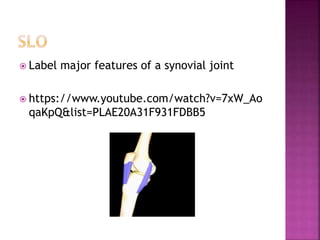
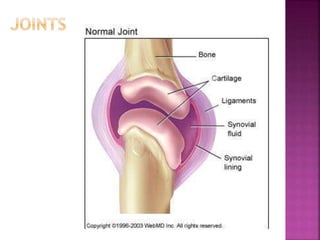
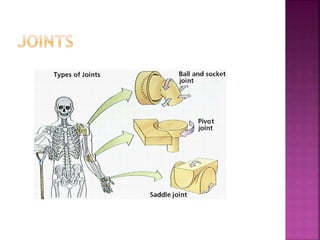
 Label major features of a synovial joint
 Identify the major features and functions of the human
circulatory system
 Outline the basic composition of human blood
 Identify the major features and functions of arteries, veins
and capillaries
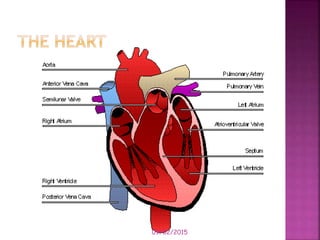
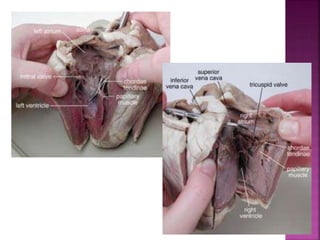
 Label the features of the human heart.
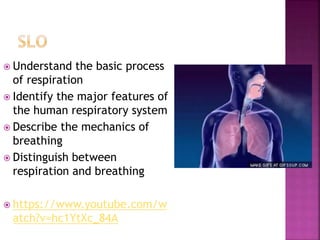
 Understand the basic process of respiration
 Identify the major features of the human respiratory
system
 Describe the mechanics of breathing
 Distinguish between respiration and breathing
 Identify the features of the male and female reproductive
systems
 Explain how fertilisation occurs in humans
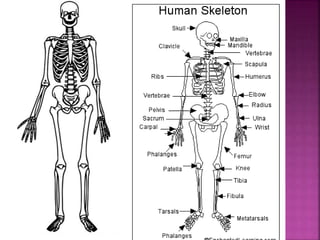
 Identify the major bones of the skeleton and
describe its function
Why do we need a skeleton?
Protect organs
Supports skin
Makes red blood cells
Used to create movement with
muscles
 Build a skeleton
 Complete Scipad page ‘Human Skeleton’,
Broken Bones, Bones Crossword, The
Function of the Skeleton
 https://play.kahoot.it/#/?quizId=69bfedeb-
8321-4861-a075-
31551b56c28a&user=ngibellini&token=3888d9
35-6c6c-456b-a1eb-6c979d632e41
 Label major features of a synovial joint
 https://www.youtube.com/watch?v=7xW_Ao
qaKpQ&list=PLAE20A31F931FDBB5
 Complete Scipad pages Joints, Arthritis
 http://learningon.theloop.school.nz/moodle
/mod/quiz/view.php?id=79095 – moodle
homework quiz
 Kahoots -
https://play.kahoot.it/#/?quizId=69bfedeb-
8321-4861-a075-
31551b56c28a&user=ngibellini&token=3888d9
35-6c6c-456b-a1eb-
6c979d632e41&playId=81ed905c-fc60-4c1b-
aa1e-035ffa1af943
 Understand the concept of antagonistic
muscles
 https://www.youtube.com/watch?v=T-
ozRNVhGVg&list=PLAE20A31F931FDBB5&inde
x=4
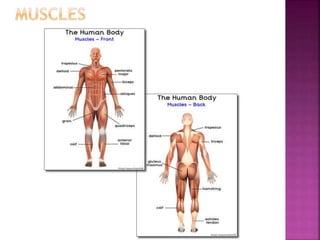
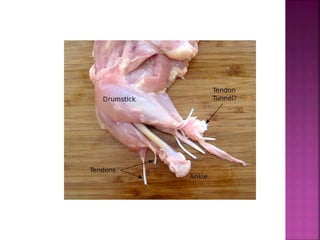
 When a muscle contracts (shortens) it pulls on
the tendon which pulls on the bone to cause
movement.
 Muscles work in pairs because they can only pull,
not push (one pulls arm up, other pulls arm
down)
 Pairs of muscles work in the opposite direction –
antagonistic pairs
 Tendons connect muscle to bone
 Ligaments link bones
 http://www.childrensuniversity.manchester.a
c.uk/media/services/thechildrensuniversityo
fmanchester/flash/exercise_3_muscles.swf
 http://www.e-
learningforkids.org/health/lesson/muscles/
 http://www.e-
learningforkids.org/science/lesson/carribean
-sea-muscles-pirates/
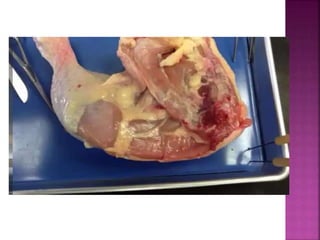
 Many animals have skeletal systems that are very
similar to ours.
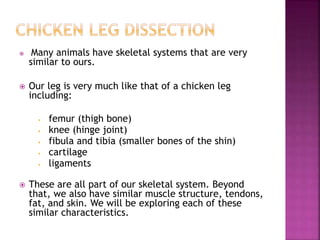
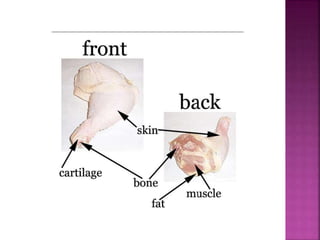
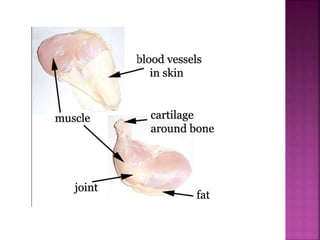
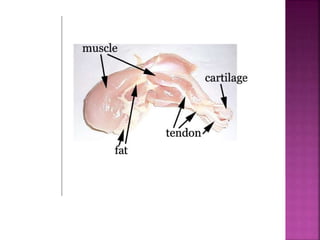
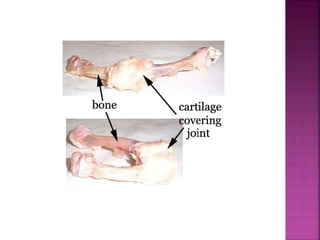
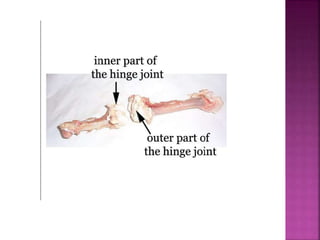
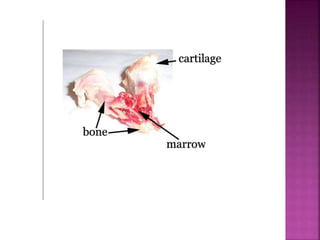
 Our leg is very much like that of a chicken leg
including:
• femur (thigh bone)
• knee (hinge joint)
• fibula and tibia (smaller bones of the shin)
• cartilage
• ligaments
 These are all part of our skeletal system. Beyond
that, we also have similar muscle structure, tendons,
fat, and skin. We will be exploring each of these
similar characteristics.
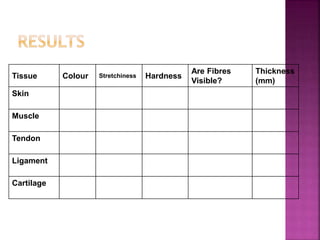
Tissue Colour Stretchiness Hardness
Are Fibres
Visible?
Thickness
(mm)
Skin
Muscle
Tendon
Ligament
Cartilage
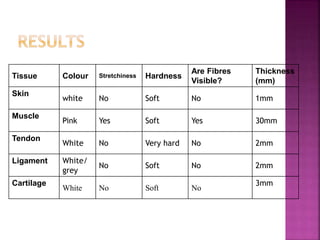
Tissue Colour Stretchiness Hardness
Are Fibres
Visible?
Thickness
(mm)
Skin
white No Soft No 1mm
Muscle
Pink Yes Soft Yes 30mm
Tendon
White No Very hard No 2mm
Ligament White/
grey
No Soft No 2mm
Cartilage
White No Soft No
3mm
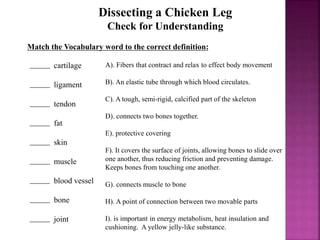
Dissecting a Chicken Leg
Check for Understanding
Match the Vocabulary word to the correct definition:
cartilage
ligament
tendon
fat
skin
muscle
blood vessel
bone
joint
A). Fibers that contract and relax to effect body movement
B). An elastic tube through which blood circulates.
C). A tough, semi-rigid, calcified part of the skeleton
D). connects two bones together.
E). protective covering
F). It covers the surface of joints, allowing bones to slide over
one another, thus reducing friction and preventing damage.
Keeps bones from touching one another.
G). connects muscle to bone
H). A point of connection between two movable parts
I). is important in energy metabolism, heat insulation and
cushioning. A yellow jelly-like substance.
_____
_____
_____
_____
_____
_____
_____
_____
_____
 Kahoots -
https://play.kahoot.it/#/?quizId=7cccb869-
05e9-4fd9-9f30-
b782f2d72681&user=ngibellini&token=3888d9
35-6c6c-456b-a1eb-6c979d632e41
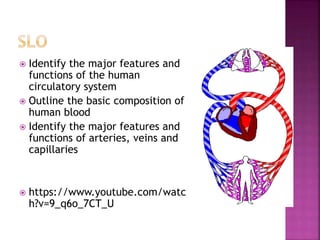
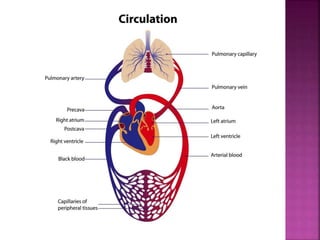
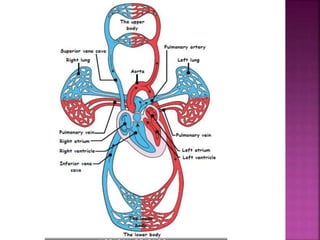
 Identify the major features and
functions of the human
circulatory system
 Outline the basic composition of
human blood
 Identify the major features and
functions of arteries, veins and
capillaries
 https://www.youtube.com/watc
h?v=9_q6o_7CT_U
09/02/2015
Transports nutrients, water, and oxygen
to your billions of body cells so they can
function
Carries away wastes such as carbon
dioxide that body cells produce.
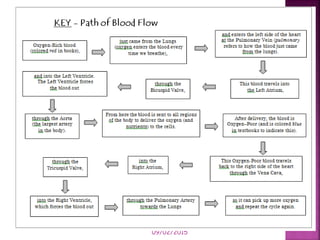
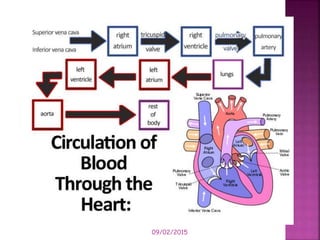
Parts of the Circulatory System
The Heart
The Blood
Blood Vessels – Arteries, veins,
capillaries
09/02/2015
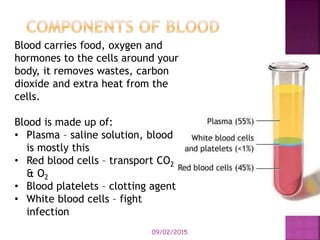
Blood carries food, oxygen and
hormones to the cells around your
body, it removes wastes, carbon
dioxide and extra heat from the
cells.
Blood is made up of:
• Plasma – saline solution, blood
is mostly this
• Red blood cells – transport CO2
& O2
• Blood platelets – clotting agent
• White blood cells – fight
infection
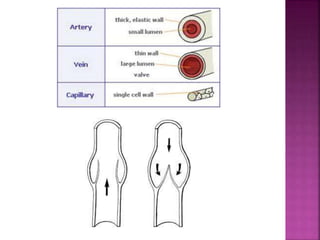
 There are three types of vessels in the human
body, and each have a special structure and
function
 Arteries take blood away from the heart, they are
thick walled to withstand the pressure of the
pumping blood
 Veins take blood back to the heart and have valves
to prevent the blood flowing backwards
 Capillaries are thin walled so that gases can diffuse
through to cells
09/02/2015
09/02/2015
09/02/2015
 Understand the basic process
of respiration
 Identify the major features of
the human respiratory system
 Describe the mechanics of
breathing
 Distinguish between
respiration and breathing
 https://www.youtube.com/w
atch?v=hc1YtXc_84A
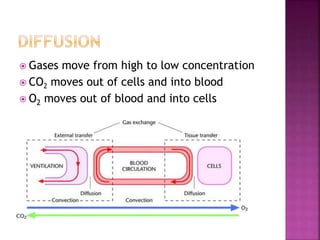
 Gases move from high to low concentration
 CO2 moves out of cells and into blood
 O2 moves out of blood and into cells
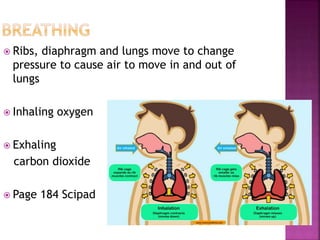
 Ribs, diaphragm and lungs move to change
pressure to cause air to move in and out of
lungs
 Inhaling oxygen
 Exhaling
carbon dioxide
 Page 184 Scipad
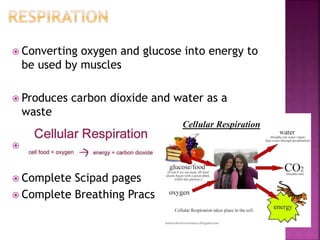
 Converting oxygen and glucose into energy to
be used by muscles
 Produces carbon dioxide and water as a
waste

 Complete Scipad pages
 Complete Breathing Pracs
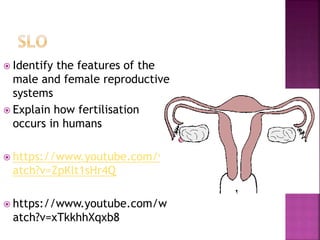
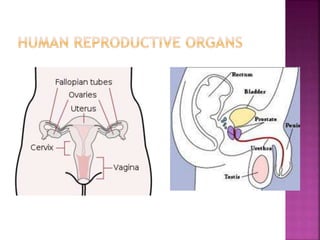
 Identify the features of the
male and female reproductive
systems
 Explain how fertilisation
occurs in humans
 https://www.youtube.com/w
atch?v=ZpKlt1sHr4Q
 https://www.youtube.com/w
atch?v=xTkkhhXqxb8
 Complete Scipad pages on the male and female
reproductive systems and fertilization
 http://www.mhhe.com/biosci/ap/maderap/grap
hics/mader04uhap/ch17/others/chap17labeling0
1.html
 http://www.mhhe.com/biosci/ap/maderap/grap
hics/mader04uhap/ch17/others/chap17labeling0
2.html
 http://interactivehuman.blogspot.co.nz/2008/0
5/reproductive-system-game.html
1. Scapula
2. Humerous
3. Ulna
4. Radius
5. Ribcage
6. Vertebrae
7. Pelvis
8. Femur
9. Oesophagus
10. Stomach
11. Duodenum
12. Liver
13. Gall bladder
14. ?
15. Pancreas
16. Small intestine
17. Appendix
18. Large intestine
19. Rectum
20. Anus
21. Kidney
22. Ureter
23. Bladder
24. Urethra
25. Vans deferens
26. Testes
27. Penis
28. Larynx
29. Trachea
30. Bronchus
31. Lung
32. Heart
33. Diaphragm
34. Clavicle
35. Sternum
36. ribs

Medical Science

  • 1.
  • 2.
     Complete thePin the Organ on the Student Activity  How well do you know your own body?  How many of the following bones, muscles and organs can you label?  Do you know what they do?  Complete the Prior Knowledge online Quiz for this topic
  • 3.
     Identify themajor bones of the skeleton and describe its function  Understand the concept of antagonistic muscles  Label major features of a synovial joint  Identify the major features and functions of the human circulatory system  Outline the basic composition of human blood  Identify the major features and functions of arteries, veins and capillaries  Label the features of the human heart.  Understand the basic process of respiration  Identify the major features of the human respiratory system  Describe the mechanics of breathing  Distinguish between respiration and breathing  Identify the features of the male and female reproductive systems  Explain how fertilisation occurs in humans
  • 4.
     Identify themajor bones of the skeleton and describe its function
  • 5.
    Why do weneed a skeleton? Protect organs Supports skin Makes red blood cells Used to create movement with muscles
  • 7.
     Build askeleton  Complete Scipad page ‘Human Skeleton’, Broken Bones, Bones Crossword, The Function of the Skeleton  https://play.kahoot.it/#/?quizId=69bfedeb- 8321-4861-a075- 31551b56c28a&user=ngibellini&token=3888d9 35-6c6c-456b-a1eb-6c979d632e41
  • 8.
     Label majorfeatures of a synovial joint  https://www.youtube.com/watch?v=7xW_Ao qaKpQ&list=PLAE20A31F931FDBB5
  • 11.
     Complete Scipadpages Joints, Arthritis  http://learningon.theloop.school.nz/moodle /mod/quiz/view.php?id=79095 – moodle homework quiz  Kahoots - https://play.kahoot.it/#/?quizId=69bfedeb- 8321-4861-a075- 31551b56c28a&user=ngibellini&token=3888d9 35-6c6c-456b-a1eb- 6c979d632e41&playId=81ed905c-fc60-4c1b- aa1e-035ffa1af943
  • 12.
     Understand theconcept of antagonistic muscles  https://www.youtube.com/watch?v=T- ozRNVhGVg&list=PLAE20A31F931FDBB5&inde x=4
  • 13.
     When amuscle contracts (shortens) it pulls on the tendon which pulls on the bone to cause movement.  Muscles work in pairs because they can only pull, not push (one pulls arm up, other pulls arm down)  Pairs of muscles work in the opposite direction – antagonistic pairs  Tendons connect muscle to bone  Ligaments link bones
  • 15.
  • 16.
     Many animalshave skeletal systems that are very similar to ours.  Our leg is very much like that of a chicken leg including: • femur (thigh bone) • knee (hinge joint) • fibula and tibia (smaller bones of the shin) • cartilage • ligaments  These are all part of our skeletal system. Beyond that, we also have similar muscle structure, tendons, fat, and skin. We will be exploring each of these similar characteristics.
  • 18.
    Tissue Colour StretchinessHardness Are Fibres Visible? Thickness (mm) Skin Muscle Tendon Ligament Cartilage
  • 19.
    Tissue Colour StretchinessHardness Are Fibres Visible? Thickness (mm) Skin white No Soft No 1mm Muscle Pink Yes Soft Yes 30mm Tendon White No Very hard No 2mm Ligament White/ grey No Soft No 2mm Cartilage White No Soft No 3mm
  • 27.
    Dissecting a ChickenLeg Check for Understanding Match the Vocabulary word to the correct definition: cartilage ligament tendon fat skin muscle blood vessel bone joint A). Fibers that contract and relax to effect body movement B). An elastic tube through which blood circulates. C). A tough, semi-rigid, calcified part of the skeleton D). connects two bones together. E). protective covering F). It covers the surface of joints, allowing bones to slide over one another, thus reducing friction and preventing damage. Keeps bones from touching one another. G). connects muscle to bone H). A point of connection between two movable parts I). is important in energy metabolism, heat insulation and cushioning. A yellow jelly-like substance. _____ _____ _____ _____ _____ _____ _____ _____ _____
  • 28.
  • 29.
     Identify themajor features and functions of the human circulatory system  Outline the basic composition of human blood  Identify the major features and functions of arteries, veins and capillaries  https://www.youtube.com/watc h?v=9_q6o_7CT_U
  • 31.
    09/02/2015 Transports nutrients, water,and oxygen to your billions of body cells so they can function Carries away wastes such as carbon dioxide that body cells produce. Parts of the Circulatory System The Heart The Blood Blood Vessels – Arteries, veins, capillaries
  • 32.
    09/02/2015 Blood carries food,oxygen and hormones to the cells around your body, it removes wastes, carbon dioxide and extra heat from the cells. Blood is made up of: • Plasma – saline solution, blood is mostly this • Red blood cells – transport CO2 & O2 • Blood platelets – clotting agent • White blood cells – fight infection
  • 33.
     There arethree types of vessels in the human body, and each have a special structure and function  Arteries take blood away from the heart, they are thick walled to withstand the pressure of the pumping blood  Veins take blood back to the heart and have valves to prevent the blood flowing backwards  Capillaries are thin walled so that gases can diffuse through to cells
  • 35.
  • 37.
  • 38.
  • 41.
     Understand thebasic process of respiration  Identify the major features of the human respiratory system  Describe the mechanics of breathing  Distinguish between respiration and breathing  https://www.youtube.com/w atch?v=hc1YtXc_84A
  • 42.
     Gases movefrom high to low concentration  CO2 moves out of cells and into blood  O2 moves out of blood and into cells
  • 43.
     Ribs, diaphragmand lungs move to change pressure to cause air to move in and out of lungs  Inhaling oxygen  Exhaling carbon dioxide  Page 184 Scipad
  • 44.
     Converting oxygenand glucose into energy to be used by muscles  Produces carbon dioxide and water as a waste   Complete Scipad pages  Complete Breathing Pracs
  • 45.
     Identify thefeatures of the male and female reproductive systems  Explain how fertilisation occurs in humans  https://www.youtube.com/w atch?v=ZpKlt1sHr4Q  https://www.youtube.com/w atch?v=xTkkhhXqxb8
  • 48.
     Complete Scipadpages on the male and female reproductive systems and fertilization  http://www.mhhe.com/biosci/ap/maderap/grap hics/mader04uhap/ch17/others/chap17labeling0 1.html  http://www.mhhe.com/biosci/ap/maderap/grap hics/mader04uhap/ch17/others/chap17labeling0 2.html  http://interactivehuman.blogspot.co.nz/2008/0 5/reproductive-system-game.html
  • 49.
    1. Scapula 2. Humerous 3.Ulna 4. Radius 5. Ribcage 6. Vertebrae 7. Pelvis 8. Femur 9. Oesophagus 10. Stomach 11. Duodenum 12. Liver 13. Gall bladder 14. ? 15. Pancreas 16. Small intestine 17. Appendix 18. Large intestine 19. Rectum 20. Anus 21. Kidney 22. Ureter 23. Bladder 24. Urethra 25. Vans deferens 26. Testes 27. Penis 28. Larynx 29. Trachea 30. Bronchus 31. Lung 32. Heart 33. Diaphragm 34. Clavicle 35. Sternum 36. ribs