Skeletal and Muscular Systems
Jasmine Peniel P. Combo
BSCS 4-3
SKELETAL SYSTEM
Types of Skeleton
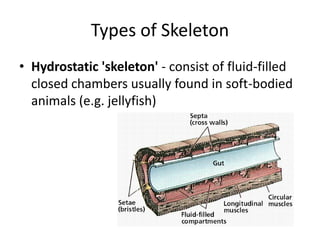
• Hydrostatic 'skeleton' - consist of fluid-filled
closed chambers usually found in soft-bodied
animals (e.g. jellyfish)
Types of Skeleton
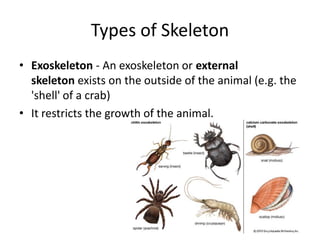
• Exoskeleton - An exoskeleton or external
skeleton exists on the outside of the animal (e.g. the
'shell' of a crab)
• It restricts the growth of the animal.
Types of Skeleton
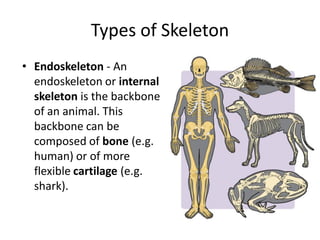
• Endoskeleton - An
endoskeleton or internal
skeleton is the backbone
of an animal. This
backbone can be
composed of bone (e.g.
human) or of more
flexible cartilage (e.g.
shark).
Human Skeleton
• The skeleton is the body part that forms the
supporting structure of an organism.
• It is the internal framework of the body.
• It is composed of 270 bones at birth – this
decreases to 206 bones by adulthood after
some bones have fused together.
• Teeth are considered part of the skeletal
system but they are not counted as bones.
Bones
• A bone is a substance that forms the skeleton of
the body. It is composed chiefly of calcium
phosphate and calcium carbonate.
• Bones must be strong enough to support body
weight and provide protection but light enough
to allow movement.
• Bones are formed by the ossification of cartilage.
All bones start off as cartilage (normally in the
womb) and they gradually turn to hard bone
(ossification) over a period of years.
• Calcium is needed for strong bone growth.
Bones
• The longest bone in the body is called the
femur, which connects the pelvis to the knee.
• The smallest bone in the body is in the middle
ear, and is called the stapes.
Bone Anatomy
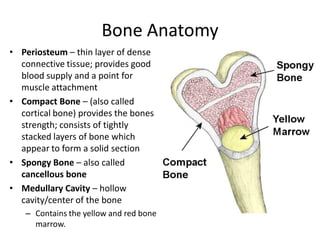
• Periosteum – thin layer of dense
connective tissue; provides good
blood supply and a point for
muscle attachment
• Compact Bone – (also called
cortical bone) provides the bones
strength; consists of tightly
stacked layers of bone which
appear to form a solid section
• Spongy Bone – also called
cancellous bone
• Medullary Cavity – hollow
cavity/center of the bone
– Contains the yellow and red bone
marrow.
Bone Anatomy
• Bone Marrow – jelly-like substance of two types
– Red Marrow which creates blood cells
– Yellow Marrow which stores minerals and some fat
• Compact bone constitutes up to 80% of the bones
weight, with spongy bone making up the additional
20%
The Axial & Appendicular Skeleton
Axial Skeleton
• Axial Skeleton is the central core of the human body
housing and protecting it’s vital organs
• composed of 80 bones
• consists of the vertebral column, the rib cage and the
skull.
Appendicular Section
• Appendicular Skeleton forms the extremities of the
arms and legs
• composed of 126 bones
• formed by the pectoral girdles, the upper limbs, the
pelvic girdle and the lower limbs
• functions are to make walking, running and other
movement possible and to protect the major organs
responsible for digestion, excretion and reproduction
SKELETAL SYSTEM PHYSIOLOGY
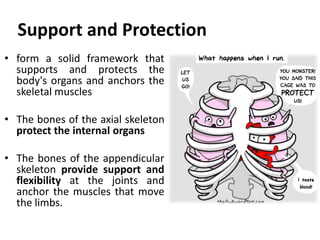
Support and Protection
• form a solid framework that
supports and protects the
body's organs and anchors the
skeletal muscles
• The bones of the axial skeleton
protect the internal organs
• The bones of the appendicular
skeleton provide support and
flexibility at the joints and
anchor the muscles that move
the limbs.
Movement
• Some bones are joined to each other by
flexible joints.
• Muscles are needed to move bones attached
by joints. Almost every skeletal muscle works
by pulling two or more bones either closer
together or further apart.
Hematopoiesis
• process of creating new blood cells in the
body
• red bone marrow produces red and white
blood cells; found inside the medullary cavity
• children tend to have more red bone marrow
than adults do
Storage
• The skeletal system stores many different types of
essential substances to facilitate growth and repair of the
body.
• The skeletal system’s cell matrix acts as our calcium bank
by storing and releasing calcium ions into the blood as
needed.
• Bone cells release osteocalcin, a hormone that helps
regulate blood sugar and fat deposition.
• The yellow bone marrow store energy in the form of
lipids.
• Red bone marrow stores some iron in the form of the
molecule ferritin to form hemoglobin in red blood cells.
Growth and Development
• Calcification – process where the osseous tissue
slowly replaces the cartilage and fibrous tissue
• At birth, the skeleton of a newborn has more than
300 bones; as a person ages, these bones grow
together and fuse into larger bones, leaving adults
with only 206 bones.
• Flat bones follow the process of intramembranous
ossification where the young bones grow from a
primary ossification center in fibrous membranes
and leave a small region of fibrous tissue in between
each other. (e.g. fontanels (soft spots) in skulls)
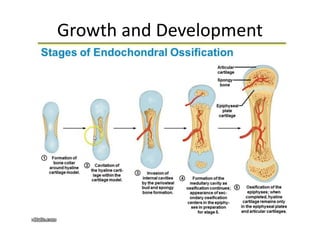
Growth and Development
• Long bones follow the process of endochondral
ossification
• A small band of hyaline cartilage remains in between
the bones as a growth plate.
• As we grow through childhood, the growth plates grow
under the influence of growth and sex hormones,
slowly separating the bones.
• At the end of puberty, the growth plate stops growing
and bones fuse permanently into a single bone.
• Endochondral ossification is mainly responsible for the
vast difference in height and limb length between birth
and adulthood
References
• http://www.bbc.co.uk/education/guides/zpkq7ty/revision/1
• https://www.qldscienceteachers.com/junior-
science/biology/skeletal-muscular-systems
• http://www.teachpe.com/anatomy/bone_structure.php
• https://www.livescience.com/22537-skeletal-system.html
• http://www.innerbody.com/image/skelfov.html
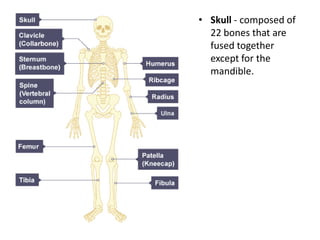
• Skull - composed of
22 bones that are
fused together
except for the
mandible.
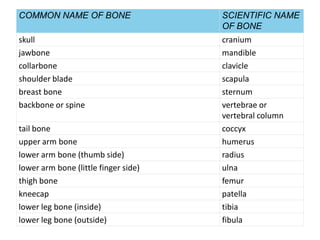
COMMON NAME OF BONE SCIENTIFIC NAME
OF BONE
skull cranium
jawbone mandible
collarbone clavicle
shoulder blade scapula
breast bone sternum
backbone or spine vertebrae or
vertebral column
tail bone coccyx
upper arm bone humerus
lower arm bone (thumb side) radius
lower arm bone (little finger side) ulna
thigh bone femur
kneecap patella
lower leg bone (inside) tibia
lower leg bone (outside) fibula

Skeletal System

  • 1.
    Skeletal and MuscularSystems Jasmine Peniel P. Combo BSCS 4-3
  • 2.
  • 3.
    Types of Skeleton •Hydrostatic 'skeleton' - consist of fluid-filled closed chambers usually found in soft-bodied animals (e.g. jellyfish)
  • 4.
    Types of Skeleton •Exoskeleton - An exoskeleton or external skeleton exists on the outside of the animal (e.g. the 'shell' of a crab) • It restricts the growth of the animal.
  • 5.
    Types of Skeleton •Endoskeleton - An endoskeleton or internal skeleton is the backbone of an animal. This backbone can be composed of bone (e.g. human) or of more flexible cartilage (e.g. shark).
  • 6.
    Human Skeleton • Theskeleton is the body part that forms the supporting structure of an organism. • It is the internal framework of the body. • It is composed of 270 bones at birth – this decreases to 206 bones by adulthood after some bones have fused together. • Teeth are considered part of the skeletal system but they are not counted as bones.
  • 7.
    Bones • A boneis a substance that forms the skeleton of the body. It is composed chiefly of calcium phosphate and calcium carbonate. • Bones must be strong enough to support body weight and provide protection but light enough to allow movement. • Bones are formed by the ossification of cartilage. All bones start off as cartilage (normally in the womb) and they gradually turn to hard bone (ossification) over a period of years. • Calcium is needed for strong bone growth.
  • 8.
    Bones • The longestbone in the body is called the femur, which connects the pelvis to the knee. • The smallest bone in the body is in the middle ear, and is called the stapes.
  • 9.
    Bone Anatomy • Periosteum– thin layer of dense connective tissue; provides good blood supply and a point for muscle attachment • Compact Bone – (also called cortical bone) provides the bones strength; consists of tightly stacked layers of bone which appear to form a solid section • Spongy Bone – also called cancellous bone • Medullary Cavity – hollow cavity/center of the bone – Contains the yellow and red bone marrow.
  • 10.
    Bone Anatomy • BoneMarrow – jelly-like substance of two types – Red Marrow which creates blood cells – Yellow Marrow which stores minerals and some fat • Compact bone constitutes up to 80% of the bones weight, with spongy bone making up the additional 20%
  • 11.
    The Axial &Appendicular Skeleton
  • 12.
    Axial Skeleton • AxialSkeleton is the central core of the human body housing and protecting it’s vital organs • composed of 80 bones • consists of the vertebral column, the rib cage and the skull.
  • 13.
    Appendicular Section • AppendicularSkeleton forms the extremities of the arms and legs • composed of 126 bones • formed by the pectoral girdles, the upper limbs, the pelvic girdle and the lower limbs • functions are to make walking, running and other movement possible and to protect the major organs responsible for digestion, excretion and reproduction
  • 14.
  • 15.
    Support and Protection •form a solid framework that supports and protects the body's organs and anchors the skeletal muscles • The bones of the axial skeleton protect the internal organs • The bones of the appendicular skeleton provide support and flexibility at the joints and anchor the muscles that move the limbs.
  • 16.
    Movement • Some bonesare joined to each other by flexible joints. • Muscles are needed to move bones attached by joints. Almost every skeletal muscle works by pulling two or more bones either closer together or further apart.
  • 17.
    Hematopoiesis • process ofcreating new blood cells in the body • red bone marrow produces red and white blood cells; found inside the medullary cavity • children tend to have more red bone marrow than adults do
  • 18.
    Storage • The skeletalsystem stores many different types of essential substances to facilitate growth and repair of the body. • The skeletal system’s cell matrix acts as our calcium bank by storing and releasing calcium ions into the blood as needed. • Bone cells release osteocalcin, a hormone that helps regulate blood sugar and fat deposition. • The yellow bone marrow store energy in the form of lipids. • Red bone marrow stores some iron in the form of the molecule ferritin to form hemoglobin in red blood cells.
  • 19.
    Growth and Development •Calcification – process where the osseous tissue slowly replaces the cartilage and fibrous tissue • At birth, the skeleton of a newborn has more than 300 bones; as a person ages, these bones grow together and fuse into larger bones, leaving adults with only 206 bones. • Flat bones follow the process of intramembranous ossification where the young bones grow from a primary ossification center in fibrous membranes and leave a small region of fibrous tissue in between each other. (e.g. fontanels (soft spots) in skulls)
  • 20.
  • 21.
    Growth and Development •Long bones follow the process of endochondral ossification • A small band of hyaline cartilage remains in between the bones as a growth plate. • As we grow through childhood, the growth plates grow under the influence of growth and sex hormones, slowly separating the bones. • At the end of puberty, the growth plate stops growing and bones fuse permanently into a single bone. • Endochondral ossification is mainly responsible for the vast difference in height and limb length between birth and adulthood
  • 22.
    References • http://www.bbc.co.uk/education/guides/zpkq7ty/revision/1 • https://www.qldscienceteachers.com/junior- science/biology/skeletal-muscular-systems •http://www.teachpe.com/anatomy/bone_structure.php • https://www.livescience.com/22537-skeletal-system.html • http://www.innerbody.com/image/skelfov.html
  • 23.
    • Skull -composed of 22 bones that are fused together except for the mandible.
  • 24.
    COMMON NAME OFBONE SCIENTIFIC NAME OF BONE skull cranium jawbone mandible collarbone clavicle shoulder blade scapula breast bone sternum backbone or spine vertebrae or vertebral column tail bone coccyx upper arm bone humerus lower arm bone (thumb side) radius lower arm bone (little finger side) ulna thigh bone femur kneecap patella lower leg bone (inside) tibia lower leg bone (outside) fibula