Medical Paper
Writing: Why the
Paper Structure is
Important?
The purpose of writing a medical research paper is not
only to tell the world about your research. It is to go
beyond the mere presentation of facts and thoughts. You
must reach out to the readers in a way that communicates
your research effectively and helps them understand the
issues at hand.
There’s no point in writing a research paper if the
readers can’t take away the most important message or
the message you want to convey through your medical
paper.
Medical Research Paper Writing
Why have Good Manuscript
Structures?
As the saying goes, “A badly written paper is equivalent
to not writing it at all”. The readers do not just read, but
also interpret from your paper.
Thus, to convey your information clearly to the readers,
it’s important that it’s structured well.
Otherwise, the readers won’t be able to understand
your point or may take away a wrong message.
Medical Paper Writing:
The Essential Elements
of its Structure
1) Introduction
(What are you studying and why)
This section to
let the readers
understand why
you undertook a
particular study.
DOs and
DON’Ts:
Use a simple and layman language which the readers
can understand.
There must be a logical reason for undertaking your
study. State this reason by providing a background of
the problem you aim to resolve through research. Cite
the studies to support your arguments.
Summarize the current knowledge on the topic, citing
appropriate studies.
Explain how your research will contribute to the
field or advance the current knowledge.
State the research question clearly.
Explain the theory behind your research study.
Don’t review all the published studies on the
topic. Only cite the relevant ones.
2) Methods
(What and how did you do)
This section describes the methods of
experiment you followed to arrive at your
conclusion. However, a well-conducted
research is always replicable. This means that
another researcher can reproduce the results
by following the methods described in
your medical paper.
DOs and
DON’Ts:Write full details of all the methods, techniques, instruments,
and the lab settings.
Give a diagram of the experimental setup.
Specify the questionnaire, survey, or other data collection
instruments
Cite the studies that support the validity and reliability of the
used methods and instruments.
Explain the analysis methods and why you chose them
Don’t exclude any important detail to just avoid writing a
lengthy description of methods.
3) Results
(What did you find)
It includes the
outcome of your
study. Start with the
most significant
findings first followed
by the less important
ones.
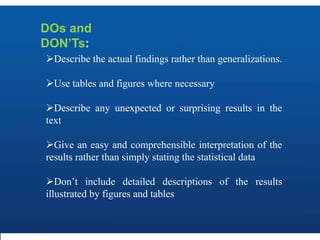
DOs and
DON’Ts:
Describe the actual findings rather than generalizations.
Use tables and figures where necessary
Describe any unexpected or surprising results in the
text
Give an easy and comprehensible interpretation of the
results rather than simply stating the statistical data
Don’t include detailed descriptions of the results
illustrated by figures and tables
4) Discussion
(Meaning of your findings)
A good discussion
describes each of the
findings with their
broader implications,
and how they can be
generalized to derive a
conclusion stated in
the introduction.
DOs and
DON’Ts:
State whether your hypothesis was supported
by any references
Explain what the results imply
Relate your findings to the previous studies in
the domain; whether your findings support or
contradict the previous studies
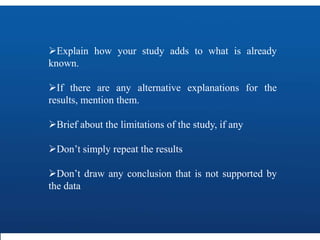
Explain how your study adds to what is already
known.
If there are any alternative explanations for the
results, mention them.
Brief about the limitations of the study, if any
Don’t simply repeat the results
Don’t draw any conclusion that is not supported by
the data
5) Conclusion
(What you learn from the
study)
Finally, state the main
conclusions of your
study. The readers
must be able to
understand what you
did, how you did, and
how you arrived at
your conclusion.
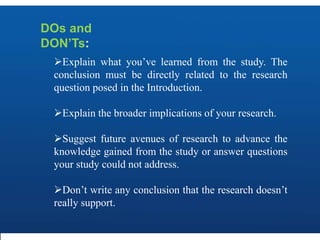
DOs and
DON’Ts:
Explain what you’ve learned from the study. The
conclusion must be directly related to the research
question posed in the Introduction.
Explain the broader implications of your research.
Suggest future avenues of research to advance the
knowledge gained from the study or answer questions
your study could not address.
Don’t write any conclusion that the research doesn’t
really support.
A good writer keeps his audience and
their variety in mind while writing his
paper.
He structures it so that the readers
know what to expect under different
sections of the medical manuscript.
Email ID: project@cognibrain.com
Phone: 044-49595223
Visit us:
https://www.cognibrain.com/

Medical Paper Writing

  • 1.
    Medical Paper Writing: Whythe Paper Structure is Important?
  • 2.
    The purpose ofwriting a medical research paper is not only to tell the world about your research. It is to go beyond the mere presentation of facts and thoughts. You must reach out to the readers in a way that communicates your research effectively and helps them understand the issues at hand. There’s no point in writing a research paper if the readers can’t take away the most important message or the message you want to convey through your medical paper. Medical Research Paper Writing
  • 3.
    Why have GoodManuscript Structures? As the saying goes, “A badly written paper is equivalent to not writing it at all”. The readers do not just read, but also interpret from your paper. Thus, to convey your information clearly to the readers, it’s important that it’s structured well. Otherwise, the readers won’t be able to understand your point or may take away a wrong message.
  • 4.
    Medical Paper Writing: TheEssential Elements of its Structure
  • 5.
    1) Introduction (What areyou studying and why) This section to let the readers understand why you undertook a particular study.
  • 6.
    DOs and DON’Ts: Use asimple and layman language which the readers can understand. There must be a logical reason for undertaking your study. State this reason by providing a background of the problem you aim to resolve through research. Cite the studies to support your arguments. Summarize the current knowledge on the topic, citing appropriate studies.
  • 7.
    Explain how yourresearch will contribute to the field or advance the current knowledge. State the research question clearly. Explain the theory behind your research study. Don’t review all the published studies on the topic. Only cite the relevant ones.
  • 8.
    2) Methods (What andhow did you do) This section describes the methods of experiment you followed to arrive at your conclusion. However, a well-conducted research is always replicable. This means that another researcher can reproduce the results by following the methods described in your medical paper.
  • 9.
    DOs and DON’Ts:Write fulldetails of all the methods, techniques, instruments, and the lab settings. Give a diagram of the experimental setup. Specify the questionnaire, survey, or other data collection instruments Cite the studies that support the validity and reliability of the used methods and instruments. Explain the analysis methods and why you chose them Don’t exclude any important detail to just avoid writing a lengthy description of methods.
  • 10.
    3) Results (What didyou find) It includes the outcome of your study. Start with the most significant findings first followed by the less important ones.
  • 11.
    DOs and DON’Ts: Describe theactual findings rather than generalizations. Use tables and figures where necessary Describe any unexpected or surprising results in the text Give an easy and comprehensible interpretation of the results rather than simply stating the statistical data Don’t include detailed descriptions of the results illustrated by figures and tables
  • 12.
    4) Discussion (Meaning ofyour findings) A good discussion describes each of the findings with their broader implications, and how they can be generalized to derive a conclusion stated in the introduction.
  • 13.
    DOs and DON’Ts: State whetheryour hypothesis was supported by any references Explain what the results imply Relate your findings to the previous studies in the domain; whether your findings support or contradict the previous studies
  • 14.
    Explain how yourstudy adds to what is already known. If there are any alternative explanations for the results, mention them. Brief about the limitations of the study, if any Don’t simply repeat the results Don’t draw any conclusion that is not supported by the data
  • 15.
    5) Conclusion (What youlearn from the study) Finally, state the main conclusions of your study. The readers must be able to understand what you did, how you did, and how you arrived at your conclusion.
  • 16.
    DOs and DON’Ts: Explain whatyou’ve learned from the study. The conclusion must be directly related to the research question posed in the Introduction. Explain the broader implications of your research. Suggest future avenues of research to advance the knowledge gained from the study or answer questions your study could not address. Don’t write any conclusion that the research doesn’t really support.
  • 17.
    A good writerkeeps his audience and their variety in mind while writing his paper. He structures it so that the readers know what to expect under different sections of the medical manuscript.
  • 19.
    Email ID: project@cognibrain.com Phone:044-49595223 Visit us: https://www.cognibrain.com/