HOW TO WRITE A MANUSCRIPT
Promising presentation - Rana Abdullah Tahan
PHD researcher
https://orcid.org/0000-0002-1093-7740
Types of Scientific Research Articles
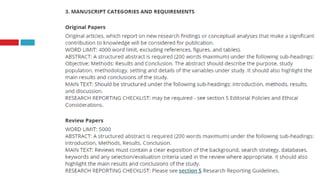
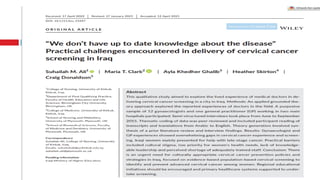
Original research, also known as primary or empirical studies . which report on new
research findings that make a significant contribution to knowledge will be considered for
publication.
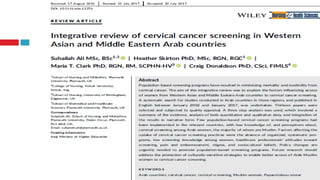
Review Papers Two types
1.Simple review (literature)
2. Systematic review
Case Description Papers Common in areas such as medicine. Authors describe a
number of clinical cases and the followed approaches
• Manuscripts are to be typed double-spaced.
• The length of the manuscript depend on the journal guidance
(should not exceed 3000 words )
Simple format for structuring
research articles
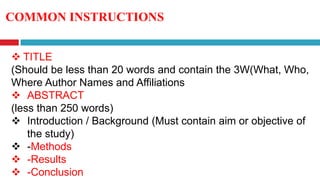
COMMON INSTRUCTIONS
 TITLE
(Should be less than 20 words and contain the 3W(What, Who,
Where Author Names and Affiliations
 ABSTRACT
(less than 250 words)
 Introduction / Background (Must contain aim or objective of
the study)
 -Methods
 -Results
 -Conclusion
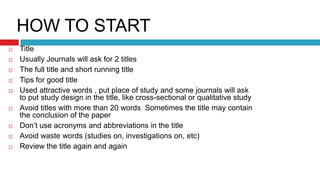
HOW TO START
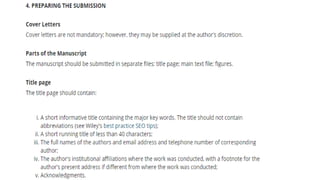
 Title
 Usually Journals will ask for 2 titles
 The full title and short running title
 Tips for good title
 Used attractive words , put place of study and some journals will ask
to put study design in the title, like cross-sectional or qualitative study
 Avoid titles with more than 20 words Sometimes the title may contain
the conclusion of the paper
 Don’t use acronyms and abbreviations in the title
 Avoid waste words (studies on, investigations on, etc)
 Review the title again and again
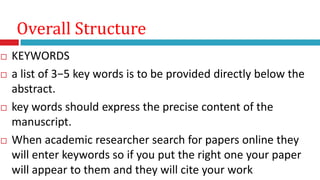
Overall Structure
 KEYWORDS
 a list of 3−5 key words is to be provided directly below the
abstract.
 key words should express the precise content of the
manuscript.
 When academic researcher search for papers online they
will enter keywords so if you put the right one your paper
will appear to them and they will cite your work
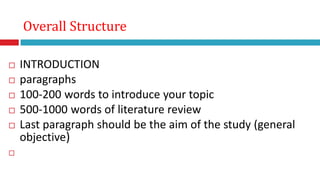
 INTRODUCTION
 paragraphs
 100-200 words to introduce your topic
 500-1000 words of literature review
 Last paragraph should be the aim of the study (general
objective)

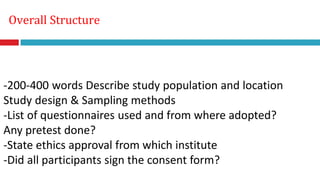
Overall Structure
Overall Structure
-200-400 words Describe study population and location
Study design & Sampling methods
-List of questionnaires used and from where adopted?
Any pretest done?
-State ethics approval from which institute
-Did all participants sign the consent form?
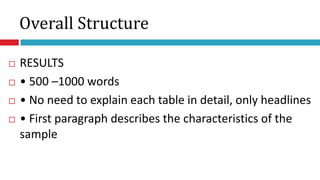
Overall Structure
 RESULTS
 • 500 –1000 words
 • No need to explain each table in detail, only headlines
 • First paragraph describes the characteristics of the
sample
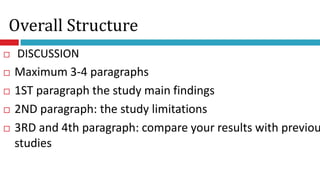
Overall Structure
 DISCUSSION
 Maximum 3-4 paragraphs
 1ST paragraph the study main findings
 2ND paragraph: the study limitations
 3RD and 4th paragraph: compare your results with previou
studies
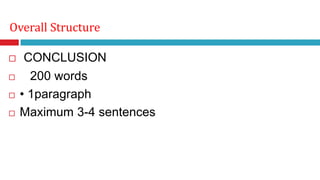
 CONCLUSION
 200 words
 • 1paragraph
 Maximum 3-4 sentences
Overall Structure
ACKNOWLEDGMENT
 1 or 2 sentences
 Conflict of interest Authors need to declare if they have
any competing of interest
REFERENCES
 Depend on each journal style
 REFERENCES
TABLES
 Maximum of 4-5 tables
 -Title of each table must be self-explanatory
 -Include p value where possible
ABSTRACT
 Not an introduction to the paper
 • It is a brief summary of each of the main IMRAD sections of the paper
 Avoid the classical “In this paper” starting
 • Avoid bibliographical references in the abstract
 • Avoid acronyms. If they must be used, their definition should be repeated in
the main text
 • In general, write the abstract in one paragraph
 • Tense: past or present tense may be used
TIPS TO WRITE GOOD ABSTARCT
 1. Write the abstract after you finish writing your paper
 2. Choose main points from your introduction and conclusion
 3. Pick out key points from the methods section
 4. Pick out the major findings from results section
 5. Add a sentence or two as a conclusion
 6. Now write a paragraph of all points chosen in steps 1 to 5
 7. Don’t add any new information or undefined abbreviations
 8. Link your sentences so that the information flows clearly
 9. Check if points presented in your paper and abstract are consistent
 10. Check if your abstract meet journal format
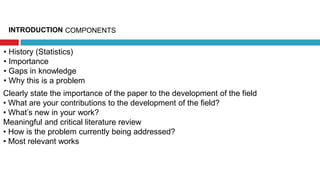
INTRODUCTION
• History (Statistics)
• Importance
• Gaps in knowledge
• Why this is a problem
COMPONENTS
Clearly state the importance of the paper to the development of the field
• What are your contributions to the development of the field?
• What’s new in your work?
Meaningful and critical literature review
• How is the problem currently being addressed?
• Most relevant works
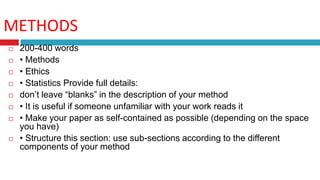
METHODS
 200-400 words
 • Methods
 • Ethics
 • Statistics Provide full details:
 don’t leave “blanks” in the description of your method
 • It is useful if someone unfamiliar with your work reads it
 • Make your paper as self-contained as possible (depending on the space
you have)
 • Structure this section: use sub-sections according to the different
components of your method
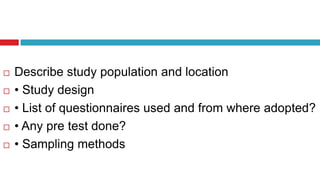
 Describe study population and location
 • Study design
 • List of questionnaires used and from where adopted?
 • Any pre test done?
 • Sampling methods
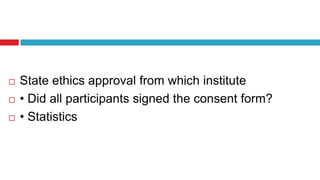
 State ethics approval from which institute
 • Did all participants signed the consent form?
 • Statistics
RESULTS
 NO NEED TO EXPLIN EACH TABLE IN DETAILS ONLY
HEADLINES
 500-1000 WORDS
 • First paragraph describe the characteristics of the sample
 • Response rate
DISCUSSION
 MAXIMUM 3-4 PARAGRAPHS
 • 500-1000 words
 • 1ST paragraph the study main findings
 • 2ND paragraph: the study limitations
 • 3RD and 4th paragraph: compare your results with
previous studies
 Evaluate the data and discuss their implications
 • Focus on the key findings
 • Justify any assumptions you make (not already
discussed in full in the methods/results sections)
 • The narrative should refer back to the introduction
 • Consider and discuss alternative explanations
 • Mention any limitations
 How does your work fit in with previous work?
 • Agreement with other studies
 •Contradictions/surprises —why?
 • What do contradictions / surprises tell us?
 • What does your
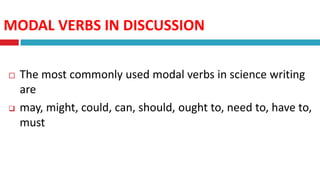
MODAL VERBS IN DISCUSSION
 The most commonly used modal verbs in science writing
are
 may, might, could, can, should, ought to, need to, have to,
must
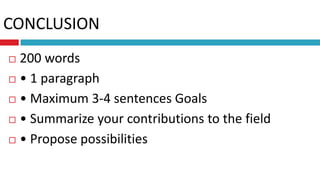
CONCLUSION
 200 words
 • 1 paragraph
 • Maximum 3-4 sentences Goals
 • Summarize your contributions to the field
 • Propose possibilities
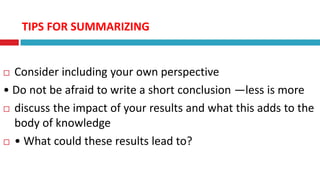
TIPS FOR SUMMARIZING
 Consider including your own perspective
• Do not be afraid to write a short conclusion —less is more
 discuss the impact of your results and what this adds to the
body of knowledge
 • What could these results lead to?
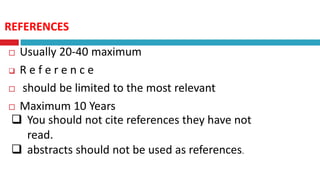
REFERENCES
 Usually 20-40 maximum
 R e f e r e n c e
 should be limited to the most relevant
 Maximum 10 Years
 You should not cite references they have not
read.
 abstracts should not be used as references.
Thank you

How to write a manuscript

  • 1.
    HOW TO WRITEA MANUSCRIPT Promising presentation - Rana Abdullah Tahan PHD researcher https://orcid.org/0000-0002-1093-7740
  • 2.
    Types of ScientificResearch Articles Original research, also known as primary or empirical studies . which report on new research findings that make a significant contribution to knowledge will be considered for publication. Review Papers Two types 1.Simple review (literature) 2. Systematic review Case Description Papers Common in areas such as medicine. Authors describe a number of clinical cases and the followed approaches
  • 3.
    • Manuscripts areto be typed double-spaced. • The length of the manuscript depend on the journal guidance (should not exceed 3000 words )
  • 8.
    Simple format forstructuring research articles
  • 10.
    COMMON INSTRUCTIONS  TITLE (Shouldbe less than 20 words and contain the 3W(What, Who, Where Author Names and Affiliations  ABSTRACT (less than 250 words)  Introduction / Background (Must contain aim or objective of the study)  -Methods  -Results  -Conclusion
  • 11.
    HOW TO START Title  Usually Journals will ask for 2 titles  The full title and short running title  Tips for good title  Used attractive words , put place of study and some journals will ask to put study design in the title, like cross-sectional or qualitative study  Avoid titles with more than 20 words Sometimes the title may contain the conclusion of the paper  Don’t use acronyms and abbreviations in the title  Avoid waste words (studies on, investigations on, etc)  Review the title again and again
  • 12.
    Overall Structure  KEYWORDS a list of 3−5 key words is to be provided directly below the abstract.  key words should express the precise content of the manuscript.  When academic researcher search for papers online they will enter keywords so if you put the right one your paper will appear to them and they will cite your work
  • 13.
     INTRODUCTION  paragraphs 100-200 words to introduce your topic  500-1000 words of literature review  Last paragraph should be the aim of the study (general objective)  Overall Structure
  • 14.
    Overall Structure -200-400 wordsDescribe study population and location Study design & Sampling methods -List of questionnaires used and from where adopted? Any pretest done? -State ethics approval from which institute -Did all participants sign the consent form?
  • 15.
    Overall Structure  RESULTS • 500 –1000 words  • No need to explain each table in detail, only headlines  • First paragraph describes the characteristics of the sample
  • 16.
    Overall Structure  DISCUSSION Maximum 3-4 paragraphs  1ST paragraph the study main findings  2ND paragraph: the study limitations  3RD and 4th paragraph: compare your results with previou studies
  • 17.
     CONCLUSION  200words  • 1paragraph  Maximum 3-4 sentences Overall Structure
  • 18.
    ACKNOWLEDGMENT  1 or2 sentences  Conflict of interest Authors need to declare if they have any competing of interest
  • 19.
    REFERENCES  Depend oneach journal style  REFERENCES
  • 20.
    TABLES  Maximum of4-5 tables  -Title of each table must be self-explanatory  -Include p value where possible
  • 21.
    ABSTRACT  Not anintroduction to the paper  • It is a brief summary of each of the main IMRAD sections of the paper  Avoid the classical “In this paper” starting  • Avoid bibliographical references in the abstract  • Avoid acronyms. If they must be used, their definition should be repeated in the main text  • In general, write the abstract in one paragraph  • Tense: past or present tense may be used
  • 22.
    TIPS TO WRITEGOOD ABSTARCT  1. Write the abstract after you finish writing your paper  2. Choose main points from your introduction and conclusion  3. Pick out key points from the methods section  4. Pick out the major findings from results section  5. Add a sentence or two as a conclusion  6. Now write a paragraph of all points chosen in steps 1 to 5  7. Don’t add any new information or undefined abbreviations  8. Link your sentences so that the information flows clearly  9. Check if points presented in your paper and abstract are consistent  10. Check if your abstract meet journal format
  • 23.
    INTRODUCTION • History (Statistics) •Importance • Gaps in knowledge • Why this is a problem COMPONENTS Clearly state the importance of the paper to the development of the field • What are your contributions to the development of the field? • What’s new in your work? Meaningful and critical literature review • How is the problem currently being addressed? • Most relevant works
  • 24.
    METHODS  200-400 words • Methods  • Ethics  • Statistics Provide full details:  don’t leave “blanks” in the description of your method  • It is useful if someone unfamiliar with your work reads it  • Make your paper as self-contained as possible (depending on the space you have)  • Structure this section: use sub-sections according to the different components of your method
  • 25.
     Describe studypopulation and location  • Study design  • List of questionnaires used and from where adopted?  • Any pre test done?  • Sampling methods
  • 26.
     State ethicsapproval from which institute  • Did all participants signed the consent form?  • Statistics
  • 27.
    RESULTS  NO NEEDTO EXPLIN EACH TABLE IN DETAILS ONLY HEADLINES  500-1000 WORDS  • First paragraph describe the characteristics of the sample  • Response rate
  • 28.
    DISCUSSION  MAXIMUM 3-4PARAGRAPHS  • 500-1000 words  • 1ST paragraph the study main findings  • 2ND paragraph: the study limitations  • 3RD and 4th paragraph: compare your results with previous studies
  • 29.
     Evaluate thedata and discuss their implications  • Focus on the key findings  • Justify any assumptions you make (not already discussed in full in the methods/results sections)  • The narrative should refer back to the introduction  • Consider and discuss alternative explanations  • Mention any limitations
  • 30.
     How doesyour work fit in with previous work?  • Agreement with other studies  •Contradictions/surprises —why?  • What do contradictions / surprises tell us?  • What does your
  • 31.
    MODAL VERBS INDISCUSSION  The most commonly used modal verbs in science writing are  may, might, could, can, should, ought to, need to, have to, must
  • 32.
    CONCLUSION  200 words • 1 paragraph  • Maximum 3-4 sentences Goals  • Summarize your contributions to the field  • Propose possibilities
  • 33.
    TIPS FOR SUMMARIZING Consider including your own perspective • Do not be afraid to write a short conclusion —less is more  discuss the impact of your results and what this adds to the body of knowledge  • What could these results lead to?
  • 34.
    REFERENCES  Usually 20-40maximum  R e f e r e n c e  should be limited to the most relevant  Maximum 10 Years  You should not cite references they have not read.  abstracts should not be used as references.
  • 35.