Annotated Bibliography
      Summarizing and Evaluating Your Sources


                           Richelle O’Neil, Prosper ISD
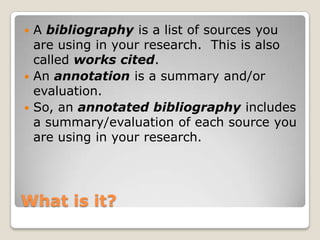
 A bibliography is a list of sources you
  are using in your research. This is also
  called works cited.
 An annotation is a summary and/or
  evaluation.
 So, an annotated bibliography includes
  a summary/evaluation of each source you
  are using in your research.


What is it?
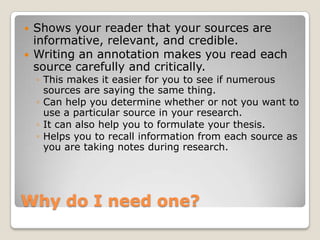
   Shows your reader that your sources are
    informative, relevant, and credible.
   Writing an annotation makes you read each
    source carefully and critically.
    ◦ This makes it easier for you to see if numerous
      sources are saying the same thing.
    ◦ Can help you determine whether or not you want to
      use a particular source in your research.
    ◦ It can also help you to formulate your thesis.
    ◦ Helps you to recall information from each source as
      you are taking notes during research.


Why do I need one?
1. Start with an MLA-formatted citation.
2. Add your annotation underneath the
   citation.
 ◦   1 paragraph
 ◦   No more than 150 words


How do I write one?
   Summarize the source
    ◦ 2-4 sentences
    ◦ If someone asked what this article/book is
      about, what would you say?
    ◦ What are the main arguments?
    ◦ What is the point of this book or article?
    ◦ What topics are covered?


What’s included in the annotation?
   Evaluate the source
    ◦   1-2 sentences
    ◦   Is the information reliable?
    ◦   Is this source biased or objective?
    ◦   What is the goal of this source?


What’s included in the annotation?
   Use the third person
    ◦ Do not use I, me, or my
   Use the literary present tense
    ◦ Examples:
      “This article discusses…”
      “This book gives a detailed view on…”
      “In this article, the author supports…”
      “This article describes…”


What should my annotation sound
like?
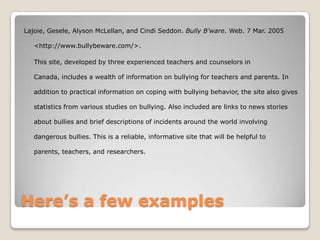
Lajoie, Gesele, Alyson McLellan, and Cindi Seddon. Bully B’ware. Web. 7 Mar. 2005

   <http://www.bullybeware.com/>.

   This site, developed by three experienced teachers and counselors in

   Canada, includes a wealth of information on bullying for teachers and parents. In

   addition to practical information on coping with bullying behavior, the site also gives

   statistics from various studies on bullying. Also included are links to news stories

   about bullies and brief descriptions of incidents around the world involving

   dangerous bullies. This is a reliable, informative site that will be helpful to

   parents, teachers, and researchers.


Here’s a few examples
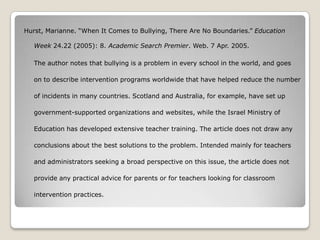
Hurst, Marianne. “When It Comes to Bullying, There Are No Boundaries.” Education

   Week 24.22 (2005): 8. Academic Search Premier. Web. 7 Apr. 2005.

   The author notes that bullying is a problem in every school in the world, and goes

   on to describe intervention programs worldwide that have helped reduce the number

   of incidents in many countries. Scotland and Australia, for example, have set up

   government-supported organizations and websites, while the Israel Ministry of

   Education has developed extensive teacher training. The article does not draw any

   conclusions about the best solutions to the problem. Intended mainly for teachers

   and administrators seeking a broad perspective on this issue, the article does not

   provide any practical advice for parents or for teachers looking for classroom

   intervention practices.
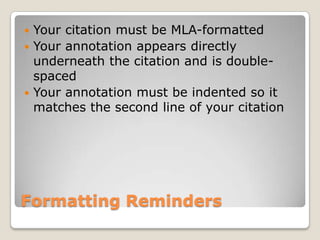
 Your citation must be MLA-formatted
 Your annotation appears directly
  underneath the citation and is double-
  spaced
 Your annotation must be indented so it
  matches the second line of your citation


Formatting Reminders
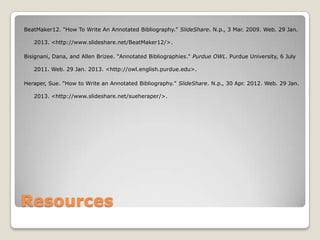
BeatMaker12. "How To Write An Annotated Bibliography." SlideShare. N.p., 3 Mar. 2009. Web. 29 Jan.

   2013. <http://www.slideshare.net/BeatMaker12/>.

Bisignani, Dana, and Allen Brizee. "Annotated Bibliographies." Purdue OWL. Purdue University, 6 July

   2011. Web. 29 Jan. 2013. <http://owl.english.purdue.edu>.

Heraper, Sue. "How to Write an Annotated Bibliography." SlideShare. N.p., 30 Apr. 2012. Web. 29 Jan.

   2013. <http://www.slideshare.net/sueheraper/>.


Resources

Annotated Bibliography

  • 1.
    Annotated Bibliography Summarizing and Evaluating Your Sources Richelle O’Neil, Prosper ISD
  • 2.
     A bibliographyis a list of sources you are using in your research. This is also called works cited.  An annotation is a summary and/or evaluation.  So, an annotated bibliography includes a summary/evaluation of each source you are using in your research. What is it?
  • 3.
    Shows your reader that your sources are informative, relevant, and credible.  Writing an annotation makes you read each source carefully and critically. ◦ This makes it easier for you to see if numerous sources are saying the same thing. ◦ Can help you determine whether or not you want to use a particular source in your research. ◦ It can also help you to formulate your thesis. ◦ Helps you to recall information from each source as you are taking notes during research. Why do I need one?
  • 4.
    1. Start withan MLA-formatted citation. 2. Add your annotation underneath the citation. ◦ 1 paragraph ◦ No more than 150 words How do I write one?
  • 5.
    Summarize the source ◦ 2-4 sentences ◦ If someone asked what this article/book is about, what would you say? ◦ What are the main arguments? ◦ What is the point of this book or article? ◦ What topics are covered? What’s included in the annotation?
  • 6.
    Evaluate the source ◦ 1-2 sentences ◦ Is the information reliable? ◦ Is this source biased or objective? ◦ What is the goal of this source? What’s included in the annotation?
  • 7.
    Use the third person ◦ Do not use I, me, or my  Use the literary present tense ◦ Examples:  “This article discusses…”  “This book gives a detailed view on…”  “In this article, the author supports…”  “This article describes…” What should my annotation sound like?
  • 8.
    Lajoie, Gesele, AlysonMcLellan, and Cindi Seddon. Bully B’ware. Web. 7 Mar. 2005 <http://www.bullybeware.com/>. This site, developed by three experienced teachers and counselors in Canada, includes a wealth of information on bullying for teachers and parents. In addition to practical information on coping with bullying behavior, the site also gives statistics from various studies on bullying. Also included are links to news stories about bullies and brief descriptions of incidents around the world involving dangerous bullies. This is a reliable, informative site that will be helpful to parents, teachers, and researchers. Here’s a few examples
  • 9.
    Hurst, Marianne. “WhenIt Comes to Bullying, There Are No Boundaries.” Education Week 24.22 (2005): 8. Academic Search Premier. Web. 7 Apr. 2005. The author notes that bullying is a problem in every school in the world, and goes on to describe intervention programs worldwide that have helped reduce the number of incidents in many countries. Scotland and Australia, for example, have set up government-supported organizations and websites, while the Israel Ministry of Education has developed extensive teacher training. The article does not draw any conclusions about the best solutions to the problem. Intended mainly for teachers and administrators seeking a broad perspective on this issue, the article does not provide any practical advice for parents or for teachers looking for classroom intervention practices.
  • 10.
     Your citationmust be MLA-formatted  Your annotation appears directly underneath the citation and is double- spaced  Your annotation must be indented so it matches the second line of your citation Formatting Reminders
  • 11.
    BeatMaker12. "How ToWrite An Annotated Bibliography." SlideShare. N.p., 3 Mar. 2009. Web. 29 Jan. 2013. <http://www.slideshare.net/BeatMaker12/>. Bisignani, Dana, and Allen Brizee. "Annotated Bibliographies." Purdue OWL. Purdue University, 6 July 2011. Web. 29 Jan. 2013. <http://owl.english.purdue.edu>. Heraper, Sue. "How to Write an Annotated Bibliography." SlideShare. N.p., 30 Apr. 2012. Web. 29 Jan. 2013. <http://www.slideshare.net/sueheraper/>. Resources