MD:JABIUR RAHAMAN
DAFFODIL INTERNATIONAL UNIVERSITY
DEPT. OF PHARMACY
Medical Food
Medical Foods
• A medical food is a specially formulated food
that meets the nutritional requirements of a
specific disease.
• FDA: Distinguishes from the broader category
of foods for special dietary use and from foods
that make health claims by the requirement
that medical foods be intended to meet
distinctive nutritional requirements of a disease
or condition, used under medical supervision
and intended for the specific dietary
management of a disease or condition.
History of medical foods
Medical foods were first developed in the
1950s, originally designed for those with
genetic diseases that could not handle certain
nutrients. The American Food and Drug
Administration (FDA) originally regulated
medical foods as drugs, because they were
intended to affect the structure or function of
the body. One of the first medical foods was
Lofenalac, an infant formula produced by
Mean Johnson Nutrition in 1957.
What regulations apply to medical
foods?
• Medical foods are regulated, as are other
foods, under the provisions of the Federal
Food, Drug, and Cosmetic Act (the Act) and
the Fair Packaging and Labeling Act.
• Under the Act, the manufacturer or
distributor is responsible for ensuring that
the food is not adulterated or misbranded.
• Ingredients used in medical foods must be
approved.
What labeling requirements apply to
medical foods?
• Medical foods must contain the following
mandatory label information: a statement of
identity (the common or usual name of the
product).
• an accurate statement of the net quantity of
contents.
• the name and place of business of the
manufacturer, packer, or distributor.
• the complete list of ingredients, listed by their
common or usual name, and in descending
order of predominance by weight.
Do medical foods have to be
approved or registered with FDA?
• Medical foods do not undergo premarket
review or approval by FDA
• Individual medical food products do not
have to be registered with FDA; however,
food facilities must be registered
Examples of medical foods
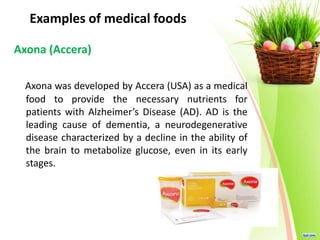
Axona (Accera)
Axona was developed by Accera (USA) as a medical
food to provide the necessary nutrients for
patients with Alzheimer’s Disease (AD). AD is the
leading cause of dementia, a neurodegenerative
disease characterized by a decline in the ability of
the brain to metabolize glucose, even in its early
stages.
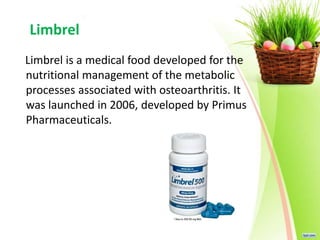
Limbrel
Limbrel is a medical food developed for the
nutritional management of the metabolic
processes associated with osteoarthritis. It
was launched in 2006, developed by Primus
Pharmaceuticals.
Deplin
Deplin was developed as an adjunctive
therapy to antidepressant drugs in
treating depression, by Pamlab Inc.
Lofenalac
Lofenalac was one of the first medical foods
developed in the late 1950s by Mead Johnson
Nutrition. It was designed for the dietary
management of pehylketonuria (PKU), a genetic
defect in the metabolism of phenylalanine
hydroxylase enzyme which converts the amino
acid phenylalanine (Phe) to tyrosine.
The Medical Foods Market
 Nutricia: specialise in the delivery of advanced
medical nutrition to all age groups, and are the
largest specialist nutrition company in Europe.
 Nestle: is the largest food and beverage
company in the world, with products sold in more
than 130 countries. Nestle aims to become the
world’s leader in nutrition, health and wellness.
 Targeted Medical Pharma: are a small
company, founded in 1999, that develop
prescription medical foods for the treatment of
chronic disease, such as pain syndromes.
 Pamlab :are now owned by Nestle
Health Science, they are a biomedical
company.
 Abbott Laboratories: are diversified
healthcare company, based in the United
States. They have four core business
focuses which include medical
diagnostics, medical devices, nutrition,
and pharmaceuticals.
Medical foods

Medical foods

  • 1.
    MD:JABIUR RAHAMAN DAFFODIL INTERNATIONALUNIVERSITY DEPT. OF PHARMACY Medical Food
  • 2.
    Medical Foods • Amedical food is a specially formulated food that meets the nutritional requirements of a specific disease. • FDA: Distinguishes from the broader category of foods for special dietary use and from foods that make health claims by the requirement that medical foods be intended to meet distinctive nutritional requirements of a disease or condition, used under medical supervision and intended for the specific dietary management of a disease or condition.
  • 3.
    History of medicalfoods Medical foods were first developed in the 1950s, originally designed for those with genetic diseases that could not handle certain nutrients. The American Food and Drug Administration (FDA) originally regulated medical foods as drugs, because they were intended to affect the structure or function of the body. One of the first medical foods was Lofenalac, an infant formula produced by Mean Johnson Nutrition in 1957.
  • 4.
    What regulations applyto medical foods? • Medical foods are regulated, as are other foods, under the provisions of the Federal Food, Drug, and Cosmetic Act (the Act) and the Fair Packaging and Labeling Act. • Under the Act, the manufacturer or distributor is responsible for ensuring that the food is not adulterated or misbranded. • Ingredients used in medical foods must be approved.
  • 5.
    What labeling requirementsapply to medical foods? • Medical foods must contain the following mandatory label information: a statement of identity (the common or usual name of the product). • an accurate statement of the net quantity of contents. • the name and place of business of the manufacturer, packer, or distributor. • the complete list of ingredients, listed by their common or usual name, and in descending order of predominance by weight.
  • 6.
    Do medical foodshave to be approved or registered with FDA? • Medical foods do not undergo premarket review or approval by FDA • Individual medical food products do not have to be registered with FDA; however, food facilities must be registered
  • 7.
    Examples of medicalfoods Axona (Accera) Axona was developed by Accera (USA) as a medical food to provide the necessary nutrients for patients with Alzheimer’s Disease (AD). AD is the leading cause of dementia, a neurodegenerative disease characterized by a decline in the ability of the brain to metabolize glucose, even in its early stages.
  • 8.
    Limbrel Limbrel is amedical food developed for the nutritional management of the metabolic processes associated with osteoarthritis. It was launched in 2006, developed by Primus Pharmaceuticals.
  • 9.
    Deplin Deplin was developedas an adjunctive therapy to antidepressant drugs in treating depression, by Pamlab Inc.
  • 10.
    Lofenalac Lofenalac was oneof the first medical foods developed in the late 1950s by Mead Johnson Nutrition. It was designed for the dietary management of pehylketonuria (PKU), a genetic defect in the metabolism of phenylalanine hydroxylase enzyme which converts the amino acid phenylalanine (Phe) to tyrosine.
  • 11.
    The Medical FoodsMarket  Nutricia: specialise in the delivery of advanced medical nutrition to all age groups, and are the largest specialist nutrition company in Europe.  Nestle: is the largest food and beverage company in the world, with products sold in more than 130 countries. Nestle aims to become the world’s leader in nutrition, health and wellness.  Targeted Medical Pharma: are a small company, founded in 1999, that develop prescription medical foods for the treatment of chronic disease, such as pain syndromes.
  • 12.
     Pamlab :arenow owned by Nestle Health Science, they are a biomedical company.  Abbott Laboratories: are diversified healthcare company, based in the United States. They have four core business focuses which include medical diagnostics, medical devices, nutrition, and pharmaceuticals.