Punjab Pure Food Rules on Foodstuffs
Presented to: Wahab Nazir
Presented by
Muhammad Imtiaz
Mishal Rashid
Ayesha Mehmood
Lahmia Azhar
1
Road map
 Food law
 The pure food ordinance 1960
 Punjab pure food rules
 Punjab food authority
 Food Safety Standers
 Foodstuffs Intended for Particular Nutritional Uses
 Two Content Layout with SmartArt
 Dietetic Foods Intended for Special Medical Purposes
2
Food Law
There are four laws that specifically deal with food safety. Three of these
laws directly focus issues related to food safety, while the fourth, the
Pakistan Standards and Quality Control Authority Act, is indirectly
relevant to food safety
Aims
 Food imports and exports
 Safety information
Labelling
3
The Pure Food Ordinance 1960
The Punjab Pure Food Ordinance was passed in order to codify and
improve the Punjab province's laws governing food manufacture and
sales
All provinces and some northern areas have adopted this law
Its aim to ensure purity of food being supplied to people in the market
and provides for preventing adultration
4
CONTI……
 The Ordinance is composed of 5 Parts and 38 Sections, In
accordance with Sections 4 through 10,
 It is illegal to mix and sell mixed foods, sell, prepare, manufacture,
import, or export unwholesome foods, sell or produce for sale food
that has been tampered with or mislabeled, etc.
5
Punjab Food Authority
Punjab Food Authority has been established under the "Punjab Food
Authority Act 2011" to ensure availability of safe and wholesome food
for human consumption
The basic purpose is to lay out standards for food articles and to
regulate their manufacturing, storage, distribution, sale and import
6
Current Status
 Pakistan’s food imports are regulated by the federal government
Food safety standards are regulated by the provincial governments
Pakistan’s 18th constitutional amendment devolved most of the
functions including agriculture to the provinces
7
Definition
In this Act– (a) “adulterated food” means the food–
(i) which is not of the nature, substance or quality which it purports or is represented to
be; or
(ii) which contains any such extraneous substance as may adversely affect the nature,
substance or quality of the food; or
(iii) which is processed, mixed, colored, powdered or coated with any other substance
in contravention of the rules or the regulations; or
(iv) any constituent of which has been wholly or in part abstracted so as to affect
injuriously its nature, substance or quality; or
(v) which contains any poisonous or other ingredient that may render it injurious to
human health
8
Food Safety Standers
 In the Pakistan Pure Food Laws (PFL) of 1963 and revised in 2007. Pakistan
Pure Food Laws ,2011. The PFL is the basis for the existing trade-related food
quality and safety legislative framework. It covers 104 food items falling under
nine broad categories:
 Milk and milk products
 Edible oils and fat products
 Beverages and food grains and cereals
 Starchy food
 Spices and condiments and sweetening agents
 Fruits and vegetables
9
Foodstuffs Intended for Particular Nutritional
Uses
Follow-up Formula
 “Follow-up-Formula” exclusively means a food intended for use, on medical ground
(s), as
 A liquid part of diet which has been provided to be suitable for the young children
from the
 Age of more than twelve (12) months up to age of three years, and is a food
prepared from
 The milk of cows or other halal animals and/or other edible constituents of animal
and /or plant origin*
10
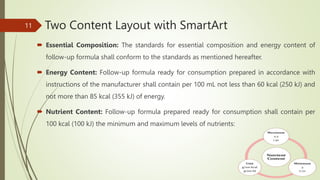
Two Content Layout with SmartArt
 Essential Composition: The standards for essential composition and energy content of
follow-up formula shall conform to the standards as mentioned hereafter.
 Energy Content: Follow-up formula ready for consumption prepared in accordance with
instructions of the manufacturer shall contain per 100 mL not less than 60 kcal (250 kJ) and
not more than 85 kcal (355 kJ) of energy.
 Nutrient Content: Follow-up formula prepared ready for consumption shall contain per
100 kcal (100 kJ) the minimum and maximum levels of nutrients:
11
Continue
 The calculation of the protein content of the final product prepared ready
for consumption should be based on N x 6.25.
 Nutritional quality equivalent to that of casein or a greater quantity of
other protein in inverse proportion to its nutritional quality.
 The quality of the protein shall not be less than 85% of that of casein.
 The total quantity of protein shall not be more than 5.5 g per 100
available calories (or 1.3 g per 100 available kilojoules).
12
Dietetic Foods Intended for Special Medical Purposes
 Are a category of foods for special dietary uses which are specially processed or
formulated and presented for the dietary management of patients and may be
used only under medical supervision.
 They are intended for the exclusive or partial feeding of patients with limited or
impaired capacity to take, digest, absorb or metabolize ordinary foodstuffs or
certain nutrients contained therein, or who have other special medically-
determined nutrient requirements, whose dietary management cannot be
achieved only by modification of the normal diet, by other foods for special
dietary uses, or by a combination of the two.
13
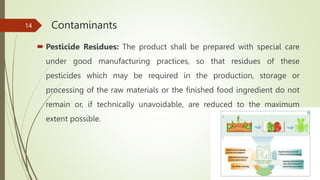
Contaminants
 Pesticide Residues: The product shall be prepared with special care
under good manufacturing practices, so that residues of these
pesticides which may be required in the production, storage or
processing of the raw materials or the finished food ingredient do not
remain or, if technically unavoidable, are reduced to the maximum
extent possible.
14
Contaminants
 Other Contaminants: The product shall be free from residues of hormones,
antibiotics as determined by means of agreed methods of analysis and practically
free from other contaminants, especially pharmacologically active substances.
 Hygiene: It is recommended that the products covered by the provision soft his
standard be prepared and handled in accordance with the appropriate sections of
the recommended international code of practice-general principle of hygiene
(CAC/RCP 11969), recommended International Codex of Hygienic Practice for
foods for infants and children (CAC/RCP 21-1979) and other relevant codex texts
such as codes of hygienic practice and codes of practice
15
Contaminants
 Packaging: The product shall be packed in containers which will safe guard the
hygienic and other qualities of the food.
 Labeling: The requirements of the Codex general standard for the labeling of
pre packaged foods (Codex standard 1-1985), the Codex guidelines on
nutrition labeling (CAC/GL 2- 1985) and the guidelines for use of nutrition and
health claims (CAC/ GL 23-1997) apply to his standard.
16
17
Thank you

Punjab pure food rules

  • 1.
    Punjab Pure FoodRules on Foodstuffs Presented to: Wahab Nazir Presented by Muhammad Imtiaz Mishal Rashid Ayesha Mehmood Lahmia Azhar 1
  • 2.
    Road map  Foodlaw  The pure food ordinance 1960  Punjab pure food rules  Punjab food authority  Food Safety Standers  Foodstuffs Intended for Particular Nutritional Uses  Two Content Layout with SmartArt  Dietetic Foods Intended for Special Medical Purposes 2
  • 3.
    Food Law There arefour laws that specifically deal with food safety. Three of these laws directly focus issues related to food safety, while the fourth, the Pakistan Standards and Quality Control Authority Act, is indirectly relevant to food safety Aims  Food imports and exports  Safety information Labelling 3
  • 4.
    The Pure FoodOrdinance 1960 The Punjab Pure Food Ordinance was passed in order to codify and improve the Punjab province's laws governing food manufacture and sales All provinces and some northern areas have adopted this law Its aim to ensure purity of food being supplied to people in the market and provides for preventing adultration 4
  • 5.
    CONTI……  The Ordinanceis composed of 5 Parts and 38 Sections, In accordance with Sections 4 through 10,  It is illegal to mix and sell mixed foods, sell, prepare, manufacture, import, or export unwholesome foods, sell or produce for sale food that has been tampered with or mislabeled, etc. 5
  • 6.
    Punjab Food Authority PunjabFood Authority has been established under the "Punjab Food Authority Act 2011" to ensure availability of safe and wholesome food for human consumption The basic purpose is to lay out standards for food articles and to regulate their manufacturing, storage, distribution, sale and import 6
  • 7.
    Current Status  Pakistan’sfood imports are regulated by the federal government Food safety standards are regulated by the provincial governments Pakistan’s 18th constitutional amendment devolved most of the functions including agriculture to the provinces 7
  • 8.
    Definition In this Act–(a) “adulterated food” means the food– (i) which is not of the nature, substance or quality which it purports or is represented to be; or (ii) which contains any such extraneous substance as may adversely affect the nature, substance or quality of the food; or (iii) which is processed, mixed, colored, powdered or coated with any other substance in contravention of the rules or the regulations; or (iv) any constituent of which has been wholly or in part abstracted so as to affect injuriously its nature, substance or quality; or (v) which contains any poisonous or other ingredient that may render it injurious to human health 8
  • 9.
    Food Safety Standers In the Pakistan Pure Food Laws (PFL) of 1963 and revised in 2007. Pakistan Pure Food Laws ,2011. The PFL is the basis for the existing trade-related food quality and safety legislative framework. It covers 104 food items falling under nine broad categories:  Milk and milk products  Edible oils and fat products  Beverages and food grains and cereals  Starchy food  Spices and condiments and sweetening agents  Fruits and vegetables 9
  • 10.
    Foodstuffs Intended forParticular Nutritional Uses Follow-up Formula  “Follow-up-Formula” exclusively means a food intended for use, on medical ground (s), as  A liquid part of diet which has been provided to be suitable for the young children from the  Age of more than twelve (12) months up to age of three years, and is a food prepared from  The milk of cows or other halal animals and/or other edible constituents of animal and /or plant origin* 10
  • 11.
    Two Content Layoutwith SmartArt  Essential Composition: The standards for essential composition and energy content of follow-up formula shall conform to the standards as mentioned hereafter.  Energy Content: Follow-up formula ready for consumption prepared in accordance with instructions of the manufacturer shall contain per 100 mL not less than 60 kcal (250 kJ) and not more than 85 kcal (355 kJ) of energy.  Nutrient Content: Follow-up formula prepared ready for consumption shall contain per 100 kcal (100 kJ) the minimum and maximum levels of nutrients: 11
  • 12.
    Continue  The calculationof the protein content of the final product prepared ready for consumption should be based on N x 6.25.  Nutritional quality equivalent to that of casein or a greater quantity of other protein in inverse proportion to its nutritional quality.  The quality of the protein shall not be less than 85% of that of casein.  The total quantity of protein shall not be more than 5.5 g per 100 available calories (or 1.3 g per 100 available kilojoules). 12
  • 13.
    Dietetic Foods Intendedfor Special Medical Purposes  Are a category of foods for special dietary uses which are specially processed or formulated and presented for the dietary management of patients and may be used only under medical supervision.  They are intended for the exclusive or partial feeding of patients with limited or impaired capacity to take, digest, absorb or metabolize ordinary foodstuffs or certain nutrients contained therein, or who have other special medically- determined nutrient requirements, whose dietary management cannot be achieved only by modification of the normal diet, by other foods for special dietary uses, or by a combination of the two. 13
  • 14.
    Contaminants  Pesticide Residues:The product shall be prepared with special care under good manufacturing practices, so that residues of these pesticides which may be required in the production, storage or processing of the raw materials or the finished food ingredient do not remain or, if technically unavoidable, are reduced to the maximum extent possible. 14
  • 15.
    Contaminants  Other Contaminants:The product shall be free from residues of hormones, antibiotics as determined by means of agreed methods of analysis and practically free from other contaminants, especially pharmacologically active substances.  Hygiene: It is recommended that the products covered by the provision soft his standard be prepared and handled in accordance with the appropriate sections of the recommended international code of practice-general principle of hygiene (CAC/RCP 11969), recommended International Codex of Hygienic Practice for foods for infants and children (CAC/RCP 21-1979) and other relevant codex texts such as codes of hygienic practice and codes of practice 15
  • 16.
    Contaminants  Packaging: Theproduct shall be packed in containers which will safe guard the hygienic and other qualities of the food.  Labeling: The requirements of the Codex general standard for the labeling of pre packaged foods (Codex standard 1-1985), the Codex guidelines on nutrition labeling (CAC/GL 2- 1985) and the guidelines for use of nutrition and health claims (CAC/ GL 23-1997) apply to his standard. 16
  • 17.