BANARAS HINDU UNIVERSITY
FACULTY OF AGRICULTURE
DEPARTMENT OF DAIRY SCIENCE AND FOODTECHNOLOGY
Topic : labelling issues in refrence of national and
international perspectives and scenario
PAVAN H M
1st yr M.Sc Food technology
• FAO works in partnership with WHO to advise the Codex
Alimentarius Commission on technical and policy matters
related to food labelling
• The Codex Committee on Food Labelling (CCFL) is the Codex
subsidiary body responsible for setting standards and
guidelines on labelling that is applicable to all foods and the
Codex General Standard for Labelling of Prepackaged Foods
(CXS 1-1985) is the key Codex instrument for delivering
information about food to the consumer.
• The Codex standard is used by countries as guidance for
harmonization and has also been used as the basis for new
food labelling policies
Need of food labelling
• Food label is a mediator for food content and consumer need
• It describes all the requirements for consumers about their
product
• It gives information from nutrition content to quantity that
should be served per serving
• Explain all the measures that should be taken before use and
after use
• It is main character for tracking the misuse and food fraud
• Label covers the all the regulations and requirements for food
label covered under FSSAI
• Food labels in Europe are governed by the Food
Information to Consumer (FIC) regulation 1169/2011.
• There are 12 mandatory pieces of information that
must be present on all European Union (EU) food
labels: product name, list of ingredients, allergens,
quantitative ingredient declaration, net quantity,
durability dates, storage, instructions for use,
business name and address, country of origin,
nutritional declaration, and alcoholic strength.
• The mandatory information must be presented in a
minimum font size.
Food Labeling and Claims
Food labeling is regulated by three different Federal agencies. The FDA
regulates all foods except meat and poultry products and cracked egg
products, which are regulated by the Food Safety and Inspection
Service (FSIS) of the Department of Agriculture. Alcoholic beverages
are regulated by the Alcohol and Tobacco Tax and Trade Bureau (TTB)
of the Department of the Treasury.
Labels for meat and poultry products and inspected eggs must have
FSIS approval before they can be marketed. Likewise, alcoholic
beverage labels must have TTB approval. FSIS has established ‘generic
label approval’ by which it allows limited changes to the label without
active review by the agency.
• In contrast, the FDA does not review product labels
before marketing, but takes enforcement action
against noncompliant products already in commerce.
• This allows the manufacturer more flexibility in
interpreting FDA policy, but places all the
responsibility for correct interpretation on the
manufacturer.
• FDA's ‘Food Labeling Guide’ provides comprehensive
guidance for food labeling
Food Labeling and Claims
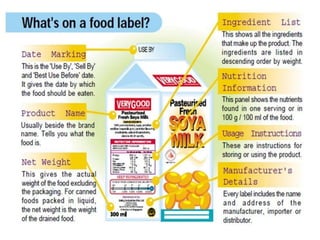
Mandatory Labeling Elements
Food labels must contain five primary elements (unless
subject to limited exemptions)
•
• statement of identity (name of the food)
•
• net quantity of contents
•
• nutrition facts
•
• ingredient statement (including allergen declaration)
•
• name and address of responsible firm
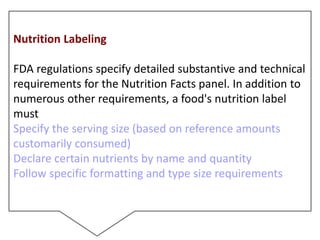
Nutrition Labeling
FDA regulations specify detailed substantive and technical
requirements for the Nutrition Facts panel. In addition to
numerous other requirements, a food's nutrition label
must
Specify the serving size (based on reference amounts
customarily consumed)
Declare certain nutrients by name and quantity
Follow specific formatting and type size requirements
• Nutrient Content Claims
•
• A nutrient content claim describes the level of a
nutrient using terms such as ‘free,’ ‘high,’ and ‘low’
or compares the level of a nutrient in a food to that
of another food, using terms such as ‘more,’
‘reduced,’ and ‘lite.
• Nutrient content claims cannot be made unless they
are authorized by the FDA.
• They can be expressed or implied, and generally,
there must be an established daily value for the
nutrient that is the subject of the claim.
• Additional label statements are required for nutrient
content claims on certain foods
• Health Claims
•
• A health claim describes the relationship between a
substance (food or food component) and a disease
or health-related condition.
• Health claims are limited to statements about
reducing disease risk and cannot be claims about the
cure, mitigation, treatment, or prevention of disease.
• Qualified Health Claims
•
• For claims for which there is no significant scientific
agreement that the claim is supported, if the FDA
agrees that the scientific evidence supports a qualified
health claim, the agency will provide claim language for
which it will exercise enforcement discretion.
• The claim language is tailored to convey the level and
quality of the science supporting the claim accurately
Medical Foods
A ‘medical food’ is a food that is “formulated to be
consumed or administered under supervision of a
physician and which is intended for the specific dietary
management of a disease or condition for which
distinctive nutritional requirements are established by
medical evaluation.”
The FDA has issued guidance on medical foods
• Infant Formula
•
• Unlike other foods, new infant formulas are subject to
premarket review by the FDA. They must meet the
labeling requirements for other foods, except Nutrition
Facts.
• There are specific nutrient content requirements for
infant formula and separate requirements for nutrition
labeling.
• Infant formula labels must have additional information,
including directions for preparation and use both in
words and as pictograms, as well as ‘use by’ dates.
Food labelling ppt.pptx

Food labelling ppt.pptx

  • 1.
    BANARAS HINDU UNIVERSITY FACULTYOF AGRICULTURE DEPARTMENT OF DAIRY SCIENCE AND FOODTECHNOLOGY Topic : labelling issues in refrence of national and international perspectives and scenario PAVAN H M 1st yr M.Sc Food technology
  • 3.
    • FAO worksin partnership with WHO to advise the Codex Alimentarius Commission on technical and policy matters related to food labelling • The Codex Committee on Food Labelling (CCFL) is the Codex subsidiary body responsible for setting standards and guidelines on labelling that is applicable to all foods and the Codex General Standard for Labelling of Prepackaged Foods (CXS 1-1985) is the key Codex instrument for delivering information about food to the consumer. • The Codex standard is used by countries as guidance for harmonization and has also been used as the basis for new food labelling policies
  • 4.
    Need of foodlabelling • Food label is a mediator for food content and consumer need • It describes all the requirements for consumers about their product • It gives information from nutrition content to quantity that should be served per serving • Explain all the measures that should be taken before use and after use • It is main character for tracking the misuse and food fraud • Label covers the all the regulations and requirements for food label covered under FSSAI
  • 5.
    • Food labelsin Europe are governed by the Food Information to Consumer (FIC) regulation 1169/2011. • There are 12 mandatory pieces of information that must be present on all European Union (EU) food labels: product name, list of ingredients, allergens, quantitative ingredient declaration, net quantity, durability dates, storage, instructions for use, business name and address, country of origin, nutritional declaration, and alcoholic strength. • The mandatory information must be presented in a minimum font size.
  • 6.
    Food Labeling andClaims Food labeling is regulated by three different Federal agencies. The FDA regulates all foods except meat and poultry products and cracked egg products, which are regulated by the Food Safety and Inspection Service (FSIS) of the Department of Agriculture. Alcoholic beverages are regulated by the Alcohol and Tobacco Tax and Trade Bureau (TTB) of the Department of the Treasury. Labels for meat and poultry products and inspected eggs must have FSIS approval before they can be marketed. Likewise, alcoholic beverage labels must have TTB approval. FSIS has established ‘generic label approval’ by which it allows limited changes to the label without active review by the agency.
  • 7.
    • In contrast,the FDA does not review product labels before marketing, but takes enforcement action against noncompliant products already in commerce. • This allows the manufacturer more flexibility in interpreting FDA policy, but places all the responsibility for correct interpretation on the manufacturer. • FDA's ‘Food Labeling Guide’ provides comprehensive guidance for food labeling Food Labeling and Claims
  • 8.
    Mandatory Labeling Elements Foodlabels must contain five primary elements (unless subject to limited exemptions) • • statement of identity (name of the food) • • net quantity of contents • • nutrition facts • • ingredient statement (including allergen declaration) • • name and address of responsible firm
  • 9.
    Nutrition Labeling FDA regulationsspecify detailed substantive and technical requirements for the Nutrition Facts panel. In addition to numerous other requirements, a food's nutrition label must Specify the serving size (based on reference amounts customarily consumed) Declare certain nutrients by name and quantity Follow specific formatting and type size requirements
  • 11.
    • Nutrient ContentClaims • • A nutrient content claim describes the level of a nutrient using terms such as ‘free,’ ‘high,’ and ‘low’ or compares the level of a nutrient in a food to that of another food, using terms such as ‘more,’ ‘reduced,’ and ‘lite. • Nutrient content claims cannot be made unless they are authorized by the FDA. • They can be expressed or implied, and generally, there must be an established daily value for the nutrient that is the subject of the claim. • Additional label statements are required for nutrient content claims on certain foods
  • 12.
    • Health Claims • •A health claim describes the relationship between a substance (food or food component) and a disease or health-related condition. • Health claims are limited to statements about reducing disease risk and cannot be claims about the cure, mitigation, treatment, or prevention of disease.
  • 13.
    • Qualified HealthClaims • • For claims for which there is no significant scientific agreement that the claim is supported, if the FDA agrees that the scientific evidence supports a qualified health claim, the agency will provide claim language for which it will exercise enforcement discretion. • The claim language is tailored to convey the level and quality of the science supporting the claim accurately
  • 14.
    Medical Foods A ‘medicalfood’ is a food that is “formulated to be consumed or administered under supervision of a physician and which is intended for the specific dietary management of a disease or condition for which distinctive nutritional requirements are established by medical evaluation.” The FDA has issued guidance on medical foods
  • 15.
    • Infant Formula • •Unlike other foods, new infant formulas are subject to premarket review by the FDA. They must meet the labeling requirements for other foods, except Nutrition Facts. • There are specific nutrient content requirements for infant formula and separate requirements for nutrition labeling. • Infant formula labels must have additional information, including directions for preparation and use both in words and as pictograms, as well as ‘use by’ dates.