Background on U.S. Food Safety System
FOR INTERNATIONAL COURSES
2
2 2
U.S. Federal Regulatory Agencies With
Food Oversight
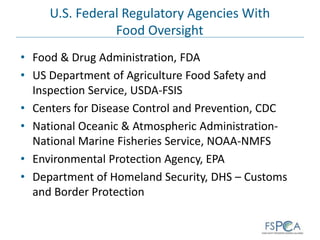
• Food & Drug Administration, FDA
• US Department of Agriculture Food Safety and
Inspection Service, USDA-FSIS
• Centers for Disease Control and Prevention, CDC
• National Oceanic & Atmospheric Administration-
National Marine Fisheries Service, NOAA-NMFS
• Environmental Protection Agency, EPA
• Department of Homeland Security, DHS – Customs
and Border Protection
U.S. Federal Regulatory Agencies With
Food Oversight
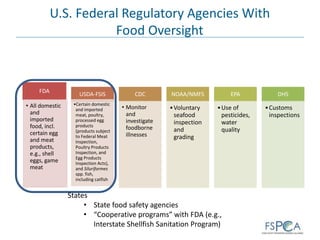
FDA
• All domestic
and
imported
food, incl.
certain egg
and meat
products,
e.g., shell
eggs, game
meat
USDA-FSIS
•Certain domestic
and imported
meat, poultry,
processed egg
products
(products subject
to Federal Meat
Inspection,
Poultry Products
Inspection, and
Egg Products
Inspection Acts),
and Siluriformes
spp. fish,
including catfish
CDC
• Monitor
and
investigate
foodborne
illnesses
NOAA/NMFS
•Voluntary
seafood
inspection
and
grading
EPA
•Use of
pesticides,
water
quality
DHS
•Customs
inspections
States
• State food safety agencies
• “Cooperative programs” with FDA (e.g.,
Interstate Shellfish Sanitation Program)
Food Safety in the U.S.
• Two main federal food safety regulatory agencies –
USDA and FDA.
• Why does it matter?
 Statutory authority
o Continuous inspection (USDA) vs. periodic inspection (FDA)
o On-farm authority (FDA)
 State and local governments work closely with FDA and
USDA regarding regulatory oversight
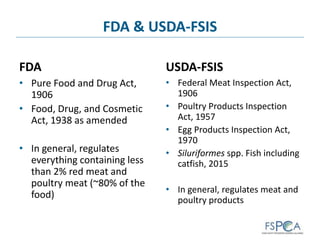
FDA & USDA-FSIS
FDA
• Pure Food and Drug Act,
1906
• Food, Drug, and Cosmetic
Act, 1938 as amended
• In general, regulates
everything containing less
than 2% red meat and
poultry meat (~80% of the
food)
USDA-FSIS
• Federal Meat Inspection Act,
1906
• Poultry Products Inspection
Act, 1957
• Egg Products Inspection Act,
1970
• Siluriformes spp. Fish including
catfish, 2015
• In general, regulates meat and
poultry products
8
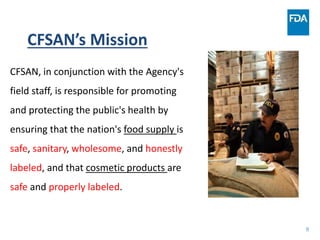
CFSAN, in conjunction with the Agency's
field staff, is responsible for promoting
and protecting the public's health by
ensuring that the nation's food supply is
safe, sanitary, wholesome, and honestly
labeled, and that cosmetic products are
safe and properly labeled.
CFSAN’s Mission
9
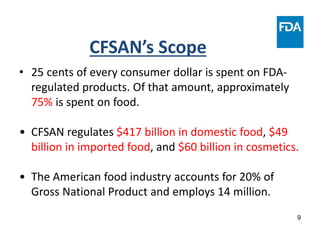
CFSAN’s Scope
• 25 cents of every consumer dollar is spent on FDA-
regulated products. Of that amount, approximately
75% is spent on food.
• CFSAN regulates $417 billion in domestic food, $49
billion in imported food, and $60 billion in cosmetics.
• The American food industry accounts for 20% of
Gross National Product and employs 14 million.
10
Major CFSAN Programs
• Office of Food Safety (OFS)
– Seafood Science
– Dairy, Egg and Meat Safety
– Produce Safety
– Food Processing Science
– Plant Products and Beverages
– Retail Food Protection (FDA Food Code)
11
Major CFSAN Programs
• Office of Nutrition and Food Labeling (ONFL)
– Infant Formula
– Allergen
– Nutrition
– Medical Foods
– Labeling
12
Major CFSAN Programs
• Office of Cosmetics and Colors (OCAC)
– Color Certification Program
– Cosmetics
• Office of Food Additive and Safety (OFAS)
– Bio-Engineered Plants
– Generally Recognized as Safe (GRAS) Program
– Food Additives (Ingredients)
Office of Regulatory Affairs (ORA)
The U.S. Food and Drug Administration’s Office of
Regulatory Affairs (ORA) is the lead office for all agency
field activities.
– ORA inspects regulated products and manufacturers
– Conducts sample analyses of regulated products and reviews
imported products offered for entry into the United States.
In pursuit of its mission, ORA also works with its state,
local, tribal, territorial and foreign counterparts
14
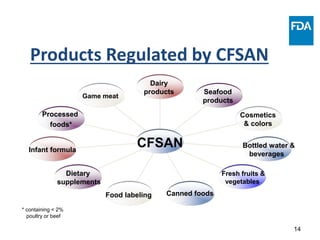
Products Regulated by CFSAN
Game meat
Processed
foods*
Infant formula
Dietary
supplements
Food labeling Canned foods
Fresh fruits &
vegetables
Bottled water &
beverages
Cosmetics
& colors
Seafood
products
Dairy
products
CFSAN
* containing < 2%
poultry or beef
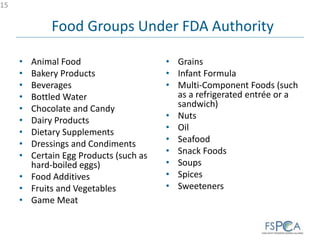
• Animal Food
• Bakery Products
• Beverages
• Bottled Water
• Chocolate and Candy
• Dairy Products
• Dietary Supplements
• Dressings and Condiments
• Certain Egg Products (such as
hard-boiled eggs)
• Food Additives
• Fruits and Vegetables
• Game Meat
• Grains
• Infant Formula
• Multi-Component Foods (such
as a refrigerated entrée or a
sandwich)
• Nuts
• Oil
• Seafood
• Snack Foods
• Soups
• Spices
• Sweeteners
15
Food Groups Under FDA Authority
Adulteration and Misbranding
Laws against adulteration and misbranding ensure that
consumers get what they pay for and that their food is safe
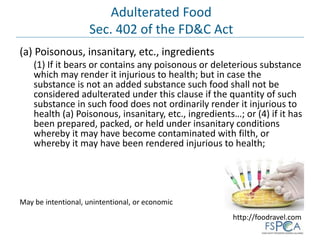
Adulterated Food
Sec. 402 of the FD&C Act
(a) Poisonous, insanitary, etc., ingredients
(1) If it bears or contains any poisonous or deleterious substance
which may render it injurious to health; but in case the
substance is not an added substance such food shall not be
considered adulterated under this clause if the quantity of such
substance in such food does not ordinarily render it injurious to
health (a) Poisonous, insanitary, etc., ingredients…; or (4) if it has
been prepared, packed, or held under insanitary conditions
whereby it may have become contaminated with filth, or
whereby it may have been rendered injurious to health;
May be intentional, unintentional, or economic
http://foodravel.com
Misbranded Food
Section 403(w) of the FD&C Act
Misbranded food is any food that:
1) its labeling or advertising is false or misleading;
2) is offered for sale under the name of another food;
3) is an imitation of another food but the label does not
bear the word “imitation”;
4) its container is made or filled to be misleading; or
5) its label does not provide
i) the name and place of the manufacturer, and
ii) an accurate statement of the quantity of the
contents in terms of weight, measure, or numerical
count
o e.g. undeclared allergens
Statutory Authority
• The Federal Food and Drugs Act of 1906
• The Federal Meat Inspection Act of 1906
• The Federal Import Milk Act (1927)
• The Federal Food, Drug, and Cosmetic Act of 1938, as
amended (FD&C Act)
• The Public Health Service Act (1944)
• The Poultry Products Inspection Act of 1957
• The Fair Packaging and Labeling Act (1966)
• The Infant Formula Act of 1980, as amended
Statutory Authority (continued)
• The Nutrition Labeling and Education Act of 1990
• The Dietary Supplement Health and Education Act of
1994
• The Bioterrorism Act of 2002
 FDA Food Facility Registration under sec. 415 of the FD&C
Act
• The Reportable Food Registry under sec. 415 of the
FD&C Act 417
• Food Allergen Labeling and Consumer Protection Act
(FALCPA) of 2004
• FDA Food Safety Modernization Act (FSMA) of 2011
21
Bioterrorism Act of 2002
1. Facility Registration:
Domestic and foreign facilities engaged in manufacturing, processing,
packing and holding of food
2. Prior Notification of Imported Foods:
Prior Notice of Imported Food Shipments
Requires advance notice of import shipments to FDA (Final Rule-
May 2009)
(Amended by FSMA Sec 304)
Requires information on prior refusals to be added to prior notice
submission. (Effective July 3, 2012)
Must be received and confirmed electronically (Final Rule- April 2009)
Not more than 30 days before arrival if submitted via CBP’s ABI/ACS
(Automated Broker Interface of the Automated Commercial System)
Not more than 15 days before arrival, if submitted via FDA’s PNSI
(Prior Notice System Interface)
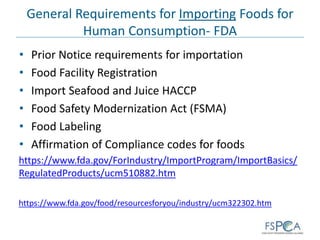
General Requirements for Importing Foods for
Human Consumption- FDA
• Prior Notice requirements for importation
• Food Facility Registration
• Import Seafood and Juice HACCP
• Food Safety Modernization Act (FSMA)
• Food Labeling
• Affirmation of Compliance codes for foods
https://www.fda.gov/ForIndustry/ImportProgram/ImportBasics/
RegulatedProducts/ucm510882.htm
https://www.fda.gov/food/resourcesforyou/industry/ucm322302.htm
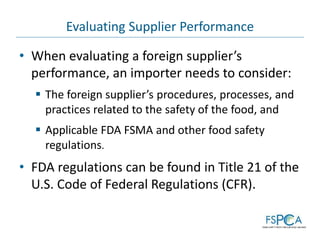
Evaluating Supplier Performance
• When evaluating a foreign supplier’s
performance, an importer needs to consider:
 The foreign supplier’s procedures, processes, and
practices related to the safety of the food, and
 Applicable FDA FSMA and other food safety
regulations.
• FDA regulations can be found in Title 21 of the
U.S. Code of Federal Regulations (CFR).
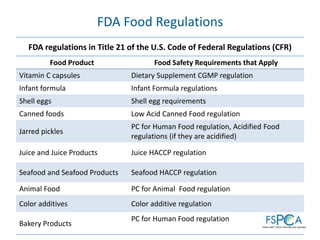
FDA Food Regulations
FDA regulations in Title 21 of the U.S. Code of Federal Regulations (CFR)
Food Product Food Safety Requirements that Apply
Vitamin C capsules Dietary Supplement CGMP regulation
Infant formula Infant Formula regulations
Shell eggs Shell egg requirements
Canned foods Low Acid Canned Food regulation
Jarred pickles
PC for Human Food regulation, Acidified Food
regulations (if they are acidified)
Juice and Juice Products Juice HACCP regulation
Seafood and Seafood Products Seafood HACCP regulation
Animal Food PC for Animal Food regulation
Color additives Color additive regulation
Bakery Products
PC for Human Food regulation
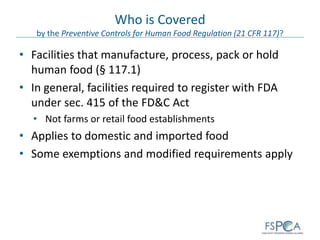
Who is Covered
by the Preventive Controls for Human Food Regulation (21 CFR 117)?
• Facilities that manufacture, process, pack or hold
human food (§ 117.1)
• In general, facilities required to register with FDA
under sec. 415 of the FD&C Act
• Not farms or retail food establishments
• Applies to domestic and imported food
• Some exemptions and modified requirements apply
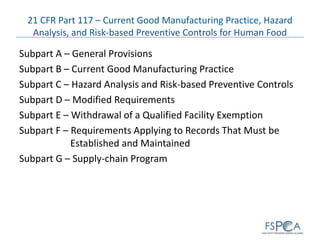
21 CFR Part 117 – Current Good Manufacturing Practice, Hazard
Analysis, and Risk-based Preventive Controls for Human Food
Subpart A – General Provisions
Subpart B – Current Good Manufacturing Practice
Subpart C – Hazard Analysis and Risk-based Preventive Controls
Subpart D – Modified Requirements
Subpart E – Withdrawal of a Qualified Facility Exemption
Subpart F – Requirements Applying to Records That Must be
Established and Maintained
Subpart G – Supply-chain Program
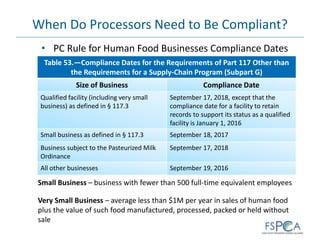
When Do Processors Need to Be Compliant?
• PC Rule for Human Food Businesses Compliance Dates
Table 53.—Compliance Dates for the Requirements of Part 117 Other than
the Requirements for a Supply-Chain Program (Subpart G)
Size of Business Compliance Date
Qualified facility (including very small
business) as defined in § 117.3
September 17, 2018, except that the
compliance date for a facility to retain
records to support its status as a qualified
facility is January 1, 2016
Small business as defined in § 117.3 September 18, 2017
Business subject to the Pasteurized Milk
Ordinance
September 17, 2018
All other businesses September 19, 2016
Small Business – business with fewer than 500 full-time equivalent employees
Very Small Business – average less than $1M per year in sales of human food
plus the value of such food manufactured, processed, packed or held without
sale
Questions?

Us food safety systems

  • 1.
    Background on U.S.Food Safety System FOR INTERNATIONAL COURSES
  • 2.
  • 3.
    U.S. Federal RegulatoryAgencies With Food Oversight • Food & Drug Administration, FDA • US Department of Agriculture Food Safety and Inspection Service, USDA-FSIS • Centers for Disease Control and Prevention, CDC • National Oceanic & Atmospheric Administration- National Marine Fisheries Service, NOAA-NMFS • Environmental Protection Agency, EPA • Department of Homeland Security, DHS – Customs and Border Protection
  • 4.
    U.S. Federal RegulatoryAgencies With Food Oversight FDA • All domestic and imported food, incl. certain egg and meat products, e.g., shell eggs, game meat USDA-FSIS •Certain domestic and imported meat, poultry, processed egg products (products subject to Federal Meat Inspection, Poultry Products Inspection, and Egg Products Inspection Acts), and Siluriformes spp. fish, including catfish CDC • Monitor and investigate foodborne illnesses NOAA/NMFS •Voluntary seafood inspection and grading EPA •Use of pesticides, water quality DHS •Customs inspections States • State food safety agencies • “Cooperative programs” with FDA (e.g., Interstate Shellfish Sanitation Program)
  • 5.
    Food Safety inthe U.S. • Two main federal food safety regulatory agencies – USDA and FDA. • Why does it matter?  Statutory authority o Continuous inspection (USDA) vs. periodic inspection (FDA) o On-farm authority (FDA)  State and local governments work closely with FDA and USDA regarding regulatory oversight
  • 6.
    FDA & USDA-FSIS FDA •Pure Food and Drug Act, 1906 • Food, Drug, and Cosmetic Act, 1938 as amended • In general, regulates everything containing less than 2% red meat and poultry meat (~80% of the food) USDA-FSIS • Federal Meat Inspection Act, 1906 • Poultry Products Inspection Act, 1957 • Egg Products Inspection Act, 1970 • Siluriformes spp. Fish including catfish, 2015 • In general, regulates meat and poultry products
  • 8.
    8 CFSAN, in conjunctionwith the Agency's field staff, is responsible for promoting and protecting the public's health by ensuring that the nation's food supply is safe, sanitary, wholesome, and honestly labeled, and that cosmetic products are safe and properly labeled. CFSAN’s Mission
  • 9.
    9 CFSAN’s Scope • 25cents of every consumer dollar is spent on FDA- regulated products. Of that amount, approximately 75% is spent on food. • CFSAN regulates $417 billion in domestic food, $49 billion in imported food, and $60 billion in cosmetics. • The American food industry accounts for 20% of Gross National Product and employs 14 million.
  • 10.
    10 Major CFSAN Programs •Office of Food Safety (OFS) – Seafood Science – Dairy, Egg and Meat Safety – Produce Safety – Food Processing Science – Plant Products and Beverages – Retail Food Protection (FDA Food Code)
  • 11.
    11 Major CFSAN Programs •Office of Nutrition and Food Labeling (ONFL) – Infant Formula – Allergen – Nutrition – Medical Foods – Labeling
  • 12.
    12 Major CFSAN Programs •Office of Cosmetics and Colors (OCAC) – Color Certification Program – Cosmetics • Office of Food Additive and Safety (OFAS) – Bio-Engineered Plants – Generally Recognized as Safe (GRAS) Program – Food Additives (Ingredients)
  • 13.
    Office of RegulatoryAffairs (ORA) The U.S. Food and Drug Administration’s Office of Regulatory Affairs (ORA) is the lead office for all agency field activities. – ORA inspects regulated products and manufacturers – Conducts sample analyses of regulated products and reviews imported products offered for entry into the United States. In pursuit of its mission, ORA also works with its state, local, tribal, territorial and foreign counterparts
  • 14.
    14 Products Regulated byCFSAN Game meat Processed foods* Infant formula Dietary supplements Food labeling Canned foods Fresh fruits & vegetables Bottled water & beverages Cosmetics & colors Seafood products Dairy products CFSAN * containing < 2% poultry or beef
  • 15.
    • Animal Food •Bakery Products • Beverages • Bottled Water • Chocolate and Candy • Dairy Products • Dietary Supplements • Dressings and Condiments • Certain Egg Products (such as hard-boiled eggs) • Food Additives • Fruits and Vegetables • Game Meat • Grains • Infant Formula • Multi-Component Foods (such as a refrigerated entrée or a sandwich) • Nuts • Oil • Seafood • Snack Foods • Soups • Spices • Sweeteners 15 Food Groups Under FDA Authority
  • 16.
    Adulteration and Misbranding Lawsagainst adulteration and misbranding ensure that consumers get what they pay for and that their food is safe
  • 17.
    Adulterated Food Sec. 402of the FD&C Act (a) Poisonous, insanitary, etc., ingredients (1) If it bears or contains any poisonous or deleterious substance which may render it injurious to health; but in case the substance is not an added substance such food shall not be considered adulterated under this clause if the quantity of such substance in such food does not ordinarily render it injurious to health (a) Poisonous, insanitary, etc., ingredients…; or (4) if it has been prepared, packed, or held under insanitary conditions whereby it may have become contaminated with filth, or whereby it may have been rendered injurious to health; May be intentional, unintentional, or economic http://foodravel.com
  • 18.
    Misbranded Food Section 403(w)of the FD&C Act Misbranded food is any food that: 1) its labeling or advertising is false or misleading; 2) is offered for sale under the name of another food; 3) is an imitation of another food but the label does not bear the word “imitation”; 4) its container is made or filled to be misleading; or 5) its label does not provide i) the name and place of the manufacturer, and ii) an accurate statement of the quantity of the contents in terms of weight, measure, or numerical count o e.g. undeclared allergens
  • 19.
    Statutory Authority • TheFederal Food and Drugs Act of 1906 • The Federal Meat Inspection Act of 1906 • The Federal Import Milk Act (1927) • The Federal Food, Drug, and Cosmetic Act of 1938, as amended (FD&C Act) • The Public Health Service Act (1944) • The Poultry Products Inspection Act of 1957 • The Fair Packaging and Labeling Act (1966) • The Infant Formula Act of 1980, as amended
  • 20.
    Statutory Authority (continued) •The Nutrition Labeling and Education Act of 1990 • The Dietary Supplement Health and Education Act of 1994 • The Bioterrorism Act of 2002  FDA Food Facility Registration under sec. 415 of the FD&C Act • The Reportable Food Registry under sec. 415 of the FD&C Act 417 • Food Allergen Labeling and Consumer Protection Act (FALCPA) of 2004 • FDA Food Safety Modernization Act (FSMA) of 2011
  • 21.
    21 Bioterrorism Act of2002 1. Facility Registration: Domestic and foreign facilities engaged in manufacturing, processing, packing and holding of food 2. Prior Notification of Imported Foods: Prior Notice of Imported Food Shipments Requires advance notice of import shipments to FDA (Final Rule- May 2009) (Amended by FSMA Sec 304) Requires information on prior refusals to be added to prior notice submission. (Effective July 3, 2012) Must be received and confirmed electronically (Final Rule- April 2009) Not more than 30 days before arrival if submitted via CBP’s ABI/ACS (Automated Broker Interface of the Automated Commercial System) Not more than 15 days before arrival, if submitted via FDA’s PNSI (Prior Notice System Interface)
  • 22.
    General Requirements forImporting Foods for Human Consumption- FDA • Prior Notice requirements for importation • Food Facility Registration • Import Seafood and Juice HACCP • Food Safety Modernization Act (FSMA) • Food Labeling • Affirmation of Compliance codes for foods https://www.fda.gov/ForIndustry/ImportProgram/ImportBasics/ RegulatedProducts/ucm510882.htm https://www.fda.gov/food/resourcesforyou/industry/ucm322302.htm
  • 23.
    Evaluating Supplier Performance •When evaluating a foreign supplier’s performance, an importer needs to consider:  The foreign supplier’s procedures, processes, and practices related to the safety of the food, and  Applicable FDA FSMA and other food safety regulations. • FDA regulations can be found in Title 21 of the U.S. Code of Federal Regulations (CFR).
  • 24.
    FDA Food Regulations FDAregulations in Title 21 of the U.S. Code of Federal Regulations (CFR) Food Product Food Safety Requirements that Apply Vitamin C capsules Dietary Supplement CGMP regulation Infant formula Infant Formula regulations Shell eggs Shell egg requirements Canned foods Low Acid Canned Food regulation Jarred pickles PC for Human Food regulation, Acidified Food regulations (if they are acidified) Juice and Juice Products Juice HACCP regulation Seafood and Seafood Products Seafood HACCP regulation Animal Food PC for Animal Food regulation Color additives Color additive regulation Bakery Products PC for Human Food regulation
  • 25.
    Who is Covered bythe Preventive Controls for Human Food Regulation (21 CFR 117)? • Facilities that manufacture, process, pack or hold human food (§ 117.1) • In general, facilities required to register with FDA under sec. 415 of the FD&C Act • Not farms or retail food establishments • Applies to domestic and imported food • Some exemptions and modified requirements apply
  • 26.
    21 CFR Part117 – Current Good Manufacturing Practice, Hazard Analysis, and Risk-based Preventive Controls for Human Food Subpart A – General Provisions Subpart B – Current Good Manufacturing Practice Subpart C – Hazard Analysis and Risk-based Preventive Controls Subpart D – Modified Requirements Subpart E – Withdrawal of a Qualified Facility Exemption Subpart F – Requirements Applying to Records That Must be Established and Maintained Subpart G – Supply-chain Program
  • 27.
    When Do ProcessorsNeed to Be Compliant? • PC Rule for Human Food Businesses Compliance Dates Table 53.—Compliance Dates for the Requirements of Part 117 Other than the Requirements for a Supply-Chain Program (Subpart G) Size of Business Compliance Date Qualified facility (including very small business) as defined in § 117.3 September 17, 2018, except that the compliance date for a facility to retain records to support its status as a qualified facility is January 1, 2016 Small business as defined in § 117.3 September 18, 2017 Business subject to the Pasteurized Milk Ordinance September 17, 2018 All other businesses September 19, 2016 Small Business – business with fewer than 500 full-time equivalent employees Very Small Business – average less than $1M per year in sales of human food plus the value of such food manufactured, processed, packed or held without sale
  • 28.