TRINITY INSTITUTE OF PROFESSIONAL STUDIES
Sector – 9, Dwarka Institutional Area, New Delhi-75
Affiliated Institution of G.G.S.IP.U, Delhi
Media Research
Paper ID-24305
Paper code-BJ(MC)305
Manmeet Kaur
TRINITY INSTITUTE OF PROFESSIONAL STUDIES
Sector – 9, Dwarka Institutional Area, New Delhi-75
Survey
 Audience and consumer surveys are commonplace in
all areas of life. This becomes immediately evident by
searching the Internet for “audience surveys” or
“consumer surveys.”
 Decision makers in businesses, consumer and
activist groups, politics, and the media use survey
results as part of their daily routine.
 Fortunately, the increased use of surveys has created
changes in the way many of the studies are
conducted and reported. More attention (although not
enough) is given to sample selection, questionnaire
design, and error rates.
1
TRINITY INSTITUTE OF PROFESSIONAL STUDIES
Sector – 9, Dwarka Institutional Area, New Delhi-75
DESCRIPTIVE AND ANALYTICAL SURVEYS
 A descriptive survey attempts to describe or document
current conditions or attitudes—that is, to explain what
exists at the moment.
 For example, the Department of Labor regularly
conducts surveys on the rate of unemployment in India.
 Broadcast stations and networks continually survey their
audiences to determine programming tastes, changing
values, and lifestyle variations that might affect
programming.
 In descriptive surveys, the interest is in discovering
the current situation in the area under study.
3
TRINITY INSTITUTE OF PROFESSIONAL STUDIES
Sector – 9, Dwarka Institutional Area, New Delhi-75
 An analytical survey attempts to describe and explain why
situations exist.
 In this approach, two or more variables are usually examined to
investigate research questions or test research hypotheses. The
results allow researchers to examine the interrelationships among
variables and to develop explanatory inferences.
 For example, television station owners survey the market to
determine how lifestyles affect viewing habits or to determine
whether viewers’ lifestyles can be used to predict the success of
syndicated programming.
 On a broader scale, television networks conduct yearly surveys to
determine how the public’s tastes and desires are changing and
how these attitudes relate to viewers’ perceptions of the three
major commercial networks.
TRINITY INSTITUTE OF PROFESSIONAL STUDIES
Sector – 9, Dwarka Institutional Area, New Delhi-75
Content
• A survey involves interviews with a
large number of respondents using a
predesigned questionnaire.
• Four basic survey methods:
–Person-administered surveys
–Computer-assisted surveys
–Self-administered surveys
–Mixed-mode (hybrid) survey
5
TRINITY INSTITUTE OF PROFESSIONAL STUDIES
Sector – 9, Dwarka Institutional Area, New Delhi-75
Surveys have several advantages
1. They can be used to investigate problems in realistic settings.
Newspaper reading, television viewing, radio listening, and
consumer behavior patterns can be examined where they
happen rather than in a laboratory or screening room under
artificial conditions.
2. The cost of surveys is reasonable when one considers the
amount of information gathered (some online surveys are
free). Researchers also can control expenses by selecting from
five major types of surveys: mail, telephone, personal
interview, group administration, and the Internet.
3. A large amount of data can be collected with relative ease
from a variety of people. Surveys allow researchers to
examine many variables (demographic and lifestyle
information, attitudes, motives, intentions, and so on) and to
use a variety of statistics to analyze the data.
6
TRINITY INSTITUTE OF PROFESSIONAL STUDIES
Sector – 9, Dwarka Institutional Area, New Delhi-75
Content
1. Surveys are not constrained by geographic
boundaries; they can be conducted almost anywhere.
2. Data helpful to survey research already exist. Data
archives, government documents, census materials,
radio and television rating books, and voter
registration lists can be used as primary sources (main
sources of data) or as secondary sources (supportive
data) of information. With archive data, it is possible
to conduct an entire survey study without ever
developing a questionnaire or contacting a single
respondent.
TRINITY INSTITUTE OF PROFESSIONAL STUDIES
Sector – 9, Dwarka Institutional Area, New Delhi-75
A few more…..
• Standardization
• Ease of administration
• Ability to tap the “unseen”
• Suitability to tabulation and statistical analysis
• Sensitivity to subgroup differences
TRINITY INSTITUTE OF PROFESSIONAL STUDIES
Sector – 9, Dwarka Institutional Area, New Delhi-75
Four Alternative Data Collection
Modes
• Person-administered: an interviewer reads
questions, either face-to-face or over the
telephone, to the respondent and records his or
her answers
• Computer-administered: computer technology
plays an essential role in the interview work
• Self-administered: the respondent completes the
survey on his or her own
• Mixed Mode: a combination of two or more
methods
TRINITY INSTITUTE OF PROFESSIONAL STUDIES
Sector – 9, Dwarka Institutional Area, New Delhi-75
Person-Administered Surveys
(Without Computer Assistance)
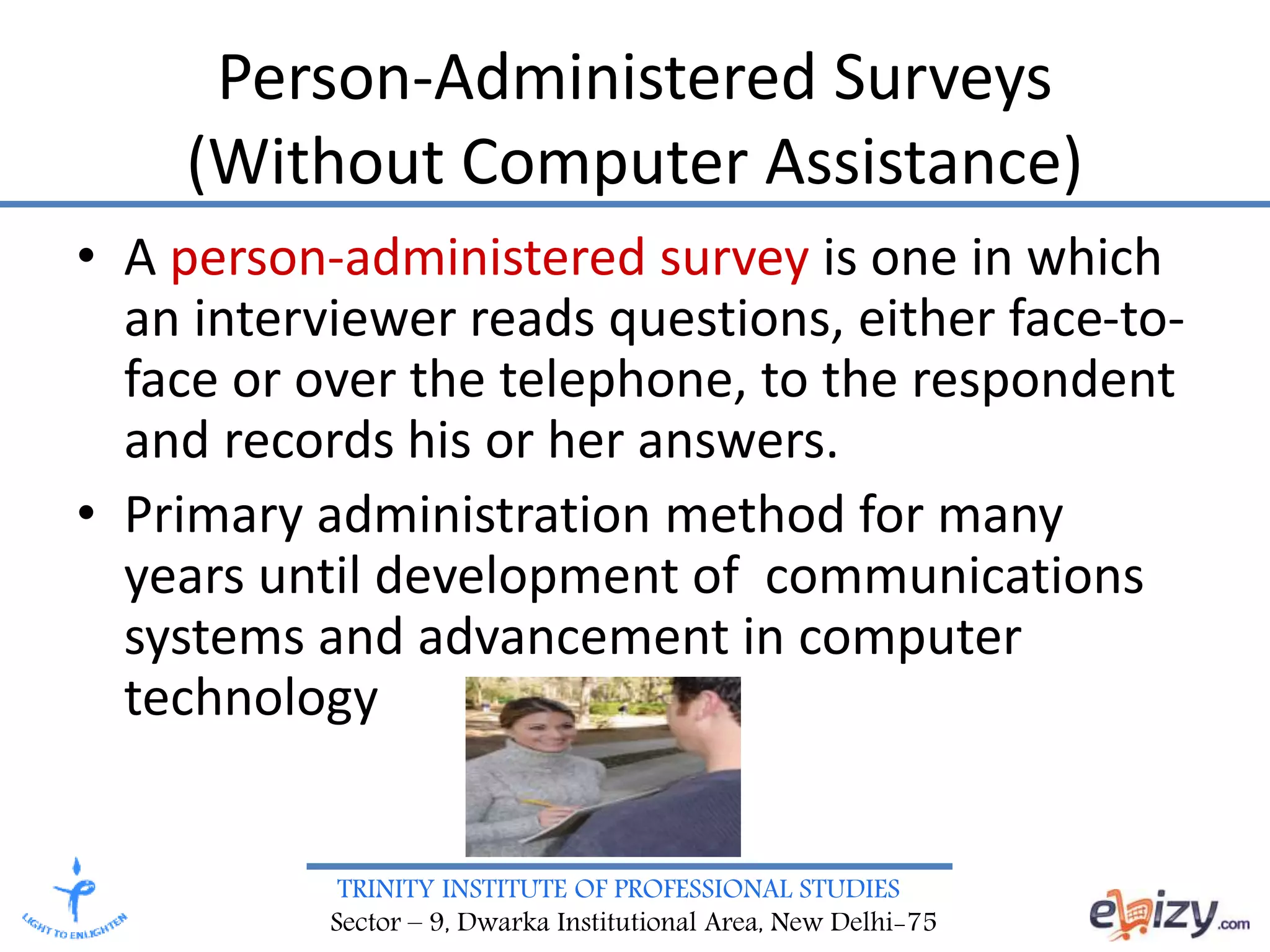
• A person-administered survey is one in which
an interviewer reads questions, either face-to-
face or over the telephone, to the respondent
and records his or her answers.
• Primary administration method for many
years until development of communications
systems and advancement in computer
technology
TRINITY INSTITUTE OF PROFESSIONAL STUDIES
Sector – 9, Dwarka Institutional Area, New Delhi-75
• Advantages:
–Feedback
–Rapport
–Quality control
–Adaptability
TRINITY INSTITUTE OF PROFESSIONAL STUDIES
Sector – 9, Dwarka Institutional Area, New Delhi-75
Disadvantages:
Humans make errors
Slow speed
High cost
Interview evaluation: apprehensive they are
answering the question “correctly.” Feel they
are being “evaluated.” Especially a problem
with sensitive topics such as hygiene,
finances, political opinions, etc.
TRINITY INSTITUTE OF PROFESSIONAL STUDIES
Sector – 9, Dwarka Institutional Area, New Delhi-75
Computer-Administered Surveys
• A computer-assisted survey is one in which
computer technology plays an essential role in
the interview work.
TRINITY INSTITUTE OF PROFESSIONAL STUDIES
Sector – 9, Dwarka Institutional Area, New Delhi-75
• Advantages:
–Speed
–Error-free interviews
–Use of pictures, videos, and graphics
–Real-time capture of data
–Reduction of “interview evaluation”
concern in respondents
TRINITY INSTITUTE OF PROFESSIONAL STUDIES
Sector – 9, Dwarka Institutional Area, New Delhi-75
• Disadvantages:
–Technical skills required
–High set-up costs
–authenticity
TRINITY INSTITUTE OF PROFESSIONAL STUDIES
Sector – 9, Dwarka Institutional Area, New Delhi-75
Self-Administered Surveys
• A self-administered survey is one in which the
respondent completes the survey on his or her
own.
• Traditional “paper & pencil” survey
TRINITY INSTITUTE OF PROFESSIONAL STUDIES
Sector – 9, Dwarka Institutional Area, New Delhi-75
• Advantages:
–Reduced cost
–Respondents control pace at which they
answer
–No interview-evaluation apprehension
TRINITY INSTITUTE OF PROFESSIONAL STUDIES
Sector – 9, Dwarka Institutional Area, New Delhi-75
Mixed-Mode (Hybrid) Surveys
• Mixed-mode surveys use multiple data
collection methods.
• It has become increasingly popular to use
mixed-mode surveys in recent years.
TRINITY INSTITUTE OF PROFESSIONAL STUDIES
Sector – 9, Dwarka Institutional Area, New Delhi-75
• Advantages:
–Multiple advantages to achieve data
collection goal…
–Example: May use online surveys to quickly
reach portion of population with Internet
access and may use telephone calling to
reach those without Internet access.
TRINITY INSTITUTE OF PROFESSIONAL STUDIES
Sector – 9, Dwarka Institutional Area, New Delhi-75
• Disadvantages
–Mode affects response?
–Additional complexity.
TRINITY INSTITUTE OF PROFESSIONAL STUDIES
Sector – 9, Dwarka Institutional Area, New Delhi-75
THANK YOU

Media Research - Survey

  • 1.
    TRINITY INSTITUTE OFPROFESSIONAL STUDIES Sector – 9, Dwarka Institutional Area, New Delhi-75 Affiliated Institution of G.G.S.IP.U, Delhi Media Research Paper ID-24305 Paper code-BJ(MC)305 Manmeet Kaur
  • 2.
    TRINITY INSTITUTE OFPROFESSIONAL STUDIES Sector – 9, Dwarka Institutional Area, New Delhi-75 Survey  Audience and consumer surveys are commonplace in all areas of life. This becomes immediately evident by searching the Internet for “audience surveys” or “consumer surveys.”  Decision makers in businesses, consumer and activist groups, politics, and the media use survey results as part of their daily routine.  Fortunately, the increased use of surveys has created changes in the way many of the studies are conducted and reported. More attention (although not enough) is given to sample selection, questionnaire design, and error rates. 1
  • 3.
    TRINITY INSTITUTE OFPROFESSIONAL STUDIES Sector – 9, Dwarka Institutional Area, New Delhi-75 DESCRIPTIVE AND ANALYTICAL SURVEYS  A descriptive survey attempts to describe or document current conditions or attitudes—that is, to explain what exists at the moment.  For example, the Department of Labor regularly conducts surveys on the rate of unemployment in India.  Broadcast stations and networks continually survey their audiences to determine programming tastes, changing values, and lifestyle variations that might affect programming.  In descriptive surveys, the interest is in discovering the current situation in the area under study. 3
  • 4.
    TRINITY INSTITUTE OFPROFESSIONAL STUDIES Sector – 9, Dwarka Institutional Area, New Delhi-75  An analytical survey attempts to describe and explain why situations exist.  In this approach, two or more variables are usually examined to investigate research questions or test research hypotheses. The results allow researchers to examine the interrelationships among variables and to develop explanatory inferences.  For example, television station owners survey the market to determine how lifestyles affect viewing habits or to determine whether viewers’ lifestyles can be used to predict the success of syndicated programming.  On a broader scale, television networks conduct yearly surveys to determine how the public’s tastes and desires are changing and how these attitudes relate to viewers’ perceptions of the three major commercial networks.
  • 5.
    TRINITY INSTITUTE OFPROFESSIONAL STUDIES Sector – 9, Dwarka Institutional Area, New Delhi-75 Content • A survey involves interviews with a large number of respondents using a predesigned questionnaire. • Four basic survey methods: –Person-administered surveys –Computer-assisted surveys –Self-administered surveys –Mixed-mode (hybrid) survey 5
  • 6.
    TRINITY INSTITUTE OFPROFESSIONAL STUDIES Sector – 9, Dwarka Institutional Area, New Delhi-75 Surveys have several advantages 1. They can be used to investigate problems in realistic settings. Newspaper reading, television viewing, radio listening, and consumer behavior patterns can be examined where they happen rather than in a laboratory or screening room under artificial conditions. 2. The cost of surveys is reasonable when one considers the amount of information gathered (some online surveys are free). Researchers also can control expenses by selecting from five major types of surveys: mail, telephone, personal interview, group administration, and the Internet. 3. A large amount of data can be collected with relative ease from a variety of people. Surveys allow researchers to examine many variables (demographic and lifestyle information, attitudes, motives, intentions, and so on) and to use a variety of statistics to analyze the data. 6
  • 7.
    TRINITY INSTITUTE OFPROFESSIONAL STUDIES Sector – 9, Dwarka Institutional Area, New Delhi-75 Content 1. Surveys are not constrained by geographic boundaries; they can be conducted almost anywhere. 2. Data helpful to survey research already exist. Data archives, government documents, census materials, radio and television rating books, and voter registration lists can be used as primary sources (main sources of data) or as secondary sources (supportive data) of information. With archive data, it is possible to conduct an entire survey study without ever developing a questionnaire or contacting a single respondent.
  • 8.
    TRINITY INSTITUTE OFPROFESSIONAL STUDIES Sector – 9, Dwarka Institutional Area, New Delhi-75 A few more….. • Standardization • Ease of administration • Ability to tap the “unseen” • Suitability to tabulation and statistical analysis • Sensitivity to subgroup differences
  • 9.
    TRINITY INSTITUTE OFPROFESSIONAL STUDIES Sector – 9, Dwarka Institutional Area, New Delhi-75 Four Alternative Data Collection Modes • Person-administered: an interviewer reads questions, either face-to-face or over the telephone, to the respondent and records his or her answers • Computer-administered: computer technology plays an essential role in the interview work • Self-administered: the respondent completes the survey on his or her own • Mixed Mode: a combination of two or more methods
  • 10.
    TRINITY INSTITUTE OFPROFESSIONAL STUDIES Sector – 9, Dwarka Institutional Area, New Delhi-75 Person-Administered Surveys (Without Computer Assistance) • A person-administered survey is one in which an interviewer reads questions, either face-to- face or over the telephone, to the respondent and records his or her answers. • Primary administration method for many years until development of communications systems and advancement in computer technology
  • 11.
    TRINITY INSTITUTE OFPROFESSIONAL STUDIES Sector – 9, Dwarka Institutional Area, New Delhi-75 • Advantages: –Feedback –Rapport –Quality control –Adaptability
  • 12.
    TRINITY INSTITUTE OFPROFESSIONAL STUDIES Sector – 9, Dwarka Institutional Area, New Delhi-75 Disadvantages: Humans make errors Slow speed High cost Interview evaluation: apprehensive they are answering the question “correctly.” Feel they are being “evaluated.” Especially a problem with sensitive topics such as hygiene, finances, political opinions, etc.
  • 13.
    TRINITY INSTITUTE OFPROFESSIONAL STUDIES Sector – 9, Dwarka Institutional Area, New Delhi-75 Computer-Administered Surveys • A computer-assisted survey is one in which computer technology plays an essential role in the interview work.
  • 14.
    TRINITY INSTITUTE OFPROFESSIONAL STUDIES Sector – 9, Dwarka Institutional Area, New Delhi-75 • Advantages: –Speed –Error-free interviews –Use of pictures, videos, and graphics –Real-time capture of data –Reduction of “interview evaluation” concern in respondents
  • 15.
    TRINITY INSTITUTE OFPROFESSIONAL STUDIES Sector – 9, Dwarka Institutional Area, New Delhi-75 • Disadvantages: –Technical skills required –High set-up costs –authenticity
  • 16.
    TRINITY INSTITUTE OFPROFESSIONAL STUDIES Sector – 9, Dwarka Institutional Area, New Delhi-75 Self-Administered Surveys • A self-administered survey is one in which the respondent completes the survey on his or her own. • Traditional “paper & pencil” survey
  • 17.
    TRINITY INSTITUTE OFPROFESSIONAL STUDIES Sector – 9, Dwarka Institutional Area, New Delhi-75 • Advantages: –Reduced cost –Respondents control pace at which they answer –No interview-evaluation apprehension
  • 18.
    TRINITY INSTITUTE OFPROFESSIONAL STUDIES Sector – 9, Dwarka Institutional Area, New Delhi-75 Mixed-Mode (Hybrid) Surveys • Mixed-mode surveys use multiple data collection methods. • It has become increasingly popular to use mixed-mode surveys in recent years.
  • 19.
    TRINITY INSTITUTE OFPROFESSIONAL STUDIES Sector – 9, Dwarka Institutional Area, New Delhi-75 • Advantages: –Multiple advantages to achieve data collection goal… –Example: May use online surveys to quickly reach portion of population with Internet access and may use telephone calling to reach those without Internet access.
  • 20.
    TRINITY INSTITUTE OFPROFESSIONAL STUDIES Sector – 9, Dwarka Institutional Area, New Delhi-75 • Disadvantages –Mode affects response? –Additional complexity.
  • 21.
    TRINITY INSTITUTE OFPROFESSIONAL STUDIES Sector – 9, Dwarka Institutional Area, New Delhi-75 THANK YOU