BMGT 311: Chapter 7	
Evaluating Survey Data Collection Methods
Learning Objectives
• To learn the four basic alternative modes for gathering survey data

•  To understand the advantages and disadvantages of each of the various data
collection modes

• To comprehend the factors researchers consider when choosing a particular
survey method

• To become knowledgeable about the details of different types of survey data
collection methods, such as personal interviews, telephone interviews, and
computer-administered interviews, including online surveys
Surveys
• A survey involves interviews
with a large number of
respondents using a
predesigned questionnaire.
Surveys
• Four basic survey methods:

• Person-administered
surveys

• Computer-assisted surveys

• Self-administered surveys

• Mixed-mode (hybrid)
surveys
Advantages of Surveys
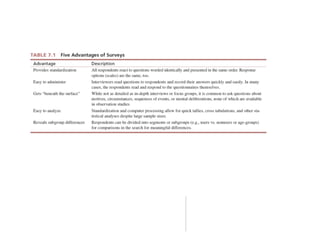
• Standardization

• Ease of administration

• Ability to tap the “unseen”

• Suitability to tabulation and statistical analysis

• Sensitivity to subgroup differences
Four Alternative 

Data Collection Modes
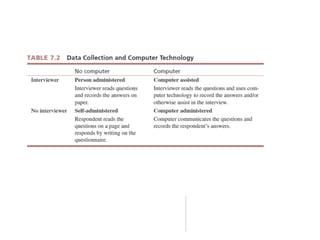
• Person administered: an interviewer reads questions, either face-to-face or
over the telephone, to the respondent and records his or her answers.

• Computer administered: the interviewer basically verbalizes the questions
while relying to some degree on computer technology to facilitate the
interview work.

• Self-administered: the respondent completes the survey on his or her own.

• Mixed mode: a combination of two or more methods
Person-Administered Surveys

(Without Computer Assistance)
• A person-administered
survey is one in which an
interviewer reads questions,
either face-to-face or over the
telephone, to the respondent
and records his or her answers.
Person-Administered Surveys

(Without Computer Assistance)
• Advantages:
• Feedback
• Rapport
• Quality control
• Adaptability
Person-Administered Surveys

(Without Computer Assistance)
• Disadvantages:
• Humans make errors
• Slow speed
• High cost
• Interview evaluation:
apprehensive they are answering
the question “correctly.” Feel they
are being “evaluated.” Especially
a problem with sensitive topics
such as hygiene, finances,
political opinions, etc.
Computer-
Administered Surveys
• Advantages:

• Breadth of user-friendly
features

• Relatively inexpensive

• Reduction of interview
evaluation concern in
respondents
Computer-
Administered Surveys
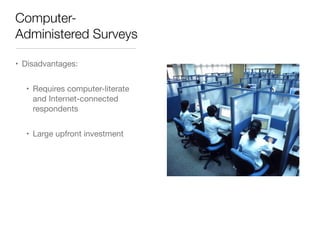
• Disadvantages:

• Requires computer-literate
and Internet-connected
respondents

• Large upfront investment
Self-Administered
Surveys
• A self-administered survey is
one in which the respondent
completes the survey on his or
her own.

• Traditional “paper and pencil”
survey

• Now given online - very popular
and cost effective
Self-Administered
Surveys
• Advantages:

• Reduced cost

• Respondents control pace
at which they answer

• No interview-evaluation
apprehension
Self-Administered
Surveys
• Disadvantages:

• Respondent controls the
survey—does not send in on
time or does not send in.

• Lack of monitoring—no one
to explain or encourage
respondents.

• High questionnaire
requirements—it must be
perfect.
Mixed-Mode (Hybrid)
Surveys
• Mixed-mode surveys use
multiple data collection
methods.

• It has become increasingly
popular to use mixed-mode
surveys in recent years.
Mixed-Mode (Hybrid)
Surveys
• Advantages:
• Multiple advantages to
achieve data collection
goal
• Example: May use online
surveys to quickly reach
portion of population with
Internet access and may
use telephone calling to
reach those without
Internet access.
Mixed-Mode (Hybrid)
Surveys
• Disadvantages:
• Mode affects response?
• Additional complexity
Survey’s in Action
• Let’s Take a Break to administer a survey among your classmates

• One Volunteer for Survey Data Collection - all others will be respondents

• 15 minutes to collect data and then give a quick overview on your findings
Survey’s in action
• Standardization: How have the response options for questions #2 and 3
standardize the survey? What might have happened if your did not give
options?

• Ease of analysis: What percent of the respondents watched TV last night?
What percent watched 4 or more hours? Who watched more TV, males pr
females?

• Easy of administration: How long did it take to administer the survey? Was
there any respondent confusion?

• What would have you done differently?
In-Home Surveys
• An in-home survey is conducted by an interviewer in the home of the
respondent. 

• Key advantages: 

• Conducted in the privacy of the home, which facilitates interviewer–
respondent rapport

• Primary administration method for many years until development of
communications systems and advancement in computer technology
Mall-Intercept
Surveys
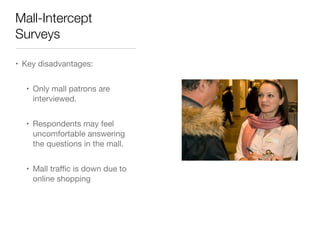
• The mall-intercept survey is one
in which the respondent is
encountered and questioned
while he or she is visiting a
shopping mall.

• Key advantages: 

• Mall-intercept interviews are
conducted in large shopping
malls, and they are less
expensive per interview than
are in-home interviews.
Mall-Intercept
Surveys
• Key disadvantages: 

• Only mall patrons are
interviewed.

• Respondents may feel
uncomfortable answering
the questions in the mall.

• Mall traffic is down due to
online shopping
In-Office Surveys
• In-office surveys take place in
person while the respondent is
in his or her office or perhaps in
a company lounge area.

• Key advantage: 

• Useful for interviewing busy
executives

• Key disadvantages: 

• Relatively high cost per
interview, Gaining access is
sometimes difficult
Central Location
Telephone Surveying
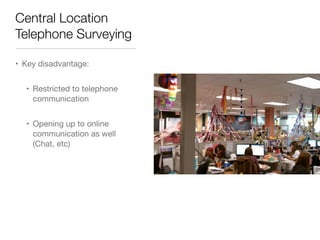
• Involves a field data collection
company installing several
telephone lines at one location
from which interviewers make
calls.

• Key advantages: 

• Fast turnaround

• Good quality control

• Reasonable cost
Central Location
Telephone Surveying
• Key disadvantage: 

• Restricted to telephone
communication

• Opening up to online
communication as well
(Chat, etc)
CATI
• The most advanced telephone interview companies have computerized the
central location telephone interviewing process with systems called
computer-assisted telephone interviews (CATI).

• Key advantages: 

• Computer eliminates human interviewer error

• Simultaneous data input to computer file

• Good quality control
Fully Automated Survey
• Some companies have developed fully automated surveys in which the
survey is administered by a computer but not online.

• In the research industry, this approach is known as completely automated
telephone survey (CATS).

• Key advantages: 

• Respondent responds at his or her own pace

• Computer data file results
Online Interviews
• The Internet-based
questionnaire in which the
respondent answers questions
online has become the industry
standard for surveys in virtually
all high-Internet-penetration
countries.

• Key advantages: 

• Ease of creating and posting

• Fast turnaround

• Computer data file/Results
Fully Computerized Online Surveys
• Key disadvantage: 

• Marketing researchers were quick to realize that online surveys presented
design challenges and opportunities related to fostering cooperation in
potential respondents.
Group Self-
Administered Survey
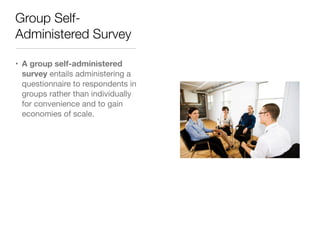
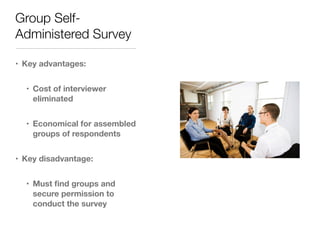
• A group self-administered
survey entails administering a
questionnaire to respondents in
groups rather than individually
for convenience and to gain
economies of scale.
Group Self-
Administered Survey
• Key advantages:
• Cost of interviewer
eliminated
• Economical for assembled
groups of respondents
• Key disadvantage:
• Must find groups and
secure permission to
conduct the survey
Drop-Off Survey
• The drop-off survey is sometimes called “drop and collect,” in which the
survey representative approaches a prospective respondent, introduces the
general purpose of the survey to the prospect, and leaves it with the
respondent to fill out on his or her own.

• Key advantages: 

• Cost of interviewer eliminated

• Appropriate for local market surveys

• Key disadvantage: Generally not appropriate for large-scale national survey
Mail Survey
• A mail survey is one in which
the questions are mailed to
prospective respondents who
are asked to fill them out and
return them to the researcher
by mail.
Mail Survey
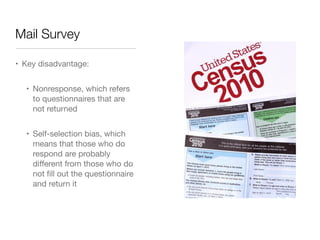
• Key disadvantage: 

• Nonresponse, which refers
to questionnaires that are
not returned

• Self-selection bias, which
means that those who do
respond are probably
different from those who do
not fill out the questionnaire
and return it
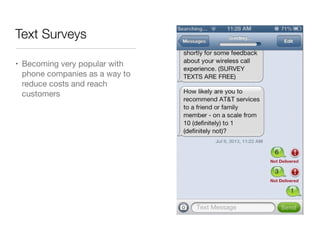
Text Surveys
• Becoming very popular with
phone companies as a way to
reduce costs and reach
customers
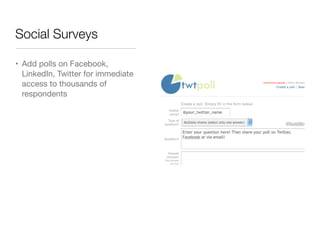
Social Surveys
• Add polls on Facebook,
LinkedIn, Twitter for immediate
access to thousands of
respondents
Choice of Survey Method
• In selecting a data collection mode, the researcher balances quality against
the following:

• Time available for data collection

• Money available for data collection (If you were trying to do a mail survey
on 100,000 people, postage alone would be $50,000)

• Type of respondent interaction required (such as sampling a product,
viewing an ad, etc.)
Choice of Survey Method
• In selecting a data collection mode, the researcher balances quality against
the following:

• Incidence rate: screen by online or telephone

• Cultural/infrastructure considerations: Scandinavian countries dislike
strangers in homes. Canada is more open. In India, <10% have phones.

Bmgt 311 chapter_7

  • 1.
    BMGT 311: Chapter7 Evaluating Survey Data Collection Methods
  • 2.
    Learning Objectives • Tolearn the four basic alternative modes for gathering survey data •  To understand the advantages and disadvantages of each of the various data collection modes • To comprehend the factors researchers consider when choosing a particular survey method • To become knowledgeable about the details of different types of survey data collection methods, such as personal interviews, telephone interviews, and computer-administered interviews, including online surveys
  • 4.
    Surveys • A surveyinvolves interviews with a large number of respondents using a predesigned questionnaire.
  • 5.
    Surveys • Four basicsurvey methods: • Person-administered surveys • Computer-assisted surveys • Self-administered surveys • Mixed-mode (hybrid) surveys
  • 6.
    Advantages of Surveys •Standardization • Ease of administration • Ability to tap the “unseen” • Suitability to tabulation and statistical analysis • Sensitivity to subgroup differences
  • 8.
    Four Alternative 
 DataCollection Modes • Person administered: an interviewer reads questions, either face-to-face or over the telephone, to the respondent and records his or her answers. • Computer administered: the interviewer basically verbalizes the questions while relying to some degree on computer technology to facilitate the interview work. • Self-administered: the respondent completes the survey on his or her own. • Mixed mode: a combination of two or more methods
  • 10.
    Person-Administered Surveys
 (Without ComputerAssistance) • A person-administered survey is one in which an interviewer reads questions, either face-to-face or over the telephone, to the respondent and records his or her answers.
  • 11.
    Person-Administered Surveys
 (Without ComputerAssistance) • Advantages: • Feedback • Rapport • Quality control • Adaptability
  • 12.
    Person-Administered Surveys
 (Without ComputerAssistance) • Disadvantages: • Humans make errors • Slow speed • High cost • Interview evaluation: apprehensive they are answering the question “correctly.” Feel they are being “evaluated.” Especially a problem with sensitive topics such as hygiene, finances, political opinions, etc.
  • 13.
    Computer- Administered Surveys • Advantages: •Breadth of user-friendly features • Relatively inexpensive • Reduction of interview evaluation concern in respondents
  • 14.
    Computer- Administered Surveys • Disadvantages: •Requires computer-literate and Internet-connected respondents • Large upfront investment
  • 15.
    Self-Administered Surveys • A self-administeredsurvey is one in which the respondent completes the survey on his or her own. • Traditional “paper and pencil” survey • Now given online - very popular and cost effective
  • 16.
    Self-Administered Surveys • Advantages: • Reducedcost • Respondents control pace at which they answer • No interview-evaluation apprehension
  • 17.
    Self-Administered Surveys • Disadvantages: • Respondentcontrols the survey—does not send in on time or does not send in. • Lack of monitoring—no one to explain or encourage respondents. • High questionnaire requirements—it must be perfect.
  • 18.
    Mixed-Mode (Hybrid) Surveys • Mixed-modesurveys use multiple data collection methods. • It has become increasingly popular to use mixed-mode surveys in recent years.
  • 19.
    Mixed-Mode (Hybrid) Surveys • Advantages: •Multiple advantages to achieve data collection goal • Example: May use online surveys to quickly reach portion of population with Internet access and may use telephone calling to reach those without Internet access.
  • 20.
    Mixed-Mode (Hybrid) Surveys • Disadvantages: •Mode affects response? • Additional complexity
  • 21.
    Survey’s in Action •Let’s Take a Break to administer a survey among your classmates • One Volunteer for Survey Data Collection - all others will be respondents • 15 minutes to collect data and then give a quick overview on your findings
  • 22.
    Survey’s in action •Standardization: How have the response options for questions #2 and 3 standardize the survey? What might have happened if your did not give options? • Ease of analysis: What percent of the respondents watched TV last night? What percent watched 4 or more hours? Who watched more TV, males pr females? • Easy of administration: How long did it take to administer the survey? Was there any respondent confusion? • What would have you done differently?
  • 24.
    In-Home Surveys • Anin-home survey is conducted by an interviewer in the home of the respondent. • Key advantages: • Conducted in the privacy of the home, which facilitates interviewer– respondent rapport • Primary administration method for many years until development of communications systems and advancement in computer technology
  • 25.
    Mall-Intercept Surveys • The mall-interceptsurvey is one in which the respondent is encountered and questioned while he or she is visiting a shopping mall. • Key advantages: • Mall-intercept interviews are conducted in large shopping malls, and they are less expensive per interview than are in-home interviews.
  • 26.
    Mall-Intercept Surveys • Key disadvantages: • Only mall patrons are interviewed. • Respondents may feel uncomfortable answering the questions in the mall. • Mall traffic is down due to online shopping
  • 27.
    In-Office Surveys • In-officesurveys take place in person while the respondent is in his or her office or perhaps in a company lounge area. • Key advantage: • Useful for interviewing busy executives • Key disadvantages: • Relatively high cost per interview, Gaining access is sometimes difficult
  • 28.
    Central Location Telephone Surveying •Involves a field data collection company installing several telephone lines at one location from which interviewers make calls. • Key advantages: • Fast turnaround • Good quality control • Reasonable cost
  • 29.
    Central Location Telephone Surveying •Key disadvantage: • Restricted to telephone communication • Opening up to online communication as well (Chat, etc)
  • 30.
    CATI • The mostadvanced telephone interview companies have computerized the central location telephone interviewing process with systems called computer-assisted telephone interviews (CATI). • Key advantages: • Computer eliminates human interviewer error • Simultaneous data input to computer file • Good quality control
  • 31.
    Fully Automated Survey •Some companies have developed fully automated surveys in which the survey is administered by a computer but not online. • In the research industry, this approach is known as completely automated telephone survey (CATS). • Key advantages: • Respondent responds at his or her own pace • Computer data file results
  • 32.
    Online Interviews • TheInternet-based questionnaire in which the respondent answers questions online has become the industry standard for surveys in virtually all high-Internet-penetration countries. • Key advantages: • Ease of creating and posting • Fast turnaround • Computer data file/Results
  • 33.
    Fully Computerized OnlineSurveys • Key disadvantage: • Marketing researchers were quick to realize that online surveys presented design challenges and opportunities related to fostering cooperation in potential respondents.
  • 34.
    Group Self- Administered Survey •A group self-administered survey entails administering a questionnaire to respondents in groups rather than individually for convenience and to gain economies of scale.
  • 35.
    Group Self- Administered Survey •Key advantages: • Cost of interviewer eliminated • Economical for assembled groups of respondents • Key disadvantage: • Must find groups and secure permission to conduct the survey
  • 36.
    Drop-Off Survey • Thedrop-off survey is sometimes called “drop and collect,” in which the survey representative approaches a prospective respondent, introduces the general purpose of the survey to the prospect, and leaves it with the respondent to fill out on his or her own. • Key advantages: • Cost of interviewer eliminated • Appropriate for local market surveys • Key disadvantage: Generally not appropriate for large-scale national survey
  • 37.
    Mail Survey • Amail survey is one in which the questions are mailed to prospective respondents who are asked to fill them out and return them to the researcher by mail.
  • 38.
    Mail Survey • Keydisadvantage: • Nonresponse, which refers to questionnaires that are not returned • Self-selection bias, which means that those who do respond are probably different from those who do not fill out the questionnaire and return it
  • 39.
    Text Surveys • Becomingvery popular with phone companies as a way to reduce costs and reach customers
  • 40.
    Social Surveys • Addpolls on Facebook, LinkedIn, Twitter for immediate access to thousands of respondents
  • 42.
    Choice of SurveyMethod • In selecting a data collection mode, the researcher balances quality against the following: • Time available for data collection • Money available for data collection (If you were trying to do a mail survey on 100,000 people, postage alone would be $50,000) • Type of respondent interaction required (such as sampling a product, viewing an ad, etc.)
  • 43.
    Choice of SurveyMethod • In selecting a data collection mode, the researcher balances quality against the following: • Incidence rate: screen by online or telephone • Cultural/infrastructure considerations: Scandinavian countries dislike strangers in homes. Canada is more open. In India, <10% have phones.