PLANT ANATOMY
Welcome to
MECHANICAL TISSUES IN PLANTS
Properties & -Significance.
By
N. Sannigrahi, Associate Professor,
Department of Botany,
Nistarini College, Purulia, 723101(W.B) India
PLANTS UNDER STRESS
MECHANICAL TISSUES & PLANTS
 Having wide range of habitats, plants have to withstand
different environmental forces like force of gravity, wind,
weather along with their body structure, weight and form.
Mechanical tissues are such group of tissues as ‘Stereome’
coined by Haberlandt and ‘Sterides’ as cells of the tissues.
Plants have to withstand-
 Longitudinal compressions due to weight of the canopy,
 Longitudinal pulling due to bending force as well as due to
weight of some parts
 Radial pressure and shearing stress , bending on any direction
due to wind current.
 The plants developed mechanical tissues with maximum
possible requirements of rigidity, elasticity and the economy of
the tissue deposition.
DIFFERENT PLANT TISSUES
MECHANICAL TISSUES
 There are four major basic building blocks of the cell wall-
cellulose, hemicelluloses, lignin and pectin. The
microstructure of the plant cell walls varies in different type of
plants with cellulose fibers reinforcing g in matrix of
hemicelluloses and pectin or lignin in one or more layers with
volume fraction and orientation of cellulosic fibers varying in
each layer.
 Some tissues are specially meant for providing mechanical
strength or support to the plant members which are frequently
subjected to various kinds of strains and stresses. The most
important mechanical tissues are sclerenchyma fibers with
highly lignified walls and peculiarly interlocked ends,
sclereids, with massive lignified walls, and collenchymas with
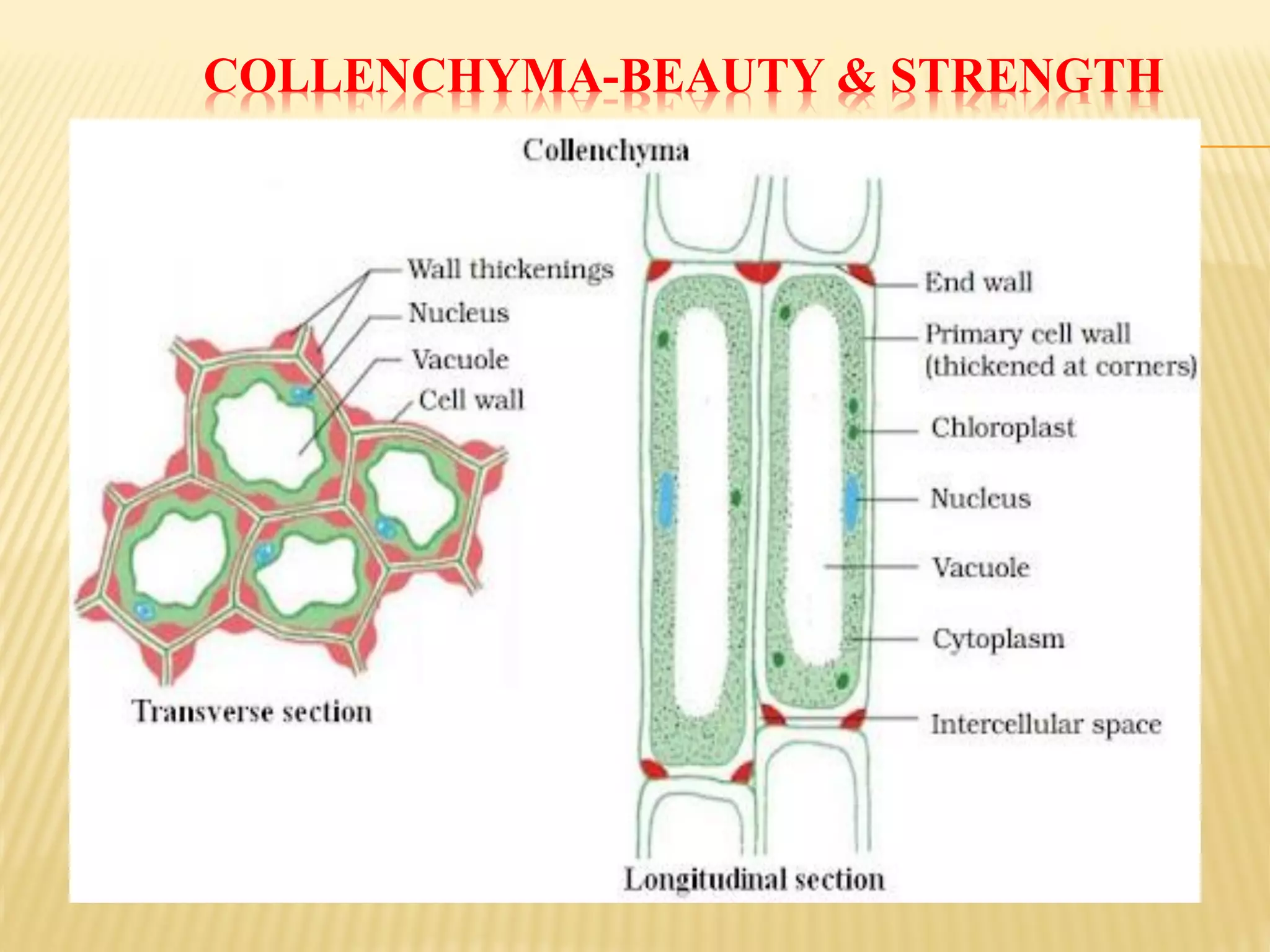
COLLENCHYMA-BEAUTY & STRENGTH
MECHANICAL TISSUES
 unevenly thickened cellulose walls. The sclerenchyma fibers,
as already stated, may be present in cortex, in pericycle, with
vascular elements and even in pith. They are undoubtedly the
most effective mechanical tissues. Sclereids may occur in
different parts of the plants for the same purpose.
 Collenchymas forms either continuous strands or isolated
patches in the superficial regions of the aerial organs of the
dicotyledons. They provide sufficient strength to the growing
organs. These tissues giving mechanical strength had been put
under a system, known as stereome, by some workers in the
last century. The tracheary elements of xylem—the xylem
fibers and extra-xylary fibers, bast fibers and wood fibers
constitute a major inputs in this regard .Thus, plants developed
different type of tissues with specialized structure to resist the
various forces of nature.
SCLERENCHYMA-STRENGTH
PROPERTIES
 tracheids and tracheae, are primarily meant for the conduction of
water and solutes. But as they possess thick lignified walls with
different types of localized thickenings, they possibly can give
mechanical support as well.
 Parenchyma tissues in stem have the micro fibrils oriented
transversely on the vertical walls so that the cells bend without
breaking and in root, the micro fibrils have steeply pitched and
helical orientation to resist extension pressure.
 Collenchymas tissues are characterized by their tensile strength and
plasticity. Some collenchymas sclerify and modify their walls in
such way they are able to withstand tensile and comprehensive
components of bending stress.
 Sclerenchyma having most plant lignin possess the hardness of a
steel. Sclerides give strength, resistance and inflexible protection
.They serve major mechanical attributes.
 Thus. Plants develop different type of specialized tissues to
withstand the adverse environmental condition as emerge from time
to time.
SCLERENCHYMA-ENGINEER
PROPERTIES OF MECHANICAL TISSUES
 In general, plants face bending, pulling and compression
pressure. So to resist these stresses, plants have distributed the
various mechanical tissues in the internal structures of the
different parts. The principles of distribution was in
conformity with the engineering principles involved in various
construction practiced in engineering sciences( Schwendener).
The plants achieved the resistance to various forces through
get max. Strength and stability with the minimum use of
materials by the tissue orientation and biomechanics of
different organs.
 PROPERITIES OF MECHANICAL TISSUES
 There are three principles based on which the mechanical
tissues have been distributed-inflexibility, inextensibility,
incompressibility. In addition to that, sheering stress is another
attributes in this regard.
 Inflexibility: It refers to the resistance to bending. The organs
which experience this are mainly aerial trunk, branches, stems,
petioles , peduncles, stalks of fruits, leaf blades etc as these are
called inflexible organs.
INFLEXIBILITY
 If a load is put at the middle portion of a straight girder
supported at the ends, the result would be a curvature when the
upper surface would be shortened and the lower lengthened.
That shows that the upper surface is subjected to compression
and the lower to tension, while at the middle portion tension
will come to zero. So requisite materials should be
concentrated on the two surfaces, which are regions of greatest
tension. The typical girders are constructed accordingly, so that
they appear as ‘I’ in cross-section.
 From this it is quite clear that to possess maximum
inflexibility in the I-girder, the strengthening material be
distributed on the peripheries known as flanges. The strength
of the girder depends on the strength of the flanges and it
increases in distance between the flanges. There is no need of
PROPERTIES
 strengthening materials at the neutral layers due to lack of
tension or zero tension.
 Thus, the I-girder can resist the bending forces whether it
comes from one side or the other side. The inflexible organs of
the plants have been constructed on the principles of I –girder
with multiple I-girders in ring to resist the bending due to
radial pressure.
 Inextensibility: It is the resistance to extension or pulling.The
roots and other organs are called inextensible organs. The
pulling of the water from well by a rope and the rope has a
tight winding of the fibers. The degree of the extensibility
depends on the cross sectional area of its resistant elements.
PROPERTIES
 The principle states that the force is evenly distributed and this
can not be satisfied unless the resisting structures are compact.
The more is the tightness of the resisting materials, the greater
is the efficiency to resist the extension pressure. Roots which
attach the plants to the soil or other substratum suffer from
longitudinal pull or tension. Mechanical tissues are
advantageously put in the central region in form of a compact
mass in these organs. The degree of resistance of course
depends on the cross sectional area of the mechanical
elements. Thus the roots have mechanical tissues associated
with the vascular elements inside the stele and built like
structure to perform the same a rope.
 Thus, the plants can withstand the adverse condition and
remain intact.
PROPERTIES
 INCOMPRESSIBILITY: It is the resistance to compressible
force. The axis of a spreading tree with its arrays of branches
and leaves has to bear the weight of the heavy crown, which
may be compared to putting a load at the top of a cylindrical
axis. Here the axis is subjected to longitudinal compression.
The mechanical tissues are effectively aggregated at the central
portion which serves as a solid column for withstanding
longitudinal compression. Therefore, the trunk is an
incompressible organ. The trunk of the plant is built on like a
pillar . In pillars, the strengthening material are found straight
and evenly distributed within the concrete materials and also
tagged to each other. This ensures the load passes to the
ground through the longitudinal axis without any damage to
the structure. Trunk in the plant is not only incompressible
part, it is also an inflexible structure as it is also subjected to
radial forces.
PROPERTIES
 Therefore, it is built on the principle of I-girder as well as like
a pillar to resist the both forces
 SHEARING STRESSES:
 The flat organs like the leaves are often subjected to violent
shearing stresses due to movement of surrounding air or water.
The wind currents work at right angles to the surface of the
leaves and cause considerable laceration. To stand against this
stress the I-girders present for securing inflexibility are firmly
held together by a large number of cross ties in form of veins
which often form a network.
 The I-girder arrangement is more pronounced in
monocotyledonous leaves, usually having parallel venation .
The margins of the leaves are particularly exposed to shearing
stresses. They have special arrangement for protection by
increased thickness of the epidermis, and frequent occurrence
of thick-walled collenchymas in the sub-epidermal region.
DISTRIBUTION OF MECHANICAL TISSUES
 Composite peripheral girders- Found in Cyperaceae &
Juncaginaceae,
 Sub-cortical fibro-vascular strands-Fibrous bundles have been
pushed from the surface into a more central position like in
Bamboo,
 Simple hollow cylinder or tube of stereome with embedded
mestome strands- Cylinders hollow but vascular strands are
fused, as found in the members of Liliaceae, Cucurbitaceae,
Chenopodiaceae etc,
 Peripheral hollow cylinder or tube of sterome reinforced by
isolated sub-epidermal girders-The flanges project from the
outer surface of the tubes at more or less regular intervals,
found in grasses.
MECHANICAL TISSUES INFLEXIBLE ORGANS
 Inflexible organs are those can resist bending and radial
forces. These organs include stems, branches, petioles,
inflorescence axis, flower axis, fruit stalks, seeds stalks etc.
The distribution of mechanical tissues are based on I-girder
principle. The mechanical tissues like collenchymas,
sclerenchyma, xylem tissues etc form the flanges and the
parenchyma, phloem tissues in between the flanges constitute
the web position of the girder. The multiple number of the
girders arranged in a ring to form a composite girder system in
cylindrical structures.
 Mainly five types of organization ( Haberlandt) of mechanical
tissues are found---
 Sub-epidermal girders-Found in Lamiaceae in square or
rectangular in outline
TISSUES IN INEXTENSIBLE STRUCTURES
 Inextensible structures are those subjected to longitudinal
stress and these include all such parts which attach the plants
to the substratum. These organs are roots, rhizomes, stilt roots
, fruit stalks etc. Here, the mechanical tissues are connected
into a single compact cable like central strand. More the
compactness, more the distribution of force to make it more
resistant. This is achieved by the formation of central
styereome3 bundle surrounded by several hadrome and
leptome groups. In the roots, stele remains compact by ring of
mechanical tissues. In some monocot climbers, longitudinal
tensions inextensibility is achieved by the sclerotic
development in the pith. In pendulous fruit stalks,
inextensibility is provided either by the contraction of fibrous
cylinder and by the strengthening of their fibrous sheaths
which accompany the internal merestome strands.
TISSUES IN INCOMPRESSIBLE STRUCTURES
 Incompressible organs faces compression pressures in plants
in trunk. Trunk bears the load of canopy and resists the radial
pressure. The trunk needs two mechanical needs-To resist
compression, To resist bending. So, the mechanical tissues
follows both the principle of incompressibility and
inflexibility. The Vascular bundles run upward to downward as
straight iron rods of a concrete pillar and transmit load to the
grounds. The secondary wood also bears the compression
pressure. The ring arrangement of the vascular bundles and the
concentric rings of the secondary wood and phloem provides
multiple I-girders and helps the trunk to withstand the radial
tensions., The stilt roots in Pandanus can withstand the
tensions due to their inextensible and inflexible properties. The
mechanical systems of stilt roots in maize having outer bast
fibers performs inflexibility and the inner serves
inextensibility.
THANKS FOR YOUR PLEASURE OF ENGINEERING IN PLANTS
ACKNOWLEDGEMENT
 Google for the different images,
 Different websites for content.
 Anatomy of angiosperms- Mishra & Dash
 Plant anatomy- B. P. Pandey,
 Plant anatomy- Pijush Roy
 Others.
 This presentation has been prepared for the UG students of
Indian Universities and other Universities without any
financial interest.

Mechanical tissues

  • 1.
    PLANT ANATOMY Welcome to MECHANICALTISSUES IN PLANTS Properties & -Significance. By N. Sannigrahi, Associate Professor, Department of Botany, Nistarini College, Purulia, 723101(W.B) India
  • 2.
  • 3.
    MECHANICAL TISSUES &PLANTS  Having wide range of habitats, plants have to withstand different environmental forces like force of gravity, wind, weather along with their body structure, weight and form. Mechanical tissues are such group of tissues as ‘Stereome’ coined by Haberlandt and ‘Sterides’ as cells of the tissues. Plants have to withstand-  Longitudinal compressions due to weight of the canopy,  Longitudinal pulling due to bending force as well as due to weight of some parts  Radial pressure and shearing stress , bending on any direction due to wind current.  The plants developed mechanical tissues with maximum possible requirements of rigidity, elasticity and the economy of the tissue deposition.
  • 4.
  • 5.
    MECHANICAL TISSUES  Thereare four major basic building blocks of the cell wall- cellulose, hemicelluloses, lignin and pectin. The microstructure of the plant cell walls varies in different type of plants with cellulose fibers reinforcing g in matrix of hemicelluloses and pectin or lignin in one or more layers with volume fraction and orientation of cellulosic fibers varying in each layer.  Some tissues are specially meant for providing mechanical strength or support to the plant members which are frequently subjected to various kinds of strains and stresses. The most important mechanical tissues are sclerenchyma fibers with highly lignified walls and peculiarly interlocked ends, sclereids, with massive lignified walls, and collenchymas with
  • 6.
  • 7.
    MECHANICAL TISSUES  unevenlythickened cellulose walls. The sclerenchyma fibers, as already stated, may be present in cortex, in pericycle, with vascular elements and even in pith. They are undoubtedly the most effective mechanical tissues. Sclereids may occur in different parts of the plants for the same purpose.  Collenchymas forms either continuous strands or isolated patches in the superficial regions of the aerial organs of the dicotyledons. They provide sufficient strength to the growing organs. These tissues giving mechanical strength had been put under a system, known as stereome, by some workers in the last century. The tracheary elements of xylem—the xylem fibers and extra-xylary fibers, bast fibers and wood fibers constitute a major inputs in this regard .Thus, plants developed different type of tissues with specialized structure to resist the various forces of nature.
  • 8.
  • 9.
    PROPERTIES  tracheids andtracheae, are primarily meant for the conduction of water and solutes. But as they possess thick lignified walls with different types of localized thickenings, they possibly can give mechanical support as well.  Parenchyma tissues in stem have the micro fibrils oriented transversely on the vertical walls so that the cells bend without breaking and in root, the micro fibrils have steeply pitched and helical orientation to resist extension pressure.  Collenchymas tissues are characterized by their tensile strength and plasticity. Some collenchymas sclerify and modify their walls in such way they are able to withstand tensile and comprehensive components of bending stress.  Sclerenchyma having most plant lignin possess the hardness of a steel. Sclerides give strength, resistance and inflexible protection .They serve major mechanical attributes.  Thus. Plants develop different type of specialized tissues to withstand the adverse environmental condition as emerge from time to time.
  • 10.
  • 11.
    PROPERTIES OF MECHANICALTISSUES  In general, plants face bending, pulling and compression pressure. So to resist these stresses, plants have distributed the various mechanical tissues in the internal structures of the different parts. The principles of distribution was in conformity with the engineering principles involved in various construction practiced in engineering sciences( Schwendener). The plants achieved the resistance to various forces through get max. Strength and stability with the minimum use of materials by the tissue orientation and biomechanics of different organs.  PROPERITIES OF MECHANICAL TISSUES  There are three principles based on which the mechanical tissues have been distributed-inflexibility, inextensibility, incompressibility. In addition to that, sheering stress is another attributes in this regard.  Inflexibility: It refers to the resistance to bending. The organs which experience this are mainly aerial trunk, branches, stems, petioles , peduncles, stalks of fruits, leaf blades etc as these are called inflexible organs.
  • 12.
    INFLEXIBILITY  If aload is put at the middle portion of a straight girder supported at the ends, the result would be a curvature when the upper surface would be shortened and the lower lengthened. That shows that the upper surface is subjected to compression and the lower to tension, while at the middle portion tension will come to zero. So requisite materials should be concentrated on the two surfaces, which are regions of greatest tension. The typical girders are constructed accordingly, so that they appear as ‘I’ in cross-section.  From this it is quite clear that to possess maximum inflexibility in the I-girder, the strengthening material be distributed on the peripheries known as flanges. The strength of the girder depends on the strength of the flanges and it increases in distance between the flanges. There is no need of
  • 13.
    PROPERTIES  strengthening materialsat the neutral layers due to lack of tension or zero tension.  Thus, the I-girder can resist the bending forces whether it comes from one side or the other side. The inflexible organs of the plants have been constructed on the principles of I –girder with multiple I-girders in ring to resist the bending due to radial pressure.  Inextensibility: It is the resistance to extension or pulling.The roots and other organs are called inextensible organs. The pulling of the water from well by a rope and the rope has a tight winding of the fibers. The degree of the extensibility depends on the cross sectional area of its resistant elements.
  • 14.
    PROPERTIES  The principlestates that the force is evenly distributed and this can not be satisfied unless the resisting structures are compact. The more is the tightness of the resisting materials, the greater is the efficiency to resist the extension pressure. Roots which attach the plants to the soil or other substratum suffer from longitudinal pull or tension. Mechanical tissues are advantageously put in the central region in form of a compact mass in these organs. The degree of resistance of course depends on the cross sectional area of the mechanical elements. Thus the roots have mechanical tissues associated with the vascular elements inside the stele and built like structure to perform the same a rope.  Thus, the plants can withstand the adverse condition and remain intact.
  • 15.
    PROPERTIES  INCOMPRESSIBILITY: Itis the resistance to compressible force. The axis of a spreading tree with its arrays of branches and leaves has to bear the weight of the heavy crown, which may be compared to putting a load at the top of a cylindrical axis. Here the axis is subjected to longitudinal compression. The mechanical tissues are effectively aggregated at the central portion which serves as a solid column for withstanding longitudinal compression. Therefore, the trunk is an incompressible organ. The trunk of the plant is built on like a pillar . In pillars, the strengthening material are found straight and evenly distributed within the concrete materials and also tagged to each other. This ensures the load passes to the ground through the longitudinal axis without any damage to the structure. Trunk in the plant is not only incompressible part, it is also an inflexible structure as it is also subjected to radial forces.
  • 16.
    PROPERTIES  Therefore, itis built on the principle of I-girder as well as like a pillar to resist the both forces  SHEARING STRESSES:  The flat organs like the leaves are often subjected to violent shearing stresses due to movement of surrounding air or water. The wind currents work at right angles to the surface of the leaves and cause considerable laceration. To stand against this stress the I-girders present for securing inflexibility are firmly held together by a large number of cross ties in form of veins which often form a network.  The I-girder arrangement is more pronounced in monocotyledonous leaves, usually having parallel venation . The margins of the leaves are particularly exposed to shearing stresses. They have special arrangement for protection by increased thickness of the epidermis, and frequent occurrence of thick-walled collenchymas in the sub-epidermal region.
  • 17.
    DISTRIBUTION OF MECHANICALTISSUES  Composite peripheral girders- Found in Cyperaceae & Juncaginaceae,  Sub-cortical fibro-vascular strands-Fibrous bundles have been pushed from the surface into a more central position like in Bamboo,  Simple hollow cylinder or tube of stereome with embedded mestome strands- Cylinders hollow but vascular strands are fused, as found in the members of Liliaceae, Cucurbitaceae, Chenopodiaceae etc,  Peripheral hollow cylinder or tube of sterome reinforced by isolated sub-epidermal girders-The flanges project from the outer surface of the tubes at more or less regular intervals, found in grasses.
  • 18.
    MECHANICAL TISSUES INFLEXIBLEORGANS  Inflexible organs are those can resist bending and radial forces. These organs include stems, branches, petioles, inflorescence axis, flower axis, fruit stalks, seeds stalks etc. The distribution of mechanical tissues are based on I-girder principle. The mechanical tissues like collenchymas, sclerenchyma, xylem tissues etc form the flanges and the parenchyma, phloem tissues in between the flanges constitute the web position of the girder. The multiple number of the girders arranged in a ring to form a composite girder system in cylindrical structures.  Mainly five types of organization ( Haberlandt) of mechanical tissues are found---  Sub-epidermal girders-Found in Lamiaceae in square or rectangular in outline
  • 19.
    TISSUES IN INEXTENSIBLESTRUCTURES  Inextensible structures are those subjected to longitudinal stress and these include all such parts which attach the plants to the substratum. These organs are roots, rhizomes, stilt roots , fruit stalks etc. Here, the mechanical tissues are connected into a single compact cable like central strand. More the compactness, more the distribution of force to make it more resistant. This is achieved by the formation of central styereome3 bundle surrounded by several hadrome and leptome groups. In the roots, stele remains compact by ring of mechanical tissues. In some monocot climbers, longitudinal tensions inextensibility is achieved by the sclerotic development in the pith. In pendulous fruit stalks, inextensibility is provided either by the contraction of fibrous cylinder and by the strengthening of their fibrous sheaths which accompany the internal merestome strands.
  • 20.
    TISSUES IN INCOMPRESSIBLESTRUCTURES  Incompressible organs faces compression pressures in plants in trunk. Trunk bears the load of canopy and resists the radial pressure. The trunk needs two mechanical needs-To resist compression, To resist bending. So, the mechanical tissues follows both the principle of incompressibility and inflexibility. The Vascular bundles run upward to downward as straight iron rods of a concrete pillar and transmit load to the grounds. The secondary wood also bears the compression pressure. The ring arrangement of the vascular bundles and the concentric rings of the secondary wood and phloem provides multiple I-girders and helps the trunk to withstand the radial tensions., The stilt roots in Pandanus can withstand the tensions due to their inextensible and inflexible properties. The mechanical systems of stilt roots in maize having outer bast fibers performs inflexibility and the inner serves inextensibility.
  • 21.
    THANKS FOR YOURPLEASURE OF ENGINEERING IN PLANTS
  • 22.
    ACKNOWLEDGEMENT  Google forthe different images,  Different websites for content.  Anatomy of angiosperms- Mishra & Dash  Plant anatomy- B. P. Pandey,  Plant anatomy- Pijush Roy  Others.  This presentation has been prepared for the UG students of Indian Universities and other Universities without any financial interest.