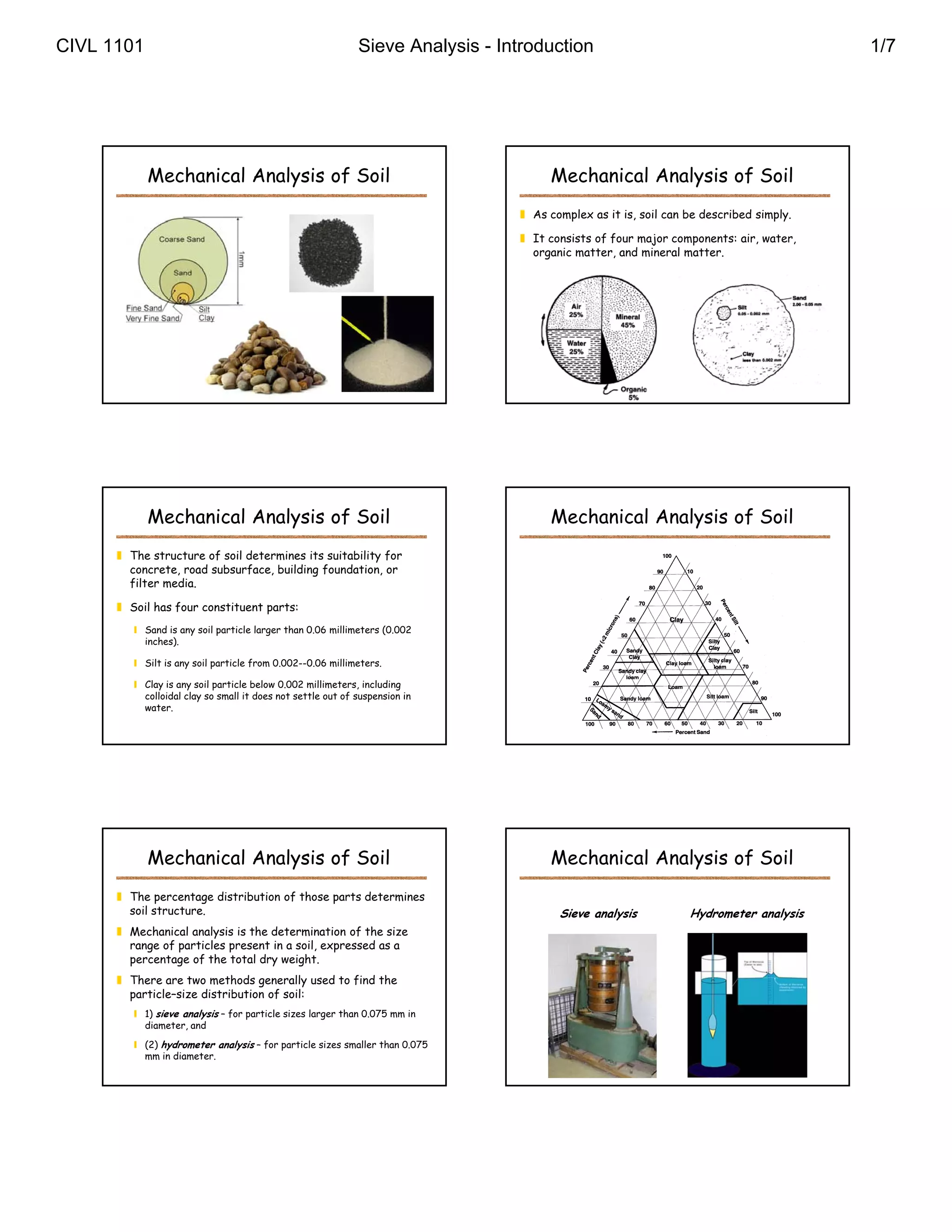
CIVL 1101                                                    Sieve Analysis - Introduction                                             1/7


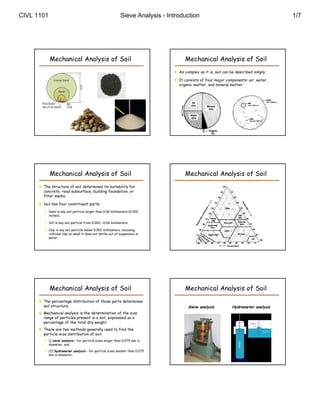
            Mechanical Analysis of Soil                                              Mechanical Analysis of Soil
                                                                                 As complex as it is, soil can be described simply.

                                                                                 It consists of four major components: air, water,
                                                                                  organic matter, and mineral matter.


            Mechanical Analysis of Soil                                              Mechanical Analysis of Soil
       The structure of soil determines its suitability for
        concrete, road subsurface, building foundation, or
        filter media.

       Soil has four constituent parts:
          Sand is any soil particle larger than 0.06 millimeters (0.002
           inches).

          Silt is any soil particle from 0.002--0.06 millimeters.

          Clay is any soil particle below 0.002 millimeters, including
           colloidal clay so small it does not settle out of suspension in
           water.


            Mechanical Analysis of Soil                                              Mechanical Analysis of Soil
       The percentage distribution of those parts determines
        soil structure.                                                                Sieve analysis           Hydrometer analysis
       Mechanical analysis is the determination of the size
        range of particles present in a soil, expressed as a
        percentage of the total d weight.
        p     t      f th t t l dry     i ht
       There are two methods generally used to find the
        particle–size distribution of soil:
          1) sieve analysis – for particle sizes larger than 0.075 mm in
           diameter, and

          (2) hydrometer analysis – for particle sizes smaller than 0.075
           mm in diameter.
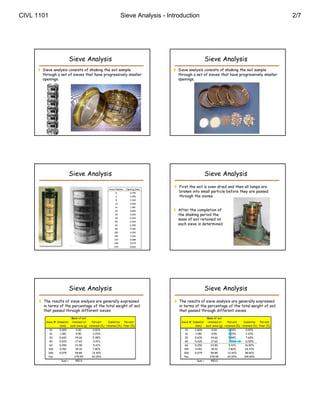
CIVL 1101                                                         Sieve Analysis - Introduction                                                                 2/7


                            Sieve Analysis                                                                    Sieve Analysis
      Sieve analysis consists of shaking the soil sample                               Sieve analysis consists of shaking the soil sample
       through a set of sieves that have progressively smaller                           through a set of sieves that have progressively smaller
       openings.                                                                         openings.


                            Sieve Analysis                                                                    Sieve Analysis
                                                                                        First the soil is oven dried and then all lumps are
                                                        Sieve Number    Opening (mm)
                                                             4             4.750         broken into small particle before they are passed
                                                             6             3.350         through the sieves
                                                             8             2.360
                                                             10            2.000
                                                             16            1.180
                                                                           1 180
                                                            20             0.850        After the completion of
                                                            30             0.600         the shaking period the
                                                            40             0.425
                                                                                         mass of soil retained on
                                                            50             0.300
                                                            60             0.250         each sieve is determined
                                                            80             0.180
                                                            100            0.150
                                                            140            0.106
                                                            170            0.088
                                                            200            0.075
                                                            270            0.053


                            Sieve Analysis                                                                    Sieve Analysis
       The results of sieve analysis are generally expressed                           The results of sieve analysis are generally expressed
        in terms of the percentage of the total weight of soil                           in terms of the percentage of the total weight of soil
        that passed through different sieves                                             that passed through different sieves
                          Mass of soil                                                                      Mass of soil
         Sieve # Di m t
         Si      Diameter retained on
                            t in d n      Percent
                                          P     nt    Cumlative
                                                      C ml ti      Percent
                                                                   P     nt                Sieve # Di m t
                                                                                           Si      Diameter retained on
                                                                                                              t in d n      Percent
                                                                                                                            P     nt    Cumlative
                                                                                                                                        C ml ti      Percent
                                                                                                                                                     P     nt
                   (mm)  each sieve (g) retained (%) retained (%) finer (%)                          (mm)  each sieve (g) retained (%) retained (%) finer (%)
            10    2.000        0.00        0.00%        0.00%          100.00%               10     2.000        0.00        0.00%        0.00%      100.00%
            16    1.180        9.90        2.20%        2.20%          97.80%                16     1.180        9.90        2.20%        2.20%      97.80%
           30     0.600        24.66       5.48%         7.68%          92.32%              30      0.600        24.66       5.48%         7.68%      92.32%
           40     0.425        17.60        3.91%       11.59%          88.41%              40      0.425        17.60        3.91%       11.59%      88.41%
           60     0.250        23.90        5.31%       16.90%          83.10%              60      0.250        23.90        5.31%       16.90%      83.10%
           100    0.150        35.10       7.80%        24.70%         75.30%               100     0.150        35.10       7.80%        24.70%     75.30%
           200    0.075        59.85       13.30%       38.00%         62.00%               200     0.075        59.85       13.30%       38.00%     62.00%
           Pan                278.99       62.00%      100.00%           0.00%              Pan                 278.99       62.00%      100.00%       0.00%
                    Sum =     450.0                                                                   Sum =     450.0
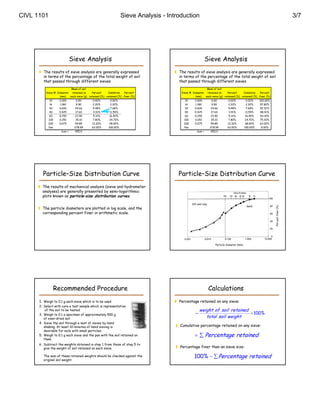
CIVL 1101                                                         Sieve Analysis - Introduction                                                                                     3/7


                             Sieve Analysis                                                                 Sieve Analysis
       The results of sieve analysis are generally expressed                         The results of sieve analysis are generally expressed
        in terms of the percentage of the total weight of soil                         in terms of the percentage of the total weight of soil
        that passed through different sieves                                           that passed through different sieves
                           Mass of soil                                                                   Mass of soil
          Sieve # Di m t
          Si      Diameter retained on
                             t in d n      Percent
                                           P     nt    Cumlative
                                                       C ml ti      Percent
                                                                    P     nt             Sieve # Di m t
                                                                                         Si      Diameter retained on
                                                                                                            t in d n      Percent
                                                                                                                          P     nt    Cumlative
                                                                                                                                      C ml ti      Percent
                                                                                                                                                   P     nt
                    (mm)  each sieve (g) retained (%) retained (%) finer (%)                       (mm)  each sieve (g) retained (%) retained (%) finer (%)
             10    2.000        0.00        0.00%        0.00%      100.00%                10     2.000          0.00       0.00%            0.00%    100.00%
             16    1.180        9.90        2.20%        2.20%      97.80%                 16     1.180          9.90       2.20%            2.20%    97.80%
            30     0.600        24.66       5.48%         7.68%      92.32%               30      0.600          24.66      5.48%             7.68%    92.32%
            40     0.425        17.60        3.91%       11.59%      88.41%               40      0.425          17.60       3.91%           11.59%    88.41%
            60     0.250        23.90        5.31%       16.90%      83.10%               60      0.250          23.90       5.31%           16.90%    83.10%
            100    0.150        35.10       7.80%        24.70%     75.30%                100     0.150          35.10      7.80%            24.70%   75.30%
            200    0.075        59.85       13.30%       38.00%     62.00%                200     0.075          59.85      13.30%           38.00%   62.00%
            Pan                278.99       62.00%      100.00%       0.00%               Pan                   278.99      62.00%          100.00%     0.00%
                     Sum =     450.0                                                                Sum =       450.0


        Particle–Size Distribution Curve                                               Particle–Size Distribution Curve
      The results of mechanical analysis (sieve and hydrometer
       analyses) are generally presented by semi–logarithmic
       plots known as particle–size distribution curves.
                                                                                                Silt and clay
                                                                                                                                             Sand


                                                                                                                                                                               %)
      Th particle diameters are plotted in log scale, and the
       The    ti l di    t         l tt d i l      l     d th


                                                                                                                                                                Percent finer (%
       corresponding percent finer in arithmetic scale.


                                                                                                                   Particle diameter (mm)


               Recommended Procedure                                                                            Calculations
      1. Weigh to 0.1 g each sieve which is to be used                                Percentage retained on any sieve:
      2. Select with care a test sample which is representative
          of the soil to be tested                                                                     weight of soil retained
      3. Weigh to 0.1 a specimen of approximately 500 g                                                                        100%
         of oven–dried soil                                                                               total soil weight
      4. Sieve the soil through a nest of sieves by hand
         shaking. At least 10 minutes of hand sieving is                               Cumulative percentage retained on any sieve:
         desirable for soils with small particles.
      5. Weigh to 0.1 g each sieve and the pan with the soil retained on                            Percentage retained
         them.
      6. Subtract the weights obtained in step 1 from those of step 5 to
         give the weight of soil retained on each sieve.                               Percentage finer than an sieve size:

        The sum of these retained weights should be checked against the                           100%   Percentage retained
        original soil weight.
CIVL 1101                                                      Sieve Analysis - Introduction                                                                                                  4/7


      Effective Size, Uniformity Coefficient, and                                                        Reading Semi-Logarithmic Scales
               Coefficient of Gradation
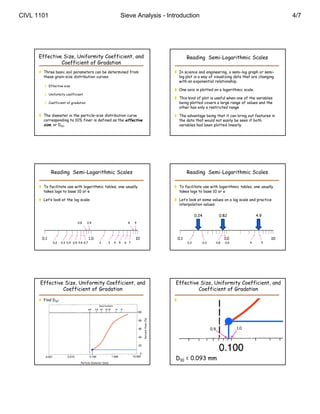
       Three basic soil parameters can be determined from                                         In science and engineering, a semi-log graph or semi-
        these grain–size distribution curves:                                                       log plot is a way of visualizing data that are changing
                                                                                                    with an exponential relationship.
          Effective size
                                                                                                   One axis is plotted on a logarithmic scale.
          Uniformity coefficient
                                                                                                   This kind of plot is useful when one of the variables
          Coefficient of gradation                                                                 being plotted covers a large range of values and the
                                                                                                    other has only a restricted range

       The diameter in the particle–size distribution curve                                       The advantage being that it can bring out features in
        corresponding to 10% finer is defined as the effective                                      the data that would not easily be seen if both
        size, or D10.                                                                               variables had been plotted linearly.


             Reading Semi-Logarithmic Scales                                                             Reading Semi-Logarithmic Scales

       To facilitate use with logarithmic tables, one usually                                     To facilitate use with logarithmic tables, one usually
        takes logs to base 10 or e                                                                  takes logs to base 10 or e

       Let’s look at the log scale:                                                               Let’s look at some values on a log scale and practice
                                                                                                    interpolation values:

                                                                                                               0.24                 0.82                       4.9
                               0.8     0.9                          8    9


       0.1                                1.0                            10                        0.1                                  1.0                          10
              0.2   0.3 0.4 0.5 0.6 0.7         2      3   4   5   6 7                                   0.2          0.3         0.8   0.9                4     5


      Effective Size, Uniformity Coefficient, and                                                 Effective Size, Uniformity Coefficient, and
               Coefficient of Gradation                                                                    Coefficient of Gradation

       Find D10:                                                                                  Find D10:
                                                                              Percent finer (%)


                                                                                                                                                                          Percent finer (%)
                                                                                            (


                                                                                                                                                                                        (


                                                                                                                            0.9                   1.0


                                                                                                  D10 = 0.093 mm
                                  Particle diameter (mm)                                                                          Particle diameter (mm)
CIVL 1101                                          Sieve Analysis - Introduction                                                                                             5/7


      Effective Size, Uniformity Coefficient, and                      Effective Size, Uniformity Coefficient, and
               Coefficient of Gradation                                         Coefficient of Gradation

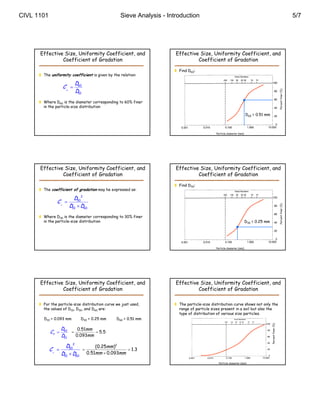
                                                                       Find D60:
       The uniformity coefficient is given by the relation:

                          D60
                   Cu 
                          D10


                                                                                                                                                         Percent finer (%)
                                                                                                                                                                       (
       Where D60 is the diameter corresponding to 60% finer
        in the particle-size distribution

                                                                                                                     D60 = 0.51 mm


                                                                                            Particle diameter (mm)


      Effective Size, Uniformity Coefficient, and                      Effective Size, Uniformity Coefficient, and
               Coefficient of Gradation                                         Coefficient of Gradation

                                                                       Find D30:
       The coefficient of gradation may he expressed as:

                        D302
               Cc 
                      D10  D60


                                                                                                                                                         Percent finer (%)
                                                                                                                                                                       (
       Where D30 is the diameter corresponding to 30% finer
        in the particle-size distribution                                                                            D30 = 0.25 mm


                                                                                            Particle diameter (mm)


      Effective Size, Uniformity Coefficient, and                      Effective Size, Uniformity Coefficient, and
               Coefficient of Gradation                                         Coefficient of Gradation

       For the particle-size distribution curve we just used,         The particle–size distribution curve shows not only the
        the values of D10, D30, and D60 are:                            range of particle sizes present in a soil but also the
                                                                        type of distribution of various size particles.
        D10 = 0.093 mm       D30 = 0.25 mm       D60 = 0.51 mm
                                                                                                                                     Percent finer (%)


                   D60    0.51mm
            Cu                  5.5
                   D10   0.093mm

                     D302        (0.25mm )2
            Cc                               1.3
                   D10  D60 0.51mm  0.093mm
                                                                                              Particle diameter (mm)
CIVL 1101                                                     Sieve Analysis - Introduction                                                                                                       6/7


      Effective Size, Uniformity Coefficient, and                                      Effective Size, Uniformity Coefficient, and
               Coefficient of Gradation                                                         Coefficient of Gradation

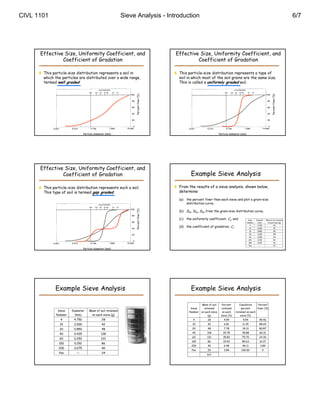
       This particle-size distribution represents a soil in                            This particle-size distribution represents a type of
        which the particles are distributed over a wide range,                           soil in which most of the soil grains are the same size.
        termed well graded                                                               This is called a uniformly graded soil.


                                                                   Percent finer (%)


                                                                                                                                                                              Percent finer (%)
                                  Particle diameter (mm)                                                                Particle diameter (mm)


      Effective Size, Uniformity Coefficient, and
               Coefficient of Gradation                                                         Example Sieve Analysis

       This particle-size distribution represents such a soil.                         From the results of a sieve analysis, shown below,
        This type of soil is termed gap graded.                                          determine:

                                                                                         (a) the percent finer than each sieve and plot a grain–size
                                                                                             distribution curve,

                                                                                         (b) D10, D30, D60 from the grain–size distribution curve,
                                                                   Percent finer (%)


                                                                                         (c) the uniformity coefficient, Cu, and                  Sieve   Diameter     Mass of soil retained
                                                                                                                                                 Number     (mm)        on each sieve (g)

                                                                                         (d) the coefficient of gradation, Cc.                     4
                                                                                                                                                   10
                                                                                                                                                           4.750
                                                                                                                                                           2.000
                                                                                                                                                                                     28
                                                                                                                                                                                     42
                                                                                                                                                  20       0.850                     48
                                                                                                                                                  40       0.425                   128
                                                                                                                                                  60       0.250                   221
                                                                                                                                                  100      0.150                     86
                                                                                                                                                  200      0.075                     40
                                                                                                                                                  Pan        ––                      24
                                  Particle diameter (mm)


               Example Sieve Analysis                                                           Example Sieve Analysis

                                                                                                         Mass of soil     Percent       Cumulative     Percent
                                                                                                Sieve     retained       retained         percent     finer (%)
                Sieve   Diameter      Mass of soil retained                                    Number   on each sieve     on each    retained on each
               Number     (mm)         on each sieve (g)                                                     (g)         sieve (%)       sieve (%)
                  4      4.750                  28                                                4          28             4.54           4.54              95.46
                 10      2.000                  42                                               10          42             6.81          11.35              88.65
                 20      0.850                  48                                               20          48             7.78          19.13              80.87

                 40      0.425                  128                                              40         128            20.75          39.88              60.12
                                                                                                 60         221            35.82          75.70              24.30
                 60      0.250                  221
                                                                                                 100         86            19.93          89.63              10.37
                 100      0.150                 86
                                                                                                 200         40             6.48          96.11               3.89
                 200     0.075                  40
                                                                                                 Pan         24            3.89           100.00                   0
                 Pan       ––                   24
                                                                                                            617
CIVL 1101                                                               Sieve Analysis - Introduction                                                                            7/7


              Example Sieve Analysis                                                                                           Example Sieve Analysis

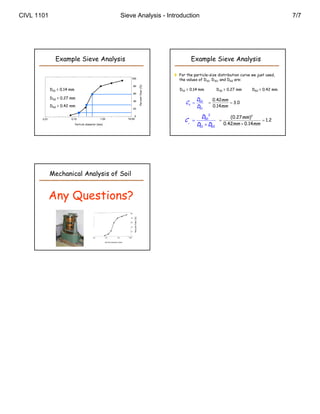
                                                                                                                       For the particle-size distribution curve we just used,
                                                                                                                        the values of D10, D30, and D60 are:


                                                                                                  Percent finer (%)
            D10 = 0.14 mm                                                                                               D10 = 0.14 mm         D30 = 0.27 mm      D60 = 0.42 mm

            D30 = 0.27 mm                                                                                                          D60       0.42mm
                                                                                                                            Cu                     3.0
            D60 = 0.42 mm                                                                                                          D10       0.14mm

                                                                                                                                     D302         (0.27mm )2
                                                                                                                           Cc                                 1.2
                            Particle diameter (mm)                                                                                 D10  D60   0.42mm  0.14mm


            Mechanical Analysis of Soil


            Any Questions?
                                                                              Percent finer (%)


                                                     Particle diameter (mm)

Mechanical analysis

  • 1.
    CIVL 1101 Sieve Analysis - Introduction 1/7 Mechanical Analysis of Soil Mechanical Analysis of Soil  As complex as it is, soil can be described simply.  It consists of four major components: air, water, organic matter, and mineral matter. Mechanical Analysis of Soil Mechanical Analysis of Soil  The structure of soil determines its suitability for concrete, road subsurface, building foundation, or filter media.  Soil has four constituent parts:  Sand is any soil particle larger than 0.06 millimeters (0.002 inches).  Silt is any soil particle from 0.002--0.06 millimeters.  Clay is any soil particle below 0.002 millimeters, including colloidal clay so small it does not settle out of suspension in water. Mechanical Analysis of Soil Mechanical Analysis of Soil  The percentage distribution of those parts determines soil structure. Sieve analysis Hydrometer analysis  Mechanical analysis is the determination of the size range of particles present in a soil, expressed as a percentage of the total d weight. p t f th t t l dry i ht  There are two methods generally used to find the particle–size distribution of soil:  1) sieve analysis – for particle sizes larger than 0.075 mm in diameter, and  (2) hydrometer analysis – for particle sizes smaller than 0.075 mm in diameter.
  • 2.
    CIVL 1101 Sieve Analysis - Introduction 2/7 Sieve Analysis Sieve Analysis  Sieve analysis consists of shaking the soil sample  Sieve analysis consists of shaking the soil sample through a set of sieves that have progressively smaller through a set of sieves that have progressively smaller openings. openings. Sieve Analysis Sieve Analysis  First the soil is oven dried and then all lumps are Sieve Number Opening (mm) 4 4.750 broken into small particle before they are passed 6 3.350 through the sieves 8 2.360 10 2.000 16 1.180 1 180 20 0.850  After the completion of 30 0.600 the shaking period the 40 0.425 mass of soil retained on 50 0.300 60 0.250 each sieve is determined 80 0.180 100 0.150 140 0.106 170 0.088 200 0.075 270 0.053 Sieve Analysis Sieve Analysis  The results of sieve analysis are generally expressed  The results of sieve analysis are generally expressed in terms of the percentage of the total weight of soil in terms of the percentage of the total weight of soil that passed through different sieves that passed through different sieves Mass of soil Mass of soil Sieve # Di m t Si Diameter retained on t in d n Percent P nt Cumlative C ml ti Percent P nt Sieve # Di m t Si Diameter retained on t in d n Percent P nt Cumlative C ml ti Percent P nt (mm) each sieve (g) retained (%) retained (%) finer (%) (mm) each sieve (g) retained (%) retained (%) finer (%) 10 2.000 0.00 0.00% 0.00% 100.00% 10 2.000 0.00 0.00% 0.00% 100.00% 16 1.180 9.90 2.20% 2.20% 97.80% 16 1.180 9.90 2.20% 2.20% 97.80% 30 0.600 24.66 5.48% 7.68% 92.32% 30 0.600 24.66 5.48% 7.68% 92.32% 40 0.425 17.60 3.91% 11.59% 88.41% 40 0.425 17.60 3.91% 11.59% 88.41% 60 0.250 23.90 5.31% 16.90% 83.10% 60 0.250 23.90 5.31% 16.90% 83.10% 100 0.150 35.10 7.80% 24.70% 75.30% 100 0.150 35.10 7.80% 24.70% 75.30% 200 0.075 59.85 13.30% 38.00% 62.00% 200 0.075 59.85 13.30% 38.00% 62.00% Pan 278.99 62.00% 100.00% 0.00% Pan 278.99 62.00% 100.00% 0.00% Sum = 450.0 Sum = 450.0
  • 3.
    CIVL 1101 Sieve Analysis - Introduction 3/7 Sieve Analysis Sieve Analysis  The results of sieve analysis are generally expressed  The results of sieve analysis are generally expressed in terms of the percentage of the total weight of soil in terms of the percentage of the total weight of soil that passed through different sieves that passed through different sieves Mass of soil Mass of soil Sieve # Di m t Si Diameter retained on t in d n Percent P nt Cumlative C ml ti Percent P nt Sieve # Di m t Si Diameter retained on t in d n Percent P nt Cumlative C ml ti Percent P nt (mm) each sieve (g) retained (%) retained (%) finer (%) (mm) each sieve (g) retained (%) retained (%) finer (%) 10 2.000 0.00 0.00% 0.00% 100.00% 10 2.000 0.00 0.00% 0.00% 100.00% 16 1.180 9.90 2.20% 2.20% 97.80% 16 1.180 9.90 2.20% 2.20% 97.80% 30 0.600 24.66 5.48% 7.68% 92.32% 30 0.600 24.66 5.48% 7.68% 92.32% 40 0.425 17.60 3.91% 11.59% 88.41% 40 0.425 17.60 3.91% 11.59% 88.41% 60 0.250 23.90 5.31% 16.90% 83.10% 60 0.250 23.90 5.31% 16.90% 83.10% 100 0.150 35.10 7.80% 24.70% 75.30% 100 0.150 35.10 7.80% 24.70% 75.30% 200 0.075 59.85 13.30% 38.00% 62.00% 200 0.075 59.85 13.30% 38.00% 62.00% Pan 278.99 62.00% 100.00% 0.00% Pan 278.99 62.00% 100.00% 0.00% Sum = 450.0 Sum = 450.0 Particle–Size Distribution Curve Particle–Size Distribution Curve  The results of mechanical analysis (sieve and hydrometer analyses) are generally presented by semi–logarithmic plots known as particle–size distribution curves. Silt and clay Sand %)  Th particle diameters are plotted in log scale, and the The ti l di t l tt d i l l d th Percent finer (% corresponding percent finer in arithmetic scale. Particle diameter (mm) Recommended Procedure Calculations 1. Weigh to 0.1 g each sieve which is to be used  Percentage retained on any sieve: 2. Select with care a test sample which is representative of the soil to be tested weight of soil retained 3. Weigh to 0.1 a specimen of approximately 500 g   100% of oven–dried soil total soil weight 4. Sieve the soil through a nest of sieves by hand shaking. At least 10 minutes of hand sieving is  Cumulative percentage retained on any sieve: desirable for soils with small particles. 5. Weigh to 0.1 g each sieve and the pan with the soil retained on   Percentage retained them. 6. Subtract the weights obtained in step 1 from those of step 5 to give the weight of soil retained on each sieve.  Percentage finer than an sieve size: The sum of these retained weights should be checked against the 100%   Percentage retained original soil weight.
  • 4.
    CIVL 1101 Sieve Analysis - Introduction 4/7 Effective Size, Uniformity Coefficient, and Reading Semi-Logarithmic Scales Coefficient of Gradation  Three basic soil parameters can be determined from  In science and engineering, a semi-log graph or semi- these grain–size distribution curves: log plot is a way of visualizing data that are changing with an exponential relationship.  Effective size  One axis is plotted on a logarithmic scale.  Uniformity coefficient  This kind of plot is useful when one of the variables  Coefficient of gradation being plotted covers a large range of values and the other has only a restricted range  The diameter in the particle–size distribution curve  The advantage being that it can bring out features in corresponding to 10% finer is defined as the effective the data that would not easily be seen if both size, or D10. variables had been plotted linearly. Reading Semi-Logarithmic Scales Reading Semi-Logarithmic Scales  To facilitate use with logarithmic tables, one usually  To facilitate use with logarithmic tables, one usually takes logs to base 10 or e takes logs to base 10 or e  Let’s look at the log scale:  Let’s look at some values on a log scale and practice interpolation values: 0.24 0.82 4.9 0.8 0.9 8 9 0.1 1.0 10 0.1 1.0 10 0.2 0.3 0.4 0.5 0.6 0.7 2 3 4 5 6 7 0.2 0.3 0.8 0.9 4 5 Effective Size, Uniformity Coefficient, and Effective Size, Uniformity Coefficient, and Coefficient of Gradation Coefficient of Gradation  Find D10:  Find D10: Percent finer (%) Percent finer (%) ( ( 0.9 1.0 D10 = 0.093 mm Particle diameter (mm) Particle diameter (mm)
  • 5.
    CIVL 1101 Sieve Analysis - Introduction 5/7 Effective Size, Uniformity Coefficient, and Effective Size, Uniformity Coefficient, and Coefficient of Gradation Coefficient of Gradation  Find D60:  The uniformity coefficient is given by the relation: D60 Cu  D10 Percent finer (%) (  Where D60 is the diameter corresponding to 60% finer in the particle-size distribution D60 = 0.51 mm Particle diameter (mm) Effective Size, Uniformity Coefficient, and Effective Size, Uniformity Coefficient, and Coefficient of Gradation Coefficient of Gradation  Find D30:  The coefficient of gradation may he expressed as: D302 Cc  D10  D60 Percent finer (%) (  Where D30 is the diameter corresponding to 30% finer in the particle-size distribution D30 = 0.25 mm Particle diameter (mm) Effective Size, Uniformity Coefficient, and Effective Size, Uniformity Coefficient, and Coefficient of Gradation Coefficient of Gradation  For the particle-size distribution curve we just used,  The particle–size distribution curve shows not only the the values of D10, D30, and D60 are: range of particle sizes present in a soil but also the type of distribution of various size particles. D10 = 0.093 mm D30 = 0.25 mm D60 = 0.51 mm Percent finer (%) D60 0.51mm Cu    5.5 D10 0.093mm D302 (0.25mm )2 Cc    1.3 D10  D60 0.51mm  0.093mm Particle diameter (mm)
  • 6.
    CIVL 1101 Sieve Analysis - Introduction 6/7 Effective Size, Uniformity Coefficient, and Effective Size, Uniformity Coefficient, and Coefficient of Gradation Coefficient of Gradation  This particle-size distribution represents a soil in  This particle-size distribution represents a type of which the particles are distributed over a wide range, soil in which most of the soil grains are the same size. termed well graded This is called a uniformly graded soil. Percent finer (%) Percent finer (%) Particle diameter (mm) Particle diameter (mm) Effective Size, Uniformity Coefficient, and Coefficient of Gradation Example Sieve Analysis  This particle-size distribution represents such a soil.  From the results of a sieve analysis, shown below, This type of soil is termed gap graded. determine: (a) the percent finer than each sieve and plot a grain–size distribution curve, (b) D10, D30, D60 from the grain–size distribution curve, Percent finer (%) (c) the uniformity coefficient, Cu, and Sieve Diameter Mass of soil retained Number (mm) on each sieve (g) (d) the coefficient of gradation, Cc. 4 10 4.750 2.000 28 42 20 0.850 48 40 0.425 128 60 0.250 221 100 0.150 86 200 0.075 40 Pan –– 24 Particle diameter (mm) Example Sieve Analysis Example Sieve Analysis Mass of soil Percent Cumulative Percent Sieve retained retained percent finer (%) Sieve Diameter Mass of soil retained Number on each sieve on each retained on each Number (mm) on each sieve (g) (g) sieve (%) sieve (%) 4 4.750 28 4 28 4.54 4.54 95.46 10 2.000 42 10 42 6.81 11.35 88.65 20 0.850 48 20 48 7.78 19.13 80.87 40 0.425 128 40 128 20.75 39.88 60.12 60 221 35.82 75.70 24.30 60 0.250 221 100 86 19.93 89.63 10.37 100 0.150 86 200 40 6.48 96.11 3.89 200 0.075 40 Pan 24 3.89 100.00 0 Pan –– 24 617
  • 7.
    CIVL 1101 Sieve Analysis - Introduction 7/7 Example Sieve Analysis Example Sieve Analysis  For the particle-size distribution curve we just used, the values of D10, D30, and D60 are: Percent finer (%) D10 = 0.14 mm D10 = 0.14 mm D30 = 0.27 mm D60 = 0.42 mm D30 = 0.27 mm D60 0.42mm Cu    3.0 D60 = 0.42 mm D10 0.14mm D302 (0.27mm )2 Cc    1.2 Particle diameter (mm) D10  D60 0.42mm  0.14mm Mechanical Analysis of Soil Any Questions? Percent finer (%) Particle diameter (mm)