Profile Highlights
Dr. ASHIK BELLARY AMIE, MISTE
ORCiD: 00000001-8462-7692
Assistant Professor
KLS VDIT,
Haliyal – 581329 Karnataka
 Reviewer for International Journal of Pavement Research and Technology,
Springer Publisher.
 Invited as a Reviewer for the 2nd International Conference on
“Transportation Infrastructure Projects – Conception to Execution”
(TIPCE2022) to be held during September 14-17, 2022, organized by the
Department of Civil Engineering, IIT Roorkee.
 Reviewer for the 8th International Conference on Transportation Systems
Engineering & Management (CTSEM 2021), held during August 26-27,
2021, was organized by the Department of Civil Engineering, National
Institute of Technology, Calicut.
1
Profile Highlights
 Selected in the Campus Interview of Larsen & Toubro Limited (Geo-
structure IC) in 2013, held in KLE Technological University, Hubli.
 Qualified GATE - 2014 in Civil Engineering paper (score = 359 and
percentile = 86.97 %).
 Received Prof. C E G Justo Gold Medal in 53rd Bangalore University
convocation for scoring highest marks in ME - Highway Engineering.
 Received the Best Project of the Year – 2017 (For Guiding the Project)
award in KSCST’s SPP exhibition held at NMAM Institute of Technology,
Nitte.
 Published Total = 04 articles out of which SCI indexed Journal = 01
(Impact factor 4.139), Scopus indexed Journal = 01, Scopus indexed
conference proceedings = 02 and Scopus indexed book chapter = 01
 Presented paper in 6 International conferences.
 Participated in more than 12 National workshops/FDP.
2
Profile Highlights
 “Experimental and Numerical Study on Performance of Undowelled
Joints in Concrete Pavements” (August 2017 – June 2022) PhD
Dissertation work.
 “Fatigue Behaviour of Stone Matrix Asphalt Mix Prepared Using
Cement, Stone Dust as Filler Material and Bagasse as Stabilizing
Additive” (August 2015 - June 2016) Final year ME project.
 “Upgradation of Road stretch of SH-34 connecting Inamhongal to Hire-
Ulligere: A detailed project report (DPR)” submitted in partial
fulfillment of ME degree (August 2015 – January 2016).
 “Congestion Reducing Measures in Dharwad CBD Area” (August 2013 -
June 2014). Major Project in final year of BE related to transportation
engineering.
3
Outline
 Introduction
 Need for bituminous mix design
 Requirements of mix
 Desirable properties of mix
 Mix design methods
 Mix design steps
 References
4
Bituminous mix design
Introduction
Pavement
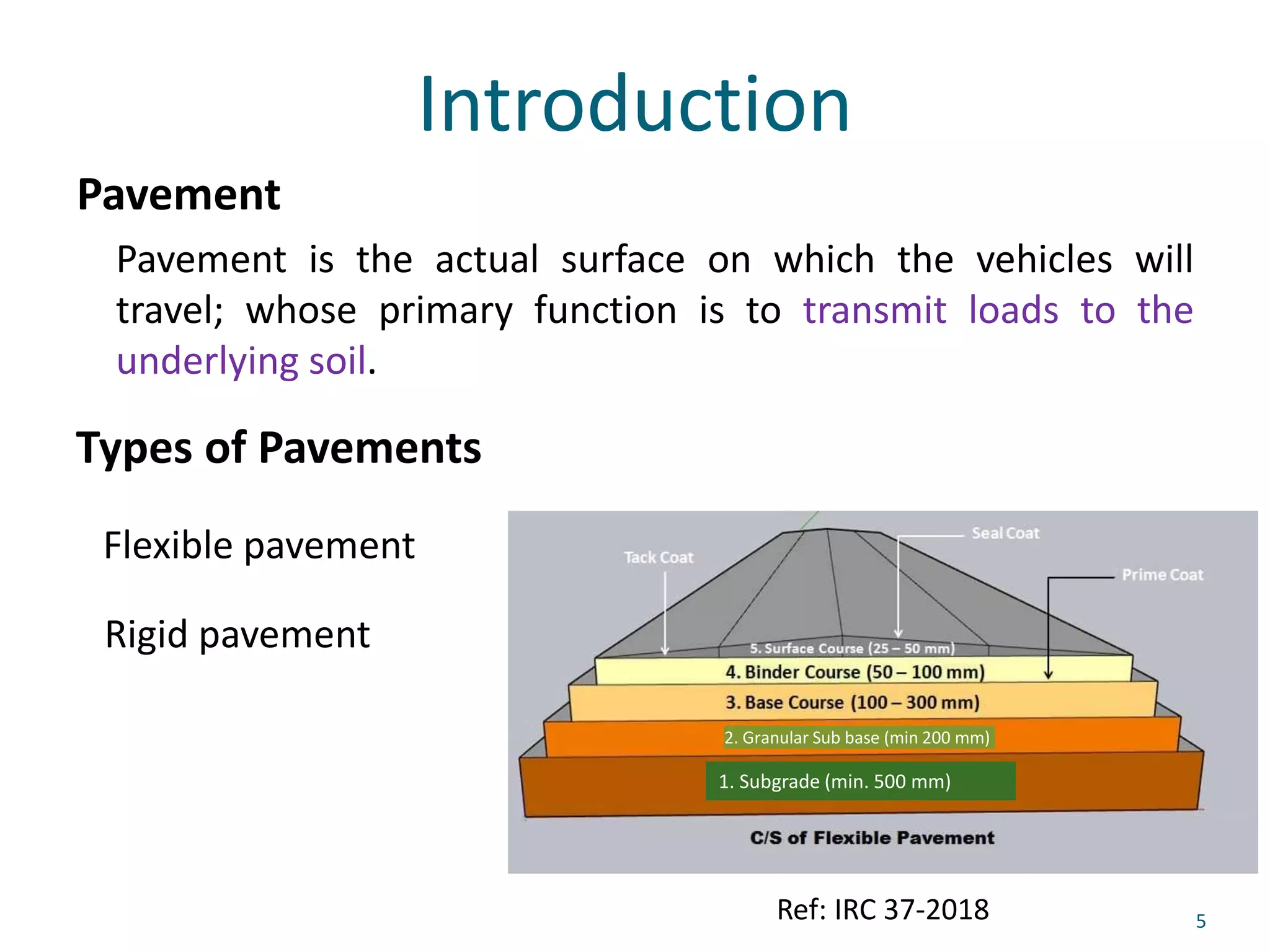
Pavement is the actual surface on which the vehicles will
travel; whose primary function is to transmit loads to the
underlying soil.
Flexible pavement
Rigid pavement
Types of Pavements
5
1. Subgrade (min. 500 mm)
2. Granular Sub base (min 200 mm)
Ref: IRC 37-2018
Introduction
Bituminous Mix
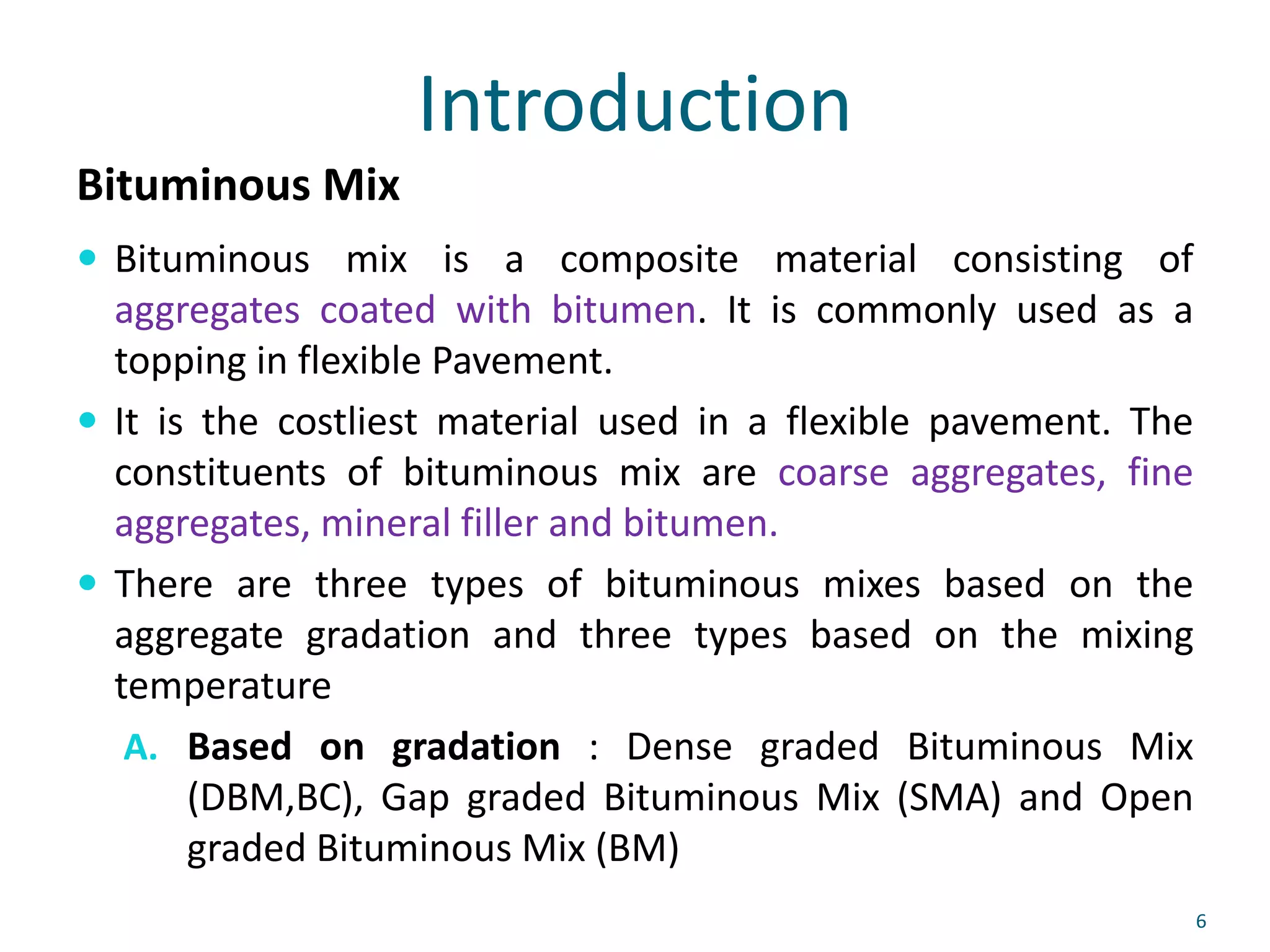
 Bituminous mix is a composite material consisting of
aggregates coated with bitumen. It is commonly used as a
topping in flexible Pavement.
 It is the costliest material used in a flexible pavement. The
constituents of bituminous mix are coarse aggregates, fine
aggregates, mineral filler and bitumen.
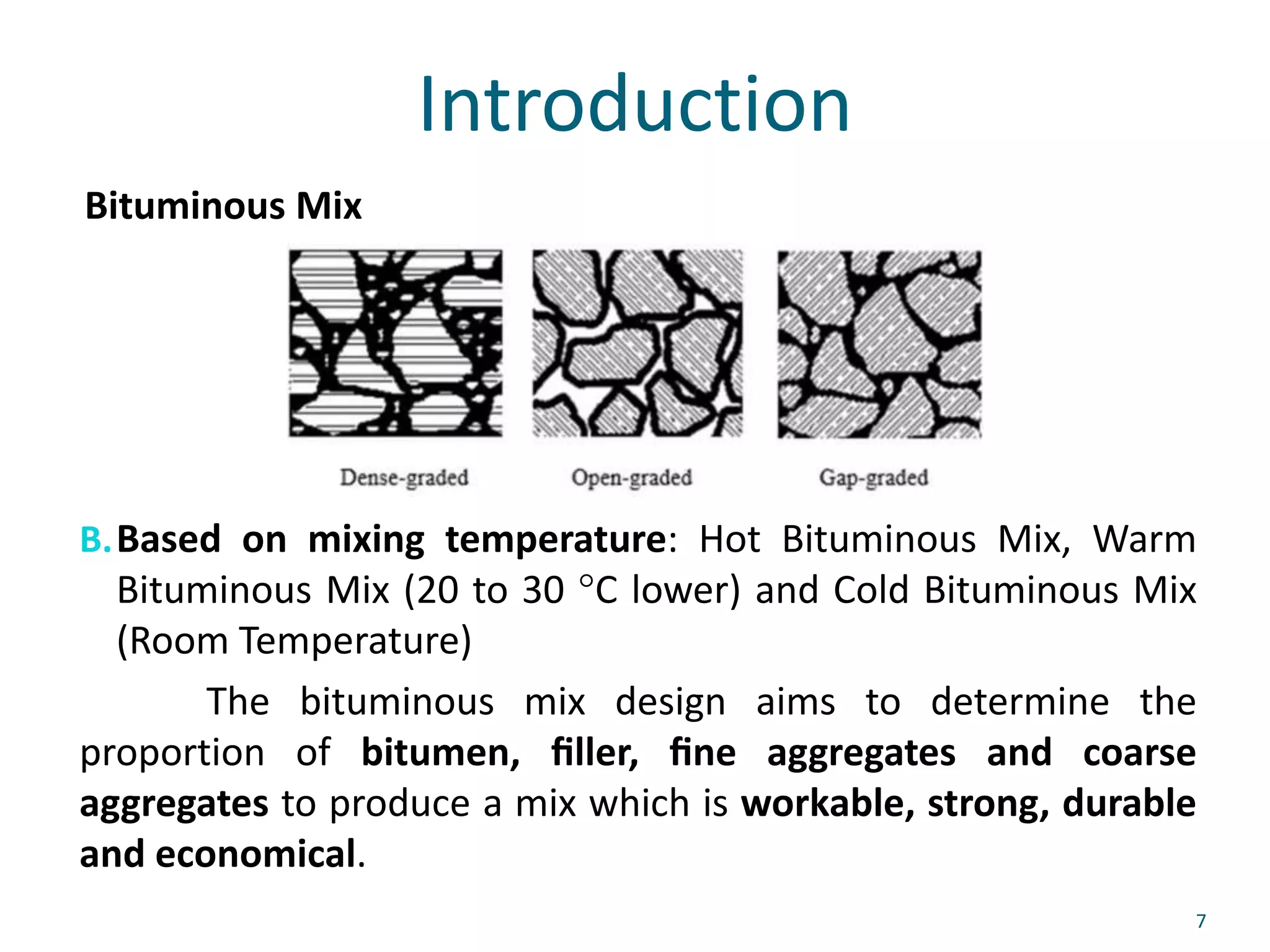
 There are three types of bituminous mixes based on the
aggregate gradation and three types based on the mixing
temperature
A. Based on gradation : Dense graded Bituminous Mix
(DBM,BC), Gap graded Bituminous Mix (SMA) and Open
graded Bituminous Mix (BM)
6
Introduction
B.Based on mixing temperature: Hot Bituminous Mix, Warm
Bituminous Mix (20 to 30 °C lower) and Cold Bituminous Mix
(Room Temperature)
The bituminous mix design aims to determine the
proportion of bitumen, filler, fine aggregates and coarse
aggregates to produce a mix which is workable, strong, durable
and economical.
7
Bituminous Mix
Need for the mix design
https://pavementinteractive.org/reference-desk/pavement-management/pavement-
distresses
Bleeding
Rutting
8
Requirements
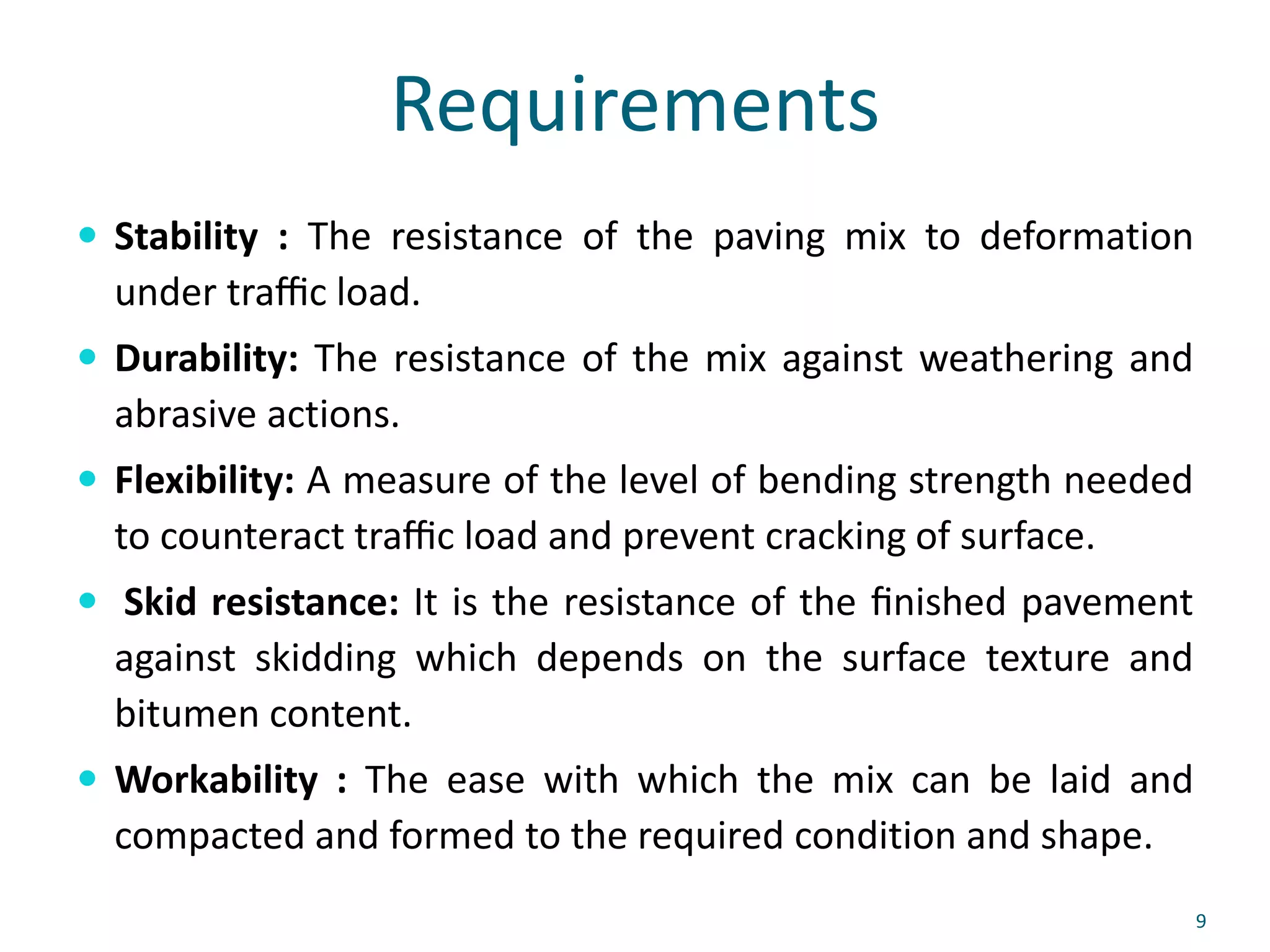
 Stability : The resistance of the paving mix to deformation
under traffic load.
 Durability: The resistance of the mix against weathering and
abrasive actions.
 Flexibility: A measure of the level of bending strength needed
to counteract traffic load and prevent cracking of surface.
 Skid resistance: It is the resistance of the finished pavement
against skidding which depends on the surface texture and
bitumen content.
 Workability : The ease with which the mix can be laid and
compacted and formed to the required condition and shape.
9
Desirable properties
 Stability to meet traffic demand
 Bitumen content to ensure proper binding and water proofing
 Voids to accommodate compaction due to traffic
 Flexibility to meet traffic loads, esp. in cold season
 Sufficient workability for construction
 Economical mix
10
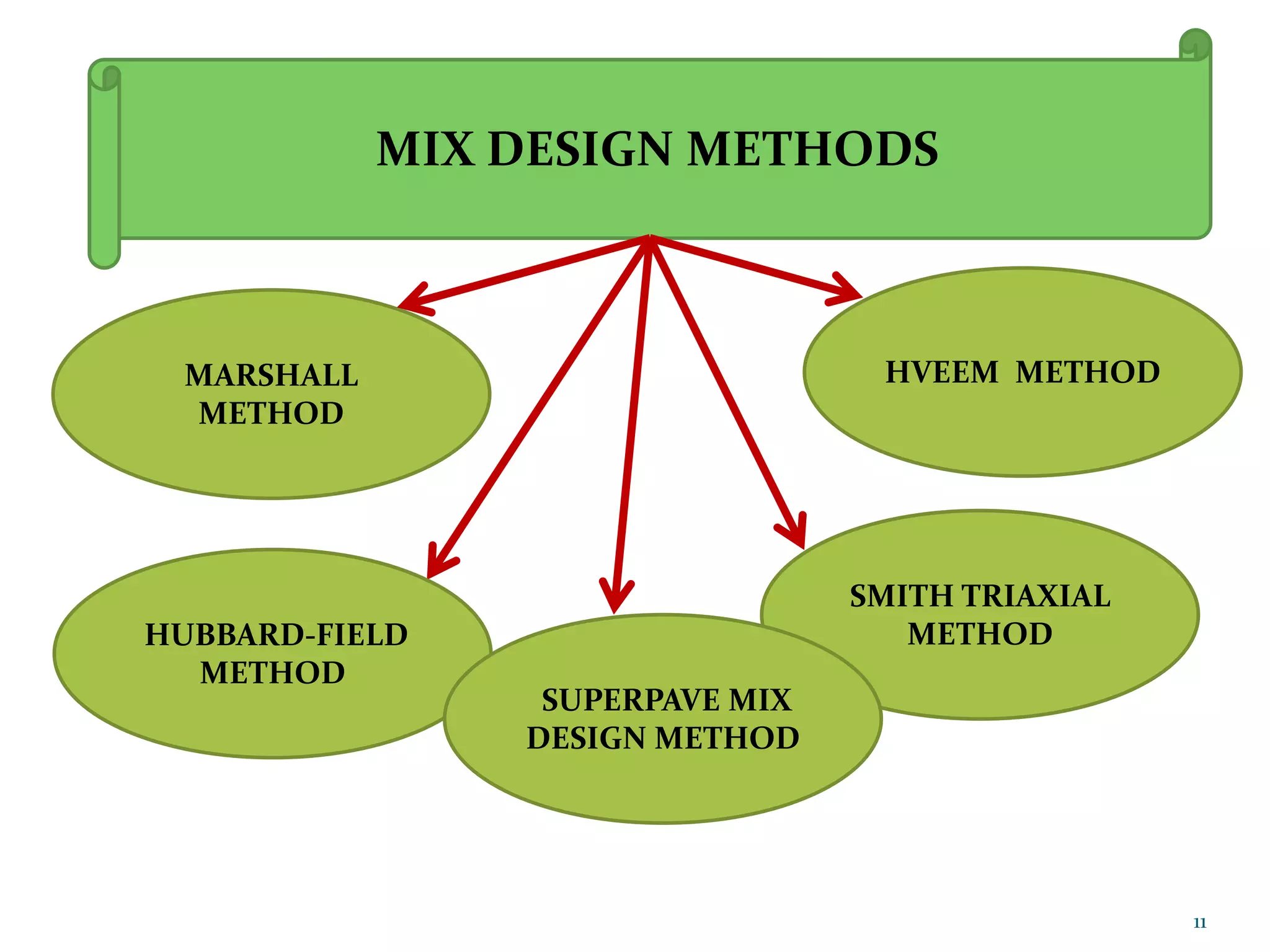
MIX DESIGN METHODS
MARSHALL
METHOD
HVEEM METHOD
HUBBARD-FIELD
METHOD
SMITH TRIAXIAL
METHOD
SUPERPAVE MIX
DESIGN METHOD
11
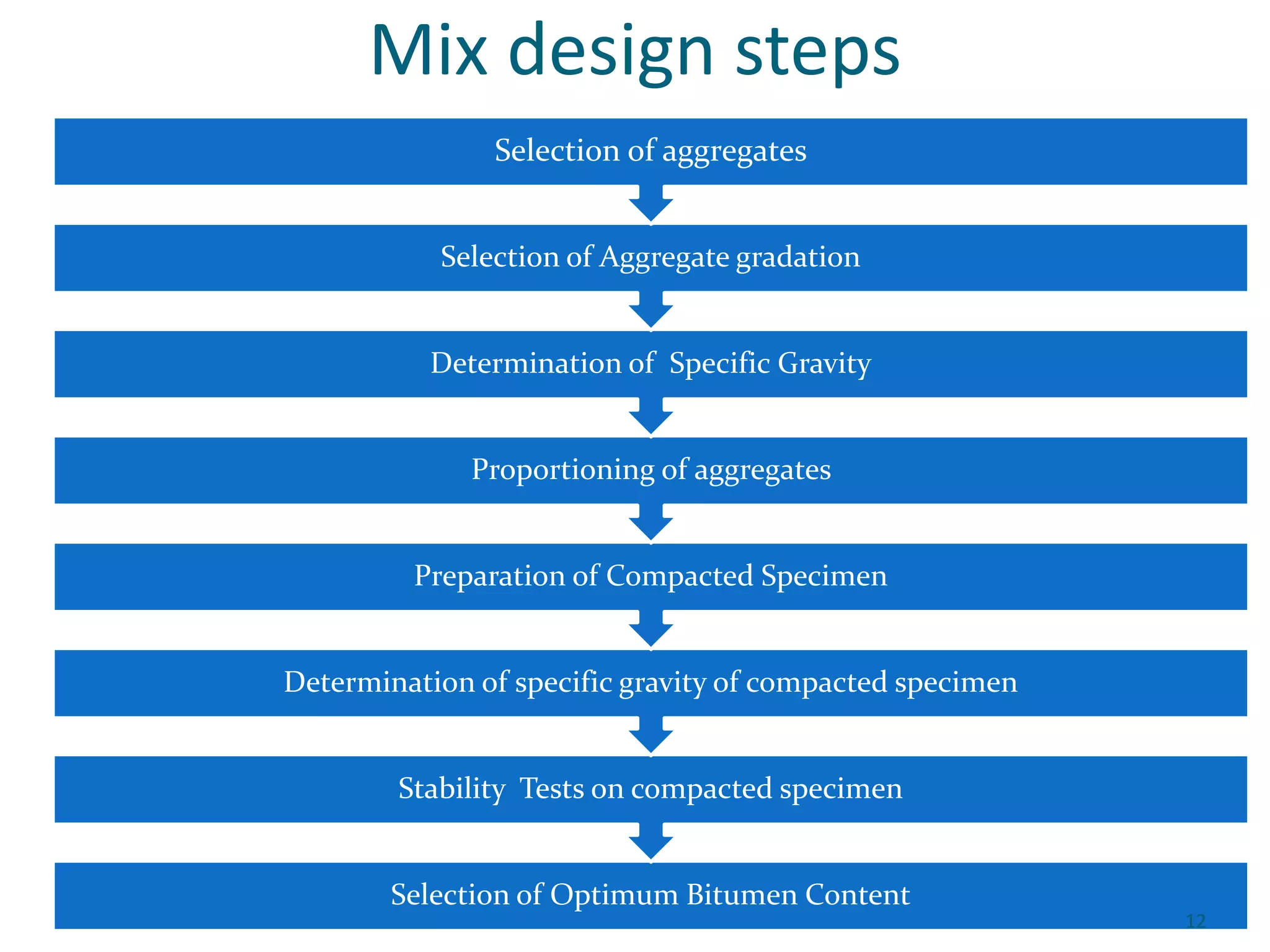
Mix design steps
Selection of Optimum Bitumen Content
Stability Tests on compacted specimen
Determination of specific gravity of compacted specimen
Preparation of Compacted Specimen
Proportioning of aggregates
Determination of Specific Gravity
Selection of Aggregate gradation
Selection of aggregates
12
Mix design steps
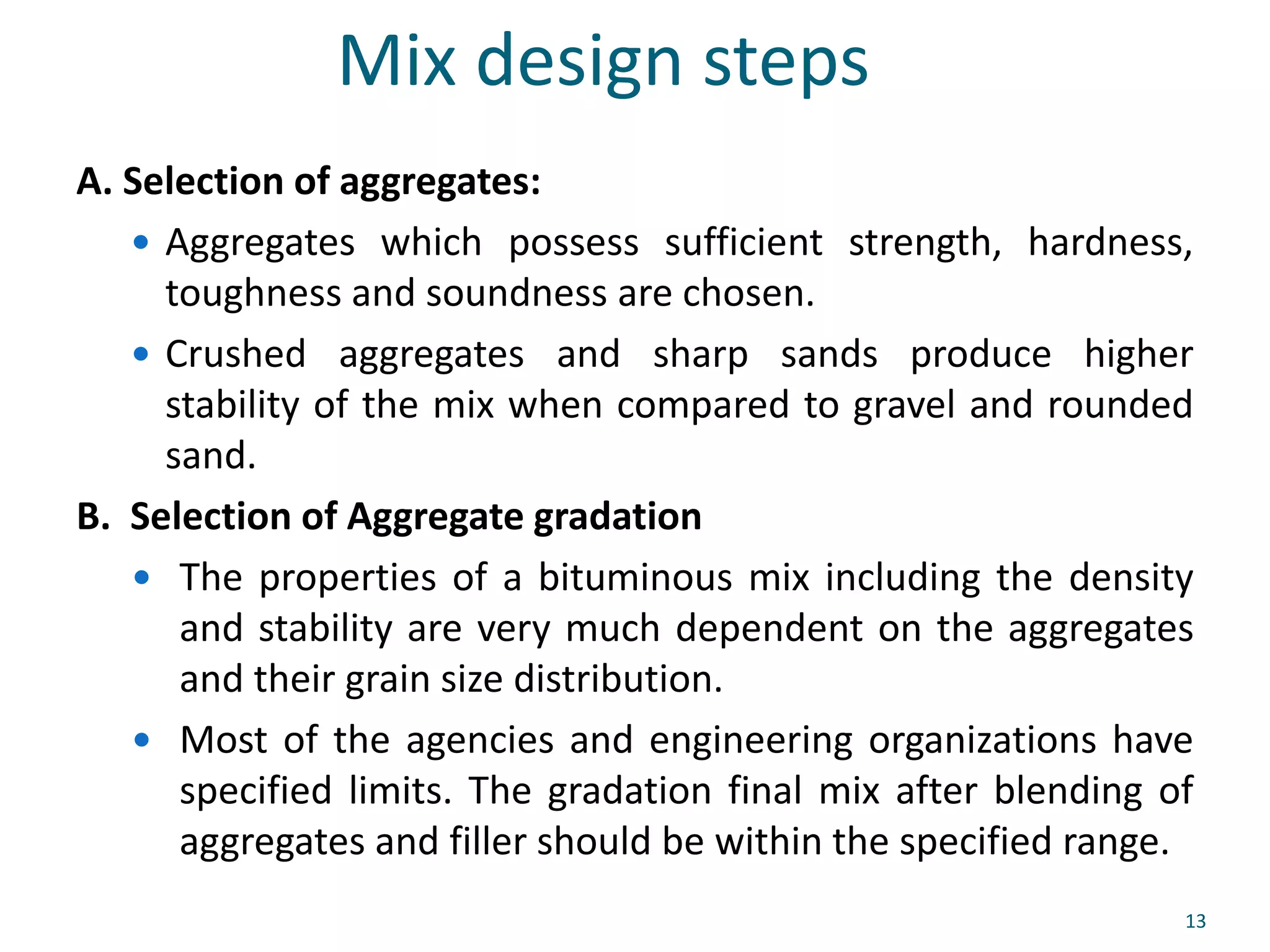
A. Selection of aggregates:
 Aggregates which possess sufficient strength, hardness,
toughness and soundness are chosen.
 Crushed aggregates and sharp sands produce higher
stability of the mix when compared to gravel and rounded
sand.
B. Selection of Aggregate gradation
 The properties of a bituminous mix including the density
and stability are very much dependent on the aggregates
and their grain size distribution.
 Most of the agencies and engineering organizations have
specified limits. The gradation final mix after blending of
aggregates and filler should be within the specified range.
13
Mix design steps
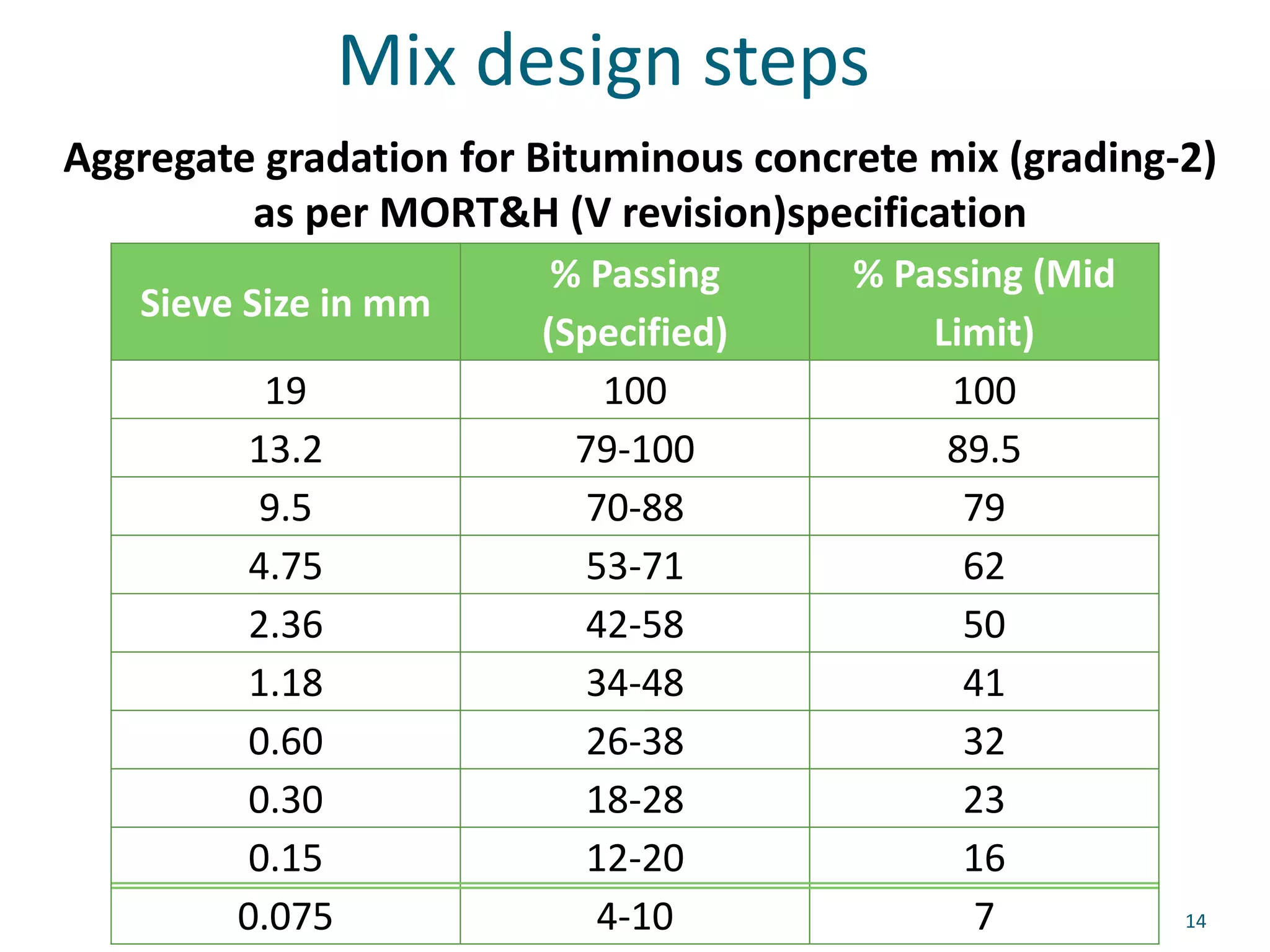
Aggregate gradation for Bituminous concrete mix (grading-2)
as per MORT&H (V revision)specification
Sieve Size in mm
% Passing
(Specified)
% Passing (Mid
Limit)
19 100 100
13.2 79-100 89.5
9.5 70-88 79
4.75 53-71 62
2.36 42-58 50
1.18 34-48 41
0.60 26-38 32
0.30 18-28 23
0.15 12-20 16
0.075 4-10 7 14
Mix design steps
C. Determination of Specific Gravity
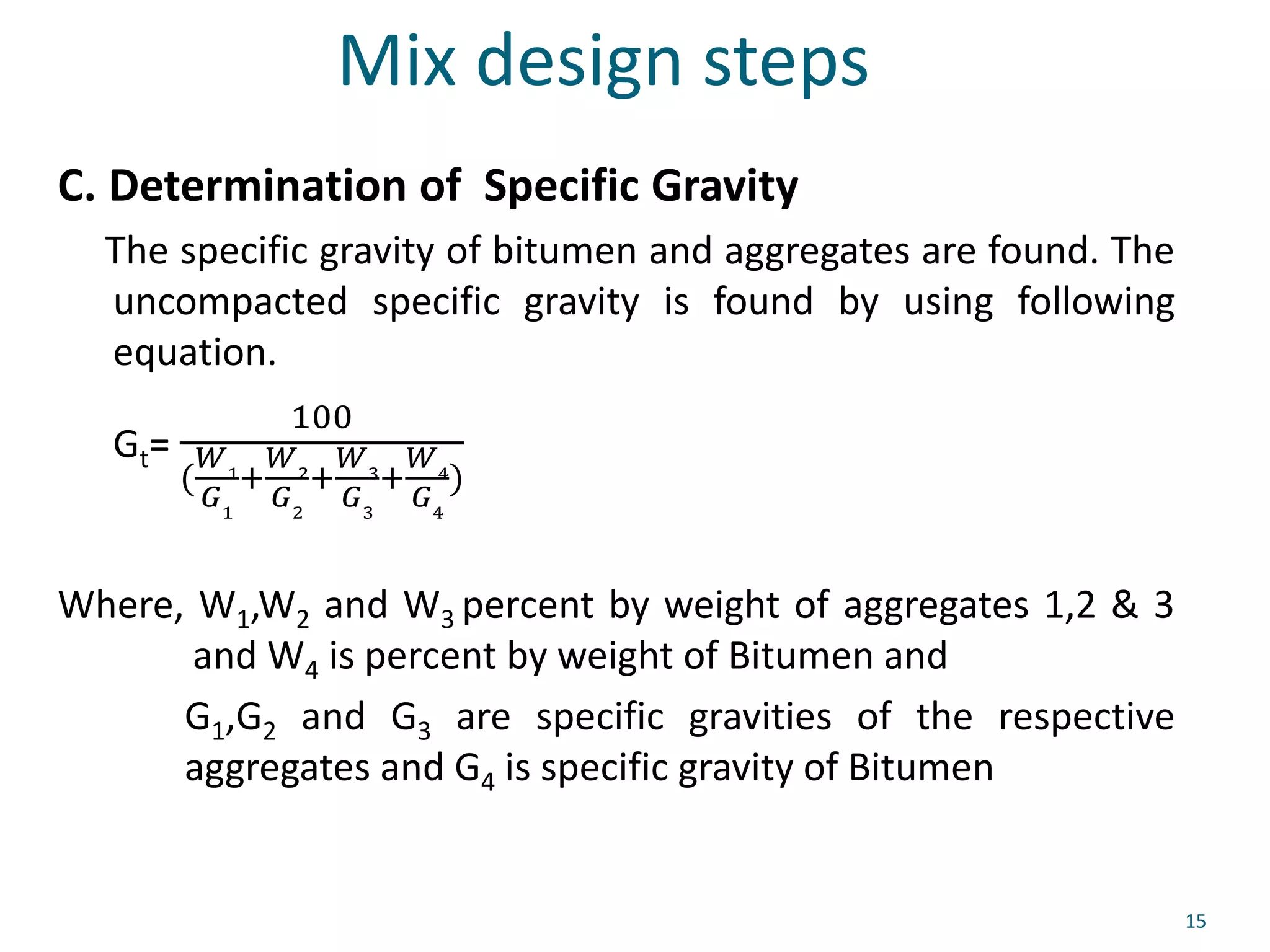
The specific gravity of bitumen and aggregates are found. The
uncompacted specific gravity is found by using following
equation.
Gt=
100
(
𝑊1
𝐺1
+
𝑊2
𝐺2
+
𝑊3
𝐺3
+
𝑊4
𝐺4
)
Where, W1,W2 and W3 percent by weight of aggregates 1,2 & 3
and W4 is percent by weight of Bitumen and
G1,G2 and G3 are specific gravities of the respective
aggregates and G4 is specific gravity of Bitumen
15
Mix design steps
D. Proportioning of aggregates
After selecting the aggregates and their gradation,
proportioning of aggregates has to be done and following are
the common methods of proportioning of aggregates:
• Trial and error procedure
• Graphical Methods: Triangular chart and Rothfutch’s method.
• Analytical Method
16
Mix design steps
E. Preparation of Compacted Specimen (Marshall
Method, Hot mix)
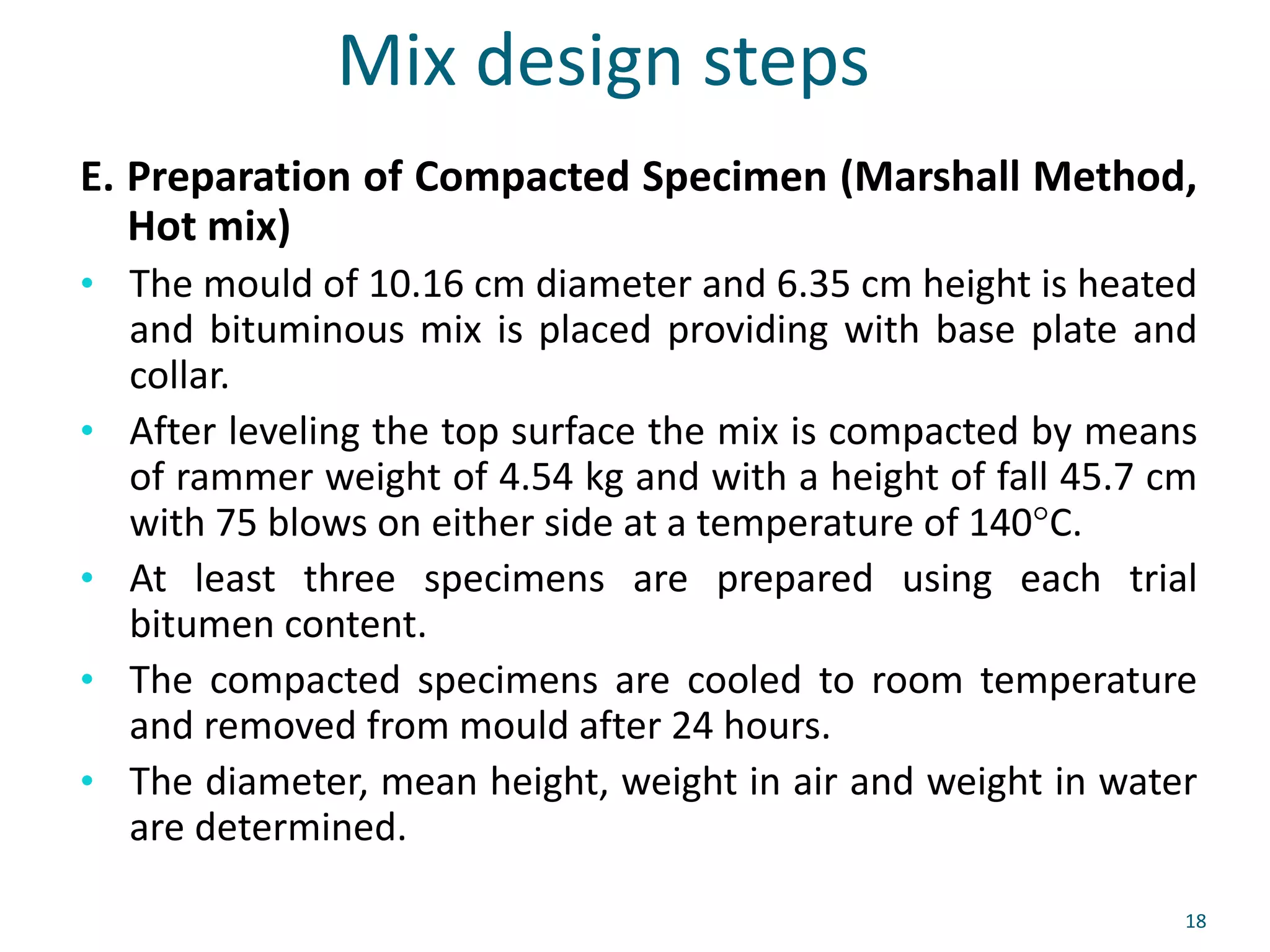
• The proportion of aggregates is done as per gradation table.
• The aggregates are heated to temperature of 170°C.
• Different trial binder contents are selected so that at least two
values are below and above the expected optimum bitumen
content.
• Required amount of Bitumen heated to temperature of 150°C.
• The heated Bitumen is added to the aggregate mix and
thoroughly mixed to have a uniform bituminous mix at a
desirable temperature 160°C.
17
Mix design steps
E. Preparation of Compacted Specimen (Marshall Method,
Hot mix)
• The mould of 10.16 cm diameter and 6.35 cm height is heated
and bituminous mix is placed providing with base plate and
collar.
• After leveling the top surface the mix is compacted by means
of rammer weight of 4.54 kg and with a height of fall 45.7 cm
with 75 blows on either side at a temperature of 140°C.
• At least three specimens are prepared using each trial
bitumen content.
• The compacted specimens are cooled to room temperature
and removed from mould after 24 hours.
• The diameter, mean height, weight in air and weight in water
are determined.
18
Mix design steps
19
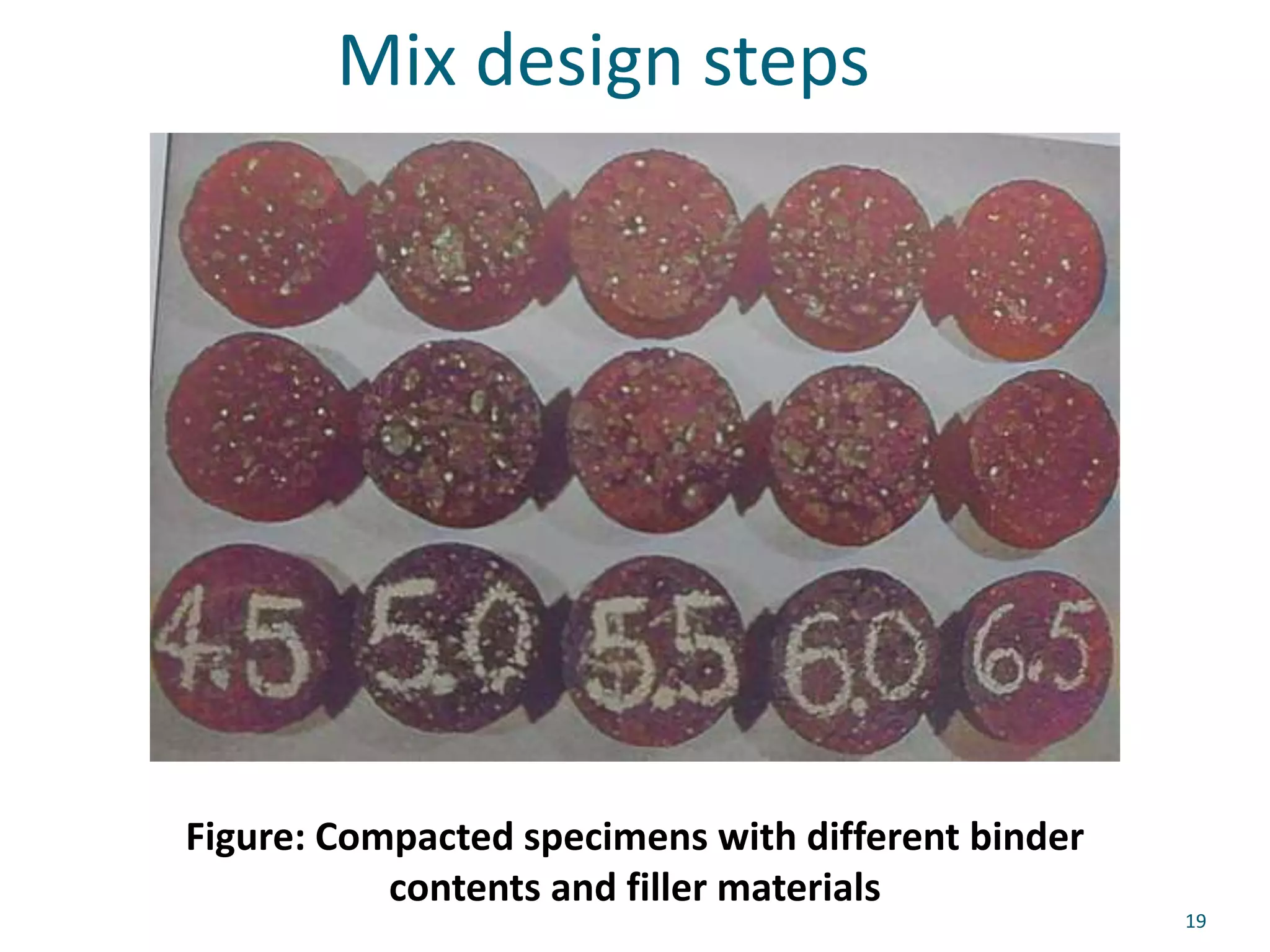
Figure: Compacted specimens with different binder
contents and filler materials
Mix design steps
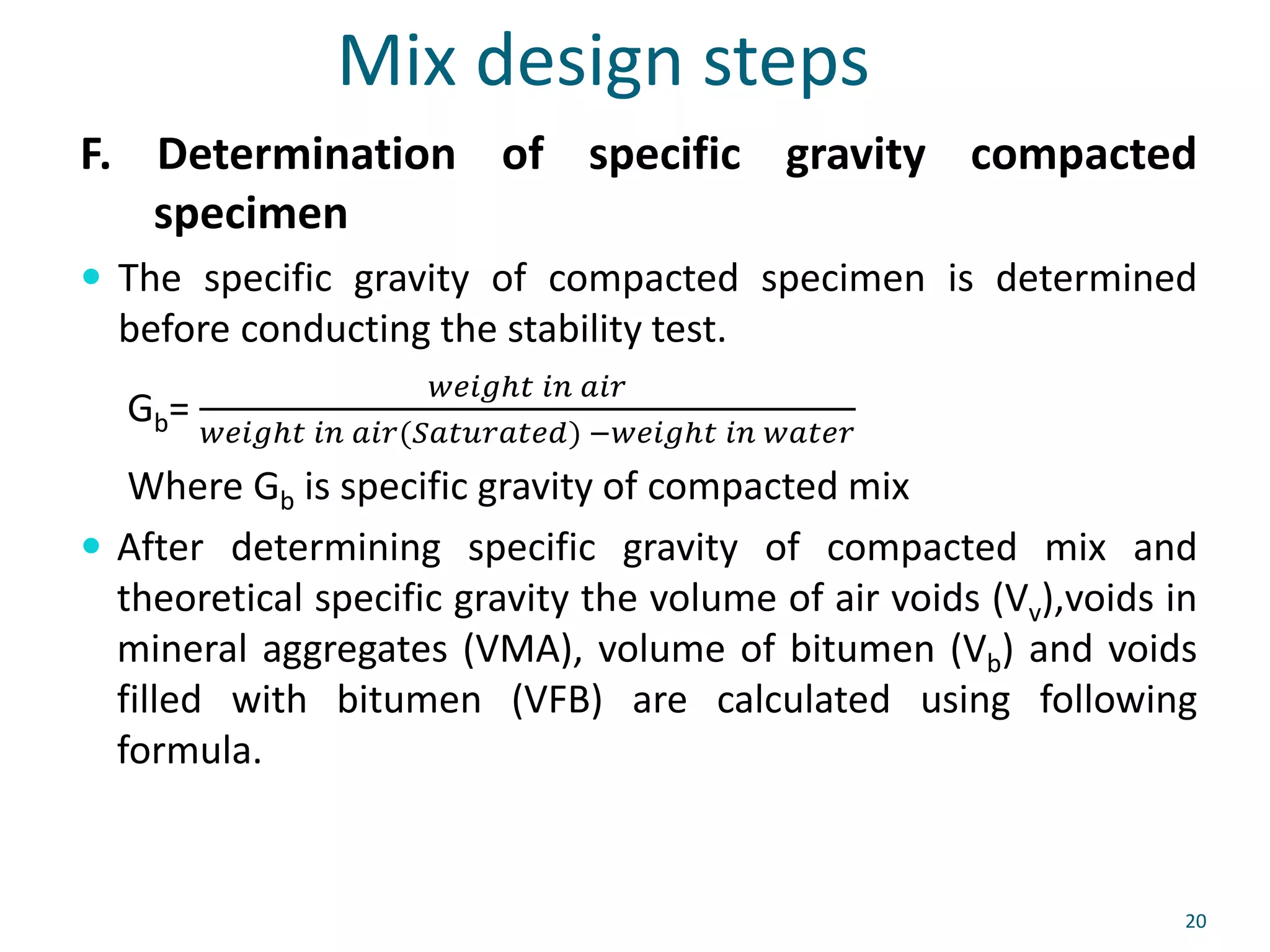
F. Determination of specific gravity compacted
specimen
 The specific gravity of compacted specimen is determined
before conducting the stability test.
Gb=
𝑤𝑒𝑖𝑔ℎ𝑡 𝑖𝑛 𝑎𝑖𝑟
𝑤𝑒𝑖𝑔ℎ𝑡 𝑖𝑛 𝑎𝑖𝑟(𝑆𝑎𝑡𝑢𝑟𝑎𝑡𝑒𝑑) −𝑤𝑒𝑖𝑔ℎ𝑡 𝑖𝑛 𝑤𝑎𝑡𝑒𝑟
Where Gb is specific gravity of compacted mix
 After determining specific gravity of compacted mix and
theoretical specific gravity the volume of air voids (Vv),voids in
mineral aggregates (VMA), volume of bitumen (Vb) and voids
filled with bitumen (VFB) are calculated using following
formula.
20
Mix design steps
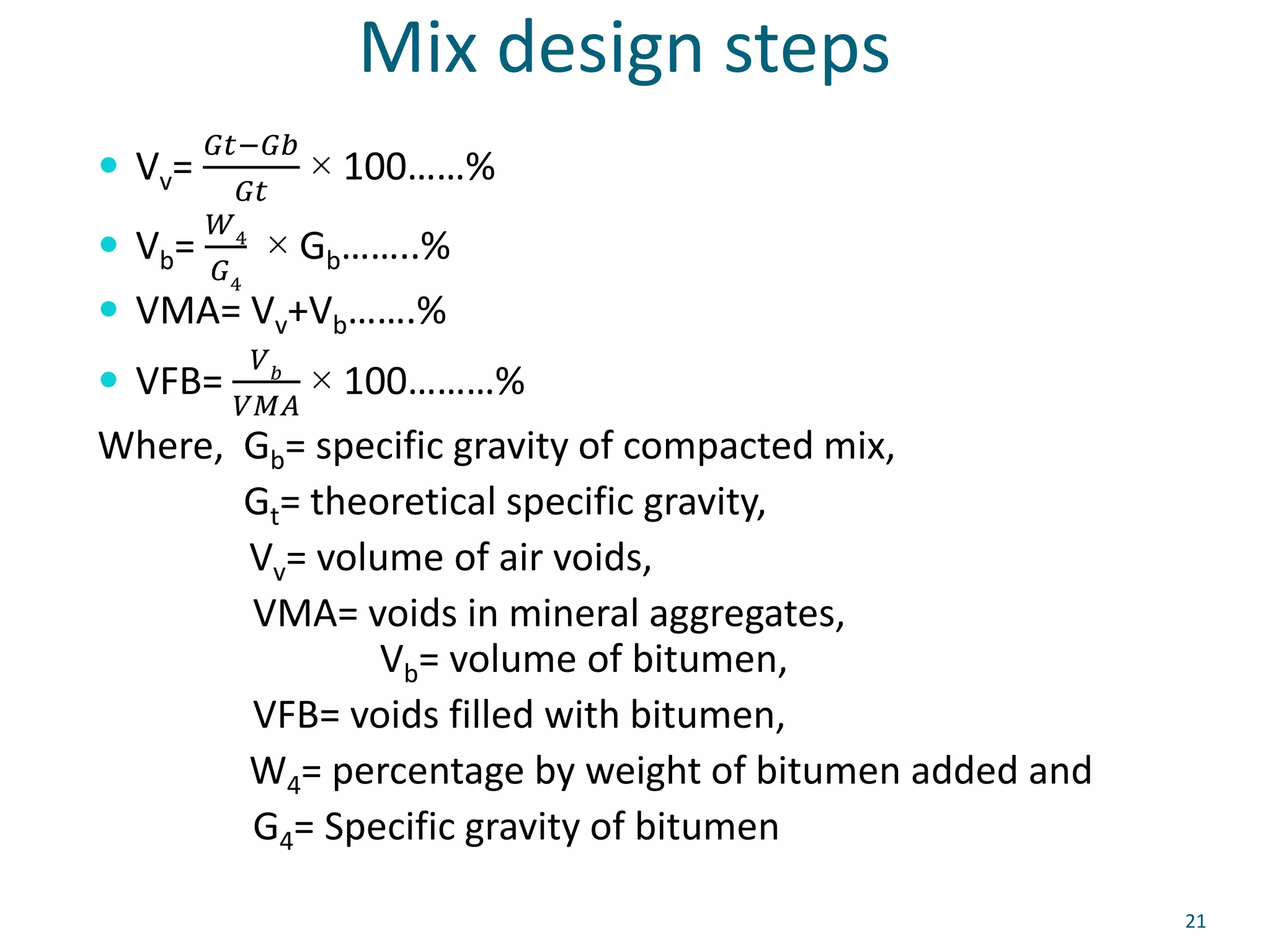
 Vv=
𝐺𝑡−𝐺𝑏
𝐺𝑡
× 100……%
 Vb=
𝑊4
𝐺4
× Gb……..%
 VMA= Vv+Vb…….%
 VFB=
𝑉𝑏
𝑉𝑀𝐴
× 100………%
Where, Gb= specific gravity of compacted mix,
Gt= theoretical specific gravity,
Vv= volume of air voids,
VMA= voids in mineral aggregates,
Vb= volume of bitumen,
VFB= voids filled with bitumen,
W4= percentage by weight of bitumen added and
G4= Specific gravity of bitumen
21
Mix design steps
G. Stability Tests on compacted specimens
Marshall Stability Test:
 Compacted cylindrical specimens - diameter 101.6 mm
and thickness 63.5 mm.
 Load - perpendicular to the axis of cylindrical specimen @
rate of deformation = 51 mm/minute @ 60°C.
There are two major features of the Marshall method of
designing Bituminous mix:
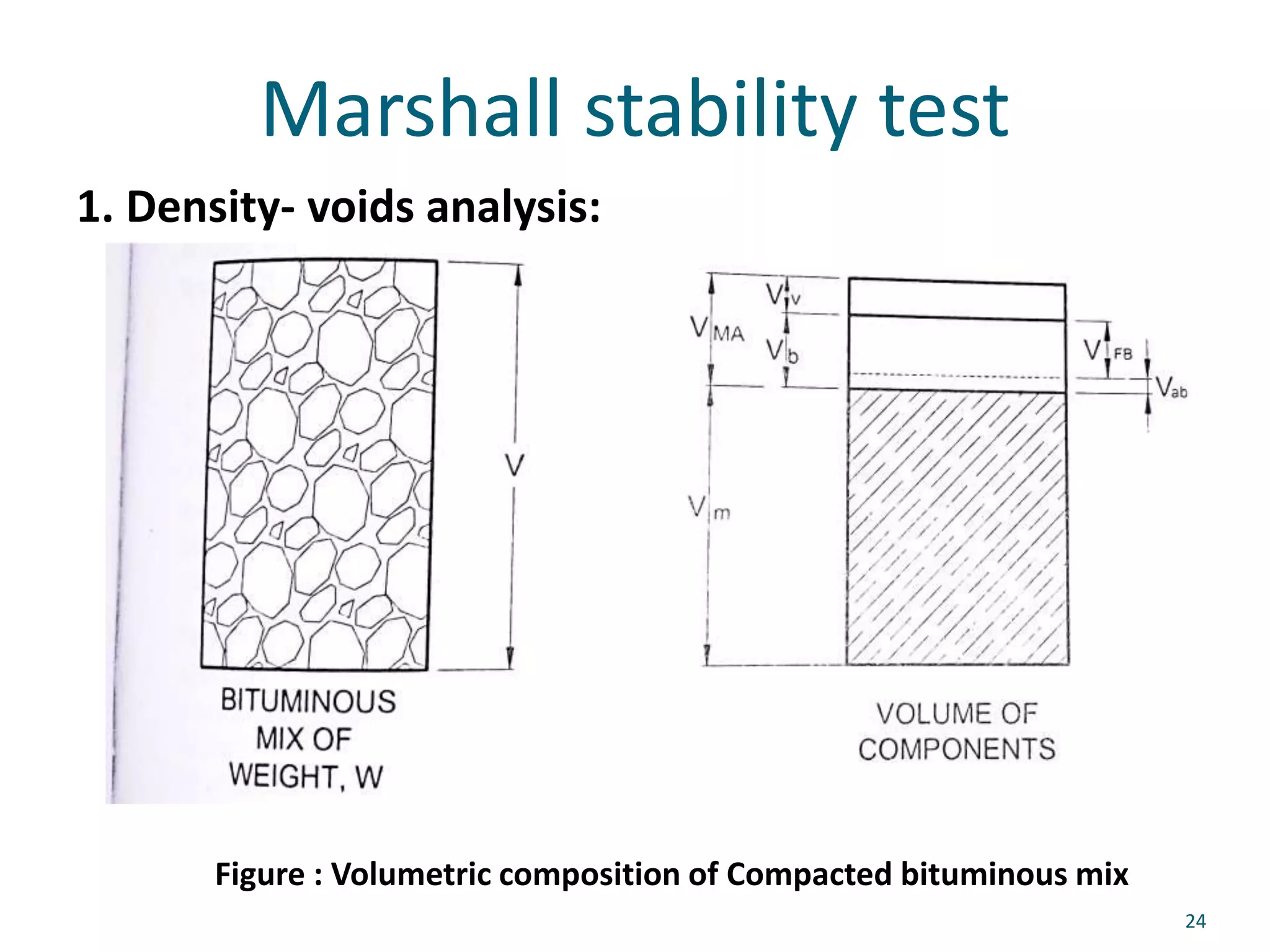
i. Density- voids analysis
ii. Stability flow analysis
22
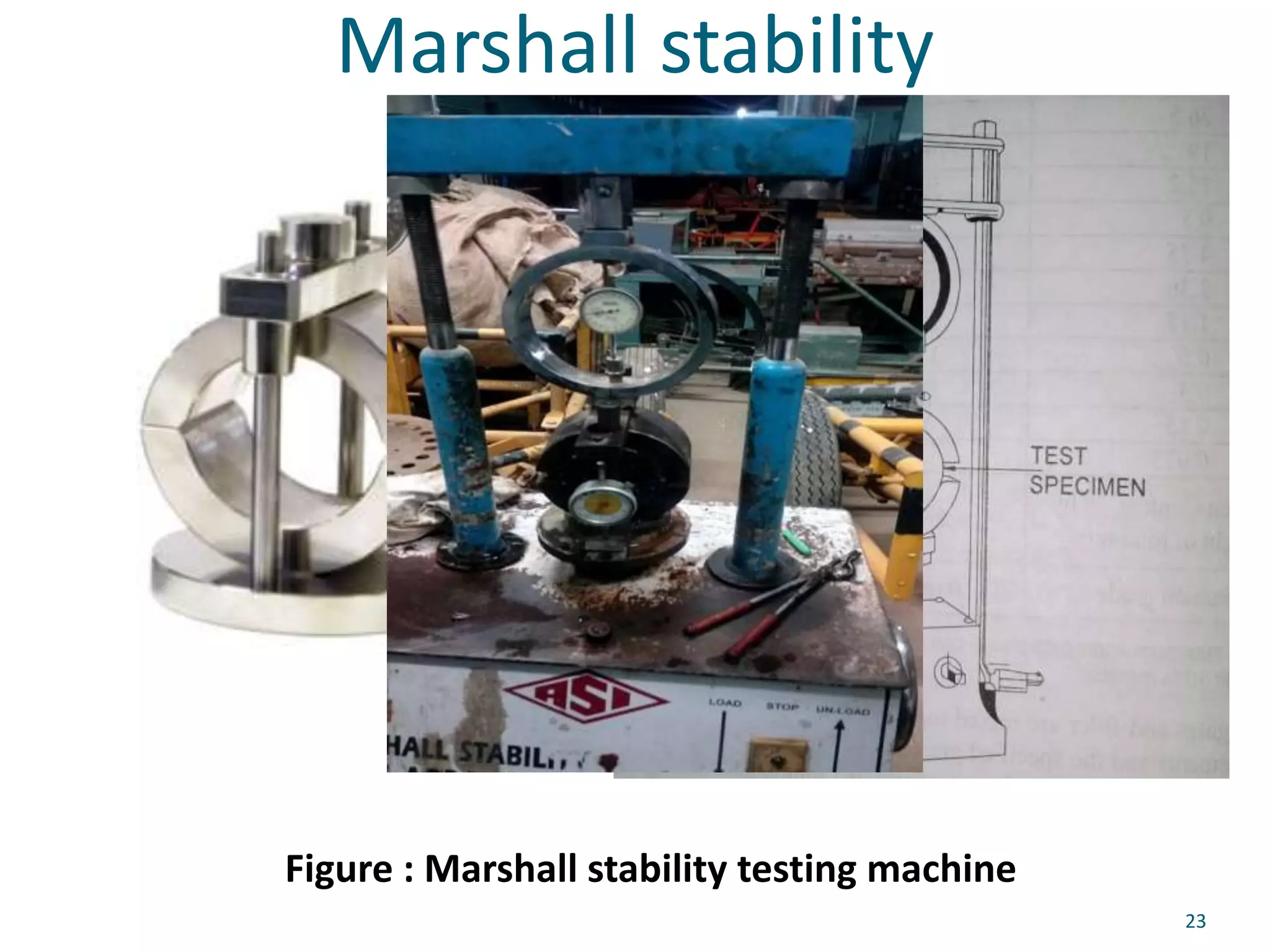
Figure : Marshall stability testing machine
Marshall stability
23
Marshall stability test
1. Density- voids analysis:
Figure : Volumetric composition of Compacted bituminous mix
24
Marshall stability test
2. Stability flow analysis
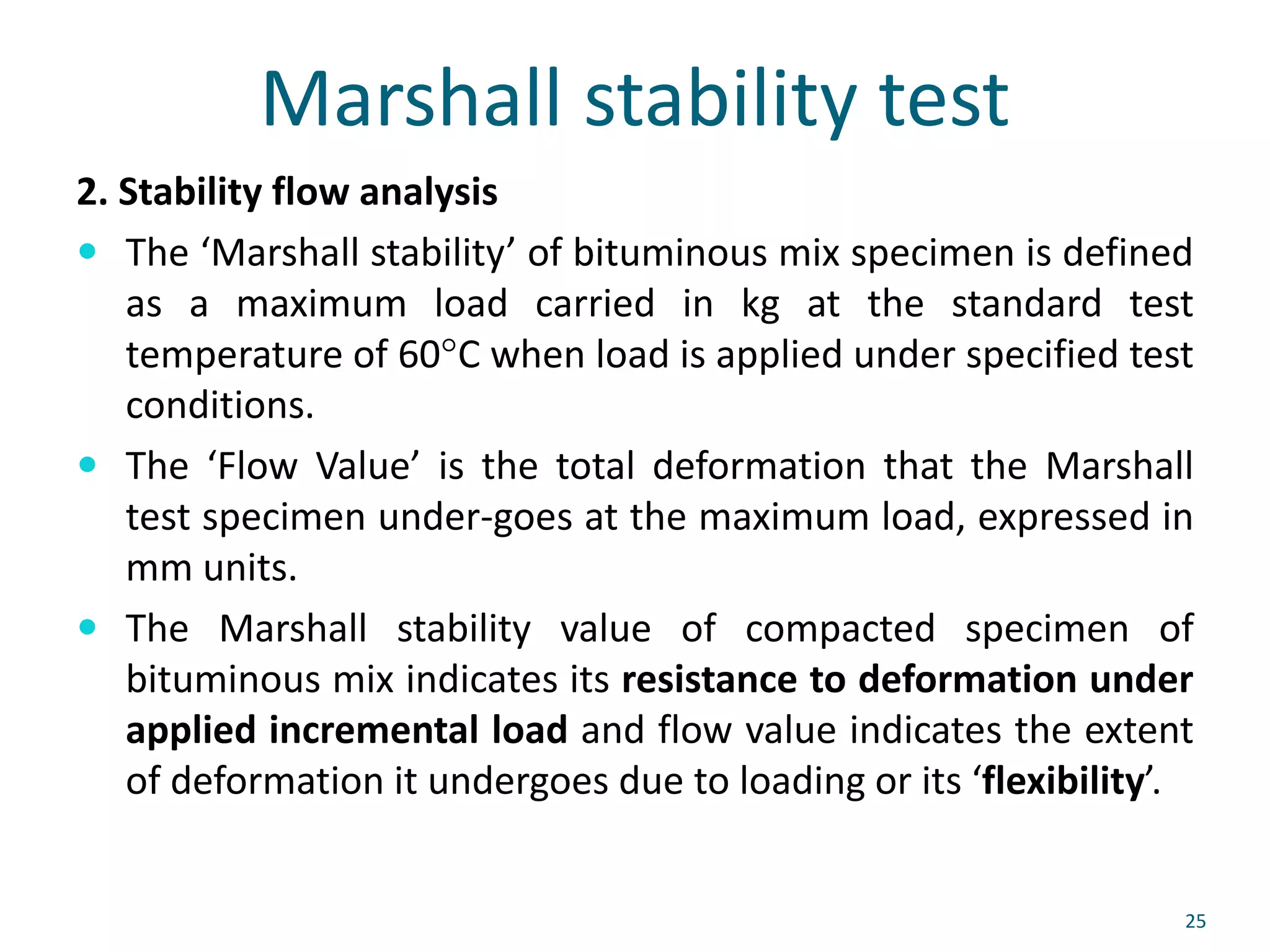
 The ‘Marshall stability’ of bituminous mix specimen is defined
as a maximum load carried in kg at the standard test
temperature of 60°C when load is applied under specified test
conditions.
 The ‘Flow Value’ is the total deformation that the Marshall
test specimen under-goes at the maximum load, expressed in
mm units.
 The Marshall stability value of compacted specimen of
bituminous mix indicates its resistance to deformation under
applied incremental load and flow value indicates the extent
of deformation it undergoes due to loading or its ‘flexibility’.
25
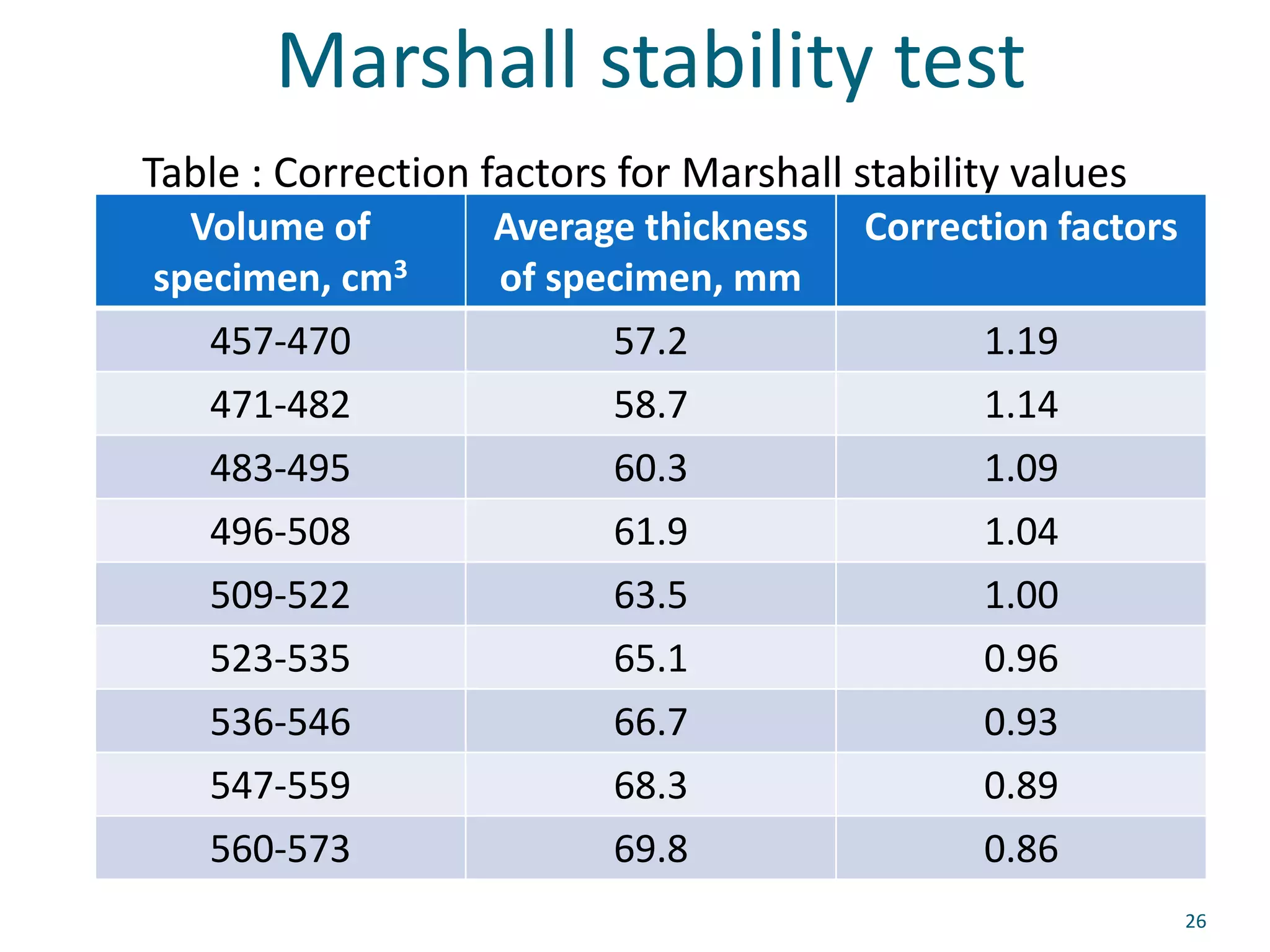
Table : Correction factors for Marshall stability values
Volume of
specimen, cm3
Average thickness
of specimen, mm
Correction factors
457-470 57.2 1.19
471-482 58.7 1.14
483-495 60.3 1.09
496-508 61.9 1.04
509-522 63.5 1.00
523-535 65.1 0.96
536-546 66.7 0.93
547-559 68.3 0.89
560-573 69.8 0.86
Marshall stability test
26
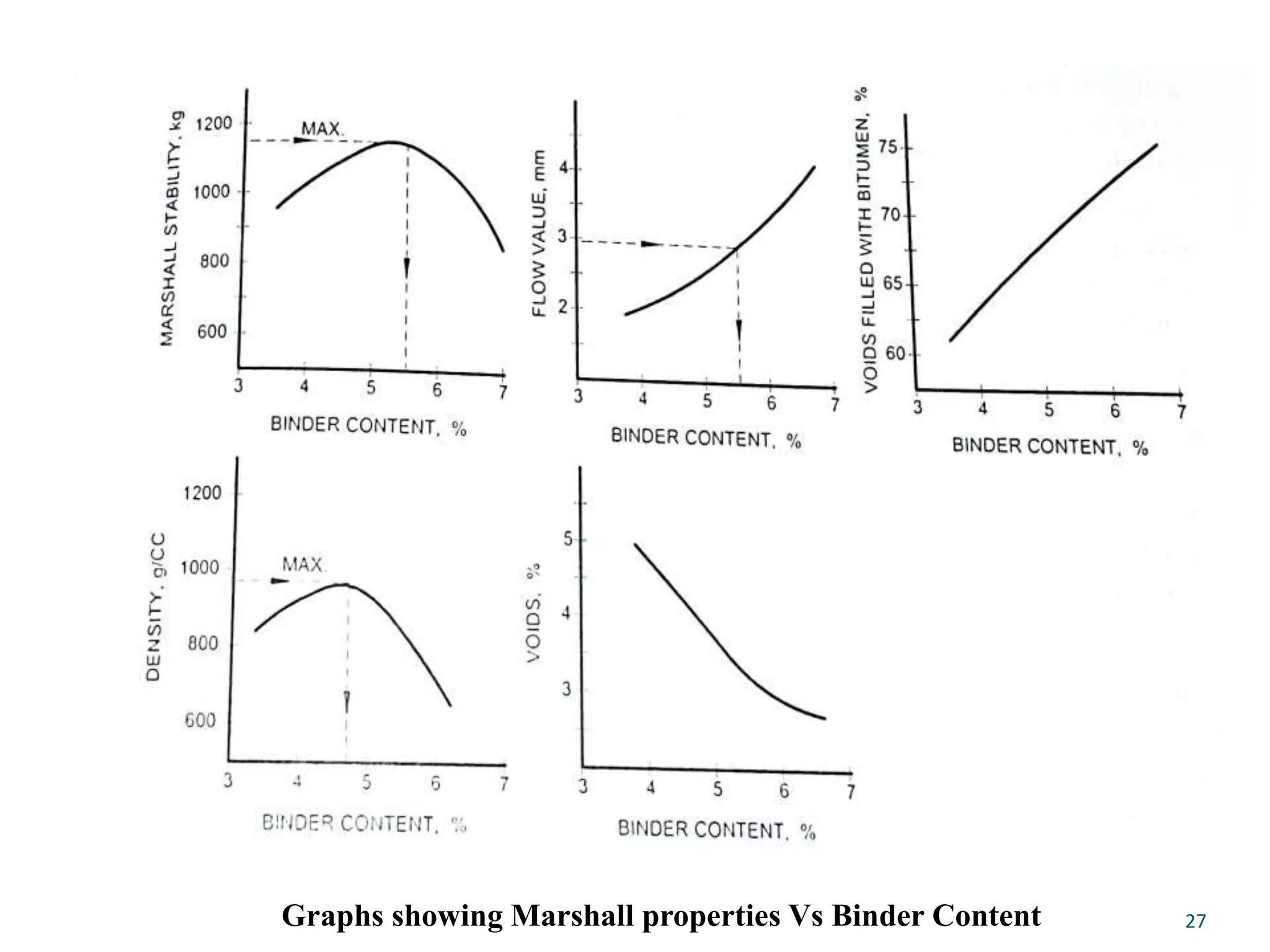
Graphs showing Marshall properties Vs Binder Content 27
Mix design steps
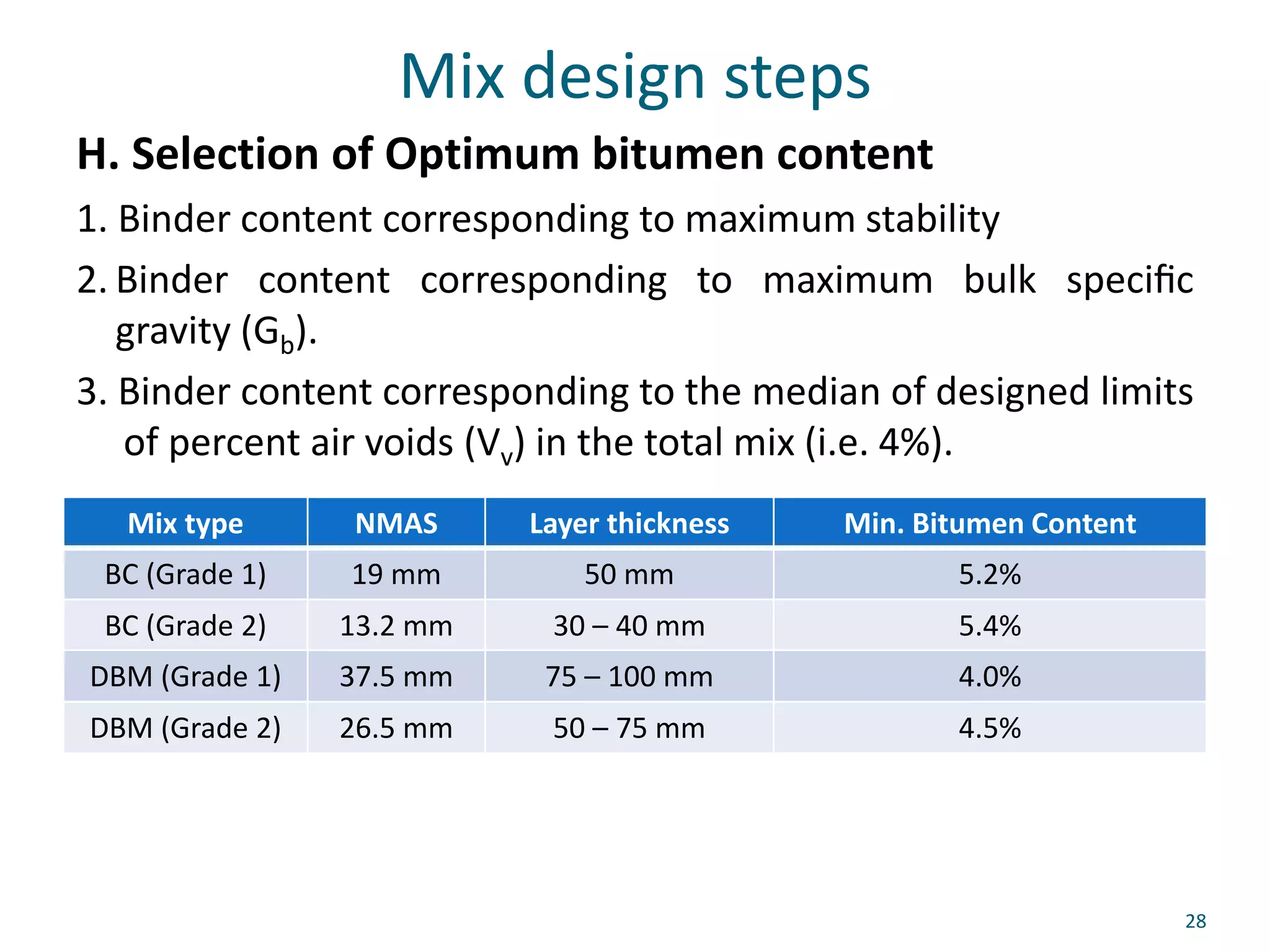
H. Selection of Optimum bitumen content
1. Binder content corresponding to maximum stability
2. Binder content corresponding to maximum bulk specific
gravity (Gb).
3. Binder content corresponding to the median of designed limits
of percent air voids (Vv) in the total mix (i.e. 4%).
28
Mix type NMAS Layer thickness Min. Bitumen Content
BC (Grade 1) 19 mm 50 mm 5.2%
BC (Grade 2) 13.2 mm 30 – 40 mm 5.4%
DBM (Grade 1) 37.5 mm 75 – 100 mm 4.0%
DBM (Grade 2) 26.5 mm 50 – 75 mm 4.5%
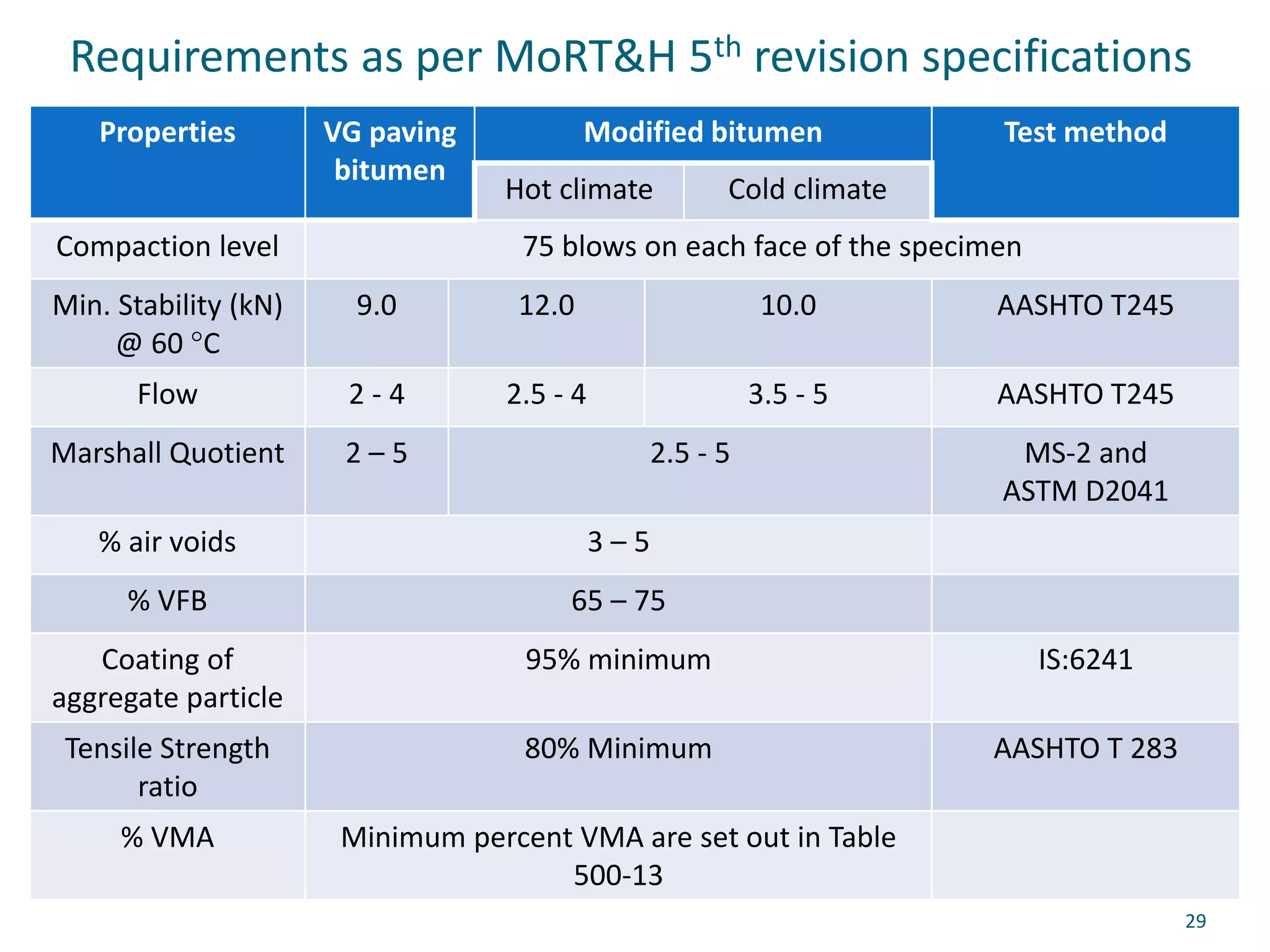
Requirements as per MoRT&H 5th revision specifications
Properties VG paving
bitumen
Modified bitumen Test method
Hot climate Cold climate
Compaction level 75 blows on each face of the specimen
Min. Stability (kN)
@ 60 °C
9.0 12.0 10.0 AASHTO T245
Flow 2 - 4 2.5 - 4 3.5 - 5 AASHTO T245
Marshall Quotient 2 – 5 2.5 - 5 MS-2 and
ASTM D2041
% air voids 3 – 5
% VFB 65 – 75
Coating of
aggregate particle
95% minimum IS:6241
Tensile Strength
ratio
80% Minimum AASHTO T 283
% VMA Minimum percent VMA are set out in Table
500-13
29
References
 Specification of ministry of road transport and highways
(MoRT&H) Govt. of India 5th revision.
 Khanna S K and Justo C E G, “Highway Material testing
(Laboratory Manual),” Nemchand and Bros,Roorkee 1997.
 Kadiyali L R and Lal N B “Principles and Practices of Highway
Engineering,” Khanna Publishers Delhi.
 NPTEL lecture notes on “Introduction to transportation
engineering,” by Tom Mathew and K V Krishnarao.
 https://pavementinteractive.org/
 De Pernia, Yolibeth Mejias. “Prediction of the Optimum Binder
Content of Open-Graded Friction Course Mixtures Using Digital
Image Processing.” University of South Florida, 2015.
30
Thank You….
31

Bituminous mix design.pptx

  • 1.
    Profile Highlights Dr. ASHIKBELLARY AMIE, MISTE ORCiD: 00000001-8462-7692 Assistant Professor KLS VDIT, Haliyal – 581329 Karnataka  Reviewer for International Journal of Pavement Research and Technology, Springer Publisher.  Invited as a Reviewer for the 2nd International Conference on “Transportation Infrastructure Projects – Conception to Execution” (TIPCE2022) to be held during September 14-17, 2022, organized by the Department of Civil Engineering, IIT Roorkee.  Reviewer for the 8th International Conference on Transportation Systems Engineering & Management (CTSEM 2021), held during August 26-27, 2021, was organized by the Department of Civil Engineering, National Institute of Technology, Calicut. 1
  • 2.
    Profile Highlights  Selectedin the Campus Interview of Larsen & Toubro Limited (Geo- structure IC) in 2013, held in KLE Technological University, Hubli.  Qualified GATE - 2014 in Civil Engineering paper (score = 359 and percentile = 86.97 %).  Received Prof. C E G Justo Gold Medal in 53rd Bangalore University convocation for scoring highest marks in ME - Highway Engineering.  Received the Best Project of the Year – 2017 (For Guiding the Project) award in KSCST’s SPP exhibition held at NMAM Institute of Technology, Nitte.  Published Total = 04 articles out of which SCI indexed Journal = 01 (Impact factor 4.139), Scopus indexed Journal = 01, Scopus indexed conference proceedings = 02 and Scopus indexed book chapter = 01  Presented paper in 6 International conferences.  Participated in more than 12 National workshops/FDP. 2
  • 3.
    Profile Highlights  “Experimentaland Numerical Study on Performance of Undowelled Joints in Concrete Pavements” (August 2017 – June 2022) PhD Dissertation work.  “Fatigue Behaviour of Stone Matrix Asphalt Mix Prepared Using Cement, Stone Dust as Filler Material and Bagasse as Stabilizing Additive” (August 2015 - June 2016) Final year ME project.  “Upgradation of Road stretch of SH-34 connecting Inamhongal to Hire- Ulligere: A detailed project report (DPR)” submitted in partial fulfillment of ME degree (August 2015 – January 2016).  “Congestion Reducing Measures in Dharwad CBD Area” (August 2013 - June 2014). Major Project in final year of BE related to transportation engineering. 3
  • 4.
    Outline  Introduction  Needfor bituminous mix design  Requirements of mix  Desirable properties of mix  Mix design methods  Mix design steps  References 4 Bituminous mix design
  • 5.
    Introduction Pavement Pavement is theactual surface on which the vehicles will travel; whose primary function is to transmit loads to the underlying soil. Flexible pavement Rigid pavement Types of Pavements 5 1. Subgrade (min. 500 mm) 2. Granular Sub base (min 200 mm) Ref: IRC 37-2018
  • 6.
    Introduction Bituminous Mix  Bituminousmix is a composite material consisting of aggregates coated with bitumen. It is commonly used as a topping in flexible Pavement.  It is the costliest material used in a flexible pavement. The constituents of bituminous mix are coarse aggregates, fine aggregates, mineral filler and bitumen.  There are three types of bituminous mixes based on the aggregate gradation and three types based on the mixing temperature A. Based on gradation : Dense graded Bituminous Mix (DBM,BC), Gap graded Bituminous Mix (SMA) and Open graded Bituminous Mix (BM) 6
  • 7.
    Introduction B.Based on mixingtemperature: Hot Bituminous Mix, Warm Bituminous Mix (20 to 30 °C lower) and Cold Bituminous Mix (Room Temperature) The bituminous mix design aims to determine the proportion of bitumen, filler, fine aggregates and coarse aggregates to produce a mix which is workable, strong, durable and economical. 7 Bituminous Mix
  • 8.
    Need for themix design https://pavementinteractive.org/reference-desk/pavement-management/pavement- distresses Bleeding Rutting 8
  • 9.
    Requirements  Stability :The resistance of the paving mix to deformation under traffic load.  Durability: The resistance of the mix against weathering and abrasive actions.  Flexibility: A measure of the level of bending strength needed to counteract traffic load and prevent cracking of surface.  Skid resistance: It is the resistance of the finished pavement against skidding which depends on the surface texture and bitumen content.  Workability : The ease with which the mix can be laid and compacted and formed to the required condition and shape. 9
  • 10.
    Desirable properties  Stabilityto meet traffic demand  Bitumen content to ensure proper binding and water proofing  Voids to accommodate compaction due to traffic  Flexibility to meet traffic loads, esp. in cold season  Sufficient workability for construction  Economical mix 10
  • 11.
    MIX DESIGN METHODS MARSHALL METHOD HVEEMMETHOD HUBBARD-FIELD METHOD SMITH TRIAXIAL METHOD SUPERPAVE MIX DESIGN METHOD 11
  • 12.
    Mix design steps Selectionof Optimum Bitumen Content Stability Tests on compacted specimen Determination of specific gravity of compacted specimen Preparation of Compacted Specimen Proportioning of aggregates Determination of Specific Gravity Selection of Aggregate gradation Selection of aggregates 12
  • 13.
    Mix design steps A.Selection of aggregates:  Aggregates which possess sufficient strength, hardness, toughness and soundness are chosen.  Crushed aggregates and sharp sands produce higher stability of the mix when compared to gravel and rounded sand. B. Selection of Aggregate gradation  The properties of a bituminous mix including the density and stability are very much dependent on the aggregates and their grain size distribution.  Most of the agencies and engineering organizations have specified limits. The gradation final mix after blending of aggregates and filler should be within the specified range. 13
  • 14.
    Mix design steps Aggregategradation for Bituminous concrete mix (grading-2) as per MORT&H (V revision)specification Sieve Size in mm % Passing (Specified) % Passing (Mid Limit) 19 100 100 13.2 79-100 89.5 9.5 70-88 79 4.75 53-71 62 2.36 42-58 50 1.18 34-48 41 0.60 26-38 32 0.30 18-28 23 0.15 12-20 16 0.075 4-10 7 14
  • 15.
    Mix design steps C.Determination of Specific Gravity The specific gravity of bitumen and aggregates are found. The uncompacted specific gravity is found by using following equation. Gt= 100 ( 𝑊1 𝐺1 + 𝑊2 𝐺2 + 𝑊3 𝐺3 + 𝑊4 𝐺4 ) Where, W1,W2 and W3 percent by weight of aggregates 1,2 & 3 and W4 is percent by weight of Bitumen and G1,G2 and G3 are specific gravities of the respective aggregates and G4 is specific gravity of Bitumen 15
  • 16.
    Mix design steps D.Proportioning of aggregates After selecting the aggregates and their gradation, proportioning of aggregates has to be done and following are the common methods of proportioning of aggregates: • Trial and error procedure • Graphical Methods: Triangular chart and Rothfutch’s method. • Analytical Method 16
  • 17.
    Mix design steps E.Preparation of Compacted Specimen (Marshall Method, Hot mix) • The proportion of aggregates is done as per gradation table. • The aggregates are heated to temperature of 170°C. • Different trial binder contents are selected so that at least two values are below and above the expected optimum bitumen content. • Required amount of Bitumen heated to temperature of 150°C. • The heated Bitumen is added to the aggregate mix and thoroughly mixed to have a uniform bituminous mix at a desirable temperature 160°C. 17
  • 18.
    Mix design steps E.Preparation of Compacted Specimen (Marshall Method, Hot mix) • The mould of 10.16 cm diameter and 6.35 cm height is heated and bituminous mix is placed providing with base plate and collar. • After leveling the top surface the mix is compacted by means of rammer weight of 4.54 kg and with a height of fall 45.7 cm with 75 blows on either side at a temperature of 140°C. • At least three specimens are prepared using each trial bitumen content. • The compacted specimens are cooled to room temperature and removed from mould after 24 hours. • The diameter, mean height, weight in air and weight in water are determined. 18
  • 19.
    Mix design steps 19 Figure:Compacted specimens with different binder contents and filler materials
  • 20.
    Mix design steps F.Determination of specific gravity compacted specimen  The specific gravity of compacted specimen is determined before conducting the stability test. Gb= 𝑤𝑒𝑖𝑔ℎ𝑡 𝑖𝑛 𝑎𝑖𝑟 𝑤𝑒𝑖𝑔ℎ𝑡 𝑖𝑛 𝑎𝑖𝑟(𝑆𝑎𝑡𝑢𝑟𝑎𝑡𝑒𝑑) −𝑤𝑒𝑖𝑔ℎ𝑡 𝑖𝑛 𝑤𝑎𝑡𝑒𝑟 Where Gb is specific gravity of compacted mix  After determining specific gravity of compacted mix and theoretical specific gravity the volume of air voids (Vv),voids in mineral aggregates (VMA), volume of bitumen (Vb) and voids filled with bitumen (VFB) are calculated using following formula. 20
  • 21.
    Mix design steps Vv= 𝐺𝑡−𝐺𝑏 𝐺𝑡 × 100……%  Vb= 𝑊4 𝐺4 × Gb……..%  VMA= Vv+Vb…….%  VFB= 𝑉𝑏 𝑉𝑀𝐴 × 100………% Where, Gb= specific gravity of compacted mix, Gt= theoretical specific gravity, Vv= volume of air voids, VMA= voids in mineral aggregates, Vb= volume of bitumen, VFB= voids filled with bitumen, W4= percentage by weight of bitumen added and G4= Specific gravity of bitumen 21
  • 22.
    Mix design steps G.Stability Tests on compacted specimens Marshall Stability Test:  Compacted cylindrical specimens - diameter 101.6 mm and thickness 63.5 mm.  Load - perpendicular to the axis of cylindrical specimen @ rate of deformation = 51 mm/minute @ 60°C. There are two major features of the Marshall method of designing Bituminous mix: i. Density- voids analysis ii. Stability flow analysis 22
  • 23.
    Figure : Marshallstability testing machine Marshall stability 23
  • 24.
    Marshall stability test 1.Density- voids analysis: Figure : Volumetric composition of Compacted bituminous mix 24
  • 25.
    Marshall stability test 2.Stability flow analysis  The ‘Marshall stability’ of bituminous mix specimen is defined as a maximum load carried in kg at the standard test temperature of 60°C when load is applied under specified test conditions.  The ‘Flow Value’ is the total deformation that the Marshall test specimen under-goes at the maximum load, expressed in mm units.  The Marshall stability value of compacted specimen of bituminous mix indicates its resistance to deformation under applied incremental load and flow value indicates the extent of deformation it undergoes due to loading or its ‘flexibility’. 25
  • 26.
    Table : Correctionfactors for Marshall stability values Volume of specimen, cm3 Average thickness of specimen, mm Correction factors 457-470 57.2 1.19 471-482 58.7 1.14 483-495 60.3 1.09 496-508 61.9 1.04 509-522 63.5 1.00 523-535 65.1 0.96 536-546 66.7 0.93 547-559 68.3 0.89 560-573 69.8 0.86 Marshall stability test 26
  • 27.
    Graphs showing Marshallproperties Vs Binder Content 27
  • 28.
    Mix design steps H.Selection of Optimum bitumen content 1. Binder content corresponding to maximum stability 2. Binder content corresponding to maximum bulk specific gravity (Gb). 3. Binder content corresponding to the median of designed limits of percent air voids (Vv) in the total mix (i.e. 4%). 28 Mix type NMAS Layer thickness Min. Bitumen Content BC (Grade 1) 19 mm 50 mm 5.2% BC (Grade 2) 13.2 mm 30 – 40 mm 5.4% DBM (Grade 1) 37.5 mm 75 – 100 mm 4.0% DBM (Grade 2) 26.5 mm 50 – 75 mm 4.5%
  • 29.
    Requirements as perMoRT&H 5th revision specifications Properties VG paving bitumen Modified bitumen Test method Hot climate Cold climate Compaction level 75 blows on each face of the specimen Min. Stability (kN) @ 60 °C 9.0 12.0 10.0 AASHTO T245 Flow 2 - 4 2.5 - 4 3.5 - 5 AASHTO T245 Marshall Quotient 2 – 5 2.5 - 5 MS-2 and ASTM D2041 % air voids 3 – 5 % VFB 65 – 75 Coating of aggregate particle 95% minimum IS:6241 Tensile Strength ratio 80% Minimum AASHTO T 283 % VMA Minimum percent VMA are set out in Table 500-13 29
  • 30.
    References  Specification ofministry of road transport and highways (MoRT&H) Govt. of India 5th revision.  Khanna S K and Justo C E G, “Highway Material testing (Laboratory Manual),” Nemchand and Bros,Roorkee 1997.  Kadiyali L R and Lal N B “Principles and Practices of Highway Engineering,” Khanna Publishers Delhi.  NPTEL lecture notes on “Introduction to transportation engineering,” by Tom Mathew and K V Krishnarao.  https://pavementinteractive.org/  De Pernia, Yolibeth Mejias. “Prediction of the Optimum Binder Content of Open-Graded Friction Course Mixtures Using Digital Image Processing.” University of South Florida, 2015. 30
  • 31.