EMPLOYEE TRAINING AND DEVELOPMENT: 
How To Measure 
Effectiveness and Impact
? 
How do you currently measure your training program and efforts?
WHAT WE HOPE YOU’LL LEARN 
Training metrics – where we’ve been and where we’re going. 
How to determine goals and key indicators. 
Five step process to create a measurement plan.
BIZLIBRARY.COM 
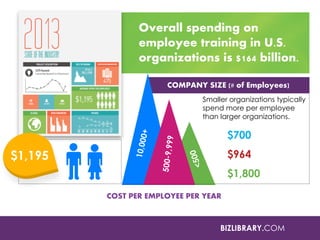
Overall spending on 
employee training in U.S. 
organizations is $164 billion. 
COMPANY SIZE (# of Employees) 
Smaller organizations typically spend more per employee than larger organizations. 
$700 
$964 
$1,800 
COST PER EMPLOYEE PER YEAR 
$1,195
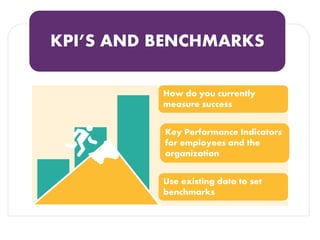
KPI’S AND BENCHMARKS 
How do you currently measure success 
Use existing data to set benchmarks 
Key Performance Indicators for employees and the organization
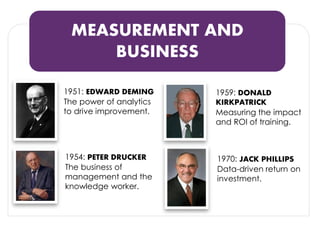
MEASUREMENT AND BUSINESS 
1951: EDWARD DEMING 
The power of analytics to drive improvement. 
1954: PETER DRUCKER 
The business of management and the knowledge worker. 
1959: DONALD KIRKPATRICK 
Measuring the impact and ROI of training. 
1970: JACK PHILLIPS 
Data-driven return on investment.
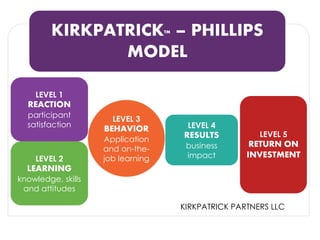
KIRKPATRICK™ – PHILLIPS MODEL 
LEVEL 1 
REACTION 
participant satisfaction 
LEVEL 2 
LEARNING 
knowledge, skills and attitudes 
LEVEL 3 
BEHAVIOR 
Application and on-the- job learning 
LEVEL 4 
RESULTS 
business impact 
LEVEL 5 
RETURN ON INVESTMENT 
KIRKPATRICK PARTNERS LLC
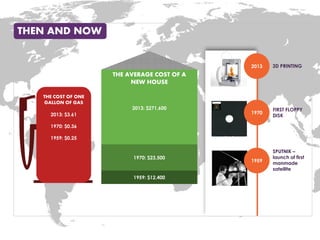
THE COST OF ONE GALLON OF GAS 
2013: $3.61 
1970: $0.36 
1959: $0.25 
2013: $271,600 
THE AVERAGE COST OF A 
NEW HOUSE 
1959: $12,400 
1970: $23,500 
2013 
1970 
1959 
SPUTNIK – launch of first manmade satellite 
FIRST FLOPPY DISK 
3D PRINTING 
THEN AND NOW
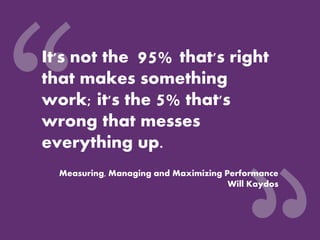
It's not the that's right that makes something work; it's the that's wrong that messes everything up. 
Measuring, Managing and Maximizing Performance 
Will Kaydos 
5% 
95%
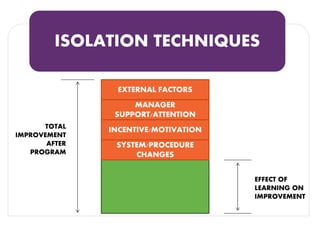
ISOLATION TECHNIQUES 
SYSTEM/PROCEDURE CHANGES 
INCENTIVE/MOTIVATION 
MANAGER SUPPORT/ATTENTION 
EXTERNAL FACTORS 
EFFECT OF LEARNING ON IMPROVEMENT 
TOTAL IMPROVEMENT AFTER PROGRAM
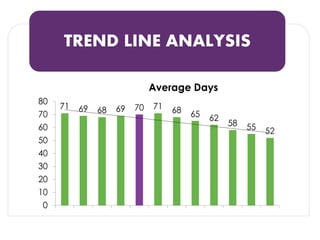
TREND LINE ANALYSIS
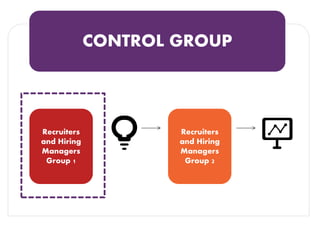
CONTROL GROUP 
Recruiters and Hiring Managers Group 1 
Recruiters and Hiring Managers Group 2
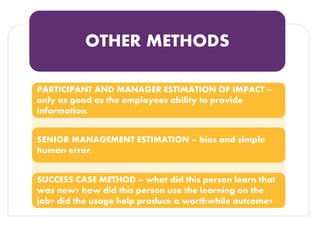
OTHER METHODS 
PARTICIPANT AND MANAGER ESTIMATION OF IMPACT – only as good as the employees ability to provide information. 
SENIOR MANAGEMENT ESTIMATION – bias and simple human error. 
SUCCESS CASE METHOD – what did this person learn that was new? how did this person use the learning on the job? did the usage help produce a worthwhile outcome?
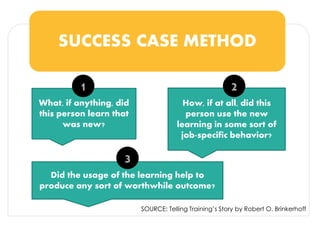
SUCCESS CASE METHOD 
What, if anything, did this person learn that was new? 
How, if at all, did this person use the new learning in some sort of job-specific behavior? 
Did the usage of the learning help to produce any sort of worthwhile outcome? 
1 
2 
3 
SOURCE: Telling Training’s Story by Robert O. Brinkerhoff
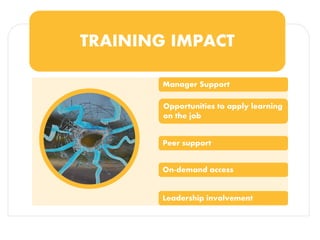
TRAINING IMPACT 
Manager Support 
Opportunities to apply learning on the job 
Peer support 
On-demand access 
Leadership involvement
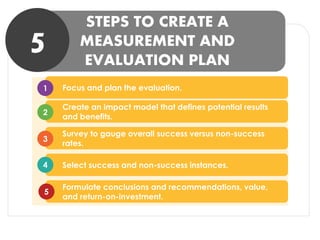
STEPS TO CREATE A MEASUREMENT AND EVALUATION PLAN 
Focus and plan the evaluation. 
1 
Create an impact model that defines potential results and benefits. 
2 
Survey to gauge overall success versus non-success rates. 
3 
Select success and non-success instances. 
4 
Formulate conclusions and recommendations, value, and return-on-investment. 
5 
5
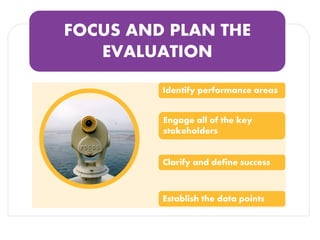
FOCUS AND PLAN THE EVALUATION 
Identify performance areas 
Engage all of the key stakeholders 
Clarify and define success 
Establish the data points
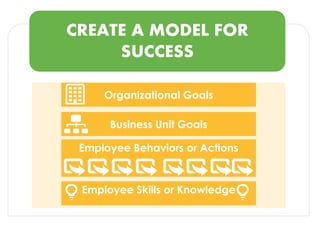
CREATE A MODEL FOR SUCCESS 
Organizational Goals 
Business Unit Goals 
Employee Behaviors or Actions 
Employee Skills or Knowledge
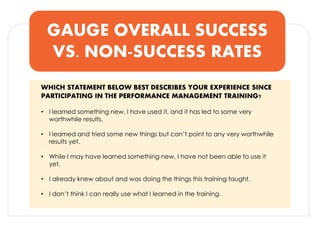
GAUGE OVERALL SUCCESS VS. NON-SUCCESS RATES 
WHICH STATEMENT BELOW BEST DESCRIBES YOUR EXPERIENCE SINCE PARTICIPATING IN THE PERFORMANCE MANAGEMENT TRAINING? 
•I learned something new, I have used it, and it has led to some very worthwhile results. 
•I learned and tried some new things but can’t point to any very worthwhile results yet. 
•While I may have learned something new, I have not been able to use it yet. 
•I already knew about and was doing the things this training taught. 
•I don’t think I can really use what I learned in the training.
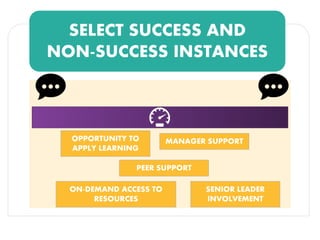
SELECT SUCCESS AND 
NON-SUCCESS INSTANCES 
MANAGER SUPPORT 
OPPORTUNITY TO APPLY LEARNING 
PEER SUPPORT 
ON-DEMAND ACCESS TO RESOURCES 
SENIOR LEADER INVOLVEMENT
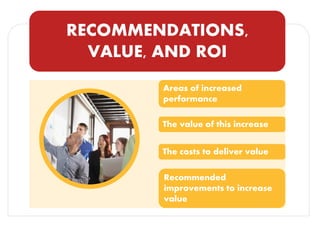
RECOMMENDATIONS, VALUE, AND ROI 
Areas of increased performance 
The value of this increase 
The costs to deliver value 
Recommended improvements to increase value
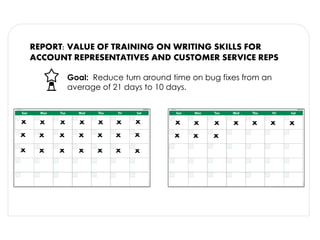
REPORT: VALUE OF TRAINING ON WRITING SKILLS FOR ACCOUNT REPRESENTATIVES AND CUSTOMER SERVICE REPS 
Goal: Reduce turn around time on bug fixes from an average of 21 days to 10 days. 
x 
x 
x 
x 
x 
x 
x 
x 
x 
x 
x 
x 
x 
x 
x 
x 
x 
x 
x 
x 
x 
x 
x 
x 
x 
x 
x 
x 
x 
x 
x
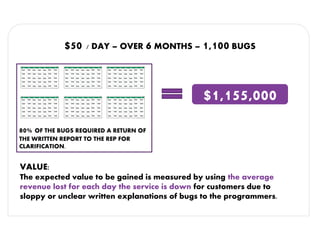
$1,155,000 
80% OF THE BUGS REQUIRED A RETURN OF THE WRITTEN REPORT TO THE REP FOR CLARIFICATION. 
$50 / DAY – OVER 6 MONTHS – 1,100 BUGS 
VALUE: 
The expected value to be gained is measured by using the average revenue lost for each day the service is down for customers due to sloppy or unclear written explanations of bugs to the programmers.
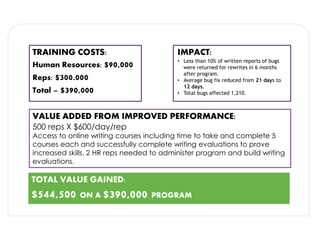
TRAINING COSTS: 
Human Resources: $90,000 
Reps: $300.000 
Total = $390,000 
VALUE ADDED FROM IMPROVED PERFORMANCE: 
500 reps X $600/day/rep 
Access to online writing courses including time to take and complete 5 courses each and successfully complete writing evaluations to prove increased skills. 2 HR reps needed to administer program and build writing evaluations. 
IMPACT: 
•Less than 10% of written reports of bugs were returned for rewrites in 6 months after program. 
•Average bug fix reduced from 21 days to 12 days. 
•Total bugs affected 1,210. 
TOTAL VALUE GAINED: 
$544,500 ON A $390,000 PROGRAM
WWW.BIZLIBRARY.COM/FREE-TRIAL 
Want to try 7 online video courses right now?
BIZLIBRARY.COM 
Jessica Petry 
Sr. Marketing Specialist 
jpetry@bizlibrary.com 
@JessLPetry 
@BizLibrary 
Chris Osborn 
Vice President of Marketing 
cosborn@bizlibrary.com 
@chrisosbornstl

Employee Training and Development: How to Measure Effectiveness and Impact - Webinar 09.25.14

  • 1.
    EMPLOYEE TRAINING ANDDEVELOPMENT: How To Measure Effectiveness and Impact
  • 2.
    ? How doyou currently measure your training program and efforts?
  • 3.
    WHAT WE HOPEYOU’LL LEARN Training metrics – where we’ve been and where we’re going. How to determine goals and key indicators. Five step process to create a measurement plan.
  • 4.
    BIZLIBRARY.COM Overall spendingon employee training in U.S. organizations is $164 billion. COMPANY SIZE (# of Employees) Smaller organizations typically spend more per employee than larger organizations. $700 $964 $1,800 COST PER EMPLOYEE PER YEAR $1,195
  • 5.
    KPI’S AND BENCHMARKS How do you currently measure success Use existing data to set benchmarks Key Performance Indicators for employees and the organization
  • 6.
    MEASUREMENT AND BUSINESS 1951: EDWARD DEMING The power of analytics to drive improvement. 1954: PETER DRUCKER The business of management and the knowledge worker. 1959: DONALD KIRKPATRICK Measuring the impact and ROI of training. 1970: JACK PHILLIPS Data-driven return on investment.
  • 7.
    KIRKPATRICK™ – PHILLIPSMODEL LEVEL 1 REACTION participant satisfaction LEVEL 2 LEARNING knowledge, skills and attitudes LEVEL 3 BEHAVIOR Application and on-the- job learning LEVEL 4 RESULTS business impact LEVEL 5 RETURN ON INVESTMENT KIRKPATRICK PARTNERS LLC
  • 8.
    THE COST OFONE GALLON OF GAS 2013: $3.61 1970: $0.36 1959: $0.25 2013: $271,600 THE AVERAGE COST OF A NEW HOUSE 1959: $12,400 1970: $23,500 2013 1970 1959 SPUTNIK – launch of first manmade satellite FIRST FLOPPY DISK 3D PRINTING THEN AND NOW
  • 9.
    It's not thethat's right that makes something work; it's the that's wrong that messes everything up. Measuring, Managing and Maximizing Performance Will Kaydos 5% 95%
  • 10.
    ISOLATION TECHNIQUES SYSTEM/PROCEDURECHANGES INCENTIVE/MOTIVATION MANAGER SUPPORT/ATTENTION EXTERNAL FACTORS EFFECT OF LEARNING ON IMPROVEMENT TOTAL IMPROVEMENT AFTER PROGRAM
  • 11.
  • 12.
    CONTROL GROUP Recruitersand Hiring Managers Group 1 Recruiters and Hiring Managers Group 2
  • 13.
    OTHER METHODS PARTICIPANTAND MANAGER ESTIMATION OF IMPACT – only as good as the employees ability to provide information. SENIOR MANAGEMENT ESTIMATION – bias and simple human error. SUCCESS CASE METHOD – what did this person learn that was new? how did this person use the learning on the job? did the usage help produce a worthwhile outcome?
  • 14.
    SUCCESS CASE METHOD What, if anything, did this person learn that was new? How, if at all, did this person use the new learning in some sort of job-specific behavior? Did the usage of the learning help to produce any sort of worthwhile outcome? 1 2 3 SOURCE: Telling Training’s Story by Robert O. Brinkerhoff
  • 15.
    TRAINING IMPACT ManagerSupport Opportunities to apply learning on the job Peer support On-demand access Leadership involvement
  • 16.
    STEPS TO CREATEA MEASUREMENT AND EVALUATION PLAN Focus and plan the evaluation. 1 Create an impact model that defines potential results and benefits. 2 Survey to gauge overall success versus non-success rates. 3 Select success and non-success instances. 4 Formulate conclusions and recommendations, value, and return-on-investment. 5 5
  • 17.
    FOCUS AND PLANTHE EVALUATION Identify performance areas Engage all of the key stakeholders Clarify and define success Establish the data points
  • 18.
    CREATE A MODELFOR SUCCESS Organizational Goals Business Unit Goals Employee Behaviors or Actions Employee Skills or Knowledge
  • 19.
    GAUGE OVERALL SUCCESSVS. NON-SUCCESS RATES WHICH STATEMENT BELOW BEST DESCRIBES YOUR EXPERIENCE SINCE PARTICIPATING IN THE PERFORMANCE MANAGEMENT TRAINING? •I learned something new, I have used it, and it has led to some very worthwhile results. •I learned and tried some new things but can’t point to any very worthwhile results yet. •While I may have learned something new, I have not been able to use it yet. •I already knew about and was doing the things this training taught. •I don’t think I can really use what I learned in the training.
  • 20.
    SELECT SUCCESS AND NON-SUCCESS INSTANCES MANAGER SUPPORT OPPORTUNITY TO APPLY LEARNING PEER SUPPORT ON-DEMAND ACCESS TO RESOURCES SENIOR LEADER INVOLVEMENT
  • 21.
    RECOMMENDATIONS, VALUE, ANDROI Areas of increased performance The value of this increase The costs to deliver value Recommended improvements to increase value
  • 22.
    REPORT: VALUE OFTRAINING ON WRITING SKILLS FOR ACCOUNT REPRESENTATIVES AND CUSTOMER SERVICE REPS Goal: Reduce turn around time on bug fixes from an average of 21 days to 10 days. x x x x x x x x x x x x x x x x x x x x x x x x x x x x x x x
  • 23.
    $1,155,000 80% OFTHE BUGS REQUIRED A RETURN OF THE WRITTEN REPORT TO THE REP FOR CLARIFICATION. $50 / DAY – OVER 6 MONTHS – 1,100 BUGS VALUE: The expected value to be gained is measured by using the average revenue lost for each day the service is down for customers due to sloppy or unclear written explanations of bugs to the programmers.
  • 24.
    TRAINING COSTS: HumanResources: $90,000 Reps: $300.000 Total = $390,000 VALUE ADDED FROM IMPROVED PERFORMANCE: 500 reps X $600/day/rep Access to online writing courses including time to take and complete 5 courses each and successfully complete writing evaluations to prove increased skills. 2 HR reps needed to administer program and build writing evaluations. IMPACT: •Less than 10% of written reports of bugs were returned for rewrites in 6 months after program. •Average bug fix reduced from 21 days to 12 days. •Total bugs affected 1,210. TOTAL VALUE GAINED: $544,500 ON A $390,000 PROGRAM
  • 25.
    WWW.BIZLIBRARY.COM/FREE-TRIAL Want totry 7 online video courses right now?
  • 26.
    BIZLIBRARY.COM Jessica Petry Sr. Marketing Specialist jpetry@bizlibrary.com @JessLPetry @BizLibrary Chris Osborn Vice President of Marketing cosborn@bizlibrary.com @chrisosbornstl