TRAINING ROADMAP
OF DEVELOPING A STRATEGIC
HENRY JOHN NUEVA
Training & Development Specialist
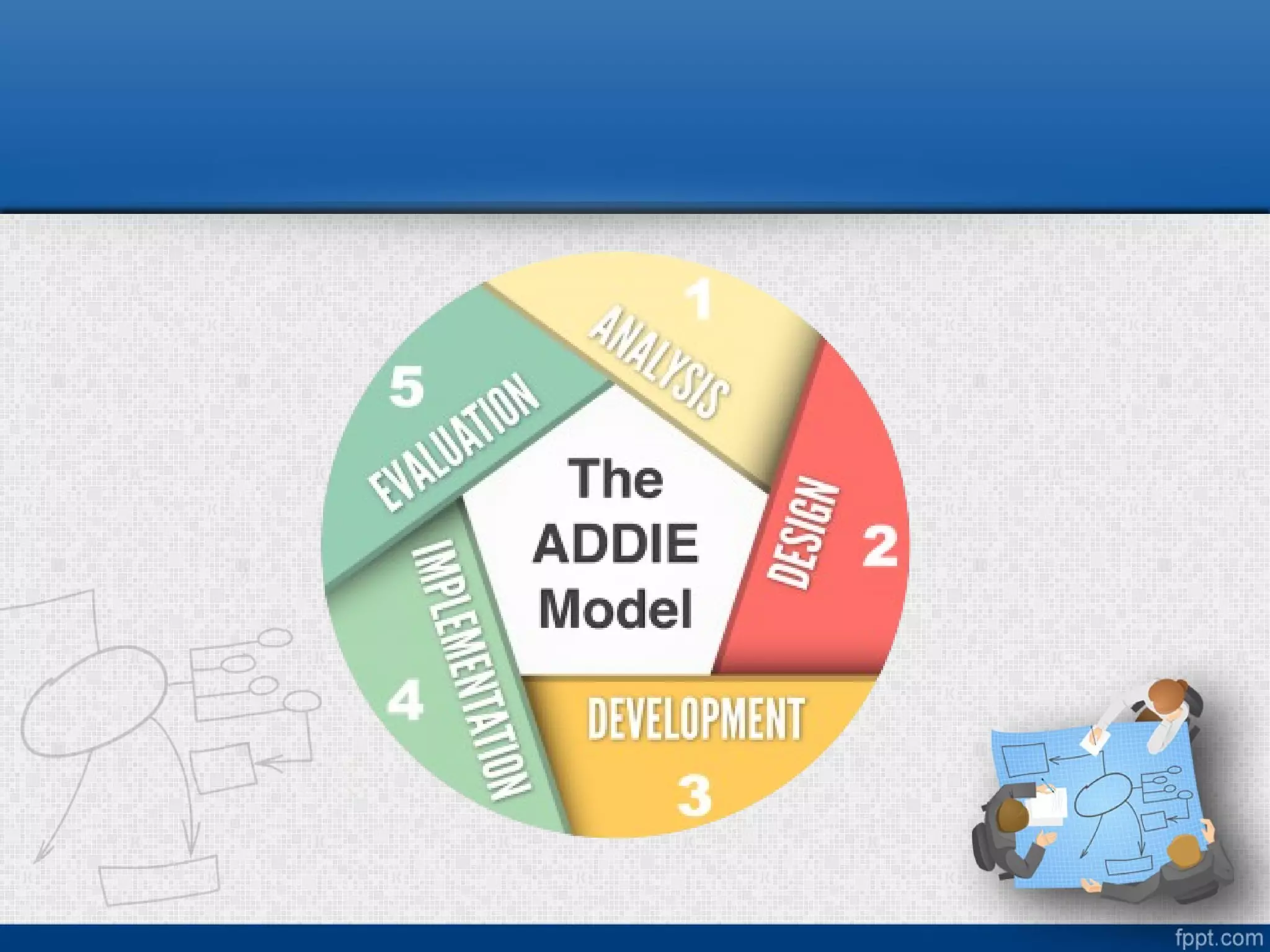
The
A.D.D.I.E.
© Manila, Philippines 2016
At the end of this presentation, you should be able to:
oUtilize the formation, implementation, and tracking of a training outreach
oAllow and adapt training needs in a well coordinated manner
oTrack and analyze metrics in order to allow continues training improvement
oDesign and develop state-of the-art training materials
oEvaluate the effectiveness of the training using processes with specific
and measurable outcomes
Answers: What is the Performance Goal?
During ANALYSISANALYSIS, the designer identifies the learning problems, the
goals and objectives, audience’s needs, existing knowledge, and any
other relevant characteristics.
Analysis stage considers the following:
STEPSSTEPS to perform when developing a Training Program:
Perform a Needs AssessmentPerform a Needs Assessment
Develop a Problem StatementDevelop a Problem Statement
Establish Goal(s)Establish Goal(s)
Determine activities/outputsDetermine activities/outputs
will be performedwill be performed
Determine what outcomesDetermine what outcomes
are desiredare desired
a TRAINING ANALYSIS Checklista TRAINING ANALYSIS Checklist
IMPORTANT:IMPORTANT:
Make sure all inputsMake sure all inputs
are clear and conciseare clear and concise
Answers: How Learners accomplish the
Performance Goal ?
During DESIGN phaseDESIGN phase, you re planning (designing) how the training
course should look in order to make the needs identified in the Analysis
stage. The Design phase is where you are creating the blueprint of
your training course.
IMPORTANT:IMPORTANT:
Create a captivating designCreate a captivating design
that suites all types & levelsthat suites all types & levels
of your participantsof your participants
5 Fundamental Questions to help you5 Fundamental Questions to help you || PRODUCE INSTRUCTIONALPRODUCE INSTRUCTIONAL
DESIGN DOCUMENTDESIGN DOCUMENT
How should the course content be organized ?
How should ideas be presented to participants ?
What delivery format should be use ?
What types of activities and exercises will best help
participants ?
How should the course measure participants’
accomplishments ?
Instructional
Strategy
Course
Format
Instructional
Design
Document
STEPSSTEPS IN DESIGN PHASEIN DESIGN PHASE
DEVELOPING AN INSTRUCTIONAL STRATEGYDEVELOPING AN INSTRUCTIONAL STRATEGY
At this point in the Design process, you make important choices about the
COURSE’S STRUCTURE & ITS METHODS.COURSE’S STRUCTURE & ITS METHODS.
How will
course be
grouped and
sequenced ?
What
instructional
methods and
tactics will be
used to
present
material?
How will
assessments
measure a
participant’s
success ?
GROUPING ANDGROUPING AND
SEQUENCING CONTENT |SEQUENCING CONTENT |
Possible Options
STEP-BY-STEPSTEP-BY-STEP
PART-TO-WHOLEPART-TO-WHOLE
WHOLE-TO-PARTWHOLE-TO-PART
KNOWN-TO-UNKNOWNKNOWN-TO-UNKNOWN
GENERAL-TO-SPECIFICGENERAL-TO-SPECIFIC
CHOOSING METHODSCHOOSING METHODS
AND TACTICS |AND TACTICS |Possible Options
GROUP DISCUSSIONSGROUP DISCUSSIONS
MODELINGMODELING
SCENARIOSSCENARIOS
MENEMONICSMENEMONICS
DRILLS & APPLIED PRACTICEDRILLS & APPLIED PRACTICE
SELECTING THESELECTING THE
COURSE FORMAT |COURSE FORMAT |
Possible Options
INSTRUCTOR-LED COURSEINSTRUCTOR-LED COURSE
PAPER-BASED SELF STUDYPAPER-BASED SELF STUDY
E-LEARNINGE-LEARNING
Meeting the Objectives
The DEVELOPMENTDEVELOPMENT phase is where you create and assemble the
contents of your training. Course materials are produced according to
decisions made during the design and analysis phase.
5 COMPONENTS5 COMPONENTS
OF DEVELOPMENT PHASE |OF DEVELOPMENT PHASE |
( 1: Review/ revise existing information sources / training materials )( 1: Review/ revise existing information sources / training materials )
Review the evaluations and metrics gathered from your last training to
determine if course materials need revision based on feedback. Revise
training materials accordingly. Update existing training materials to
reflect regulatory and policy changes. Search for additional/improved
training materials that can be incorporated into your training and revise
training materials if warranted.
5 COMPONENTS5 COMPONENTS
OF DEVELOPMENT PHASE |OF DEVELOPMENT PHASE |
( 2: Selecting appropriate methods and media )( 2: Selecting appropriate methods and media )
• Assess what your training venue offers?
• Can you do PowerPoint, show video/audio clips, and have access to
breakout rooms?
• Does your training use a mix of methods, media and delivery?
Choose instructors that have appropriate knowledge of the subject for
the audience. Train instructors if necessary in public speaking skills,
PowerPoint, technical training, etc. Check your program’s budget for
how much you can spend on printing, design, copying, training
instructors, etc.
5 COMPONENTS5 COMPONENTS
OF DEVELOPMENT PHASE |OF DEVELOPMENT PHASE |
( 3: Developing all new course materials )( 3: Developing all new course materials )
• Focus your course materials on the ‘need to knows’ rather than the
‘nice to knows’. Material focus should be environment based – training
to focus on the why of the regulation
• Are course materials customized to your audience?
• Develop evaluation materials.
• Do your course materials meet your learning objectives and will it work
in the training venue you’ve chosen?
• Have you included real world scenarios that will interest your attendees
and promote discussion that will further learning objectives?
• Develop training seminar announcements, publicity documents,
promotion and other types of marketing materials.
5 COMPONENTS5 COMPONENTS
OF DEVELOPMENT PHASE |OF DEVELOPMENT PHASE |
( 4: Validating Course Materials )( 4: Validating Course Materials )
Share course materials with both internal and external stakeholders to
get feedback prior to implementation. Stakeholders should review for
completeness, regulatory and policy accuracy. People who are actually
trying to learn the regulatory material provide a very rigorous test for
your material and they’re often very willing to provide candid feedback.
5 COMPONENTS5 COMPONENTS
OF DEVELOPMENT PHASE |OF DEVELOPMENT PHASE |
( 5: Developing an Instructional Management Plan )( 5: Developing an Instructional Management Plan )
Develop an instructor guide for the course. This guide focuses on the
what if’s – for example, what happens if one of the instructors is sick? It
may include, but is not limited to,
•An outline for the training, instructions for activities
•Course agenda;
•Instructor bios;
•List of key points that must be covered
•Other information necessary to make sure the training session runs
smoothly.
Delivering the Solution
The IMPLEMENTATIONIMPLEMENTATION
phase follows the Development phase and ensures that:
COMMONCOMMON
ISSUES |ISSUES |Course Materials
COMMONCOMMON
ISSUES |ISSUES | Instructors
COMMONCOMMON
ISSUES |ISSUES |Course Schedule
Ensuring Quality
EVALUATIONEVALUATION should be done continuously throughout the ADDIE
process, and be used to align the proposed targeted training goals with
specific measurable results.
IMPORTANT:IMPORTANT:
Measure and analysis is the keyMeasure and analysis is the key
to continuous improvement ofto continuous improvement of
the training providedthe training provided to attainto attain
desired training goals.desired training goals.
1. General improvement in compliance/behaviors/actions and/or
increased participation
2. Improvement in compliance/behaviors/actions for the program and
topics of concern.
3. Improvement in compliance/behaviors/actions by attendees or
participants.
4. Retention of new knowledge by attendees or participants
5. Increased training attendance or participation
COMMONCOMMON
EVALUATION METRICS |EVALUATION METRICS |
Mandatory
THANK YOU !THANK YOU !
END OF PRESENTATIONEND OF PRESENTATION

The A.D.D.I.E. of Developing a Strategic Training Roadmap

  • 1.
    TRAINING ROADMAP OF DEVELOPINGA STRATEGIC HENRY JOHN NUEVA Training & Development Specialist The A.D.D.I.E. © Manila, Philippines 2016
  • 2.
    At the endof this presentation, you should be able to: oUtilize the formation, implementation, and tracking of a training outreach oAllow and adapt training needs in a well coordinated manner oTrack and analyze metrics in order to allow continues training improvement oDesign and develop state-of the-art training materials oEvaluate the effectiveness of the training using processes with specific and measurable outcomes
  • 5.
    Answers: What isthe Performance Goal?
  • 6.
    During ANALYSISANALYSIS, thedesigner identifies the learning problems, the goals and objectives, audience’s needs, existing knowledge, and any other relevant characteristics. Analysis stage considers the following:
  • 7.
    STEPSSTEPS to performwhen developing a Training Program: Perform a Needs AssessmentPerform a Needs Assessment Develop a Problem StatementDevelop a Problem Statement Establish Goal(s)Establish Goal(s) Determine activities/outputsDetermine activities/outputs will be performedwill be performed Determine what outcomesDetermine what outcomes are desiredare desired
  • 8.
    a TRAINING ANALYSISChecklista TRAINING ANALYSIS Checklist IMPORTANT:IMPORTANT: Make sure all inputsMake sure all inputs are clear and conciseare clear and concise
  • 9.
    Answers: How Learnersaccomplish the Performance Goal ?
  • 10.
    During DESIGN phaseDESIGNphase, you re planning (designing) how the training course should look in order to make the needs identified in the Analysis stage. The Design phase is where you are creating the blueprint of your training course. IMPORTANT:IMPORTANT: Create a captivating designCreate a captivating design that suites all types & levelsthat suites all types & levels of your participantsof your participants
  • 11.
    5 Fundamental Questionsto help you5 Fundamental Questions to help you || PRODUCE INSTRUCTIONALPRODUCE INSTRUCTIONAL DESIGN DOCUMENTDESIGN DOCUMENT How should the course content be organized ? How should ideas be presented to participants ? What delivery format should be use ? What types of activities and exercises will best help participants ? How should the course measure participants’ accomplishments ?
  • 12.
  • 13.
    DEVELOPING AN INSTRUCTIONALSTRATEGYDEVELOPING AN INSTRUCTIONAL STRATEGY
  • 14.
    At this pointin the Design process, you make important choices about the COURSE’S STRUCTURE & ITS METHODS.COURSE’S STRUCTURE & ITS METHODS. How will course be grouped and sequenced ? What instructional methods and tactics will be used to present material? How will assessments measure a participant’s success ?
  • 15.
    GROUPING ANDGROUPING AND SEQUENCINGCONTENT |SEQUENCING CONTENT | Possible Options STEP-BY-STEPSTEP-BY-STEP PART-TO-WHOLEPART-TO-WHOLE WHOLE-TO-PARTWHOLE-TO-PART KNOWN-TO-UNKNOWNKNOWN-TO-UNKNOWN GENERAL-TO-SPECIFICGENERAL-TO-SPECIFIC
  • 16.
    CHOOSING METHODSCHOOSING METHODS ANDTACTICS |AND TACTICS |Possible Options GROUP DISCUSSIONSGROUP DISCUSSIONS MODELINGMODELING SCENARIOSSCENARIOS MENEMONICSMENEMONICS DRILLS & APPLIED PRACTICEDRILLS & APPLIED PRACTICE
  • 17.
    SELECTING THESELECTING THE COURSEFORMAT |COURSE FORMAT | Possible Options INSTRUCTOR-LED COURSEINSTRUCTOR-LED COURSE PAPER-BASED SELF STUDYPAPER-BASED SELF STUDY E-LEARNINGE-LEARNING
  • 18.
  • 19.
    The DEVELOPMENTDEVELOPMENT phaseis where you create and assemble the contents of your training. Course materials are produced according to decisions made during the design and analysis phase.
  • 20.
    5 COMPONENTS5 COMPONENTS OFDEVELOPMENT PHASE |OF DEVELOPMENT PHASE | ( 1: Review/ revise existing information sources / training materials )( 1: Review/ revise existing information sources / training materials ) Review the evaluations and metrics gathered from your last training to determine if course materials need revision based on feedback. Revise training materials accordingly. Update existing training materials to reflect regulatory and policy changes. Search for additional/improved training materials that can be incorporated into your training and revise training materials if warranted.
  • 21.
    5 COMPONENTS5 COMPONENTS OFDEVELOPMENT PHASE |OF DEVELOPMENT PHASE | ( 2: Selecting appropriate methods and media )( 2: Selecting appropriate methods and media ) • Assess what your training venue offers? • Can you do PowerPoint, show video/audio clips, and have access to breakout rooms? • Does your training use a mix of methods, media and delivery? Choose instructors that have appropriate knowledge of the subject for the audience. Train instructors if necessary in public speaking skills, PowerPoint, technical training, etc. Check your program’s budget for how much you can spend on printing, design, copying, training instructors, etc.
  • 22.
    5 COMPONENTS5 COMPONENTS OFDEVELOPMENT PHASE |OF DEVELOPMENT PHASE | ( 3: Developing all new course materials )( 3: Developing all new course materials ) • Focus your course materials on the ‘need to knows’ rather than the ‘nice to knows’. Material focus should be environment based – training to focus on the why of the regulation • Are course materials customized to your audience? • Develop evaluation materials. • Do your course materials meet your learning objectives and will it work in the training venue you’ve chosen? • Have you included real world scenarios that will interest your attendees and promote discussion that will further learning objectives? • Develop training seminar announcements, publicity documents, promotion and other types of marketing materials.
  • 23.
    5 COMPONENTS5 COMPONENTS OFDEVELOPMENT PHASE |OF DEVELOPMENT PHASE | ( 4: Validating Course Materials )( 4: Validating Course Materials ) Share course materials with both internal and external stakeholders to get feedback prior to implementation. Stakeholders should review for completeness, regulatory and policy accuracy. People who are actually trying to learn the regulatory material provide a very rigorous test for your material and they’re often very willing to provide candid feedback.
  • 24.
    5 COMPONENTS5 COMPONENTS OFDEVELOPMENT PHASE |OF DEVELOPMENT PHASE | ( 5: Developing an Instructional Management Plan )( 5: Developing an Instructional Management Plan ) Develop an instructor guide for the course. This guide focuses on the what if’s – for example, what happens if one of the instructors is sick? It may include, but is not limited to, •An outline for the training, instructions for activities •Course agenda; •Instructor bios; •List of key points that must be covered •Other information necessary to make sure the training session runs smoothly.
  • 25.
  • 26.
    The IMPLEMENTATIONIMPLEMENTATION phase followsthe Development phase and ensures that:
  • 27.
  • 28.
  • 29.
  • 30.
  • 31.
    EVALUATIONEVALUATION should bedone continuously throughout the ADDIE process, and be used to align the proposed targeted training goals with specific measurable results. IMPORTANT:IMPORTANT: Measure and analysis is the keyMeasure and analysis is the key to continuous improvement ofto continuous improvement of the training providedthe training provided to attainto attain desired training goals.desired training goals.
  • 33.
    1. General improvementin compliance/behaviors/actions and/or increased participation 2. Improvement in compliance/behaviors/actions for the program and topics of concern. 3. Improvement in compliance/behaviors/actions by attendees or participants. 4. Retention of new knowledge by attendees or participants 5. Increased training attendance or participation COMMONCOMMON EVALUATION METRICS |EVALUATION METRICS | Mandatory
  • 34.
    THANK YOU !THANKYOU ! END OF PRESENTATIONEND OF PRESENTATION