.


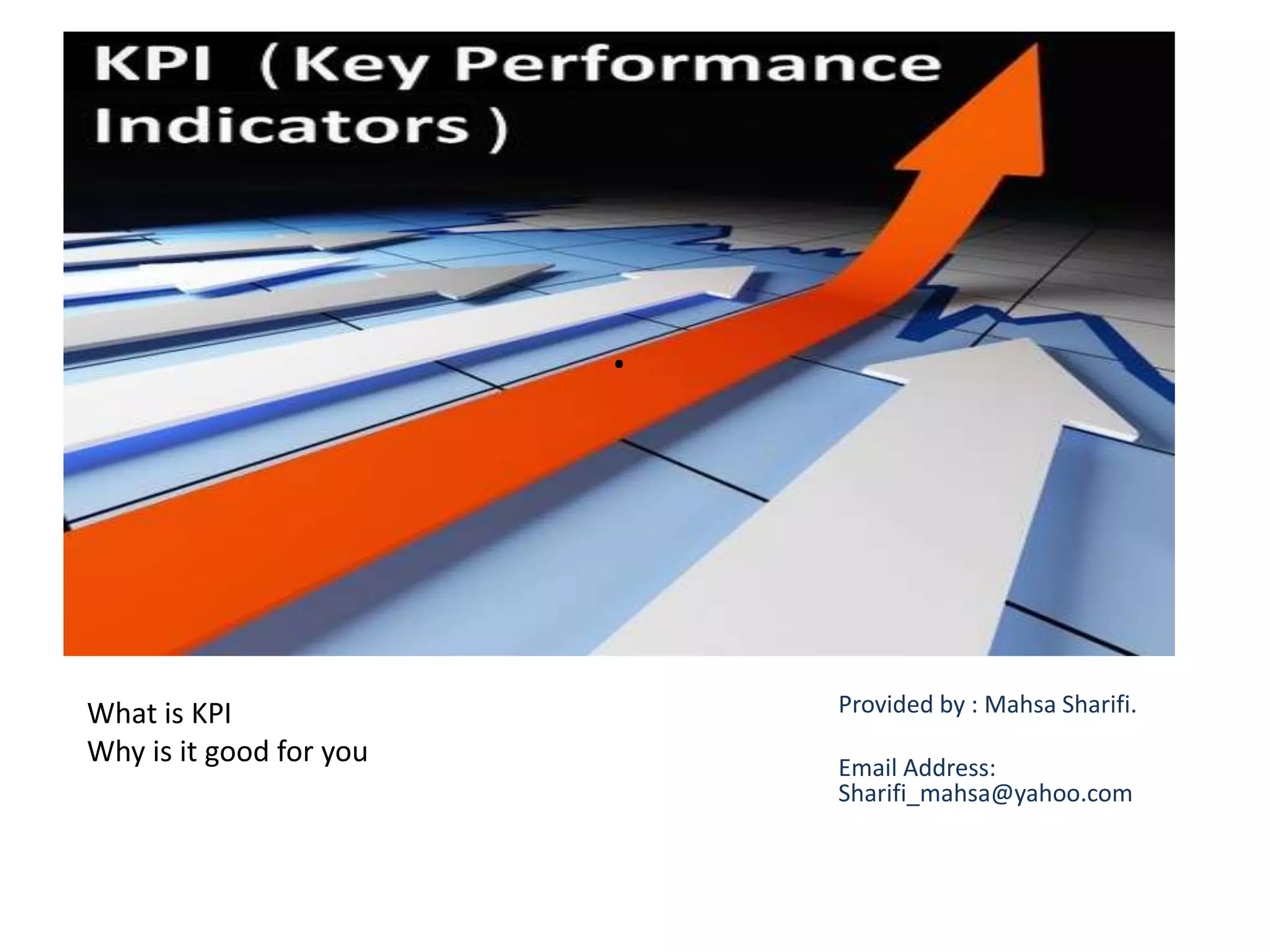
What is KPI                  Provided by : Mahsa Sharifi.
Why is it good for you       Email Address:
                             Sharifi_mahsa@yahoo.com
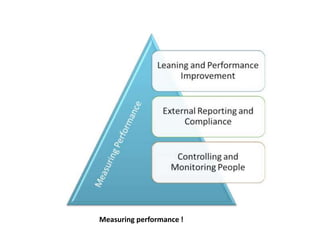
Measuring performance
• Measuring something is the best way to make
  it improve,
• if you don't measure, you don't really know
  what's going on.
•   To Evaluate
•   To Control
•   To Budget
•   To Motivate
•   To Promote
KPI Examples and Templates.

• KPIs, metrics, and ratios for any department in your organization.
  Key performance indicators (KPIs) do exactly what their name
  suggests: they provide an indication of your performance by
  measuring key processes. By monitoring the right KPIs, you can gain
  valuable insight into your performance and make the adjustments
  needed to optimize your performance.
• they provide an indication of your performance by measuring key
  processes
• The challenge is knowing which KPIs are most important to monitor
  to get the results you want. That's why we've put together this list
  of KPIs for each department in your organization. Each KPI should
  come with a definition, calculation, and example.
• The challenge
Categorization of indicators

• Quantitative indicators which can be presented as a
  number.
• Practical indicators that interface with existing company
  processes.
• Directional indicators specifying whether an organization
  is getting better or not.
• Actionable indicators are sufficiently in an organization's
  control to affect change.
• Financial indicators used in performance measurement
  and when looking at an operating index.
Managers should know the answers…
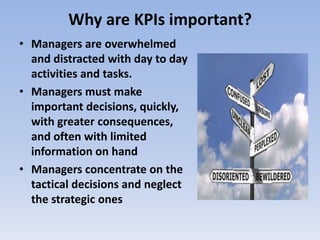
Why are KPIs important?
• Managers are overwhelmed
  and distracted with day to day
  activities and tasks.
• Managers must make
  important decisions, quickly,
  with greater consequences,
  and often with limited
  information on hand
• Managers concentrate on the
  tactical decisions and neglect
  the strategic ones
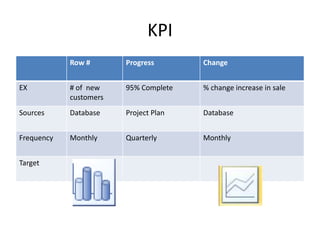
KPI
            Row #       Progress       Change


EX          # of new    95% Complete   % change increase in sale
            customers
Sources     Database    Project Plan   Database


Frequency   Monthly     Quarterly      Monthly


Target
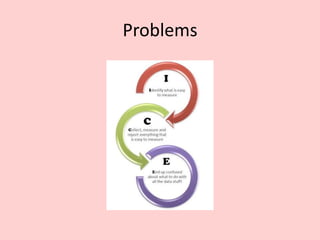
Problems
Still Not convinced ?Why KPI ?
• Say ‘Yes’ to Key Performance Indicators (KPIs)
  Because Guess Work is for D!

   KPIs give you a complete picture of plan vs.
   actual results.


                               KPIs give you a complete picture of plan vs.
                               actual results.
KPIs should focus on a single strategy
• KPIs should all be linked to the strategy
• • KPIs should be consistent
• • KPIs should be mutually reinforcing
Measuring performance !
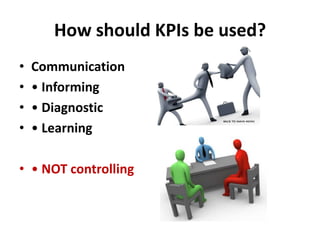
How should KPIs be used?
•   Communication
•   • Informing
•   • Diagnostic
•   • Learning

• • NOT controlling
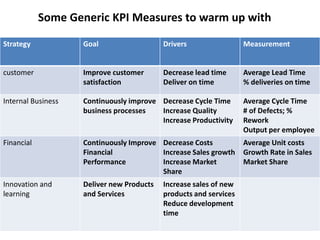
Some Generic KPI Measures to warm up with

Strategy            Goal                   Drivers                 Measurement


customer            Improve customer       Decrease lead time      Average Lead Time
                    satisfaction           Deliver on time         % deliveries on time

Internal Business   Continuously improve Decrease Cycle Time       Average Cycle Time
                    business processes   Increase Quality          # of Defects; %
                                         Increase Productivity     Rework
                                                                   Output per employee
Financial           Continuously Improve Decrease Costs            Average Unit costs
                    Financial            Increase Sales growth     Growth Rate in Sales
                    Performance          Increase Market           Market Share
                                         Share
Innovation and      Deliver new Products   Increase sales of new
learning            and Services           products and services
                                           Reduce development
                                           time
You are what you measure.

• Measure. Find insights. Take action. OR
                die trying
You Are What You Measure, So Choose
          Your KPIs Wisely!

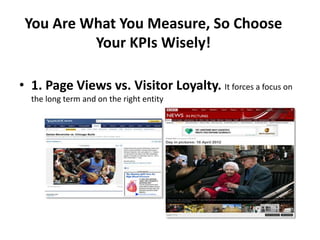
• 1. Page Views vs. Visitor Loyalty. It forces a focus on
  the long term and on the right entity
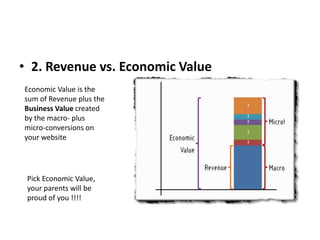
• 2. Revenue vs. Economic Value
Economic Value is the
sum of Revenue plus the
Business Value created
by the macro- plus
micro-conversions on
your website


 Pick Economic Value,
 your parents will be
 proud of you !!!!
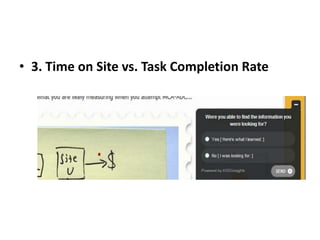
• 3. Time on Site vs. Task Completion Rate
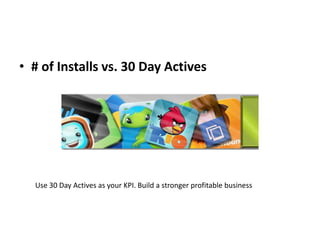
• # of Installs vs. 30 Day Actives


  Use 30 Day Actives as your KPI. Build a stronger profitable business
Are we on the same page ?
•   It is important to point out that I'm not advocating that you stop measuring page views,
    revenue, time on site or # of installs. They are all fine metrics. You'll most likely use them as
    diagnostic measures when you analyze the metrics I do recommend you shift to.
•   I'm advocating that you not make them KPIs, don't crown them God, don't allow your
    employees to solve just for the primitive six. Because none of these six metrics incentivize
    optimal behavior or business outcomes.
•   You become what you measure, so why not solve for what actually matters?
•   Let me close with a quote on incentives, from the inimitable Steve Jobs…
•   "Incentive structures work. So you have to be very careful of what you incent people to do,
    because various incentive structures create all sorts of consequences that you can't
    anticipate. Everybody at Pixar is incented to build the company: whether they're working
    on the film; whether they're working on a potential direct-to-video product; whether
    they're working on a CD-ROM. Whatever their combination of creative and technical talent
    may be, we want them incented to make the whole company successful."
•   No one could have framed it better than Steve.
•   Incentive structures are not a web analytics problem. They are an organization design
    problem. But in choosing the optimal metrics to crown as heroes we can use data to
    incentivize the right behavior, value creation for a company, and deliver happiness to
    customer
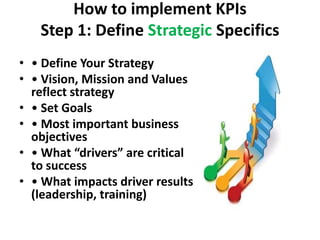
How to implement KPIs
   Step 1: Define Strategic Specifics
• • Define Your Strategy
• • Vision, Mission and Values
  reflect strategy
• • Set Goals
• • Most important business
  objectives
• • What “drivers” are critical
  to success
• • What impacts driver results
  (leadership, training)
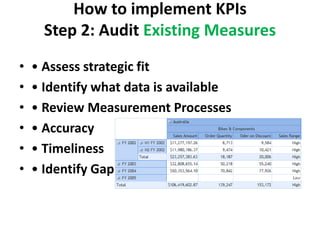
How to implement KPIs
      Step 2: Audit Existing Measures
•   • Assess strategic fit
•   • Identify what data is available
•   • Review Measurement Processes
•   • Accuracy
•   • Timeliness
•   • Identify Gaps
How to implement KPIs
      Step 3: Develop New Measures
•   • Bridge the gaps, examples of strategic data
•   often missing:
•   • Employee Satisfaction Survey
•   • Customer Satisfaction Survey
•   • Rework %
•   • On-time Delivery %
How to implement KPIs
      Step 3: Develop New Measures
•   • Measures must reflect performance and
•   progress of the business
•   • Must be quantifiable
•   • Must be compared to another number
•   • last year
•   • budget/goal
•   • trend
•   • Can be acted upon
How to implement KPIs
      Step 3: Develop New Measures
•   • KPI title: Employee Turnover
•   • Defined: number of employees who resign or are
•   terminated for any reason divided by the number of
•   employees at the beginning of the year. Reductions
•   in force excluded
•   • Measured: Payroll termination report by reason
•   • Goal: Reduce turnover by 10%; FY 2009 objective is
•   15 %.
How to implement KPIs
      Step 4: Analyze and Report
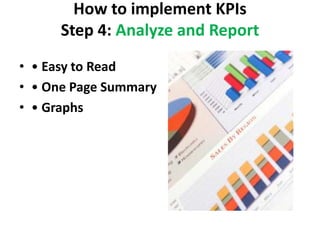
• • Easy to Read
• • One Page Summary
• • Graphs
How to implement KPIs
     Step 5: Continuous Improvement
•   • Set Priorities base a stragegy
•   • SMART Goals
•   • Assign Accountability
•   • Track Improvement
•   • Set New Goals
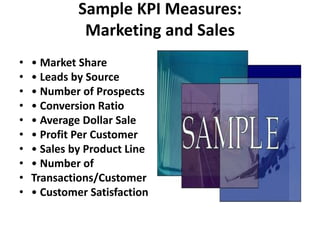
Sample KPI Measures:
              Marketing and Sales
•   • Market Share
•   • Leads by Source
•   • Number of Prospects
•   • Conversion Ratio
•   • Average Dollar Sale
•   • Profit Per Customer
•   • Sales by Product Line
•   • Number of
•   Transactions/Customer
•   • Customer Satisfaction
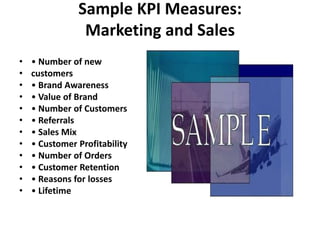
Sample KPI Measures:
                Marketing and Sales
•   • Number of new
•   customers
•   • Brand Awareness
•   • Value of Brand
•   • Number of Customers
•   • Referrals
•   • Sales Mix
•   • Customer Profitability
•   • Number of Orders
•   • Customer Retention
•   • Reasons for losses
•   • Lifetime
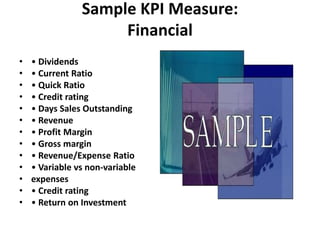
Sample KPI Measure:
                     Financial
•   • Dividends
•   • Current Ratio
•   • Quick Ratio
•   • Credit rating
•   • Days Sales Outstanding
•   • Revenue
•   • Profit Margin
•   • Gross margin
•   • Revenue/Expense Ratio
•   • Variable vs non-variable
•   expenses
•   • Credit rating
•   • Return on Investment
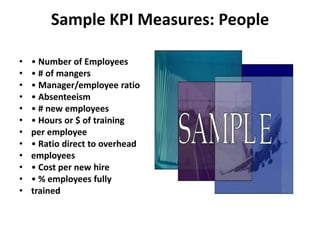
Sample KPI Measures: People

•   • Number of Employees
•   • # of mangers
•   • Manager/employee ratio
•   • Absenteeism
•   • # new employees
•   • Hours or $ of training
•   per employee
•   • Ratio direct to overhead
•   employees
•   • Cost per new hire
•   • % employees fully
•   trained
Things Every Owner
            Should Know
• The profitability of the
   business depends on
how well the employees
consistently perform
critical activities.
• Employees perform best
   when they
understand how their
performance affects the
bottom line, and how their
performance is measured.
Things Every Owner
                Should Know
• Small changes in
  critical areas can have
  a great impact on the
  bottom line.
• What gets measured
  gets done, and what
  gets rewarded gets
  done again.
Problems of experts.
• In practice, overseeing key performance indicators can
  prove expensive or difficult for organizations. Some
  indicators such as staff morale may be impossible to
  quantify. As such dubious KPIs can be adopted that can
  be used as a rough guide rather than a precise
  benchmark.
• Another serious issue in practice is that once a
  measure is created, it becomes difficult to adjust to
  changing needs as historical comparisons will be lost.
  As such measures are kept even if of dubious
  relevance, because history does exist.
• Comparisons between different organizations are often
  difficult as they depend on specific in-house practices
  and policies.
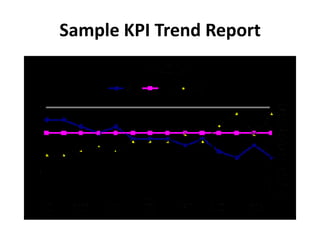
Sample KPI Trend Report
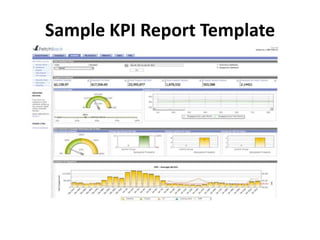
Sample KPI Report Template
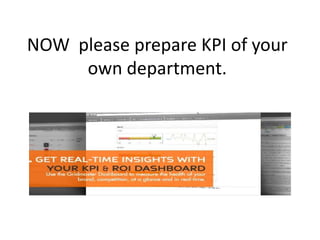
NOW please prepare KPI of your
     own department.
KPI mahsa sharifi 2012

KPI mahsa sharifi 2012

  • 1.
    . What is KPI Provided by : Mahsa Sharifi. Why is it good for you Email Address: Sharifi_mahsa@yahoo.com
  • 2.
    Measuring performance • Measuringsomething is the best way to make it improve, • if you don't measure, you don't really know what's going on. • To Evaluate • To Control • To Budget • To Motivate • To Promote
  • 3.
    KPI Examples andTemplates. • KPIs, metrics, and ratios for any department in your organization. Key performance indicators (KPIs) do exactly what their name suggests: they provide an indication of your performance by measuring key processes. By monitoring the right KPIs, you can gain valuable insight into your performance and make the adjustments needed to optimize your performance. • they provide an indication of your performance by measuring key processes • The challenge is knowing which KPIs are most important to monitor to get the results you want. That's why we've put together this list of KPIs for each department in your organization. Each KPI should come with a definition, calculation, and example. • The challenge
  • 4.
    Categorization of indicators •Quantitative indicators which can be presented as a number. • Practical indicators that interface with existing company processes. • Directional indicators specifying whether an organization is getting better or not. • Actionable indicators are sufficiently in an organization's control to affect change. • Financial indicators used in performance measurement and when looking at an operating index.
  • 5.
    Managers should knowthe answers…
  • 6.
    Why are KPIsimportant? • Managers are overwhelmed and distracted with day to day activities and tasks. • Managers must make important decisions, quickly, with greater consequences, and often with limited information on hand • Managers concentrate on the tactical decisions and neglect the strategic ones
  • 7.
    KPI Row # Progress Change EX # of new 95% Complete % change increase in sale customers Sources Database Project Plan Database Frequency Monthly Quarterly Monthly Target
  • 8.
  • 9.
    Still Not convinced?Why KPI ? • Say ‘Yes’ to Key Performance Indicators (KPIs) Because Guess Work is for D! KPIs give you a complete picture of plan vs. actual results. KPIs give you a complete picture of plan vs. actual results.
  • 11.
    KPIs should focuson a single strategy • KPIs should all be linked to the strategy • • KPIs should be consistent • • KPIs should be mutually reinforcing
  • 12.
  • 13.
    How should KPIsbe used? • Communication • • Informing • • Diagnostic • • Learning • • NOT controlling
  • 14.
    Some Generic KPIMeasures to warm up with Strategy Goal Drivers Measurement customer Improve customer Decrease lead time Average Lead Time satisfaction Deliver on time % deliveries on time Internal Business Continuously improve Decrease Cycle Time Average Cycle Time business processes Increase Quality # of Defects; % Increase Productivity Rework Output per employee Financial Continuously Improve Decrease Costs Average Unit costs Financial Increase Sales growth Growth Rate in Sales Performance Increase Market Market Share Share Innovation and Deliver new Products Increase sales of new learning and Services products and services Reduce development time
  • 15.
    You are whatyou measure. • Measure. Find insights. Take action. OR die trying
  • 16.
    You Are WhatYou Measure, So Choose Your KPIs Wisely! • 1. Page Views vs. Visitor Loyalty. It forces a focus on the long term and on the right entity
  • 17.
    • 2. Revenuevs. Economic Value Economic Value is the sum of Revenue plus the Business Value created by the macro- plus micro-conversions on your website Pick Economic Value, your parents will be proud of you !!!!
  • 18.
    • 3. Timeon Site vs. Task Completion Rate
  • 19.
    • # ofInstalls vs. 30 Day Actives Use 30 Day Actives as your KPI. Build a stronger profitable business
  • 20.
    Are we onthe same page ? • It is important to point out that I'm not advocating that you stop measuring page views, revenue, time on site or # of installs. They are all fine metrics. You'll most likely use them as diagnostic measures when you analyze the metrics I do recommend you shift to. • I'm advocating that you not make them KPIs, don't crown them God, don't allow your employees to solve just for the primitive six. Because none of these six metrics incentivize optimal behavior or business outcomes. • You become what you measure, so why not solve for what actually matters? • Let me close with a quote on incentives, from the inimitable Steve Jobs… • "Incentive structures work. So you have to be very careful of what you incent people to do, because various incentive structures create all sorts of consequences that you can't anticipate. Everybody at Pixar is incented to build the company: whether they're working on the film; whether they're working on a potential direct-to-video product; whether they're working on a CD-ROM. Whatever their combination of creative and technical talent may be, we want them incented to make the whole company successful." • No one could have framed it better than Steve. • Incentive structures are not a web analytics problem. They are an organization design problem. But in choosing the optimal metrics to crown as heroes we can use data to incentivize the right behavior, value creation for a company, and deliver happiness to customer
  • 22.
    How to implementKPIs Step 1: Define Strategic Specifics • • Define Your Strategy • • Vision, Mission and Values reflect strategy • • Set Goals • • Most important business objectives • • What “drivers” are critical to success • • What impacts driver results (leadership, training)
  • 23.
    How to implementKPIs Step 2: Audit Existing Measures • • Assess strategic fit • • Identify what data is available • • Review Measurement Processes • • Accuracy • • Timeliness • • Identify Gaps
  • 24.
    How to implementKPIs Step 3: Develop New Measures • • Bridge the gaps, examples of strategic data • often missing: • • Employee Satisfaction Survey • • Customer Satisfaction Survey • • Rework % • • On-time Delivery %
  • 25.
    How to implementKPIs Step 3: Develop New Measures • • Measures must reflect performance and • progress of the business • • Must be quantifiable • • Must be compared to another number • • last year • • budget/goal • • trend • • Can be acted upon
  • 26.
    How to implementKPIs Step 3: Develop New Measures • • KPI title: Employee Turnover • • Defined: number of employees who resign or are • terminated for any reason divided by the number of • employees at the beginning of the year. Reductions • in force excluded • • Measured: Payroll termination report by reason • • Goal: Reduce turnover by 10%; FY 2009 objective is • 15 %.
  • 27.
    How to implementKPIs Step 4: Analyze and Report • • Easy to Read • • One Page Summary • • Graphs
  • 28.
    How to implementKPIs Step 5: Continuous Improvement • • Set Priorities base a stragegy • • SMART Goals • • Assign Accountability • • Track Improvement • • Set New Goals
  • 29.
    Sample KPI Measures: Marketing and Sales • • Market Share • • Leads by Source • • Number of Prospects • • Conversion Ratio • • Average Dollar Sale • • Profit Per Customer • • Sales by Product Line • • Number of • Transactions/Customer • • Customer Satisfaction
  • 30.
    Sample KPI Measures: Marketing and Sales • • Number of new • customers • • Brand Awareness • • Value of Brand • • Number of Customers • • Referrals • • Sales Mix • • Customer Profitability • • Number of Orders • • Customer Retention • • Reasons for losses • • Lifetime
  • 31.
    Sample KPI Measure: Financial • • Dividends • • Current Ratio • • Quick Ratio • • Credit rating • • Days Sales Outstanding • • Revenue • • Profit Margin • • Gross margin • • Revenue/Expense Ratio • • Variable vs non-variable • expenses • • Credit rating • • Return on Investment
  • 32.
    Sample KPI Measures:People • • Number of Employees • • # of mangers • • Manager/employee ratio • • Absenteeism • • # new employees • • Hours or $ of training • per employee • • Ratio direct to overhead • employees • • Cost per new hire • • % employees fully • trained
  • 33.
    Things Every Owner Should Know • The profitability of the business depends on how well the employees consistently perform critical activities. • Employees perform best when they understand how their performance affects the bottom line, and how their performance is measured.
  • 34.
    Things Every Owner Should Know • Small changes in critical areas can have a great impact on the bottom line. • What gets measured gets done, and what gets rewarded gets done again.
  • 35.
    Problems of experts. •In practice, overseeing key performance indicators can prove expensive or difficult for organizations. Some indicators such as staff morale may be impossible to quantify. As such dubious KPIs can be adopted that can be used as a rough guide rather than a precise benchmark. • Another serious issue in practice is that once a measure is created, it becomes difficult to adjust to changing needs as historical comparisons will be lost. As such measures are kept even if of dubious relevance, because history does exist. • Comparisons between different organizations are often difficult as they depend on specific in-house practices and policies.
  • 36.
  • 37.
  • 38.
    NOW please prepareKPI of your own department.