INDICATORS OF HEALTH & DISEASE
Amita Kashyap
Professor and Head (Com. Medicine)
S.M.S. Medical College, Jaipur
INDICATORS OF HEALTH & DISEASE
“…..for the health administrator, nothing could
be more valuable than to have, at his
command, one or measuring rods to help
him in his task and also in assessing his
specific problems relating to the health of
the people, in designing his plans to deal
with these, in guiding his administration
and in evaluating his schemes….” WHO
CHARACTERISTICS OF INDICATORS
Ideal indicators should be:-
 Valid,
 Reliable and objective,
 Sensitive,
 Specific
 Feasible Relevant
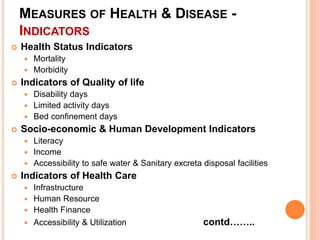
MEASURES OF HEALTH & DISEASE -
INDICATORS
 Health Status Indicators
 Mortality
 Morbidity
 Indicators of Quality of life
 Disability days
 Limited activity days
 Bed confinement days
 Socio-economic & Human Development Indicators
 Literacy
 Income
 Accessibility to safe water & Sanitary excreta disposal facilities
 Indicators of Health Care
 Infrastructure
 Human Resource
 Health Finance
 Accessibility & Utilization contd……..
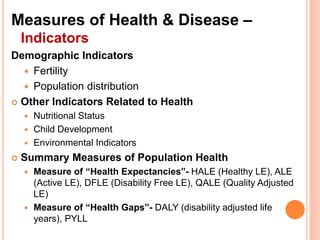
Measures of Health & Disease –
Indicators
Demographic Indicators
 Fertility
 Population distribution
 Other Indicators Related to Health
 Nutritional Status
 Child Development
 Environmental Indicators
 Summary Measures of Population Health
 Measure of “Health Expectancies”- HALE (Healthy LE), ALE
(Active LE), DFLE (Disability Free LE), QALE (Quality Adjusted
LE)
 Measure of “Health Gaps”- DALY (disability adjusted life
years), PYLL
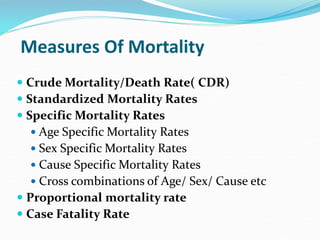
Measures Of Mortality
 Crude Mortality/Death Rate( CDR)
 Standardized Mortality Rates
 Specific Mortality Rates
 Age Specific Mortality Rates
 Sex Specific Mortality Rates
 Cause Specific Mortality Rates
 Cross combinations of Age/ Sex/ Cause etc
 Proportional mortality rate
 Case Fatality Rate
Measures Of Mortality
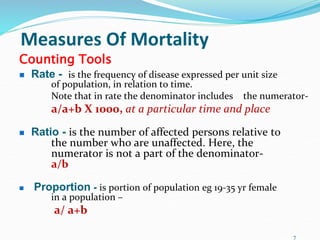
Counting Tools
 Rate - is the frequency of disease expressed per unit size
of population, in relation to time.
Note that in rate the denominator includes the numerator-
a/a+b X 1000, at a particular time and place
 Ratio - is the number of affected persons relative to
the number who are unaffected. Here, the
numerator is not a part of the denominator-
a/b
 Proportion - is portion of population eg 19-35 yr female
in a population –
a/ a+b
7
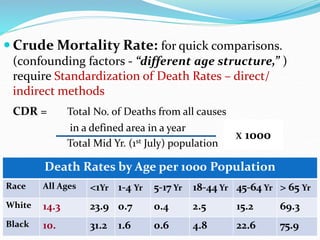
 Crude Mortality Rate: for quick comparisons.
(confounding factors - “different age structure,” )
require Standardization of Death Rates – direct/
indirect methods
CDR = Total No. of Deaths from all causes
in a defined area in a year
Total Mid Yr. (1st July) population
Death Rates by Age per 1000 Population
Race All Ages <1Yr 1-4 Yr 5-17 Yr 18-44 Yr 45-64 Yr > 65 Yr
White 14.3 23.9 0.7 0.4 2.5 15.2 69.3
Black 10. 31.2 1.6 0.6 4.8 22.6 75.9
X 1000
Specific Mortality Rates
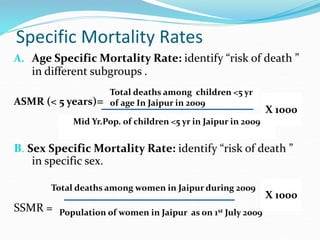
A. Age Specific Mortality Rate: identify “risk of death ”
in different subgroups .
ASMR (< 5 years)=
B. Sex Specific Mortality Rate: identify “risk of death ”
in specific sex.
SSMR =
Total deaths among children <5 yr
of age In Jaipur in 2009
Mid Yr.Pop. of children <5 yr in Jaipur in 2009
X 1000
Total deaths among women in Jaipur during 2009
Population of women in Jaipur as on 1st July 2009
X 1000
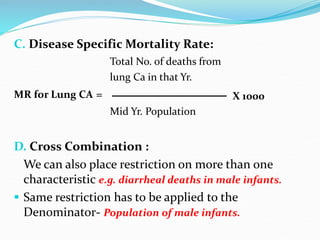
C. Disease Specific Mortality Rate:
Total No. of deaths from
lung Ca in that Yr.
MR for Lung CA =
Mid Yr. Population
D. Cross Combination :
We can also place restriction on more than one
characteristic e.g. diarrheal deaths in male infants.
 Same restriction has to be applied to the
Denominator- Population of male infants.
X 1000
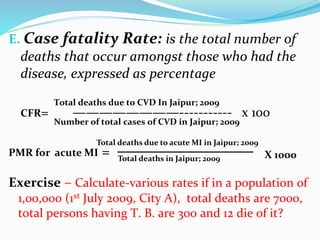
E. Case fatality Rate: is the total number of
deaths that occur amongst those who had the
disease, expressed as percentage
CFR= ————————----------- x 100
PMR for acute MI =
Exercise – Calculate-various rates if in a population of
1,00,000 (1st July 2009, City A), total deaths are 7000,
total persons having T. B. are 300 and 12 die of it?
Total deaths due to CVD In Jaipur; 2009
Number of total cases of CVD in Jaipur; 2009
Total deaths due to acute MI in Jaipur; 2009
Total deaths in Jaipur; 2009 X 1000
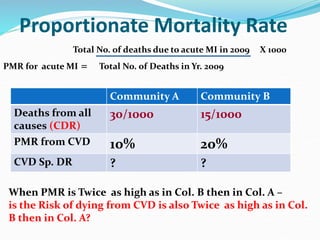
Proportionate Mortality Rate
Total No. of deaths due to acute MI in 2009 X 1000
PMR for acute MI = Total No. of Deaths in Yr. 2009
Community A Community B
Deaths from all
causes (CDR)
30/1000 15/1000
PMR from CVD 10% 20%
CVD Sp. DR ? ?
When PMR is Twice as high as in Col. B then in Col. A –
is the Risk of dying from CVD is also Twice as high as in Col.
B then in Col. A?
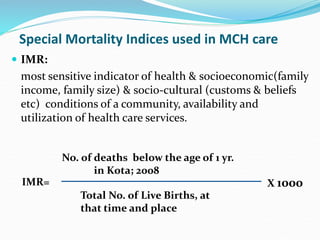
Special Mortality Indices used in MCH care
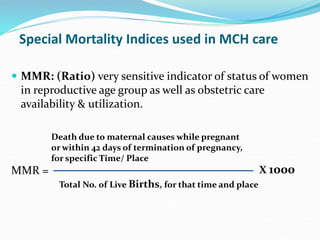
 IMR:
most sensitive indicator of health & socioeconomic(family
income, family size) & socio-cultural (customs & beliefs
etc) conditions of a community, availability and
utilization of health care services.
Total No. of Live Births, at
that time and place
X 1000
IMR=
No. of deaths below the age of 1 yr.
in Kota; 2008
Special Mortality Indices used in MCH care
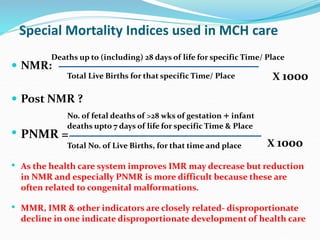
 MMR: (Ratio) very sensitive indicator of status of women
in reproductive age group as well as obstetric care
availability & utilization.
MMR =
Death due to maternal causes while pregnant
or within 42 days of termination of pregnancy,
for specific Time/ Place
Total No. of Live Births, for that time and place
X 1000
Special Mortality Indices used in MCH care
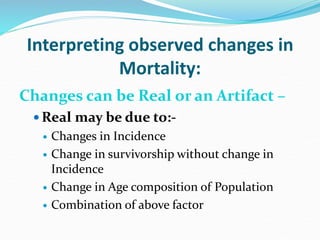
 NMR:
 Post NMR ?
• PNMR =
• As the health care system improves IMR may decrease but reduction
in NMR and especially PNMR is more difficult because these are
often related to congenital malformations.
• MMR, IMR & other indicators are closely related- disproportionate
decline in one indicate disproportionate development of health care
No. of fetal deaths of >28 wks of gestation + infant
deaths upto 7 days of life for specific Time & Place
Total No. of Live Births, for that time and place X 1000
Deaths up to (including) 28 days of life for specific Time/ Place
Total Live Births for that specific Time/ Place X 1000
Interpreting observed changes in
Mortality:
Changes can be Real or an Artifact –
 Real may be due to:-
 Changes in Incidence
 Change in survivorship without change in
Incidence
 Change in Age composition of Population
 Combination of above factor
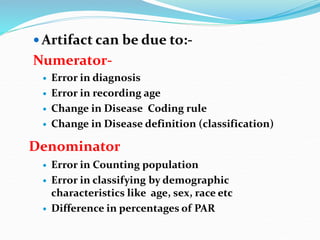
 Artifact can be due to:-
Numerator-
 Error in diagnosis
 Error in recording age
 Change in Disease Coding rule
 Change in Disease definition (classification)
Denominator
 Error in Counting population
 Error in classifying by demographic
characteristics like age, sex, race etc
 Difference in percentages of PAR
Measures of Morbidity
 Incidence
 Prevalence
 Notification rates
 Attendance rates at OPD/IPD/ICU etc
 Duration of stay in hospital and
 Spells of sickness or absence from work or
school
Measure of Morbidity:
 Incidence: The number of persons in a defined
population who become ill with a certain disease
during a defined time period.
i.e. A description of how new cases of disease are
occurring. “force of morbidity”, “rate of flow”
of cases from non disease to disease state.
 Prevalence: The number of persons in a defined
population who have a particular disease at a specific
time.
i.e. A “snapshot” of disease at a point in time in
a population.
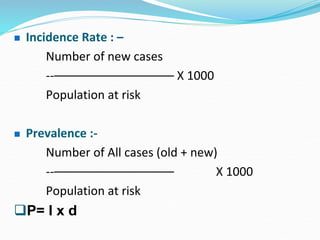
 Incidence Rate : –
Number of new cases
--–––––––––––––––––– X 1000
Population at risk
 Prevalence :-
Number of All cases (old + new)
--–––––––––––––––––– X 1000
Population at risk
P= I x d
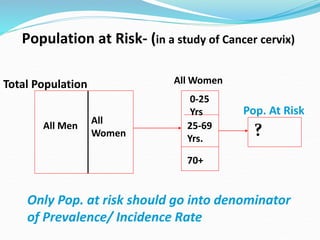
Population at Risk- (in a study of Cancer cervix)
All Men
All
Women
0-25
Yrs
25-69
Yrs.
70+
?
All Women
Pop. At Risk
Total Population
Only Pop. at risk should go into denominator
of Prevalence/ Incidence Rate
22
Prevalence-Types
 Point Prevalence
 Period Prevalence
So far as prevalence is concerned it
generally refers to point prevalence.
However when the period of observation is
large it is referred as period prevalence
where the numerator will have all existing
cases plus all new cases occurring during
period of observation and denominator will
be mid year population of PAR
23
Prevalence has its use in –
1. Determination of the sickness load
2. Planning of health services in relation to
a) Infrastructure
b) Manpower
c) Facilities, and
d) Finances
3. In making community diagnosis
24
Date of Onset of disease
Date of death
R
Case no.
1
2
3
4
5
R
Date of recurrence
R =
July 30, 2003 June30, 2004
Incidence: Population=300
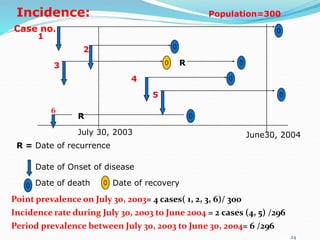
Point prevalence on July 30, 2003= 4 cases( 1, 2, 3, 6)/ 300
Incidence rate during July 30, 2003 to June 2004 = 2 cases (4, 5) /296
Period prevalence between July 30, 2003 to June 30, 2004= 6 /296
6
Date of recovery
Exercise:
There were 1500 cases of Measles in Jaipur among
children 0-5 years, In 2004. calculate Incidence Rate if
Pop. Of Jaipur is 2500000 & children 0-5 yrs are 15% of
the total Population and 45% are vaccinated.
Following should be Excluded from (PAR)
a. people currently having disease
b. people who had had the disease
c. people who are protected on account of-
immunization, habits and earlier intervention;
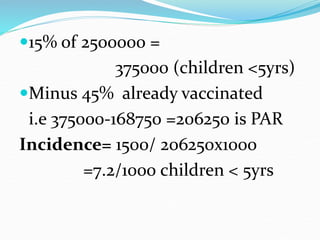
15% of 2500000 =
375000 (children <5yrs)
Minus 45% already vaccinated
i.e 375000-168750 =206250 is PAR
Incidence= 1500/ 206250x1000
=7.2/1000 children < 5yrs
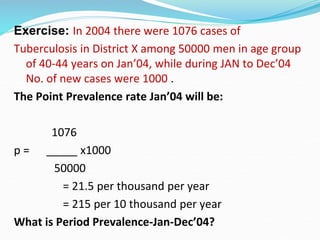
Exercise: In 2004 there were 1076 cases of
Tuberculosis in District X among 50000 men in age group
of 40-44 years on Jan’04, while during JAN to Dec’04
No. of new cases were 1000 .
The Point Prevalence rate Jan’04 will be:
1076
p = _____ x1000
50000
= 21.5 per thousand per year
= 215 per 10 thousand per year
What is Period Prevalence-Jan-Dec’04?
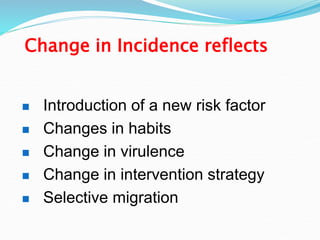
Change in Incidence reflects
 Introduction of a new risk factor
 Changes in habits
 Change in virulence
 Change in intervention strategy
 Selective migration
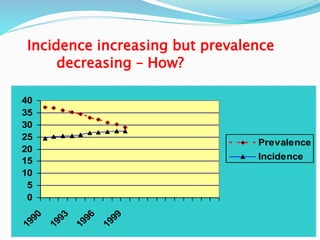
Incidence increasing but prevalence
decreasing – How?
0
5
10
15
20
25
30
35
40
1
9
9
0
1
9
9
3
1
9
9
6
1
9
9
9
Prevalence
Incidence
30
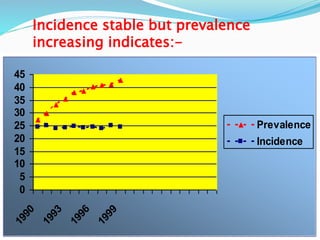
Incidence stable but prevalence
increasing indicates:-
0
5
10
15
20
25
30
35
40
45
1
9
9
0
1
9
9
3
1
9
9
6
1
9
9
9
Prevalence
Incidence
31
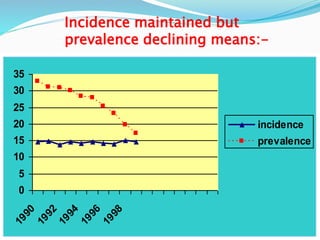
Incidence maintained but
prevalence declining means:-
0
5
10
15
20
25
30
35
1
9
9
0
1
9
9
2
1
9
9
4
1
9
9
6
1
9
9
8
incidence
prevalence
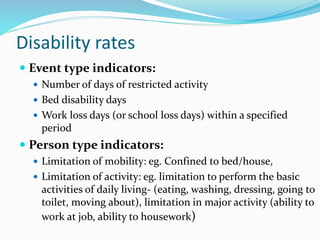
Disability rates
 Event type indicators:
 Number of days of restricted activity
 Bed disability days
 Work loss days (or school loss days) within a specified
period
 Person type indicators:
 Limitation of mobility: eg. Confined to bed/house,
 Limitation of activity: eg. limitation to perform the basic
activities of daily living- (eating, washing, dressing, going to
toilet, moving about), limitation in major activity (ability to
work at job, ability to housework)
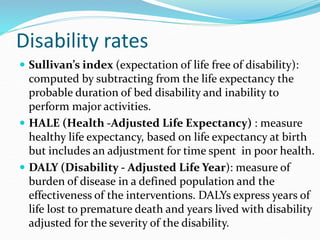
Disability rates
 Sullivan’s index (expectation of life free of disability):
computed by subtracting from the life expectancy the
probable duration of bed disability and inability to
perform major activities.
 HALE (Health -Adjusted Life Expectancy) : measure
healthy life expectancy, based on life expectancy at birth
but includes an adjustment for time spent in poor health.
 DALY (Disability - Adjusted Life Year): measure of
burden of disease in a defined population and the
effectiveness of the interventions. DALYs express years of
life lost to premature death and years lived with disability
adjusted for the severity of the disability.
Nutritional status indicators
Nutritional status is a positive health
indicator.
Three nutritional status indicators
important as indicators of health status:
1. Anthropometric measurements of
preschool children:- weight, height and
mid arm circumference;
2. Height( and sometimes weight) of children
at school entry and
3. Prevalence of low birth weight (<2.5 kg.)
Health care delivery indicators
 Doctor-population ratio
 Doctor-nurse ratio
 Population-bed ratio
 Population per health facility
 Population per traditional birth attendant
These indicators reflect the equity of
distribution of health resources in different
parts of the country and provision of health
care.
Utilization rates
Utilization of services is expressed as the
proportion of people in need of a service to
who actually receive it in a given period.
 Health care utilization is affected by:
 Availability
 Accessibility of health services and
 The attitude of people towards his health
 and the health care system.
 Health needs and health status of population
indicates utilization of health services.
Utilization rates
1. ANC Received
2. Delivery supervised by a trained birth
attendant.
3. Fully immunized children.
4. Use of various methods of family planning.
5. Bed occupancy rate.
6. Average length of stay.
7. Bed turn over ratio.
Indicators of social and mental health
 Suicide,
 Homicide,
 Act of violence and crime,
 Road traffic accidents,
 Juvenile delinquency,
 Alcohol and drug abuse,
 Smoking,
 Obesity,
 Battered baby and battered wife syndromes;
 Nand abandoned youth in the neighborhood.
These social indicators provide a guide to social action
for improving the health of the people.
Environmental indicators
 Access to safe water and sanitation,
(percentage of households with safe water in
the home or within 15 min. walking distance,
adequate sanitary facilities in the home or
immediate vicinity)
 Pollution of water and air,
 Exposure to Radiation,
 Exposure to noise,
 Toxic substances in food and drinks.
Socio economic indicators
 Rate of population increase
 Per capita GNP
 Level of unemployment
 Dependency ratio
 Literacy rate, especially female literacy rates
 Family size
 Housing: overcrowding - No. of persons per
room
 Per capita calorie availability
Health policy indicators
The relevant indicators are:
 proportion of GNP spent on health services
 proportion of GNP spent on health related
activities (including water supply and
sanitation, housing and nutrition,
community development)
 proportion of total health resources
devoted to primary health care
Health for all indicators
Four categories of indicator given by WHO
1. Health policy indicators
Political commitment to heath for all
Resource allocation
The degree of equity of distribution of
health services
Community involvement
Organizational framework and managerial
process
Health for all indicators
2. Social and economic indicators
related to health
Rate of population increase
GNP or GDP
Income distribution
Work conditions
Adult literacy rate
Housing
Food availability
Health for all indicators
3. Indicators for the provision of
health care
Availability
Accessibility
Utilization
Quality of care
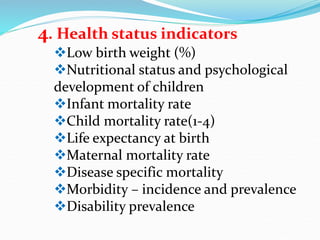
4. Health status indicators
Low birth weight (%)
Nutritional status and psychological
development of children
Infant mortality rate
Child mortality rate(1-4)
Life expectancy at birth
Maternal mortality rate
Disease specific mortality
Morbidity – incidence and prevalence
Disability prevalence
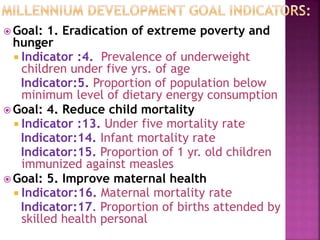
 Goal: 1. Eradication of extreme poverty and
hunger
 Indicator :4. Prevalence of underweight
children under five yrs. of age
Indicator:5. Proportion of population below
minimum level of dietary energy consumption
 Goal: 4. Reduce child mortality
 Indicator :13. Under five mortality rate
Indicator:14. Infant mortality rate
Indicator:15. Proportion of 1 yr. old children
immunized against measles
 Goal: 5. Improve maternal health
 Indicator:16. Maternal mortality rate
Indicator:17. Proportion of births attended by
skilled health personal
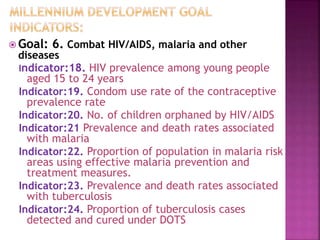
 Goal: 6. Combat HIV/AIDS, malaria and other
diseases
Indicator:18. HIV prevalence among young people
aged 15 to 24 years
Indicator:19. Condom use rate of the contraceptive
prevalence rate
Indicator:20. No. of children orphaned by HIV/AIDS
Indicator:21 Prevalence and death rates associated
with malaria
Indicator:22. Proportion of population in malaria risk
areas using effective malaria prevention and
treatment measures.
Indicator:23. Prevalence and death rates associated
with tuberculosis
Indicator:24. Proportion of tuberculosis cases
detected and cured under DOTS
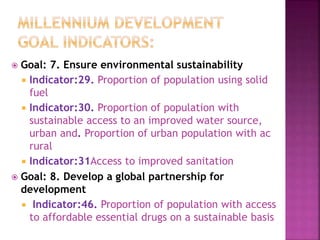
 Goal: 7. Ensure environmental sustainability
 Indicator:29. Proportion of population using solid
fuel
 Indicator:30. Proportion of population with
sustainable access to an improved water source,
urban and. Proportion of urban population with ac
rural
 Indicator:31Access to improved sanitation
 Goal: 8. Develop a global partnership for
development
 Indicator:46. Proportion of population with access
to affordable essential drugs on a sustainable basis
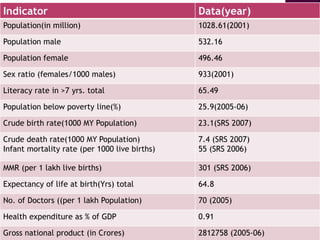
Indicator Data(year)
Population(in million) 1028.61(2001)
Population male 532.16
Population female 496.46
Sex ratio (females/1000 males) 933(2001)
Literacy rate in >7 yrs. total 65.49
Population below poverty line(%) 25.9(2005-06)
Crude birth rate(1000 MY Population) 23.1(SRS 2007)
Crude death rate(1000 MY Population)
Infant mortality rate (per 1000 live births)
7.4 (SRS 2007)
55 (SRS 2006)
MMR (per 1 lakh live births) 301 (SRS 2006)
Expectancy of life at birth(Yrs) total 64.8
No. of Doctors ((per 1 lakh Population) 70 (2005)
Health expenditure as % of GDP 0.91
Gross national product (in Crores) 2812758 (2005-06)
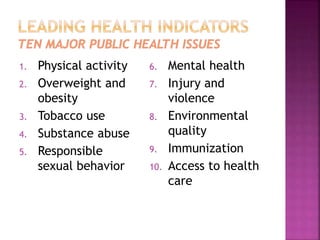
1. Physical activity
2. Overweight and
obesity
3. Tobacco use
4. Substance abuse
5. Responsible
sexual behavior
6. Mental health
7. Injury and
violence
8. Environmental
quality
9. Immunization
10. Access to health
care
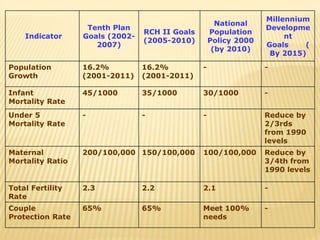
Indicator
Tenth Plan
Goals (2002-
2007)
RCH II Goals
(2005-2010)
National
Population
Policy 2000
(by 2010)
Millennium
Developme
nt
Goals (
By 2015)
Population
Growth
16.2%
(2001-2011)
16.2%
(2001-2011)
- -
Infant
Mortality Rate
45/1000 35/1000 30/1000 -
Under 5
Mortality Rate
- - - Reduce by
2/3rds
from 1990
levels
Maternal
Mortality Ratio
200/100,000 150/100,000 100/100,000 Reduce by
3/4th from
1990 levels
Total Fertility
Rate
2.3 2.2 2.1 -
Couple
Protection Rate
65% 65% Meet 100%
needs
-
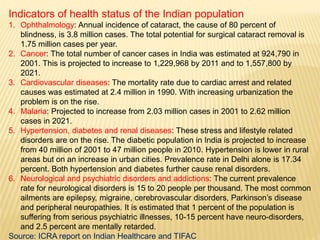
Indicators of health status of the Indian population
1. Ophthalmology: Annual incidence of cataract, the cause of 80 percent of
blindness, is 3.8 million cases. The total potential for surgical cataract removal is
1.75 million cases per year.
2. Cancer: The total number of cancer cases in India was estimated at 924,790 in
2001. This is projected to increase to 1,229,968 by 2011 and to 1,557,800 by
2021.
3. Cardiovascular diseases: The mortality rate due to cardiac arrest and related
causes was estimated at 2.4 million in 1990. With increasing urbanization the
problem is on the rise.
4. Malaria: Projected to increase from 2.03 million cases in 2001 to 2.62 million
cases in 2021.
5. Hypertension, diabetes and renal diseases: These stress and lifestyle related
disorders are on the rise. The diabetic population in India is projected to increase
from 40 million of 2001 to 47 million people in 2010. Hypertension is lower in rural
areas but on an increase in urban cities. Prevalence rate in Delhi alone is 17.34
percent. Both hypertension and diabetes further cause renal disorders.
6. Neurological and psychiatric disorders and addictions: The current prevalence
rate for neurological disorders is 15 to 20 people per thousand. The most common
ailments are epilepsy, migraine, cerebrovascular disorders, Parkinson’s disease
and peripheral neuropathies. It is estimated that 1 percent of the population is
suffering from serious psychiatric illnesses, 10-15 percent have neuro-disorders,
and 2.5 percent are mentally retarded.
Source: ICRA report on Indian Healthcare and TIFAC

Basic Concepts of PH

  • 1.
    INDICATORS OF HEALTH& DISEASE Amita Kashyap Professor and Head (Com. Medicine) S.M.S. Medical College, Jaipur
  • 2.
    INDICATORS OF HEALTH& DISEASE “…..for the health administrator, nothing could be more valuable than to have, at his command, one or measuring rods to help him in his task and also in assessing his specific problems relating to the health of the people, in designing his plans to deal with these, in guiding his administration and in evaluating his schemes….” WHO
  • 3.
    CHARACTERISTICS OF INDICATORS Idealindicators should be:-  Valid,  Reliable and objective,  Sensitive,  Specific  Feasible Relevant
  • 4.
    MEASURES OF HEALTH& DISEASE - INDICATORS  Health Status Indicators  Mortality  Morbidity  Indicators of Quality of life  Disability days  Limited activity days  Bed confinement days  Socio-economic & Human Development Indicators  Literacy  Income  Accessibility to safe water & Sanitary excreta disposal facilities  Indicators of Health Care  Infrastructure  Human Resource  Health Finance  Accessibility & Utilization contd……..
  • 5.
    Measures of Health& Disease – Indicators Demographic Indicators  Fertility  Population distribution  Other Indicators Related to Health  Nutritional Status  Child Development  Environmental Indicators  Summary Measures of Population Health  Measure of “Health Expectancies”- HALE (Healthy LE), ALE (Active LE), DFLE (Disability Free LE), QALE (Quality Adjusted LE)  Measure of “Health Gaps”- DALY (disability adjusted life years), PYLL
  • 6.
    Measures Of Mortality Crude Mortality/Death Rate( CDR)  Standardized Mortality Rates  Specific Mortality Rates  Age Specific Mortality Rates  Sex Specific Mortality Rates  Cause Specific Mortality Rates  Cross combinations of Age/ Sex/ Cause etc  Proportional mortality rate  Case Fatality Rate
  • 7.
    Measures Of Mortality CountingTools  Rate - is the frequency of disease expressed per unit size of population, in relation to time. Note that in rate the denominator includes the numerator- a/a+b X 1000, at a particular time and place  Ratio - is the number of affected persons relative to the number who are unaffected. Here, the numerator is not a part of the denominator- a/b  Proportion - is portion of population eg 19-35 yr female in a population – a/ a+b 7
  • 8.
     Crude MortalityRate: for quick comparisons. (confounding factors - “different age structure,” ) require Standardization of Death Rates – direct/ indirect methods CDR = Total No. of Deaths from all causes in a defined area in a year Total Mid Yr. (1st July) population Death Rates by Age per 1000 Population Race All Ages <1Yr 1-4 Yr 5-17 Yr 18-44 Yr 45-64 Yr > 65 Yr White 14.3 23.9 0.7 0.4 2.5 15.2 69.3 Black 10. 31.2 1.6 0.6 4.8 22.6 75.9 X 1000
  • 9.
    Specific Mortality Rates A.Age Specific Mortality Rate: identify “risk of death ” in different subgroups . ASMR (< 5 years)= B. Sex Specific Mortality Rate: identify “risk of death ” in specific sex. SSMR = Total deaths among children <5 yr of age In Jaipur in 2009 Mid Yr.Pop. of children <5 yr in Jaipur in 2009 X 1000 Total deaths among women in Jaipur during 2009 Population of women in Jaipur as on 1st July 2009 X 1000
  • 10.
    C. Disease SpecificMortality Rate: Total No. of deaths from lung Ca in that Yr. MR for Lung CA = Mid Yr. Population D. Cross Combination : We can also place restriction on more than one characteristic e.g. diarrheal deaths in male infants.  Same restriction has to be applied to the Denominator- Population of male infants. X 1000
  • 11.
    E. Case fatalityRate: is the total number of deaths that occur amongst those who had the disease, expressed as percentage CFR= ————————----------- x 100 PMR for acute MI = Exercise – Calculate-various rates if in a population of 1,00,000 (1st July 2009, City A), total deaths are 7000, total persons having T. B. are 300 and 12 die of it? Total deaths due to CVD In Jaipur; 2009 Number of total cases of CVD in Jaipur; 2009 Total deaths due to acute MI in Jaipur; 2009 Total deaths in Jaipur; 2009 X 1000
  • 12.
    Proportionate Mortality Rate TotalNo. of deaths due to acute MI in 2009 X 1000 PMR for acute MI = Total No. of Deaths in Yr. 2009 Community A Community B Deaths from all causes (CDR) 30/1000 15/1000 PMR from CVD 10% 20% CVD Sp. DR ? ? When PMR is Twice as high as in Col. B then in Col. A – is the Risk of dying from CVD is also Twice as high as in Col. B then in Col. A?
  • 13.
    Special Mortality Indicesused in MCH care  IMR: most sensitive indicator of health & socioeconomic(family income, family size) & socio-cultural (customs & beliefs etc) conditions of a community, availability and utilization of health care services. Total No. of Live Births, at that time and place X 1000 IMR= No. of deaths below the age of 1 yr. in Kota; 2008
  • 14.
    Special Mortality Indicesused in MCH care  MMR: (Ratio) very sensitive indicator of status of women in reproductive age group as well as obstetric care availability & utilization. MMR = Death due to maternal causes while pregnant or within 42 days of termination of pregnancy, for specific Time/ Place Total No. of Live Births, for that time and place X 1000
  • 15.
    Special Mortality Indicesused in MCH care  NMR:  Post NMR ? • PNMR = • As the health care system improves IMR may decrease but reduction in NMR and especially PNMR is more difficult because these are often related to congenital malformations. • MMR, IMR & other indicators are closely related- disproportionate decline in one indicate disproportionate development of health care No. of fetal deaths of >28 wks of gestation + infant deaths upto 7 days of life for specific Time & Place Total No. of Live Births, for that time and place X 1000 Deaths up to (including) 28 days of life for specific Time/ Place Total Live Births for that specific Time/ Place X 1000
  • 16.
    Interpreting observed changesin Mortality: Changes can be Real or an Artifact –  Real may be due to:-  Changes in Incidence  Change in survivorship without change in Incidence  Change in Age composition of Population  Combination of above factor
  • 17.
     Artifact canbe due to:- Numerator-  Error in diagnosis  Error in recording age  Change in Disease Coding rule  Change in Disease definition (classification) Denominator  Error in Counting population  Error in classifying by demographic characteristics like age, sex, race etc  Difference in percentages of PAR
  • 18.
    Measures of Morbidity Incidence  Prevalence  Notification rates  Attendance rates at OPD/IPD/ICU etc  Duration of stay in hospital and  Spells of sickness or absence from work or school
  • 19.
    Measure of Morbidity: Incidence: The number of persons in a defined population who become ill with a certain disease during a defined time period. i.e. A description of how new cases of disease are occurring. “force of morbidity”, “rate of flow” of cases from non disease to disease state.  Prevalence: The number of persons in a defined population who have a particular disease at a specific time. i.e. A “snapshot” of disease at a point in time in a population.
  • 20.
     Incidence Rate: – Number of new cases --–––––––––––––––––– X 1000 Population at risk  Prevalence :- Number of All cases (old + new) --–––––––––––––––––– X 1000 Population at risk P= I x d
  • 21.
    Population at Risk-(in a study of Cancer cervix) All Men All Women 0-25 Yrs 25-69 Yrs. 70+ ? All Women Pop. At Risk Total Population Only Pop. at risk should go into denominator of Prevalence/ Incidence Rate
  • 22.
    22 Prevalence-Types  Point Prevalence Period Prevalence So far as prevalence is concerned it generally refers to point prevalence. However when the period of observation is large it is referred as period prevalence where the numerator will have all existing cases plus all new cases occurring during period of observation and denominator will be mid year population of PAR
  • 23.
    23 Prevalence has itsuse in – 1. Determination of the sickness load 2. Planning of health services in relation to a) Infrastructure b) Manpower c) Facilities, and d) Finances 3. In making community diagnosis
  • 24.
    24 Date of Onsetof disease Date of death R Case no. 1 2 3 4 5 R Date of recurrence R = July 30, 2003 June30, 2004 Incidence: Population=300 Point prevalence on July 30, 2003= 4 cases( 1, 2, 3, 6)/ 300 Incidence rate during July 30, 2003 to June 2004 = 2 cases (4, 5) /296 Period prevalence between July 30, 2003 to June 30, 2004= 6 /296 6 Date of recovery
  • 25.
    Exercise: There were 1500cases of Measles in Jaipur among children 0-5 years, In 2004. calculate Incidence Rate if Pop. Of Jaipur is 2500000 & children 0-5 yrs are 15% of the total Population and 45% are vaccinated. Following should be Excluded from (PAR) a. people currently having disease b. people who had had the disease c. people who are protected on account of- immunization, habits and earlier intervention;
  • 26.
    15% of 2500000= 375000 (children <5yrs) Minus 45% already vaccinated i.e 375000-168750 =206250 is PAR Incidence= 1500/ 206250x1000 =7.2/1000 children < 5yrs
  • 27.
    Exercise: In 2004there were 1076 cases of Tuberculosis in District X among 50000 men in age group of 40-44 years on Jan’04, while during JAN to Dec’04 No. of new cases were 1000 . The Point Prevalence rate Jan’04 will be: 1076 p = _____ x1000 50000 = 21.5 per thousand per year = 215 per 10 thousand per year What is Period Prevalence-Jan-Dec’04?
  • 28.
    Change in Incidencereflects  Introduction of a new risk factor  Changes in habits  Change in virulence  Change in intervention strategy  Selective migration
  • 29.
    Incidence increasing butprevalence decreasing – How? 0 5 10 15 20 25 30 35 40 1 9 9 0 1 9 9 3 1 9 9 6 1 9 9 9 Prevalence Incidence
  • 30.
    30 Incidence stable butprevalence increasing indicates:- 0 5 10 15 20 25 30 35 40 45 1 9 9 0 1 9 9 3 1 9 9 6 1 9 9 9 Prevalence Incidence
  • 31.
    31 Incidence maintained but prevalencedeclining means:- 0 5 10 15 20 25 30 35 1 9 9 0 1 9 9 2 1 9 9 4 1 9 9 6 1 9 9 8 incidence prevalence
  • 32.
    Disability rates  Eventtype indicators:  Number of days of restricted activity  Bed disability days  Work loss days (or school loss days) within a specified period  Person type indicators:  Limitation of mobility: eg. Confined to bed/house,  Limitation of activity: eg. limitation to perform the basic activities of daily living- (eating, washing, dressing, going to toilet, moving about), limitation in major activity (ability to work at job, ability to housework)
  • 33.
    Disability rates  Sullivan’sindex (expectation of life free of disability): computed by subtracting from the life expectancy the probable duration of bed disability and inability to perform major activities.  HALE (Health -Adjusted Life Expectancy) : measure healthy life expectancy, based on life expectancy at birth but includes an adjustment for time spent in poor health.  DALY (Disability - Adjusted Life Year): measure of burden of disease in a defined population and the effectiveness of the interventions. DALYs express years of life lost to premature death and years lived with disability adjusted for the severity of the disability.
  • 34.
    Nutritional status indicators Nutritionalstatus is a positive health indicator. Three nutritional status indicators important as indicators of health status: 1. Anthropometric measurements of preschool children:- weight, height and mid arm circumference; 2. Height( and sometimes weight) of children at school entry and 3. Prevalence of low birth weight (<2.5 kg.)
  • 35.
    Health care deliveryindicators  Doctor-population ratio  Doctor-nurse ratio  Population-bed ratio  Population per health facility  Population per traditional birth attendant These indicators reflect the equity of distribution of health resources in different parts of the country and provision of health care.
  • 36.
    Utilization rates Utilization ofservices is expressed as the proportion of people in need of a service to who actually receive it in a given period.  Health care utilization is affected by:  Availability  Accessibility of health services and  The attitude of people towards his health  and the health care system.  Health needs and health status of population indicates utilization of health services.
  • 37.
    Utilization rates 1. ANCReceived 2. Delivery supervised by a trained birth attendant. 3. Fully immunized children. 4. Use of various methods of family planning. 5. Bed occupancy rate. 6. Average length of stay. 7. Bed turn over ratio.
  • 38.
    Indicators of socialand mental health  Suicide,  Homicide,  Act of violence and crime,  Road traffic accidents,  Juvenile delinquency,  Alcohol and drug abuse,  Smoking,  Obesity,  Battered baby and battered wife syndromes;  Nand abandoned youth in the neighborhood. These social indicators provide a guide to social action for improving the health of the people.
  • 39.
    Environmental indicators  Accessto safe water and sanitation, (percentage of households with safe water in the home or within 15 min. walking distance, adequate sanitary facilities in the home or immediate vicinity)  Pollution of water and air,  Exposure to Radiation,  Exposure to noise,  Toxic substances in food and drinks.
  • 40.
    Socio economic indicators Rate of population increase  Per capita GNP  Level of unemployment  Dependency ratio  Literacy rate, especially female literacy rates  Family size  Housing: overcrowding - No. of persons per room  Per capita calorie availability
  • 41.
    Health policy indicators Therelevant indicators are:  proportion of GNP spent on health services  proportion of GNP spent on health related activities (including water supply and sanitation, housing and nutrition, community development)  proportion of total health resources devoted to primary health care
  • 42.
    Health for allindicators Four categories of indicator given by WHO 1. Health policy indicators Political commitment to heath for all Resource allocation The degree of equity of distribution of health services Community involvement Organizational framework and managerial process
  • 43.
    Health for allindicators 2. Social and economic indicators related to health Rate of population increase GNP or GDP Income distribution Work conditions Adult literacy rate Housing Food availability
  • 44.
    Health for allindicators 3. Indicators for the provision of health care Availability Accessibility Utilization Quality of care
  • 45.
    4. Health statusindicators Low birth weight (%) Nutritional status and psychological development of children Infant mortality rate Child mortality rate(1-4) Life expectancy at birth Maternal mortality rate Disease specific mortality Morbidity – incidence and prevalence Disability prevalence
  • 46.
     Goal: 1.Eradication of extreme poverty and hunger  Indicator :4. Prevalence of underweight children under five yrs. of age Indicator:5. Proportion of population below minimum level of dietary energy consumption  Goal: 4. Reduce child mortality  Indicator :13. Under five mortality rate Indicator:14. Infant mortality rate Indicator:15. Proportion of 1 yr. old children immunized against measles  Goal: 5. Improve maternal health  Indicator:16. Maternal mortality rate Indicator:17. Proportion of births attended by skilled health personal
  • 47.
     Goal: 6.Combat HIV/AIDS, malaria and other diseases Indicator:18. HIV prevalence among young people aged 15 to 24 years Indicator:19. Condom use rate of the contraceptive prevalence rate Indicator:20. No. of children orphaned by HIV/AIDS Indicator:21 Prevalence and death rates associated with malaria Indicator:22. Proportion of population in malaria risk areas using effective malaria prevention and treatment measures. Indicator:23. Prevalence and death rates associated with tuberculosis Indicator:24. Proportion of tuberculosis cases detected and cured under DOTS
  • 48.
     Goal: 7.Ensure environmental sustainability  Indicator:29. Proportion of population using solid fuel  Indicator:30. Proportion of population with sustainable access to an improved water source, urban and. Proportion of urban population with ac rural  Indicator:31Access to improved sanitation  Goal: 8. Develop a global partnership for development  Indicator:46. Proportion of population with access to affordable essential drugs on a sustainable basis
  • 49.
    Indicator Data(year) Population(in million)1028.61(2001) Population male 532.16 Population female 496.46 Sex ratio (females/1000 males) 933(2001) Literacy rate in >7 yrs. total 65.49 Population below poverty line(%) 25.9(2005-06) Crude birth rate(1000 MY Population) 23.1(SRS 2007) Crude death rate(1000 MY Population) Infant mortality rate (per 1000 live births) 7.4 (SRS 2007) 55 (SRS 2006) MMR (per 1 lakh live births) 301 (SRS 2006) Expectancy of life at birth(Yrs) total 64.8 No. of Doctors ((per 1 lakh Population) 70 (2005) Health expenditure as % of GDP 0.91 Gross national product (in Crores) 2812758 (2005-06)
  • 50.
    1. Physical activity 2.Overweight and obesity 3. Tobacco use 4. Substance abuse 5. Responsible sexual behavior 6. Mental health 7. Injury and violence 8. Environmental quality 9. Immunization 10. Access to health care
  • 51.
    Indicator Tenth Plan Goals (2002- 2007) RCHII Goals (2005-2010) National Population Policy 2000 (by 2010) Millennium Developme nt Goals ( By 2015) Population Growth 16.2% (2001-2011) 16.2% (2001-2011) - - Infant Mortality Rate 45/1000 35/1000 30/1000 - Under 5 Mortality Rate - - - Reduce by 2/3rds from 1990 levels Maternal Mortality Ratio 200/100,000 150/100,000 100/100,000 Reduce by 3/4th from 1990 levels Total Fertility Rate 2.3 2.2 2.1 - Couple Protection Rate 65% 65% Meet 100% needs -
  • 52.
    Indicators of healthstatus of the Indian population 1. Ophthalmology: Annual incidence of cataract, the cause of 80 percent of blindness, is 3.8 million cases. The total potential for surgical cataract removal is 1.75 million cases per year. 2. Cancer: The total number of cancer cases in India was estimated at 924,790 in 2001. This is projected to increase to 1,229,968 by 2011 and to 1,557,800 by 2021. 3. Cardiovascular diseases: The mortality rate due to cardiac arrest and related causes was estimated at 2.4 million in 1990. With increasing urbanization the problem is on the rise. 4. Malaria: Projected to increase from 2.03 million cases in 2001 to 2.62 million cases in 2021. 5. Hypertension, diabetes and renal diseases: These stress and lifestyle related disorders are on the rise. The diabetic population in India is projected to increase from 40 million of 2001 to 47 million people in 2010. Hypertension is lower in rural areas but on an increase in urban cities. Prevalence rate in Delhi alone is 17.34 percent. Both hypertension and diabetes further cause renal disorders. 6. Neurological and psychiatric disorders and addictions: The current prevalence rate for neurological disorders is 15 to 20 people per thousand. The most common ailments are epilepsy, migraine, cerebrovascular disorders, Parkinson’s disease and peripheral neuropathies. It is estimated that 1 percent of the population is suffering from serious psychiatric illnesses, 10-15 percent have neuro-disorders, and 2.5 percent are mentally retarded. Source: ICRA report on Indian Healthcare and TIFAC