Your Money Our Mission Mike Szczechura, National Accounts Manager – Media-Cable-Broadband James Stevens & Daniels 1283 College Park Drive, Dover, Delaware 19904 Direct 800-305-0773 Ext. 154  Fax 302-735-4679 Linkedin:  http://www.linkedin.com/in/mikesz   Follow me on Twitter:  mikewithrev   Steps to Optimize A/R Management in  Today’s Economy
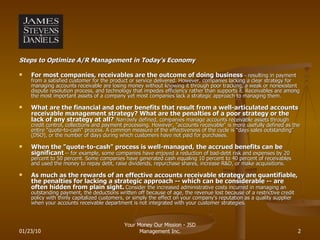
Steps to Optimize A/R Management in Today’s Economy For most companies, receivables are the outcome of doing business  --  resulting in payment from a satisfied customer for the product or service delivered. However, companies lacking a clear strategy for managing accounts receivable are losing money without knowing it through poor tracking, a weak or nonexistent dispute resolution process, and technology that impedes efficiency rather than supports it. Receivables are among the most important assets of a company yet most companies lack a strategic approach to managing them. What are the financial and other benefits that result from a well-articulated accounts receivable management strategy? What are the penalties of a poor strategy or the lack of any strategy at all?   Narrowly defined, companies manage accounts receivable assets through credit control, collections and payment processing. However, "accounts receivable" is more usefully defined as the entire "quote-to-cash" process. A common measure of the effectiveness of the cycle is “days sales outstanding” (DSO), or the number of days during which customers have not paid for purchases.  When the "quote-to-cash" process is well-managed, the accrued benefits can be significant   -- for example, some companies have enjoyed a reduction of bad-debt risk and expenses by 20 percent to 50 percent. Some companies have generated cash equaling 10 percent to 40 percent of receivables and used the money to repay debt, raise dividends, repurchase shares, increase R&D, or make acquisitions. As much as the rewards of an effective accounts receivable strategy are quantifiable, the penalties for lacking a strategic approach -- which can be considerable -- are often hidden from plain sight.   Consider the increased administrative costs incurred in managing an outstanding payment, the deductions written off because of age, the revenue lost because of a restrictive credit policy with thinly capitalized customers, or simply the effect on your company's reputation as a quality supplier when your accounts receivable department is not integrated with your customer strategies. 01/23/10 Your Money Our Mission - JSD Management Inc.
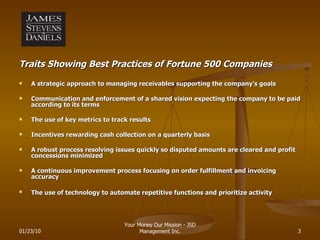
Traits Showing Best Practices of Fortune 500 Companies A strategic approach to managing receivables supporting the company's goals   Communication and enforcement of a shared vision expecting the company to be paid according to its terms   The use of key metrics to track results   Incentives rewarding cash collection on a quarterly basis A robust process resolving issues quickly so disputed amounts are cleared and profit concessions minimized   A continuous improvement process focusing on order fulfillment and invoicing accuracy   The use of technology to automate repetitive functions and prioritize activity   01/23/10 Your Money Our Mission - JSD Management Inc.
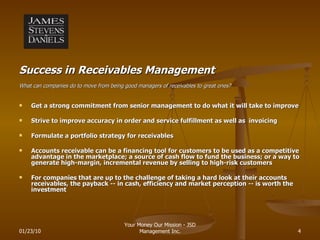
Success in Receivables Management What can companies do to move from being good managers of receivables to great ones? Get a strong commitment from senior management to do what it will take to improve Strive to improve accuracy in order and service fulfillment as well as  invoicing Formulate a portfolio strategy for receivables Accounts receivable can be a financing tool for customers to be used as a competitive advantage in the marketplace; a source of cash flow to fund the business; or a way to generate high-margin, incremental revenue by selling to high-risk customers For companies that are up to the challenge of taking a hard look at their accounts receivables, the payback -- in cash, efficiency and market perception -- is worth the investment 01/23/10 Your Money Our Mission - JSD Management Inc.
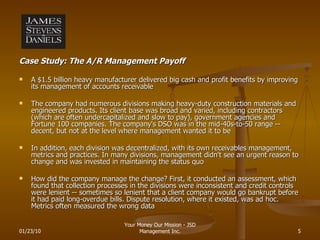
Case Study: The A/R Management Payoff A $1.5 billion heavy manufacturer delivered big cash and profit benefits by improving its management of accounts receivable The company had numerous divisions making heavy-duty construction materials and engineered products. Its client base was broad and varied, including contractors (which are often undercapitalized and slow to pay), government agencies and Fortune 100 companies. The company's DSO was in the mid-40s-to-50 range -- decent, but not at the level where management wanted it to be In addition, each division was decentralized, with its own receivables management, metrics and practices. In many divisions, management didn't see an urgent reason to change and was invested in maintaining the status quo How did the company manage the change? First, it conducted an assessment, which found that collection processes in the divisions were inconsistent and credit controls were lenient -- sometimes so lenient that a client company would go bankrupt before it had paid long-overdue bills. Dispute resolution, where it existed, was ad hoc. Metrics often measured the wrong data 01/23/10 Your Money Our Mission - JSD Management Inc.
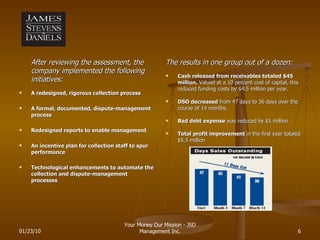
After reviewing the assessment, the company implemented the following initiatives: A redesigned, rigorous collection process   A formal, documented, dispute-management process  Redesigned reports to enable management An incentive plan for collection staff to spur performance Technological enhancements to automate the collection   and dispute-management processes The results in one group out of a dozen: Cash released from receivables totaled $45 million.  Valued at a 10 percent cost of capital, this reduced funding costs by $4.5 million per year. DSO decreased  from 47 days to 36 days over the course of 14 months. Bad debt expense  was reduced by $1 million Total profit improvement  in the first year totaled $5.5 million 01/23/10 Your Money Our Mission - JSD Management Inc.
01/23/10 Your Money Our Mission - JSD Management Inc. Your Write Off And Your Net Profit Is? 2% 3% 4% 5% 6% 10%   You will need the following amount of additional sales to offset the loss $100,000 $5,000,000 $3,333,333 $2,500,000 $2,000,000 $1,666,666 $1,000,000 $250,000 $12,500,000 $8,333,333 $6,250,000 $5,000,000 $4,166,666 $2,500,000 $500,000 $25,000,000 $16,666,666 $12,500,000 $10,000,000 $8,333,333 $5,000,000 $750,000 $37,500,000 $25,000,000 $18,750,000 $15,000,000 $12,500,000 $7,500,000 $1,000,000 $50,000,000 $33,333,333 $25,000,000 $20,000,000 $16,666,666 $10,000,000 $1,500,000 $75,000,000 $50,000,000 $37,500,000 $30,000,000 $25,000,000 $15,000,000 $2,000,000 $100,000,000 $66,666,666 $50,000,000 $40,000,000 $33,333,333 $20,000,000
In conclusion: Time is money and measuring it as such will allow you to look at your gains and losses more accurately Thank you for your time! 01/23/10 Your Money Our Mission - JSD Management Inc.

Steps To Optimize A.R. Management

  • 1.
    Your Money OurMission Mike Szczechura, National Accounts Manager – Media-Cable-Broadband James Stevens & Daniels 1283 College Park Drive, Dover, Delaware 19904 Direct 800-305-0773 Ext. 154 Fax 302-735-4679 Linkedin: http://www.linkedin.com/in/mikesz Follow me on Twitter: mikewithrev Steps to Optimize A/R Management in Today’s Economy
  • 2.
    Steps to OptimizeA/R Management in Today’s Economy For most companies, receivables are the outcome of doing business -- resulting in payment from a satisfied customer for the product or service delivered. However, companies lacking a clear strategy for managing accounts receivable are losing money without knowing it through poor tracking, a weak or nonexistent dispute resolution process, and technology that impedes efficiency rather than supports it. Receivables are among the most important assets of a company yet most companies lack a strategic approach to managing them. What are the financial and other benefits that result from a well-articulated accounts receivable management strategy? What are the penalties of a poor strategy or the lack of any strategy at all? Narrowly defined, companies manage accounts receivable assets through credit control, collections and payment processing. However, "accounts receivable" is more usefully defined as the entire "quote-to-cash" process. A common measure of the effectiveness of the cycle is “days sales outstanding” (DSO), or the number of days during which customers have not paid for purchases. When the "quote-to-cash" process is well-managed, the accrued benefits can be significant -- for example, some companies have enjoyed a reduction of bad-debt risk and expenses by 20 percent to 50 percent. Some companies have generated cash equaling 10 percent to 40 percent of receivables and used the money to repay debt, raise dividends, repurchase shares, increase R&D, or make acquisitions. As much as the rewards of an effective accounts receivable strategy are quantifiable, the penalties for lacking a strategic approach -- which can be considerable -- are often hidden from plain sight. Consider the increased administrative costs incurred in managing an outstanding payment, the deductions written off because of age, the revenue lost because of a restrictive credit policy with thinly capitalized customers, or simply the effect on your company's reputation as a quality supplier when your accounts receivable department is not integrated with your customer strategies. 01/23/10 Your Money Our Mission - JSD Management Inc.
  • 3.
    Traits Showing BestPractices of Fortune 500 Companies A strategic approach to managing receivables supporting the company's goals Communication and enforcement of a shared vision expecting the company to be paid according to its terms The use of key metrics to track results Incentives rewarding cash collection on a quarterly basis A robust process resolving issues quickly so disputed amounts are cleared and profit concessions minimized A continuous improvement process focusing on order fulfillment and invoicing accuracy The use of technology to automate repetitive functions and prioritize activity 01/23/10 Your Money Our Mission - JSD Management Inc.
  • 4.
    Success in ReceivablesManagement What can companies do to move from being good managers of receivables to great ones? Get a strong commitment from senior management to do what it will take to improve Strive to improve accuracy in order and service fulfillment as well as invoicing Formulate a portfolio strategy for receivables Accounts receivable can be a financing tool for customers to be used as a competitive advantage in the marketplace; a source of cash flow to fund the business; or a way to generate high-margin, incremental revenue by selling to high-risk customers For companies that are up to the challenge of taking a hard look at their accounts receivables, the payback -- in cash, efficiency and market perception -- is worth the investment 01/23/10 Your Money Our Mission - JSD Management Inc.
  • 5.
    Case Study: TheA/R Management Payoff A $1.5 billion heavy manufacturer delivered big cash and profit benefits by improving its management of accounts receivable The company had numerous divisions making heavy-duty construction materials and engineered products. Its client base was broad and varied, including contractors (which are often undercapitalized and slow to pay), government agencies and Fortune 100 companies. The company's DSO was in the mid-40s-to-50 range -- decent, but not at the level where management wanted it to be In addition, each division was decentralized, with its own receivables management, metrics and practices. In many divisions, management didn't see an urgent reason to change and was invested in maintaining the status quo How did the company manage the change? First, it conducted an assessment, which found that collection processes in the divisions were inconsistent and credit controls were lenient -- sometimes so lenient that a client company would go bankrupt before it had paid long-overdue bills. Dispute resolution, where it existed, was ad hoc. Metrics often measured the wrong data 01/23/10 Your Money Our Mission - JSD Management Inc.
  • 6.
    After reviewing theassessment, the company implemented the following initiatives: A redesigned, rigorous collection process A formal, documented, dispute-management process Redesigned reports to enable management An incentive plan for collection staff to spur performance Technological enhancements to automate the collection and dispute-management processes The results in one group out of a dozen: Cash released from receivables totaled $45 million. Valued at a 10 percent cost of capital, this reduced funding costs by $4.5 million per year. DSO decreased from 47 days to 36 days over the course of 14 months. Bad debt expense was reduced by $1 million Total profit improvement in the first year totaled $5.5 million 01/23/10 Your Money Our Mission - JSD Management Inc.
  • 7.
    01/23/10 Your MoneyOur Mission - JSD Management Inc. Your Write Off And Your Net Profit Is? 2% 3% 4% 5% 6% 10%   You will need the following amount of additional sales to offset the loss $100,000 $5,000,000 $3,333,333 $2,500,000 $2,000,000 $1,666,666 $1,000,000 $250,000 $12,500,000 $8,333,333 $6,250,000 $5,000,000 $4,166,666 $2,500,000 $500,000 $25,000,000 $16,666,666 $12,500,000 $10,000,000 $8,333,333 $5,000,000 $750,000 $37,500,000 $25,000,000 $18,750,000 $15,000,000 $12,500,000 $7,500,000 $1,000,000 $50,000,000 $33,333,333 $25,000,000 $20,000,000 $16,666,666 $10,000,000 $1,500,000 $75,000,000 $50,000,000 $37,500,000 $30,000,000 $25,000,000 $15,000,000 $2,000,000 $100,000,000 $66,666,666 $50,000,000 $40,000,000 $33,333,333 $20,000,000
  • 8.
    In conclusion: Timeis money and measuring it as such will allow you to look at your gains and losses more accurately Thank you for your time! 01/23/10 Your Money Our Mission - JSD Management Inc.