Using the Common Core
State Standards with
Gifted and Advanced
Learners
Joyce VanTassel-Baska, EdD.

College of William and Mary
September, 2013
Participant outcomes
Participants will be able to:

--Analyze CCSS for differentiation needs
--Create differentiated task demands, based on the
standards

--Evaluate school-based needs for implementation of CCSS
adaptations for the gifted
What are the new common core
state standards (CCSS)?
-Designed by teams across states in math
and language arts
-Aligned with 21st Century skills: informed
by TIMSS et al.
-Strong emphasis on thinking, problemsolving, collaboration, and communication
Myths about the common core
standards
• They replace the need for gifted programs.
• They are all high level in how they are articulated.
• They use the same type of assessments used in the past.
Sample ELA curriculum
Standards (compressed)
To develop argument in written
and oral forms

Sample elements:
•Analyze different texts.
•Draw appropriate inferences, given a set of data.
•Forecast implications of a given
decision or action
Center for Gifted Education
The College of William and Mary
Why does the gifted community need to
be involved?
• CCSS will dictate to a great extent teacher education and
accreditation.
• CCSS will come to be considered our national curriculum.
• CCSS will be the point of departure for all gifted curriculum.

We need to be involved in the work of the CCSS as it evolves!
What is Differentiation?

The process of differentiation is the deliberate
adaptation and modification of the curriculum,
instructional processes, and assessments to
respond to the needs of gifted learners.
Differentiation Features in a
Curriculum
• Acceleration
• Complexity
• Depth
• Creativity

Center for Gifted Education
The College of William and Mary
Content adaptations needed for gifted
learners in the common core
• Acceleration and streamlining
• Differentiating and remodeling
• Integrating across content disciplines
Strategy #1 Acceleration and
streamlining
 CCSS Language standards @ Grade 3, 5, & 8
 --Demonstrate command of the conventions of English grammar
and usage when writing or speaking. (ie. parts of speech, tense,
function of nouns @ Gr.3, 5; verbals and voice@Gr. 8)
 --Demonstrate command of the conventions of standard English
capitalization, punctuation, and spelling when writing.
Adaptation for gifted learners
•

Preassess grammar knowledge on form, function, and sentence
patterns

•

Preassess usage principles

•

Streamline teaching of unlearned aspects of grammar and usage

•

Engage gifted learners in editing text for grammar and usage
errors; provide challenging reading selections and target
words/sentences for analysis
Strategy #2 Differentiation and
remodeling
 CCSS Math, Statistics and Probability (Gr. 6)
 Summarize numerical data sets in relation to their context.
 Typical learner: On grade level graph provided to interpret.
 Gifted learner: Large dataset found from Census Bureau, NSC, etc.
with questions to explore at the analytical and evaluative levels.
Phase I Preassess knowledge of statistics and
group by results. Streamline instruction for top
group (s)
Phase II
Assignment of task demand to the top group:
Use statistics (ie.mean, median, mode,
frequencies and percentages) to analyze one of
the following data sets, prepare graphs to
illustrate your understanding of the data, and
present findings to an appropriate audience.
Options for Phase II
Health care expenses for people in each decade of life from
10 to 90 years for the years 2006-2011,
OR
Auto sales in the US by car type across 10 years compared to
world sales for those same car makes,
OR
Ten year trends in salary for different sectors of the US
economy for 2000-2010.
Phase III

Follow-up questions to consider:
 What would you predict would be the trend
for your data over the next 5 years?


How would you estimate it?



What factors would influence it?
Strategy #3 Integrate ELA and Math
Standards
 CCSS Standard in English Language Arts @ Gr. 3.5, and 8:
 W7 Conduct short research projects that use several sources to
build knowledge through investigation of a topic. Gr. 8 (to answer a
question)
 CCSS Standard in math @ Gr. 3, 5, & 8

 Represent and interpret data (creating &using graphs); delineate
functions
A Sample Task Demand Incorporating
Standards across Math and ELA
Ask students to design an experiment to test a question of
interest to them:
Examples:
A. Do people prefer Product X over Product Y?
B. Are ants attracted to sugar?
C. Are girls more addicted to computers than
boys?
A research report must be prepared and presented, using
technology applications. Be sure to address your
hypothesis,your data collection techniques, appropriate data
tables, your conclusions, and your implications of the findings
based on your original question.
Instructional adaptations needed for
gifted learners
• Use of scaffolds that elevate thinking
• Use of inquiry models such as PBL and shared inquiry
• Use of higher order questions for discussion and reflection
Overview of CCSS
Standards Booklet in
English language Arts
Joyce VanTassel-Baska
College of William and Mary
Assumptions
 Developmental aspect of giftedness
 Domain-specific predispositions
 Emergent aptitudes, based on challenge

 Interaction of affect and cognition on
learning
 Learning diversity
Key Topics Addressed in the Guide
 Definitions and rationale

 Alignments
 Strategies for differentiation and integration of CCSS for
advanced learners
 Assessment differentiation
 Professional development
 Collaboration

 Model Timeline
 Research support
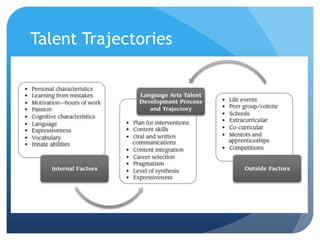
Talent Trajectories
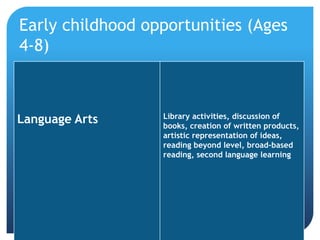
Early childhood opportunities (Ages
4-8)

Language Arts

Library activities, discussion of
books, creation of written products,
artistic representation of ideas,
reading beyond level, broad-based
reading, second language learning
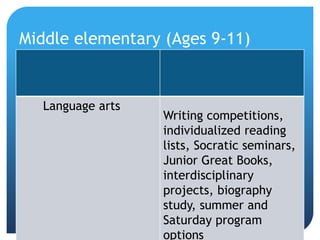
Middle elementary (Ages 9-11)

Language arts

Writing competitions,
individualized reading
lists, Socratic seminars,
Junior Great Books,
interdisciplinary
projects, biography
study, summer and
Saturday program
options
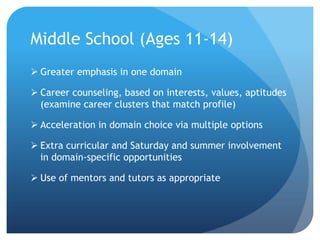
Middle School (Ages 11-14)
 Greater emphasis in one domain

 Career counseling, based on interests, values, aptitudes
(examine career clusters that match profile)
 Acceleration in domain choice via multiple options

 Extra curricular and Saturday and summer involvement
in domain-specific opportunities
 Use of mentors and tutors as appropriate
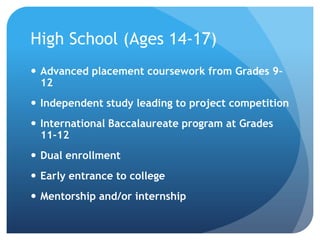
High School (Ages 14-17)
 Advanced placement coursework from Grades 912
 Independent study leading to project competition
 International Baccalaureate program at Grades
11-12
 Dual enrollment
 Early entrance to college

 Mentorship and/or internship
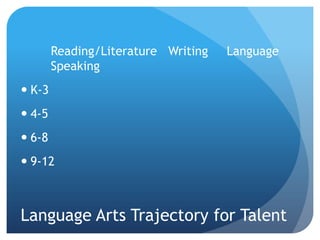
Reading/Literature Writing
Speaking

Language

 K-3
 4-5

 6-8
 9-12

Language Arts Trajectory for Talent
Key Differentiation Features
applied in ELA
 Preassessment for advanced work
 Creative production
 Focus on concepts, issues, and themes

 Instructional pacing
 Complexity and depth
Differentiated Assessments for
ELA
 Performance-based, including product
assessments
-emphasis on transfer, problem-solving,
higher level thinking

 Portfolio
-emphasis on specific growth over time
Language Arts Strands
 Literature
 Informational text
 Writing

 Language
 Speaking and listening
Major Emphases across the
Standards
 Analysis and development of argument
 Elevation of information text (nonfiction
reading across the curriculum)
 Use of multi-media
 Emphasis on products and presentations
Differentiating the CCSS in
ELA Reading Literature and
Informational Texts
ELA Reading Differentiation
Activities for advanced learners are:
 More abstract
 More idea based
 More complex
 Thinking at multiple levels simultaneously

 Working with multiple variables

 Multiple creative opportunities
 Creative context to express innovative ideas
ELA Reading (Literature)
Grade 5 Standard 1
 Quote accurately from a text when explaining what the
text says explicitly and when drawing inferences from the
text.

Typical Learner
 Students will select a line from Carl Sandburg‟s poem
“Fog” and make an inference about what the author
means.
ELA Reading (Literature)
RL 5.1 Advanced Learners
 Advanced students will define personification, select a line
from Carl Sandburg‟s poem “Fog” and describe how
Sandburg uses personification to enhance his meaning.
Students will create their own personification poem using
“Fog” as a model or add an additional stanza to “Fog.”
RL 5.1 Differentiation Approach
 Content Differentiation (depth and complexity)
Language of the discipline (personification)
 Process Differentiation
While the typical learners are drawing inferences, the advanced
learners are drawing inferences through the lens of the author‟s
use of personification.
 Product Differentiation
Creation of personification poems using Fog as a model
Application and Practice
RL 9-10.1
 Cite strong and thorough textual evidence to support analysis of
what the text says exactly as well as inferences drawn from the
text.
 (Typical) Students will read “The Raven” by Edgar Allan Poe.
After reading the poem, students use textual evidence to
support an analysis of what the text says about undying
devotion. Analysis must include direct quotes form the text as
well as inferences drawn from the text.
Application and Practice
Your tasks within your group
1.

Develop a differentiated task for advanced learners
based on the typical learner task.

2.

Describe the differentiation strategy your group
employed in designing the advanced learner task.
ELA Reading (Informational)
Grade 8 Standard 6
 Determine an author‟s point of view or purpose in a text and
analyze how the author acknowledges and responds to
conflicting evidence or viewpoints.

Typical Learner


Students will review opinions from a Supreme Court case,
determine each author‟s point of view, and summarize how he
or she responds to the other viewpoints. Students will create
a graphic organizer comparing the two points of view.
ELA Reading (Informational)
RI 8.6 Advanced Learners
 Advanced learners will review opinions from a Supreme Court
case, determine each author‟s point of view, summarize other
viewpoints, and then prepare a written rebuttal to the author‟s
point of view in the same format.
RL 8.6 Differentiation Approach
 Process Differentiation
Advanced task is more open-ended requiring abstract thought
and complexity.
 Process Differentiation
While typical learners compare two points of view of others,
advanced learners write and defend their own point of view.
 Product Differentiation
Written rebuttal versus graphic organizer
Application and Practice
RI 1.6
 Distinguish between information provided by pictures or
other illustrations and information provided by the words
in a text.
 (Typical) Students will be able to articulate whether they
obtained information from the text and/or the illustration.
Application and Practice
Your tasks within your group
1.

Develop a differentiated task for advanced learners
based on the typical learner task.

2.

Describe the differentiation strategy your group
employed in designing the advanced learner task.
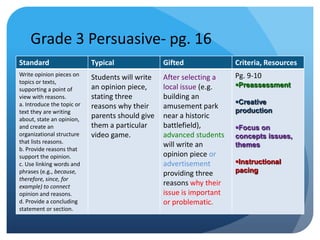
Grade 3 Persuasive- pg. 16
Standard

Typical

Gifted

Criteria, Resources

Write opinion pieces on
topics or texts,
supporting a point of
view with reasons.
a. Introduce the topic or
text they are writing
about, state an opinion,
and create an
organizational structure
that lists reasons.
b. Provide reasons that
support the opinion.
c. Use linking words and
phrases (e.g., because,
therefore, since, for
example) to connect
opinion and reasons.
d. Provide a concluding
statement or section.

Students will write
an opinion piece,
stating three
reasons why their
parents should give
them a particular
video game.

After selecting a
local issue (e.g.
building an
amusement park
near a historic
battlefield),
advanced students
will write an
opinion piece or
advertisement
providing three
reasons why their
issue is important
or problematic.

Pg. 9-10
Preassessment
Creative
production
Focus on
concepts issues,
themes
Instructional
pacing
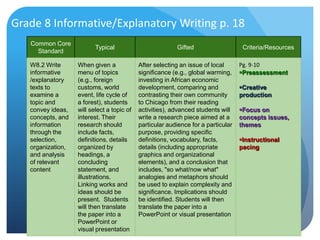
Grade 8 Informative/Explanatory Writing p. 18
Common Core
Standard
W8.2 Write
informative
/explanatory
texts to
examine a
topic and
convey ideas,
concepts, and
information
through the
selection,
organization,
and analysis
of relevant
content

Typical

Gifted

When given a
menu of topics
(e.g., foreign
customs, world
event, life cycle of
a forest), students
will select a topic of
interest. Their
research should
include facts,
definitions, details
organized by
headings, a
concluding
statement, and
illustrations.
Linking works and
ideas should be
present. Students
will then translate
the paper into a
PowerPoint or
visual presentation

After selecting an issue of local
significance (e.g., global warming,
investing in African economic
development, comparing and
contrasting their own community
to Chicago from their reading
activities), advanced students will
write a research piece aimed at a
particular audience for a particular
purpose, providing specific
definitions, vocabulary, facts,
details (including appropriate
graphics and organizational
elements), and a conclusion that
includes, "so what/now what"
analogies and metaphors should
be used to explain complexity and
significance. Implications should
be identified. Students will then
translate the paper into a
PowerPoint or visual presentation

Criteria/Resources
Pg. 9-10
Preassessment
Creative
production

Focus on
concepts issues,
themes
Instructional
pacing
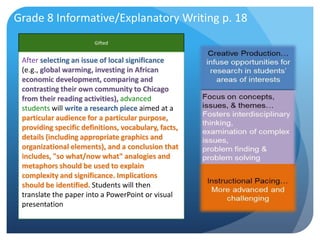
Grade 8 Informative/Explanatory Writing p. 18
Gifted

After selecting an issue of local significance
(e.g., global warming, investing in African
economic development, comparing and
contrasting their own community to Chicago
from their reading activities), advanced
students will write a research piece aimed at a
particular audience for a particular purpose,
providing specific definitions, vocabulary, facts,
details (including appropriate graphics and
organizational elements), and a conclusion that
includes, "so what/now what" analogies and
metaphors should be used to explain
complexity and significance. Implications
should be identified. Students will then
translate the paper into a PowerPoint or visual
presentation
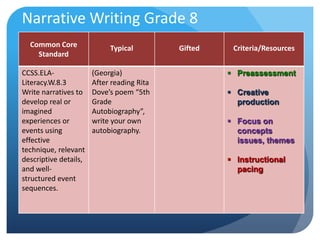
Narrative Writing Grade 8
Common Core
Standard

Typical

CCSS.ELALiteracy.W.8.3
Write narratives to
develop real or
imagined
experiences or
events using
effective
technique, relevant
descriptive details,
and wellstructured event
sequences.

(Georgia)
After reading Rita
Dove’s poem “5th
Grade
Autobiography”,
write your own
autobiography.

Gifted

Criteria/Resources
 Preassessment
 Creative
production
 Focus on
concepts
issues, themes

 Instructional
pacing
Your Turn!
 Taking a standard from the Narrative Section, devise a “gifted”
activity for advanced students that uses the criteria of:
 Preassessment

 Creative production

 Focus on concepts issues, themes

 Instructional pacing
Language differentiation
Strategy #1 Acceleration and
streamlining
 Language standards @ Grade 3, 5, & 8
 --Demonstrate command of the conventions of English
grammar and usage when writing or speaking. (ie. parts of
speech, tense, function of nouns @ Gr.3, 5; verbals and
voice@Gr. 8)
 --Demonstrate command of the conventions of standard
English capitalization, punctuation, and spelling when
writing.
Adaptation for gifted learners
•

Preassess grammar knowledge on form, function, and
sentence patterns

•

Preassess usage principles

•

Streamline teaching of unlearned aspects of grammar and
usage

•

Engage gifted learners in editing text for grammar and
usage errors; provide challenging reading selections and
target words/sentences for analysis
Application
How could you diagnose and provide appropriate level and
type of differentiation for gifted learners in respect to the
following elements of the CCSS?
Choose one:
 capitalization and punctuation
 tense and voice
 types of sentences
Assessments for the ELA CCSS:
What will they look like?
Assessment in the new CCSS
(Smarter Balance, 3/12 website
http://www.smarterbalanced.org
/sample-items-and-performancetasks/
 Two consortia and contracts let to design new
assessments, due to be used in 2014-2015
 Five Sample language arts released items follow to
illustrate approaches used.
Claims used to build assessments
 Claim #1 – Reading
 “Students can read closely and analytically to comprehend a range of increasingly
complex literary and informational texts.”
 Claim #2 – Writing
 “Students can produce effective and well-grounded writing for a range of purposes
and audiences.”
 Claim #3 – Speaking and Listening
 “Students can employ effective speaking and listening skills for a range of
purposes and audiences.”
 Claim #4 – Research/Inquiry
 “Students can engage in research and inquiry to investigate topics, and to
analyze, integrate, and present information.”
Grade: 4
Claim 1: Students can read closely and analytically to
comprehend a range of increasingly complex literary and
informational texts.
Target 1. KEY DETAILS: Use explicit details and implicit
information from the text to support answers or basic
inferences.

CCSS: RL-1, RL-3
This item asks students to identify supporting details for
an inference.
Sample item #1
o

Read selection and answer the following questions:
What does Naomi learn about Grandma Ruth? Use details from the text
to support your answer. Type your answer in the space provided.

 Read the sentences from the passage. Then answer the question.



“My grandma pulled the ball out, unwrapped it, and held it out for us to
see. The ball was scarred almost beyond recognition. It had dog bite
marks, dirt scuffs, and fraying seams. Right in the middle was a big
signature in black ink that I had somehow overlooked. It was smudged
now and faded, but it still clearly said „Babe Ruth.‟ I began to shake
inside.”



Click on two phrases from the paragraph that help you understand the
meaning of scarred.
Sample #2
 The following is the beginning of a story that a student
is writing for a class assignment. The story needs more
details and an ending. Read the beginning of the story
and then complete the task that follows.
 Reading: Oliver’s Big Splash
 Write an ending for the story by adding details to tell
what happens next.
Sample 3
 Why There Should Be a Longer School Day
 Schools should have a longer school day for students.
First, students could learn more about different
subjects if the school day were longer. Also, students
could get extra help from teachers. More hours in class
each day would also mean more vacations scattered
throughout the year.
Now look at the following daily schedule for a school that
has switched to a longer school day. Revise the paragraph
by adding details from the daily schedule that help
support the reasons for having a longer school day.
Sample #4
“Planes on the Brain” by Elisabeth Deffner, from Faces
Magazine. Copyright 2011 by Carus Publishing Company.
How does the author emphasize the point that the TAM
program was a positive influence on the sisters‟ lives? Use
details from the text to support your answer.
Highlight the parts of the text that provide evidence to
support the idea that the Tuskegee Airmen were
historically important.
What does the author mean by “the sky is no longer the
limit”? How does the meaning apply to the Anyadike
sisters? Use details from the text to support your
response.
Sample #5
 Read the text and complete the task that follows it.

Cell Phones in School—Yes or No?
Based on what you read in the text, do you think cell
phones should be allowed in schools? Using the lists
provided in the text, write a paragraph arguing why your
position is more reasonable than the opposing position.
Other assessment archetypes
 View a video and answer questions about it.

 Read a passage and provide response, given multiple
choice format.
 The following excerpt is from a writer’s first draft of a
narrative essay. Read the excerpt. Then rewrite it,
revising it to correct errors.
Literature assessment model for
gifted
Use new text to have students analyze the following:

 Key themes
 Key lines
 Key concepts used
 Creation of new title with rationale
Writing assessment model for
gifted
 Give students a writing prompt that asks
them to apply a given model of writing to a
new piece. Rubrics focus on the
organizational aspects of the given model.

 Example: Persuasive Writng
Should internet access be controlled?
Rubric dimensions: Claim, Data, Warrant
Speaking and Listening
Assessment for gifted
 Presentations as products
 Use of a rubric that includes the dimensions
of :
 Clarity
 Organization
 Comprehensiveness
 Creativity
Open-ended comments on strengths and
areas for improvement.
Language assessments for gifted
 Pre-post grammar and usage assessments

 Product assessment
Create text that manipulates language
in specific ways through choices.
Example: Develop a narrative that uses
descriptive language to convey emotion.
Analyze your word choices and how they
contribute to the power of the writing.
Develop a haiku or diamonte poem, using the
characteristics of each form. How does the
form impact meaning for the reader?
Resources for implementation:
Research-based Differentiated
Materials for the Gifted
• Mathematics
– Mentoring Mathematical Minds (M3)
– Techniques of Problem-solving
(TOPS)
– Connected Math
• Language Arts
– W&M Language Arts Units
– Junior Great Books
– Jacob's Ladder
What can gifted leaders do?
• Organize professional development on
awareness and implementation issues.
• Design scope and sequence for gifted
learners in math and ELA.
• Hold work sessions for remodeling
curriculum.
Resources available from NAGC
• Online FAQ's
• Online white paper
• Educator guides:
--Mathematics I and II
– Language Arts I and II
– Science
Reflection
 What concerns do you have about implementing the new common
core curriculum standards?

 What will be your strategy for implementation?

 How will you utilize professional development as a part of the
process?
“The future will require individuals who are able to
formulate new problems, come up with new
solutions, and adapt readily to the new ideas of
others.”
--Csikszentmihalyi & Wolfe, 2000, p. 91

Using the Common Core

  • 1.
    Using the CommonCore State Standards with Gifted and Advanced Learners Joyce VanTassel-Baska, EdD. College of William and Mary September, 2013
  • 2.
    Participant outcomes Participants willbe able to: --Analyze CCSS for differentiation needs --Create differentiated task demands, based on the standards --Evaluate school-based needs for implementation of CCSS adaptations for the gifted
  • 3.
    What are thenew common core state standards (CCSS)? -Designed by teams across states in math and language arts -Aligned with 21st Century skills: informed by TIMSS et al. -Strong emphasis on thinking, problemsolving, collaboration, and communication
  • 4.
    Myths about thecommon core standards • They replace the need for gifted programs. • They are all high level in how they are articulated. • They use the same type of assessments used in the past.
  • 5.
    Sample ELA curriculum Standards(compressed) To develop argument in written and oral forms Sample elements: •Analyze different texts. •Draw appropriate inferences, given a set of data. •Forecast implications of a given decision or action Center for Gifted Education The College of William and Mary
  • 6.
    Why does thegifted community need to be involved? • CCSS will dictate to a great extent teacher education and accreditation. • CCSS will come to be considered our national curriculum. • CCSS will be the point of departure for all gifted curriculum. We need to be involved in the work of the CCSS as it evolves!
  • 7.
    What is Differentiation? Theprocess of differentiation is the deliberate adaptation and modification of the curriculum, instructional processes, and assessments to respond to the needs of gifted learners.
  • 8.
    Differentiation Features ina Curriculum • Acceleration • Complexity • Depth • Creativity Center for Gifted Education The College of William and Mary
  • 9.
    Content adaptations neededfor gifted learners in the common core • Acceleration and streamlining • Differentiating and remodeling • Integrating across content disciplines
  • 10.
    Strategy #1 Accelerationand streamlining  CCSS Language standards @ Grade 3, 5, & 8  --Demonstrate command of the conventions of English grammar and usage when writing or speaking. (ie. parts of speech, tense, function of nouns @ Gr.3, 5; verbals and voice@Gr. 8)  --Demonstrate command of the conventions of standard English capitalization, punctuation, and spelling when writing.
  • 11.
    Adaptation for giftedlearners • Preassess grammar knowledge on form, function, and sentence patterns • Preassess usage principles • Streamline teaching of unlearned aspects of grammar and usage • Engage gifted learners in editing text for grammar and usage errors; provide challenging reading selections and target words/sentences for analysis
  • 12.
    Strategy #2 Differentiationand remodeling  CCSS Math, Statistics and Probability (Gr. 6)  Summarize numerical data sets in relation to their context.  Typical learner: On grade level graph provided to interpret.  Gifted learner: Large dataset found from Census Bureau, NSC, etc. with questions to explore at the analytical and evaluative levels.
  • 13.
    Phase I Preassessknowledge of statistics and group by results. Streamline instruction for top group (s) Phase II Assignment of task demand to the top group: Use statistics (ie.mean, median, mode, frequencies and percentages) to analyze one of the following data sets, prepare graphs to illustrate your understanding of the data, and present findings to an appropriate audience.
  • 14.
    Options for PhaseII Health care expenses for people in each decade of life from 10 to 90 years for the years 2006-2011, OR Auto sales in the US by car type across 10 years compared to world sales for those same car makes, OR Ten year trends in salary for different sectors of the US economy for 2000-2010.
  • 15.
    Phase III Follow-up questionsto consider:  What would you predict would be the trend for your data over the next 5 years?  How would you estimate it?  What factors would influence it?
  • 16.
    Strategy #3 IntegrateELA and Math Standards  CCSS Standard in English Language Arts @ Gr. 3.5, and 8:  W7 Conduct short research projects that use several sources to build knowledge through investigation of a topic. Gr. 8 (to answer a question)  CCSS Standard in math @ Gr. 3, 5, & 8  Represent and interpret data (creating &using graphs); delineate functions
  • 17.
    A Sample TaskDemand Incorporating Standards across Math and ELA Ask students to design an experiment to test a question of interest to them: Examples: A. Do people prefer Product X over Product Y? B. Are ants attracted to sugar? C. Are girls more addicted to computers than boys? A research report must be prepared and presented, using technology applications. Be sure to address your hypothesis,your data collection techniques, appropriate data tables, your conclusions, and your implications of the findings based on your original question.
  • 18.
    Instructional adaptations neededfor gifted learners • Use of scaffolds that elevate thinking • Use of inquiry models such as PBL and shared inquiry • Use of higher order questions for discussion and reflection
  • 19.
    Overview of CCSS StandardsBooklet in English language Arts Joyce VanTassel-Baska College of William and Mary
  • 20.
    Assumptions  Developmental aspectof giftedness  Domain-specific predispositions  Emergent aptitudes, based on challenge  Interaction of affect and cognition on learning  Learning diversity
  • 21.
    Key Topics Addressedin the Guide  Definitions and rationale  Alignments  Strategies for differentiation and integration of CCSS for advanced learners  Assessment differentiation  Professional development  Collaboration  Model Timeline  Research support
  • 22.
  • 23.
    Early childhood opportunities(Ages 4-8) Language Arts Library activities, discussion of books, creation of written products, artistic representation of ideas, reading beyond level, broad-based reading, second language learning
  • 24.
    Middle elementary (Ages9-11) Language arts Writing competitions, individualized reading lists, Socratic seminars, Junior Great Books, interdisciplinary projects, biography study, summer and Saturday program options
  • 25.
    Middle School (Ages11-14)  Greater emphasis in one domain  Career counseling, based on interests, values, aptitudes (examine career clusters that match profile)  Acceleration in domain choice via multiple options  Extra curricular and Saturday and summer involvement in domain-specific opportunities  Use of mentors and tutors as appropriate
  • 26.
    High School (Ages14-17)  Advanced placement coursework from Grades 912  Independent study leading to project competition  International Baccalaureate program at Grades 11-12  Dual enrollment  Early entrance to college  Mentorship and/or internship
  • 27.
    Reading/Literature Writing Speaking Language  K-3 4-5  6-8  9-12 Language Arts Trajectory for Talent
  • 28.
    Key Differentiation Features appliedin ELA  Preassessment for advanced work  Creative production  Focus on concepts, issues, and themes  Instructional pacing  Complexity and depth
  • 29.
    Differentiated Assessments for ELA Performance-based, including product assessments -emphasis on transfer, problem-solving, higher level thinking  Portfolio -emphasis on specific growth over time
  • 30.
    Language Arts Strands Literature  Informational text  Writing  Language  Speaking and listening
  • 31.
    Major Emphases acrossthe Standards  Analysis and development of argument  Elevation of information text (nonfiction reading across the curriculum)  Use of multi-media  Emphasis on products and presentations
  • 32.
    Differentiating the CCSSin ELA Reading Literature and Informational Texts
  • 33.
    ELA Reading Differentiation Activitiesfor advanced learners are:  More abstract  More idea based  More complex  Thinking at multiple levels simultaneously  Working with multiple variables  Multiple creative opportunities  Creative context to express innovative ideas
  • 34.
    ELA Reading (Literature) Grade5 Standard 1  Quote accurately from a text when explaining what the text says explicitly and when drawing inferences from the text. Typical Learner  Students will select a line from Carl Sandburg‟s poem “Fog” and make an inference about what the author means.
  • 35.
    ELA Reading (Literature) RL5.1 Advanced Learners  Advanced students will define personification, select a line from Carl Sandburg‟s poem “Fog” and describe how Sandburg uses personification to enhance his meaning. Students will create their own personification poem using “Fog” as a model or add an additional stanza to “Fog.”
  • 36.
    RL 5.1 DifferentiationApproach  Content Differentiation (depth and complexity) Language of the discipline (personification)  Process Differentiation While the typical learners are drawing inferences, the advanced learners are drawing inferences through the lens of the author‟s use of personification.  Product Differentiation Creation of personification poems using Fog as a model
  • 37.
    Application and Practice RL9-10.1  Cite strong and thorough textual evidence to support analysis of what the text says exactly as well as inferences drawn from the text.  (Typical) Students will read “The Raven” by Edgar Allan Poe. After reading the poem, students use textual evidence to support an analysis of what the text says about undying devotion. Analysis must include direct quotes form the text as well as inferences drawn from the text.
  • 38.
    Application and Practice Yourtasks within your group 1. Develop a differentiated task for advanced learners based on the typical learner task. 2. Describe the differentiation strategy your group employed in designing the advanced learner task.
  • 39.
    ELA Reading (Informational) Grade8 Standard 6  Determine an author‟s point of view or purpose in a text and analyze how the author acknowledges and responds to conflicting evidence or viewpoints. Typical Learner  Students will review opinions from a Supreme Court case, determine each author‟s point of view, and summarize how he or she responds to the other viewpoints. Students will create a graphic organizer comparing the two points of view.
  • 40.
    ELA Reading (Informational) RI8.6 Advanced Learners  Advanced learners will review opinions from a Supreme Court case, determine each author‟s point of view, summarize other viewpoints, and then prepare a written rebuttal to the author‟s point of view in the same format.
  • 41.
    RL 8.6 DifferentiationApproach  Process Differentiation Advanced task is more open-ended requiring abstract thought and complexity.  Process Differentiation While typical learners compare two points of view of others, advanced learners write and defend their own point of view.  Product Differentiation Written rebuttal versus graphic organizer
  • 42.
    Application and Practice RI1.6  Distinguish between information provided by pictures or other illustrations and information provided by the words in a text.  (Typical) Students will be able to articulate whether they obtained information from the text and/or the illustration.
  • 43.
    Application and Practice Yourtasks within your group 1. Develop a differentiated task for advanced learners based on the typical learner task. 2. Describe the differentiation strategy your group employed in designing the advanced learner task.
  • 44.
    Grade 3 Persuasive-pg. 16 Standard Typical Gifted Criteria, Resources Write opinion pieces on topics or texts, supporting a point of view with reasons. a. Introduce the topic or text they are writing about, state an opinion, and create an organizational structure that lists reasons. b. Provide reasons that support the opinion. c. Use linking words and phrases (e.g., because, therefore, since, for example) to connect opinion and reasons. d. Provide a concluding statement or section. Students will write an opinion piece, stating three reasons why their parents should give them a particular video game. After selecting a local issue (e.g. building an amusement park near a historic battlefield), advanced students will write an opinion piece or advertisement providing three reasons why their issue is important or problematic. Pg. 9-10 Preassessment Creative production Focus on concepts issues, themes Instructional pacing
  • 45.
    Grade 8 Informative/ExplanatoryWriting p. 18 Common Core Standard W8.2 Write informative /explanatory texts to examine a topic and convey ideas, concepts, and information through the selection, organization, and analysis of relevant content Typical Gifted When given a menu of topics (e.g., foreign customs, world event, life cycle of a forest), students will select a topic of interest. Their research should include facts, definitions, details organized by headings, a concluding statement, and illustrations. Linking works and ideas should be present. Students will then translate the paper into a PowerPoint or visual presentation After selecting an issue of local significance (e.g., global warming, investing in African economic development, comparing and contrasting their own community to Chicago from their reading activities), advanced students will write a research piece aimed at a particular audience for a particular purpose, providing specific definitions, vocabulary, facts, details (including appropriate graphics and organizational elements), and a conclusion that includes, "so what/now what" analogies and metaphors should be used to explain complexity and significance. Implications should be identified. Students will then translate the paper into a PowerPoint or visual presentation Criteria/Resources Pg. 9-10 Preassessment Creative production Focus on concepts issues, themes Instructional pacing
  • 46.
    Grade 8 Informative/ExplanatoryWriting p. 18 Gifted After selecting an issue of local significance (e.g., global warming, investing in African economic development, comparing and contrasting their own community to Chicago from their reading activities), advanced students will write a research piece aimed at a particular audience for a particular purpose, providing specific definitions, vocabulary, facts, details (including appropriate graphics and organizational elements), and a conclusion that includes, "so what/now what" analogies and metaphors should be used to explain complexity and significance. Implications should be identified. Students will then translate the paper into a PowerPoint or visual presentation
  • 47.
    Narrative Writing Grade8 Common Core Standard Typical CCSS.ELALiteracy.W.8.3 Write narratives to develop real or imagined experiences or events using effective technique, relevant descriptive details, and wellstructured event sequences. (Georgia) After reading Rita Dove’s poem “5th Grade Autobiography”, write your own autobiography. Gifted Criteria/Resources  Preassessment  Creative production  Focus on concepts issues, themes  Instructional pacing
  • 48.
    Your Turn!  Takinga standard from the Narrative Section, devise a “gifted” activity for advanced students that uses the criteria of:  Preassessment  Creative production  Focus on concepts issues, themes  Instructional pacing
  • 49.
  • 50.
    Strategy #1 Accelerationand streamlining  Language standards @ Grade 3, 5, & 8  --Demonstrate command of the conventions of English grammar and usage when writing or speaking. (ie. parts of speech, tense, function of nouns @ Gr.3, 5; verbals and voice@Gr. 8)  --Demonstrate command of the conventions of standard English capitalization, punctuation, and spelling when writing.
  • 51.
    Adaptation for giftedlearners • Preassess grammar knowledge on form, function, and sentence patterns • Preassess usage principles • Streamline teaching of unlearned aspects of grammar and usage • Engage gifted learners in editing text for grammar and usage errors; provide challenging reading selections and target words/sentences for analysis
  • 52.
    Application How could youdiagnose and provide appropriate level and type of differentiation for gifted learners in respect to the following elements of the CCSS? Choose one:  capitalization and punctuation  tense and voice  types of sentences
  • 53.
    Assessments for theELA CCSS: What will they look like?
  • 54.
    Assessment in thenew CCSS (Smarter Balance, 3/12 website http://www.smarterbalanced.org /sample-items-and-performancetasks/  Two consortia and contracts let to design new assessments, due to be used in 2014-2015  Five Sample language arts released items follow to illustrate approaches used.
  • 55.
    Claims used tobuild assessments  Claim #1 – Reading  “Students can read closely and analytically to comprehend a range of increasingly complex literary and informational texts.”  Claim #2 – Writing  “Students can produce effective and well-grounded writing for a range of purposes and audiences.”  Claim #3 – Speaking and Listening  “Students can employ effective speaking and listening skills for a range of purposes and audiences.”  Claim #4 – Research/Inquiry  “Students can engage in research and inquiry to investigate topics, and to analyze, integrate, and present information.”
  • 56.
    Grade: 4 Claim 1:Students can read closely and analytically to comprehend a range of increasingly complex literary and informational texts. Target 1. KEY DETAILS: Use explicit details and implicit information from the text to support answers or basic inferences. CCSS: RL-1, RL-3 This item asks students to identify supporting details for an inference.
  • 57.
    Sample item #1 o Readselection and answer the following questions: What does Naomi learn about Grandma Ruth? Use details from the text to support your answer. Type your answer in the space provided.  Read the sentences from the passage. Then answer the question.  “My grandma pulled the ball out, unwrapped it, and held it out for us to see. The ball was scarred almost beyond recognition. It had dog bite marks, dirt scuffs, and fraying seams. Right in the middle was a big signature in black ink that I had somehow overlooked. It was smudged now and faded, but it still clearly said „Babe Ruth.‟ I began to shake inside.”  Click on two phrases from the paragraph that help you understand the meaning of scarred.
  • 58.
    Sample #2  Thefollowing is the beginning of a story that a student is writing for a class assignment. The story needs more details and an ending. Read the beginning of the story and then complete the task that follows.  Reading: Oliver’s Big Splash  Write an ending for the story by adding details to tell what happens next.
  • 59.
    Sample 3  WhyThere Should Be a Longer School Day  Schools should have a longer school day for students. First, students could learn more about different subjects if the school day were longer. Also, students could get extra help from teachers. More hours in class each day would also mean more vacations scattered throughout the year. Now look at the following daily schedule for a school that has switched to a longer school day. Revise the paragraph by adding details from the daily schedule that help support the reasons for having a longer school day.
  • 60.
    Sample #4 “Planes onthe Brain” by Elisabeth Deffner, from Faces Magazine. Copyright 2011 by Carus Publishing Company. How does the author emphasize the point that the TAM program was a positive influence on the sisters‟ lives? Use details from the text to support your answer. Highlight the parts of the text that provide evidence to support the idea that the Tuskegee Airmen were historically important. What does the author mean by “the sky is no longer the limit”? How does the meaning apply to the Anyadike sisters? Use details from the text to support your response.
  • 61.
    Sample #5  Readthe text and complete the task that follows it. Cell Phones in School—Yes or No? Based on what you read in the text, do you think cell phones should be allowed in schools? Using the lists provided in the text, write a paragraph arguing why your position is more reasonable than the opposing position.
  • 62.
    Other assessment archetypes View a video and answer questions about it.  Read a passage and provide response, given multiple choice format.  The following excerpt is from a writer’s first draft of a narrative essay. Read the excerpt. Then rewrite it, revising it to correct errors.
  • 63.
    Literature assessment modelfor gifted Use new text to have students analyze the following:  Key themes  Key lines  Key concepts used  Creation of new title with rationale
  • 64.
    Writing assessment modelfor gifted  Give students a writing prompt that asks them to apply a given model of writing to a new piece. Rubrics focus on the organizational aspects of the given model.  Example: Persuasive Writng Should internet access be controlled? Rubric dimensions: Claim, Data, Warrant
  • 65.
    Speaking and Listening Assessmentfor gifted  Presentations as products  Use of a rubric that includes the dimensions of :  Clarity  Organization  Comprehensiveness  Creativity Open-ended comments on strengths and areas for improvement.
  • 66.
    Language assessments forgifted  Pre-post grammar and usage assessments  Product assessment Create text that manipulates language in specific ways through choices. Example: Develop a narrative that uses descriptive language to convey emotion. Analyze your word choices and how they contribute to the power of the writing. Develop a haiku or diamonte poem, using the characteristics of each form. How does the form impact meaning for the reader?
  • 67.
    Resources for implementation: Research-basedDifferentiated Materials for the Gifted • Mathematics – Mentoring Mathematical Minds (M3) – Techniques of Problem-solving (TOPS) – Connected Math • Language Arts – W&M Language Arts Units – Junior Great Books – Jacob's Ladder
  • 68.
    What can giftedleaders do? • Organize professional development on awareness and implementation issues. • Design scope and sequence for gifted learners in math and ELA. • Hold work sessions for remodeling curriculum.
  • 69.
    Resources available fromNAGC • Online FAQ's • Online white paper • Educator guides: --Mathematics I and II – Language Arts I and II – Science
  • 70.
    Reflection  What concernsdo you have about implementing the new common core curriculum standards?  What will be your strategy for implementation?  How will you utilize professional development as a part of the process?
  • 71.
    “The future willrequire individuals who are able to formulate new problems, come up with new solutions, and adapt readily to the new ideas of others.” --Csikszentmihalyi & Wolfe, 2000, p. 91