Reading with English Language Learners Dr. Susan Rutledge, Ph.D Curriculum and Instruction in TESOL [email_address] CELI Conference July 29, 2009 “ We learn language, we learn through language, and we learn about language.”  (Freeman & Freeman, 2004)
Empathy Exercise Close Your Eyes & Listen Song Open your eyes How do you feel?  Let’s listen again! Now how do you feel?  What made this experience different?
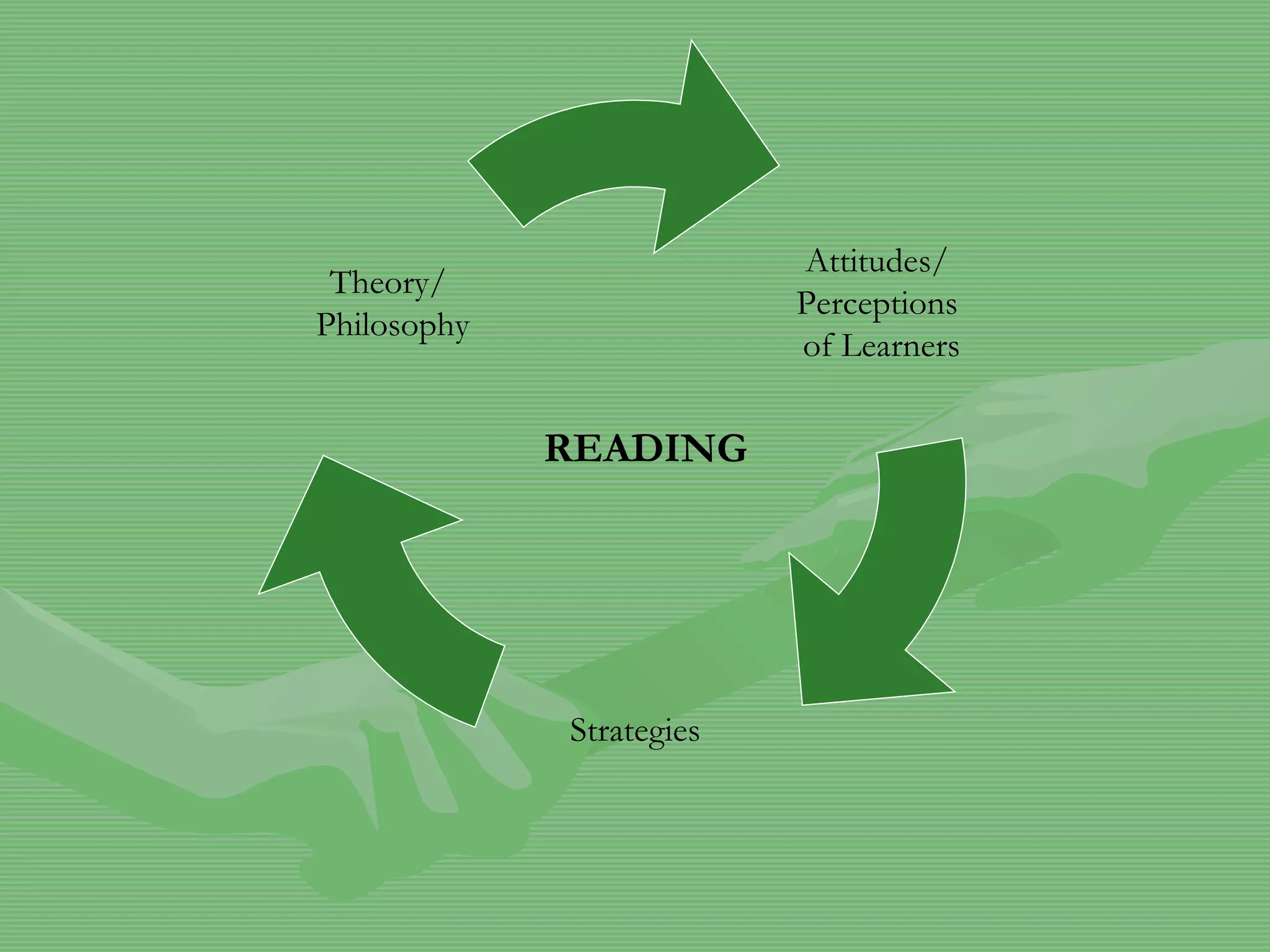
READING Attitudes/  Perceptions  of Learners Strategies Theory/ Philosophy
Who are ELL learners? ELL learners come from a variety of backgrounds Spanish speakers represent the largest number of ELL learners nation wide. Some are 1 st  generation, some are 2 nd  generation, and some are 3 rd  generation. They can be from a foreign country and they can be born in the U.S . They may or may not have an educational background. They may or may not be literate in their native language. They may or may not be able to write in their native language
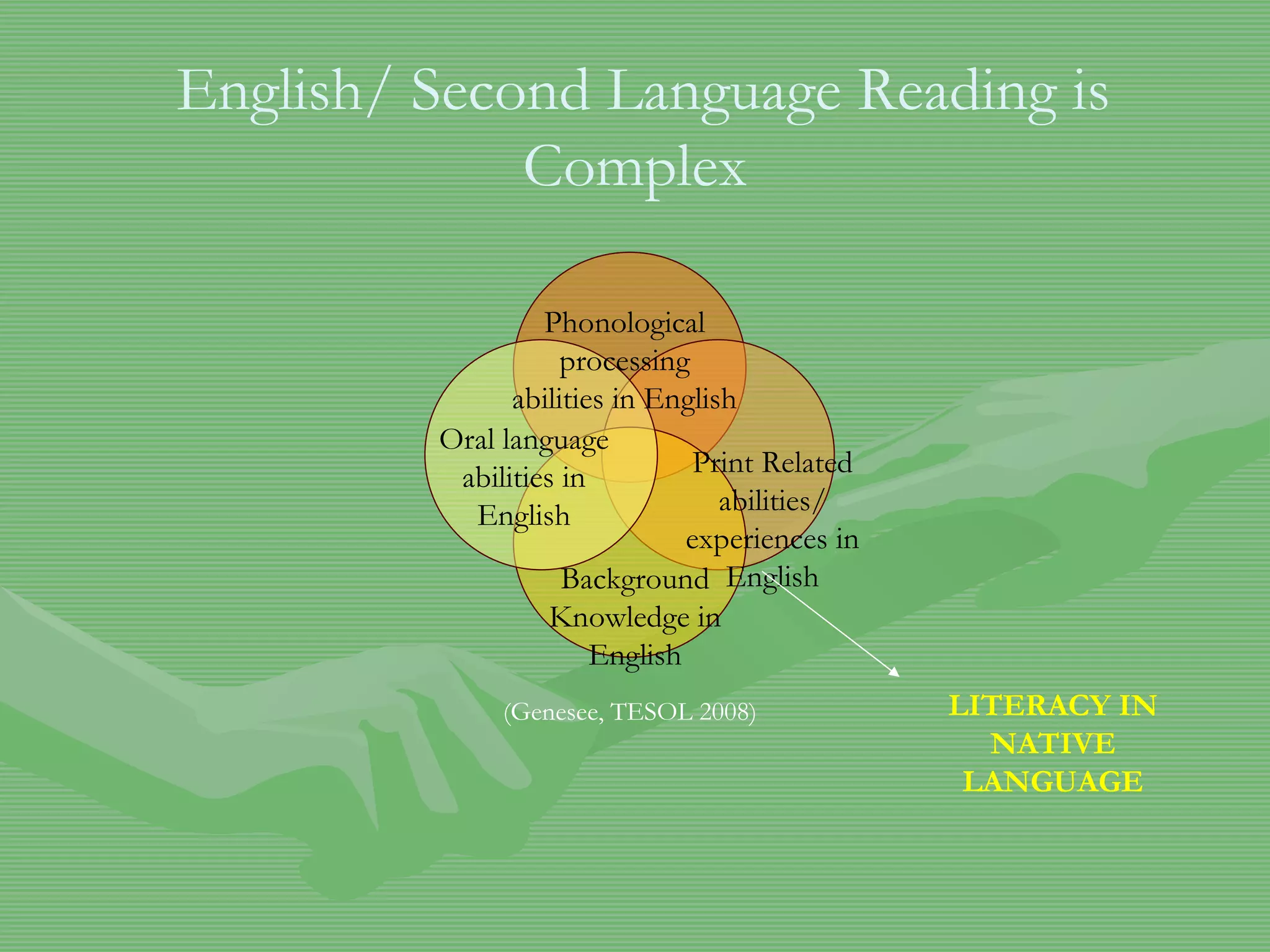
English/ Second Language Reading is Complex Phonological processing abilities in English Print Related abilities/ experiences in English Background Knowledge in English Oral language abilities in English LITERACY IN NATIVE LANGUAGE (Genesee, TESOL 2008)
What Can Teachers Do? Have a deep Understanding of English? What does this mean? Phonology, Morphology, Syntax, Semantics, & Pragmatics Understand First and Second Language Acquisition First Language Stages Second Language Stages Language is a moving Target (Levine, 2008) Social English 1-3 years Academic English 5-7 years Teaching any Subject requires teaching the language, vocabulary, and organizational structures
What Can Teachers Do? Informed:  Ask questions!! Has the student gone to school in his/ her home country? Is the student literate in his/ her native language? What is your student’s English proficiency? What does the proficiency test examine? Understand and utilize your ELL learner’s proficiency level to guide your instruction. What is proficiency? “The degree of skill with which a person can read, write, speak, or understand a language.” (Richards & Schmidt, 2002) How do you know your student’s proficiency level? ASK  the English language learner teacher/ tutor Understand the Proficiency Assessment Used CAN DO Descriptors
What Can Teachers Do? Limited English Proficiency affects learning & assessment Not familiar to them culturally and linguistically Reading is a cognitive and socially constructed pursuit Incorporate students’ cultures Multicultural Literature Multicultural Video Compare English to the Student’s native language Oral Written Communicate clearly Does not mean talking loudly to student!! Clear goals & expectations Collaborative: Work with the ELL provider Talk with the parents!!!!!!!
Cultural Influences Culture produces and develops background knowledge, words, sentences, and text structures Spanish speaking students are accustomed to a phonetically stable alphabetic spelling in which each letter represents a sound English readers use less consistent letter and word cues to determine the meaning and the grammatical function of a word.  The Chinese character system has no link between speech sounds and the written symbol.  Reading directionality also varies among languages. Languages such as English and Russian are read left to right, top to bottom, while Arabic is read right to left. Making inferences, where students challenge or reinterpret text, is a critical reading comprehension skill for American readers, but is considered inappropriate and even disrespectful, in other cultures.
Oral Language Classroom Talk is IMPORTANT! Multiple opportunities to talk with peers and teachers Primary source of information and language about the topics being discussed Learners internalize and use to express their own meanings. adaptations may include speaking slowly, using short sentences, paraphrasing the same message several different ways, and explaining word meanings.  use gestures, pictures, and props to make meaning more clear.  Teachers need to model how adults converse about books. Literacy requires large blocks of time for reading, but it also must provide for discussion, conversations, reflection, and revision (Allington & Cunningham, 2002).
Word Level Word Study Activities Help ESL students understand and use Academic Language Content Specific Plasma, Square,  Other Vocabulary Directions, fill-in the blank, Factor, compare, similar Words that have multiple meanings such as wave Wave of immigrants vs. Ocean wave Examples Vocabulary Closed–Captioning Television offers a novel experience for students to interact with the spoken and printed word simultaneously. TPR helps the least proficient ELL students actively and physically understand vocabulary and concepts.  The idea is for the teacher to choose words or concepts that are easily demonstrated physically such as commands, movement directions, prepositions, and body parts.
Whole Text Paired Reading pairing a skilled reader with a less-skilled reader.  The skilled reader demonstrates appropriate reading rate, inflection, and pausing for the less-skilled reader The skilled reader in each pair reads the connected text first. Then the less-skilled reader reads the same text The less-skilled reader has a role model of fluent reading, as well as repeated exposure to text   Writing to Read:  Gaining Knowledge from Texts Helps meaning construction and comprehension Formal writing such as personal narrative, comparison/contrast, and expository compositions assist ELL students make deeper connections to their reading  Allows students to analyze and synthesize texts Think of your experience as an immigrant.  Describe a special experience you have had as an immigrant?  Why was it special?  What did that experience teach you about the immigrant experience in the U.S?  Relate your experience to the section we read on immigration to the U.S.
CARS  Content Area Reading Strategies   Content Texts are Expository What does this mean? Specific actions readers take to make meaning from text. Reading is like a conversation between author and reader.  Authors make decisions about how to effectively communicate through a piece of writing.  Readers use specific strategies to help them understand what authors are trying to communicate.  Before, During, and After Reading What are they? Higher order Thinking Skills/ Questions Reading Strategy
Examples Dual Language Books Spelling City Sight Word Activities WordSift ESL Class Introduction
Why? National Statistics ELL students comprise the fastest growing K-12 population in the U.S. (Reeves, 2002; Karabanerick & Clemens-Noda, 2004) 10.3 % of K-12 population (Batalova, Fix, & Murray, 2006) 44% of 4 th  grade ELLs scored “below basic” in Math & 70% scored “below basic” in Reading (NCES, 2007) 69% of 8 th  grade ELLs scored “below basic” in Math 70% of 8 th  grade ELLs scored “below basic” in Reading
Mississippi ELL stats ELL Population Approximately 1% of total student population 75% free-reduced lunch 6% special education Number of years student has been an ELL Less than 1  11.2% 1 year 18.3% 2 years 19.3% 3 or more years 29.2% Monitored 22.1% (Kasse, AMTESOL, 2008)
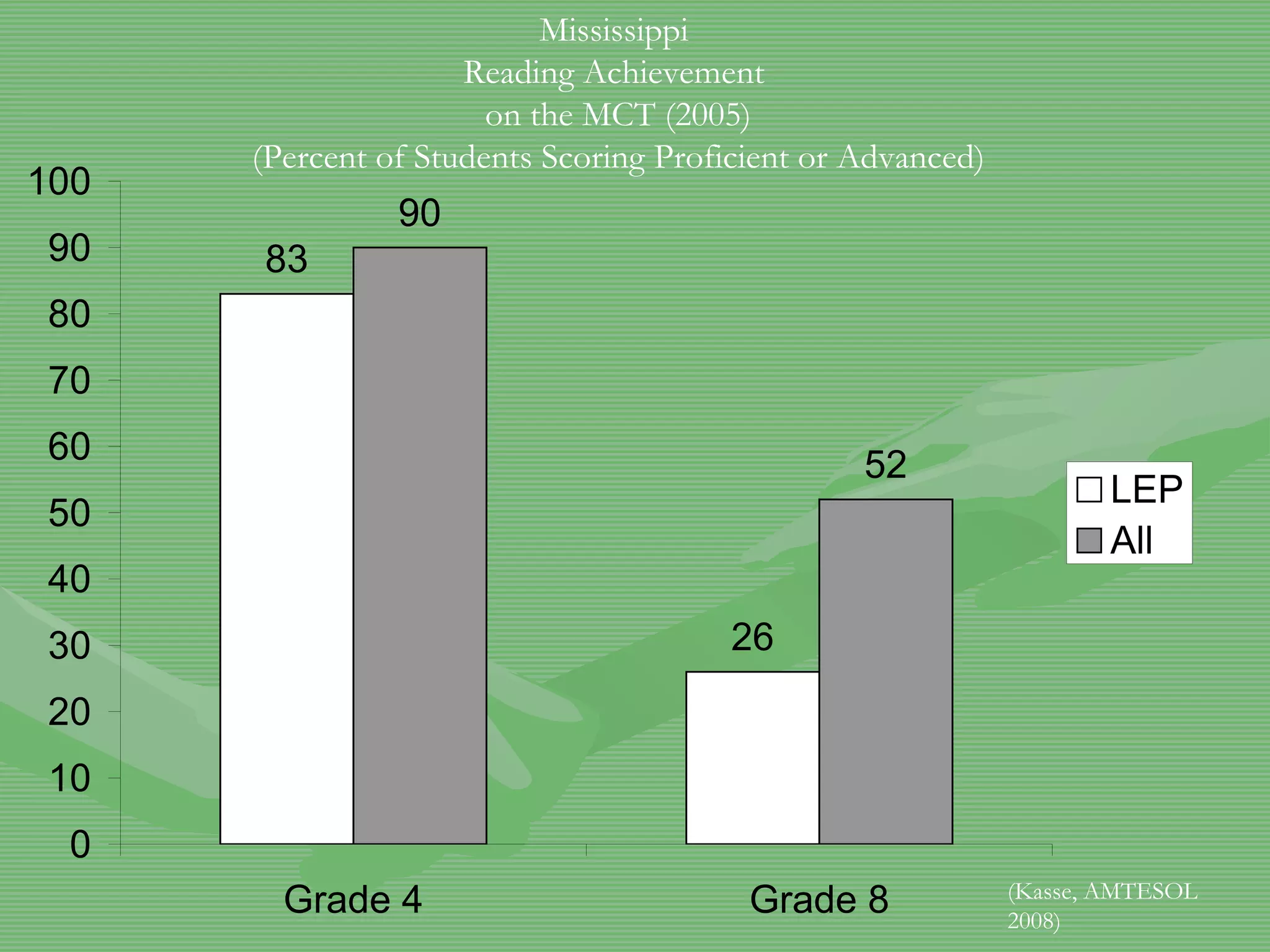
Mississippi Reading Achievement  on the MCT (2005)  (Percent of Students Scoring Proficient or Advanced) (Kasse, AMTESOL 2008)
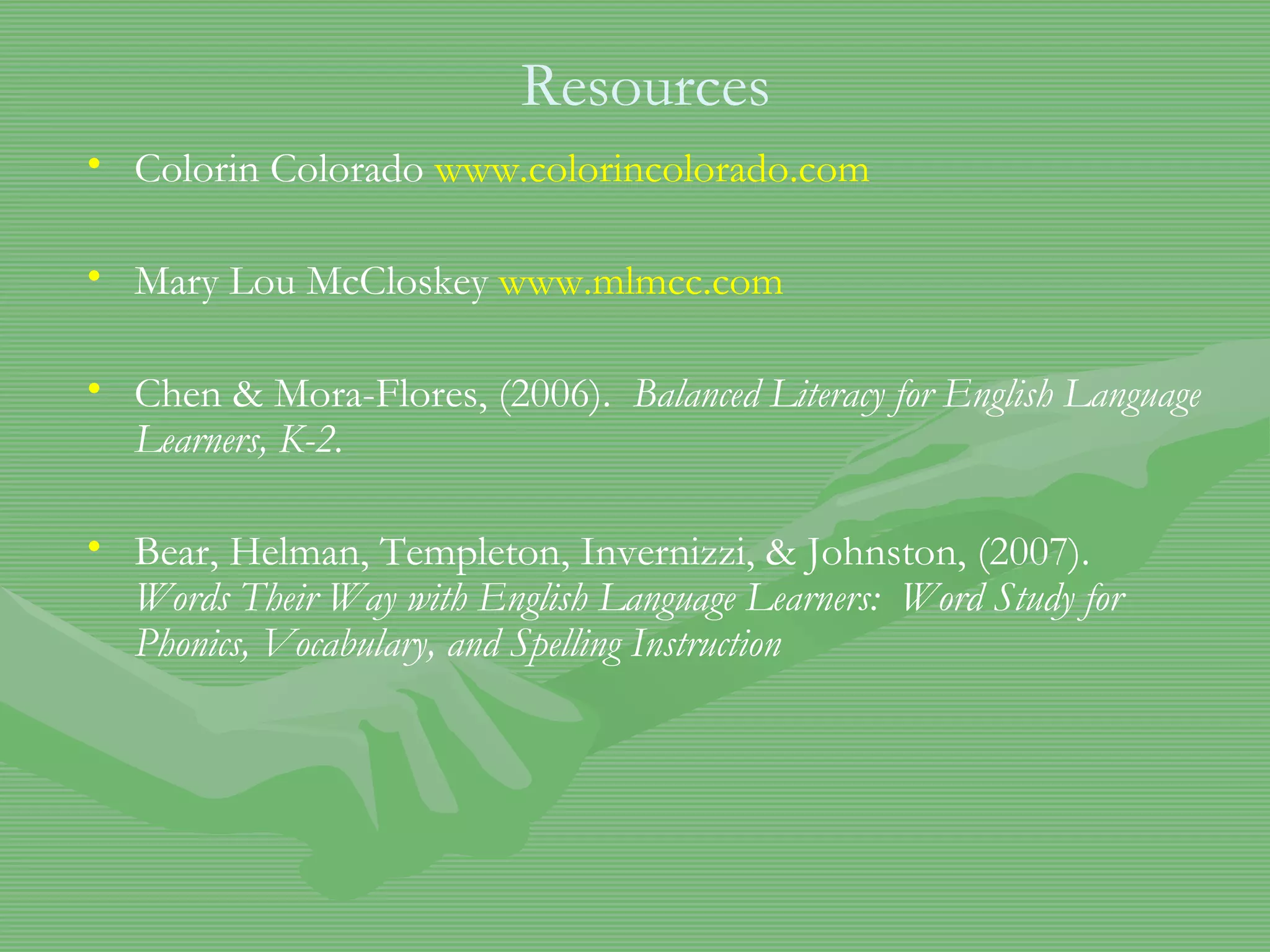
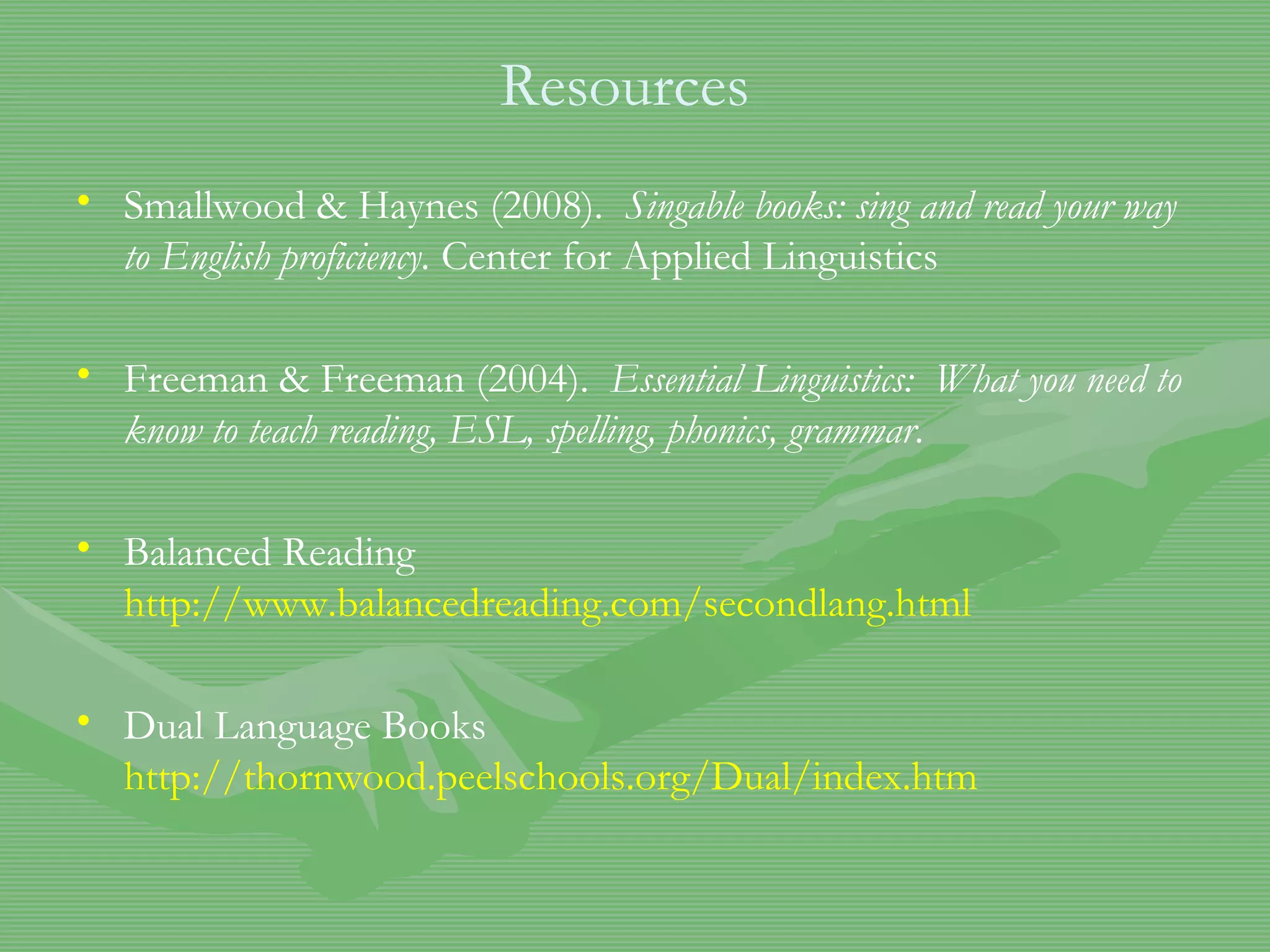
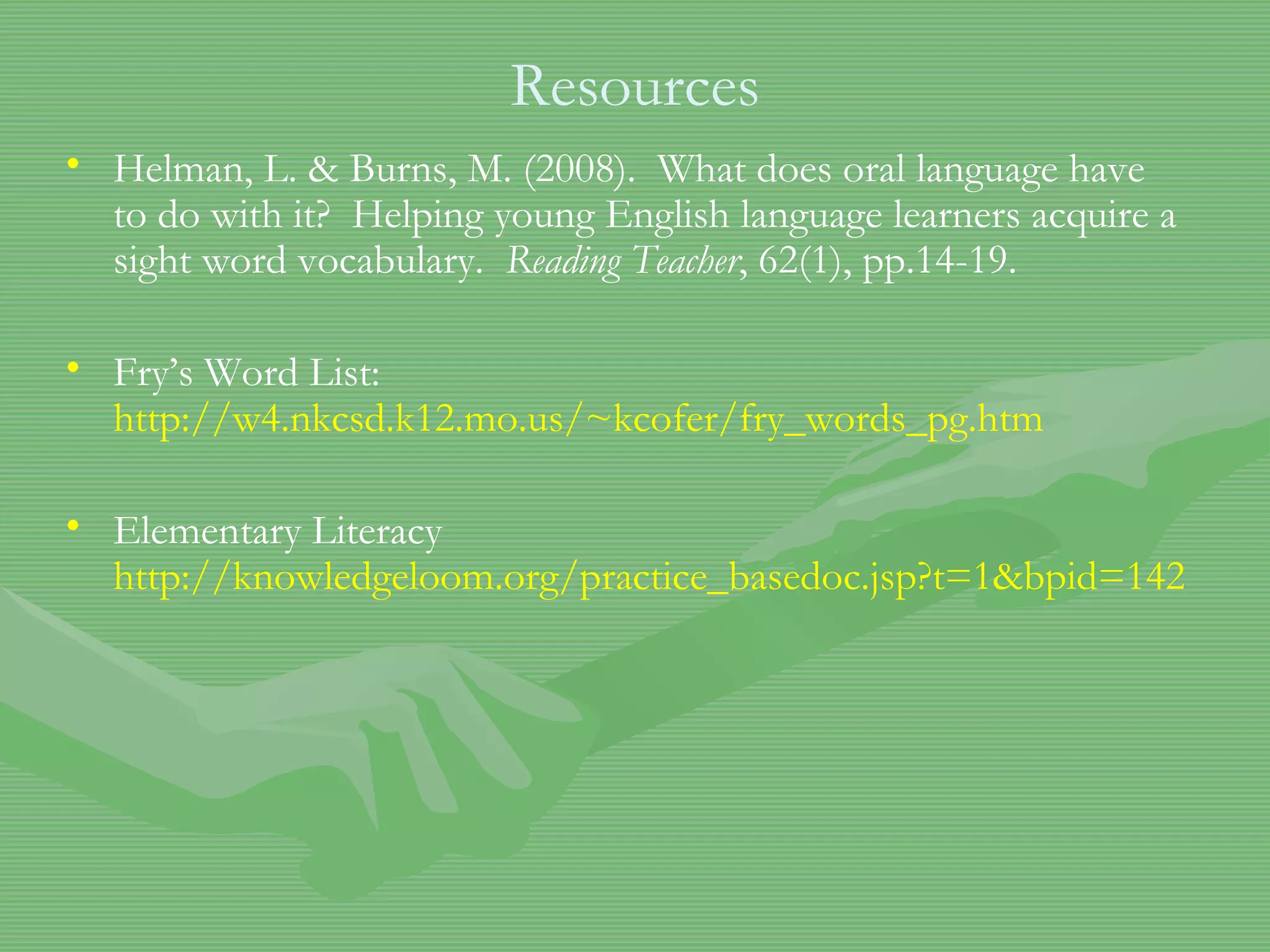
Conclusion Remember to think of the LANGUAGE first. words not only have direct and literal dictionary meanings, but also have affective meanings and connotative meanings Crawl, Walk, Run Explain & Demonstrate Practice Perform Improvement in reading skills depends mostly on what students do with what they read; how they engage the text
Spasiba   We are ALL Language Teachers THANK YOU!!! GRACIAS XIE XIE Doh-mo - ardei ga-toe   Kamsa hamnida
Resources Colorin Colorado  www.colorincolorado.com Mary Lou McCloskey  www.mlmcc.com Chen & Mora-Flores, (2006).  Balanced Literacy for English Language Learners, K-2. Bear, Helman, Templeton, Invernizzi, & Johnston, (2007).  Words Their Way with English Language Learners:  Word Study for Phonics, Vocabulary, and Spelling Instruction
Resources Smallwood & Haynes (2008).  Singable books: sing and read your way to English proficiency.  Center for Applied Linguistics Freeman & Freeman (2004).  Essential Linguistics:  What you need to know to teach reading, ESL, spelling, phonics, grammar .  Balanced Reading  http://www.balancedreading.com/secondlang.html Dual Language Books  http://thornwood.peelschools.org/Dual/index.htm
Resources Helman, L. & Burns, M. (2008).  What does oral language have to do with it?  Helping young English language learners acquire a sight word vocabulary.  Reading Teacher , 62(1), pp.14-19. Fry’s Word List:  http://w4.nkcsd.k12.mo.us/~kcofer/fry_words_pg.htm Elementary Literacy  http://knowledgeloom.org/practice_basedoc.jsp?t=1&bpid=1427&aspect=3&location=2&parentid=1426&bpinterid=1426&spotlightid=1393&testflag=yes#1
Resources Allington, R.L., & Cunningham, P. (2002).  Schools that work  (2nd ed.). New York: Longman.  Mora, J.K.  (1999)  Using Multicultural Literature to Teach Reading Processes  http://coe.sdsu.edu/people/jmora/MulticulturalLit / Hispanic American Images  http://comminfo.rutgers.edu/professional-development/childlit/ChildrenLit/hispanic.html
Resources Asian American Images  http://comminfo.rutgers.edu/professional-development/childlit/ChildrenLit/asian.html Word Sift:  http://www.wordsift.com/ Kasper, L.F. (1996).  Writing to read: Enhancing ESL students’ reading proficiency through written response to text.  TETYC Kinsella, K.  (2006). Academic Vocabulary information.
Resources Karabenick, S.A. & Clemens-Noda, P.A. (2004).  Professional development implications of teachers’ beliefs and attitudes toward English language learners.  Bilingual Research Journal,  28 (1), 55-75.  Retrieved October 15, 2005, from  http://brj.asu.edu/content/vol28_no1/art4.pdf Batalova, J., Fix, M., & Murray, J. (2007). Measures of change: The democracy and literacy of adolescent English learners -A report to Carnegie Corporation of New York. Washington, DC: Migration Policy Institute .   Reeves, J. (2001).  Secondary teachers’ attitudes and perceptions of inclusion of ESL students in mainstream classes.  Doctoral dissertation.  Dissertation International Abstracts,  (UMI No. 3062322)
Resources Law and Eckes, (1995).  Assessment and ESL: A Handbook for K-12 Teachers.  Using Paired Reading To Help ESL Students Become Fluent And Accurate Readers  Reading Improvement ,  Summer, 2001  by  Daqi  Li ,  Sandra  Nes   Capps, R., Fix, M., Murray, J., Ost, J., Passel, J. & Herwantoro, S. (2005).  The new demography of America’s Schools: Immigration and the No Child Left Behind.   Washington, DC:  The Urban Institute

Reading With English Language Learners

  • 1.
    Reading with EnglishLanguage Learners Dr. Susan Rutledge, Ph.D Curriculum and Instruction in TESOL [email_address] CELI Conference July 29, 2009 “ We learn language, we learn through language, and we learn about language.” (Freeman & Freeman, 2004)
  • 2.
    Empathy Exercise CloseYour Eyes & Listen Song Open your eyes How do you feel? Let’s listen again! Now how do you feel? What made this experience different?
  • 3.
    READING Attitudes/ Perceptions of Learners Strategies Theory/ Philosophy
  • 4.
    Who are ELLlearners? ELL learners come from a variety of backgrounds Spanish speakers represent the largest number of ELL learners nation wide. Some are 1 st generation, some are 2 nd generation, and some are 3 rd generation. They can be from a foreign country and they can be born in the U.S . They may or may not have an educational background. They may or may not be literate in their native language. They may or may not be able to write in their native language
  • 5.
    English/ Second LanguageReading is Complex Phonological processing abilities in English Print Related abilities/ experiences in English Background Knowledge in English Oral language abilities in English LITERACY IN NATIVE LANGUAGE (Genesee, TESOL 2008)
  • 6.
    What Can TeachersDo? Have a deep Understanding of English? What does this mean? Phonology, Morphology, Syntax, Semantics, & Pragmatics Understand First and Second Language Acquisition First Language Stages Second Language Stages Language is a moving Target (Levine, 2008) Social English 1-3 years Academic English 5-7 years Teaching any Subject requires teaching the language, vocabulary, and organizational structures
  • 7.
    What Can TeachersDo? Informed: Ask questions!! Has the student gone to school in his/ her home country? Is the student literate in his/ her native language? What is your student’s English proficiency? What does the proficiency test examine? Understand and utilize your ELL learner’s proficiency level to guide your instruction. What is proficiency? “The degree of skill with which a person can read, write, speak, or understand a language.” (Richards & Schmidt, 2002) How do you know your student’s proficiency level? ASK the English language learner teacher/ tutor Understand the Proficiency Assessment Used CAN DO Descriptors
  • 8.
    What Can TeachersDo? Limited English Proficiency affects learning & assessment Not familiar to them culturally and linguistically Reading is a cognitive and socially constructed pursuit Incorporate students’ cultures Multicultural Literature Multicultural Video Compare English to the Student’s native language Oral Written Communicate clearly Does not mean talking loudly to student!! Clear goals & expectations Collaborative: Work with the ELL provider Talk with the parents!!!!!!!
  • 9.
    Cultural Influences Cultureproduces and develops background knowledge, words, sentences, and text structures Spanish speaking students are accustomed to a phonetically stable alphabetic spelling in which each letter represents a sound English readers use less consistent letter and word cues to determine the meaning and the grammatical function of a word. The Chinese character system has no link between speech sounds and the written symbol. Reading directionality also varies among languages. Languages such as English and Russian are read left to right, top to bottom, while Arabic is read right to left. Making inferences, where students challenge or reinterpret text, is a critical reading comprehension skill for American readers, but is considered inappropriate and even disrespectful, in other cultures.
  • 10.
    Oral Language ClassroomTalk is IMPORTANT! Multiple opportunities to talk with peers and teachers Primary source of information and language about the topics being discussed Learners internalize and use to express their own meanings. adaptations may include speaking slowly, using short sentences, paraphrasing the same message several different ways, and explaining word meanings. use gestures, pictures, and props to make meaning more clear. Teachers need to model how adults converse about books. Literacy requires large blocks of time for reading, but it also must provide for discussion, conversations, reflection, and revision (Allington & Cunningham, 2002).
  • 11.
    Word Level WordStudy Activities Help ESL students understand and use Academic Language Content Specific Plasma, Square, Other Vocabulary Directions, fill-in the blank, Factor, compare, similar Words that have multiple meanings such as wave Wave of immigrants vs. Ocean wave Examples Vocabulary Closed–Captioning Television offers a novel experience for students to interact with the spoken and printed word simultaneously. TPR helps the least proficient ELL students actively and physically understand vocabulary and concepts. The idea is for the teacher to choose words or concepts that are easily demonstrated physically such as commands, movement directions, prepositions, and body parts.
  • 12.
    Whole Text PairedReading pairing a skilled reader with a less-skilled reader. The skilled reader demonstrates appropriate reading rate, inflection, and pausing for the less-skilled reader The skilled reader in each pair reads the connected text first. Then the less-skilled reader reads the same text The less-skilled reader has a role model of fluent reading, as well as repeated exposure to text Writing to Read: Gaining Knowledge from Texts Helps meaning construction and comprehension Formal writing such as personal narrative, comparison/contrast, and expository compositions assist ELL students make deeper connections to their reading Allows students to analyze and synthesize texts Think of your experience as an immigrant. Describe a special experience you have had as an immigrant? Why was it special? What did that experience teach you about the immigrant experience in the U.S? Relate your experience to the section we read on immigration to the U.S.
  • 13.
    CARS ContentArea Reading Strategies Content Texts are Expository What does this mean? Specific actions readers take to make meaning from text. Reading is like a conversation between author and reader. Authors make decisions about how to effectively communicate through a piece of writing. Readers use specific strategies to help them understand what authors are trying to communicate. Before, During, and After Reading What are they? Higher order Thinking Skills/ Questions Reading Strategy
  • 14.
    Examples Dual LanguageBooks Spelling City Sight Word Activities WordSift ESL Class Introduction
  • 15.
    Why? National StatisticsELL students comprise the fastest growing K-12 population in the U.S. (Reeves, 2002; Karabanerick & Clemens-Noda, 2004) 10.3 % of K-12 population (Batalova, Fix, & Murray, 2006) 44% of 4 th grade ELLs scored “below basic” in Math & 70% scored “below basic” in Reading (NCES, 2007) 69% of 8 th grade ELLs scored “below basic” in Math 70% of 8 th grade ELLs scored “below basic” in Reading
  • 16.
    Mississippi ELL statsELL Population Approximately 1% of total student population 75% free-reduced lunch 6% special education Number of years student has been an ELL Less than 1 11.2% 1 year 18.3% 2 years 19.3% 3 or more years 29.2% Monitored 22.1% (Kasse, AMTESOL, 2008)
  • 17.
    Mississippi Reading Achievement on the MCT (2005) (Percent of Students Scoring Proficient or Advanced) (Kasse, AMTESOL 2008)
  • 18.
    Conclusion Remember tothink of the LANGUAGE first. words not only have direct and literal dictionary meanings, but also have affective meanings and connotative meanings Crawl, Walk, Run Explain & Demonstrate Practice Perform Improvement in reading skills depends mostly on what students do with what they read; how they engage the text
  • 19.
    Spasiba We are ALL Language Teachers THANK YOU!!! GRACIAS XIE XIE Doh-mo - ardei ga-toe Kamsa hamnida
  • 20.
    Resources Colorin Colorado www.colorincolorado.com Mary Lou McCloskey www.mlmcc.com Chen & Mora-Flores, (2006). Balanced Literacy for English Language Learners, K-2. Bear, Helman, Templeton, Invernizzi, & Johnston, (2007). Words Their Way with English Language Learners: Word Study for Phonics, Vocabulary, and Spelling Instruction
  • 21.
    Resources Smallwood &Haynes (2008). Singable books: sing and read your way to English proficiency. Center for Applied Linguistics Freeman & Freeman (2004). Essential Linguistics: What you need to know to teach reading, ESL, spelling, phonics, grammar . Balanced Reading http://www.balancedreading.com/secondlang.html Dual Language Books http://thornwood.peelschools.org/Dual/index.htm
  • 22.
    Resources Helman, L.& Burns, M. (2008). What does oral language have to do with it? Helping young English language learners acquire a sight word vocabulary. Reading Teacher , 62(1), pp.14-19. Fry’s Word List: http://w4.nkcsd.k12.mo.us/~kcofer/fry_words_pg.htm Elementary Literacy http://knowledgeloom.org/practice_basedoc.jsp?t=1&bpid=1427&aspect=3&location=2&parentid=1426&bpinterid=1426&spotlightid=1393&testflag=yes#1
  • 23.
    Resources Allington, R.L.,& Cunningham, P. (2002). Schools that work (2nd ed.). New York: Longman. Mora, J.K. (1999) Using Multicultural Literature to Teach Reading Processes http://coe.sdsu.edu/people/jmora/MulticulturalLit / Hispanic American Images http://comminfo.rutgers.edu/professional-development/childlit/ChildrenLit/hispanic.html
  • 24.
    Resources Asian AmericanImages http://comminfo.rutgers.edu/professional-development/childlit/ChildrenLit/asian.html Word Sift: http://www.wordsift.com/ Kasper, L.F. (1996). Writing to read: Enhancing ESL students’ reading proficiency through written response to text. TETYC Kinsella, K. (2006). Academic Vocabulary information.
  • 25.
    Resources Karabenick, S.A.& Clemens-Noda, P.A. (2004). Professional development implications of teachers’ beliefs and attitudes toward English language learners. Bilingual Research Journal, 28 (1), 55-75. Retrieved October 15, 2005, from http://brj.asu.edu/content/vol28_no1/art4.pdf Batalova, J., Fix, M., & Murray, J. (2007). Measures of change: The democracy and literacy of adolescent English learners -A report to Carnegie Corporation of New York. Washington, DC: Migration Policy Institute . Reeves, J. (2001). Secondary teachers’ attitudes and perceptions of inclusion of ESL students in mainstream classes. Doctoral dissertation. Dissertation International Abstracts, (UMI No. 3062322)
  • 26.
    Resources Law andEckes, (1995). Assessment and ESL: A Handbook for K-12 Teachers. Using Paired Reading To Help ESL Students Become Fluent And Accurate Readers Reading Improvement , Summer, 2001 by Daqi Li , Sandra Nes Capps, R., Fix, M., Murray, J., Ost, J., Passel, J. & Herwantoro, S. (2005). The new demography of America’s Schools: Immigration and the No Child Left Behind. Washington, DC: The Urban Institute