ENGLISH AS A
SECOND
LANGUAGE
Learning objective:
Describe some of the difficulties
and challenges facing ELL students
in the U.S.
Terms
 StandardizedTest Scores- A standardized test is a
test that is administered and scored in a consistent, or
"standard", manner.
 Native Speaker-A person who grew up with a
particular language as their mother tongue.
 Tolerance-The ability or practice of tolerating; an
acceptance or patience with the beliefs, opinions or
practices of others; a lack of bigotry.
English as a second language (ESL),
English for speakers of other languages
(ESOL) and English as a foreign
language (EFL) all refer to the use or
study of English by speakers with
different native languages.Generally,
English Language Learners (ELL) are
refugees, immigrants, or their children.
They must learn English as a Second
Language (ESL) in order to function in
their new host country.
Supporters of ESL programs claim they play an important role in the
formation of peer networks and adjustment to school and society in
their new homes. Having class among other students learning English
as a second language relieves the pressure of making mistakes when
speaking in class or to peers. ESL programs also allow students to meet
and form friendships with other non-native speakers from
different cultures, promoting racial tolerance and multiculturalism.
Barriers for ELL Students
ELL students often have difficulty interacting with native speakers. ELL students may avoid interactions
with native speakers because they are frustrated with or embarrassed by their English ability.
Immigrant students often also lack knowledge about popular U.S. culture, which limits their conversations
with native speakers to academic topics. In classroom group activities with native speakers, ELL students
often do not participate, again because of embarrassment of their English.
In most mainstream classrooms, teacher-led discussion is the most common form of lesson. In this
setting, ELL students will fail to participate, and often have difficulty understanding teachers because
they talk too fast, do not use visual aids, or use native colloquialisms.
ELL students also have trouble getting involved with extracurricular activities with native speakers for
similar reasons. Students fail to join extra-curricular activities because of the language barrier.
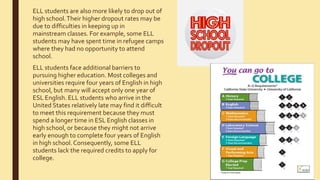
ELL students are also more likely to drop out of
high school.Their higher dropout rates may be
due to difficulties in keeping up in
mainstream classes. For example, some ELL
students may have spent time in refugee camps
where they had no opportunity to attend
school.
ELL students face additional barriers to
pursuing higher education. Most colleges and
universities require four years of English in high
school, but many will accept only one year of
ESL English. ELL students who arrive in the
United States relatively late may find it difficult
to meet this requirement because they must
spend a longer time in ESL English classes in
high school, or because they might not arrive
early enough to complete four years of English
in high school.Consequently, some ELL
students lack the required credits to apply for
college.
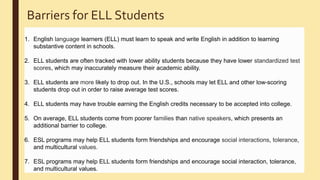
Barriers for ELL Students
1. English language learners (ELL) must learn to speak and write English in addition to learning
substantive content in schools.
2. ELL students are often tracked with lower ability students because they have lower standardized test
scores, which may inaccurately measure their academic ability.
3. ELL students are more likely to drop out. In the U.S., schools may let ELL and other low-scoring
students drop out in order to raise average test scores.
4. ELL students may have trouble earning the English credits necessary to be accepted into college.
5. On average, ELL students come from poorer families than native speakers, which presents an
additional barrier to college.
6. ESL programs may help ELL students form friendships and encourage social interactions, tolerance,
and multicultural values.
7. ESL programs may help ELL students form friendships and encourage social interaction, tolerance,
and multicultural values.

English as a second language

  • 1.
  • 2.
    Learning objective: Describe someof the difficulties and challenges facing ELL students in the U.S.
  • 3.
    Terms  StandardizedTest Scores-A standardized test is a test that is administered and scored in a consistent, or "standard", manner.  Native Speaker-A person who grew up with a particular language as their mother tongue.  Tolerance-The ability or practice of tolerating; an acceptance or patience with the beliefs, opinions or practices of others; a lack of bigotry.
  • 4.
    English as asecond language (ESL), English for speakers of other languages (ESOL) and English as a foreign language (EFL) all refer to the use or study of English by speakers with different native languages.Generally, English Language Learners (ELL) are refugees, immigrants, or their children. They must learn English as a Second Language (ESL) in order to function in their new host country.
  • 5.
    Supporters of ESLprograms claim they play an important role in the formation of peer networks and adjustment to school and society in their new homes. Having class among other students learning English as a second language relieves the pressure of making mistakes when speaking in class or to peers. ESL programs also allow students to meet and form friendships with other non-native speakers from different cultures, promoting racial tolerance and multiculturalism.
  • 6.
  • 7.
    ELL students oftenhave difficulty interacting with native speakers. ELL students may avoid interactions with native speakers because they are frustrated with or embarrassed by their English ability. Immigrant students often also lack knowledge about popular U.S. culture, which limits their conversations with native speakers to academic topics. In classroom group activities with native speakers, ELL students often do not participate, again because of embarrassment of their English. In most mainstream classrooms, teacher-led discussion is the most common form of lesson. In this setting, ELL students will fail to participate, and often have difficulty understanding teachers because they talk too fast, do not use visual aids, or use native colloquialisms. ELL students also have trouble getting involved with extracurricular activities with native speakers for similar reasons. Students fail to join extra-curricular activities because of the language barrier.
  • 8.
    ELL students arealso more likely to drop out of high school.Their higher dropout rates may be due to difficulties in keeping up in mainstream classes. For example, some ELL students may have spent time in refugee camps where they had no opportunity to attend school. ELL students face additional barriers to pursuing higher education. Most colleges and universities require four years of English in high school, but many will accept only one year of ESL English. ELL students who arrive in the United States relatively late may find it difficult to meet this requirement because they must spend a longer time in ESL English classes in high school, or because they might not arrive early enough to complete four years of English in high school.Consequently, some ELL students lack the required credits to apply for college.
  • 9.
    Barriers for ELLStudents 1. English language learners (ELL) must learn to speak and write English in addition to learning substantive content in schools. 2. ELL students are often tracked with lower ability students because they have lower standardized test scores, which may inaccurately measure their academic ability. 3. ELL students are more likely to drop out. In the U.S., schools may let ELL and other low-scoring students drop out in order to raise average test scores. 4. ELL students may have trouble earning the English credits necessary to be accepted into college. 5. On average, ELL students come from poorer families than native speakers, which presents an additional barrier to college. 6. ESL programs may help ELL students form friendships and encourage social interactions, tolerance, and multicultural values. 7. ESL programs may help ELL students form friendships and encourage social interaction, tolerance, and multicultural values.