UNIVERSIDAD TÉCNICA DE AMBATO
FACULTAD DE CIENCIAS HUMANAS Y DE LA
EDUCACIÓN
CARRERA DE IDIOMAS
LESSON PLANNING AND OBSERVATION
VOCABULARY
NAME: ERIKA VACA
SEMESTER: 5 TH
Lingua franca:
/lɪŋɡwə ˈfræŋkə/
Meaning:
A language that is adopted
as a common language
between speakers whose
native languages are
different.
Example: The national language of Zambia is English,
which also serves as the lingua franca.
Functions:
/ˈfʌŋkʃən/
 Meaning: The purpose for which an utterance or unit of
language is used.
Example: syllabus is organized of the different
Language functions the learners need to express or
understand to communicate effectively
Independent users of English:
/ɪndɪˈpɛndənt//yo̅o̅′zər/,/ɒv/ /ˈɪŋɡlɪʃ/
 Meaning: are defined as users
being able to carry on most
conversations, who can write
comprehensibly, they don’t
need help to communicate,
they aren’t highly competent,
but they are adequate to carry
on most functions.
Example: B1 level communicates effectively as
independent users of English.
communicate effectively
/kəˈmjuːnɪˌkeɪt/ /ɪˈfektɪvlɪ/
 Meaning: business conversations and expressing
thoughts of cultural topics, as well as explaining
differences among cultures.
Example: Ecuadorian students are able to communicate
effectively with foreign people.
real time
/ˈrɪəl/ /taɪm/
 Meaning: This calculation has been made considering
the 200 annual hours devoted to the teaching of English,
a deduction of 20 hours for testing, and an additional
deduction of 60 hours (due to 40 mostly and not 60-
minute class periods), thus giving us the real teaching
time of 120 hours.
Example: The system shows the school in real time
(Lightbown & Spada, 2011)
 Meaning: Up to March, 2014, English was an elective subject
from 2nd to 7th year EGB (Acuerdo Ministerial No. 306-11);
therefore, some students must have already been exposed to
the target language by the time they started the 8th year EGB
because the curriculum adjustment here proposed started in
2012. Since March 2014 and through two new Ministerial
Agreements (Acuerdo Ministerial 0041-14 y 0052-14) English
will be a compulsory subject for primary school starting in
2016
Example: Students who began learning English at an
earlier age in programs offering only a few hours a
week of instruction (Lightbown & Spada, 2011)
Components
/kəmˈpoʊnənt/
 Meaning: a constituent part; element. It is worth
mentioning that these components (linguistic,
sociolinguistic, and pragmatic) comprise and are
activated through the development of the four language
skills (listening, speaking, reading, and writing)—
divided in the layout of this document, yet integrated in
practice.
Example: the curriculum has specific objectives for the
components of communicative language competence.
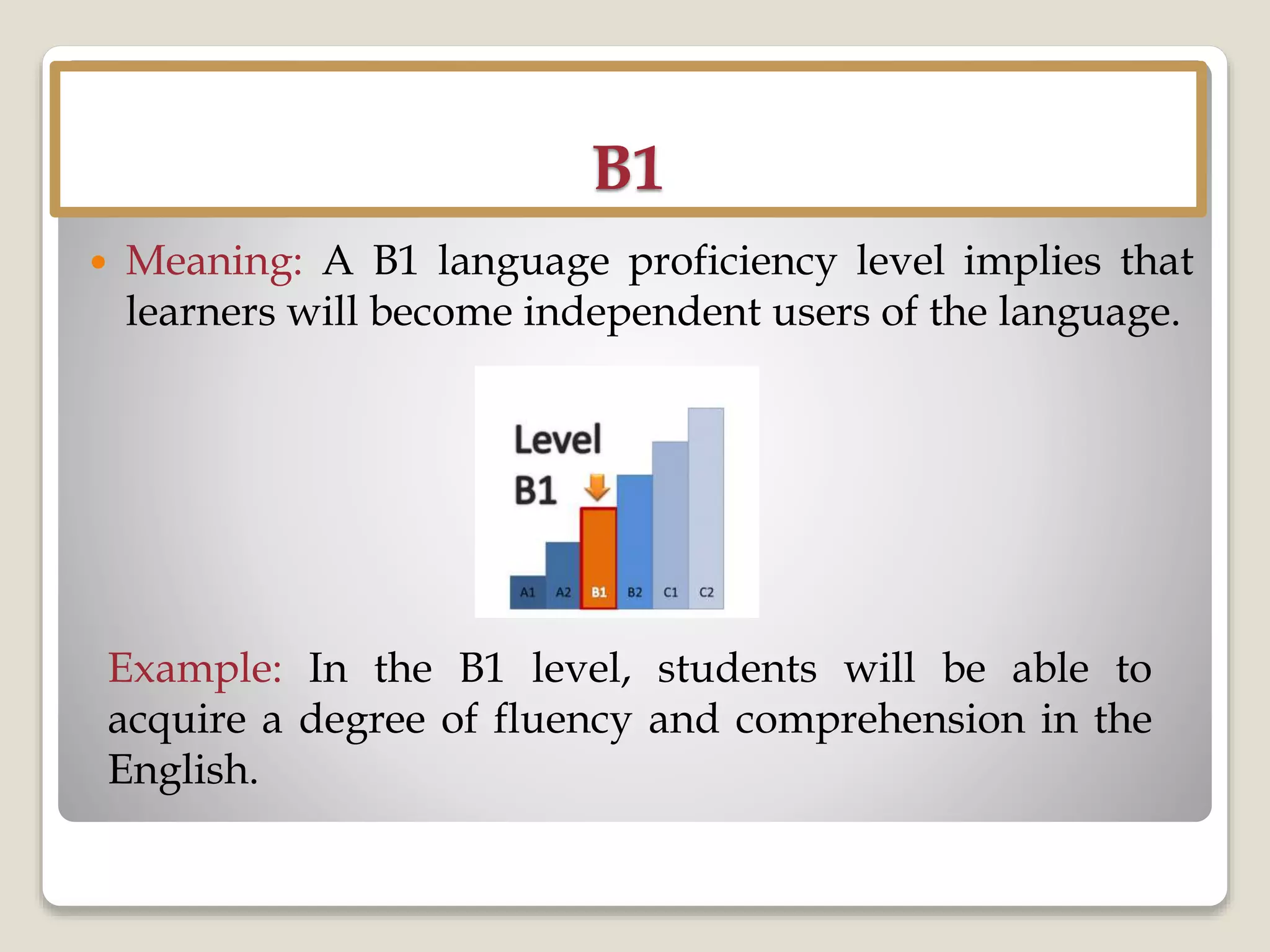
B1
 Meaning: A B1 language proficiency level implies that
learners will become independent users of the language.
Example: In the B1 level, students will be able to
acquire a degree of fluency and comprehension in the
English.
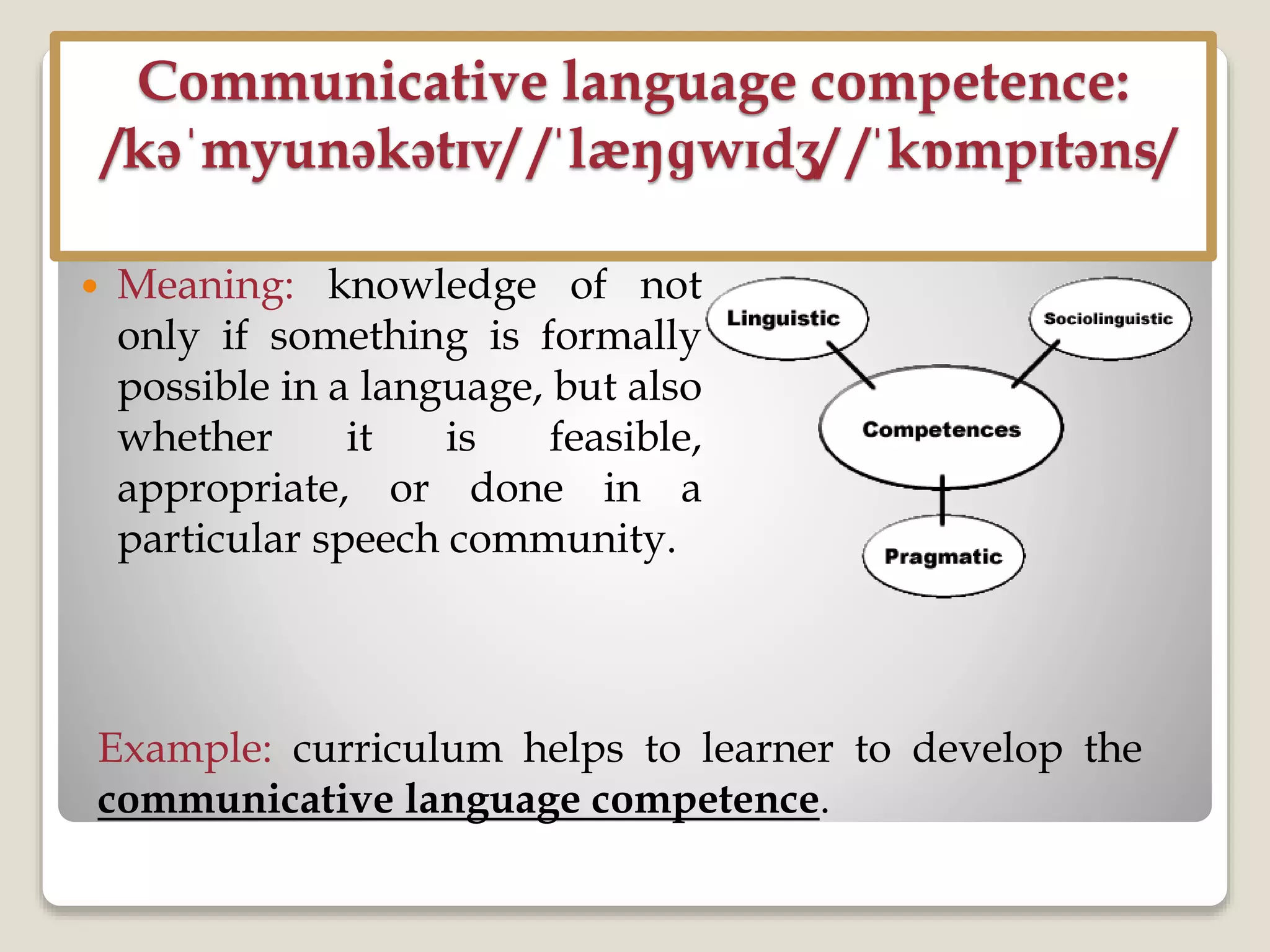
Communicative language competence:
/kəˈmyunəkətɪv/ /ˈlæŋɡwɪdʒ/ /ˈkɒmpɪtəns/
 Meaning: knowledge of not
only if something is formally
possible in a language, but also
whether it is feasible,
appropriate, or done in a
particular speech community.
Example: curriculum helps to learner to develop the
communicative language competence.
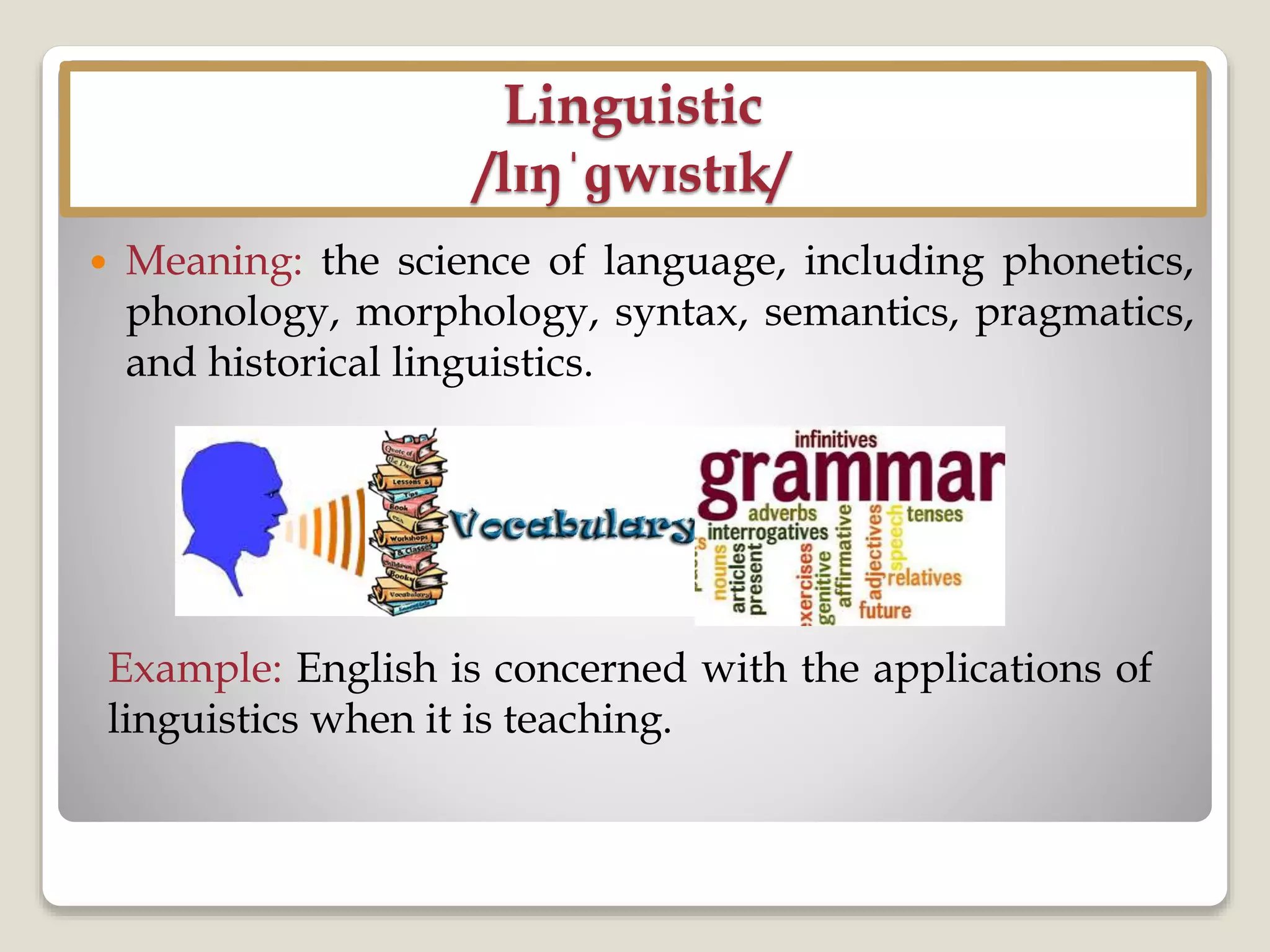
Linguistic
/lɪŋˈɡwɪstɪk/
 Meaning: the science of language, including phonetics,
phonology, morphology, syntax, semantics, pragmatics,
and historical linguistics.
Example: English is concerned with the applications of
linguistics when it is teaching.
Sociolinguistic
/ˌsəʊsɪəʊlɪŋˈgwɪstɪk/
 Meaning: the study of language as it functions in society;
the study of the interaction between linguistic and social
variables.
Example: Sociolinguistics is concerned with language
in social and cultural context.
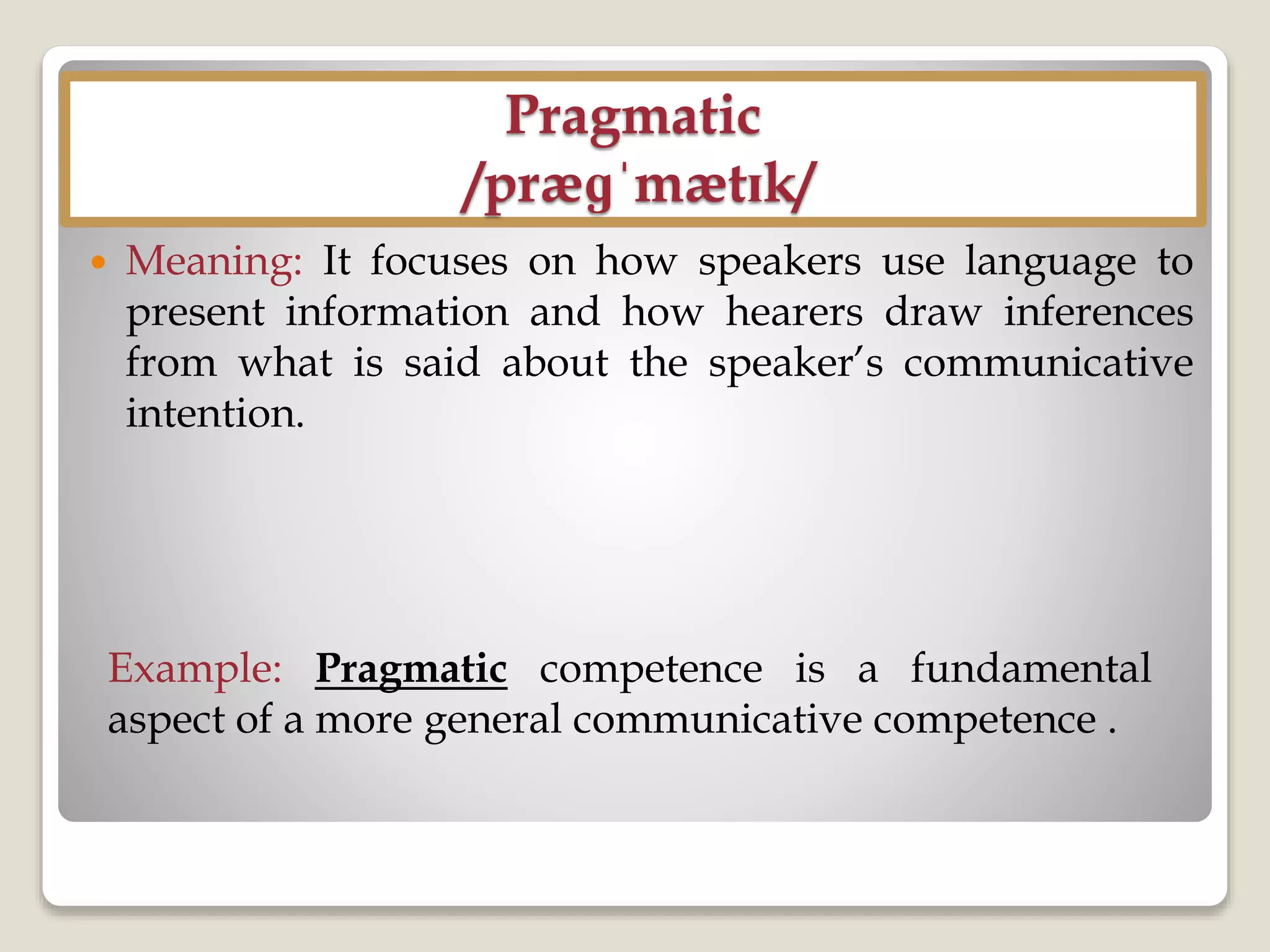
Pragmatic
/præɡˈmætɪk/
 Meaning: It focuses on how speakers use language to
present information and how hearers draw inferences
from what is said about the speaker’s communicative
intention.
Example: Pragmatic competence is a fundamental
aspect of a more general communicative competence .
Exponents
/ɪkˈspoʊnənt/
 Meaning: language items needed for functions or speech
acts such as identifying, describing, inviting, offering.
Example: language Learning use their most common
exponents.
Neutral register
/ˈnjuːtrəl/ /ˈrɛdʒɪstə/
 Meaning: Register refers to the formality or informality
of the language used in particular situations; formal
register is used on a job application. Informal register is
used in relaxed or friendly situations. Therefore, neutral
register refers to language that is neither too formal nor
too informal and is more generally applicable in a
variety of situations.
Example: Can you tell me the time, please?
Informational texts:
/ˌɪnfəˈmeɪʃənl/ /tɛkst/
 Meaning: texts designed to convery information about
something rather than to tell or advance a narrative. They are
characterized by the following features: (1) their primary
purpose is to convey factual information about the natural
and social world, (2) they typically address whole classes of
things in a timeless way and (3) they come in many different
formats (e.g. books, magazines, handouts, brochures, CD
rooms and the internet)
Example: Students write Informational texts
Transactional texts:
/trænˈzækʃənl/ /tɛkst/
 Meaning: are texts that serve for communication of ideas
and information between individuals with text types
that include: business letters, friendly emails, interviews,
invitations, postcards, weblog entries.
Example: Daniela will be able to write transactional
texts.
Expository texts:
/ɪkˈspɒzɪtərɪ/ /tɛkst/
 Meaning: are the ones which inform, describe or explain
something and include autobiographies, short
descriptions, media articles.
Example: Students produce very simple expository
texts.
Personal domain:
/ˈpɜːsənəl/ /dəˈmeɪn/
 Meaning: comprises family relations and individual
social practices.
Example: Learners speak about personal domain.
Educational domain
/ˌɛdjʊˈkeɪʃənəl/ /dəˈmeɪn/
 Meaning: is concerned with the learning context where
the aim is to acquire specific knowledge or skills.
Example: Daniela is going to talk about educational
domain
Public domain:
/ˈpʌblɪk/ /dəˈmeɪn/
 Meaning: refers to everything connected with ordinary
social interaction—e.g. public services, cultural and
leisure activities of public nature, and relations with the
media.
Example: Children will be able to speak about public
domain.
Personal background:
/ˈpɜːsənəl/ /ˈbækˌɡraʊnd/
 Meaning: includes personal identification; house, home,
and environment; daily life; free time and entertainment;
and relations with other people.
Example: this vocabulary is phrases related to their
personal background
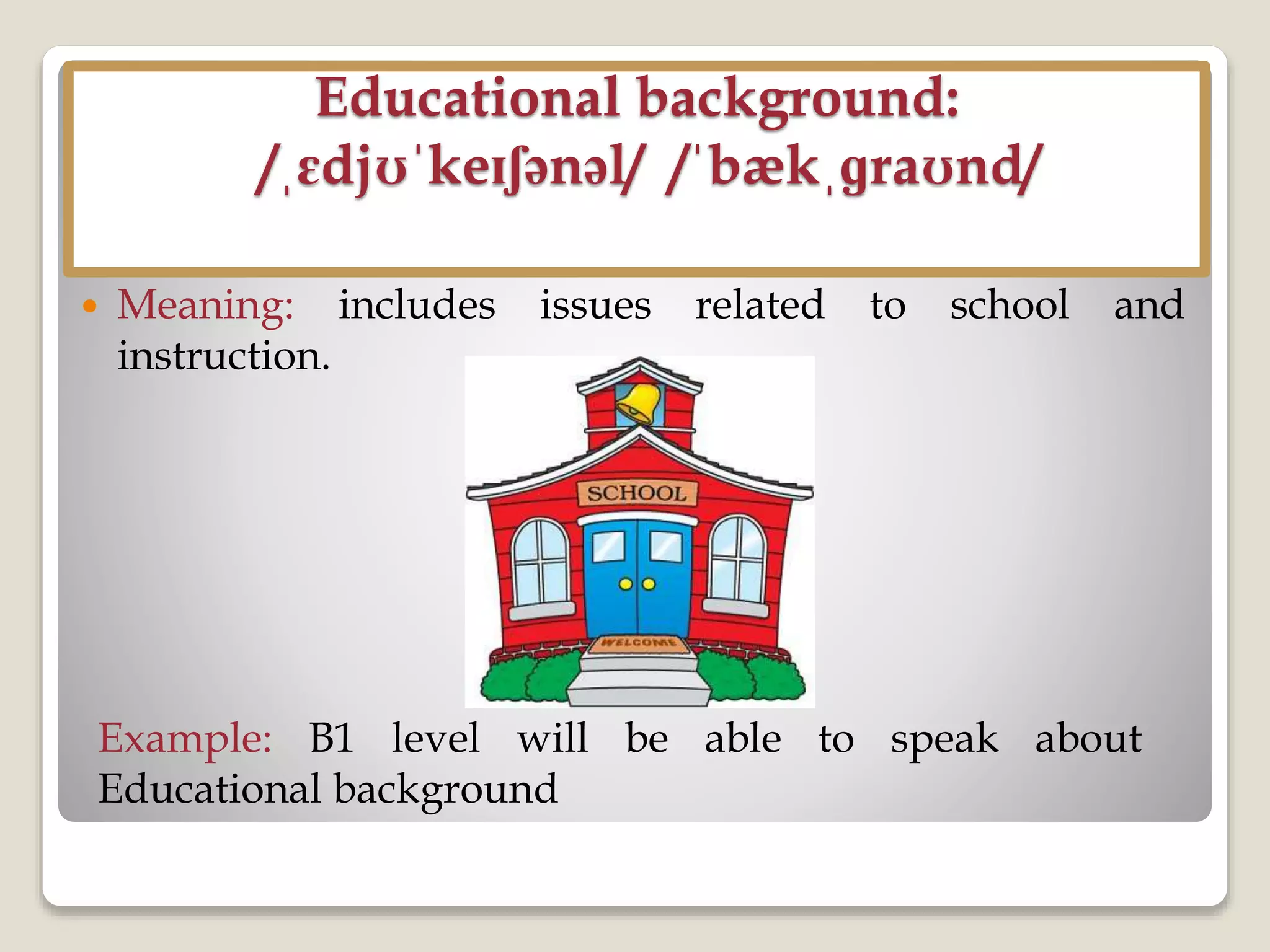
Educational background:
/ˌɛdjʊˈkeɪʃənəl/ /ˈbækˌɡraʊnd/
 Meaning: includes issues related to school and
instruction.
Example: B1 level will be able to speak about
Educational background
Social background
/ˈsəʊʃəl/ /ˈbækˌɡraʊnd/
 Meaning: includes public entertainment, travel, health
and body care, shopping, food and drink, and services
Example: Andres has a basic repertoire of words and
phrases related to his social background.
Backtracking:
/ˈbækˌtræk/
 Meaning: to return by the same route by which one has
come
Example: Teacher decided to backtrack that topic
because students didn't understand.
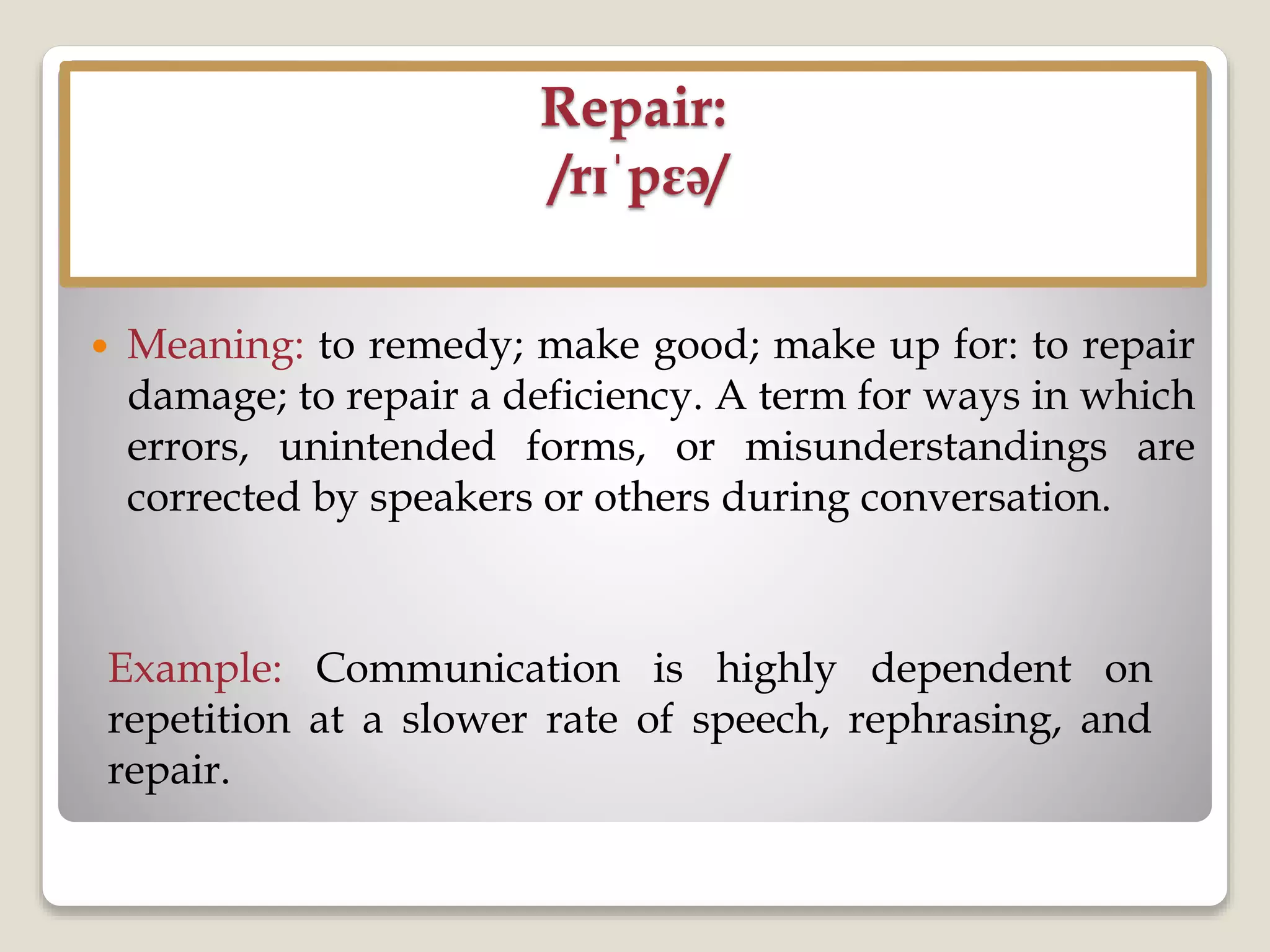
Repair:
/rɪˈpɛə/
 Meaning: to remedy; make good; make up for: to repair
damage; to repair a deficiency. A term for ways in which
errors, unintended forms, or misunderstandings are
corrected by speakers or others during conversation.
Example: Communication is highly dependent on
repetition at a slower rate of speech, rephrasing, and
repair.
Display question:
/dɪˈspleɪ/ /ˈkwɛstʃən/
 Meaning: a question which is not a real question.
 Is this a book? Yes, it’s a book.”
Example: students ask and answer simple display
questions
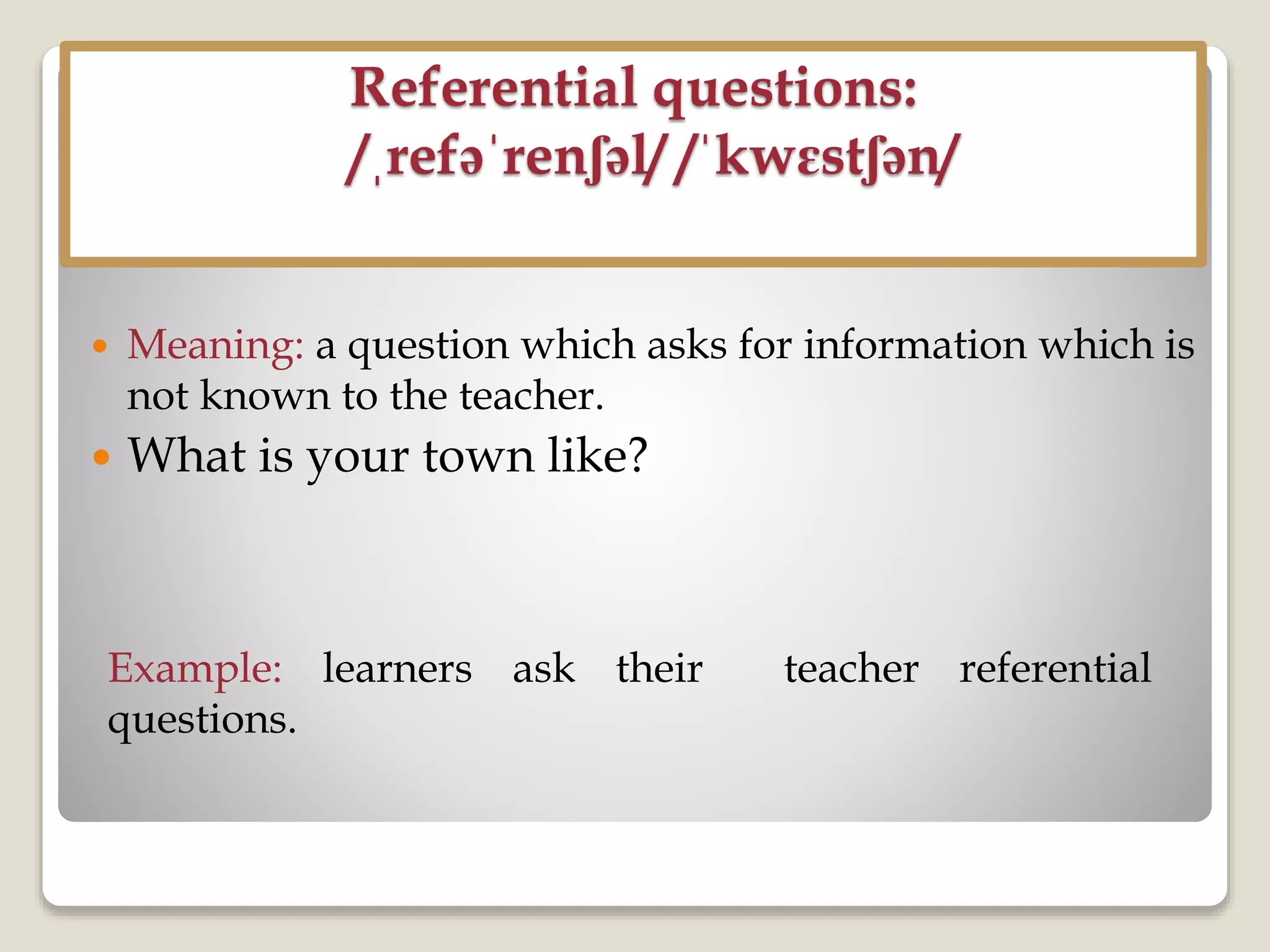
Referential questions:
/ˌrefəˈrenʃəl/ /ˈkwɛstʃən/
 Meaning: a question which asks for information which is
not known to the teacher.
 What is your town like?
Example: learners ask their teacher referential
questions.
Procedural texts:
/prəˈsiːdjʊrəl/ /tɛkst/
 Meaning: a genre of writing that explains the
instructions or directions to complete a task with text
types that include recipes and ‘how to’ instructions.
Example: Danna explains instruction to make a
delicious dish. Then She writes a procedural texts.
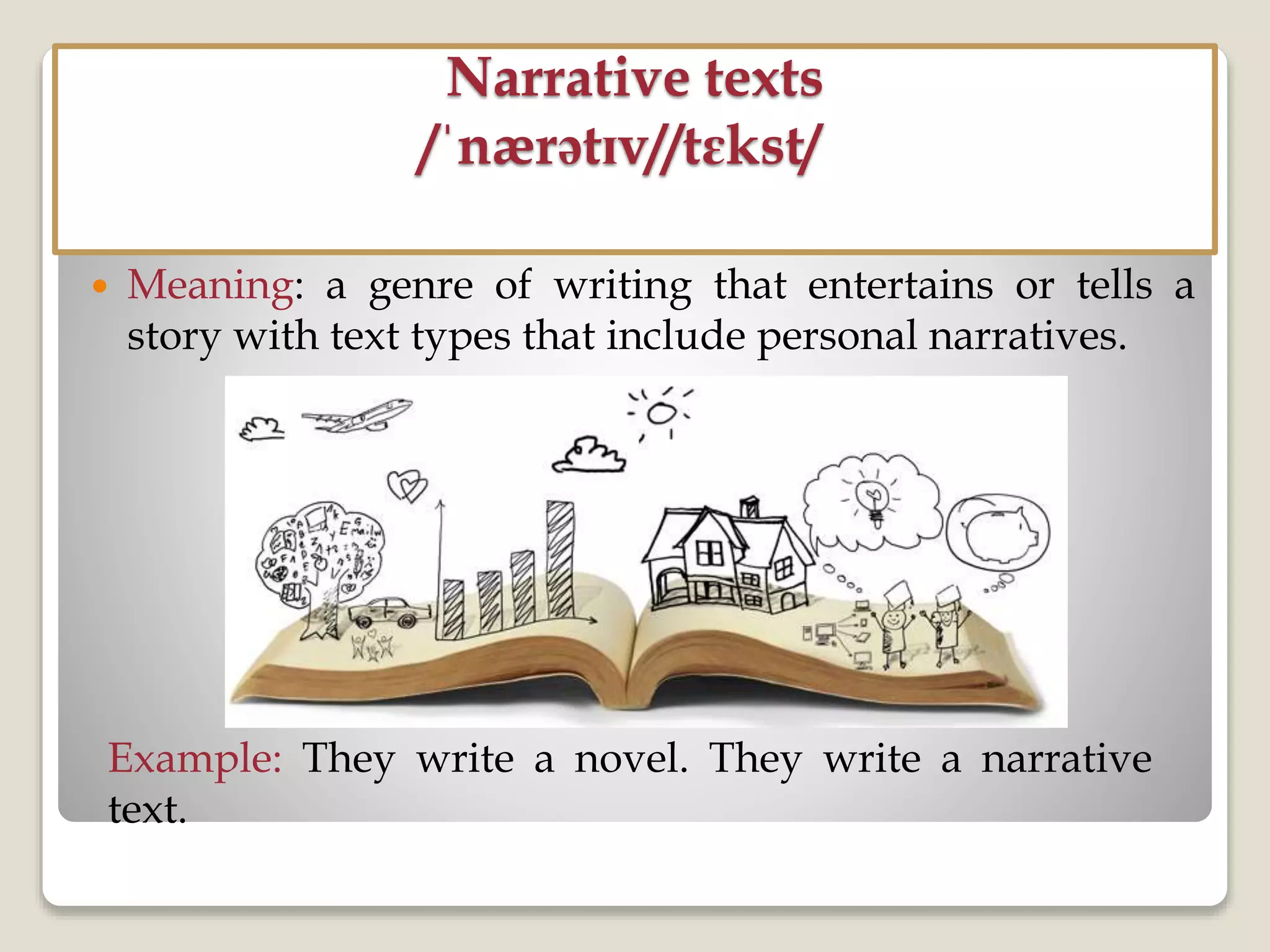
Narrative texts
/ˈnærətɪv//tɛkst/
 Meaning: a genre of writing that entertains or tells a
story with text types that include personal narratives.
Example: They write a novel. They write a narrative
text.
Vocational domain:
/vəʊˈkeɪʃənəl/ /dəˈmeɪn/
 Meaning: it embraces everything concerned with
people’s activities and relations in the exercise of their
occupations.
Example: Teachers are a guide to students who went
through the vocational domain.
Realistic fiction
/ˌrɪəˈlɪstɪk/ /ˈfɪkʃən/
 Meaning: stories based on characters, settings, problems,
events, and solutions that could happen in real life.
Example: We discuss a problem and it is realistic
fiction.
Persuasive texts:
/pəˈsweɪsɪv/ /tɛkst/
 Meaning: a genre of writing that attempts to convince
readers to embrace a particular point of view
Example: Ana sees a movie review in a persuasive text.
Circumlocutions:
/ˌsɝkəmloʊˈkyuʃən/
 Meaning: a roundabout or indirect way of speaking; the
use of more words than necessary to express an idea.
Example: They have sufficient vocabulary to express
themselves with some circumlocutions on topics such
as family, and current events.
Salient politeness conventions:
/ˈseɪlɪənt/ /pəˈlaɪtnɪs/ /kənˈvɛnʃən/
 Meaning: particularly those affecting everyday life,
living conditions, interpersonal relations, and major
values and attitudes.
Example: Students will be aware of salient politeness
conventions of the foreign culture.
Persuasive essays:
/pəˈsweɪsɪv/ / ˈɛseɪ /
 Meaning: In persuasive or argumentative writing, we try
to convince others to agree with our facts, share our
values, accept our argument or conclusions and adopt
our way of thinking.
Example: A1 level won't be able to produce persuasive
essays.
relevant information
/ˈrɛlɪvənt/ /ˌɪnfəˈmeɪʃən/
 Meaning: This may involve determining the audience
for whom the text was produced and the attitudes and
communicative intentions of the author, etc.
Example: In this text, there is relevant information.
Dead ends:
/dɛd/ /ɛnd/
 Meaning: a situation in which no progress can be made
or no advancement is possible;
Example: Reached an impasse on the negotiations. That
business is a dead end.
Jumpiness:
/ˈdʒʌmpi/
 Meaning: subject to sudden, involuntary starts, esp.
from nervousness, fear, excitement, etc.
Example: The long wait is making me jumpy.
Vaca E. flashcards

Vaca E. flashcards

  • 1.
    UNIVERSIDAD TÉCNICA DEAMBATO FACULTAD DE CIENCIAS HUMANAS Y DE LA EDUCACIÓN CARRERA DE IDIOMAS LESSON PLANNING AND OBSERVATION VOCABULARY NAME: ERIKA VACA SEMESTER: 5 TH
  • 2.
    Lingua franca: /lɪŋɡwə ˈfræŋkə/ Meaning: Alanguage that is adopted as a common language between speakers whose native languages are different. Example: The national language of Zambia is English, which also serves as the lingua franca.
  • 3.
    Functions: /ˈfʌŋkʃən/  Meaning: Thepurpose for which an utterance or unit of language is used. Example: syllabus is organized of the different Language functions the learners need to express or understand to communicate effectively
  • 4.
    Independent users ofEnglish: /ɪndɪˈpɛndənt//yo̅o̅′zər/,/ɒv/ /ˈɪŋɡlɪʃ/  Meaning: are defined as users being able to carry on most conversations, who can write comprehensibly, they don’t need help to communicate, they aren’t highly competent, but they are adequate to carry on most functions. Example: B1 level communicates effectively as independent users of English.
  • 5.
    communicate effectively /kəˈmjuːnɪˌkeɪt/ /ɪˈfektɪvlɪ/ Meaning: business conversations and expressing thoughts of cultural topics, as well as explaining differences among cultures. Example: Ecuadorian students are able to communicate effectively with foreign people.
  • 6.
    real time /ˈrɪəl/ /taɪm/ Meaning: This calculation has been made considering the 200 annual hours devoted to the teaching of English, a deduction of 20 hours for testing, and an additional deduction of 60 hours (due to 40 mostly and not 60- minute class periods), thus giving us the real teaching time of 120 hours. Example: The system shows the school in real time
  • 7.
    (Lightbown & Spada,2011)  Meaning: Up to March, 2014, English was an elective subject from 2nd to 7th year EGB (Acuerdo Ministerial No. 306-11); therefore, some students must have already been exposed to the target language by the time they started the 8th year EGB because the curriculum adjustment here proposed started in 2012. Since March 2014 and through two new Ministerial Agreements (Acuerdo Ministerial 0041-14 y 0052-14) English will be a compulsory subject for primary school starting in 2016 Example: Students who began learning English at an earlier age in programs offering only a few hours a week of instruction (Lightbown & Spada, 2011)
  • 8.
    Components /kəmˈpoʊnənt/  Meaning: aconstituent part; element. It is worth mentioning that these components (linguistic, sociolinguistic, and pragmatic) comprise and are activated through the development of the four language skills (listening, speaking, reading, and writing)— divided in the layout of this document, yet integrated in practice. Example: the curriculum has specific objectives for the components of communicative language competence.
  • 9.
    B1  Meaning: AB1 language proficiency level implies that learners will become independent users of the language. Example: In the B1 level, students will be able to acquire a degree of fluency and comprehension in the English.
  • 10.
    Communicative language competence: /kəˈmyunəkətɪv//ˈlæŋɡwɪdʒ/ /ˈkɒmpɪtəns/  Meaning: knowledge of not only if something is formally possible in a language, but also whether it is feasible, appropriate, or done in a particular speech community. Example: curriculum helps to learner to develop the communicative language competence.
  • 11.
    Linguistic /lɪŋˈɡwɪstɪk/  Meaning: thescience of language, including phonetics, phonology, morphology, syntax, semantics, pragmatics, and historical linguistics. Example: English is concerned with the applications of linguistics when it is teaching.
  • 12.
    Sociolinguistic /ˌsəʊsɪəʊlɪŋˈgwɪstɪk/  Meaning: thestudy of language as it functions in society; the study of the interaction between linguistic and social variables. Example: Sociolinguistics is concerned with language in social and cultural context.
  • 13.
    Pragmatic /præɡˈmætɪk/  Meaning: Itfocuses on how speakers use language to present information and how hearers draw inferences from what is said about the speaker’s communicative intention. Example: Pragmatic competence is a fundamental aspect of a more general communicative competence .
  • 14.
    Exponents /ɪkˈspoʊnənt/  Meaning: languageitems needed for functions or speech acts such as identifying, describing, inviting, offering. Example: language Learning use their most common exponents.
  • 15.
    Neutral register /ˈnjuːtrəl/ /ˈrɛdʒɪstə/ Meaning: Register refers to the formality or informality of the language used in particular situations; formal register is used on a job application. Informal register is used in relaxed or friendly situations. Therefore, neutral register refers to language that is neither too formal nor too informal and is more generally applicable in a variety of situations. Example: Can you tell me the time, please?
  • 16.
    Informational texts: /ˌɪnfəˈmeɪʃənl/ /tɛkst/ Meaning: texts designed to convery information about something rather than to tell or advance a narrative. They are characterized by the following features: (1) their primary purpose is to convey factual information about the natural and social world, (2) they typically address whole classes of things in a timeless way and (3) they come in many different formats (e.g. books, magazines, handouts, brochures, CD rooms and the internet) Example: Students write Informational texts
  • 17.
    Transactional texts: /trænˈzækʃənl/ /tɛkst/ Meaning: are texts that serve for communication of ideas and information between individuals with text types that include: business letters, friendly emails, interviews, invitations, postcards, weblog entries. Example: Daniela will be able to write transactional texts.
  • 18.
    Expository texts: /ɪkˈspɒzɪtərɪ/ /tɛkst/ Meaning: are the ones which inform, describe or explain something and include autobiographies, short descriptions, media articles. Example: Students produce very simple expository texts.
  • 19.
    Personal domain: /ˈpɜːsənəl/ /dəˈmeɪn/ Meaning: comprises family relations and individual social practices. Example: Learners speak about personal domain.
  • 20.
    Educational domain /ˌɛdjʊˈkeɪʃənəl/ /dəˈmeɪn/ Meaning: is concerned with the learning context where the aim is to acquire specific knowledge or skills. Example: Daniela is going to talk about educational domain
  • 21.
    Public domain: /ˈpʌblɪk/ /dəˈmeɪn/ Meaning: refers to everything connected with ordinary social interaction—e.g. public services, cultural and leisure activities of public nature, and relations with the media. Example: Children will be able to speak about public domain.
  • 22.
    Personal background: /ˈpɜːsənəl/ /ˈbækˌɡraʊnd/ Meaning: includes personal identification; house, home, and environment; daily life; free time and entertainment; and relations with other people. Example: this vocabulary is phrases related to their personal background
  • 23.
    Educational background: /ˌɛdjʊˈkeɪʃənəl/ /ˈbækˌɡraʊnd/ Meaning: includes issues related to school and instruction. Example: B1 level will be able to speak about Educational background
  • 24.
    Social background /ˈsəʊʃəl/ /ˈbækˌɡraʊnd/ Meaning: includes public entertainment, travel, health and body care, shopping, food and drink, and services Example: Andres has a basic repertoire of words and phrases related to his social background.
  • 25.
    Backtracking: /ˈbækˌtræk/  Meaning: toreturn by the same route by which one has come Example: Teacher decided to backtrack that topic because students didn't understand.
  • 26.
    Repair: /rɪˈpɛə/  Meaning: toremedy; make good; make up for: to repair damage; to repair a deficiency. A term for ways in which errors, unintended forms, or misunderstandings are corrected by speakers or others during conversation. Example: Communication is highly dependent on repetition at a slower rate of speech, rephrasing, and repair.
  • 27.
    Display question: /dɪˈspleɪ/ /ˈkwɛstʃən/ Meaning: a question which is not a real question.  Is this a book? Yes, it’s a book.” Example: students ask and answer simple display questions
  • 28.
    Referential questions: /ˌrefəˈrenʃəl/ /ˈkwɛstʃən/ Meaning: a question which asks for information which is not known to the teacher.  What is your town like? Example: learners ask their teacher referential questions.
  • 29.
    Procedural texts: /prəˈsiːdjʊrəl/ /tɛkst/ Meaning: a genre of writing that explains the instructions or directions to complete a task with text types that include recipes and ‘how to’ instructions. Example: Danna explains instruction to make a delicious dish. Then She writes a procedural texts.
  • 30.
    Narrative texts /ˈnærətɪv//tɛkst/  Meaning:a genre of writing that entertains or tells a story with text types that include personal narratives. Example: They write a novel. They write a narrative text.
  • 31.
    Vocational domain: /vəʊˈkeɪʃənəl/ /dəˈmeɪn/ Meaning: it embraces everything concerned with people’s activities and relations in the exercise of their occupations. Example: Teachers are a guide to students who went through the vocational domain.
  • 32.
    Realistic fiction /ˌrɪəˈlɪstɪk/ /ˈfɪkʃən/ Meaning: stories based on characters, settings, problems, events, and solutions that could happen in real life. Example: We discuss a problem and it is realistic fiction.
  • 33.
    Persuasive texts: /pəˈsweɪsɪv/ /tɛkst/ Meaning: a genre of writing that attempts to convince readers to embrace a particular point of view Example: Ana sees a movie review in a persuasive text.
  • 34.
    Circumlocutions: /ˌsɝkəmloʊˈkyuʃən/  Meaning: aroundabout or indirect way of speaking; the use of more words than necessary to express an idea. Example: They have sufficient vocabulary to express themselves with some circumlocutions on topics such as family, and current events.
  • 35.
    Salient politeness conventions: /ˈseɪlɪənt//pəˈlaɪtnɪs/ /kənˈvɛnʃən/  Meaning: particularly those affecting everyday life, living conditions, interpersonal relations, and major values and attitudes. Example: Students will be aware of salient politeness conventions of the foreign culture.
  • 36.
    Persuasive essays: /pəˈsweɪsɪv/ /ˈɛseɪ /  Meaning: In persuasive or argumentative writing, we try to convince others to agree with our facts, share our values, accept our argument or conclusions and adopt our way of thinking. Example: A1 level won't be able to produce persuasive essays.
  • 37.
    relevant information /ˈrɛlɪvənt/ /ˌɪnfəˈmeɪʃən/ Meaning: This may involve determining the audience for whom the text was produced and the attitudes and communicative intentions of the author, etc. Example: In this text, there is relevant information.
  • 38.
    Dead ends: /dɛd/ /ɛnd/ Meaning: a situation in which no progress can be made or no advancement is possible; Example: Reached an impasse on the negotiations. That business is a dead end.
  • 39.
    Jumpiness: /ˈdʒʌmpi/  Meaning: subjectto sudden, involuntary starts, esp. from nervousness, fear, excitement, etc. Example: The long wait is making me jumpy.