Achieving the
                Common Core
Understanding the K-12 Common Core State Standards
in English Language Arts and Literacy in History/Social
Studies, Science, and Technical Subjects

                The K–12 Common Core State Standards in English Language Arts and Literacy in History/Social
                Studies, Science, and Technical Subjects are the result of a collaborative effort between state depart-
                ments of education, teachers, experts in a wide array of fields, and professional organizations. The
                standards establish specific K-12 grade-by-grade standards (and grade spans in high school) in reading,
                writing, speaking and listening, and language with a steady progression of development leading to
                college and career readiness by the end of high school.
                The standards are grounded in evidence, including the best work of states and high-performing
                nations, frameworks developed for the National Assessment of Educational Progress (NAEP), academic
                research, curriculum surveys, assessment data on college- and career-ready performance, and input
                from educators at all levels and from a variety of subjects. High points include:


                Reading


                The standards establish a “staircase” of increasing complexity in what students must be able to read so
                that all students are ready for the demands of college- and career-level reading no later than the end of
                high school. The standards also require the progressive development of reading comprehension so that
                students advancing through the grades are able to gain more from whatever they are reading.
                Through reading a diverse array of classic and contemporary literature as well as challenging informa-
                tional texts in a range of subjects, students are expected to build knowledge, gain insights, explore
                possibilities, and broaden their perspectives. The standards intentionally do not offer a reading list, leav-
                ing this matter to states and/or districts, but they do offer numerous illustrative texts suggestive of the
                kinds of high-quality, increasingly-complex texts from a wide variety of disciplines that students must
                encounter each year.
                The standards avoid the “content-versus-skills” debate by recognizing that both are essential and
                neither is sufficient. The standards require certain critical types of texts for all students, including classic
                myths and stories from around the world, informational and technical texts, foundational U.S. docu-
                ments, seminal works of American literature, and the writings of Shakespeare. The standards appropri-
                ately defer the many remaining decisions about what and how to teach to states, districts, and schools.


                Writing


                The ability to write logical arguments based on substantive claims, sound reasoning, and relevant
                evidence is a cornerstone of the writing standards, with opinion writing—a basic form of argument—
                extending down into the earliest grades.
                Research—both short, focused projects (such as those commonly required in the workplace) and
                sustained inquiry—is emphasized throughout the standards but most prominently in the writing strand
                since written analysis and presentation of findings are critical in both college and careers. Annotated
                samples of student writing accompany the standards and help establish clear performance levels in
                writing arguments, informational/explanatory texts, and narratives in the various grades.


            1775 Eye Street NW   • Suite 410 • Washington, DC 20006 • Phone (202) 419-1540 • www.achieve.org
                                                        © June 2010
Achieving the
                Common Core

                Speaking and Listening


                The standards require that students be able to gain, evaluate, and present increasingly-complex infor-
                mation, ideas, and evidence through listening and speaking as well as through a wide range of media.
                An important focus of the speaking and listening standards is purposeful speaking and listening in
                various academic settings—including one-on-one, small-group, and whole-classroom. Formal presenta-
                tions are one important way such communication occurs, but so are the more informal discussions that
                take place as students collaborate to answer questions, build understanding, and solve problems.


                Language


                The vocabulary standards require that students be able to determine word meanings, identify the
                nuances of words, and steadily expand their repertoire of words and phrases, particularly those impor-
                tant to academic discourse. The standards expect that students will grow their vocabularies through a
                mix of conversations, direct instruction, and reading.
                Standards for conventions (grammar, usage, punctuation, capitalization, and spelling) and language
                choice recognize that students must be able to use formal English in their writing and speaking but that
                they must also be able to make informed, skillful choices among the many ways to express themselves
                in a variety of contexts.
                Vocabulary and conventions are treated in their own strand not because skills in these areas should be
                handled in isolation but because their use extends across reading, writing, speaking, and listening.


                Media and Technology


                Rather than be set off in a separate section, skills related to media and technology (both critical
                analysis and production of media) are integrated throughout the ELA and Literacy in History/Social
                Studies, Science, and Technical Subjects standards.


                Literacy Standards in History/Social Studies, Science and Technical Subjects

                Starting in grade 6, the reading and writing standards are divided into two sections, one focusing
                on ELA, and the other focusing on history/social studies, science, and technical subjects. This divi-
                sion reflects the role both English teachers and teachers in other content areas play in developing the
                literacy skills students need for success in college and careers. Individuals in college, workforce training
                programs and the workplace will be expected to read demanding informational texts and to write infor-
                mational and explanatory texts with clarity and coherence. These standards outline the literacy skills
                necessary to prepare students for those future challenges.


                      Achieve is a bipartisan, nonprofit education reform organization that has worked with states,
                      individually and through the 35-state American Diploma Project, for over a decade to ensure that state
                      K-12 standards, graduation requirements, assessments and accountability systems are calibrated to
                      graduate students from high school ready for college, careers and life. Achieve has partnered with NGA
                      and CCSSO on the Common Core State Standards Initiative and a number of its staff and consultants
                      served on writing and review teams. For more information about Achieve, see www.achieve.org


            1775 Eye Street NW   • Suite 410 • Washington, DC 20006 • Phone (202) 419-1540 • www.achieve.org
                                                        © June 2010

Achieving Success with Common Core ELA

  • 1.
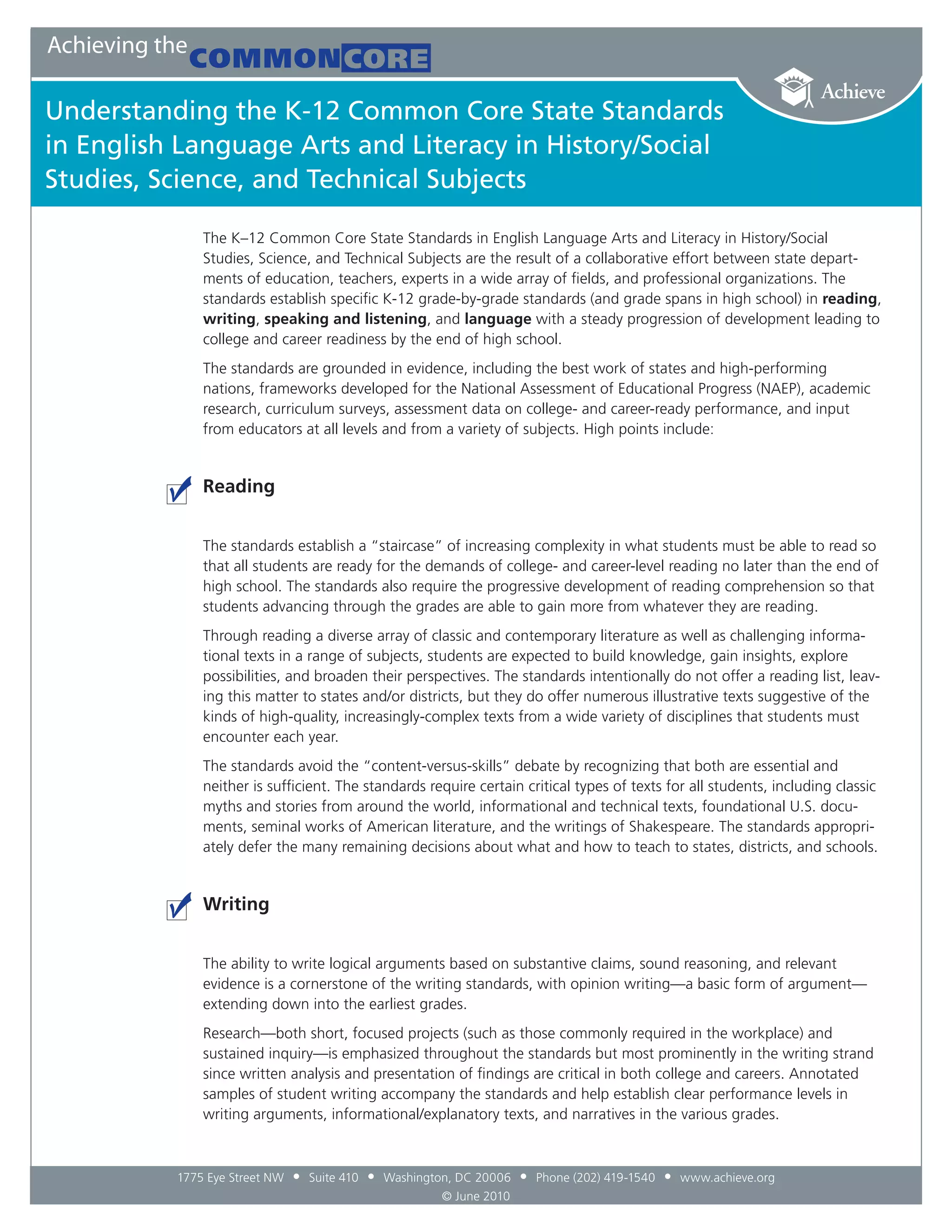
    Achieving the Common Core Understanding the K-12 Common Core State Standards in English Language Arts and Literacy in History/Social Studies, Science, and Technical Subjects The K–12 Common Core State Standards in English Language Arts and Literacy in History/Social Studies, Science, and Technical Subjects are the result of a collaborative effort between state depart- ments of education, teachers, experts in a wide array of fields, and professional organizations. The standards establish specific K-12 grade-by-grade standards (and grade spans in high school) in reading, writing, speaking and listening, and language with a steady progression of development leading to college and career readiness by the end of high school. The standards are grounded in evidence, including the best work of states and high-performing nations, frameworks developed for the National Assessment of Educational Progress (NAEP), academic research, curriculum surveys, assessment data on college- and career-ready performance, and input from educators at all levels and from a variety of subjects. High points include: Reading The standards establish a “staircase” of increasing complexity in what students must be able to read so that all students are ready for the demands of college- and career-level reading no later than the end of high school. The standards also require the progressive development of reading comprehension so that students advancing through the grades are able to gain more from whatever they are reading. Through reading a diverse array of classic and contemporary literature as well as challenging informa- tional texts in a range of subjects, students are expected to build knowledge, gain insights, explore possibilities, and broaden their perspectives. The standards intentionally do not offer a reading list, leav- ing this matter to states and/or districts, but they do offer numerous illustrative texts suggestive of the kinds of high-quality, increasingly-complex texts from a wide variety of disciplines that students must encounter each year. The standards avoid the “content-versus-skills” debate by recognizing that both are essential and neither is sufficient. The standards require certain critical types of texts for all students, including classic myths and stories from around the world, informational and technical texts, foundational U.S. docu- ments, seminal works of American literature, and the writings of Shakespeare. The standards appropri- ately defer the many remaining decisions about what and how to teach to states, districts, and schools. Writing The ability to write logical arguments based on substantive claims, sound reasoning, and relevant evidence is a cornerstone of the writing standards, with opinion writing—a basic form of argument— extending down into the earliest grades. Research—both short, focused projects (such as those commonly required in the workplace) and sustained inquiry—is emphasized throughout the standards but most prominently in the writing strand since written analysis and presentation of findings are critical in both college and careers. Annotated samples of student writing accompany the standards and help establish clear performance levels in writing arguments, informational/explanatory texts, and narratives in the various grades. 1775 Eye Street NW • Suite 410 • Washington, DC 20006 • Phone (202) 419-1540 • www.achieve.org © June 2010
  • 2.
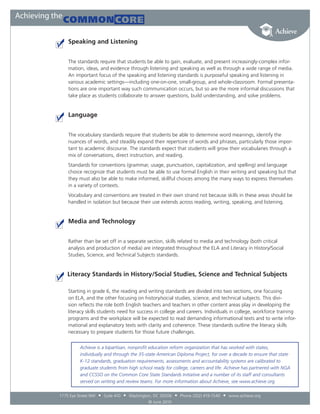
    Achieving the Common Core Speaking and Listening The standards require that students be able to gain, evaluate, and present increasingly-complex infor- mation, ideas, and evidence through listening and speaking as well as through a wide range of media. An important focus of the speaking and listening standards is purposeful speaking and listening in various academic settings—including one-on-one, small-group, and whole-classroom. Formal presenta- tions are one important way such communication occurs, but so are the more informal discussions that take place as students collaborate to answer questions, build understanding, and solve problems. Language The vocabulary standards require that students be able to determine word meanings, identify the nuances of words, and steadily expand their repertoire of words and phrases, particularly those impor- tant to academic discourse. The standards expect that students will grow their vocabularies through a mix of conversations, direct instruction, and reading. Standards for conventions (grammar, usage, punctuation, capitalization, and spelling) and language choice recognize that students must be able to use formal English in their writing and speaking but that they must also be able to make informed, skillful choices among the many ways to express themselves in a variety of contexts. Vocabulary and conventions are treated in their own strand not because skills in these areas should be handled in isolation but because their use extends across reading, writing, speaking, and listening. Media and Technology Rather than be set off in a separate section, skills related to media and technology (both critical analysis and production of media) are integrated throughout the ELA and Literacy in History/Social Studies, Science, and Technical Subjects standards. Literacy Standards in History/Social Studies, Science and Technical Subjects Starting in grade 6, the reading and writing standards are divided into two sections, one focusing on ELA, and the other focusing on history/social studies, science, and technical subjects. This divi- sion reflects the role both English teachers and teachers in other content areas play in developing the literacy skills students need for success in college and careers. Individuals in college, workforce training programs and the workplace will be expected to read demanding informational texts and to write infor- mational and explanatory texts with clarity and coherence. These standards outline the literacy skills necessary to prepare students for those future challenges. Achieve is a bipartisan, nonprofit education reform organization that has worked with states, individually and through the 35-state American Diploma Project, for over a decade to ensure that state K-12 standards, graduation requirements, assessments and accountability systems are calibrated to graduate students from high school ready for college, careers and life. Achieve has partnered with NGA and CCSSO on the Common Core State Standards Initiative and a number of its staff and consultants served on writing and review teams. For more information about Achieve, see www.achieve.org 1775 Eye Street NW • Suite 410 • Washington, DC 20006 • Phone (202) 419-1540 • www.achieve.org © June 2010