NEIU19
Fall 2013
• Background of PA Core

Agenda

•
•
•

Standards
Brief overview of Teacher
Effectiveness
PA Core ELA Shifts
PA Academic Standards for
ELA
•
•
•

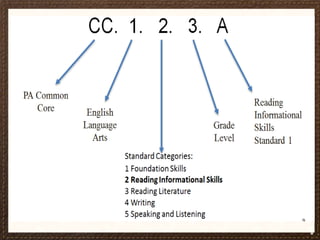
1.2 Reading Informational Text
1.3 Reading Literature
Text Complexity
*
*
CC Intro
– Initiated in 1996 by the National Governors
Association (NGA) and Council of Chief State
School Officers (CCSSO)

Core State
Standards

– Result in College and Career Readiness

• Are students leaving schools with the
content and skills they need?
– Developed in collaboration with teachers, school
administrators, and experts and informed by
other top performing countries

– Fewer, Higher and Clearer Expectations
– 87% of PA Academic Standards are moderately
or very strongly aligned to Common Core
Standards
*
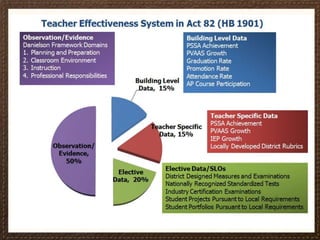
Teacher
Effectiveness:
TheDanielson
Framework

Beginning 2013-14, teacher evaluations will be based on
classroom observations by principal/supervisor including
evidence that demonstrates behaviors associated with
improving student achievement:
●

Planning and preparation, including selecting standards-based
lesson goals and designing effective instruction and assessment

●

Classroom environment, including establishing a culture for
learning and appropriate classroom management techniques
that maximize instructional time

●

Instruction, including the use of research-based strategies
which engage students in meaningful learning and utilize
assessment results to make decisions abut student needs

●

Professional responsibilities, including using systems for
managing student data and communicating with student
families
PA Assessment Information
Pennsylvania
Academic
Standards
for ELA

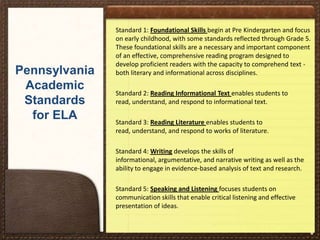
Standard 1: Foundational Skills begin at Pre Kindergarten and focus
on early childhood, with some standards reflected through Grade 5.
These foundational skills are a necessary and important component
of an effective, comprehensive reading program designed to
develop proficient readers with the capacity to comprehend text both literary and informational across disciplines.
Standard 2: Reading Informational Text enables students to
read, understand, and respond to informational text.
Standard 3: Reading Literature enables students to
read, understand, and respond to works of literature.
Standard 4: Writing develops the skills of
informational, argumentative, and narrative writing as well as the
ability to engage in evidence-based analysis of text and research.
Standard 5: Speaking and Listening focuses students on
communication skills that enable critical listening and effective
presentation of ideas.

*
*
How are the
Assessment
Anchors
organized?
5 ELA/Literacy Shifts

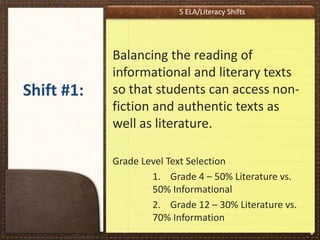
Shift #1:

Balancing the reading of
informational and literary texts
so that students can access nonfiction and authentic texts as
well as literature.
Grade Level Text Selection
1. Grade 4 – 50% Literature vs.
50% Informational
2. Grade 12 – 30% Literature vs.
70% Information
*
5 ELA/Literacy Shifts

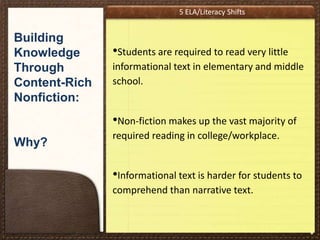
Building
Knowledge
Through
Content-Rich
Nonfiction:

•Students are required to read very little
informational text in elementary and middle
school.

•Non-fiction makes up the vast majority of
Why?

required reading in college/workplace.

•Informational text is harder for students to
comprehend than narrative text.

*
5 ELA/Literacy Shifts

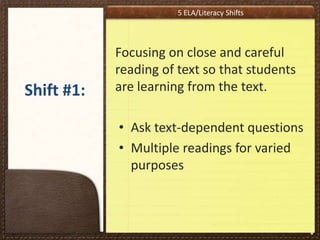
Shift #1:

Focusing on close and careful
reading of text so that students
are learning from the text.
• Ask text-dependent questions
• Multiple readings for varied
purposes

*
5 ELA/Literacy Shifts

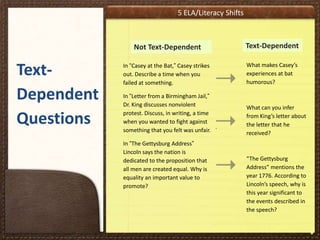
Not Text-Dependent

TextDependent
Questions

Text-Dependent

In “Casey at the Bat,” Casey strikes
out. Describe a time when you
failed at something.

What makes Casey’s
experiences at bat
humorous?

In “Letter from a Birmingham Jail,”
Dr. King discusses nonviolent
protest. Discuss, in writing, a time
when you wanted to fight against
something that you felt was unfair.

What can you infer
from King’s letter about
the letter that he
received?

In “The Gettysburg Address”
Lincoln says the nation is
dedicated to the proposition that
all men are created equal. Why is
equality an important value to
promote?

“The Gettysburg
Address” mentions the
year 1776. According to
Lincoln’s speech, why is
this year significant to
the events described in
the speech?

*
5 ELA/Literacy Shifts

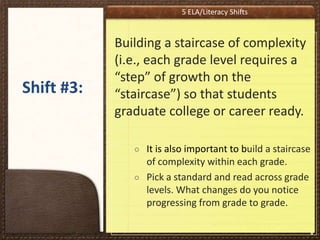
Shift #3:

Building a staircase of complexity
(i.e., each grade level requires a
“step” of growth on the
“staircase”) so that students
graduate college or career ready.
○ It is also important to build a staircase

of complexity within each grade.
○ Pick a standard and read across grade
levels. What changes do you notice
progressing from grade to grade.
*
5 ELA/Literacy Shifts

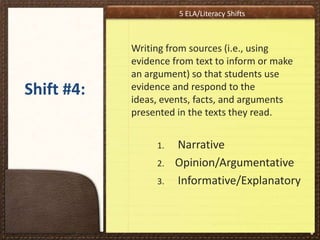
Shift #4:

Writing from sources (i.e., using
evidence from text to inform or make
an argument) so that students use
evidence and respond to the
ideas, events, facts, and arguments
presented in the texts they read.
1.
2.
3.

Narrative
Opinion/Argumentative
Informative/Explanatory

*
5 ELA/Literacy Shifts

Shift #5:

Stressing an academically
focused vocabulary so
that students can access
more complex texts.

*
Research
Behind
Vocabulary
Instruction

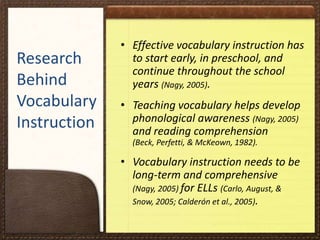
• Effective vocabulary instruction has
to start early, in preschool, and
continue throughout the school
years (Nagy, 2005).
• Teaching vocabulary helps develop
phonological awareness (Nagy, 2005)
and reading comprehension
(Beck, Perfetti, & McKeown, 1982).

• Vocabulary instruction needs to be
long-term and comprehensive
(Nagy, 2005) for ELLs (Carlo, August, &
Snow, 2005; Calderón et al., 2005).
More
Research

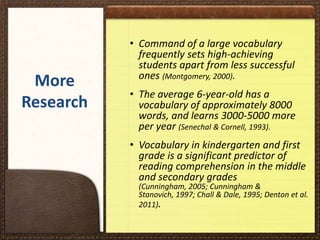
• Command of a large vocabulary
frequently sets high-achieving
students apart from less successful
ones (Montgomery, 2000).
• The average 6-year-old has a
vocabulary of approximately 8000
words, and learns 3000-5000 more
per year (Senechal & Cornell, 1993).
• Vocabulary in kindergarten and first
grade is a significant predictor of
reading comprehension in the middle
and secondary grades

(Cunningham, 2005; Cunningham &
Stanovich, 1997; Chall & Dale, 1995; Denton et al.
2011).
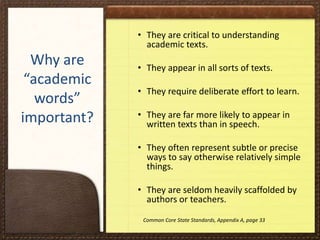
• They are critical to understanding
academic texts.

Why are
“academic
words”
important?

• They appear in all sorts of texts.
• They require deliberate effort to learn.
• They are far more likely to appear in
written texts than in speech.
• They often represent subtle or precise
ways to say otherwise relatively simple
things.

• They are seldom heavily scaffolded by
authors or teachers.
Common Core State Standards, Appendix A, page 33
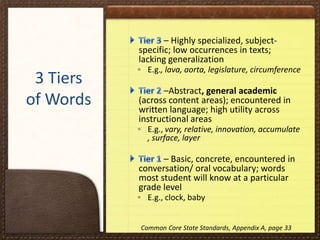
– Highly specialized, subjectspecific; low occurrences in texts;
lacking generalization

3 Tiers
of Words

◦ E.g., lava, aorta, legislature, circumference

–Abstract, general academic
(across content areas); encountered in
written language; high utility across
instructional areas

◦ E.g., vary, relative, innovation, accumulate
, surface, layer

– Basic, concrete, encountered in
conversation/ oral vocabulary; words
most student will know at a particular
grade level

◦ E.g., clock, baby

Common Core State Standards, Appendix A, page 33
Choosing words

• Joe interceded in his friends’
dispute.
• Which word would you choose to
pre-teach?
Which word?
Determining whether a word is a
word. Ask yourself…
• is this a generally useful word?
• does the word relate to other words and
ideas that students know or have been
learning?
• is the word useful in helping students
understand text?
• If the answer is ‘yes’ to all three
questions, the word is likely a Tier 2 word.
If not… probably a Tier 3 word.
interceded
Why?
• Verbs are where the action is
–
–
–
–

Teach intercede and other ‘inter’ words…
Likely to see it again in grade-level text
Likely to see it on assessments
We are going to start calling these useful words
“Tier 2 words”
Step by Step Vocabulary
Instruction
For Tier 2 words

1. Read the story/text.

2. Contextualize the word.

3. Have the students say the word.
4. Provide student friendly definition.
5. Give an example in another context.
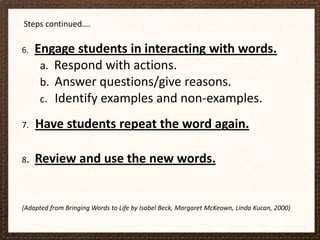
Steps continued….
6.

Engage students in interacting with words.
a. Respond with actions.
b. Answer questions/give reasons.
c. Identify examples and non-examples.

7.

Have students repeat the word again.

8.

Review and use the new words.

(Adapted from Bringing Words to Life by Isabel Beck, Margaret McKeown, Linda Kucan, 2000)
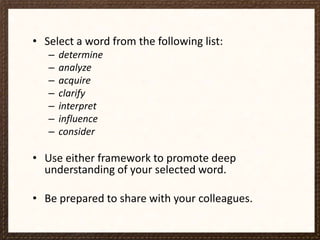
Your turn…

• Select a word from the following list:
–
–
–
–
–
–
–

determine
analyze
acquire
clarify
interpret
influence
consider

• Use either framework to promote deep
understanding of your selected word.
• Be prepared to share with your colleagues.
Standard 1.2
Activity
Time!

Reading
Informational
Text
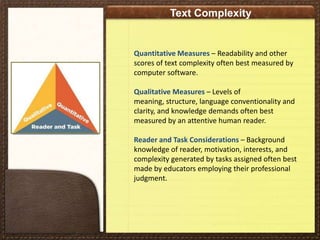
Text Complexity

Quantitative Measures – Readability and other
scores of text complexity often best measured by
computer software.
Qualitative Measures – Levels of
meaning, structure, language conventionality and
clarity, and knowledge demands often best
measured by an attentive human reader.
Reader and Task Considerations – Background
knowledge of reader, motivation, interests, and
complexity generated by tasks assigned often best
made by educators employing their professional
judgment.
Standard 1.3
Reading
Literature
Activity

• In your grade level, familiarize yourself
with the skills in standard 1.3.

• Watch America Achieves: The Lottery
and look for skills this lesson addressed.
• Choose a poem from the text exemplars
(Appendix B) and create a lesson plan
which incorporates at least three
common core skills in standard 1.3.

Present your lessons!

*
Visit the PDE SAS Website

Where can I
find more
information?

–

–

Select Standards
Select Common Core

Pinterest.com/ceceliamecca
Cecelia Mecca, PhD cmecca@iu19.org
Mary Lou Heron mheron@iu19.org
Mike Zwanch mzwanch@iu19.org

*

Introduction to ELA/Literacy PA Core Standards, Grades 9-12

  • 1.
  • 2.
    • Background ofPA Core Agenda • • • Standards Brief overview of Teacher Effectiveness PA Core ELA Shifts PA Academic Standards for ELA • • • 1.2 Reading Informational Text 1.3 Reading Literature Text Complexity *
  • 3.
  • 4.
  • 5.
    – Initiated in1996 by the National Governors Association (NGA) and Council of Chief State School Officers (CCSSO) Core State Standards – Result in College and Career Readiness • Are students leaving schools with the content and skills they need? – Developed in collaboration with teachers, school administrators, and experts and informed by other top performing countries – Fewer, Higher and Clearer Expectations – 87% of PA Academic Standards are moderately or very strongly aligned to Common Core Standards *
  • 7.
    Teacher Effectiveness: TheDanielson Framework Beginning 2013-14, teacherevaluations will be based on classroom observations by principal/supervisor including evidence that demonstrates behaviors associated with improving student achievement: ● Planning and preparation, including selecting standards-based lesson goals and designing effective instruction and assessment ● Classroom environment, including establishing a culture for learning and appropriate classroom management techniques that maximize instructional time ● Instruction, including the use of research-based strategies which engage students in meaningful learning and utilize assessment results to make decisions abut student needs ● Professional responsibilities, including using systems for managing student data and communicating with student families PA Assessment Information
  • 9.
    Pennsylvania Academic Standards for ELA Standard 1:Foundational Skills begin at Pre Kindergarten and focus on early childhood, with some standards reflected through Grade 5. These foundational skills are a necessary and important component of an effective, comprehensive reading program designed to develop proficient readers with the capacity to comprehend text both literary and informational across disciplines. Standard 2: Reading Informational Text enables students to read, understand, and respond to informational text. Standard 3: Reading Literature enables students to read, understand, and respond to works of literature. Standard 4: Writing develops the skills of informational, argumentative, and narrative writing as well as the ability to engage in evidence-based analysis of text and research. Standard 5: Speaking and Listening focuses students on communication skills that enable critical listening and effective presentation of ideas. *
  • 10.
  • 11.
  • 13.
    5 ELA/Literacy Shifts Shift#1: Balancing the reading of informational and literary texts so that students can access nonfiction and authentic texts as well as literature. Grade Level Text Selection 1. Grade 4 – 50% Literature vs. 50% Informational 2. Grade 12 – 30% Literature vs. 70% Information *
  • 14.
    5 ELA/Literacy Shifts Building Knowledge Through Content-Rich Nonfiction: •Studentsare required to read very little informational text in elementary and middle school. •Non-fiction makes up the vast majority of Why? required reading in college/workplace. •Informational text is harder for students to comprehend than narrative text. *
  • 15.
    5 ELA/Literacy Shifts Shift#1: Focusing on close and careful reading of text so that students are learning from the text. • Ask text-dependent questions • Multiple readings for varied purposes *
  • 16.
    5 ELA/Literacy Shifts NotText-Dependent TextDependent Questions Text-Dependent In “Casey at the Bat,” Casey strikes out. Describe a time when you failed at something. What makes Casey’s experiences at bat humorous? In “Letter from a Birmingham Jail,” Dr. King discusses nonviolent protest. Discuss, in writing, a time when you wanted to fight against something that you felt was unfair. What can you infer from King’s letter about the letter that he received? In “The Gettysburg Address” Lincoln says the nation is dedicated to the proposition that all men are created equal. Why is equality an important value to promote? “The Gettysburg Address” mentions the year 1776. According to Lincoln’s speech, why is this year significant to the events described in the speech? *
  • 17.
    5 ELA/Literacy Shifts Shift#3: Building a staircase of complexity (i.e., each grade level requires a “step” of growth on the “staircase”) so that students graduate college or career ready. ○ It is also important to build a staircase of complexity within each grade. ○ Pick a standard and read across grade levels. What changes do you notice progressing from grade to grade. *
  • 18.
    5 ELA/Literacy Shifts Shift#4: Writing from sources (i.e., using evidence from text to inform or make an argument) so that students use evidence and respond to the ideas, events, facts, and arguments presented in the texts they read. 1. 2. 3. Narrative Opinion/Argumentative Informative/Explanatory *
  • 19.
    5 ELA/Literacy Shifts Shift#5: Stressing an academically focused vocabulary so that students can access more complex texts. *
  • 20.
    Research Behind Vocabulary Instruction • Effective vocabularyinstruction has to start early, in preschool, and continue throughout the school years (Nagy, 2005). • Teaching vocabulary helps develop phonological awareness (Nagy, 2005) and reading comprehension (Beck, Perfetti, & McKeown, 1982). • Vocabulary instruction needs to be long-term and comprehensive (Nagy, 2005) for ELLs (Carlo, August, & Snow, 2005; Calderón et al., 2005).
  • 21.
    More Research • Command ofa large vocabulary frequently sets high-achieving students apart from less successful ones (Montgomery, 2000). • The average 6-year-old has a vocabulary of approximately 8000 words, and learns 3000-5000 more per year (Senechal & Cornell, 1993). • Vocabulary in kindergarten and first grade is a significant predictor of reading comprehension in the middle and secondary grades (Cunningham, 2005; Cunningham & Stanovich, 1997; Chall & Dale, 1995; Denton et al. 2011).
  • 22.
    • They arecritical to understanding academic texts. Why are “academic words” important? • They appear in all sorts of texts. • They require deliberate effort to learn. • They are far more likely to appear in written texts than in speech. • They often represent subtle or precise ways to say otherwise relatively simple things. • They are seldom heavily scaffolded by authors or teachers. Common Core State Standards, Appendix A, page 33
  • 23.
    – Highly specialized,subjectspecific; low occurrences in texts; lacking generalization 3 Tiers of Words ◦ E.g., lava, aorta, legislature, circumference –Abstract, general academic (across content areas); encountered in written language; high utility across instructional areas ◦ E.g., vary, relative, innovation, accumulate , surface, layer – Basic, concrete, encountered in conversation/ oral vocabulary; words most student will know at a particular grade level ◦ E.g., clock, baby Common Core State Standards, Appendix A, page 33
  • 24.
    Choosing words • Joeinterceded in his friends’ dispute. • Which word would you choose to pre-teach? Which word?
  • 25.
    Determining whether aword is a word. Ask yourself… • is this a generally useful word? • does the word relate to other words and ideas that students know or have been learning? • is the word useful in helping students understand text? • If the answer is ‘yes’ to all three questions, the word is likely a Tier 2 word. If not… probably a Tier 3 word.
  • 26.
    interceded Why? • Verbs arewhere the action is – – – – Teach intercede and other ‘inter’ words… Likely to see it again in grade-level text Likely to see it on assessments We are going to start calling these useful words “Tier 2 words”
  • 27.
    Step by StepVocabulary Instruction For Tier 2 words 1. Read the story/text. 2. Contextualize the word. 3. Have the students say the word. 4. Provide student friendly definition. 5. Give an example in another context.
  • 28.
    Steps continued…. 6. Engage studentsin interacting with words. a. Respond with actions. b. Answer questions/give reasons. c. Identify examples and non-examples. 7. Have students repeat the word again. 8. Review and use the new words. (Adapted from Bringing Words to Life by Isabel Beck, Margaret McKeown, Linda Kucan, 2000)
  • 29.
    Your turn… • Selecta word from the following list: – – – – – – – determine analyze acquire clarify interpret influence consider • Use either framework to promote deep understanding of your selected word. • Be prepared to share with your colleagues.
  • 31.
  • 32.
    Text Complexity Quantitative Measures– Readability and other scores of text complexity often best measured by computer software. Qualitative Measures – Levels of meaning, structure, language conventionality and clarity, and knowledge demands often best measured by an attentive human reader. Reader and Task Considerations – Background knowledge of reader, motivation, interests, and complexity generated by tasks assigned often best made by educators employing their professional judgment.
  • 33.
    Standard 1.3 Reading Literature Activity • Inyour grade level, familiarize yourself with the skills in standard 1.3. • Watch America Achieves: The Lottery and look for skills this lesson addressed. • Choose a poem from the text exemplars (Appendix B) and create a lesson plan which incorporates at least three common core skills in standard 1.3. Present your lessons! *
  • 34.
    Visit the PDESAS Website Where can I find more information? – – Select Standards Select Common Core Pinterest.com/ceceliamecca Cecelia Mecca, PhD cmecca@iu19.org Mary Lou Heron mheron@iu19.org Mike Zwanch mzwanch@iu19.org *

Editor's Notes

  • #14 WARM UP ACTIVITY: Think about the last three things you read. Inventory the room, make a list of readings. Mostly informational?
  • #15 Later we will discuss 1.2 (information text) in more detail
  • #21 This slide provides educators with the research on vocabulary instruction.
  • #22 This slides provides educators with research on vocabulary instruction.
  • #23 Have participants read through the bullet points that explain why academic words are important.
  • #24 Show participants an example of the 3 tiers of words. Tier 2 words are the words that are called academic vocabulary. ACTIVITY: Hand out The Lottery. Individually, pick 5 words that you would spend time teaching. List each on a separate sticky note.Put words on the wall.
  • #28 The next two slides show the steps Isabel Beck gives in her book Bringing Words to Life to teach academic vocabulary.
  • #30 After going through each framework, have participants get in groups based on similar grade levels. Allow each group to choose a word. (May use a variety of picture books, newspaper articles, Internet articles, textbooks, etc.) Have each group use the steps provided and script a lesson that a teacher may use in the classroom. Ask for volunteers to share with the rest of the group the lesson they constructed.
  • #32 QUADRANT ACTIVITYActivities:I. Choose an informational text you teach (or would teach in the future)Upper left, list an activity you might complete with this textUpper right, list corresponding skillsFamiliarize yourself with the standardsLower left, revise the activity to incorporate additional standardsLower right, identify the new skillsFAVORITE/LEAST FAVORITE SKILLSOn the back of the paper, list two skills you are most comfortable with currently. SHARE.Choose two skills/areas for growth. SHARE.
  • #33 ACTIVITY: Handout Qualitative Measures Rubric
  • #35 Bring standards to session #2