1 
CHAPTER 7 
SYSTEMS DEVELOPMENT 
Management Information Systems, 9th edition, 
By Raymond McLeod, Jr. and George P. Schell 
© 2004, Prentice Hall, Inc.
Learning Objectives 
• Recognize the systems approach as the basic framework 
for solving problems of all kinds. 
• Know how to apply the systems approach in solving 
systems problems. 
• Understand that the systems development life cycle 
(SDLC) is a methodology—a recommended way to 
develop systems. 
• Be familiar with the main SDLC approaches—the 
traditional waterfall cycle, prototyping, rapid application 
development, phased development, and business process 
redesign. 
• Know the basics of modeling processes with data flow 
diagrams and use cases. 
• Understand how systems development projects are 
managed in a top-down fashion. 
2
3 
Introduction 
• Both managers and systems developers can apply 
the systems approach when solving problems 
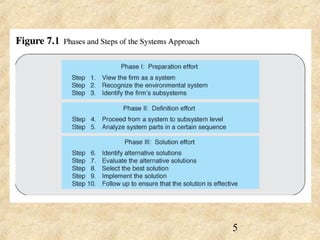
• The approach consists of three phases of effort: 
– Preparation consists of viewing the firm as a 
system, recognizing the environmental system, 
and identifying the firm’s subsystems 
– Definition involves proceeding from a system 
to a subsystem level and analyzing system 
parts in a certain sequence 
– Solution involves identifying the alternative 
solutions, evaluating them, and selecting the 
best one
THE SYSTEMS APPROACH 
• John Dewey identified three series of judgments 
involved in adequately resolving a controversy 
1. Recognize the controversy 
2. Weigh alternative claims 
3. Form a judgment 
• During the late 1960s/early 1970s, interest in 
systematic problem solving strengthened 
• Management scientists and information specialists 
produced a recommended framework that became 
known as the systems approach—a series of 
problem-solving steps that ensure the problem is first 
understood, alternative solutions are considered, and 
the selected solution works (Figure 7.1) 
4
5
The System’s Approach (cont.) 
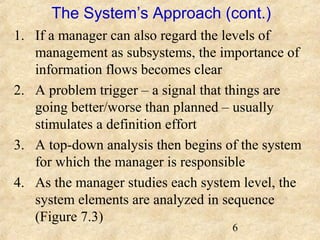
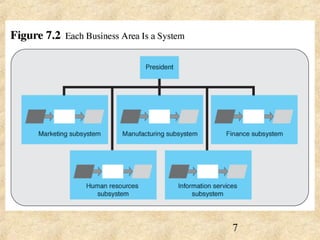
1. If a manager can also regard the levels of 
management as subsystems, the importance of 
information flows becomes clear 
2. A problem trigger – a signal that things are 
going better/worse than planned – usually 
stimulates a definition effort 
3. A top-down analysis then begins of the system 
for which the manager is responsible 
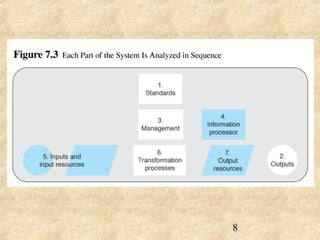
4. As the manager studies each system level, the 
system elements are analyzed in sequence 
(Figure 7.3) 
6
7
8
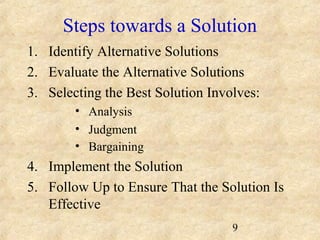
Steps towards a Solution 
1. Identify Alternative Solutions 
2. Evaluate the Alternative Solutions 
3. Selecting the Best Solution Involves: 
9 
• Analysis 
• Judgment 
• Bargaining 
4. Implement the Solution 
5. Follow Up to Ensure That the Solution Is 
Effective
THE SYSTEMS DEVELOPMENT 
10 
LIFE CYCLE 
• The system life development cycle 
(SDLC) is an application of the 
systems approach methodology to the 
development of an information system
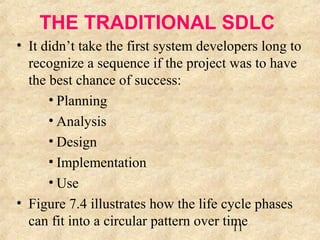
THE TRADITIONAL SDLC 
• It didn’t take the first system developers long to 
recognize a sequence if the project was to have 
the best chance of success: 
11 
• Planning 
• Analysis 
• Design 
• Implementation 
• Use 
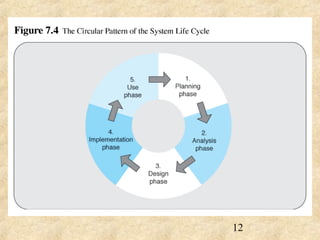
• Figure 7.4 illustrates how the life cycle phases 
can fit into a circular pattern over time
12
13 
PROTOTYPING 
• A prototype is a version of a potential system that 
provides the developers and potential users with an 
idea of how the system will function when completed 
• In prototyping, a prototype is produced as quickly as 
possible, perhaps overnight, to obtain user feedback 
that will enable the prototype to be improved 
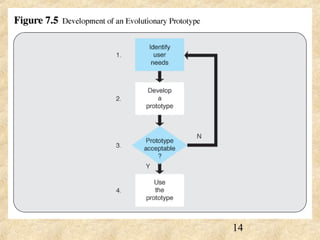
• Figure 7.5 shows the four steps involved in developing 
an evolutionary prototype 
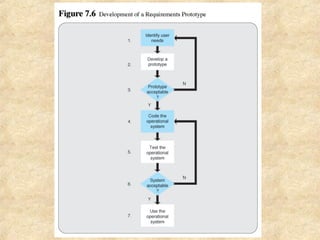
• Figure 7.6 shows the steps involved in developing a 
requirements prototype 
• As prototyping has proven to be one of the most 
successful methodologies, it would be difficult to find 
a development project that didn’t use it to some degree
14
15
RAPID APPLICATION 
DEVELOPMENT 
• Rapid Application Development (RAD), is a term 
coined by James Martin. It refers to a development 
life cycle intended to produce systems quickly 
without sacrificing quality 
• Information engineering is the name that Martin 
gave to his overall approach to system development, 
which treats it as a firm-wide activity, while the term 
enterprise is used to describe the entire firm 
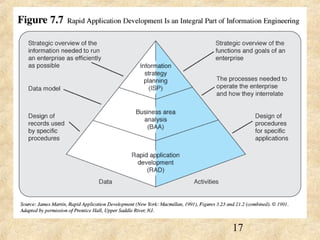
• Figure 7.7 illustrates the top-down nature of 
information engineering, involving both data (the left 
face of the pyramid) and activities (the right face) 
16
17
18 
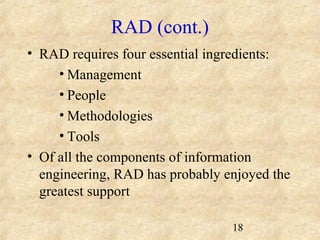
RAD (cont.) 
• RAD requires four essential ingredients: 
•Management 
• People 
•Methodologies 
• Tools 
• Of all the components of information 
engineering, RAD has probably enjoyed the 
greatest support
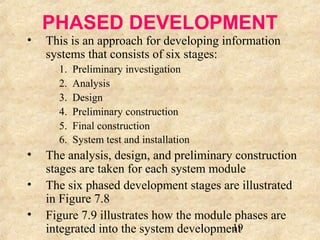
PHASED DEVELOPMENT 
• This is an approach for developing information 
19 
systems that consists of six stages: 
1. Preliminary investigation 
2. Analysis 
3. Design 
4. Preliminary construction 
5. Final construction 
6. System test and installation 
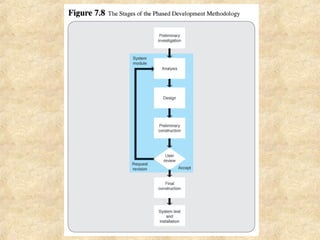
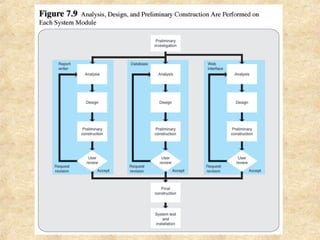
• The analysis, design, and preliminary construction 
stages are taken for each system module 
• The six phased development stages are illustrated 
in Figure 7.8 
• Figure 7.9 illustrates how the module phases are 
integrated into the system development
20
21
BUSINESS PROCESS REDESIGN 
• The process of reworking the systems has been 
called reengineering or business process redesign 
(BPR) 
• BPR affects the firm’s IT operation in two ways: 
1. IT can apply BPR to the redesign of legacy 
systems that can no longer be kept alive by 
ordinary maintenance 
2. When a firm applies BPR to its major operations, 
the effort invariably has a ripple effect that 
results in the redesign of information systems 
• IT has devised reverse engineering, restructuring, 
and reengineering that can be applied separately or 
in combination for applying BPR 
22
Three Techniques for Applying 
23 
BPR 
1. As used in computing, reverse engineering is the 
process of analyzing an existing system to identify 
its elements and their interrelationships, as well as to 
create documentation in a higher level of abstraction 
than currently exists. 
2. Restructuring is the transformation of a system into 
another form without changing its functionality 
3. Reengineering is the complete redesign of a system 
with the objective of changing its functionality 
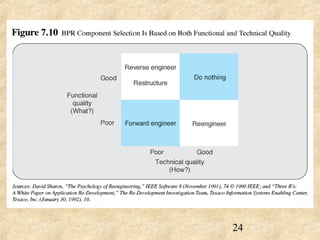
• The proper mix depends on the current state of the 
system in terms of its functional and technical 
quality. Figure 7.10 is a diagram that shows these 
two influences
24
PUTTING THE TRADITIONAL SDLC, 
PROTOTYPING, RAD, PHASED 
DEVELOPMENT, AND BPR IN 
25 
PERSPECTIVE 
• The traditional SDLC, prototyping, RAD, and BPR 
are methodologies that are recommended ways of 
developing an information system 
• Currently, firms are revamping many systems that 
were implemented with computer technology that 
is now obsolete 
• The name BPR is used for this. Prototyping, RAD, 
and phased development can be utilized in a BPR 
project to meet users’ needs in a responsive way
Process Modeling 
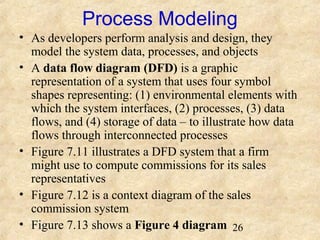
• As developers perform analysis and design, they 
model the system data, processes, and objects 
• A data flow diagram (DFD) is a graphic 
representation of a system that uses four symbol 
shapes representing: (1) environmental elements with 
which the system interfaces, (2) processes, (3) data 
flows, and (4) storage of data – to illustrate how data 
flows through interconnected processes 
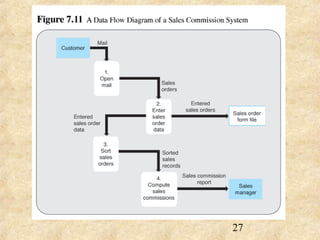
• Figure 7.11 illustrates a DFD system that a firm 
might use to compute commissions for its sales 
representatives 
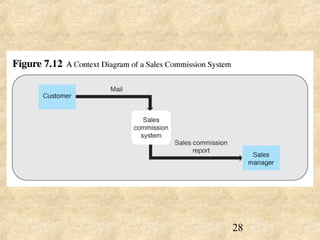
• Figure 7.12 is a context diagram of the sales 
commission system 
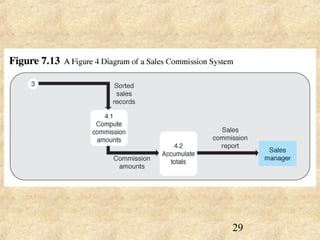
• Figure 7.13 shows a Figure 4 diagram 
26
27
28
29
30 
Use Cases 
• A use case is a narrative description in an outline form 
of the dialog that occurs between a primary (usually a 
computer program) and a secondary system (a person 
interacting with the computer program) 
There are two use case formats: 
• A continuous narrative with each action numbered 
sequentially;and 
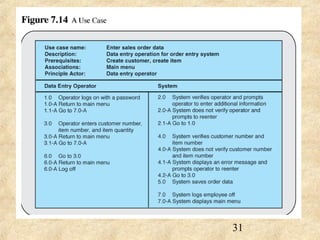
• The other is called the ping pong format because it 
consists of two narratives and the numbering indicates 
how the tasks alternate between the primary and 
secondary systems (Figure 7.14) 
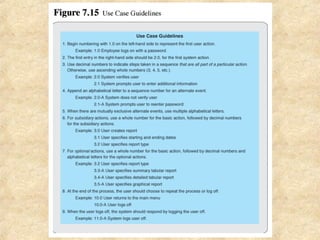
• A set of guidelines for preparing a use case in the ping 
pong format is shown in Figure 7.15
31
32
PROJECT MANAGEMENT 
• Today, it is possible for life cycle 
management to span several organizational 
levels and involve managers outside of IT 
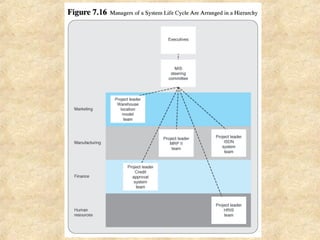
• Figure 7.16 shows the hierarchical nature of 
project management 
• In this example, there are five development 
projects going at the same time, all managed 
by the MIS steering committee 
33
34
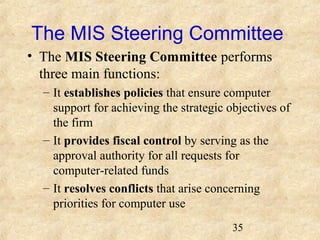
The MIS Steering Committee 
• The MIS Steering Committee performs 
three main functions: 
– It establishes policies that ensure computer 
support for achieving the strategic objectives of 
the firm 
– It provides fiscal control by serving as the 
approval authority for all requests for 
computer-related funds 
– It resolves conflicts that arise concerning 
priorities for computer use 
35
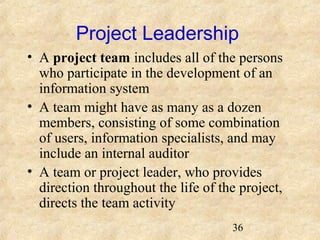
Project Leadership 
• A project team includes all of the persons 
who participate in the development of an 
information system 
• A team might have as many as a dozen 
members, consisting of some combination 
of users, information specialists, and may 
include an internal auditor 
• A team or project leader, who provides 
direction throughout the life of the project, 
directs the team activity 
36
The Project Management 
37 
Mechanism 
• The basis for project management is the project plan 
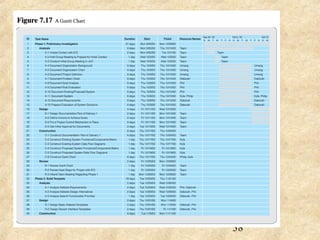
• A popular format for a detailed plan is a Gantt chart, 
which identifies the tasks, who will perform them, 
and when they will be performed 
• A Gantt chart is a horizontal bar chart that includes 
a bar for each task to be performed arranged in a time 
sequence 
• Figure 7.17 is the first part of a Gantt chart, prepared 
using a Microsoft Excel spreadsheet 
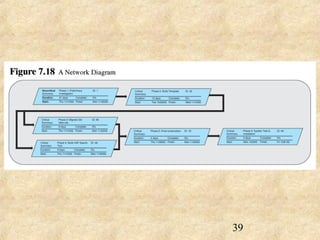
• A complement to the Gantt chart is the network 
diagram. Figure 7.18 is a high-level network 
diagram that identifies the phases of a project
38
39
END OF CHAPTER 7 
40

Mc leod9e ch07 systems development

  • 1.
    1 CHAPTER 7 SYSTEMS DEVELOPMENT Management Information Systems, 9th edition, By Raymond McLeod, Jr. and George P. Schell © 2004, Prentice Hall, Inc.
  • 2.
    Learning Objectives •Recognize the systems approach as the basic framework for solving problems of all kinds. • Know how to apply the systems approach in solving systems problems. • Understand that the systems development life cycle (SDLC) is a methodology—a recommended way to develop systems. • Be familiar with the main SDLC approaches—the traditional waterfall cycle, prototyping, rapid application development, phased development, and business process redesign. • Know the basics of modeling processes with data flow diagrams and use cases. • Understand how systems development projects are managed in a top-down fashion. 2
  • 3.
    3 Introduction •Both managers and systems developers can apply the systems approach when solving problems • The approach consists of three phases of effort: – Preparation consists of viewing the firm as a system, recognizing the environmental system, and identifying the firm’s subsystems – Definition involves proceeding from a system to a subsystem level and analyzing system parts in a certain sequence – Solution involves identifying the alternative solutions, evaluating them, and selecting the best one
  • 4.
    THE SYSTEMS APPROACH • John Dewey identified three series of judgments involved in adequately resolving a controversy 1. Recognize the controversy 2. Weigh alternative claims 3. Form a judgment • During the late 1960s/early 1970s, interest in systematic problem solving strengthened • Management scientists and information specialists produced a recommended framework that became known as the systems approach—a series of problem-solving steps that ensure the problem is first understood, alternative solutions are considered, and the selected solution works (Figure 7.1) 4
  • 5.
  • 6.
    The System’s Approach(cont.) 1. If a manager can also regard the levels of management as subsystems, the importance of information flows becomes clear 2. A problem trigger – a signal that things are going better/worse than planned – usually stimulates a definition effort 3. A top-down analysis then begins of the system for which the manager is responsible 4. As the manager studies each system level, the system elements are analyzed in sequence (Figure 7.3) 6
  • 7.
  • 8.
  • 9.
    Steps towards aSolution 1. Identify Alternative Solutions 2. Evaluate the Alternative Solutions 3. Selecting the Best Solution Involves: 9 • Analysis • Judgment • Bargaining 4. Implement the Solution 5. Follow Up to Ensure That the Solution Is Effective
  • 10.
    THE SYSTEMS DEVELOPMENT 10 LIFE CYCLE • The system life development cycle (SDLC) is an application of the systems approach methodology to the development of an information system
  • 11.
    THE TRADITIONAL SDLC • It didn’t take the first system developers long to recognize a sequence if the project was to have the best chance of success: 11 • Planning • Analysis • Design • Implementation • Use • Figure 7.4 illustrates how the life cycle phases can fit into a circular pattern over time
  • 12.
  • 13.
    13 PROTOTYPING •A prototype is a version of a potential system that provides the developers and potential users with an idea of how the system will function when completed • In prototyping, a prototype is produced as quickly as possible, perhaps overnight, to obtain user feedback that will enable the prototype to be improved • Figure 7.5 shows the four steps involved in developing an evolutionary prototype • Figure 7.6 shows the steps involved in developing a requirements prototype • As prototyping has proven to be one of the most successful methodologies, it would be difficult to find a development project that didn’t use it to some degree
  • 14.
  • 15.
  • 16.
    RAPID APPLICATION DEVELOPMENT • Rapid Application Development (RAD), is a term coined by James Martin. It refers to a development life cycle intended to produce systems quickly without sacrificing quality • Information engineering is the name that Martin gave to his overall approach to system development, which treats it as a firm-wide activity, while the term enterprise is used to describe the entire firm • Figure 7.7 illustrates the top-down nature of information engineering, involving both data (the left face of the pyramid) and activities (the right face) 16
  • 17.
  • 18.
    18 RAD (cont.) • RAD requires four essential ingredients: •Management • People •Methodologies • Tools • Of all the components of information engineering, RAD has probably enjoyed the greatest support
  • 19.
    PHASED DEVELOPMENT •This is an approach for developing information 19 systems that consists of six stages: 1. Preliminary investigation 2. Analysis 3. Design 4. Preliminary construction 5. Final construction 6. System test and installation • The analysis, design, and preliminary construction stages are taken for each system module • The six phased development stages are illustrated in Figure 7.8 • Figure 7.9 illustrates how the module phases are integrated into the system development
  • 20.
  • 21.
  • 22.
    BUSINESS PROCESS REDESIGN • The process of reworking the systems has been called reengineering or business process redesign (BPR) • BPR affects the firm’s IT operation in two ways: 1. IT can apply BPR to the redesign of legacy systems that can no longer be kept alive by ordinary maintenance 2. When a firm applies BPR to its major operations, the effort invariably has a ripple effect that results in the redesign of information systems • IT has devised reverse engineering, restructuring, and reengineering that can be applied separately or in combination for applying BPR 22
  • 23.
    Three Techniques forApplying 23 BPR 1. As used in computing, reverse engineering is the process of analyzing an existing system to identify its elements and their interrelationships, as well as to create documentation in a higher level of abstraction than currently exists. 2. Restructuring is the transformation of a system into another form without changing its functionality 3. Reengineering is the complete redesign of a system with the objective of changing its functionality • The proper mix depends on the current state of the system in terms of its functional and technical quality. Figure 7.10 is a diagram that shows these two influences
  • 24.
  • 25.
    PUTTING THE TRADITIONALSDLC, PROTOTYPING, RAD, PHASED DEVELOPMENT, AND BPR IN 25 PERSPECTIVE • The traditional SDLC, prototyping, RAD, and BPR are methodologies that are recommended ways of developing an information system • Currently, firms are revamping many systems that were implemented with computer technology that is now obsolete • The name BPR is used for this. Prototyping, RAD, and phased development can be utilized in a BPR project to meet users’ needs in a responsive way
  • 26.
    Process Modeling •As developers perform analysis and design, they model the system data, processes, and objects • A data flow diagram (DFD) is a graphic representation of a system that uses four symbol shapes representing: (1) environmental elements with which the system interfaces, (2) processes, (3) data flows, and (4) storage of data – to illustrate how data flows through interconnected processes • Figure 7.11 illustrates a DFD system that a firm might use to compute commissions for its sales representatives • Figure 7.12 is a context diagram of the sales commission system • Figure 7.13 shows a Figure 4 diagram 26
  • 27.
  • 28.
  • 29.
  • 30.
    30 Use Cases • A use case is a narrative description in an outline form of the dialog that occurs between a primary (usually a computer program) and a secondary system (a person interacting with the computer program) There are two use case formats: • A continuous narrative with each action numbered sequentially;and • The other is called the ping pong format because it consists of two narratives and the numbering indicates how the tasks alternate between the primary and secondary systems (Figure 7.14) • A set of guidelines for preparing a use case in the ping pong format is shown in Figure 7.15
  • 31.
  • 32.
  • 33.
    PROJECT MANAGEMENT •Today, it is possible for life cycle management to span several organizational levels and involve managers outside of IT • Figure 7.16 shows the hierarchical nature of project management • In this example, there are five development projects going at the same time, all managed by the MIS steering committee 33
  • 34.
  • 35.
    The MIS SteeringCommittee • The MIS Steering Committee performs three main functions: – It establishes policies that ensure computer support for achieving the strategic objectives of the firm – It provides fiscal control by serving as the approval authority for all requests for computer-related funds – It resolves conflicts that arise concerning priorities for computer use 35
  • 36.
    Project Leadership •A project team includes all of the persons who participate in the development of an information system • A team might have as many as a dozen members, consisting of some combination of users, information specialists, and may include an internal auditor • A team or project leader, who provides direction throughout the life of the project, directs the team activity 36
  • 37.
    The Project Management 37 Mechanism • The basis for project management is the project plan • A popular format for a detailed plan is a Gantt chart, which identifies the tasks, who will perform them, and when they will be performed • A Gantt chart is a horizontal bar chart that includes a bar for each task to be performed arranged in a time sequence • Figure 7.17 is the first part of a Gantt chart, prepared using a Microsoft Excel spreadsheet • A complement to the Gantt chart is the network diagram. Figure 7.18 is a high-level network diagram that identifies the phases of a project
  • 38.
  • 39.
  • 40.