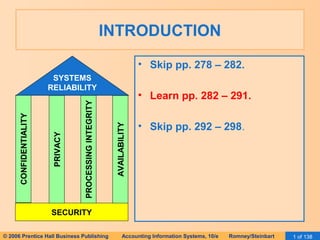
INTRODUCTION 
• Skip pp. 278 – 282. 
• Learn pp. 282 – 291. 
• Skip pp. 292 – 298. 
SYSTEMS 
RELIABILITY 
PROCESSING INTEGRITY 
SECURITY CONFIDENTIALITY 
PRIVACY 
AVAILABILITY 
© 2006 Prentice Hall Business Publishing Accounting Information Systems, 10/e Romney/Steinbart 1 of 138
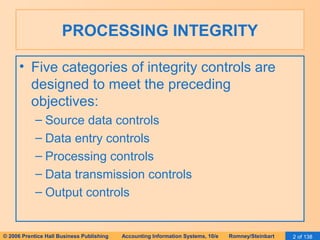
PROCESSING INTEGRITY 
• Five categories of integrity controls are 
designed to meet the preceding 
objectives: 
– Source data controls 
– Data entry controls 
– Processing controls 
– Data transmission controls 
– Output controls 
© 2006 Prentice Hall Business Publishing Accounting Information Systems, 10/e Romney/Steinbart 2 of 138
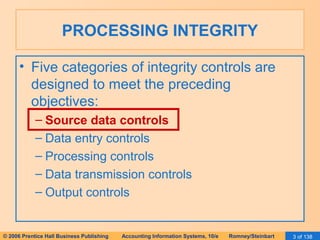
PROCESSING INTEGRITY 
• Five categories of integrity controls are 
designed to meet the preceding 
objectives: 
– Source data controls 
– Data entry controls 
– Processing controls 
– Data transmission controls 
– Output controls 
© 2006 Prentice Hall Business Publishing Accounting Information Systems, 10/e Romney/Steinbart 3 of 138
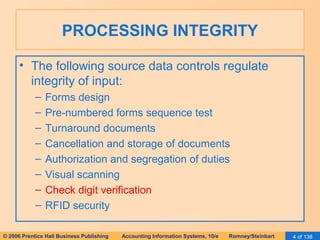
PROCESSING INTEGRITY 
• The following source data controls regulate 
integrity of input: 
– Forms design 
– Pre-numbered forms sequence test 
– Turnaround documents 
– Cancellation and storage of documents 
– Authorization and segregation of duties 
– Visual scanning 
– Check digit verification 
– RFID security 
© 2006 Prentice Hall Business Publishing Accounting Information Systems, 10/e Romney/Steinbart 4 of 138
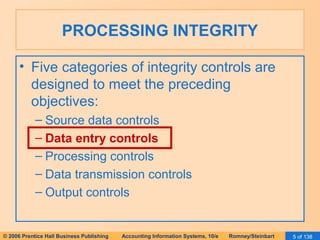
PROCESSING INTEGRITY 
• Five categories of integrity controls are 
designed to meet the preceding 
objectives: 
– Source data controls 
– Data entry controls 
– Processing controls 
– Data transmission controls 
– Output controls 
© 2006 Prentice Hall Business Publishing Accounting Information Systems, 10/e Romney/Steinbart 5 of 138
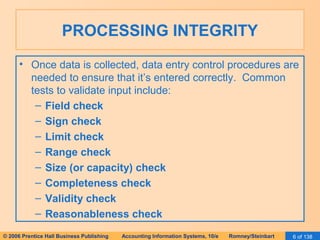
PROCESSING INTEGRITY 
• Once data is collected, data entry control procedures are 
needed to ensure that it’s entered correctly. Common 
tests to validate input include: 
– Field check 
– Sign check 
– Limit check 
– Range check 
– Size (or capacity) check 
– Completeness check 
– Validity check 
– Reasonableness check 
© 2006 Prentice Hall Business Publishing Accounting Information Systems, 10/e Romney/Steinbart 6 of 138
• Four Types of Questions 
• The instructor will ….. 
– 1. State data input test (field check) 
• List 4 possible definitions 
– 2. State data input test (field check) 
• List 4 possible examples 
– Which one is an example. 
– Which one is not an example. 
– 3. State definition of data input test 
• List 4 possible terms 
– 4. State example of data input test 
• List 4 possible terms 
• In all types of question….. 
– 1 is correct 
– 1 is “way off” (maybe ‘sounds like could be term’) 
© 2006 Prentice Hall Business Publishing Accounting Information Systems, 10/e Romney/Steinbart 7 of 138
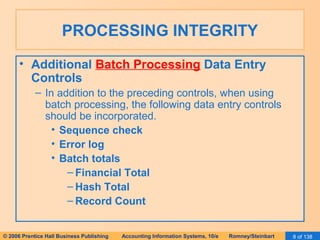
PROCESSING INTEGRITY 
• Additional Batch Processing Data Entry 
Controls 
– In addition to the preceding controls, when using 
batch processing, the following data entry controls 
should be incorporated. 
• Sequence check 
• Error log 
• Batch totals 
– Financial Total 
– Hash Total 
– Record Count 
© 2006 Prentice Hall Business Publishing Accounting Information Systems, 10/e Romney/Steinbart 8 of 138
PROCESSING INTEGRITY 
• Additional online data entry controls 
– Online processing data entry controls include: 
• Transaction logs 
– Includes detailed records of all transaction data. 
– Identifies the sequence in which transaction were 
entered 
– Can be used to reconstruct damaged online files. 
© 2006 Prentice Hall Business Publishing Accounting Information Systems, 10/e Romney/Steinbart 9 of 138
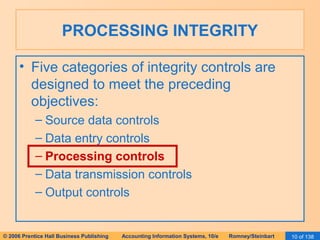
PROCESSING INTEGRITY 
• Five categories of integrity controls are 
designed to meet the preceding 
objectives: 
– Source data controls 
– Data entry controls 
– Processing controls 
– Data transmission controls 
– Output controls 
© 2006 Prentice Hall Business Publishing Accounting Information Systems, 10/e Romney/Steinbart 10 of 138
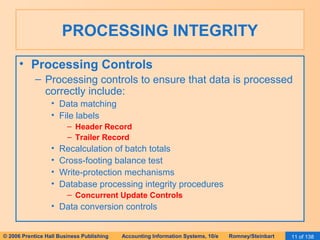
PROCESSING INTEGRITY 
• Processing Controls 
– Processing controls to ensure that data is processed 
correctly include: 
• Data matching 
• File labels 
– Header Record 
– Trailer Record 
• Recalculation of batch totals 
• Cross-footing balance test 
• Write-protection mechanisms 
• Database processing integrity procedures 
– Concurrent Update Controls 
• Data conversion controls 
© 2006 Prentice Hall Business Publishing Accounting Information Systems, 10/e Romney/Steinbart 11 of 138
PROCESSING INTEGRITY 
• Five categories of integrity controls are 
designed to meet the preceding 
objectives: 
– Source data controls 
– Data entry controls 
– Processing controls 
– Data transmission controls 
– Output controls 
© 2006 Prentice Hall Business Publishing Accounting Information Systems, 10/e Romney/Steinbart 12 of 138
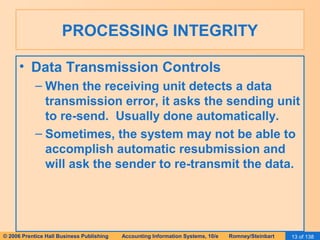
PROCESSING INTEGRITY 
• Data Transmission Controls 
– When the receiving unit detects a data 
transmission error, it asks the sending unit 
to re-send. Usually done automatically. 
– Sometimes, the system may not be able to 
accomplish automatic resubmission and 
will ask the sender to re-transmit the data. 
© 2006 Prentice Hall Business Publishing Accounting Information Systems, 10/e Romney/Steinbart 13 of 138
PROCESSING INTEGRITY 
• Message Acknowledgment Techniques 
– A number of message acknowledgment 
techniques can be used to let the sender of 
an electronic message know that a message 
was received: 
• Echo check 
• Trailer record 
© 2006 Prentice Hall Business Publishing Accounting Information Systems, 10/e Romney/Steinbart 14 of 138
PROCESSING INTEGRITY 
• Five categories of integrity controls are 
designed to meet the preceding objectives: 
– Source data controls 
– Data entry controls 
– Processing controls 
– Data transmission controls 
– Output controls 
© 2006 Prentice Hall Business Publishing Accounting Information Systems, 10/e Romney/Steinbart 15 of 138
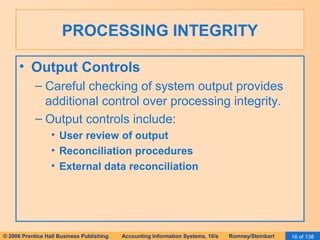
PROCESSING INTEGRITY 
• Output Controls 
– Careful checking of system output provides 
additional control over processing integrity. 
– Output controls include: 
• User review of output 
• Reconciliation procedures 
• External data reconciliation 
© 2006 Prentice Hall Business Publishing Accounting Information Systems, 10/e Romney/Steinbart 16 of 138
Example: Credit Sales Processing 
– Shows how Processing Integrity Controls are implemented. 
– When Studying: Try to tie examples to previous terms & definitions. 
However, some examples do not tie back. 
– 7 Steps in Batch Processing (pp. 288 – 289) 
– 3 Major Steps in Online Processing (pp. 289 – 291) 
• Online Data Entry 
• Online Processing 
• Online Output 
© 2006 Prentice Hall Business Publishing Accounting Information Systems, 10/e Romney/Steinbart 17 of 138
• In Access Assignment 1, we specified 
that the data field “RRNumber” in the 
Receiving Report table should be strictly 
autonumber. This is an example of: 
a) Limit Check 
b) Size Check 
c) Field Check 
d) Completeness Check 
© 2006 Prentice Hall Business Publishing Accounting Information Systems, 10/e Romney/Steinbart 18 of 138
• The data entry control “validity check” 
would detect discrepancies between the 
primary key fields and prevent the 
enforcement of referential integrity. 
Which of the following is a best example: 
a) A zip code of BY23A 
b) A product ID such as “BOX 16” 
c) A vendor ID, such as “LASRON” that is not 
listed in the Vendor table 
d) An employee without a pay-rate 
© 2006 Prentice Hall Business Publishing Accounting Information Systems, 10/e Romney/Steinbart 19 of 138
• Which of the following processing control 
most likely contains the “file name” for 
the file being processed? 
a) Header record 
b) Each individual record in the file 
c) Batch total 
d) Trailer record. 
© 2006 Prentice Hall Business Publishing Accounting Information Systems, 10/e Romney/Steinbart 20 of 138
• Summing up all employee ID numbers 
for a batch of Receiving activities is an 
example of… 
a) Financial total 
b) Query total 
c) Check digit verification 
d) Hash total 
© 2006 Prentice Hall Business Publishing Accounting Information Systems, 10/e Romney/Steinbart 21 of 138

Accounting information system introduction

  • 1.
    INTRODUCTION • Skippp. 278 – 282. • Learn pp. 282 – 291. • Skip pp. 292 – 298. SYSTEMS RELIABILITY PROCESSING INTEGRITY SECURITY CONFIDENTIALITY PRIVACY AVAILABILITY © 2006 Prentice Hall Business Publishing Accounting Information Systems, 10/e Romney/Steinbart 1 of 138
  • 2.
    PROCESSING INTEGRITY •Five categories of integrity controls are designed to meet the preceding objectives: – Source data controls – Data entry controls – Processing controls – Data transmission controls – Output controls © 2006 Prentice Hall Business Publishing Accounting Information Systems, 10/e Romney/Steinbart 2 of 138
  • 3.
    PROCESSING INTEGRITY •Five categories of integrity controls are designed to meet the preceding objectives: – Source data controls – Data entry controls – Processing controls – Data transmission controls – Output controls © 2006 Prentice Hall Business Publishing Accounting Information Systems, 10/e Romney/Steinbart 3 of 138
  • 4.
    PROCESSING INTEGRITY •The following source data controls regulate integrity of input: – Forms design – Pre-numbered forms sequence test – Turnaround documents – Cancellation and storage of documents – Authorization and segregation of duties – Visual scanning – Check digit verification – RFID security © 2006 Prentice Hall Business Publishing Accounting Information Systems, 10/e Romney/Steinbart 4 of 138
  • 5.
    PROCESSING INTEGRITY •Five categories of integrity controls are designed to meet the preceding objectives: – Source data controls – Data entry controls – Processing controls – Data transmission controls – Output controls © 2006 Prentice Hall Business Publishing Accounting Information Systems, 10/e Romney/Steinbart 5 of 138
  • 6.
    PROCESSING INTEGRITY •Once data is collected, data entry control procedures are needed to ensure that it’s entered correctly. Common tests to validate input include: – Field check – Sign check – Limit check – Range check – Size (or capacity) check – Completeness check – Validity check – Reasonableness check © 2006 Prentice Hall Business Publishing Accounting Information Systems, 10/e Romney/Steinbart 6 of 138
  • 7.
    • Four Typesof Questions • The instructor will ….. – 1. State data input test (field check) • List 4 possible definitions – 2. State data input test (field check) • List 4 possible examples – Which one is an example. – Which one is not an example. – 3. State definition of data input test • List 4 possible terms – 4. State example of data input test • List 4 possible terms • In all types of question….. – 1 is correct – 1 is “way off” (maybe ‘sounds like could be term’) © 2006 Prentice Hall Business Publishing Accounting Information Systems, 10/e Romney/Steinbart 7 of 138
  • 8.
    PROCESSING INTEGRITY •Additional Batch Processing Data Entry Controls – In addition to the preceding controls, when using batch processing, the following data entry controls should be incorporated. • Sequence check • Error log • Batch totals – Financial Total – Hash Total – Record Count © 2006 Prentice Hall Business Publishing Accounting Information Systems, 10/e Romney/Steinbart 8 of 138
  • 9.
    PROCESSING INTEGRITY •Additional online data entry controls – Online processing data entry controls include: • Transaction logs – Includes detailed records of all transaction data. – Identifies the sequence in which transaction were entered – Can be used to reconstruct damaged online files. © 2006 Prentice Hall Business Publishing Accounting Information Systems, 10/e Romney/Steinbart 9 of 138
  • 10.
    PROCESSING INTEGRITY •Five categories of integrity controls are designed to meet the preceding objectives: – Source data controls – Data entry controls – Processing controls – Data transmission controls – Output controls © 2006 Prentice Hall Business Publishing Accounting Information Systems, 10/e Romney/Steinbart 10 of 138
  • 11.
    PROCESSING INTEGRITY •Processing Controls – Processing controls to ensure that data is processed correctly include: • Data matching • File labels – Header Record – Trailer Record • Recalculation of batch totals • Cross-footing balance test • Write-protection mechanisms • Database processing integrity procedures – Concurrent Update Controls • Data conversion controls © 2006 Prentice Hall Business Publishing Accounting Information Systems, 10/e Romney/Steinbart 11 of 138
  • 12.
    PROCESSING INTEGRITY •Five categories of integrity controls are designed to meet the preceding objectives: – Source data controls – Data entry controls – Processing controls – Data transmission controls – Output controls © 2006 Prentice Hall Business Publishing Accounting Information Systems, 10/e Romney/Steinbart 12 of 138
  • 13.
    PROCESSING INTEGRITY •Data Transmission Controls – When the receiving unit detects a data transmission error, it asks the sending unit to re-send. Usually done automatically. – Sometimes, the system may not be able to accomplish automatic resubmission and will ask the sender to re-transmit the data. © 2006 Prentice Hall Business Publishing Accounting Information Systems, 10/e Romney/Steinbart 13 of 138
  • 14.
    PROCESSING INTEGRITY •Message Acknowledgment Techniques – A number of message acknowledgment techniques can be used to let the sender of an electronic message know that a message was received: • Echo check • Trailer record © 2006 Prentice Hall Business Publishing Accounting Information Systems, 10/e Romney/Steinbart 14 of 138
  • 15.
    PROCESSING INTEGRITY •Five categories of integrity controls are designed to meet the preceding objectives: – Source data controls – Data entry controls – Processing controls – Data transmission controls – Output controls © 2006 Prentice Hall Business Publishing Accounting Information Systems, 10/e Romney/Steinbart 15 of 138
  • 16.
    PROCESSING INTEGRITY •Output Controls – Careful checking of system output provides additional control over processing integrity. – Output controls include: • User review of output • Reconciliation procedures • External data reconciliation © 2006 Prentice Hall Business Publishing Accounting Information Systems, 10/e Romney/Steinbart 16 of 138
  • 17.
    Example: Credit SalesProcessing – Shows how Processing Integrity Controls are implemented. – When Studying: Try to tie examples to previous terms & definitions. However, some examples do not tie back. – 7 Steps in Batch Processing (pp. 288 – 289) – 3 Major Steps in Online Processing (pp. 289 – 291) • Online Data Entry • Online Processing • Online Output © 2006 Prentice Hall Business Publishing Accounting Information Systems, 10/e Romney/Steinbart 17 of 138
  • 18.
    • In AccessAssignment 1, we specified that the data field “RRNumber” in the Receiving Report table should be strictly autonumber. This is an example of: a) Limit Check b) Size Check c) Field Check d) Completeness Check © 2006 Prentice Hall Business Publishing Accounting Information Systems, 10/e Romney/Steinbart 18 of 138
  • 19.
    • The dataentry control “validity check” would detect discrepancies between the primary key fields and prevent the enforcement of referential integrity. Which of the following is a best example: a) A zip code of BY23A b) A product ID such as “BOX 16” c) A vendor ID, such as “LASRON” that is not listed in the Vendor table d) An employee without a pay-rate © 2006 Prentice Hall Business Publishing Accounting Information Systems, 10/e Romney/Steinbart 19 of 138
  • 20.
    • Which ofthe following processing control most likely contains the “file name” for the file being processed? a) Header record b) Each individual record in the file c) Batch total d) Trailer record. © 2006 Prentice Hall Business Publishing Accounting Information Systems, 10/e Romney/Steinbart 20 of 138
  • 21.
    • Summing upall employee ID numbers for a batch of Receiving activities is an example of… a) Financial total b) Query total c) Check digit verification d) Hash total © 2006 Prentice Hall Business Publishing Accounting Information Systems, 10/e Romney/Steinbart 21 of 138