Chapter 11 
Multinational 
Accounting: 
Foreign Currency 
Transactions and 
Financial 
Instruments
11-2 
Multinational Accounting 
• Many companies, large and small, depend on 
international markets for supplies of goods and 
for sales of their products and services. 
• This chapter and Chapter 12 discuss the 
accounting issues associated with companies 
that operate internationally.
11-3 
Multinational Accounting 
• The U.S. entity may incur foreign currency 
risks whenever it conducts transactions in 
other currencies. 
• For example, if a U.S. company acquires a 
machine on credit from a Swiss manufacturer, 
the Swiss company may require payment in 
Swiss francs (SFr).
11-4 
Multinational Accounting 
• This means the U.S. company must eventually 
use a foreign currency broker or a bank to 
exchange U.S. dollars for Swiss francs in order 
to pay for the machine. 
• In the process, the U.S. company may 
experience foreign currency gains or losses 
from fluctuations in the value of the U.S. dollar 
relative to the Swiss franc.
11-5 
Multinational Accounting 
• Multinational enterprises (MNEs) often transact 
in a variety of currencies as a result of their 
export and import activities. 
• There are approximately 150 different currencies 
around the world, but most international trade 
has been settled in six major currencies that 
have shown stability and general acceptance 
over time: the U.S. dollar, the British pound, the 
Canadian dollar, the European euro, the 
Japanese yen, and the Swiss franc.
11-6 
Multinational Accounting 
• A growing international trend is the adoption of 
the ISO 9000 series of standards by companies 
engaging in international trade. 
• These standards, adopted by the International 
Organization for Standardization (ISO) in 1987, 
specify the degree of conformance to rigorous 
quality programs in various product design and 
production processes.
11-7 
Multinational Accounting 
• Companies undergo a thorough quality control audit 
during the certification process, and many of these 
companies see the ISO 9000 series of standards as part 
of their total quality management programs. 
• The value of the ISO certification in the marketplace is 
that a company’s customers are given additional 
assurance that the certified company focuses on 
continuous improvement and has a quality focus in all its 
processes from the initial stages of production through 
postsale servicing.
11-8 
Accounting Issues 
• Accountants must be able to record and report 
transactions involving exchanges of U.S. dollars 
and foreign currencies. 

• Foreign currency transactions of a U.S. 
company include sales, purchases, and other 
transactions giving rise to a transfer of foreign 
currency or recording receivables or payables 
which are denominated—that is, numerically 
specified to be settled—in a foreign currency.
11-9 
Accounting Issues 
• Because financial statements of virtually all 
U.S. companies are prepared using the U.S. 
dollar as the reporting currency, transactions 
denominated in other currencies must be 
restated to their U.S. dollar equivalents before 
they can be recorded in the U.S. company’s 
books and included in its financial statements. 

• This process of restating foreign currency 
transactions to their U.S. dollar equivalent 
values is termed translation.
11-10 
Accounting Issues 
• In addition, many large U.S. corporations have 
multinational operations, such as foreign-based 
subsidiaries or branches. 
• The foreign currency amounts in the financial 
statements of these subsidiaries have to be 
translated, that is, restated, into their U.S. dollar 
equivalents, before they can be consolidated 
with the financial statements of the U.S. parent 
company that uses the U.S. dollar as its 
reporting currency unit.
11-11 
Accounting Issues 
• FASB 52 serves as the primary guide for 
accounting for accounts receivable and 
accounts payable transactions that require 
payment or receipt in a foreign currency. 
• FASB 133 guides the accounting for financial 
instruments specified as derivatives for the 
purpose of hedging certain items.
11-12 
Direct Exchange Rate 
• The direct exchange rate (DER) is the number 
of local currency units (LCUs) needed to acquire 
one foreign currency unit (FCU). 
• From the viewpoint of a U.S. entity, the direct 
exchange rate can be viewed as the dollar cost 
of one foreign currency unit.
11-13 
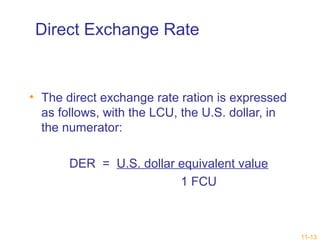
Direct Exchange Rate 
• The direct exchange rate ration is expressed 
as follows, with the LCU, the U.S. dollar, in 
the numerator: 
DER = U.S. dollar equivalent value 
1 FCU
11-14 
Indirect Exchange Rate 
• The indirect exchange rate (IER) is the 
reciprocal of the direct exchange rate. 
• From the viewpoint of a U.S. entity, the 
indirect exchange rate can be viewed 
as the number of foreign currency units 
that 1 U.S. dollar can acquire.
11-15 
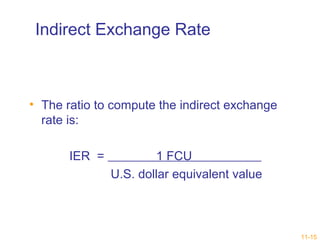
Indirect Exchange Rate 
• The ratio to compute the indirect exchange 
rate is: 
IER = 1 FCU 
U.S. dollar equivalent value
Exchange Rate Mnemonic 
• A mnemonic to help remember the difference in 
exchange rates is to note that the U.S. dollar is 
the numerator for the direct rate (the foreign 
currency unit is in the denominator), and the 
foreign currency unit is in the numerator for the 
indirect exchange rate (with the U.S. dollar in the 
denominator). 
• The terms currency is the numerator and the 
base currency is the denominator in the 
exchange rate ratio. The numerator is the key to 
identification of the rate. 
11-16
11-17 
Spot Rates versus Current Rates 
• FASB 52 refers to the use of both spot rates and 
current rates for measuring foreign operations. 
• The spot rate is the exchange rate for immediate 
delivery of currencies. 
• The current rate is defined simply as the spot 
rate on the entity’s balance sheet date.
Forward Exchange Rates 
• A third exchange rate is the rate on future, or 
forward, exchanges of currencies. 
• Active dealer markets in forward exchange 
contracts are maintained for companies wishing 
to receive, or deliver, major international 
currencies. 
• The advantage of a forward exchange market is 
that the U.S. dollar equivalent value of a future 
receipt or disbursement of foreign currency units 
may be “locked in” at the time a contract is 
made. 
11-18
11-19 
Foreign Currency Transactions 
• Foreign currency transactions are economic 
activities denominated in a currency other than 
the entity’s recording currency. Examples: 
• Purchases or sales of goods or services 
(imports or exports), the prices of which are 
stated in a foreign currency. 
• Loans payable or receivable in a foreign 
currency. 
• The purchase or sale of foreign currency 
forward exchange contracts. 
• Purchases or sale of foreign currency units.
11-20 
Import and Export Transactions 
• Payables and receivables that are denominated 
in a foreign currency, must be measured and 
recorded by the U.S. entity in the currency used 
for its accounting records—the U.S. dollar. 
• The relevant exchange rate for settlement of a 
transaction denominated in a foreign currency 
is the spot exchange rate on the date of 
settlement.
11-21 
Import and Export Transactions 
• At the time the transaction is settled, payables 
or receivables denominated in foreign currency 
units must be adjusted to their current U.S. 
dollar equivalent value. 
• If financial statements are prepared before the 
foreign currency payables or receivables are 
settled, their account balances must be adjusted 
to their U.S. dollar equivalent values as of the 
balance sheet date, using the current rate on 
the balance sheet date.
11-22 
Import and Export Transactions 
• An overview of the required accounting for an 
import or export foreign currency transaction 
on credit is as follows: 
– Transaction date. 
• Record the purchase or sale transaction 
at the U.S. dollar equivalent value using 
the spot direct exchange rate on this date. 
• Continued on next slide.
11-23 
Import and Export Transactions 
– Balance sheet date. 
• Adjust the payable or receivable to its U.S. 
dollar equivalent, end-of-period value using 
the current direct exchange rate. 
• Recognize any exchange gain or loss for 
the change in rates between the 
transaction and balance sheet dates. 
• Continued on next slide.
11-24 
Import and Export Transactions 
– Settlement date. 
• First adjust the foreign currency payable or 
receivable for any changes in the exchange 
rate between the balance sheet date (or 
transaction date if transaction occurs after 
the balance sheet date) and the settlement 
date, recording any exchange gain or loss 
as required. 
• Then record the settlement of the foreign 
currency payable or receivable.
11-25 
Risk Management 
• Companies need to manage their risks. 
• There are a variety of financial instruments 
that managements have developed to manage 
their business risks. 
• For example, companies may enter into 
purchase options to guarantee the future price 
of a purchase of a raw material needed in 
production.
Risk Management 
• Those companies operating internationally are 
subject not only to the normal business risks but 
are typically subject to additional risks from 
possible changes in currency exchange rates 
because of their transacting in more than one 
currency. 
• Multinational entities manage their foreign 
currency risks by using one of several types of 
financial instruments: Foreign currency 
denominated forward exchange contract; 
Foreign currency option; and, Foreign currency 
futures. 
11-26
11-27 
Financial Instrument 
• A financial instrument is cash, evidence of 
ownership, or a contract that both: 
• Imposes on one entity a contractual 
obligation to deliver cash or another 
instrument, and 
• Conveys to the second entity that 
contractual right to receive cash or 
another financial instrument. 
• Examples include cash, stock, notes payable 
and receivable, and many financial contracts.
Derivative 
• A derivative is a financial instrument or other 
contract whose value is “derived from” some 
other item which has a value that is variable 
and can change over time. 
• An example of a derivative is a foreign currency 
forward exchange contract whose value is 
derived from changes in the foreign currency 
exchange rate over the term of the contract. 
• Note that not all financial instruments are 
derviatives. 
11-28
Fair Value Hedge 
• Fair value hedges are those designed to hedge 
the exposure to potential changes in the fair 
value of (a) a recognized asset or liability such 
as available-for-sale investments, or (b) an 
unrecognized firm commitment for which a 
binding agreement exists such as to buy or sell 
inventory. 
• The gains or losses on the hedged asset or 
liability, and the hedging instrument, are 
recognized in current earnings on the income 
statement. 
11-29
11-30 
Cash Flow Hedge 
• Cash flow hedges are those designed to hedge 
the exposure to potential changes in the 
anticipated cash flows, either into or out of the 
company, for (a) a recognized asset or liability 
such as future interest payments on variable-interest 
debt, or (b) a forecasted cash 
transaction such as a forecasted purchase 
or sale. 
• Continued on next slide.
11-31 
Cash Flow Hedge 
• The gain or loss on the effective portion of the 
hedging instrument should be reported in other 
comprehensive income. 
• The gain or loss on the ineffective portion is 
reported in current earnings on the statement 
of income.
11-32 
Hedges of a Net Investment 
• In the earlier discussions of the use of forward 
exchange contracts as a hedging instrument, the 
exchange risks from transactions denominated 
in a foreign currency could be offset. 
• This same concept is applied by the U.S. 
companies that view a net investment in a 
foreign entity as a long-term commitment that 
exposes them to foreign currency risk.
Hedges of a Net Investment 
• A number of balance sheet management tools 
are available for a U.S. company to hedge its 
net investment in a foreign affiliate. 
• Management may use forward exchange 
contracts, other foreign currency commitments, 
or certain intercompany financing arrangements, 
including intercompany transactions. 
• Any effects of exchange rate fluctuations 
between the pound and the dollar would be 
offset by the investment in the British subsidiary 
and the loan payable. 
11-33
Hedges of a Net Investment 
• FASB 133 specifies that for derivative financial 
instruments designated as a hedge of the 
foreign currency exposure of a net investment 
in a foreign operation, the portion of the change 
in fair value equivalent to a foreign currency 
transaction gain or loss would be reported in 
other comprehensive income. 
• That part of other comprehensive income 
resulting from a hedge of a net investment in 
a foreign operation shall then become part of 
the cumulative translation adjustment in 
accumulated other comprehensive income. 
11-34
11-35 
You Will Survive This Chapter !!! 
• Virtually all companies have foreign 
transactions. 
• The general rule is that accounts resulting 
from transactions denominated in foreign 
currency units must be valued and reported 
at their equivalent U.S. dollar values. 
• Forward exchange contracts typically use the 
forward rate for determining current fair value.
11-36 
You Will Survive This Chapter !!! 
• For fair value hedges, the gain or loss is taken 
into current earnings. 
• For cash-flow hedges, the gain or loss—for the 
effective portion of the hedging instrument—is 
taken to other comprehensive income for the 
period.
11-37 
You Will Survive This Chapter !!! 
• For cash-flow hedges, the gain or loss—for the 
ineffective portion of the hedging instrument—is 
taken into current earnings for the period. 
• For a hedge of a net investment, the gain or loss 
is taken to other comprehensive income for the 
period.
Chapter 11 
End of Chapter

Multinational accounting

  • 1.
    Chapter 11 Multinational Accounting: Foreign Currency Transactions and Financial Instruments
  • 2.
    11-2 Multinational Accounting • Many companies, large and small, depend on international markets for supplies of goods and for sales of their products and services. • This chapter and Chapter 12 discuss the accounting issues associated with companies that operate internationally.
  • 3.
    11-3 Multinational Accounting • The U.S. entity may incur foreign currency risks whenever it conducts transactions in other currencies. • For example, if a U.S. company acquires a machine on credit from a Swiss manufacturer, the Swiss company may require payment in Swiss francs (SFr).
  • 4.
    11-4 Multinational Accounting • This means the U.S. company must eventually use a foreign currency broker or a bank to exchange U.S. dollars for Swiss francs in order to pay for the machine. • In the process, the U.S. company may experience foreign currency gains or losses from fluctuations in the value of the U.S. dollar relative to the Swiss franc.
  • 5.
    11-5 Multinational Accounting • Multinational enterprises (MNEs) often transact in a variety of currencies as a result of their export and import activities. • There are approximately 150 different currencies around the world, but most international trade has been settled in six major currencies that have shown stability and general acceptance over time: the U.S. dollar, the British pound, the Canadian dollar, the European euro, the Japanese yen, and the Swiss franc.
  • 6.
    11-6 Multinational Accounting • A growing international trend is the adoption of the ISO 9000 series of standards by companies engaging in international trade. • These standards, adopted by the International Organization for Standardization (ISO) in 1987, specify the degree of conformance to rigorous quality programs in various product design and production processes.
  • 7.
    11-7 Multinational Accounting • Companies undergo a thorough quality control audit during the certification process, and many of these companies see the ISO 9000 series of standards as part of their total quality management programs. • The value of the ISO certification in the marketplace is that a company’s customers are given additional assurance that the certified company focuses on continuous improvement and has a quality focus in all its processes from the initial stages of production through postsale servicing.
  • 8.
    11-8 Accounting Issues • Accountants must be able to record and report transactions involving exchanges of U.S. dollars and foreign currencies. • Foreign currency transactions of a U.S. company include sales, purchases, and other transactions giving rise to a transfer of foreign currency or recording receivables or payables which are denominated—that is, numerically specified to be settled—in a foreign currency.
  • 9.
    11-9 Accounting Issues • Because financial statements of virtually all U.S. companies are prepared using the U.S. dollar as the reporting currency, transactions denominated in other currencies must be restated to their U.S. dollar equivalents before they can be recorded in the U.S. company’s books and included in its financial statements. • This process of restating foreign currency transactions to their U.S. dollar equivalent values is termed translation.
  • 10.
    11-10 Accounting Issues • In addition, many large U.S. corporations have multinational operations, such as foreign-based subsidiaries or branches. • The foreign currency amounts in the financial statements of these subsidiaries have to be translated, that is, restated, into their U.S. dollar equivalents, before they can be consolidated with the financial statements of the U.S. parent company that uses the U.S. dollar as its reporting currency unit.
  • 11.
    11-11 Accounting Issues • FASB 52 serves as the primary guide for accounting for accounts receivable and accounts payable transactions that require payment or receipt in a foreign currency. • FASB 133 guides the accounting for financial instruments specified as derivatives for the purpose of hedging certain items.
  • 12.
    11-12 Direct ExchangeRate • The direct exchange rate (DER) is the number of local currency units (LCUs) needed to acquire one foreign currency unit (FCU). • From the viewpoint of a U.S. entity, the direct exchange rate can be viewed as the dollar cost of one foreign currency unit.
  • 13.
    11-13 Direct ExchangeRate • The direct exchange rate ration is expressed as follows, with the LCU, the U.S. dollar, in the numerator: DER = U.S. dollar equivalent value 1 FCU
  • 14.
    11-14 Indirect ExchangeRate • The indirect exchange rate (IER) is the reciprocal of the direct exchange rate. • From the viewpoint of a U.S. entity, the indirect exchange rate can be viewed as the number of foreign currency units that 1 U.S. dollar can acquire.
  • 15.
    11-15 Indirect ExchangeRate • The ratio to compute the indirect exchange rate is: IER = 1 FCU U.S. dollar equivalent value
  • 16.
    Exchange Rate Mnemonic • A mnemonic to help remember the difference in exchange rates is to note that the U.S. dollar is the numerator for the direct rate (the foreign currency unit is in the denominator), and the foreign currency unit is in the numerator for the indirect exchange rate (with the U.S. dollar in the denominator). • The terms currency is the numerator and the base currency is the denominator in the exchange rate ratio. The numerator is the key to identification of the rate. 11-16
  • 17.
    11-17 Spot Ratesversus Current Rates • FASB 52 refers to the use of both spot rates and current rates for measuring foreign operations. • The spot rate is the exchange rate for immediate delivery of currencies. • The current rate is defined simply as the spot rate on the entity’s balance sheet date.
  • 18.
    Forward Exchange Rates • A third exchange rate is the rate on future, or forward, exchanges of currencies. • Active dealer markets in forward exchange contracts are maintained for companies wishing to receive, or deliver, major international currencies. • The advantage of a forward exchange market is that the U.S. dollar equivalent value of a future receipt or disbursement of foreign currency units may be “locked in” at the time a contract is made. 11-18
  • 19.
    11-19 Foreign CurrencyTransactions • Foreign currency transactions are economic activities denominated in a currency other than the entity’s recording currency. Examples: • Purchases or sales of goods or services (imports or exports), the prices of which are stated in a foreign currency. • Loans payable or receivable in a foreign currency. • The purchase or sale of foreign currency forward exchange contracts. • Purchases or sale of foreign currency units.
  • 20.
    11-20 Import andExport Transactions • Payables and receivables that are denominated in a foreign currency, must be measured and recorded by the U.S. entity in the currency used for its accounting records—the U.S. dollar. • The relevant exchange rate for settlement of a transaction denominated in a foreign currency is the spot exchange rate on the date of settlement.
  • 21.
    11-21 Import andExport Transactions • At the time the transaction is settled, payables or receivables denominated in foreign currency units must be adjusted to their current U.S. dollar equivalent value. • If financial statements are prepared before the foreign currency payables or receivables are settled, their account balances must be adjusted to their U.S. dollar equivalent values as of the balance sheet date, using the current rate on the balance sheet date.
  • 22.
    11-22 Import andExport Transactions • An overview of the required accounting for an import or export foreign currency transaction on credit is as follows: – Transaction date. • Record the purchase or sale transaction at the U.S. dollar equivalent value using the spot direct exchange rate on this date. • Continued on next slide.
  • 23.
    11-23 Import andExport Transactions – Balance sheet date. • Adjust the payable or receivable to its U.S. dollar equivalent, end-of-period value using the current direct exchange rate. • Recognize any exchange gain or loss for the change in rates between the transaction and balance sheet dates. • Continued on next slide.
  • 24.
    11-24 Import andExport Transactions – Settlement date. • First adjust the foreign currency payable or receivable for any changes in the exchange rate between the balance sheet date (or transaction date if transaction occurs after the balance sheet date) and the settlement date, recording any exchange gain or loss as required. • Then record the settlement of the foreign currency payable or receivable.
  • 25.
    11-25 Risk Management • Companies need to manage their risks. • There are a variety of financial instruments that managements have developed to manage their business risks. • For example, companies may enter into purchase options to guarantee the future price of a purchase of a raw material needed in production.
  • 26.
    Risk Management •Those companies operating internationally are subject not only to the normal business risks but are typically subject to additional risks from possible changes in currency exchange rates because of their transacting in more than one currency. • Multinational entities manage their foreign currency risks by using one of several types of financial instruments: Foreign currency denominated forward exchange contract; Foreign currency option; and, Foreign currency futures. 11-26
  • 27.
    11-27 Financial Instrument • A financial instrument is cash, evidence of ownership, or a contract that both: • Imposes on one entity a contractual obligation to deliver cash or another instrument, and • Conveys to the second entity that contractual right to receive cash or another financial instrument. • Examples include cash, stock, notes payable and receivable, and many financial contracts.
  • 28.
    Derivative • Aderivative is a financial instrument or other contract whose value is “derived from” some other item which has a value that is variable and can change over time. • An example of a derivative is a foreign currency forward exchange contract whose value is derived from changes in the foreign currency exchange rate over the term of the contract. • Note that not all financial instruments are derviatives. 11-28
  • 29.
    Fair Value Hedge • Fair value hedges are those designed to hedge the exposure to potential changes in the fair value of (a) a recognized asset or liability such as available-for-sale investments, or (b) an unrecognized firm commitment for which a binding agreement exists such as to buy or sell inventory. • The gains or losses on the hedged asset or liability, and the hedging instrument, are recognized in current earnings on the income statement. 11-29
  • 30.
    11-30 Cash FlowHedge • Cash flow hedges are those designed to hedge the exposure to potential changes in the anticipated cash flows, either into or out of the company, for (a) a recognized asset or liability such as future interest payments on variable-interest debt, or (b) a forecasted cash transaction such as a forecasted purchase or sale. • Continued on next slide.
  • 31.
    11-31 Cash FlowHedge • The gain or loss on the effective portion of the hedging instrument should be reported in other comprehensive income. • The gain or loss on the ineffective portion is reported in current earnings on the statement of income.
  • 32.
    11-32 Hedges ofa Net Investment • In the earlier discussions of the use of forward exchange contracts as a hedging instrument, the exchange risks from transactions denominated in a foreign currency could be offset. • This same concept is applied by the U.S. companies that view a net investment in a foreign entity as a long-term commitment that exposes them to foreign currency risk.
  • 33.
    Hedges of aNet Investment • A number of balance sheet management tools are available for a U.S. company to hedge its net investment in a foreign affiliate. • Management may use forward exchange contracts, other foreign currency commitments, or certain intercompany financing arrangements, including intercompany transactions. • Any effects of exchange rate fluctuations between the pound and the dollar would be offset by the investment in the British subsidiary and the loan payable. 11-33
  • 34.
    Hedges of aNet Investment • FASB 133 specifies that for derivative financial instruments designated as a hedge of the foreign currency exposure of a net investment in a foreign operation, the portion of the change in fair value equivalent to a foreign currency transaction gain or loss would be reported in other comprehensive income. • That part of other comprehensive income resulting from a hedge of a net investment in a foreign operation shall then become part of the cumulative translation adjustment in accumulated other comprehensive income. 11-34
  • 35.
    11-35 You WillSurvive This Chapter !!! • Virtually all companies have foreign transactions. • The general rule is that accounts resulting from transactions denominated in foreign currency units must be valued and reported at their equivalent U.S. dollar values. • Forward exchange contracts typically use the forward rate for determining current fair value.
  • 36.
    11-36 You WillSurvive This Chapter !!! • For fair value hedges, the gain or loss is taken into current earnings. • For cash-flow hedges, the gain or loss—for the effective portion of the hedging instrument—is taken to other comprehensive income for the period.
  • 37.
    11-37 You WillSurvive This Chapter !!! • For cash-flow hedges, the gain or loss—for the ineffective portion of the hedging instrument—is taken into current earnings for the period. • For a hedge of a net investment, the gain or loss is taken to other comprehensive income for the period.
  • 38.
    Chapter 11 Endof Chapter