ACCOUNTING
INFORMATION
SYSTEM
AN OVERVIEW
PRESENTED BY:
Saket Kashyap
CONTENT
• DATAAND INFORMATION
• WHAT IS AIS
• HISTORY OF AIS
• EFFECT OF MODERN TECHNOLOGY ON AIS
• COMPONENT
• MODEL OF AIS
• STEPS IN AIS
• OBJECTIVE ,PURPOSE AND USE OF AIS
• LIMITATION OF AIS
• CAREER OPPORTUNITIES IN AIS
Difference Between Data and Information
• Data means facts maybe numeric,
Texts, pictures, graphs etc…
• It may be represented by symbols
• Data is input
• Information is processed data
• More meaningful for users
• Information is output
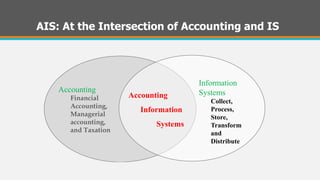
AIS: At the Intersection of Accounting and IS
Accounting
Financial
Accounting,
Managerial
accounting,
and Taxation
Accounting
Information
Systems
Information
Systems
Collect,
Process,
Store,
Transform
and
Distribute
AIS
• Collection of data and processing procedures
• Creates needed information for users.
• AIS don’t just support accounting and finance business processes. They
often create information that is useful to non-Accountants
Finance: cash forecasts and actual payment and receipt information
Marketing: Sales, summary analyses, cost information, and sales forecasts
Human Resources: payroll analyses( including employee benefit
information) and projections of future personnel costs
Production: inventory summaries and product cost analyses
History of Accounting Information Systems
Accounting information systems were predominantly developed “in-house” as
legacy systems. Such solutions were difficult to develop and expensive to maintain.
Today, accounting information systems are more commonly sold as prebuilt software
packages from vendors such as Microsoft, Sage Group, SAP and Oracle where it is
configured and customized to match the organization’s business processes. As the
need for connectivity and consolidation between other business systems increased,
accounting information systems were merged with larger, more centralized systems
known as enterprise resource planning
The Effect of Modern Technology in Accounting
Technology has greatly improved the accounting industry over the past several
decades. As personal computers have become standard office equipment, companies
have utilized accounting software as replacements for standard paper ledgers and
loose-leaf binders. Companies have also been able to customize their technology
needs to their business operations, eliminating unnecessary tasks in their accounting
processes. In addition to increased productivity, companies have developed faster
financial reporting and centralized accounting operations.
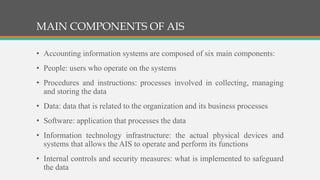
MAIN COMPONENTS OF AIS
• Accounting information systems are composed of six main components:
• People: users who operate on the systems
• Procedures and instructions: processes involved in collecting, managing
and storing the data
• Data: data that is related to the organization and its business processes
• Software: application that processes the data
• Information technology infrastructure: the actual physical devices and
systems that allows the AIS to operate and perform its functions
• Internal controls and security measures: what is implemented to safeguard
the data
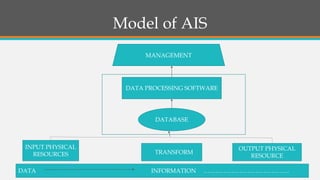
Model of AIS
MANAGEMENT
DATA PROCESSING SOFTWARE
DATABASE
INPUT PHYSICAL
RESOURCES TRANSFORM
OUTPUT PHYSICAL
RESOURCE
DATA INFORMATION …………………………………….
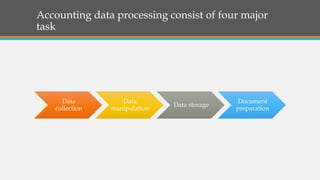
Accounting data processing consist of four major
task
Data
collection
Data
manipulation
Data storage
Document
preparation
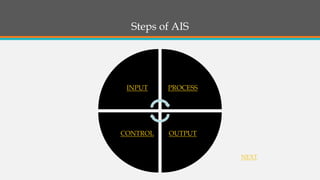
Steps of AIS
INPUT PROCESS
OUTPUTCONTROL
NEXT
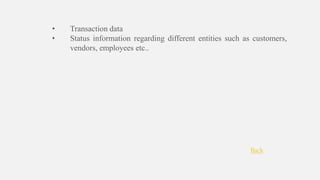
• Transaction data
• Status information regarding different entities such as customers,
vendors, employees etc..
Back
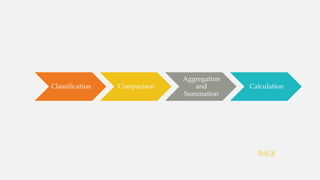
Classification Comparison
Aggregation
and
Summation
Calculation
BACK
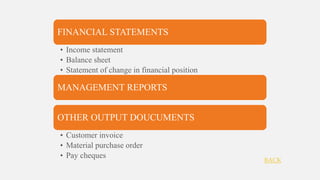
FINANCIAL STATEMENTS
• Income statement
• Balance sheet
• Statement of change in financial position
MANAGEMENT REPORTS
OTHER OUTPUT DOUCUMENTS
• Customer invoice
• Material purchase order
• Pay cheques
BACK
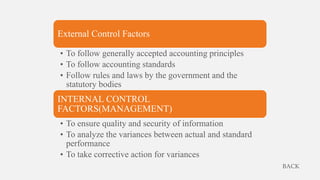
External Control Factors
• To follow generally accepted accounting principles
• To follow accounting standards
• Follow rules and laws by the government and the
statutory bodies
INTERNAL CONTROL
FACTORS(MANAGEMENT)
• To ensure quality and security of information
• To analyze the variances between actual and standard
performance
• To take corrective action for variances
BACK
Objective of AIS
• To provide reliable accounting information to different users.
• Supporting routine activities
• To meet statutory reporting needs of an enterprise.
• To protect the enterprise from the possible risk of misuse of accounting data.
PURPOSES OF AIS
• Inventory control
• Sales order processing
• Accounts receivable
• Accounts payable
• Payroll
• General ledger
USE OF AIS BY
• Various customers
• Manager
• Consultant
• Evaluator
• Provider of accounting and tax services
Limitation of Accounting Information System
• COST
• RELIABILITY OF COMPUTERS
• FRAUD
• ADDITIONAL SOFTWARE
• HUMAN ERROR
• TRAINING
Careers in Accounting Information Systems
Systems consultants
provide help with information systems in
 Designing information systems,
 Selecting hardware and software, or
 Re-engineering business processes.
Value-added resellers (VARs)
Sell a certain software program and
Provide consulting services to companies ain software program and
provide consulting services to companies.
Accounting information system

Accounting information system

  • 1.
  • 2.
    CONTENT • DATAAND INFORMATION •WHAT IS AIS • HISTORY OF AIS • EFFECT OF MODERN TECHNOLOGY ON AIS • COMPONENT • MODEL OF AIS • STEPS IN AIS • OBJECTIVE ,PURPOSE AND USE OF AIS • LIMITATION OF AIS • CAREER OPPORTUNITIES IN AIS
  • 3.
    Difference Between Dataand Information • Data means facts maybe numeric, Texts, pictures, graphs etc… • It may be represented by symbols • Data is input • Information is processed data • More meaningful for users • Information is output
  • 4.
    AIS: At theIntersection of Accounting and IS Accounting Financial Accounting, Managerial accounting, and Taxation Accounting Information Systems Information Systems Collect, Process, Store, Transform and Distribute
  • 5.
    AIS • Collection ofdata and processing procedures • Creates needed information for users. • AIS don’t just support accounting and finance business processes. They often create information that is useful to non-Accountants Finance: cash forecasts and actual payment and receipt information Marketing: Sales, summary analyses, cost information, and sales forecasts Human Resources: payroll analyses( including employee benefit information) and projections of future personnel costs Production: inventory summaries and product cost analyses
  • 6.
    History of AccountingInformation Systems Accounting information systems were predominantly developed “in-house” as legacy systems. Such solutions were difficult to develop and expensive to maintain. Today, accounting information systems are more commonly sold as prebuilt software packages from vendors such as Microsoft, Sage Group, SAP and Oracle where it is configured and customized to match the organization’s business processes. As the need for connectivity and consolidation between other business systems increased, accounting information systems were merged with larger, more centralized systems known as enterprise resource planning
  • 7.
    The Effect ofModern Technology in Accounting Technology has greatly improved the accounting industry over the past several decades. As personal computers have become standard office equipment, companies have utilized accounting software as replacements for standard paper ledgers and loose-leaf binders. Companies have also been able to customize their technology needs to their business operations, eliminating unnecessary tasks in their accounting processes. In addition to increased productivity, companies have developed faster financial reporting and centralized accounting operations.
  • 8.
    MAIN COMPONENTS OFAIS • Accounting information systems are composed of six main components: • People: users who operate on the systems • Procedures and instructions: processes involved in collecting, managing and storing the data • Data: data that is related to the organization and its business processes • Software: application that processes the data • Information technology infrastructure: the actual physical devices and systems that allows the AIS to operate and perform its functions • Internal controls and security measures: what is implemented to safeguard the data
  • 9.
    Model of AIS MANAGEMENT DATAPROCESSING SOFTWARE DATABASE INPUT PHYSICAL RESOURCES TRANSFORM OUTPUT PHYSICAL RESOURCE DATA INFORMATION …………………………………….
  • 10.
    Accounting data processingconsist of four major task Data collection Data manipulation Data storage Document preparation
  • 11.
    Steps of AIS INPUTPROCESS OUTPUTCONTROL NEXT
  • 12.
    • Transaction data •Status information regarding different entities such as customers, vendors, employees etc.. Back
  • 13.
  • 14.
    FINANCIAL STATEMENTS • Incomestatement • Balance sheet • Statement of change in financial position MANAGEMENT REPORTS OTHER OUTPUT DOUCUMENTS • Customer invoice • Material purchase order • Pay cheques BACK
  • 15.
    External Control Factors •To follow generally accepted accounting principles • To follow accounting standards • Follow rules and laws by the government and the statutory bodies INTERNAL CONTROL FACTORS(MANAGEMENT) • To ensure quality and security of information • To analyze the variances between actual and standard performance • To take corrective action for variances BACK
  • 16.
    Objective of AIS •To provide reliable accounting information to different users. • Supporting routine activities • To meet statutory reporting needs of an enterprise. • To protect the enterprise from the possible risk of misuse of accounting data.
  • 17.
    PURPOSES OF AIS •Inventory control • Sales order processing • Accounts receivable • Accounts payable • Payroll • General ledger
  • 18.
    USE OF AISBY • Various customers • Manager • Consultant • Evaluator • Provider of accounting and tax services
  • 19.
    Limitation of AccountingInformation System • COST • RELIABILITY OF COMPUTERS • FRAUD • ADDITIONAL SOFTWARE • HUMAN ERROR • TRAINING
  • 20.
    Careers in AccountingInformation Systems Systems consultants provide help with information systems in  Designing information systems,  Selecting hardware and software, or  Re-engineering business processes. Value-added resellers (VARs) Sell a certain software program and Provide consulting services to companies ain software program and provide consulting services to companies.