System Analysis and Design
Chapter 1: The systems analyst and information systems development
At the end of this chapter:
●Explain the role of system analyst in information systems development.
●Describe the fundamental systems development life cycle and its four
phases.
●Explain the importance of linking the information system to business
needs.
●Be able to create a system request.
●Describe technical, economic, and organizational feasibility assessment.
●Be able to perform a feasibility analysis.
Systems Development Life Cycle
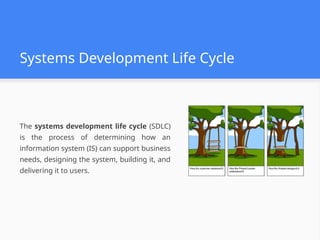
The systems development life cycle (SDLC)
is the process of determining how an
information system (IS) can support business
needs, designing the system, building it, and
delivering it to users.
The Systems Analyst
● Works closely with all project team members so that the team develops the
right system in an effective way.
● Must understand how to apply technology to solve business problems.
● Serve as change agents who identify the organizational improvements
needed, design systems to implement those changes, and train and motivate
others to use the systems.
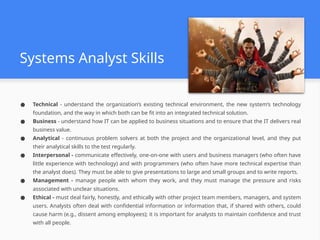
Systems Analyst Skills
● Technical - understand the organization’s existing technical environment, the new system’s technology
foundation, and the way in which both can be fit into an integrated technical solution.
● Business - understand how IT can be applied to business situations and to ensure that the IT delivers real
business value.
● Analytical - continuous problem solvers at both the project and the organizational level, and they put
their analytical skills to the test regularly.
● Interpersonal - communicate effectively, one-on-one with users and business managers (who often have
little experience with technology) and with programmers (who often have more technical expertise than
the analyst does). They must be able to give presentations to large and small groups and to write reports.
● Management - manage people with whom they work, and they must manage the pressure and risks
associated with unclear situations.
● Ethical - must deal fairly, honestly, and ethically with other project team members, managers, and system
users. Analysts often deal with confidential information or information that, if shared with others, could
cause harm (e.g., dissent among employees); it is important for analysts to maintain confidence and trust
with all people.
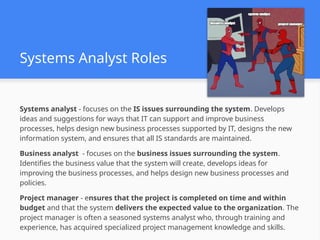
Systems Analyst Roles
Systems analyst - focuses on the IS issues surrounding the system. Develops
ideas and suggestions for ways that IT can support and improve business
processes, helps design new business processes supported by IT, designs the new
information system, and ensures that all IS standards are maintained.
Business analyst - focuses on the business issues surrounding the system.
Identifies the business value that the system will create, develops ideas for
improving the business processes, and helps design new business processes and
policies.
Project manager - ensures that the project is completed on time and within
budget and that the system delivers the expected value to the organization. The
project manager is often a seasoned systems analyst who, through training and
experience, has acquired specialized project management knowledge and skills.
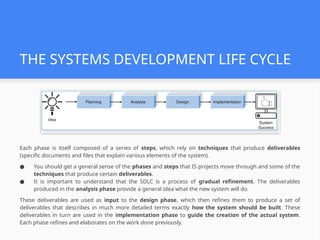
THE SYSTEMS DEVELOPMENT LIFE CYCLE
Each phase is itself composed of a series of steps, which rely on techniques that produce deliverables
(specific documents and files that explain various elements of the system).
● You should get a general sense of the phases and steps that IS projects move through and some of the
techniques that produce certain deliverables.
● It is important to understand that the SDLC is a process of gradual refinement. The deliverables
produced in the analysis phase provide a general idea what the new system will do.
These deliverables are used as input to the design phase, which then refines them to produce a set of
deliverables that describes in much more detailed terms exactly how the system should be built. These
deliverables in turn are used in the implementation phase to guide the creation of the actual system.
Each phase refines and elaborates on the work done previously.
Systems Development Life Cycle Phases
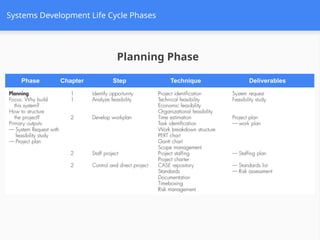
Planning Phase
Purpose: Understand why an information system should be built and determine how the
project team will build it.
Steps:
1. Project Initiation:
a. Identify Business Value: Determine how the system will lower costs or increase
revenues.
b. Source of Ideas: New system ideas often originate from non-IS departments (e.g.,
marketing, accounting).
c. System Request: A brief summary of business needs and how the system will
create value.
d. Feasibility Analysis: Evaluate the project's viability:
i. Technical Feasibility: Can we build it?
ii. Economic Feasibility: Will it provide business value?
iii. Organizational Feasibility: If we build it, will it be used?
e. Approval: Present the system request and feasibility analysis to an information
systems approval committee (or steering committee) for a decision on whether to
proceed.
2. Project Management:
a. Project Plan: Once approved, the project manager creates a plan outlining how
the project will be developed.
b. Work Plan & Staffing: Develop a work plan and staff the project.
c. Control & Direction: Implement techniques to control and direct the project
through the SDLC.
Systems Development Life Cycle Phases
Phase Chapter Step Technique Deliverables
Planning Phase
Systems Development Life Cycle Phases
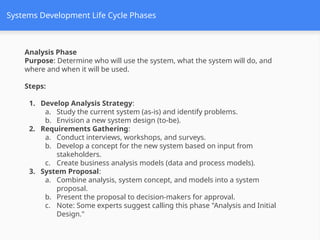
Analysis Phase
Purpose: Determine who will use the system, what the system will do, and
where and when it will be used.
Steps:
1. Develop Analysis Strategy:
a. Study the current system (as-is) and identify problems.
b. Envision a new system design (to-be).
2. Requirements Gathering:
a. Conduct interviews, workshops, and surveys.
b. Develop a concept for the new system based on input from
stakeholders.
c. Create business analysis models (data and process models).
3. System Proposal:
a. Combine analysis, system concept, and models into a system
proposal.
b. Present the proposal to decision-makers for approval.
c. Note: Some experts suggest calling this phase "Analysis and Initial
Design."
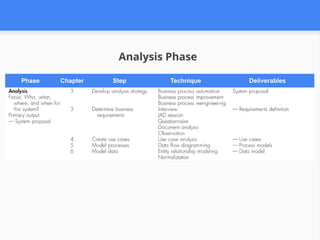
Phase Chapter Step Technique Deliverables
Analysis Phase
Systems Development Life Cycle Phases
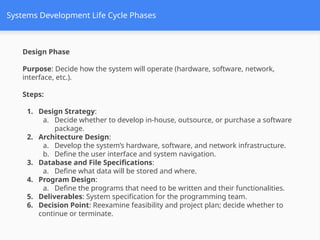
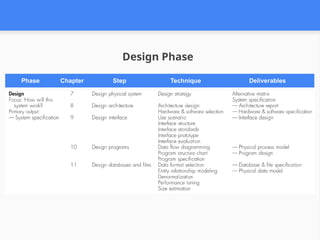
Design Phase
Purpose: Decide how the system will operate (hardware, software, network,
interface, etc.).
Steps:
1. Design Strategy:
a. Decide whether to develop in-house, outsource, or purchase a software
package.
2. Architecture Design:
a. Develop the system’s hardware, software, and network infrastructure.
b. Define the user interface and system navigation.
3. Database and File Specifications:
a. Define what data will be stored and where.
4. Program Design:
a. Define the programs that need to be written and their functionalities.
5. Deliverables: System specification for the programming team.
6. Decision Point: Reexamine feasibility and project plan; decide whether to
continue or terminate.
Phase Chapter Step Technique Deliverables
Design Phase
Systems Development Life Cycle Phases
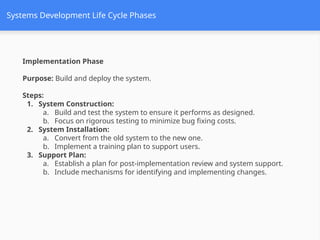
Implementation Phase
Purpose: Build and deploy the system.
Steps:
1. System Construction:
a. Build and test the system to ensure it performs as designed.
b. Focus on rigorous testing to minimize bug fixing costs.
2. System Installation:
a. Convert from the old system to the new one.
b. Implement a training plan to support users.
3. Support Plan:
a. Establish a plan for post-implementation review and system support.
b. Include mechanisms for identifying and implementing changes.
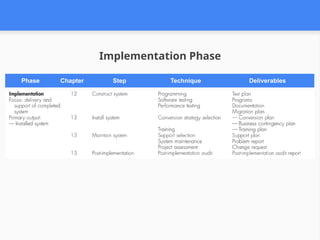
Phase Chapter Step Technique Deliverables
Implementation Phase
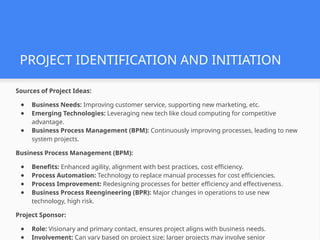
PROJECT IDENTIFICATION AND INITIATION
Sources of Project Ideas:
● Business Needs: Improving customer service, supporting new marketing, etc.
● Emerging Technologies: Leveraging new tech like cloud computing for competitive
advantage.
● Business Process Management (BPM): Continuously improving processes, leading to new
system projects.
Business Process Management (BPM):
● Benefits: Enhanced agility, alignment with best practices, cost efficiency.
● Process Automation: Technology to replace manual processes for cost efficiencies.
● Process Improvement: Redesigning processes for better efficiency and effectiveness.
● Business Process Reengineering (BPR): Major changes in operations to use new
technology, high risk.
Project Sponsor:
● Role: Visionary and primary contact, ensures project aligns with business needs.
● Involvement: Can vary based on project size; larger projects may involve senior
PROJECT IDENTIFICATION AND INITIATION
System Request:
● Components: Project sponsor, business need, business requirements, business value, special
issues.
● Purpose: Formally initiate the project by submitting for approval.
Feasibility Analysis:
● Technical Feasibility: Can we build it? (assess risks like familiarity, size, compatibility).
● Economic Feasibility: Should we build it? (cost-benefit analysis, ROI, break-even point).
● Organizational Feasibility: Will they come? (support from stakeholders, strategic alignment).
System Request
Purpose
● Describes business reasons for building a system.
● Outlines the expected value the system will provide.
Completion:
● Typically completed by the project sponsor.
● Part of a formal project selection process within an organization.
System Request
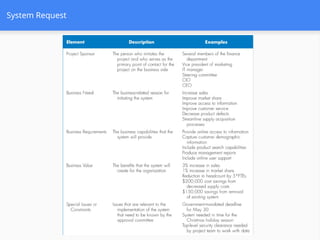
Elements of a System Request:
● Project Sponsor: Primary contact for the project.
● Business Need: Reasons prompting the project.
● Business Requirements: Capabilities the system must have.
● Business Value: Expected benefits from the system.
● Special Issues: Other considerations (e.g., deadlines).
Approval Process:
● Submitted to an approval committee or decision-making body.
● The committee reviews and decides whether to proceed with further
investigation.
● If approved, the next step is to conduct a feasibility analysis.
System Request
Applying the Concepts
Tune Source is a company headquartered in southern California. Tune Source is the
brainchild of three entrepreneurs with ties to the music industry: John Margolis, Megan
Taylor, and Phil Cooper. Originally, John and Phil partnered to open a number of brick and
mortar stores in southern California specializing in hard-to-find and classic jazz, rock,
country, and folk recordings. Megan soon was invited to join the partnership because of
her contacts and knowledge of classical music. Tune Source quickly became known as the
place to go to find rare audio recordings. Annual sales last year were $40 million with
annual growth at about 3%–5% per year.
Background
John, Megan, and Phil, like many others in the music industry, watched with alarm the rise
of music-sharing websites like Napster, as music consumers shared digital audio files
without paying for them, denying artists and record labels royalties associated with sales.
Once the legal battle over copyright infringement was resolved and Napster was shut
down, the partners set about establishing agreements with a variety of industry partners
in order to offer a legitimate digital music download resource for customers in their
market niche. Phil has asked Carly Edwards, a rising star in the Tune Source marketing
department, to spearhead the digital music download project. Tune Source currently has
a website that enables customers to search for and purchase CDs. This site was initially
developed by an Internet consulting firm and is hosted by a prominent local Internet
Service Provider (ISP) in Los Angeles. The IT department at Tune Source has become
experienced with Internet technology as it has worked with the ISP to maintain the site.
Applying the Concepts
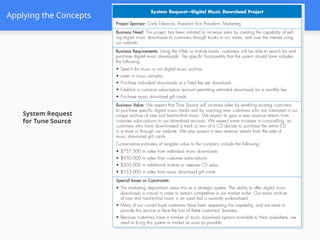
System Request
for Tune Source
Feasibility Analysis
Purpose:
● Assesses whether a proposed system project should proceed.
● Identifies risks and helps in managing them.
Components:
● Technical Feasibility: Can we build it?
○ Familiarity with application and technology.
○ Project size and system compatibility.
● Economic Feasibility: Should we build it?
○ Development costs vs. benefits (ROI, BEP, NPV).
● Organizational Feasibility: If we build it, will they come?
○ Alignment with business objectives and stakeholder support.
Feasibility Analysis
Process:
● Conducted after system request approval.
● Results in a feasibility study deliverable.
● Revisable throughout the SDLC as project conditions change.
Outcome:
● Guides project decision-making.
● Ensures that investments are wise and risks are managed.
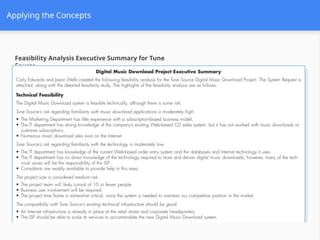
Applying the Concepts
Feasibility Analysis Executive Summary for Tune
Source
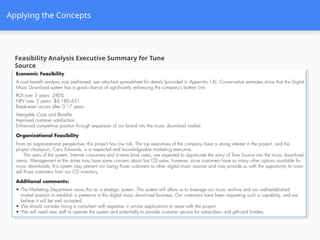
Applying the Concepts
Feasibility Analysis Executive Summary for Tune
Source
Summary
Systems Analyst Skills and Specializations:
● Role: Systems analysts analyze business situations, identify improvement opportunities, and
design systems that add value. They act as change agents within organizations.
● Skills Required: Technical, business, analytical, interpersonal, management, and ethical skills.
● Specializations: Analysts may focus on areas like business analysis, requirements analysis,
infrastructure, change management, or project management.
System Development Life Cycle (SDLC):
● Process: The SDLC is a structured process for system development, including:
1. Planning: Identify business value, conduct feasibility analysis, and plan the project.
2. Analysis: Develop strategies, gather information, and create analysis models.
3. Design: Create design strategies, physical and architecture designs, interface and
database designs, and program design.
4. Implementation: Build, install, and maintain the system.
Summary
Project Identification and Initiation:
● Project Identification: Starts with recognizing a business need that IT can address.
● Project Initiation: Involves creating and assessing goals and expectations for a new
system, starting with identifying business value and developing a system request.
System Request:
● Purpose: A document outlining the business value, sponsor, needs, requirements, and
value of the proposed system, submitted to an approval committee for evaluation.
Feasibility Analysis:
● Technical Feasibility: Assesses if the system can be built, considering risks like familiarity
with the application, technology, project size, and system compatibility.
● Economic Feasibility: Determines if the system should be built through a cost-benefit
analysis.
● Organizational Feasibility: Evaluates system acceptance by users, its alignment with
business strategy, and stakeholder support.
Assignment
1. Compare and contrast the role of a systems analyst, business analyst,
and infrastructure analyst.
2. Describe the major phases in the systems development life cycle
(SDLC).
3. What are the purposes of the system request and the feasibility
analysis?
Group Project - Part 1
Each group will propose a system to be developed throughout the semester. The
groups are encouraged to propose a system that can be used by the school. By the
end of the semester, students are expected to have at least completed the first
iteration of the project, with features that can already be used by stakeholders and
users. The SDLC framework to be used for these projects will be discussed in the
upcoming chapters.
For now, each group is expected to submit the following:
1. System Request
2. Feasibility Analysis

1. The systems analyst and information systems development.pptx

  • 1.
    System Analysis andDesign Chapter 1: The systems analyst and information systems development
  • 2.
    At the endof this chapter: ●Explain the role of system analyst in information systems development. ●Describe the fundamental systems development life cycle and its four phases. ●Explain the importance of linking the information system to business needs. ●Be able to create a system request. ●Describe technical, economic, and organizational feasibility assessment. ●Be able to perform a feasibility analysis.
  • 3.
    Systems Development LifeCycle The systems development life cycle (SDLC) is the process of determining how an information system (IS) can support business needs, designing the system, building it, and delivering it to users.
  • 4.
    The Systems Analyst ●Works closely with all project team members so that the team develops the right system in an effective way. ● Must understand how to apply technology to solve business problems. ● Serve as change agents who identify the organizational improvements needed, design systems to implement those changes, and train and motivate others to use the systems.
  • 5.
    Systems Analyst Skills ●Technical - understand the organization’s existing technical environment, the new system’s technology foundation, and the way in which both can be fit into an integrated technical solution. ● Business - understand how IT can be applied to business situations and to ensure that the IT delivers real business value. ● Analytical - continuous problem solvers at both the project and the organizational level, and they put their analytical skills to the test regularly. ● Interpersonal - communicate effectively, one-on-one with users and business managers (who often have little experience with technology) and with programmers (who often have more technical expertise than the analyst does). They must be able to give presentations to large and small groups and to write reports. ● Management - manage people with whom they work, and they must manage the pressure and risks associated with unclear situations. ● Ethical - must deal fairly, honestly, and ethically with other project team members, managers, and system users. Analysts often deal with confidential information or information that, if shared with others, could cause harm (e.g., dissent among employees); it is important for analysts to maintain confidence and trust with all people.
  • 6.
    Systems Analyst Roles Systemsanalyst - focuses on the IS issues surrounding the system. Develops ideas and suggestions for ways that IT can support and improve business processes, helps design new business processes supported by IT, designs the new information system, and ensures that all IS standards are maintained. Business analyst - focuses on the business issues surrounding the system. Identifies the business value that the system will create, develops ideas for improving the business processes, and helps design new business processes and policies. Project manager - ensures that the project is completed on time and within budget and that the system delivers the expected value to the organization. The project manager is often a seasoned systems analyst who, through training and experience, has acquired specialized project management knowledge and skills.
  • 7.
    THE SYSTEMS DEVELOPMENTLIFE CYCLE Each phase is itself composed of a series of steps, which rely on techniques that produce deliverables (specific documents and files that explain various elements of the system). ● You should get a general sense of the phases and steps that IS projects move through and some of the techniques that produce certain deliverables. ● It is important to understand that the SDLC is a process of gradual refinement. The deliverables produced in the analysis phase provide a general idea what the new system will do. These deliverables are used as input to the design phase, which then refines them to produce a set of deliverables that describes in much more detailed terms exactly how the system should be built. These deliverables in turn are used in the implementation phase to guide the creation of the actual system. Each phase refines and elaborates on the work done previously.
  • 8.
    Systems Development LifeCycle Phases Planning Phase Purpose: Understand why an information system should be built and determine how the project team will build it. Steps: 1. Project Initiation: a. Identify Business Value: Determine how the system will lower costs or increase revenues. b. Source of Ideas: New system ideas often originate from non-IS departments (e.g., marketing, accounting). c. System Request: A brief summary of business needs and how the system will create value. d. Feasibility Analysis: Evaluate the project's viability: i. Technical Feasibility: Can we build it? ii. Economic Feasibility: Will it provide business value? iii. Organizational Feasibility: If we build it, will it be used? e. Approval: Present the system request and feasibility analysis to an information systems approval committee (or steering committee) for a decision on whether to proceed. 2. Project Management: a. Project Plan: Once approved, the project manager creates a plan outlining how the project will be developed. b. Work Plan & Staffing: Develop a work plan and staff the project. c. Control & Direction: Implement techniques to control and direct the project through the SDLC.
  • 9.
    Systems Development LifeCycle Phases Phase Chapter Step Technique Deliverables Planning Phase
  • 10.
    Systems Development LifeCycle Phases Analysis Phase Purpose: Determine who will use the system, what the system will do, and where and when it will be used. Steps: 1. Develop Analysis Strategy: a. Study the current system (as-is) and identify problems. b. Envision a new system design (to-be). 2. Requirements Gathering: a. Conduct interviews, workshops, and surveys. b. Develop a concept for the new system based on input from stakeholders. c. Create business analysis models (data and process models). 3. System Proposal: a. Combine analysis, system concept, and models into a system proposal. b. Present the proposal to decision-makers for approval. c. Note: Some experts suggest calling this phase "Analysis and Initial Design."
  • 11.
    Phase Chapter StepTechnique Deliverables Analysis Phase
  • 12.
    Systems Development LifeCycle Phases Design Phase Purpose: Decide how the system will operate (hardware, software, network, interface, etc.). Steps: 1. Design Strategy: a. Decide whether to develop in-house, outsource, or purchase a software package. 2. Architecture Design: a. Develop the system’s hardware, software, and network infrastructure. b. Define the user interface and system navigation. 3. Database and File Specifications: a. Define what data will be stored and where. 4. Program Design: a. Define the programs that need to be written and their functionalities. 5. Deliverables: System specification for the programming team. 6. Decision Point: Reexamine feasibility and project plan; decide whether to continue or terminate.
  • 13.
    Phase Chapter StepTechnique Deliverables Design Phase
  • 14.
    Systems Development LifeCycle Phases Implementation Phase Purpose: Build and deploy the system. Steps: 1. System Construction: a. Build and test the system to ensure it performs as designed. b. Focus on rigorous testing to minimize bug fixing costs. 2. System Installation: a. Convert from the old system to the new one. b. Implement a training plan to support users. 3. Support Plan: a. Establish a plan for post-implementation review and system support. b. Include mechanisms for identifying and implementing changes.
  • 15.
    Phase Chapter StepTechnique Deliverables Implementation Phase
  • 16.
    PROJECT IDENTIFICATION ANDINITIATION Sources of Project Ideas: ● Business Needs: Improving customer service, supporting new marketing, etc. ● Emerging Technologies: Leveraging new tech like cloud computing for competitive advantage. ● Business Process Management (BPM): Continuously improving processes, leading to new system projects. Business Process Management (BPM): ● Benefits: Enhanced agility, alignment with best practices, cost efficiency. ● Process Automation: Technology to replace manual processes for cost efficiencies. ● Process Improvement: Redesigning processes for better efficiency and effectiveness. ● Business Process Reengineering (BPR): Major changes in operations to use new technology, high risk. Project Sponsor: ● Role: Visionary and primary contact, ensures project aligns with business needs. ● Involvement: Can vary based on project size; larger projects may involve senior
  • 17.
    PROJECT IDENTIFICATION ANDINITIATION System Request: ● Components: Project sponsor, business need, business requirements, business value, special issues. ● Purpose: Formally initiate the project by submitting for approval. Feasibility Analysis: ● Technical Feasibility: Can we build it? (assess risks like familiarity, size, compatibility). ● Economic Feasibility: Should we build it? (cost-benefit analysis, ROI, break-even point). ● Organizational Feasibility: Will they come? (support from stakeholders, strategic alignment).
  • 18.
    System Request Purpose ● Describesbusiness reasons for building a system. ● Outlines the expected value the system will provide. Completion: ● Typically completed by the project sponsor. ● Part of a formal project selection process within an organization.
  • 19.
    System Request Elements ofa System Request: ● Project Sponsor: Primary contact for the project. ● Business Need: Reasons prompting the project. ● Business Requirements: Capabilities the system must have. ● Business Value: Expected benefits from the system. ● Special Issues: Other considerations (e.g., deadlines). Approval Process: ● Submitted to an approval committee or decision-making body. ● The committee reviews and decides whether to proceed with further investigation. ● If approved, the next step is to conduct a feasibility analysis.
  • 20.
  • 21.
    Applying the Concepts TuneSource is a company headquartered in southern California. Tune Source is the brainchild of three entrepreneurs with ties to the music industry: John Margolis, Megan Taylor, and Phil Cooper. Originally, John and Phil partnered to open a number of brick and mortar stores in southern California specializing in hard-to-find and classic jazz, rock, country, and folk recordings. Megan soon was invited to join the partnership because of her contacts and knowledge of classical music. Tune Source quickly became known as the place to go to find rare audio recordings. Annual sales last year were $40 million with annual growth at about 3%–5% per year. Background John, Megan, and Phil, like many others in the music industry, watched with alarm the rise of music-sharing websites like Napster, as music consumers shared digital audio files without paying for them, denying artists and record labels royalties associated with sales. Once the legal battle over copyright infringement was resolved and Napster was shut down, the partners set about establishing agreements with a variety of industry partners in order to offer a legitimate digital music download resource for customers in their market niche. Phil has asked Carly Edwards, a rising star in the Tune Source marketing department, to spearhead the digital music download project. Tune Source currently has a website that enables customers to search for and purchase CDs. This site was initially developed by an Internet consulting firm and is hosted by a prominent local Internet Service Provider (ISP) in Los Angeles. The IT department at Tune Source has become experienced with Internet technology as it has worked with the ISP to maintain the site.
  • 22.
    Applying the Concepts SystemRequest for Tune Source
  • 23.
    Feasibility Analysis Purpose: ● Assesseswhether a proposed system project should proceed. ● Identifies risks and helps in managing them. Components: ● Technical Feasibility: Can we build it? ○ Familiarity with application and technology. ○ Project size and system compatibility. ● Economic Feasibility: Should we build it? ○ Development costs vs. benefits (ROI, BEP, NPV). ● Organizational Feasibility: If we build it, will they come? ○ Alignment with business objectives and stakeholder support.
  • 24.
    Feasibility Analysis Process: ● Conductedafter system request approval. ● Results in a feasibility study deliverable. ● Revisable throughout the SDLC as project conditions change. Outcome: ● Guides project decision-making. ● Ensures that investments are wise and risks are managed.
  • 25.
    Applying the Concepts FeasibilityAnalysis Executive Summary for Tune Source
  • 26.
    Applying the Concepts FeasibilityAnalysis Executive Summary for Tune Source
  • 27.
    Summary Systems Analyst Skillsand Specializations: ● Role: Systems analysts analyze business situations, identify improvement opportunities, and design systems that add value. They act as change agents within organizations. ● Skills Required: Technical, business, analytical, interpersonal, management, and ethical skills. ● Specializations: Analysts may focus on areas like business analysis, requirements analysis, infrastructure, change management, or project management. System Development Life Cycle (SDLC): ● Process: The SDLC is a structured process for system development, including: 1. Planning: Identify business value, conduct feasibility analysis, and plan the project. 2. Analysis: Develop strategies, gather information, and create analysis models. 3. Design: Create design strategies, physical and architecture designs, interface and database designs, and program design. 4. Implementation: Build, install, and maintain the system.
  • 28.
    Summary Project Identification andInitiation: ● Project Identification: Starts with recognizing a business need that IT can address. ● Project Initiation: Involves creating and assessing goals and expectations for a new system, starting with identifying business value and developing a system request. System Request: ● Purpose: A document outlining the business value, sponsor, needs, requirements, and value of the proposed system, submitted to an approval committee for evaluation. Feasibility Analysis: ● Technical Feasibility: Assesses if the system can be built, considering risks like familiarity with the application, technology, project size, and system compatibility. ● Economic Feasibility: Determines if the system should be built through a cost-benefit analysis. ● Organizational Feasibility: Evaluates system acceptance by users, its alignment with business strategy, and stakeholder support.
  • 29.
    Assignment 1. Compare andcontrast the role of a systems analyst, business analyst, and infrastructure analyst. 2. Describe the major phases in the systems development life cycle (SDLC). 3. What are the purposes of the system request and the feasibility analysis?
  • 30.
    Group Project -Part 1 Each group will propose a system to be developed throughout the semester. The groups are encouraged to propose a system that can be used by the school. By the end of the semester, students are expected to have at least completed the first iteration of the project, with features that can already be used by stakeholders and users. The SDLC framework to be used for these projects will be discussed in the upcoming chapters. For now, each group is expected to submit the following: 1. System Request 2. Feasibility Analysis