Empathy Prepared by: Pankaj Prabhakar
Contents  Meaning Why Empathy ??? Difference between  Pity, Sympathy, Emotional Contagion, Empathy,  Apathy  Factors of Empathizing with others Benefits of Empathetic Listening How to become Empathetic Listener Guidelines for  Empathic Listening
Meaning of Empathy understand another's state of mind or  Empathy  is the capacity to recognize or  emotion .  It is often characterized as the ability to " put oneself into another's shoes ", or to in some way experience the outlook or emotions of another being within oneself.
Why Empathy…? Maslow’s Hierarchy of Human Needs  …
Difference between  Pity, Sympathy, Emotional Contagion, Empathy,  Apathy  Pity is, "Things are bad for you, you seem as though you need help." Sympathy is, "I'm sorry for your sadness, I wish to help." Emotional Contagion is, "You feel sad and now I feel sad." Empathy is, "I recognize how you feel." Apathy is, "I don't care how you feel. "
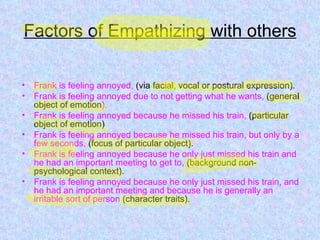
Factors of Empathizing with others Frank is feeling annoyed,  (via facial, vocal or postural expression).   Frank is feeling annoyed due to not getting what he wants,  (general object of emotion ).  Frank is feeling annoyed because he missed his train,  (particular object of emotion)  Frank is feeling annoyed because he missed his train, but only by a few seconds,  (focus of particular object).   Frank is feeling annoyed because he only just missed his train and he had an important meeting to get to,  (background non-psychological context).  Frank is feeling annoyed because he only just missed his train, and he had an important meeting and because he is generally an irritable sort of person  (character traits).
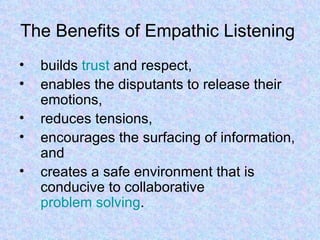
The Benefits of Empathic Listening  builds  trust  and respect,  enables the disputants to release their emotions,  reduces tensions,  encourages the surfacing of information, and  creates a safe environment that is conducive to collaborative  problem solving .
How to Listen with Empathy  willingness to let the other parties dominate the discussion,  attentiveness to what is being said,  care not to interrupt,  use of open-ended questions,  sensitivity to the emotions being expressed, and  ability to reflect back to the other party the substance and feelings being expressed
Guidelines for Empathic Listening   Be attentive. Be interested. Be alert and not distracted. Create a positive atmosphere through nonverbal behavior.  Be a sounding board -- allow the speaker to bounce ideas and feelings off you while assuming a nonjudgmental, non-critical manner.  Don't ask a lot of questions. They can give the impression you are "grilling" the speaker.  Act like a mirror -- reflect back what you think the speaker is saying and feeling.  Indicate you are listening by   Providing brief, noncommittal acknowledging responses, e.g., "Uh-huh," "I see."  Invitations to say more, e.g., "Tell me about it," "I'd like to hear about that."  Follow good listening "ground rules:"   Don't interrupt.  Don't change the subject or move in a new direction.  Don't rehearse in your own head.  Don't interrogate.  Don't teach.  Don't give advice.  Do  reflect back to the speaker what you understand and how you think the speaker feels
We appreciate your  empathetic listening... Thank you

Empathy

  • 1.
    Empathy Prepared by:Pankaj Prabhakar
  • 2.
    Contents MeaningWhy Empathy ??? Difference between Pity, Sympathy, Emotional Contagion, Empathy, Apathy Factors of Empathizing with others Benefits of Empathetic Listening How to become Empathetic Listener Guidelines for Empathic Listening
  • 3.
    Meaning of Empathyunderstand another's state of mind or Empathy is the capacity to recognize or emotion . It is often characterized as the ability to " put oneself into another's shoes ", or to in some way experience the outlook or emotions of another being within oneself.
  • 4.
    Why Empathy…? Maslow’sHierarchy of Human Needs …
  • 5.
    Difference between Pity, Sympathy, Emotional Contagion, Empathy, Apathy Pity is, "Things are bad for you, you seem as though you need help." Sympathy is, "I'm sorry for your sadness, I wish to help." Emotional Contagion is, "You feel sad and now I feel sad." Empathy is, "I recognize how you feel." Apathy is, "I don't care how you feel. "
  • 6.
    Factors of Empathizingwith others Frank is feeling annoyed, (via facial, vocal or postural expression). Frank is feeling annoyed due to not getting what he wants, (general object of emotion ). Frank is feeling annoyed because he missed his train, (particular object of emotion) Frank is feeling annoyed because he missed his train, but only by a few seconds, (focus of particular object). Frank is feeling annoyed because he only just missed his train and he had an important meeting to get to, (background non-psychological context). Frank is feeling annoyed because he only just missed his train, and he had an important meeting and because he is generally an irritable sort of person (character traits).
  • 7.
    The Benefits ofEmpathic Listening builds trust and respect, enables the disputants to release their emotions, reduces tensions, encourages the surfacing of information, and creates a safe environment that is conducive to collaborative problem solving .
  • 8.
    How to Listenwith Empathy willingness to let the other parties dominate the discussion, attentiveness to what is being said, care not to interrupt, use of open-ended questions, sensitivity to the emotions being expressed, and ability to reflect back to the other party the substance and feelings being expressed
  • 9.
    Guidelines for EmpathicListening Be attentive. Be interested. Be alert and not distracted. Create a positive atmosphere through nonverbal behavior. Be a sounding board -- allow the speaker to bounce ideas and feelings off you while assuming a nonjudgmental, non-critical manner. Don't ask a lot of questions. They can give the impression you are "grilling" the speaker. Act like a mirror -- reflect back what you think the speaker is saying and feeling. Indicate you are listening by Providing brief, noncommittal acknowledging responses, e.g., "Uh-huh," "I see." Invitations to say more, e.g., "Tell me about it," "I'd like to hear about that." Follow good listening "ground rules:" Don't interrupt. Don't change the subject or move in a new direction. Don't rehearse in your own head. Don't interrogate. Don't teach. Don't give advice. Do reflect back to the speaker what you understand and how you think the speaker feels
  • 10.
    We appreciate your empathetic listening... Thank you