JSPM’S
Charak College Of Pharmacy & Research
Gat no.720/1&2, Wagholi, Pune-Nagar Road,wagholi,
                 pune -412207


                   Detection of HPLC

   Presented By,                   Guided By,
Miss. Shradha Jedge               Dr. Rajesh J Oswal
                               Prof.Sandip Kshirsagar


Department Of Pharmaceutical Chemistry
Detection of HPLC
INDEX

 INTRODUCTION

 TYPES

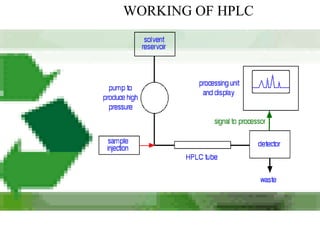
 WORKING OF HPLC
WORKING OF HPLC
WHAT IS DETECTOR

An instrument use to detect or observe.

 selection of detector is on the basis of analyze
   or sample under detection.

 visualize components of the mixture being
  eluted off the chromatography column.
Properties of detector
 Low drift and noise level (particularly crucial in trace
analysis).
 High sensitivity, Fast response, Operational simplicity
  and reliability, non-destructive, inert (non-reactive)
 Produce uniform, reliable and reproducible detection
  and analytic data.
 Compatible for all types of compounds under testing.
 Wide linear dynamic range (simplifies quantization).
 Low dead volume (minimal peak broadening).
 Cell design which eliminates remixing of the separated
  bands.
 Insensitivity to changes in type of solvent, flow rate.
 It should be tunable so that detection can be optimized
  for different compounds.
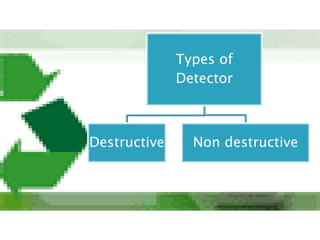
Types of
              Detector


Destructive     Non destructive
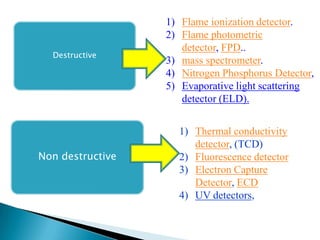
1) Flame ionization detector.
                  2) Flame photometric
                     detector, FPD..
  Destructive
                  3) mass spectrometer.
                  4) Nitrogen Phosphorus Detector,
                  5) Evaporative light scattering
                     detector (ELD).


                    1) Thermal conductivity
                       detector, (TCD)
Non destructive     2) Fluorescence detector
                    3) Electron Capture
                       Detector, ECD
                    4) UV detectors,
1) UV DETECTOR
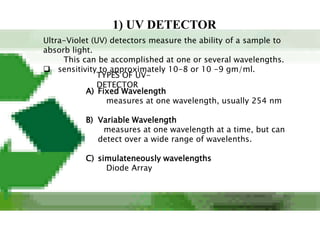
Ultra-Violet (UV) detectors measure the ability of a sample to
absorb light.
     This can be accomplished at one or several wavelengths.
 sensitivity to approximately 10-8 or 10 -9 gm/ml.
               TYPES OF UV-
               DETECTOR
           A) Fixed Wavelength
                 measures at one wavelength, usually 254 nm

          B) Variable Wavelength
              measures at one wavelength at a time, but can
             detect over a wide range of wavelenths.

          C) simulateneously wavelengths
               Diode Array
UV detectors
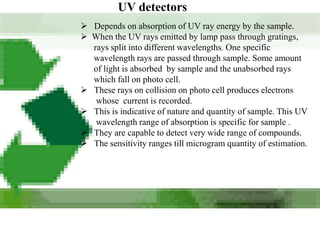
 Depends on absorption of UV ray energy by the sample.
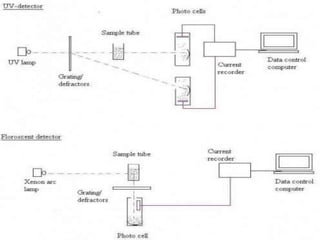
 When the UV rays emitted by lamp pass through gratings,
  rays split into different wavelengths. One specific
  wavelength rays are passed through sample. Some amount
  of light is absorbed by sample and the unabsorbed rays
  which fall on photo cell.
 These rays on collision on photo cell produces electrons
   whose current is recorded.
 This is indicative of nature and quantity of sample. This UV
   wavelength range of absorption is specific for sample .
 They are capable to detect very wide range of compounds.
 The sensitivity ranges till microgram quantity of estimation.
2) FLUORESCENCE DETECTOR

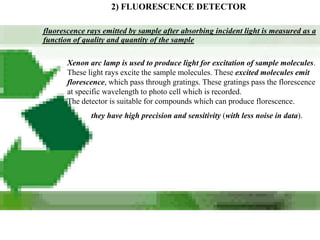
fluorescence rays emitted by sample after absorbing incident light is measured as a
function of quality and quantity of the sample

       Xenon arc lamp is used to produce light for excitation of sample molecules.
       These light rays excite the sample molecules. These excited molecules emit
       florescence, which pass through gratings. These gratings pass the florescence
       at specific wavelength to photo cell which is recorded.
       The detector is suitable for compounds which can produce florescence.
              they have high precision and sensitivity (with less noise in data).
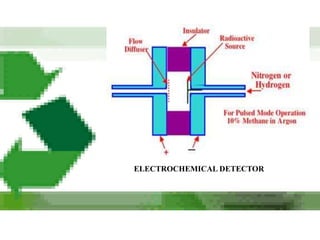
3) ELECTROCHEMICAL DETECTOR


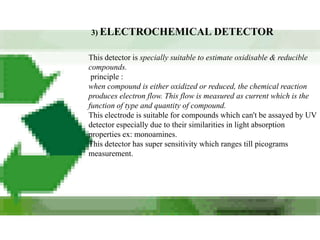
This detector is specially suitable to estimate oxidisable & reducible
compounds.
 principle :
when compound is either oxidized or reduced, the chemical reaction
produces electron flow. This flow is measured as current which is the
function of type and quantity of compound.
This electrode is suitable for compounds which can't be assayed by UV
detector especially due to their similarities in light absorption
properties ex: monoamines.
This detector has super sensitivity which ranges till picograms
measurement.
ELECTROCHEMICAL DETECTOR
4) THERMAL CONDUCTIVITY DETECTOR
(TCD)

 chemical specific detector commonly used gas-liquid chromatography.
This detector senses changes in the thermal conductivity of the column
   effluent and compares it to a reference flow of carrier gas.Since most
   compounds have a thermal conductivity much less than that of the
   common carrier gases of helium or hydrogen, when an analyte elutes
   from the column the effluent thermal conductivity is reduced, and a
  detectable signal is produced.
 Operation
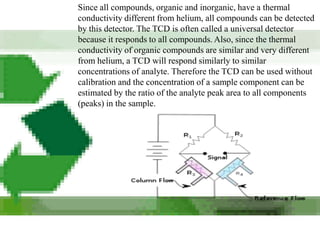
  The TCD consists of an electrically heated filament in a temperature-
  controlled cell. Under normal conditions there is a stable heat flow from
  the filament to the detector body. When an analyte elutes and the thermal
  conductivity of the column effluent is reduced, the filament heats up and
  changes resistance. This resistance change is often sensed by a
Wheatstone bridge circuit which produces a measurable voltage change.
The column effluent flows over one of the resistors while the reference flow
is over a second resistor in the four-resistor circuit.
Since all compounds, organic and inorganic, have a thermal
conductivity different from helium, all compounds can be detected
by this detector. The TCD is often called a universal detector
because it responds to all compounds. Also, since the thermal
conductivity of organic compounds are similar and very different
from helium, a TCD will respond similarly to similar
concentrations of analyte. Therefore the TCD can be used without
calibration and the concentration of a sample component can be
estimated by the ratio of the analyte peak area to all components
(peaks) in the sample.
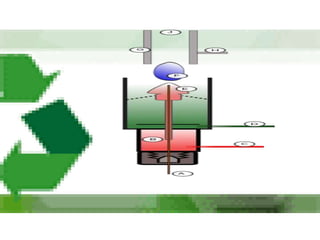
5) flame ionization detector (FID)

As the name suggests, analysis involves the detection of ions. The source of these
ions is a small hydrogen-air flame.
 Sometimes hydrogen-oxygen flames are used due to an ability to increase
detection sensitivity, however for most analysis, the use of compressed
breathable air is sufficient.
 The resulting flame burns at such a temperature as to pyrolyze most organic
compounds, producing positively charged ions and electrons.In order to detect
these ions, two electrodes are used to provide a potential difference.
The positive electrode doubles as the nozzle head where the flame is produced.
The other, negative electrode is positioned above the flame. When first
designed, the negative electrode was either tear-drop shaped or angular piece of
platinum.
Today, the design has been modified into a tubular electrode, commonly referred
to as a collector plate. The ions thus are attracted to the collector plate and upon
hitting the plate, induce a current. This current is measured with a high-
impedance picoammeter and fed into an integrator
 How the final data is displayed is based on the computer and software. In
general, a graph is displayed that has time on the x-axis and total ion on the y-
axis.The current measured corresponds roughly to the proportion of reduced
carbon atoms in the flame.
Specifically how the ions are produced is not necessarily understood, but the
response of the detector is determined by the number of carbon atoms (ions)
Thank you

Shradha jedge

  • 1.
    JSPM’S Charak College OfPharmacy & Research Gat no.720/1&2, Wagholi, Pune-Nagar Road,wagholi, pune -412207 Detection of HPLC Presented By, Guided By, Miss. Shradha Jedge Dr. Rajesh J Oswal Prof.Sandip Kshirsagar Department Of Pharmaceutical Chemistry
  • 2.
  • 3.
  • 4.
  • 5.
    WHAT IS DETECTOR Aninstrument use to detect or observe.  selection of detector is on the basis of analyze or sample under detection.  visualize components of the mixture being eluted off the chromatography column.
  • 6.
    Properties of detector Low drift and noise level (particularly crucial in trace analysis).  High sensitivity, Fast response, Operational simplicity and reliability, non-destructive, inert (non-reactive)  Produce uniform, reliable and reproducible detection and analytic data.  Compatible for all types of compounds under testing.  Wide linear dynamic range (simplifies quantization).  Low dead volume (minimal peak broadening).  Cell design which eliminates remixing of the separated bands.  Insensitivity to changes in type of solvent, flow rate.  It should be tunable so that detection can be optimized for different compounds.
  • 7.
    Types of Detector Destructive Non destructive
  • 8.
    1) Flame ionizationdetector. 2) Flame photometric detector, FPD.. Destructive 3) mass spectrometer. 4) Nitrogen Phosphorus Detector, 5) Evaporative light scattering detector (ELD). 1) Thermal conductivity detector, (TCD) Non destructive 2) Fluorescence detector 3) Electron Capture Detector, ECD 4) UV detectors,
  • 9.
    1) UV DETECTOR Ultra-Violet(UV) detectors measure the ability of a sample to absorb light. This can be accomplished at one or several wavelengths.  sensitivity to approximately 10-8 or 10 -9 gm/ml. TYPES OF UV- DETECTOR A) Fixed Wavelength measures at one wavelength, usually 254 nm B) Variable Wavelength measures at one wavelength at a time, but can detect over a wide range of wavelenths. C) simulateneously wavelengths Diode Array
  • 10.
    UV detectors  Dependson absorption of UV ray energy by the sample.  When the UV rays emitted by lamp pass through gratings, rays split into different wavelengths. One specific wavelength rays are passed through sample. Some amount of light is absorbed by sample and the unabsorbed rays which fall on photo cell.  These rays on collision on photo cell produces electrons whose current is recorded.  This is indicative of nature and quantity of sample. This UV wavelength range of absorption is specific for sample .  They are capable to detect very wide range of compounds.  The sensitivity ranges till microgram quantity of estimation.
  • 12.
    2) FLUORESCENCE DETECTOR fluorescencerays emitted by sample after absorbing incident light is measured as a function of quality and quantity of the sample Xenon arc lamp is used to produce light for excitation of sample molecules. These light rays excite the sample molecules. These excited molecules emit florescence, which pass through gratings. These gratings pass the florescence at specific wavelength to photo cell which is recorded. The detector is suitable for compounds which can produce florescence. they have high precision and sensitivity (with less noise in data).
  • 13.
    3) ELECTROCHEMICAL DETECTOR Thisdetector is specially suitable to estimate oxidisable & reducible compounds. principle : when compound is either oxidized or reduced, the chemical reaction produces electron flow. This flow is measured as current which is the function of type and quantity of compound. This electrode is suitable for compounds which can't be assayed by UV detector especially due to their similarities in light absorption properties ex: monoamines. This detector has super sensitivity which ranges till picograms measurement.
  • 14.
  • 15.
    4) THERMAL CONDUCTIVITYDETECTOR (TCD)  chemical specific detector commonly used gas-liquid chromatography. This detector senses changes in the thermal conductivity of the column effluent and compares it to a reference flow of carrier gas.Since most compounds have a thermal conductivity much less than that of the common carrier gases of helium or hydrogen, when an analyte elutes from the column the effluent thermal conductivity is reduced, and a detectable signal is produced. Operation The TCD consists of an electrically heated filament in a temperature- controlled cell. Under normal conditions there is a stable heat flow from the filament to the detector body. When an analyte elutes and the thermal conductivity of the column effluent is reduced, the filament heats up and changes resistance. This resistance change is often sensed by a Wheatstone bridge circuit which produces a measurable voltage change. The column effluent flows over one of the resistors while the reference flow is over a second resistor in the four-resistor circuit.
  • 16.
    Since all compounds,organic and inorganic, have a thermal conductivity different from helium, all compounds can be detected by this detector. The TCD is often called a universal detector because it responds to all compounds. Also, since the thermal conductivity of organic compounds are similar and very different from helium, a TCD will respond similarly to similar concentrations of analyte. Therefore the TCD can be used without calibration and the concentration of a sample component can be estimated by the ratio of the analyte peak area to all components (peaks) in the sample.
  • 17.
    5) flame ionizationdetector (FID) As the name suggests, analysis involves the detection of ions. The source of these ions is a small hydrogen-air flame. Sometimes hydrogen-oxygen flames are used due to an ability to increase detection sensitivity, however for most analysis, the use of compressed breathable air is sufficient. The resulting flame burns at such a temperature as to pyrolyze most organic compounds, producing positively charged ions and electrons.In order to detect these ions, two electrodes are used to provide a potential difference. The positive electrode doubles as the nozzle head where the flame is produced. The other, negative electrode is positioned above the flame. When first designed, the negative electrode was either tear-drop shaped or angular piece of platinum. Today, the design has been modified into a tubular electrode, commonly referred to as a collector plate. The ions thus are attracted to the collector plate and upon hitting the plate, induce a current. This current is measured with a high- impedance picoammeter and fed into an integrator How the final data is displayed is based on the computer and software. In general, a graph is displayed that has time on the x-axis and total ion on the y- axis.The current measured corresponds roughly to the proportion of reduced carbon atoms in the flame. Specifically how the ions are produced is not necessarily understood, but the response of the detector is determined by the number of carbon atoms (ions)
  • 19.