BASICS OF LCMS SHIMADZU MODEL
8040 & CHROMATOGHAPHY METHOD
DEVELOPMENT
 BY Prashik Sudhir Shimpi
 Mpharm QA
07Nov2020
1
WHAT IS MASS SPECTROMETER?
“A mass spectrometer is an instrument that
measures the masses of individual
molecules that have been converted to
ions...”
from “What is Mass Spectrometry” by ASMS
“A mass spectrometer is universal ion
detector ... not a universal detector”
2
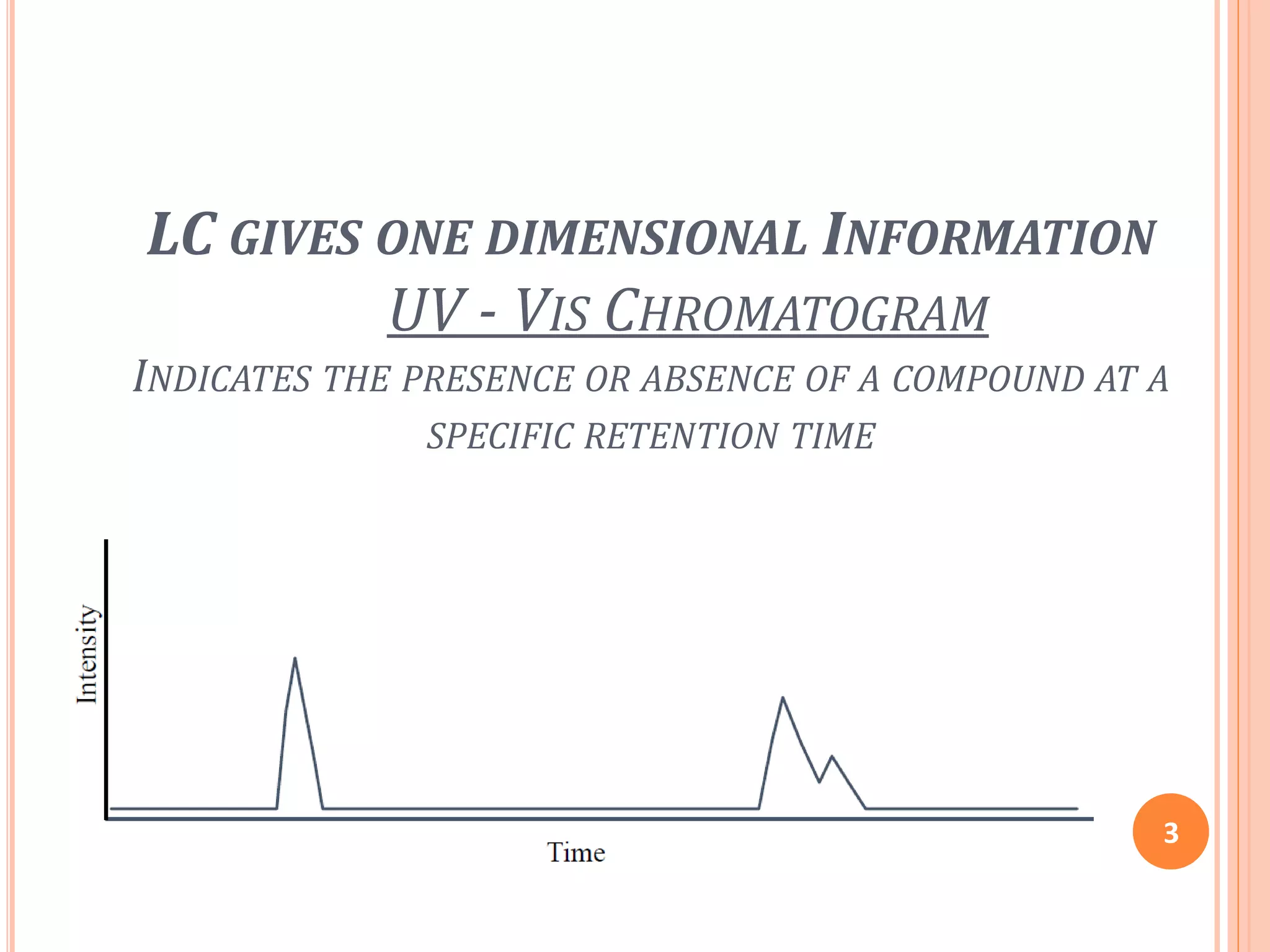
LC GIVES ONE DIMENSIONAL INFORMATION
UV - VIS CHROMATOGRAM
INDICATES THE PRESENCE OR ABSENCE OF A COMPOUND AT A
SPECIFIC RETENTION TIME
3
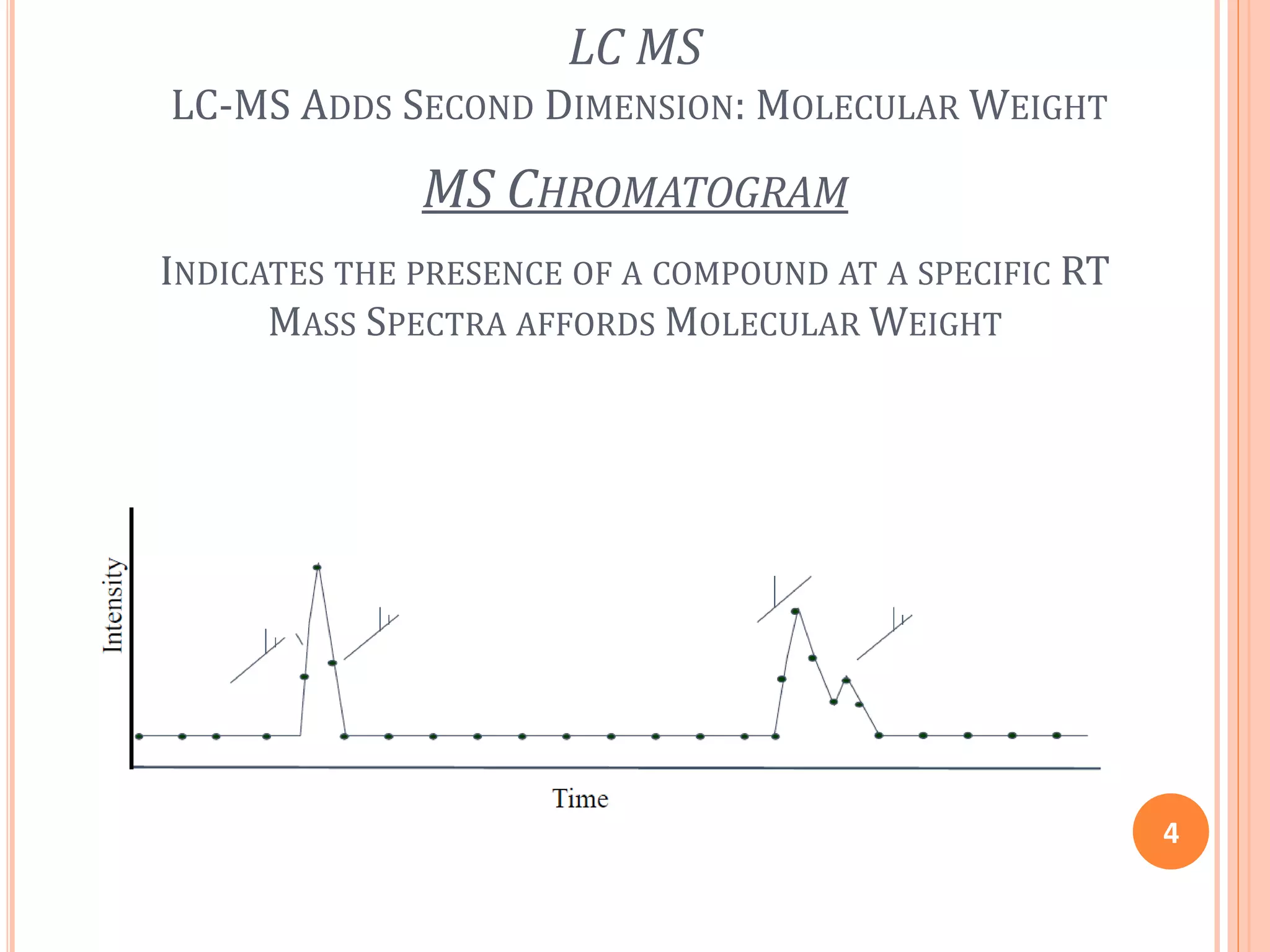
LC MS
LC-MS ADDS SECOND DIMENSION: MOLECULAR WEIGHT
MS CHROMATOGRAM
INDICATES THE PRESENCE OF A COMPOUND AT A SPECIFIC RT
MASS SPECTRA AFFORDS MOLECULAR WEIGHT
4
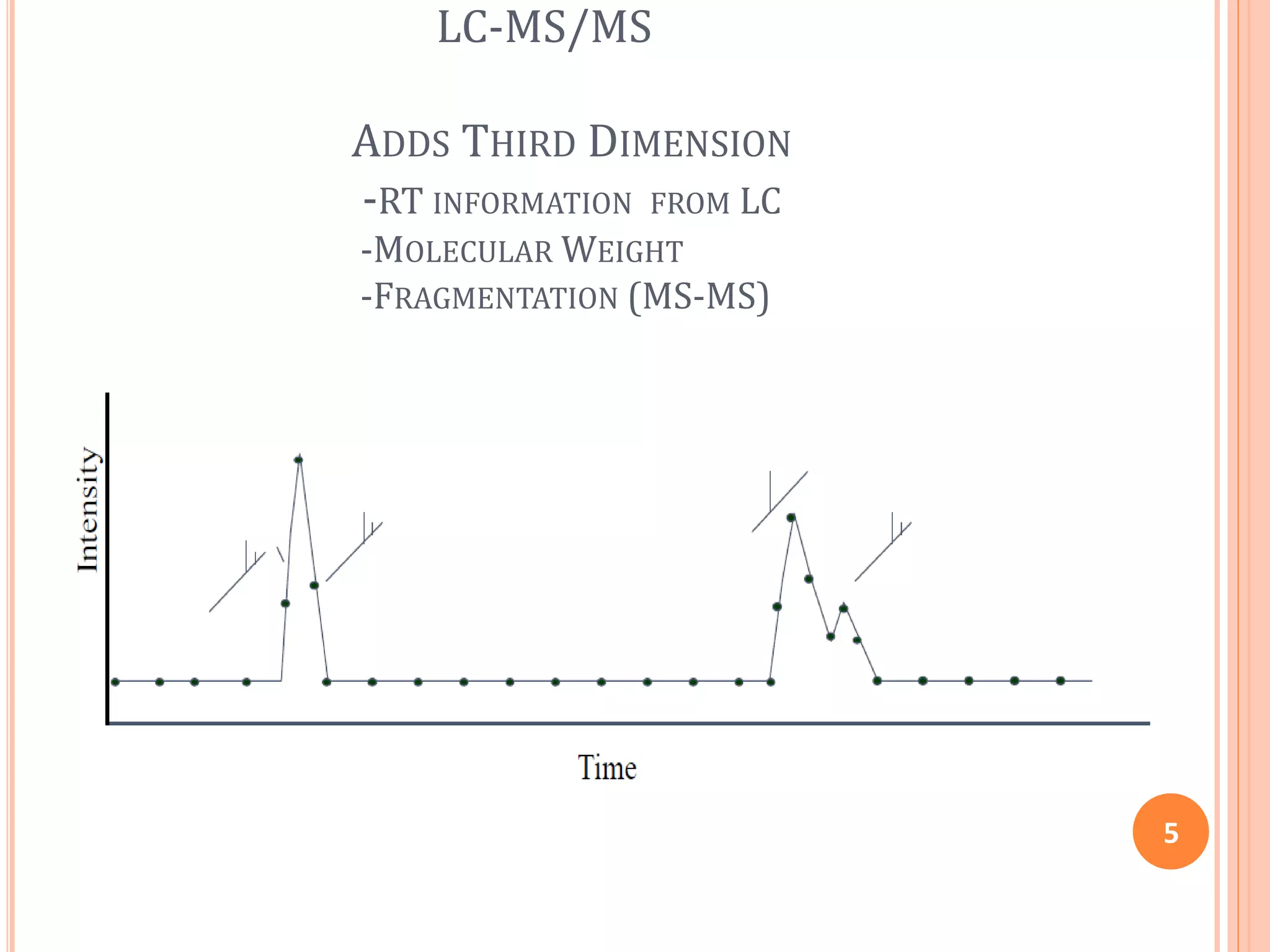
LC-MS/MS
ADDS THIRD DIMENSION
-RT INFORMATION FROM LC
-MOLECULAR WEIGHT
-FRAGMENTATION (MS-MS)
5
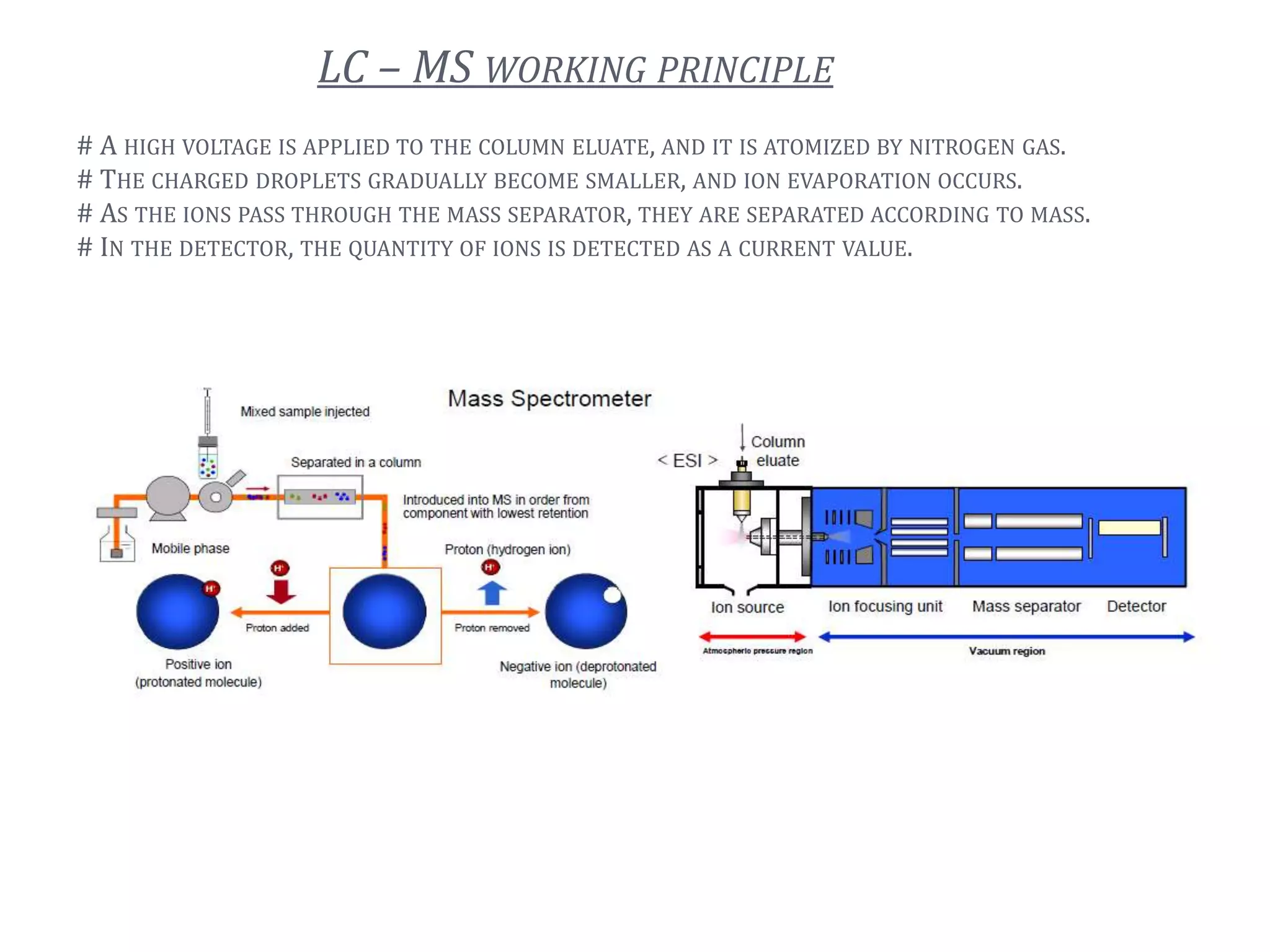
LC – MS WORKING PRINCIPLE
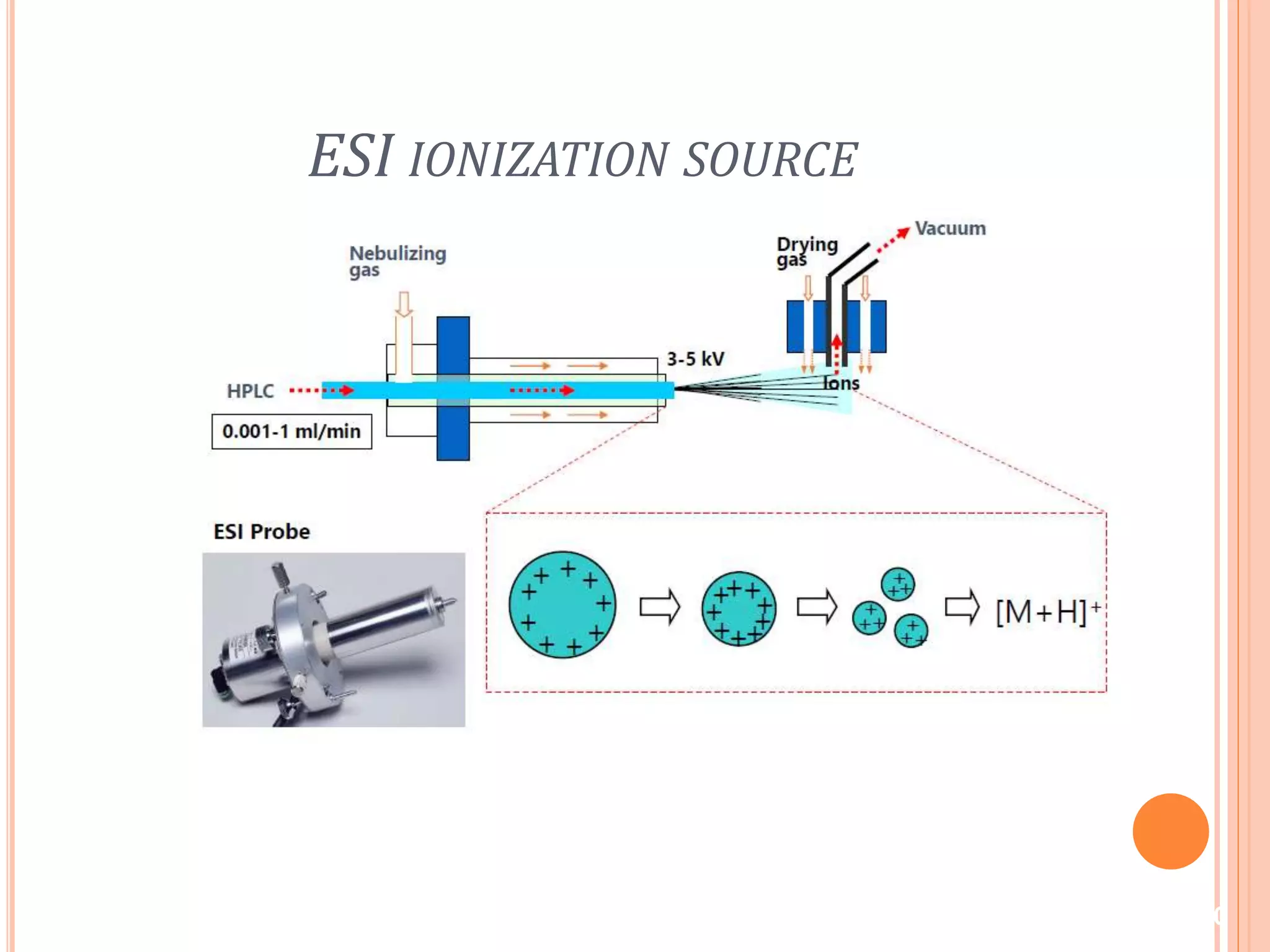
# A HIGH VOLTAGE IS APPLIED TO THE COLUMN ELUATE, AND IT IS ATOMIZED BY NITROGEN GAS.
# THE CHARGED DROPLETS GRADUALLY BECOME SMALLER, AND ION EVAPORATION OCCURS.
# AS THE IONS PASS THROUGH THE MASS SEPARATOR, THEY ARE SEPARATED ACCORDING TO MASS.
# IN THE DETECTOR, THE QUANTITY OF IONS IS DETECTED AS A CURRENT VALUE.
6
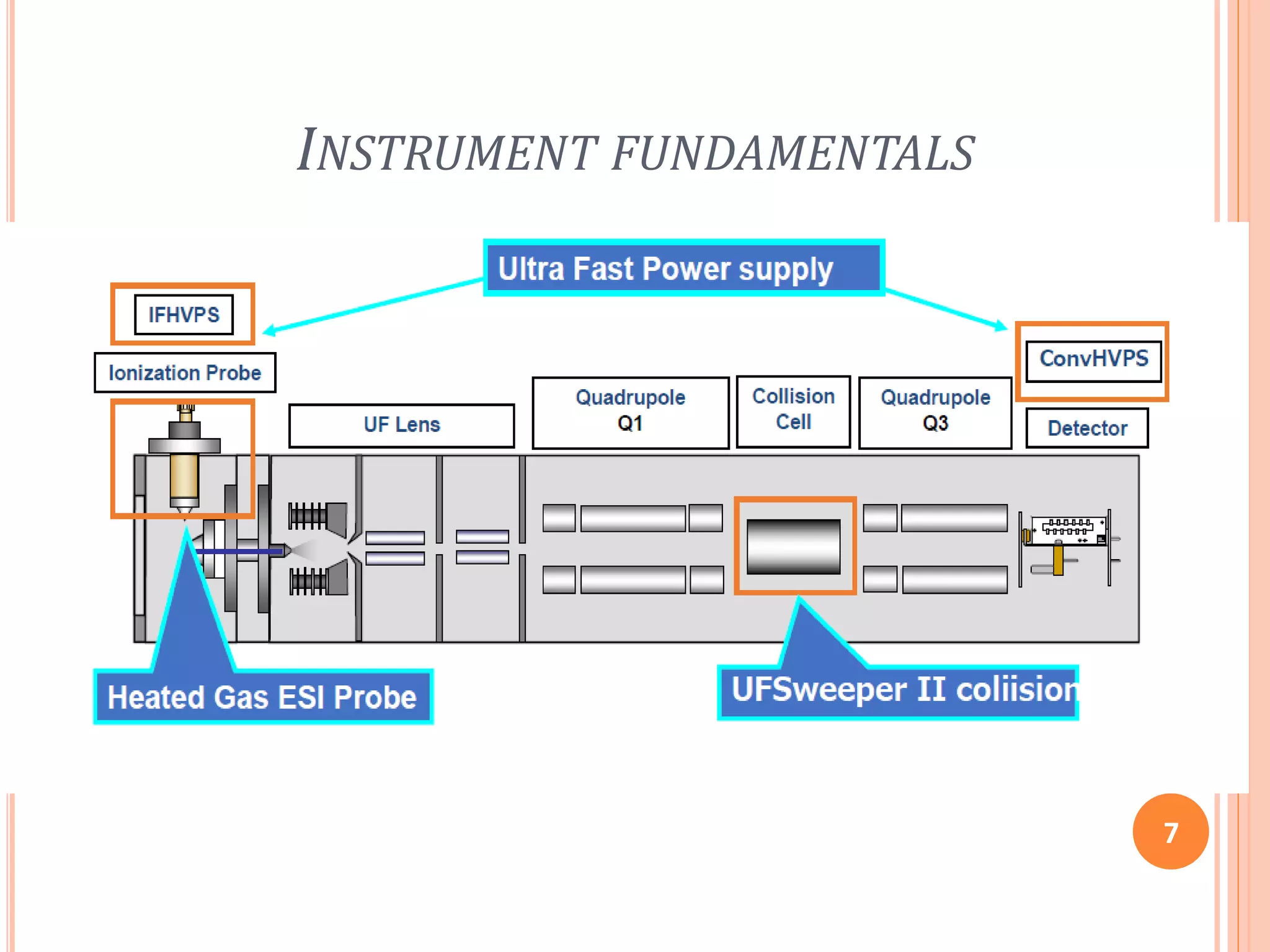
INSTRUMENT FUNDAMENTALS
7
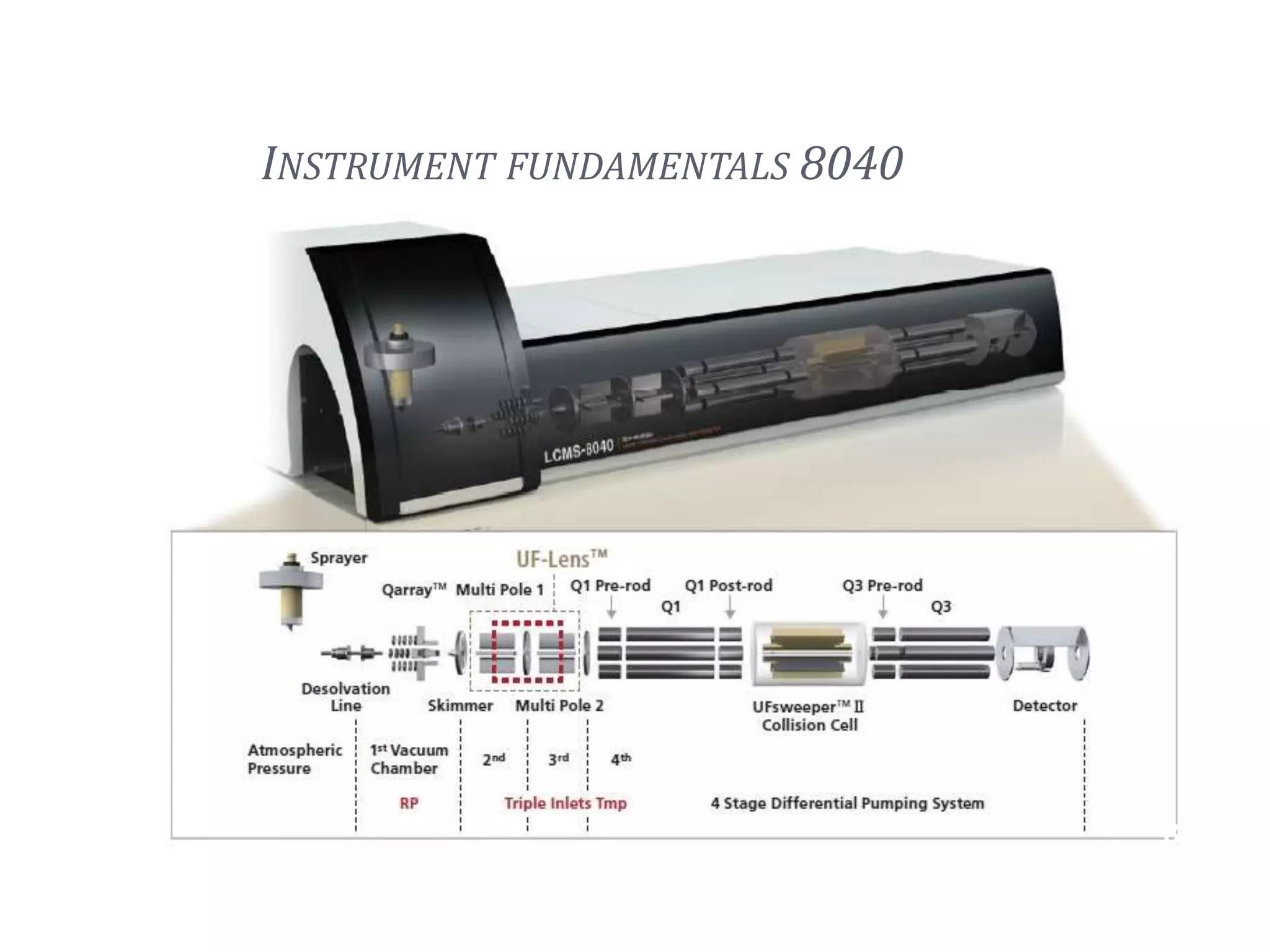
INSTRUMENT FUNDAMENTALS 8040
8
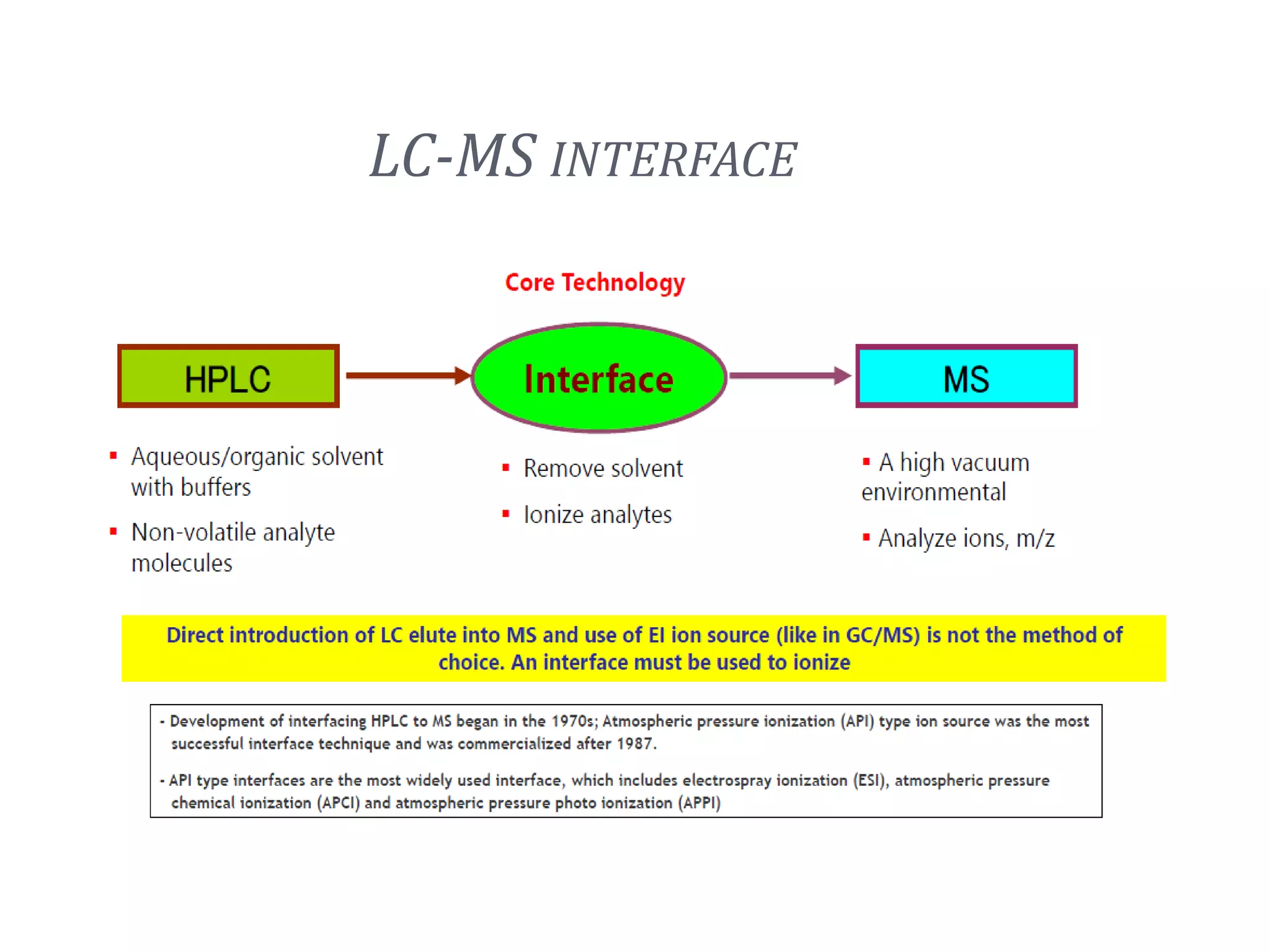
LC-MS INTERFACE
9
ESI IONIZATION SOURCE
10
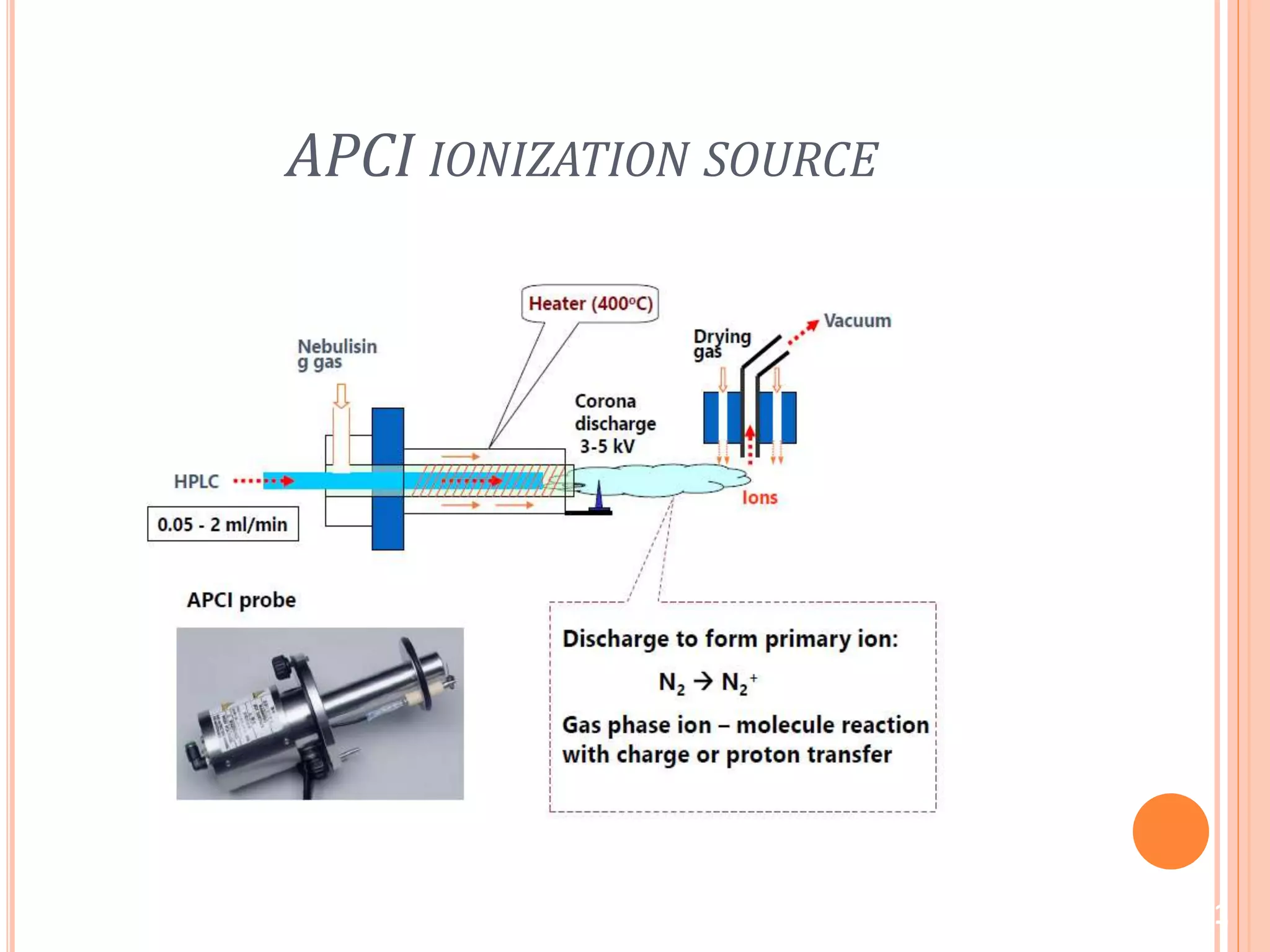
APCI IONIZATION SOURCE
11
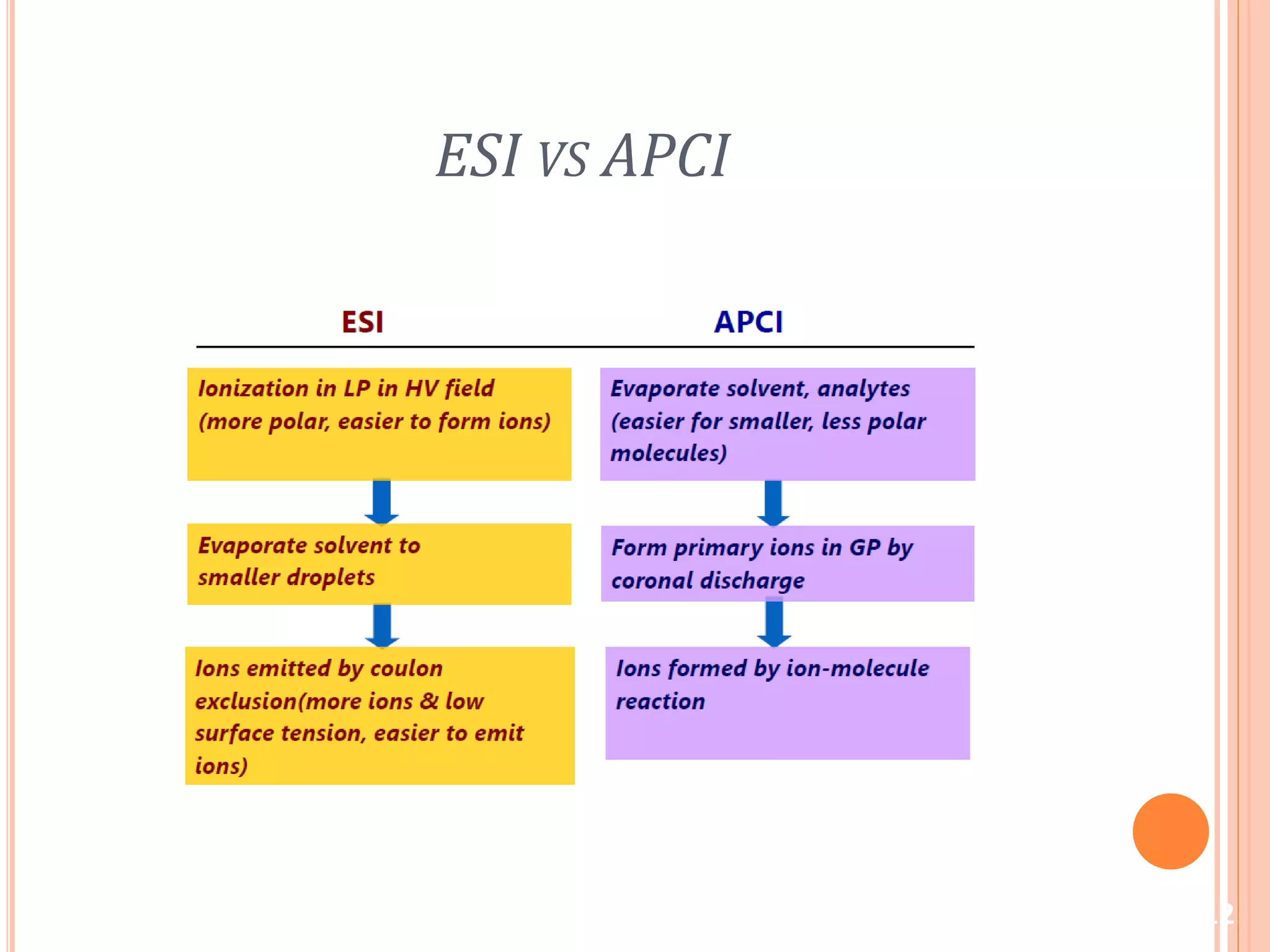
ESI VS APCI
12
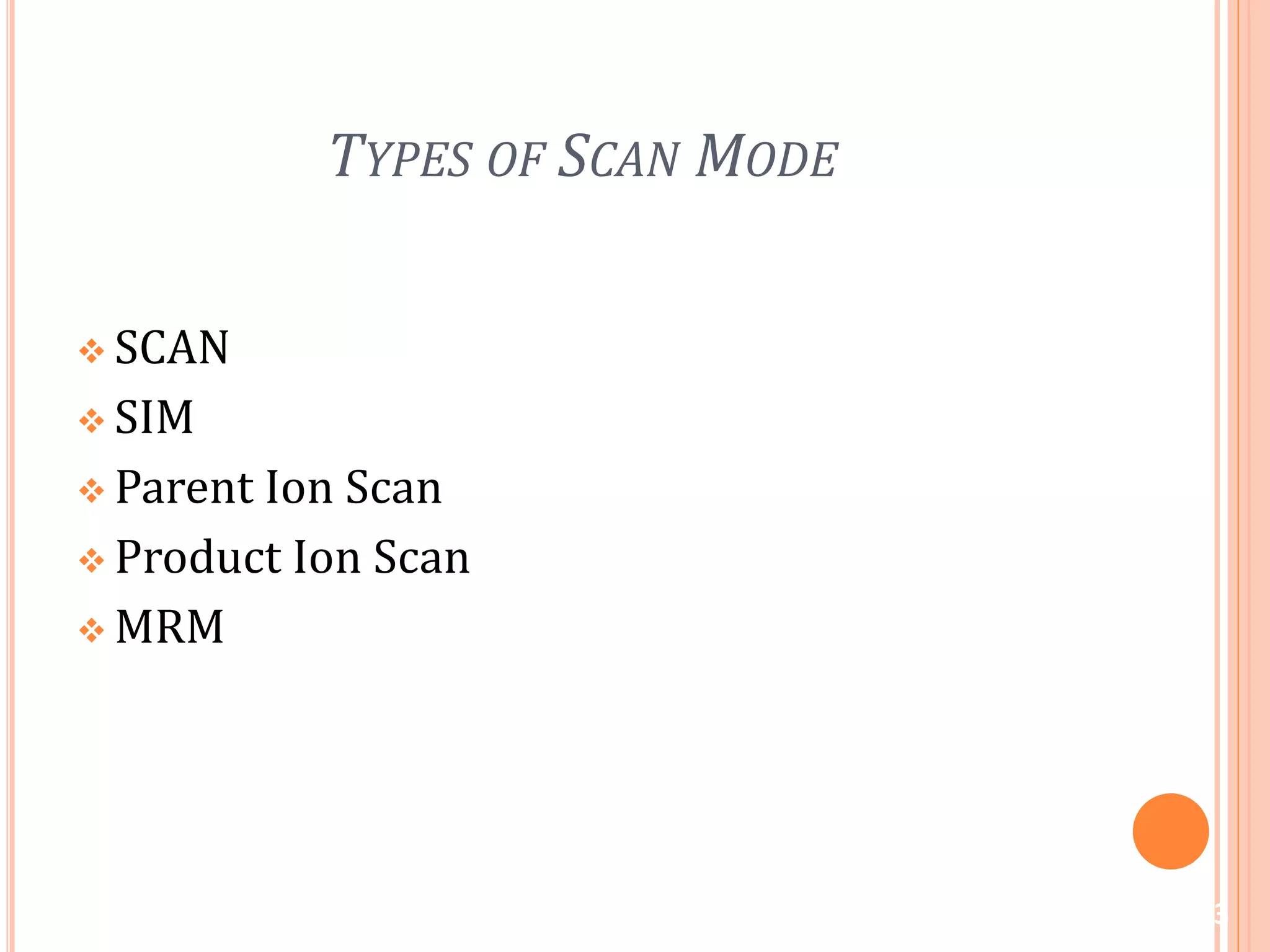
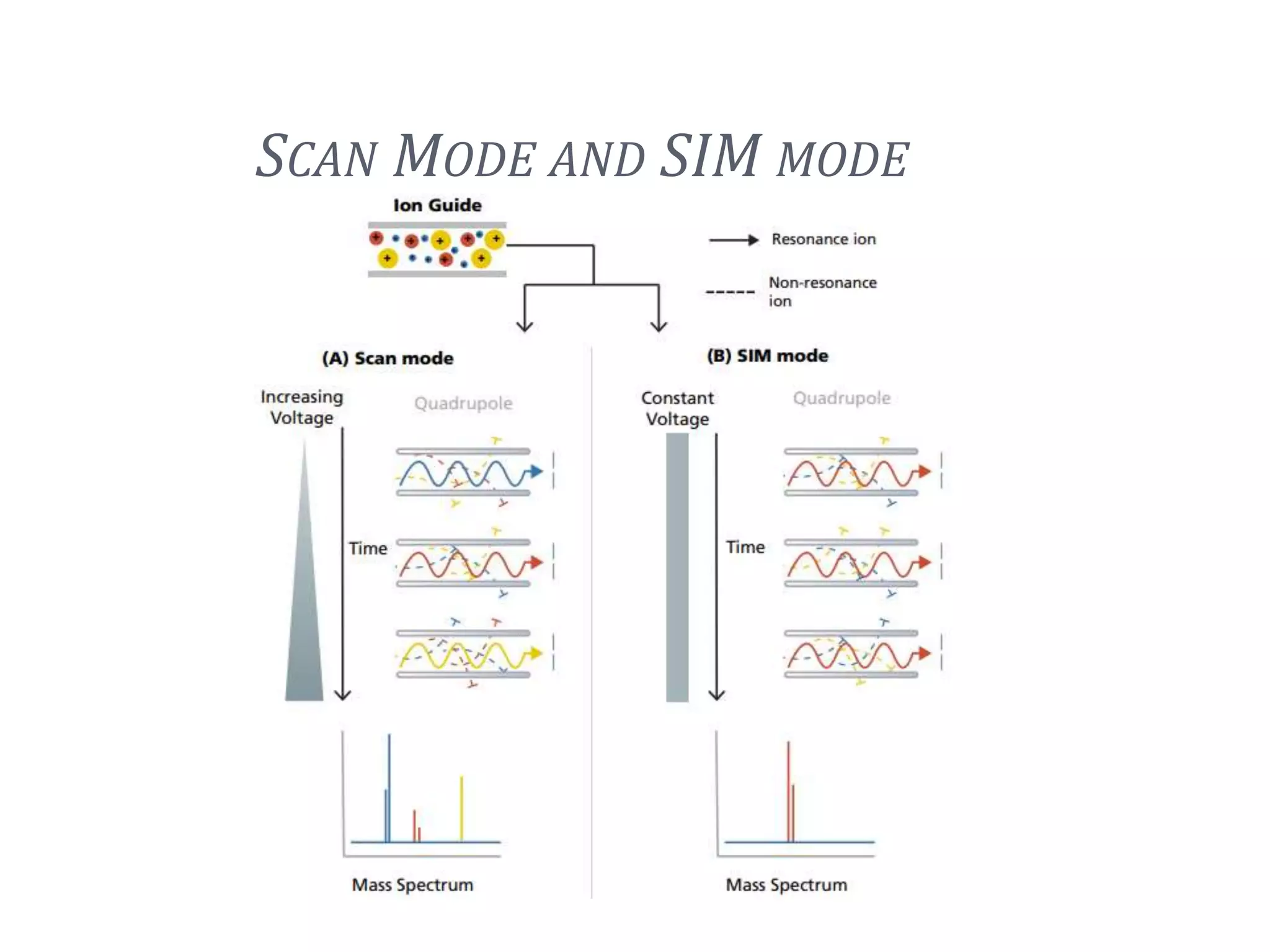
TYPES OF SCAN MODE
 SCAN
 SIM
 Parent Ion Scan
 Product Ion Scan
 MRM
13
SCAN MODE AND SIM MODE
14
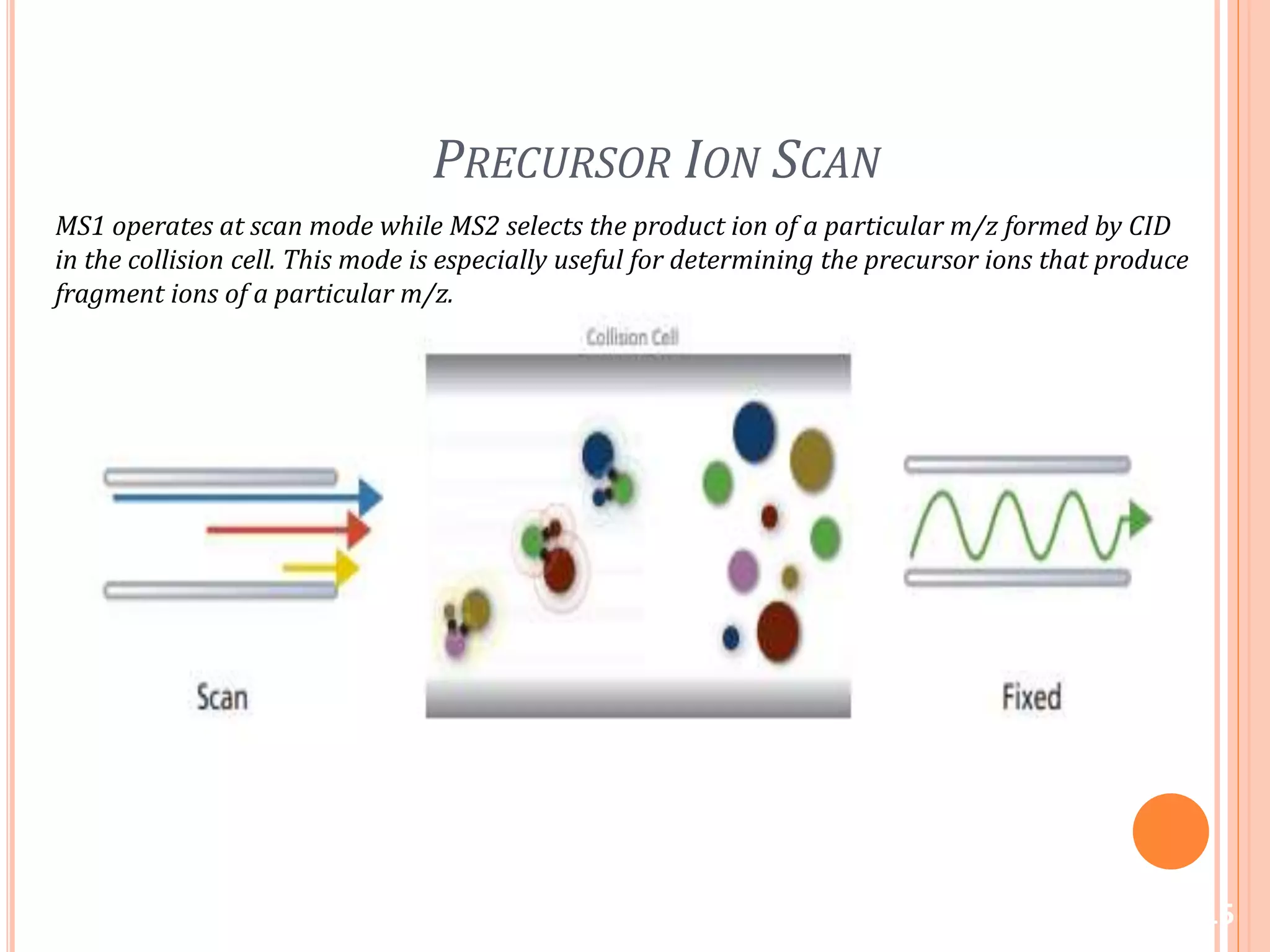
PRECURSOR ION SCAN
15
MS1 operates at scan mode while MS2 selects the product ion of a particular m/z formed by CID
in the collision cell. This mode is especially useful for determining the precursor ions that produce
fragment ions of a particular m/z.
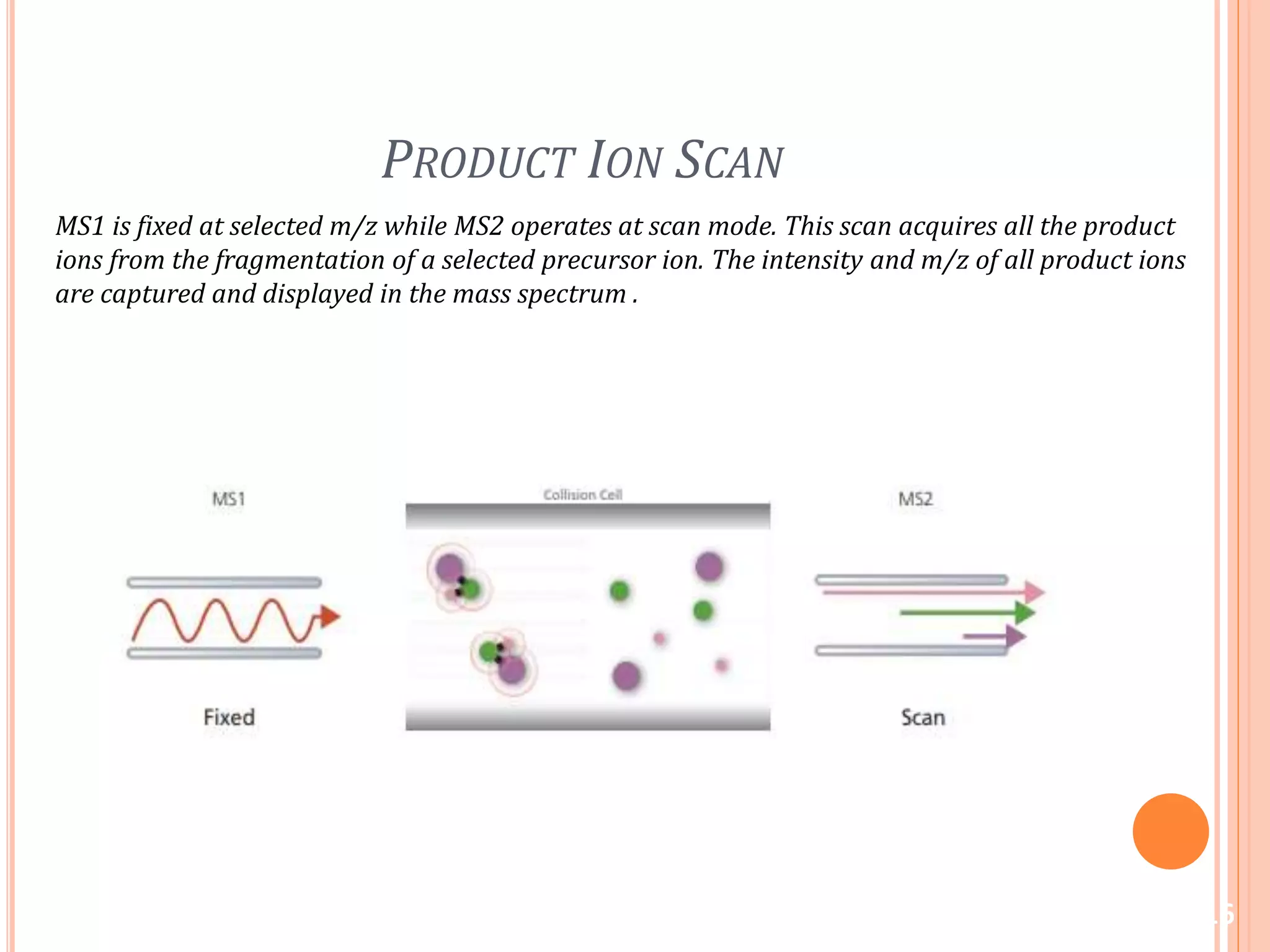
PRODUCT ION SCAN
16
MS1 is fixed at selected m/z while MS2 operates at scan mode. This scan acquires all the product
ions from the fragmentation of a selected precursor ion. The intensity and m/z of all product ions
are captured and displayed in the mass spectrum .
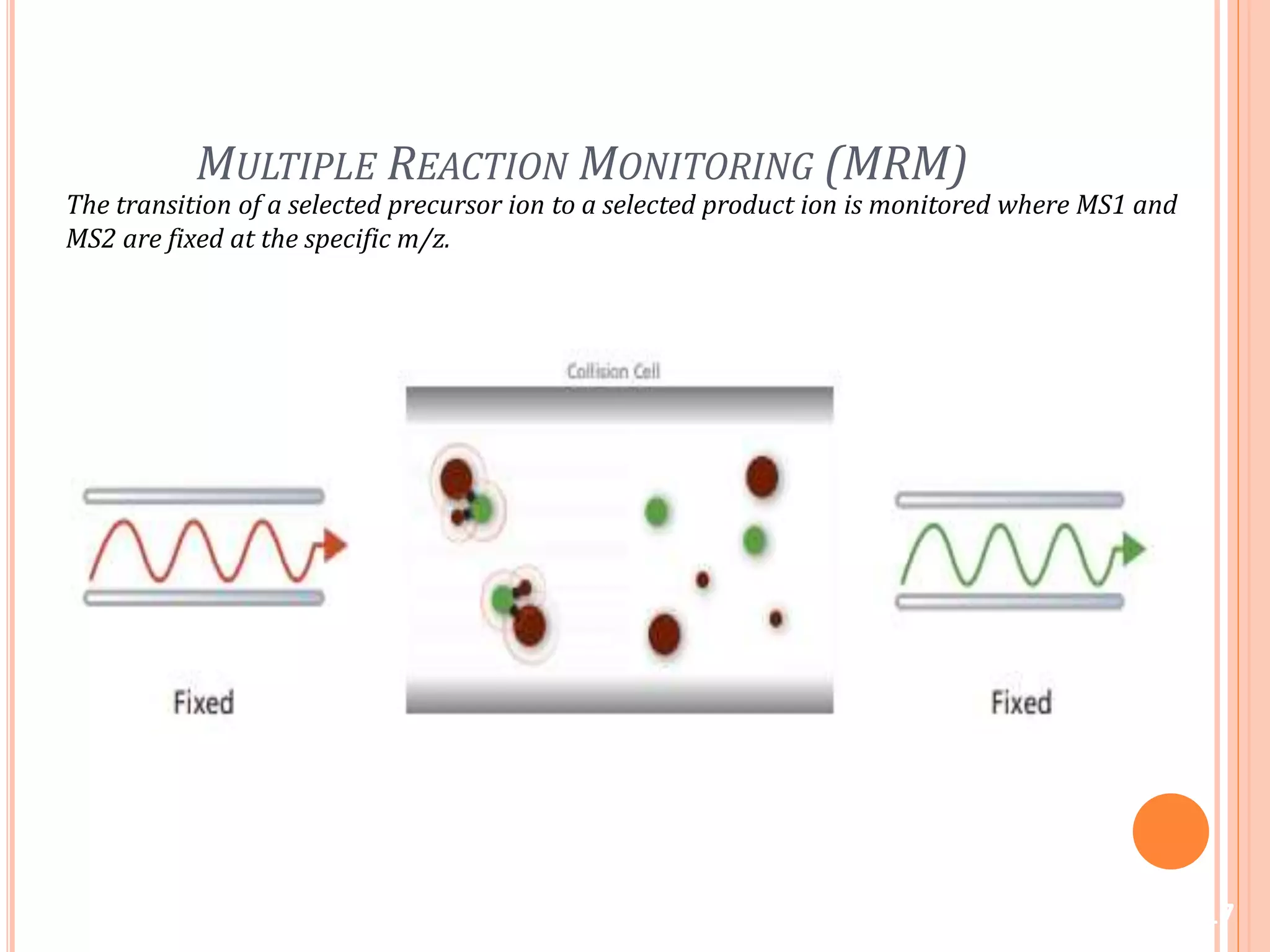
MULTIPLE REACTION MONITORING (MRM)
17
The transition of a selected precursor ion to a selected product ion is monitored where MS1 and
MS2 are fixed at the specific m/z.
LCMS METHOD SET UP
 LCMS method set up
 Converting LC method to LCMS method:
 LC methods are available for many samples
 Save time on developing suitable LC conditions
 LC methods may need some modifications to be suitable for
LCMS
18
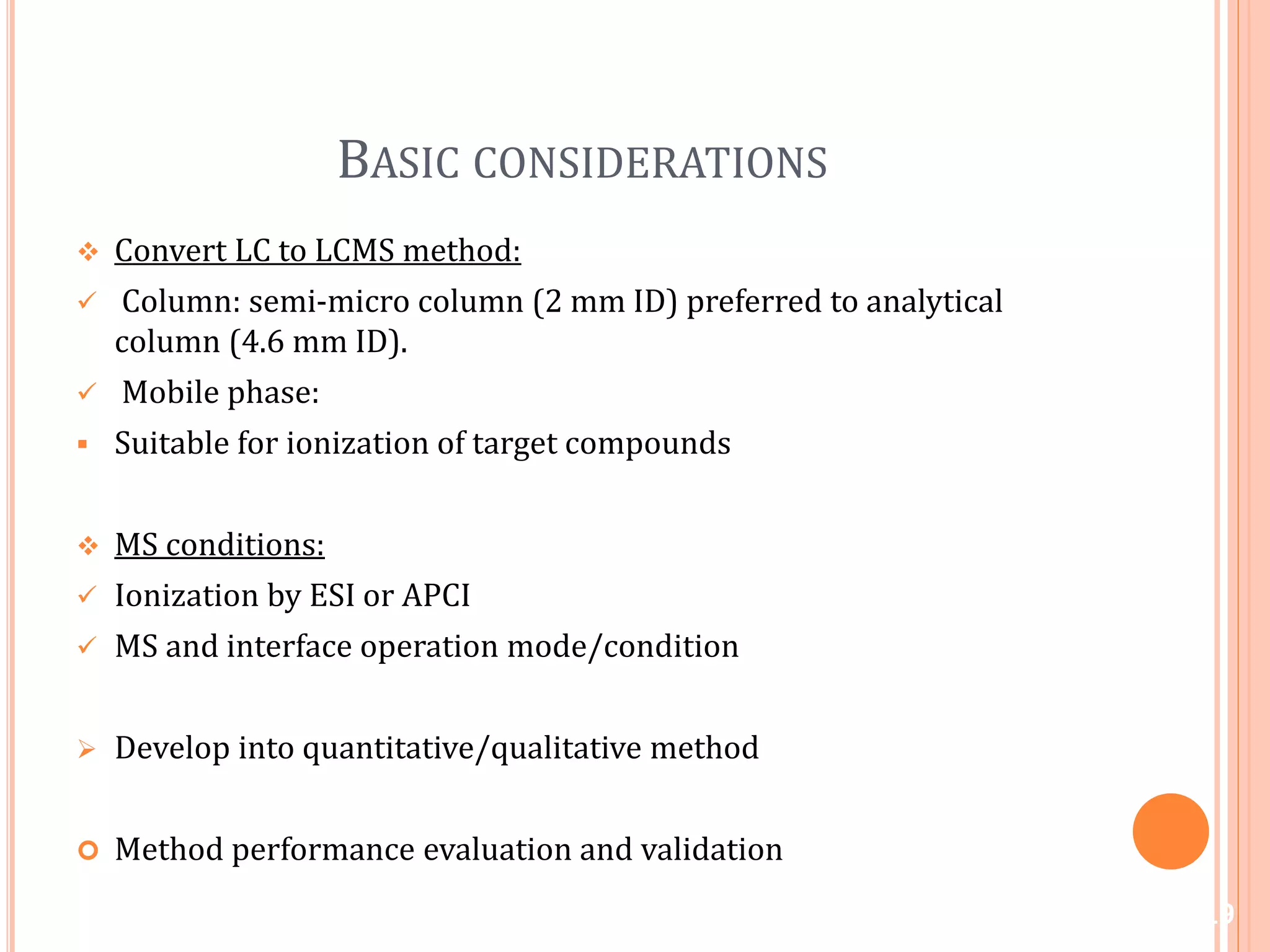
BASIC CONSIDERATIONS
 Convert LC to LCMS method:
 Column: semi-micro column (2 mm ID) preferred to analytical
column (4.6 mm ID).
 Mobile phase:
 Suitable for ionization of target compounds
 MS conditions:
 Ionization by ESI or APCI
 MS and interface operation mode/condition
 Develop into quantitative/qualitative method
 Method performance evaluation and validation
19
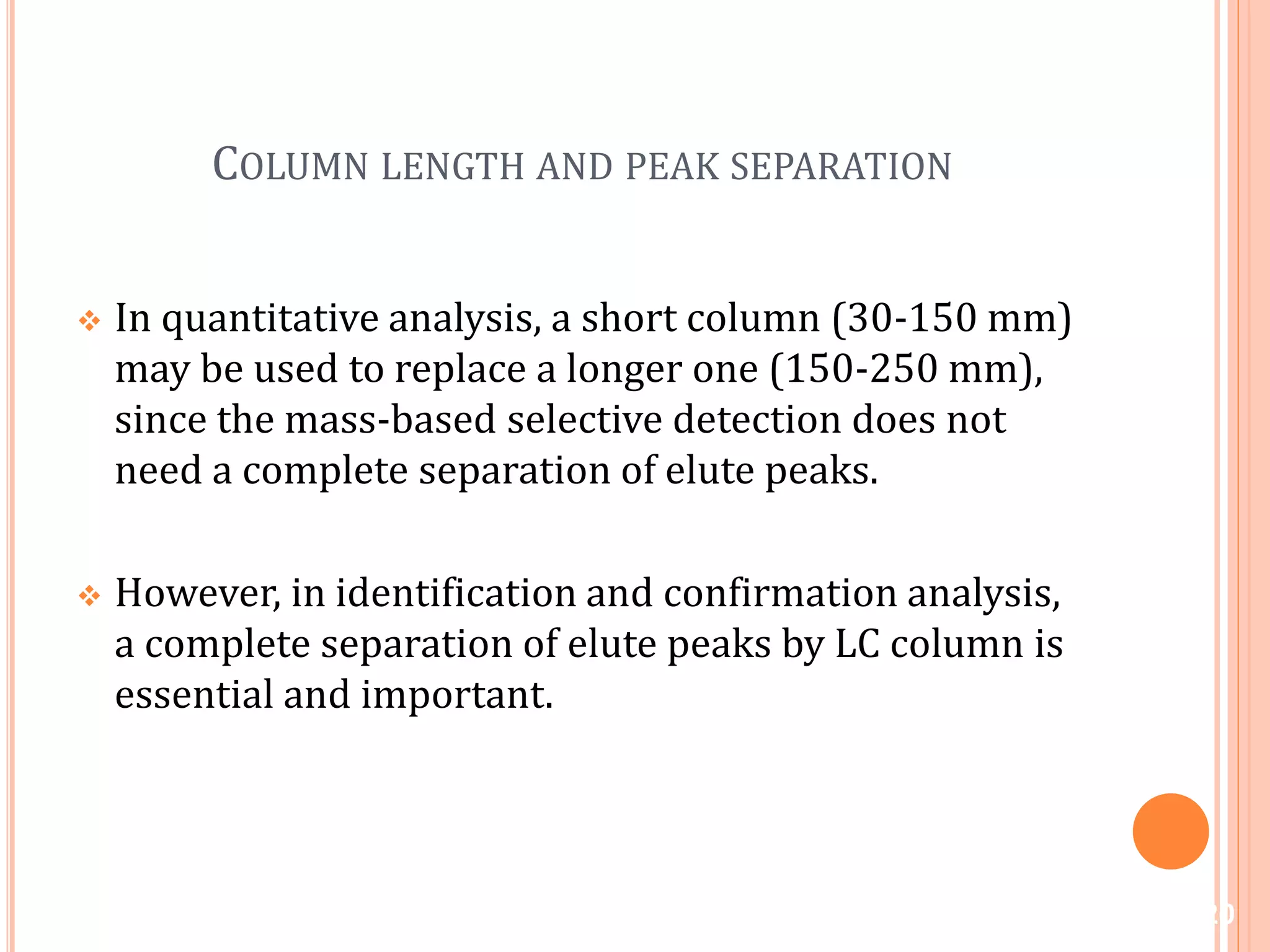
COLUMN LENGTH AND PEAK SEPARATION
 In quantitative analysis, a short column (30-150 mm)
may be used to replace a longer one (150-250 mm),
since the mass-based selective detection does not
need a complete separation of elute peaks.
 However, in identification and confirmation analysis,
a complete separation of elute peaks by LC column is
essential and important.
20
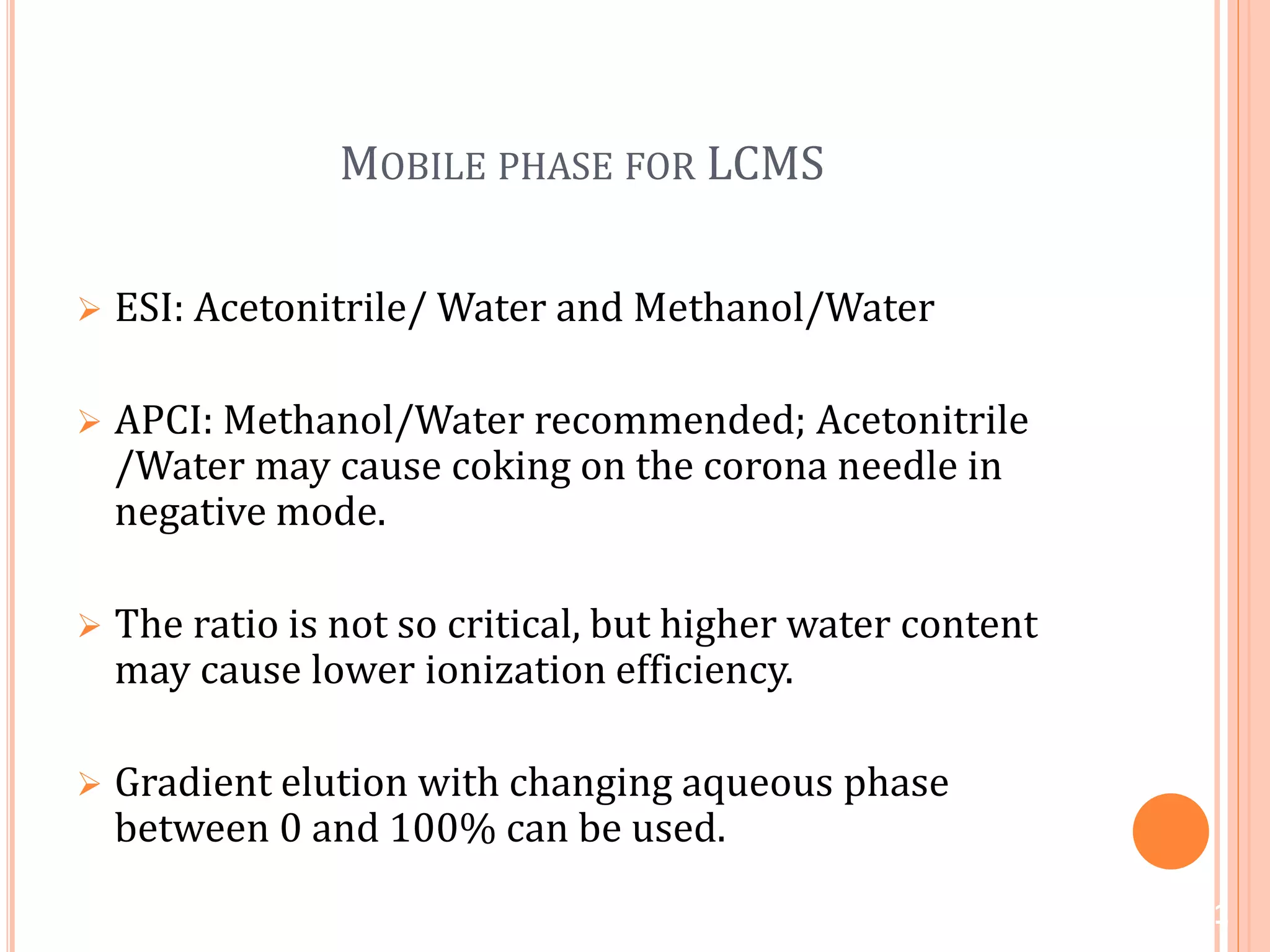
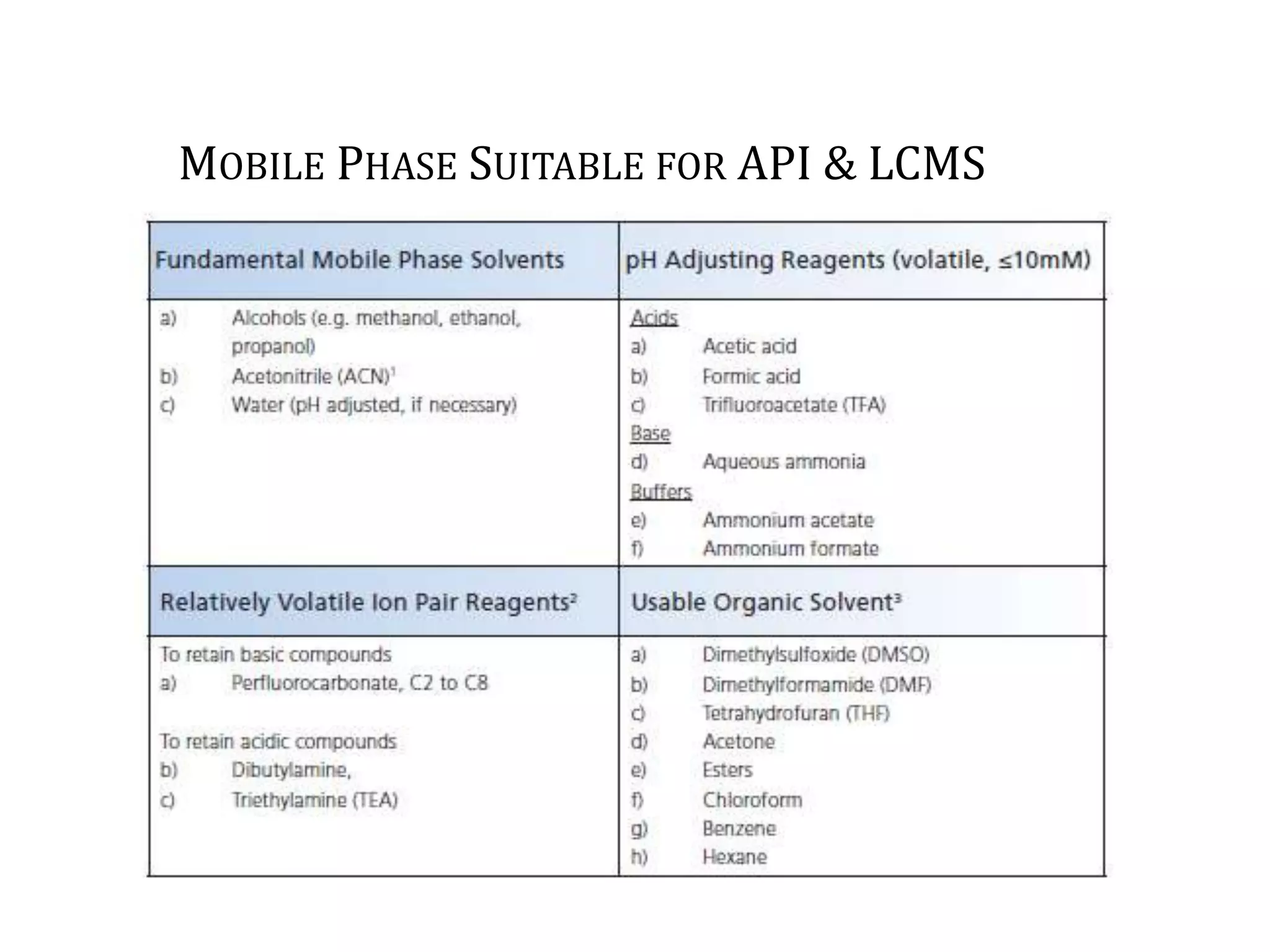
MOBILE PHASE FOR LCMS
 ESI: Acetonitrile/ Water and Methanol/Water
 APCI: Methanol/Water recommended; Acetonitrile
/Water may cause coking on the corona needle in
negative mode.
 The ratio is not so critical, but higher water content
may cause lower ionization efficiency.
 Gradient elution with changing aqueous phase
between 0 and 100% can be used.
21
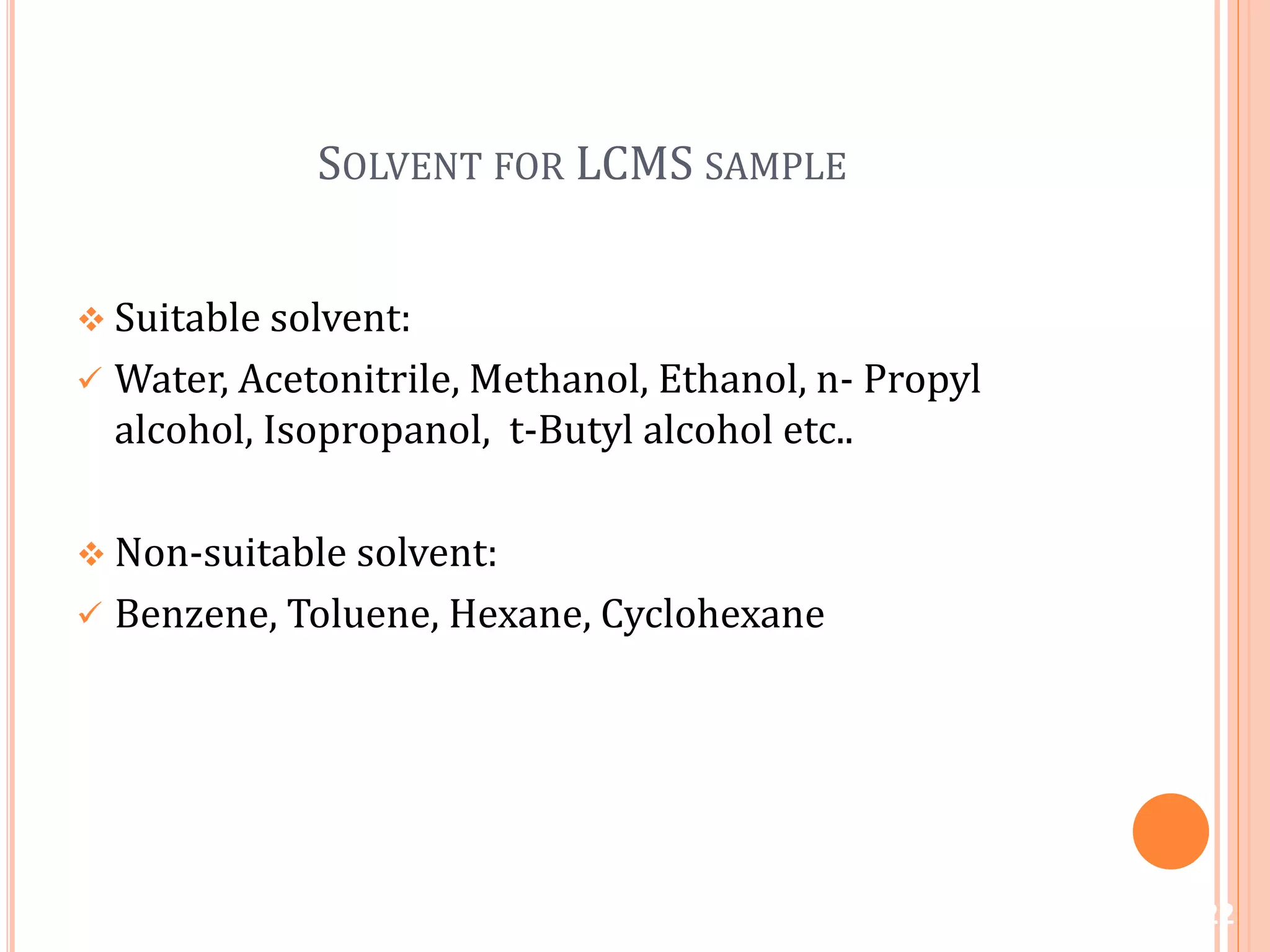
SOLVENT FOR LCMS SAMPLE
 Suitable solvent:
 Water, Acetonitrile, Methanol, Ethanol, n- Propyl
alcohol, Isopropanol, t-Butyl alcohol etc..
 Non-suitable solvent:
 Benzene, Toluene, Hexane, Cyclohexane
22
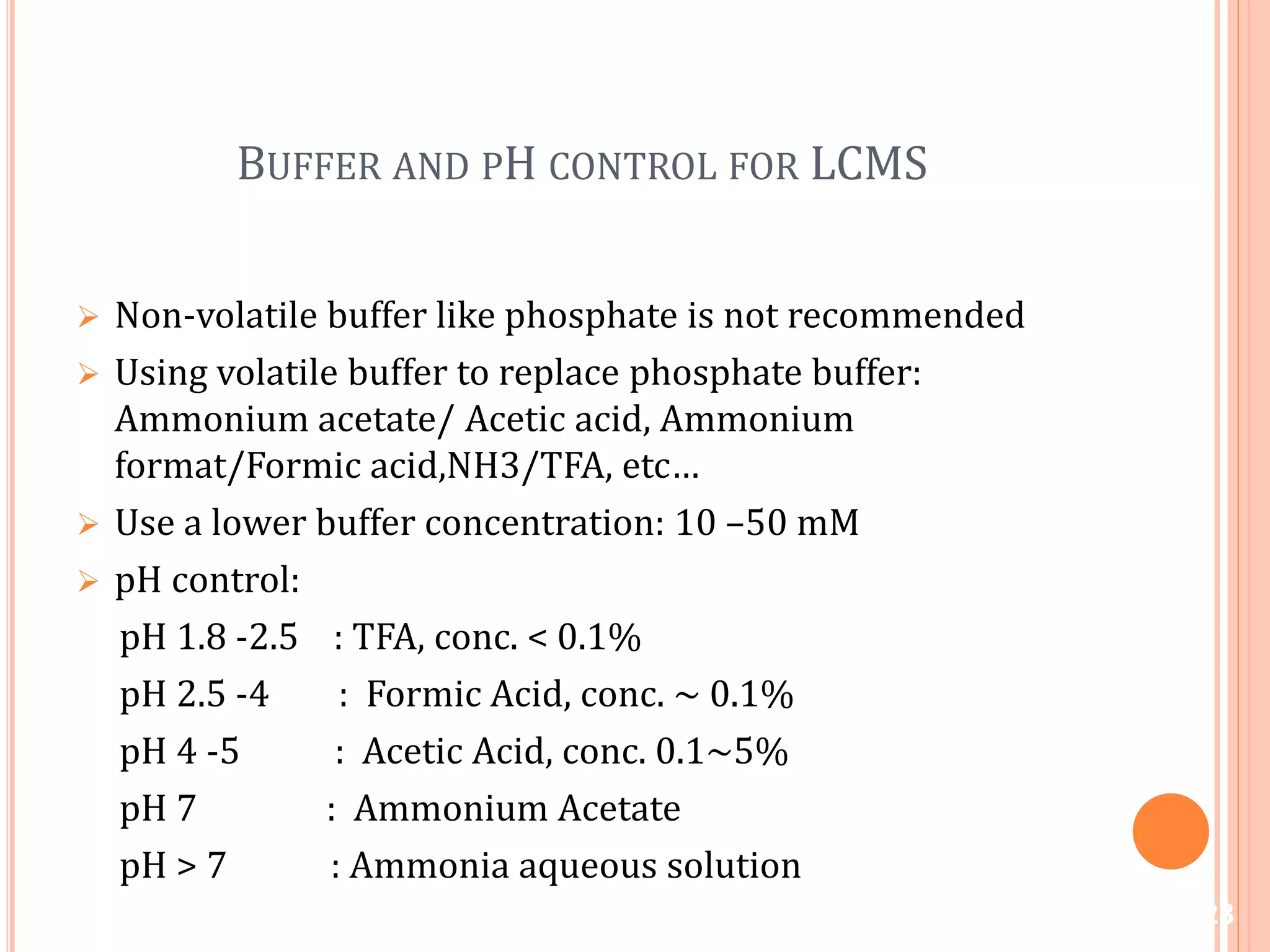
BUFFER AND PH CONTROL FOR LCMS
 Non-volatile buffer like phosphate is not recommended
 Using volatile buffer to replace phosphate buffer:
Ammonium acetate/ Acetic acid, Ammonium
format/Formic acid,NH3/TFA, etc…
 Use a lower buffer concentration: 10 –50 mM
 pH control:
pH 1.8 -2.5 : TFA, conc. < 0.1%
pH 2.5 -4 : Formic Acid, conc. ~ 0.1%
pH 4 -5 : Acetic Acid, conc. 0.1~5%
pH 7 : Ammonium Acetate
pH > 7 : Ammonia aqueous solution
23
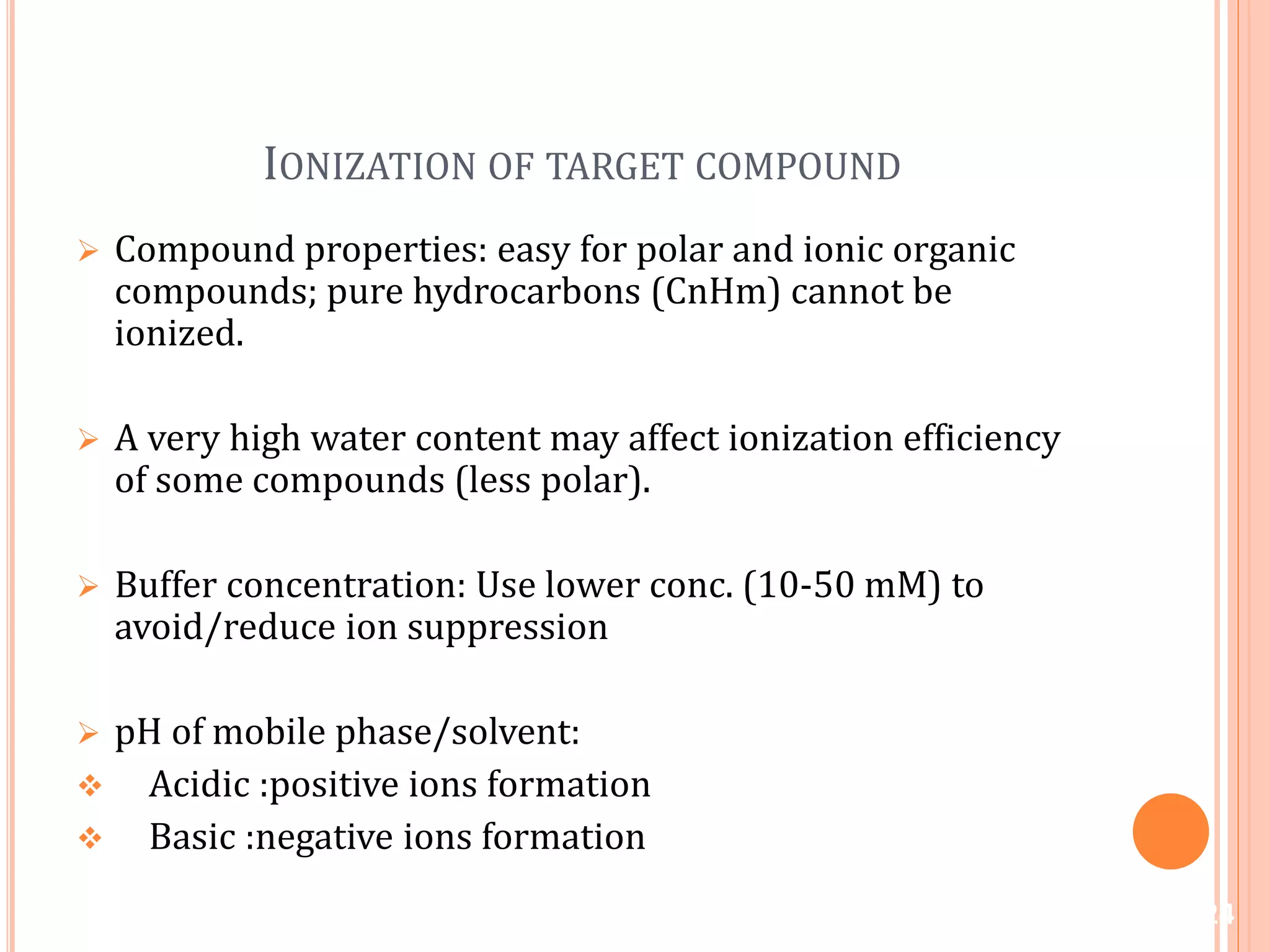
IONIZATION OF TARGET COMPOUND
 Compound properties: easy for polar and ionic organic
compounds; pure hydrocarbons (CnHm) cannot be
ionized.
 A very high water content may affect ionization efficiency
of some compounds (less polar).
 Buffer concentration: Use lower conc. (10-50 mM) to
avoid/reduce ion suppression
 pH of mobile phase/solvent:
 Acidic :positive ions formation
 Basic :negative ions formation
24
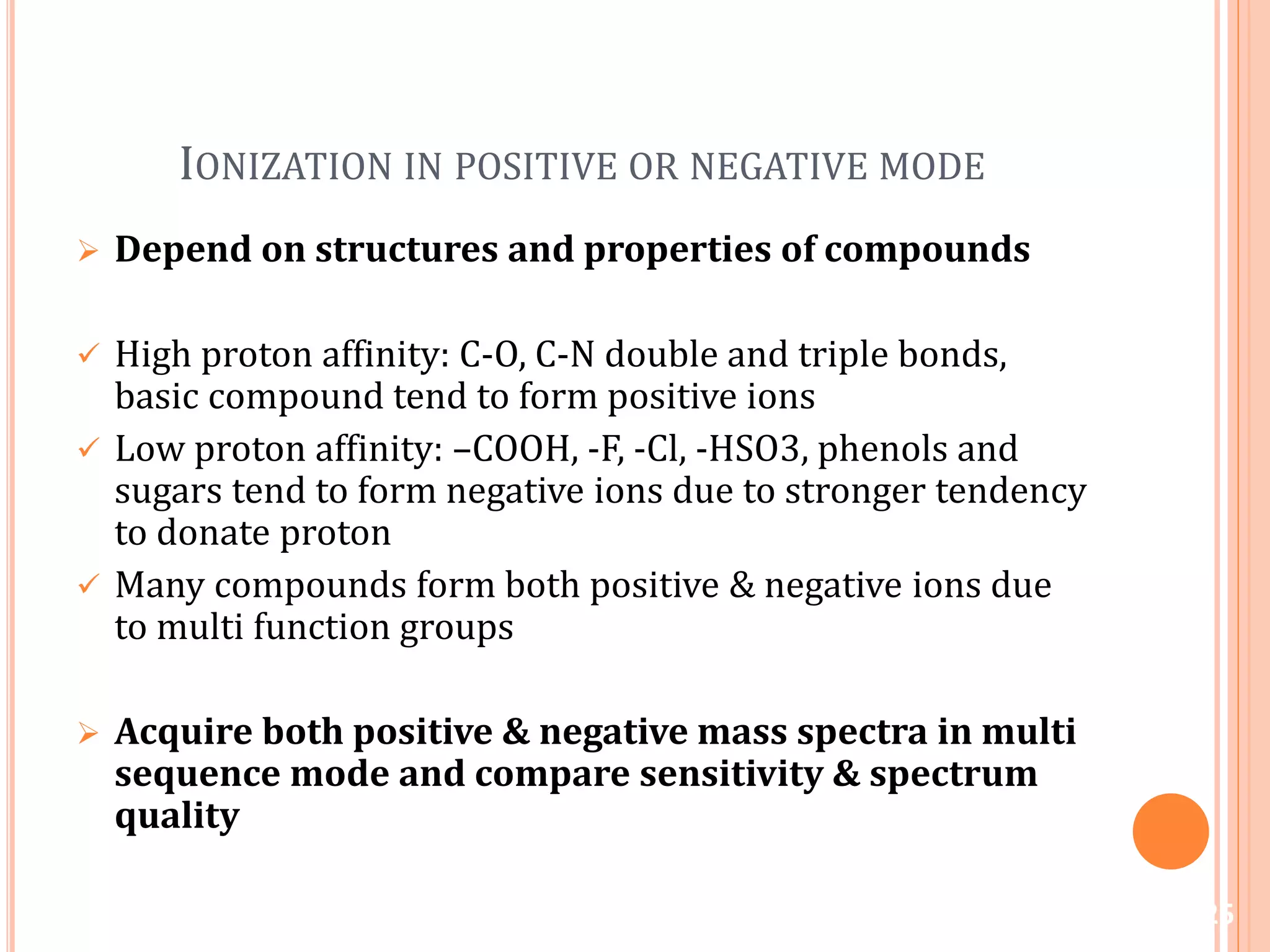
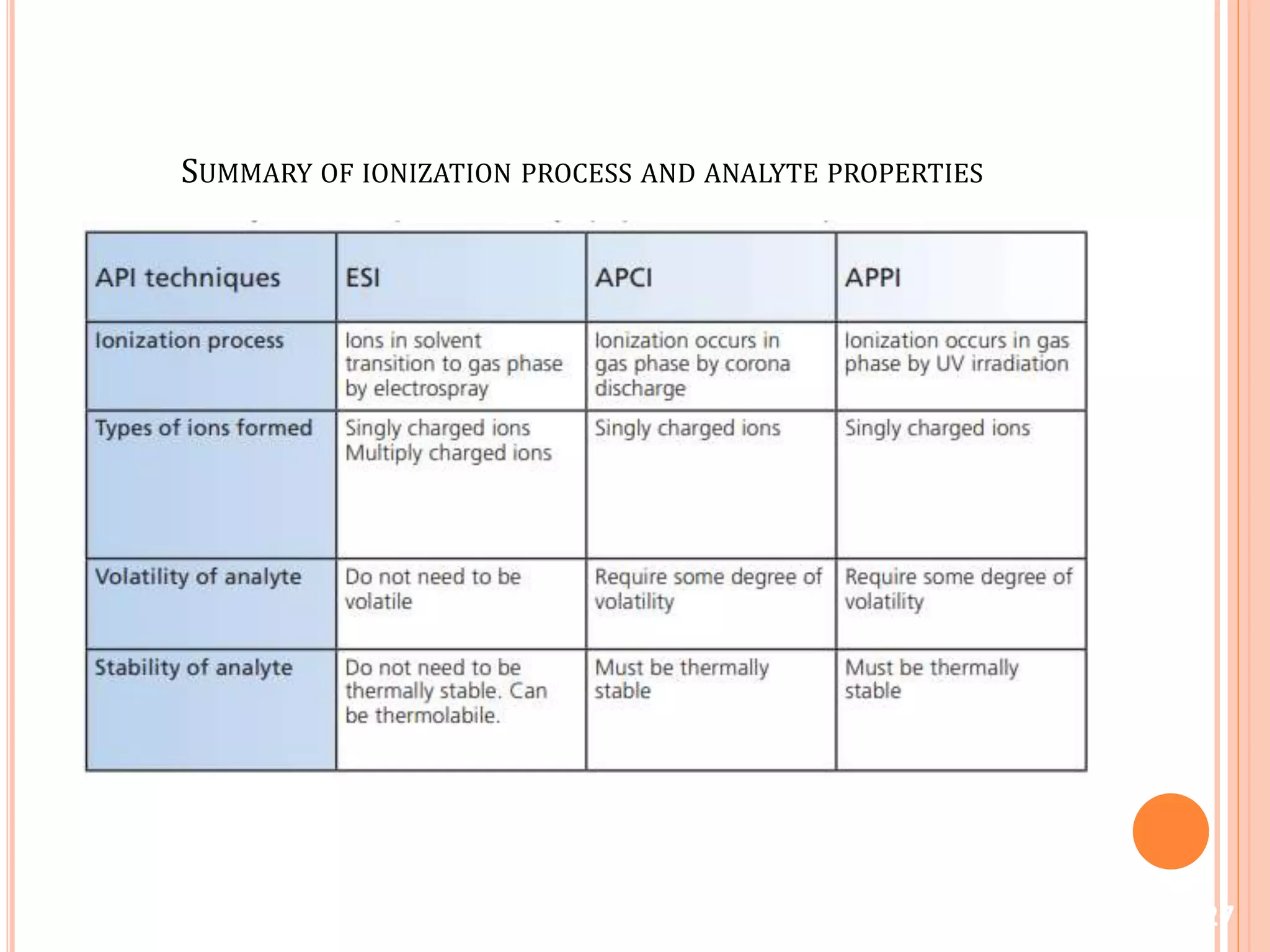
IONIZATION IN POSITIVE OR NEGATIVE MODE
 Depend on structures and properties of compounds
 High proton affinity: C-O, C-N double and triple bonds,
basic compound tend to form positive ions
 Low proton affinity: –COOH, -F, -Cl, -HSO3, phenols and
sugars tend to form negative ions due to stronger tendency
to donate proton
 Many compounds form both positive & negative ions due
to multi function groups
 Acquire both positive & negative mass spectra in multi
sequence mode and compare sensitivity & spectrum
quality
25
MOBILE PHASE SUITABLE FOR API & LCMS
26
SUMMARY OF IONIZATION PROCESS AND ANALYTE PROPERTIES
27
Thank You
28

Lcms basics shimadzu 8040

  • 1.
    BASICS OF LCMSSHIMADZU MODEL 8040 & CHROMATOGHAPHY METHOD DEVELOPMENT  BY Prashik Sudhir Shimpi  Mpharm QA 07Nov2020 1
  • 2.
    WHAT IS MASSSPECTROMETER? “A mass spectrometer is an instrument that measures the masses of individual molecules that have been converted to ions...” from “What is Mass Spectrometry” by ASMS “A mass spectrometer is universal ion detector ... not a universal detector” 2
  • 3.
    LC GIVES ONEDIMENSIONAL INFORMATION UV - VIS CHROMATOGRAM INDICATES THE PRESENCE OR ABSENCE OF A COMPOUND AT A SPECIFIC RETENTION TIME 3
  • 4.
    LC MS LC-MS ADDSSECOND DIMENSION: MOLECULAR WEIGHT MS CHROMATOGRAM INDICATES THE PRESENCE OF A COMPOUND AT A SPECIFIC RT MASS SPECTRA AFFORDS MOLECULAR WEIGHT 4
  • 5.
    LC-MS/MS ADDS THIRD DIMENSION -RTINFORMATION FROM LC -MOLECULAR WEIGHT -FRAGMENTATION (MS-MS) 5
  • 6.
    LC – MSWORKING PRINCIPLE # A HIGH VOLTAGE IS APPLIED TO THE COLUMN ELUATE, AND IT IS ATOMIZED BY NITROGEN GAS. # THE CHARGED DROPLETS GRADUALLY BECOME SMALLER, AND ION EVAPORATION OCCURS. # AS THE IONS PASS THROUGH THE MASS SEPARATOR, THEY ARE SEPARATED ACCORDING TO MASS. # IN THE DETECTOR, THE QUANTITY OF IONS IS DETECTED AS A CURRENT VALUE. 6
  • 7.
  • 8.
  • 9.
  • 10.
  • 11.
  • 12.
  • 13.
    TYPES OF SCANMODE  SCAN  SIM  Parent Ion Scan  Product Ion Scan  MRM 13
  • 14.
    SCAN MODE ANDSIM MODE 14
  • 15.
    PRECURSOR ION SCAN 15 MS1operates at scan mode while MS2 selects the product ion of a particular m/z formed by CID in the collision cell. This mode is especially useful for determining the precursor ions that produce fragment ions of a particular m/z.
  • 16.
    PRODUCT ION SCAN 16 MS1is fixed at selected m/z while MS2 operates at scan mode. This scan acquires all the product ions from the fragmentation of a selected precursor ion. The intensity and m/z of all product ions are captured and displayed in the mass spectrum .
  • 17.
    MULTIPLE REACTION MONITORING(MRM) 17 The transition of a selected precursor ion to a selected product ion is monitored where MS1 and MS2 are fixed at the specific m/z.
  • 18.
    LCMS METHOD SETUP  LCMS method set up  Converting LC method to LCMS method:  LC methods are available for many samples  Save time on developing suitable LC conditions  LC methods may need some modifications to be suitable for LCMS 18
  • 19.
    BASIC CONSIDERATIONS  ConvertLC to LCMS method:  Column: semi-micro column (2 mm ID) preferred to analytical column (4.6 mm ID).  Mobile phase:  Suitable for ionization of target compounds  MS conditions:  Ionization by ESI or APCI  MS and interface operation mode/condition  Develop into quantitative/qualitative method  Method performance evaluation and validation 19
  • 20.
    COLUMN LENGTH ANDPEAK SEPARATION  In quantitative analysis, a short column (30-150 mm) may be used to replace a longer one (150-250 mm), since the mass-based selective detection does not need a complete separation of elute peaks.  However, in identification and confirmation analysis, a complete separation of elute peaks by LC column is essential and important. 20
  • 21.
    MOBILE PHASE FORLCMS  ESI: Acetonitrile/ Water and Methanol/Water  APCI: Methanol/Water recommended; Acetonitrile /Water may cause coking on the corona needle in negative mode.  The ratio is not so critical, but higher water content may cause lower ionization efficiency.  Gradient elution with changing aqueous phase between 0 and 100% can be used. 21
  • 22.
    SOLVENT FOR LCMSSAMPLE  Suitable solvent:  Water, Acetonitrile, Methanol, Ethanol, n- Propyl alcohol, Isopropanol, t-Butyl alcohol etc..  Non-suitable solvent:  Benzene, Toluene, Hexane, Cyclohexane 22
  • 23.
    BUFFER AND PHCONTROL FOR LCMS  Non-volatile buffer like phosphate is not recommended  Using volatile buffer to replace phosphate buffer: Ammonium acetate/ Acetic acid, Ammonium format/Formic acid,NH3/TFA, etc…  Use a lower buffer concentration: 10 –50 mM  pH control: pH 1.8 -2.5 : TFA, conc. < 0.1% pH 2.5 -4 : Formic Acid, conc. ~ 0.1% pH 4 -5 : Acetic Acid, conc. 0.1~5% pH 7 : Ammonium Acetate pH > 7 : Ammonia aqueous solution 23
  • 24.
    IONIZATION OF TARGETCOMPOUND  Compound properties: easy for polar and ionic organic compounds; pure hydrocarbons (CnHm) cannot be ionized.  A very high water content may affect ionization efficiency of some compounds (less polar).  Buffer concentration: Use lower conc. (10-50 mM) to avoid/reduce ion suppression  pH of mobile phase/solvent:  Acidic :positive ions formation  Basic :negative ions formation 24
  • 25.
    IONIZATION IN POSITIVEOR NEGATIVE MODE  Depend on structures and properties of compounds  High proton affinity: C-O, C-N double and triple bonds, basic compound tend to form positive ions  Low proton affinity: –COOH, -F, -Cl, -HSO3, phenols and sugars tend to form negative ions due to stronger tendency to donate proton  Many compounds form both positive & negative ions due to multi function groups  Acquire both positive & negative mass spectra in multi sequence mode and compare sensitivity & spectrum quality 25
  • 26.
    MOBILE PHASE SUITABLEFOR API & LCMS 26
  • 27.
    SUMMARY OF IONIZATIONPROCESS AND ANALYTE PROPERTIES 27
  • 28.

Editor's Notes

  • #4 Vis Chromatogram •Indicates the presence or absence of a compound at a specific retention time