A seminar on
Liquid Chromatography & Mass Spectroscopy
Presented by:-
Mr. Choudhary B.M.
CONTENTS :
 INTRODUCTION
 BASIC PRINCIPLE OF LC/MS
 INSTRUMENTATION
 COMPONENTS OF MASS SPECTROMETER
 IONIZATION METHODS
 MASSANALYZER
 DETECTORS
 TANDEM MASS SPECTROMETRY
 APPLICATIONS OF LCMS
 FUTURE PROSPECTS OF LCMS
LIQUID CHROMATOGRAPHY -MASS SPECTROMETRY
 INTRODUCTION:
 Liquid chromatography-mass spectrometry (LC/MS) is a technique that uses liquid chromatography (or
HPLC) with the mass spectrometry.
 It is an analytical chemistry technique that combines the physical
separation capabilities of liquid chromatography with the mass analysis
capabilitiesof mass spectrometry.
Basic Principle of LC/MS:
 LC/MS combines the separating power of High Performance Liquid
Chromatography(HPLC),with the detection power of MassSpectrometry.
1. High Performance Liquid Chromatography (HPLC):
 Liquid chromatography involves two main phases:
 Mobile phase: Liquid (solvents i.e. ethanol, Acetonitrile).
 Stationary phase: Column packed with very small
particles
2. Mass Spectrometry:
 Analytical technique that measures the mass- to-charge
ratio of charged particles.
Working Principle:
 MS works by ionizing chemical compounds to generate charged
molecules or molecule fragments and measuring their mass-to-charge
ratios.
 The components of the sample are ionized by one of a variety of
methods.
 The ions are separated according to their mass-to- charge ratio in
an analyzer by electromagnetic field.
 The ions are detected, usually by a quantitative method. The ion
signal isprocessed into mass spectra.
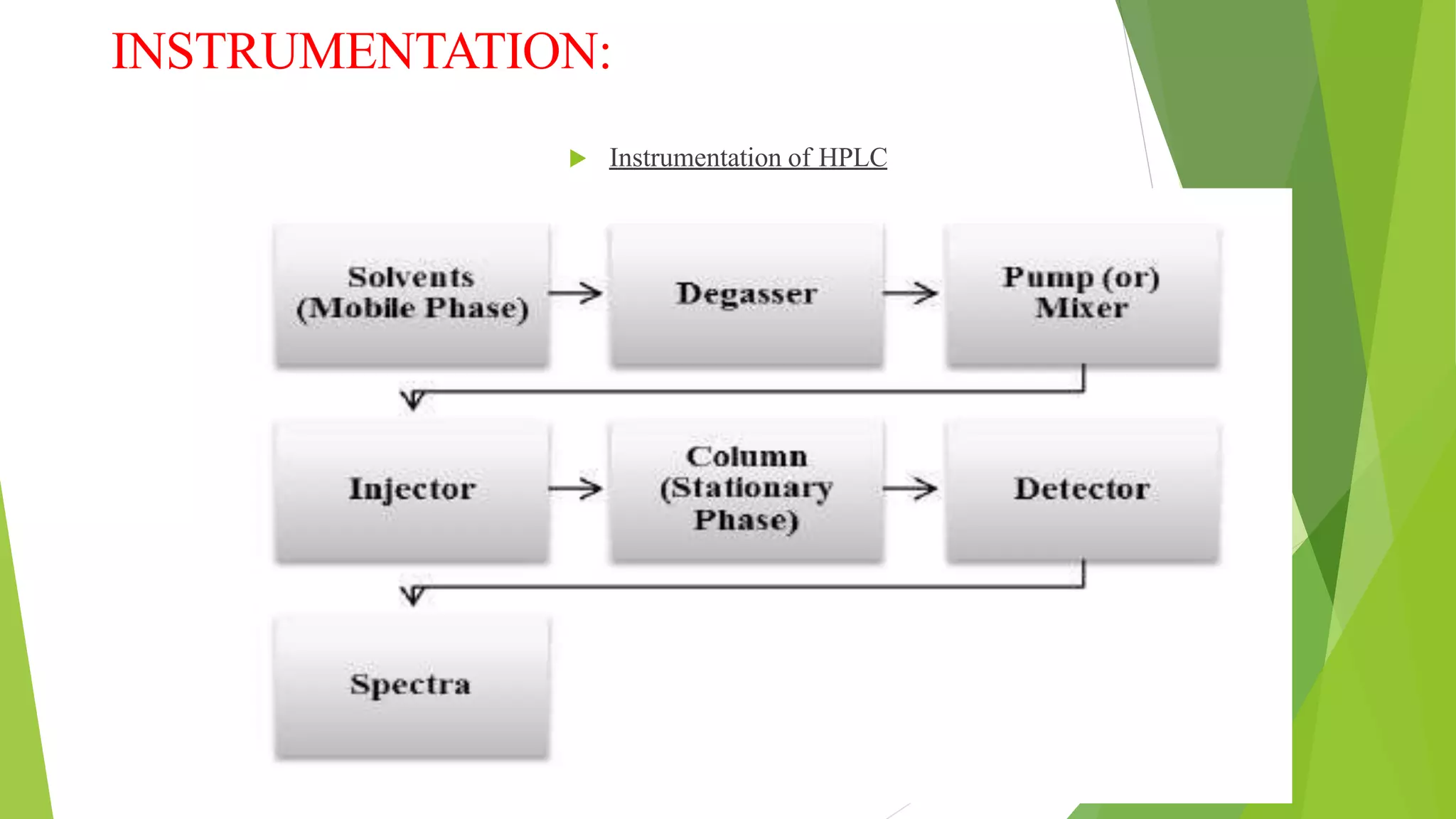
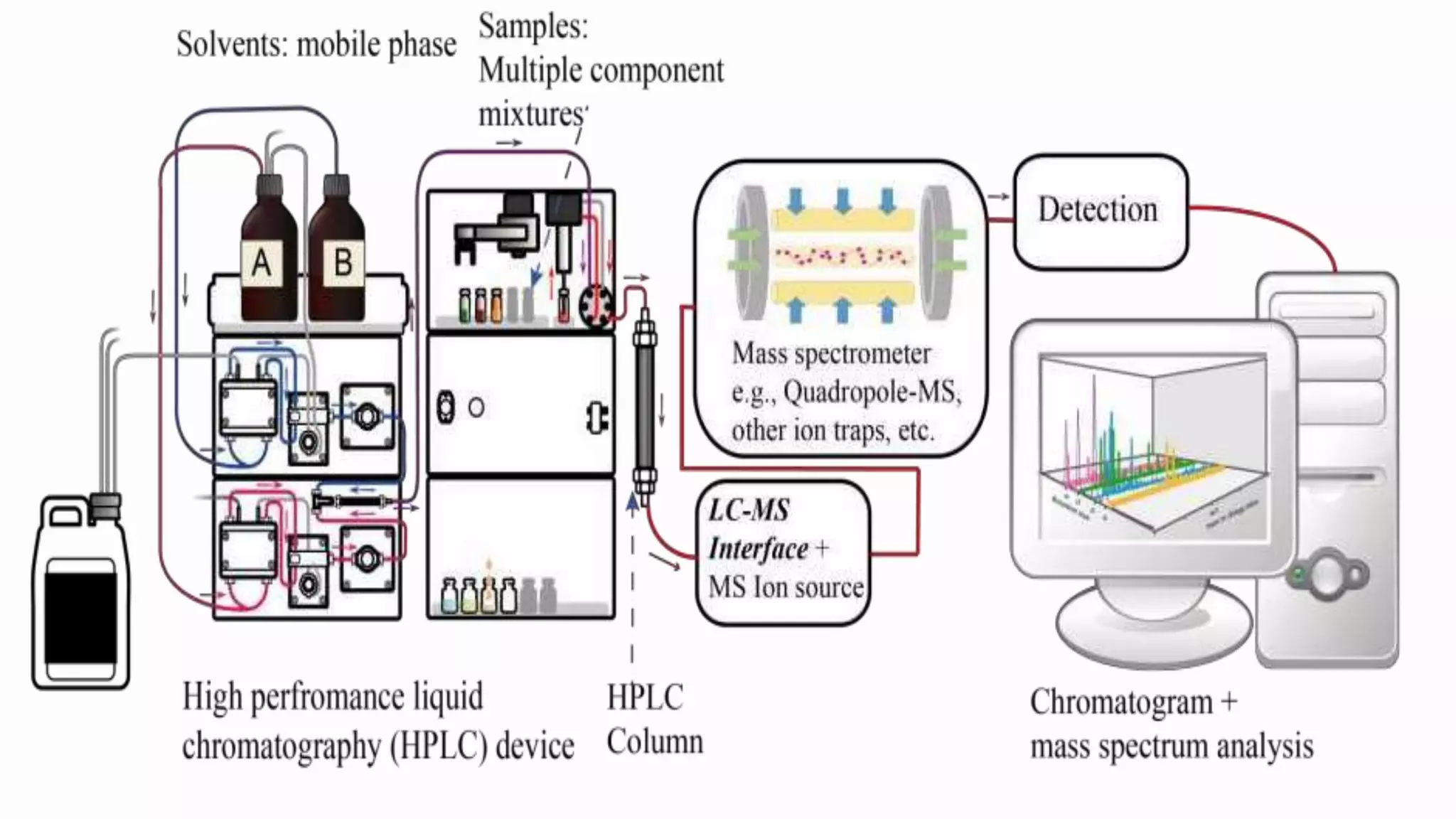
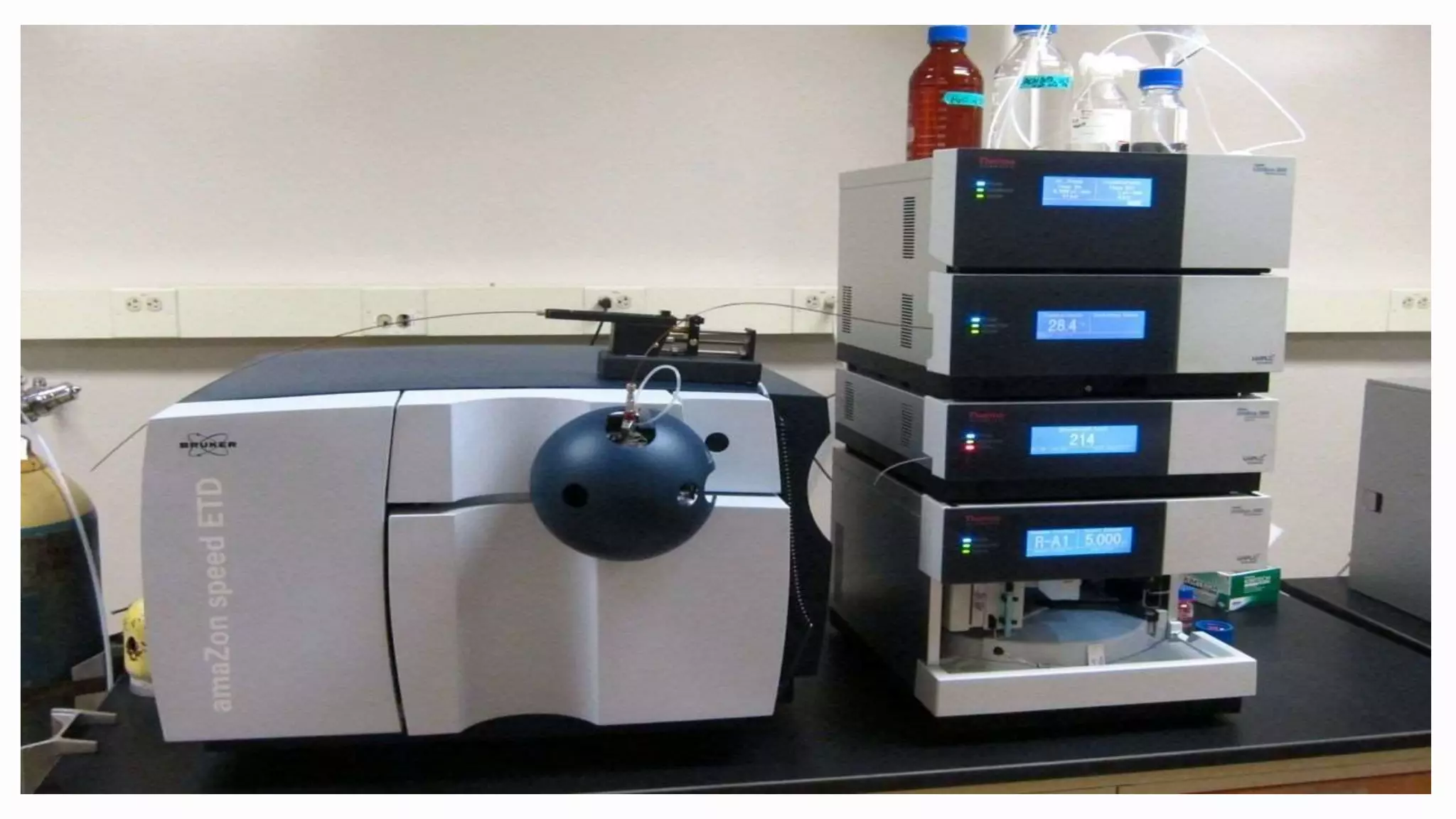
INSTRUMENTATION:
 Instrumentation of HPLC
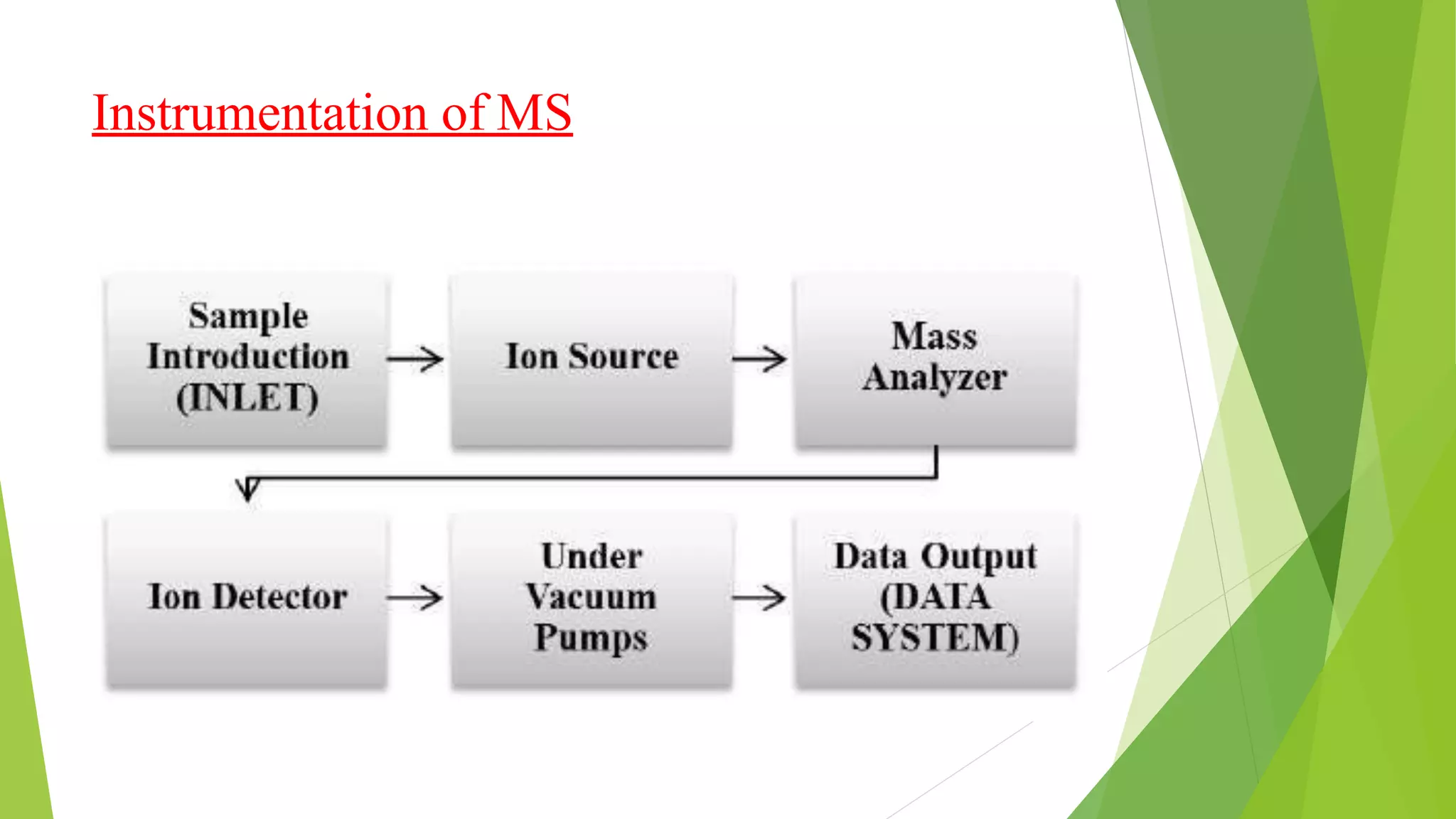
Instrumentation of MS
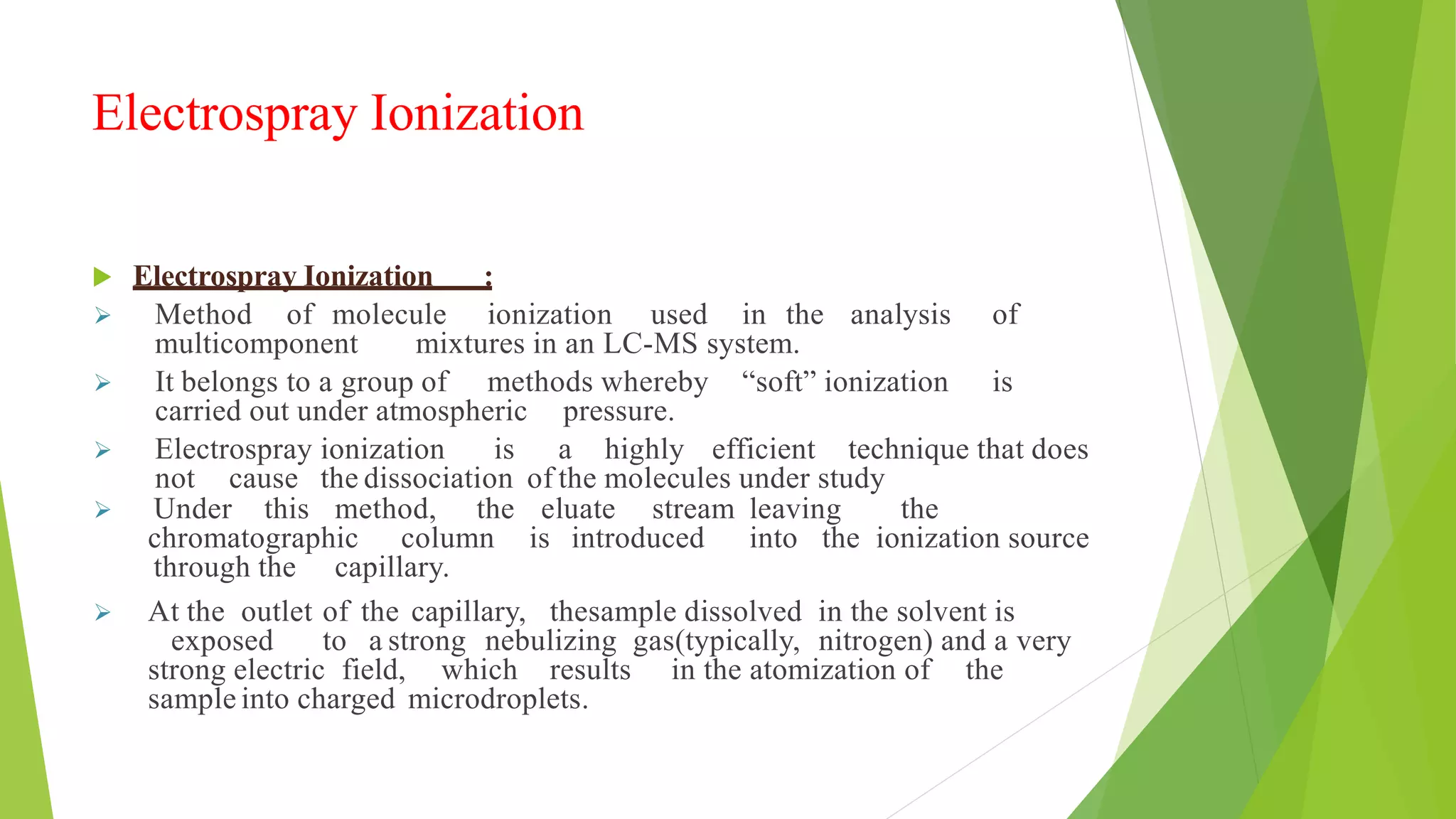
Components of Mass Spectrometer :
 Ion source,which can convert gas phase sample molecules into
ions.
 Analyzer,where ions are separated according to their mass-to-
charge ratio by applying electromagnetic fields.
 Detector,where ions are counted thus calculating the abundances of
each ion present.
 Ionization Methods :
 Following are the most common ionization methods :
i. Electrospray Ionization
ii. Atmospheric Pressure Chemical Ionization (APCI)
iii. Atmospheric Pressure Photo-ionization (APPI)
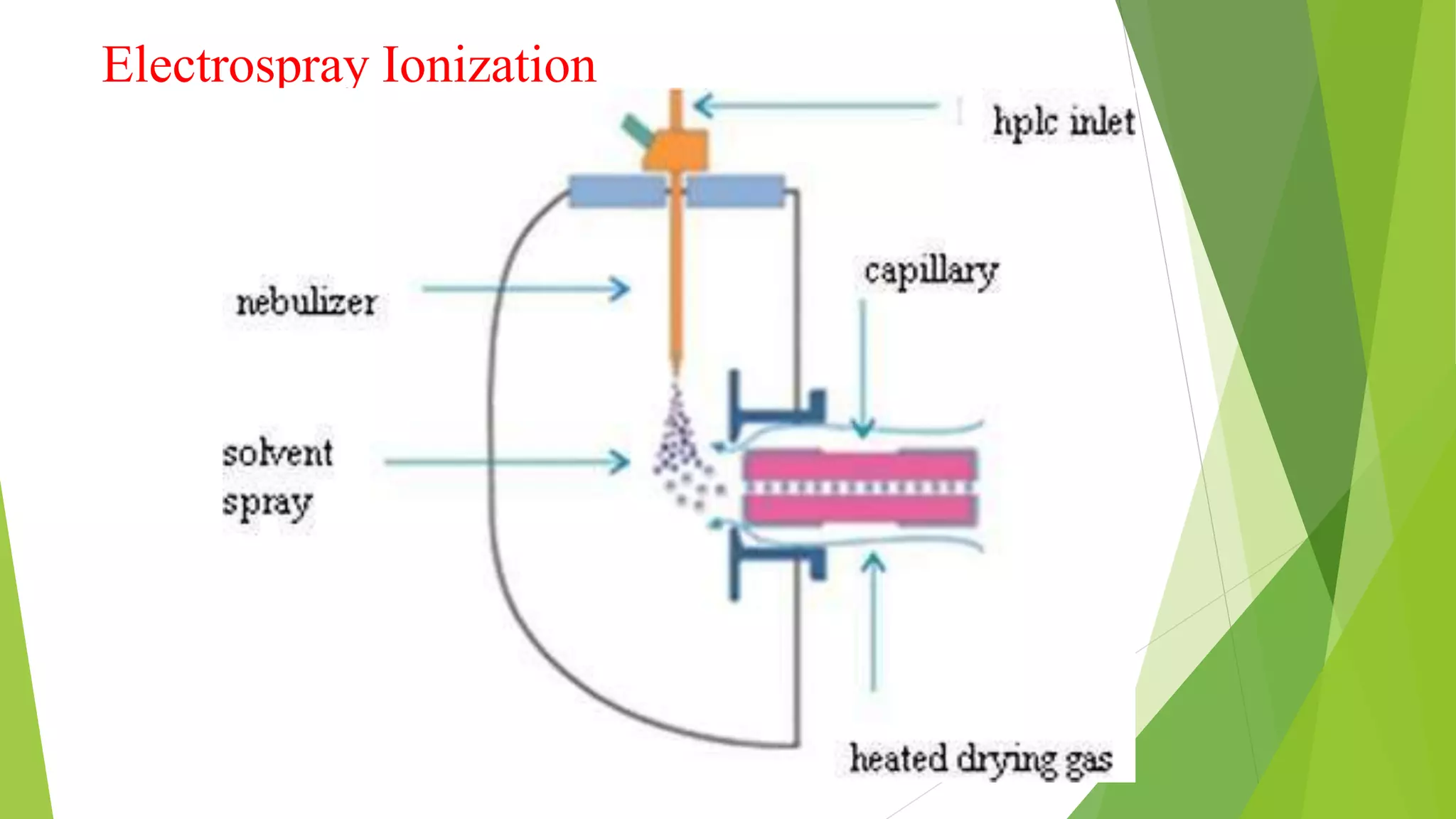
Electrospray Ionization
 Electrospray Ionization :
 Method of molecule ionization used in the analysis of
multicomponent mixtures in an LC-MS system.
 It belongs to a group of methods whereby “soft” ionization is
carried out under atmospheric pressure.
 Electrospray ionization is a highly efficient technique that does
not cause the dissociation of the molecules under study
 Under this method, the eluate stream leaving the
chromatographic column is introduced into the ionization source
through the capillary.
 At the outlet of the capillary, thesample dissolved in the solvent is
exposed to a strong nebulizing gas(typically, nitrogen) and a very
strong electric field, which results in the atomization of the
sample into charged microdroplets.
Electrospray Ionization
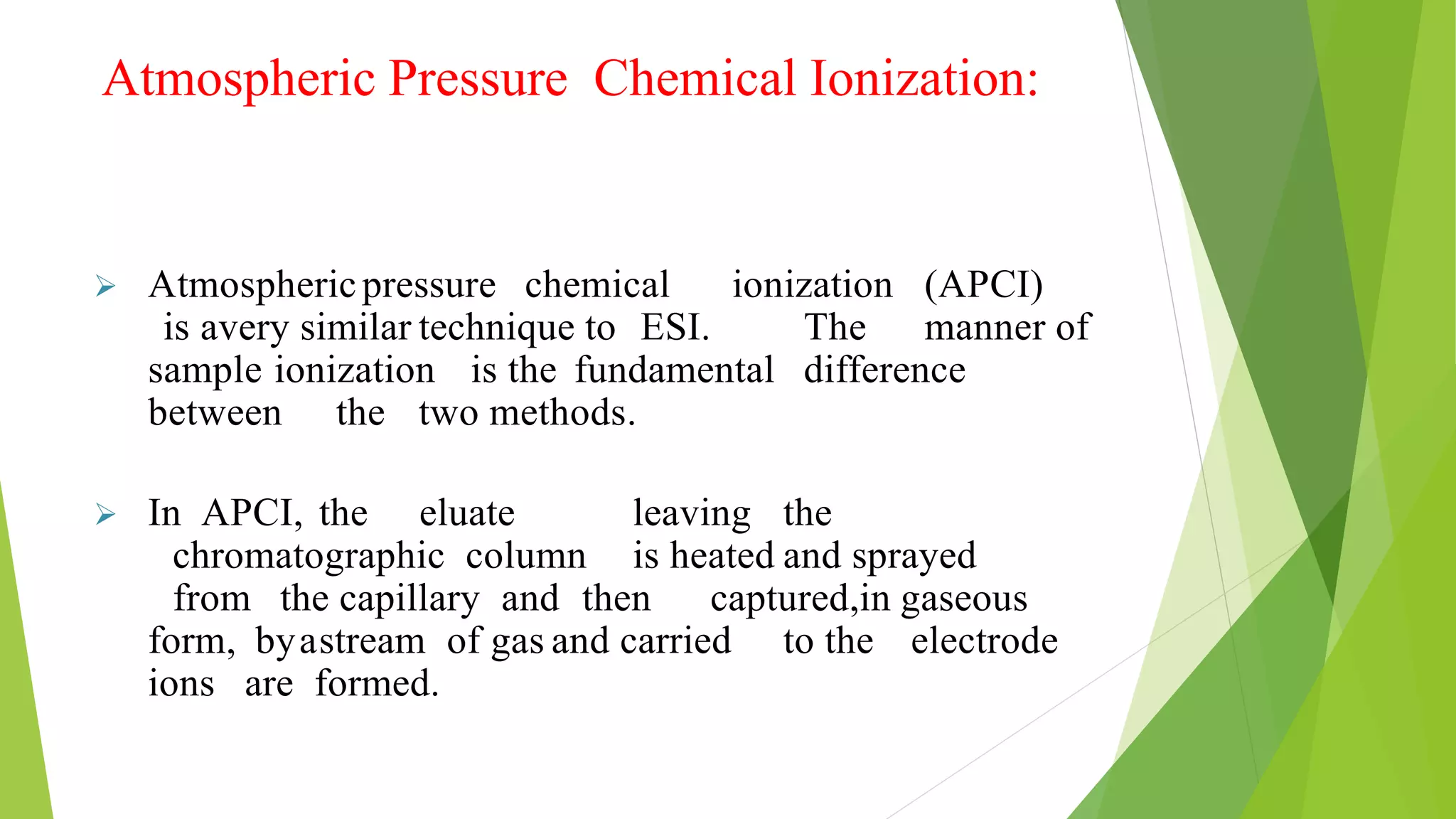
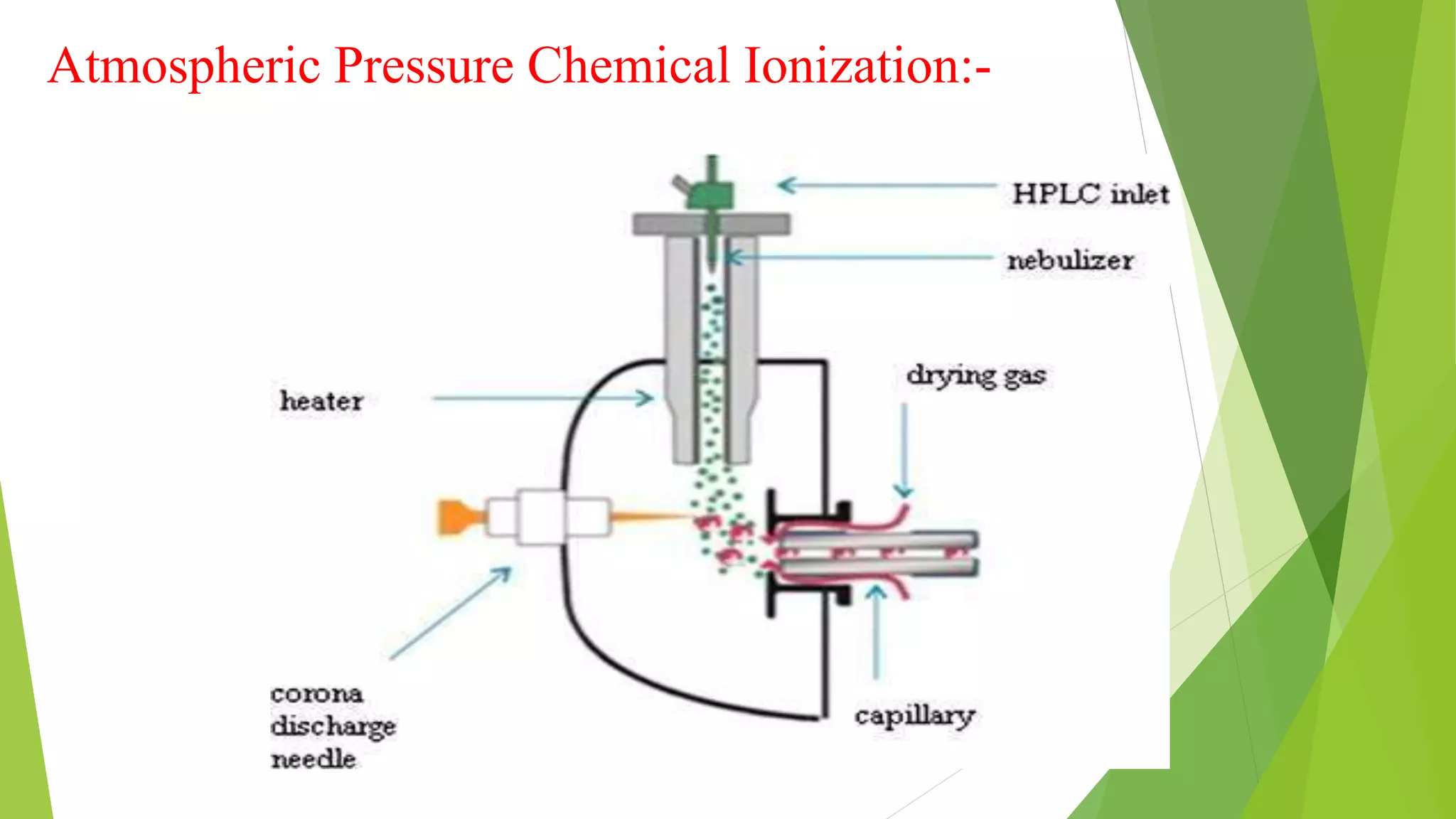
Atmospheric Pressure Chemical Ionization:
 Atmosphericpressure chemical ionization (APCI)
is avery similar technique to ESI. The manner of
sample ionization is the fundamental difference
between the two methods.
 In APCI, the eluate leaving the
chromatographic column is heated and sprayed
from the capillary and then captured,in gaseous
form, byastream of gas and carried to the electrode
ions are formed.
Atmospheric Pressure Chemical Ionization:-
Atmospheric Pressure Photo- ionization :
 Atmospheric pressure photo-ionisation (APPI) uses
photons to excite and ionize molecules after
nebulisation.
 The energy of the photons is chosen to minimize concurrent
ionization of solvents and ion source gases.
 The technique also gives predominantly singly-charged ions
and has been used for the analysis of neutral compounds
such as steroids and has been reviewed.
Mass Analyzer :
 Its task is to separate ions in terms of their mass-to-
charge ratio and to direct the beam of focused ions to
the detector.
 The key performance parameters of an analyzer
include;
(a) separation efficiency
(b) m/z measurement precision
(c) range of the m/z values measured
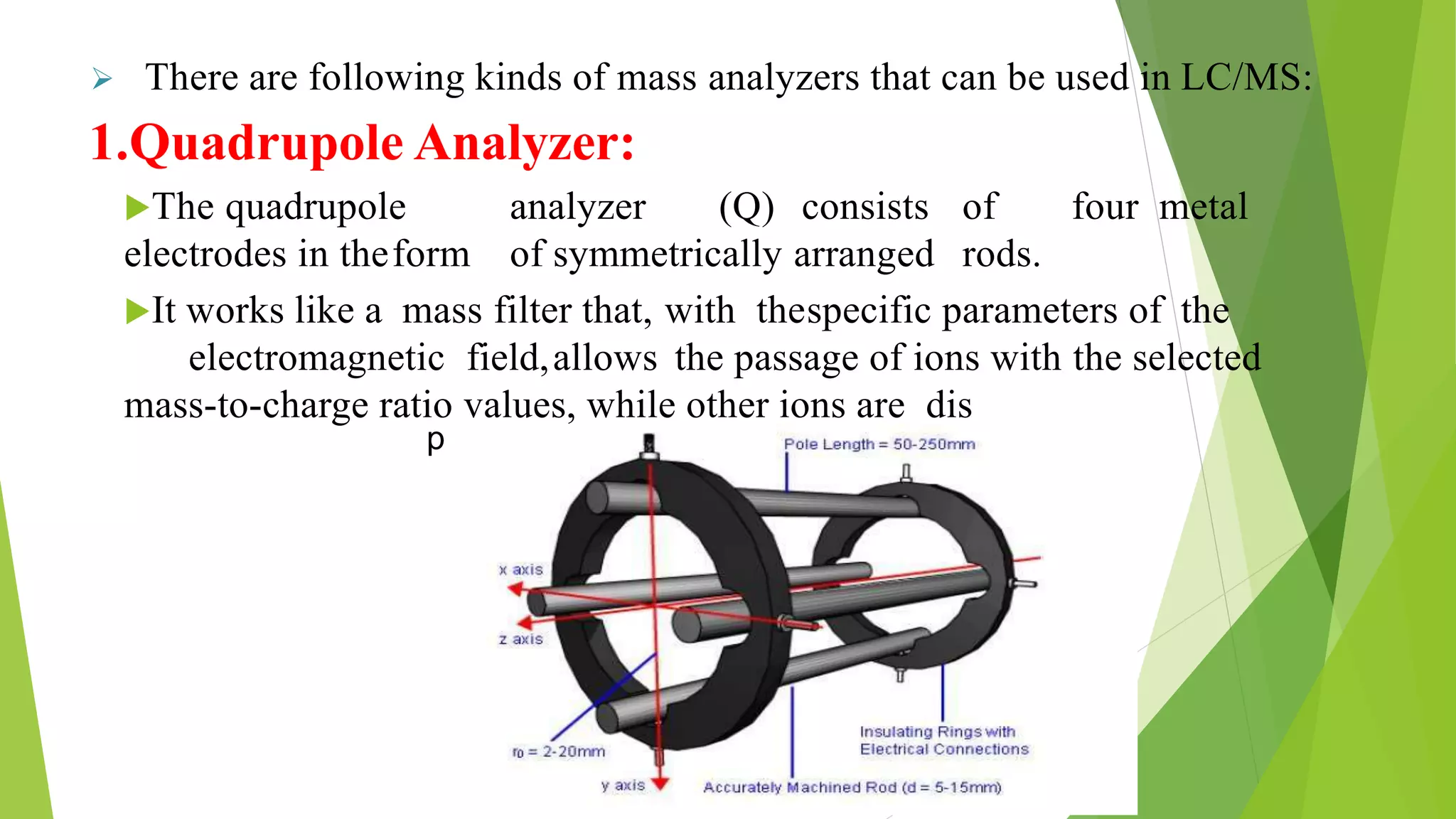
persed and do not reach the detector.
 There are following kinds of mass analyzers that can be used in LC/MS:
1.Quadrupole Analyzer:
The quadrupole analyzer (Q) consists of four metal
electrodes in theform of symmetrically arranged rods.
It works like a mass filter that, with thespecific parameters of the
electromagnetic field,allows the passage of ions with the selected
mass-to-charge ratio values, while other ions are dis
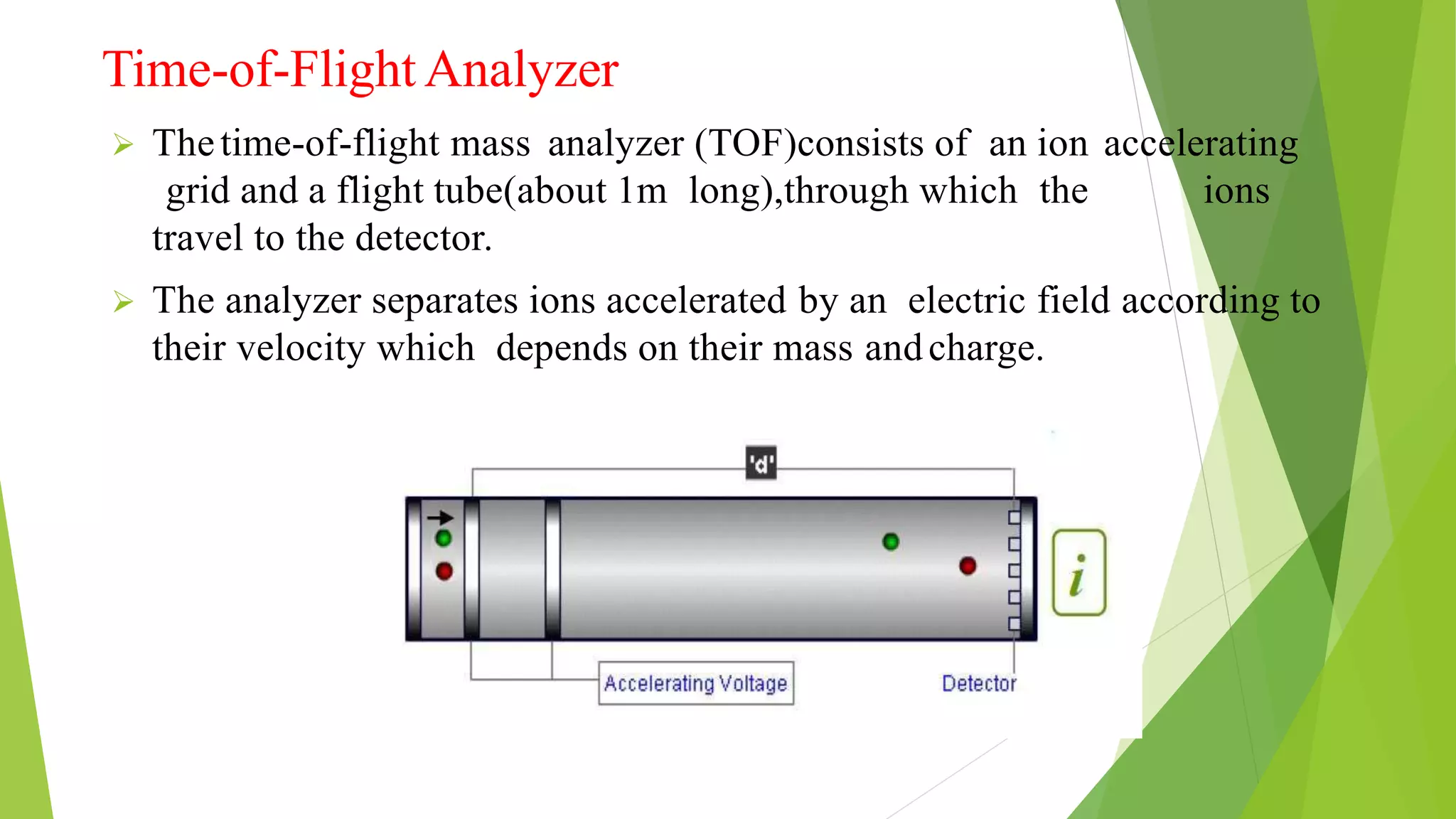
Time-of-Flight Analyzer
 Thetime-of-flight mass analyzer (TOF)consists of an ion accelerating
grid and a flight tube(about 1m long),through which the ions
travel to the detector.
 The analyzer separates ions accelerated by an electric field according to
their velocity which depends on their mass andcharge.
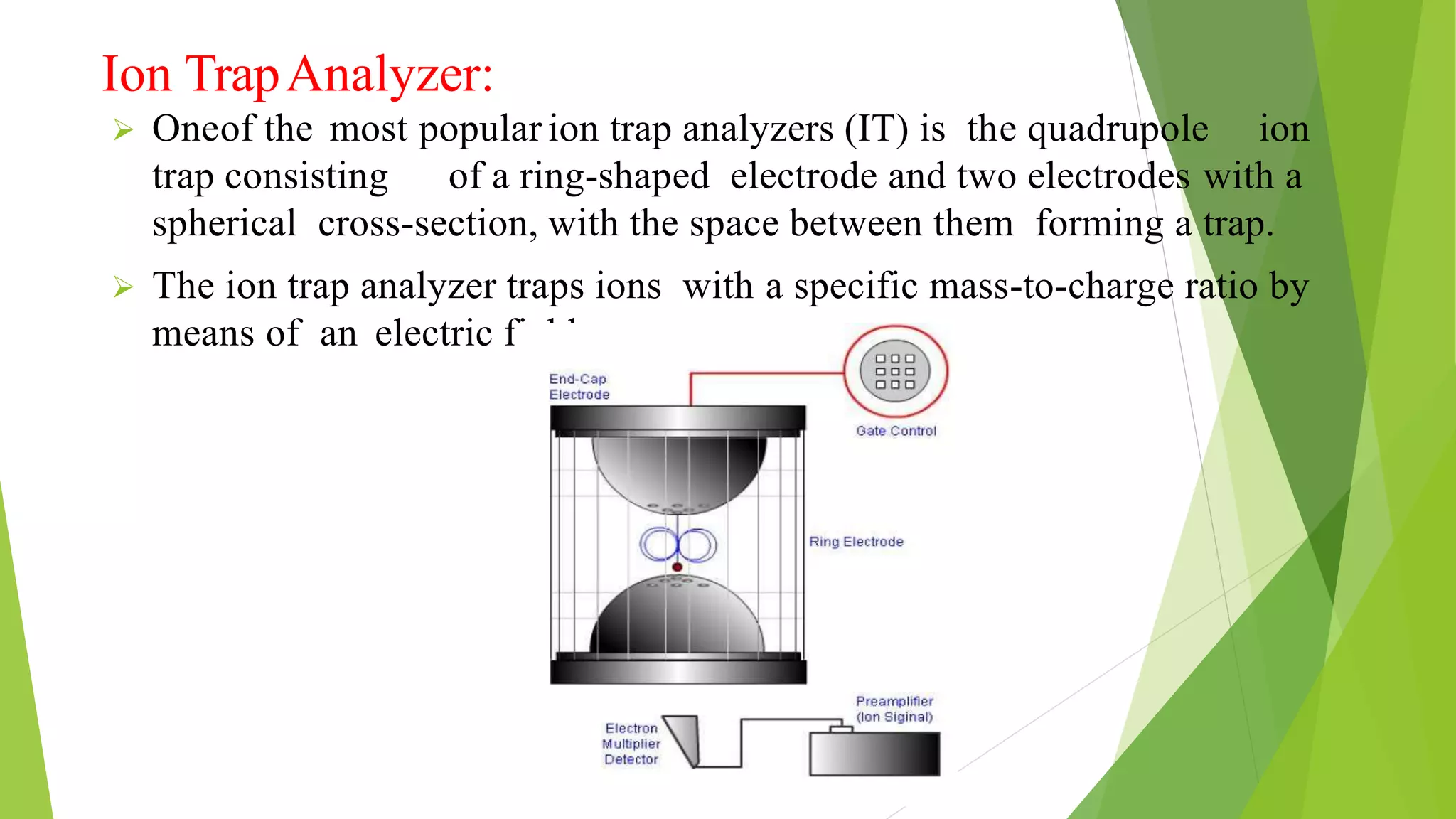
Ion TrapAnalyzer:
 Oneof the most popular ion trap analyzers (IT) is the quadrupole ion
trap consisting of a ring-shaped electrode and two electrodes with a
spherical cross-section, with the space between them forming a trap.
 The ion trap analyzer traps ions with a specific mass-to-charge ratio by
means of an electric field.
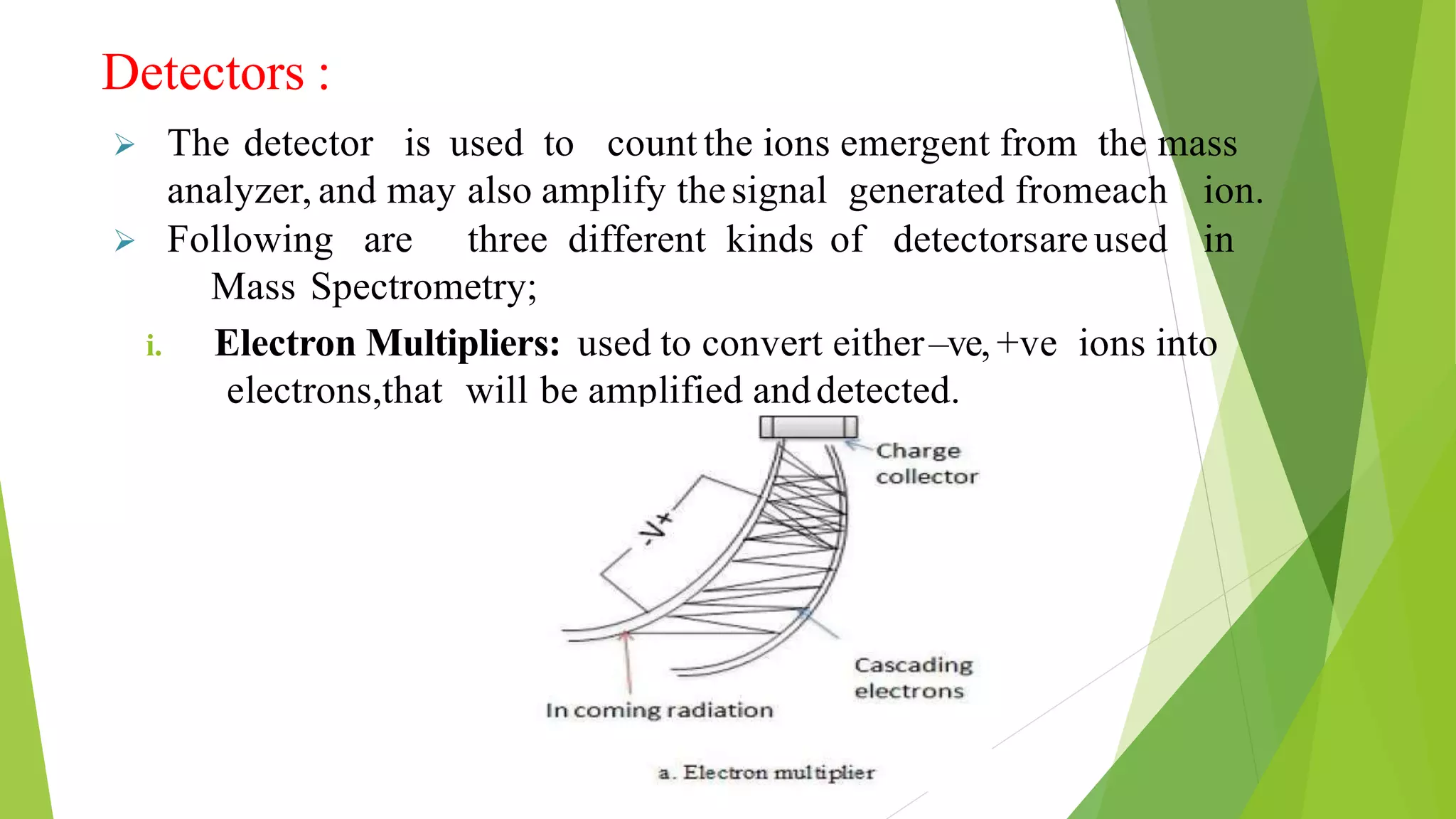
Detectors :
 The detector is used to count the ions emergent from the mass
analyzer, and may also amplify thesignal generated fromeach ion.
 Following are three different kinds of detectorsareused in
Mass Spectrometry;
i. Electron Multipliers: used to convert either–ve, +ve ions into
electrons,that will be amplified anddetected.
Interface :
 The interface is most often an electrospray ion source;however
atmospheric pressurechemical ionization interface is also used.
Various techniques of deposition and drying have also been used
such as using moving belts;however the most common of these
is off-line MALDI deposition.
 LC/ MS for Detailed Structure-Dependent Analysis:
It is hard in HPLC to be certain about purity of a particular peak,
and if it contains only a single chemical. Adding a Mass Spectrometry
to this will tell you the masses of all the chemicals present in the peak,
which can be used for identifying them, and an excellent method to
check for the purity.
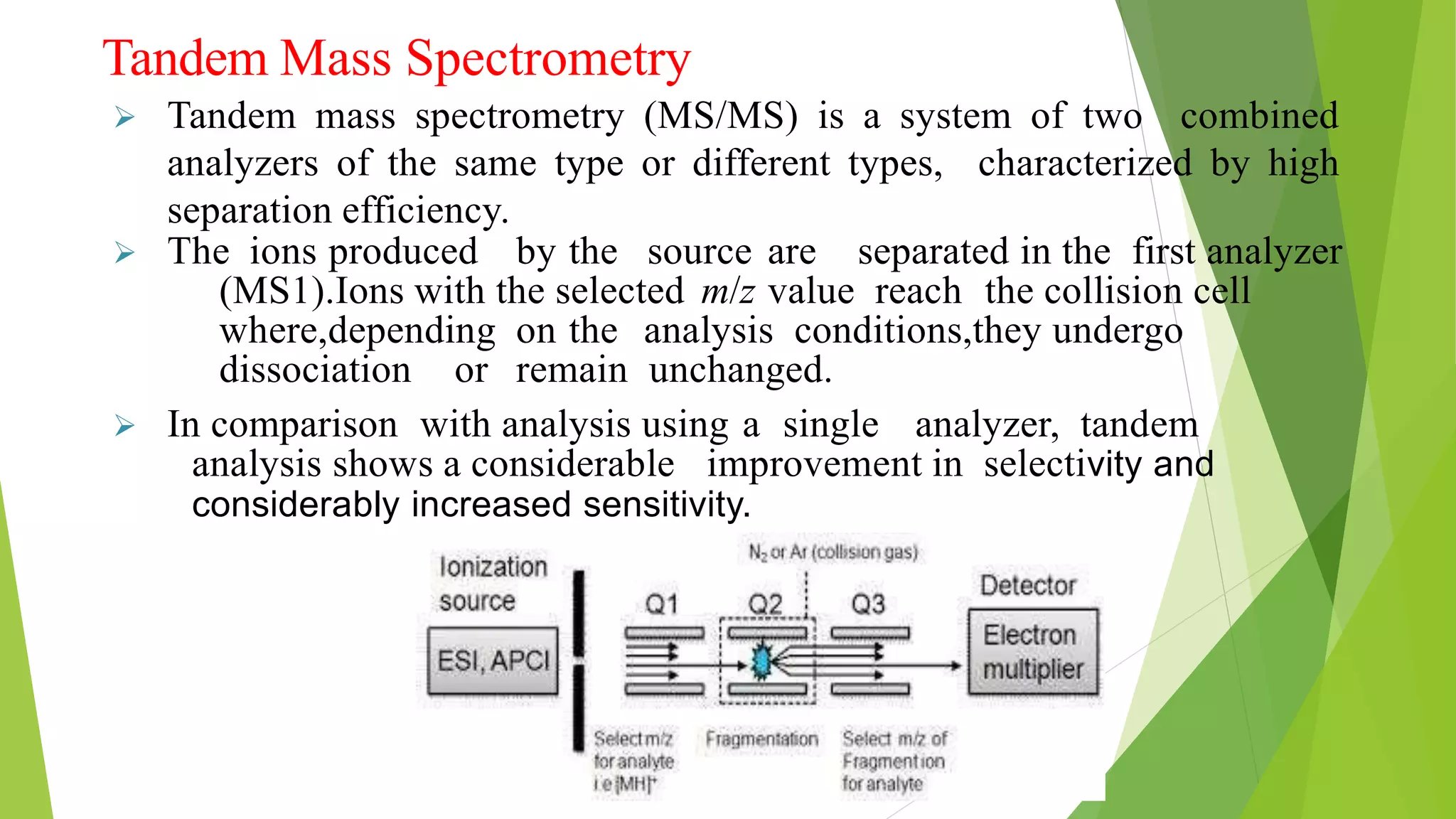
Tandem Mass Spectrometry
 Tandem mass spectrometry (MS/MS) is a system of two combined
analyzers of the same type or different types, characterized by high
separation efficiency.
 The ions produced by the source are separated in the first analyzer
(MS1).Ions with the selected m/z value reach the collision cell
where,depending on the analysis conditions,they undergo
dissociation or remain unchanged.
 In comparison with analysis using a single analyzer, tandem
analysis shows a considerable improvement in selectivity and
considerably increased sensitivity.
APPLICATIONS OF LCMS :
 Molecular Weight Determination
 Structural Elucidation
 Pharmaceutical Applications
 Food and Environmental Applications
 Characterization and Identification of Compounds
 Carotenoids
 Proteomics
 Glycopeptides Characterization
 Peptide Mapping
 Bioanalysis of various Biological Samples
 Analysis of Complex Lipid Mixtures :
 It is a LC-MS-based methodology for the investigation of pid
mixtures where it has described, and its application to the analysis
of human lipoprotein-associated lipids is demonstrated.
 Phytoconstituents:
 LC–MS provides a tool for differentiating this immense plant
biodiversity due to this technique’s capability of analyzing a broad
range of metabolites and highly polar and/or higher molecular
weight molecules(oligosaccharides and lipids).
References:
 Kumar, P. R., &Rini,R. (2016). LCMS-A REVIEW AND A
RECENT UPDATE.
 Stachniuk, A., & Fornal, E. (2016). Liquid Chromatography-Mass
Spectrometry in the Analysis of Pesticide Residues in Food. Food
Analytical Methods, 9(6), 1654-1665.
 Parasuraman, S., Anish, R.,Balamurugan, S., Muralidharan,
S., Kumar,K.J., & Vijayan,V. (2014). An Overview of Liquid
Chromatography-Mass Spectroscopy Instrumentation.
Pharmaceutical Methods, 5(2), 47.

Lc ms

  • 1.
    A seminar on LiquidChromatography & Mass Spectroscopy Presented by:- Mr. Choudhary B.M.
  • 2.
    CONTENTS :  INTRODUCTION BASIC PRINCIPLE OF LC/MS  INSTRUMENTATION  COMPONENTS OF MASS SPECTROMETER  IONIZATION METHODS  MASSANALYZER  DETECTORS  TANDEM MASS SPECTROMETRY  APPLICATIONS OF LCMS  FUTURE PROSPECTS OF LCMS
  • 3.
    LIQUID CHROMATOGRAPHY -MASSSPECTROMETRY  INTRODUCTION:  Liquid chromatography-mass spectrometry (LC/MS) is a technique that uses liquid chromatography (or HPLC) with the mass spectrometry.  It is an analytical chemistry technique that combines the physical separation capabilities of liquid chromatography with the mass analysis capabilitiesof mass spectrometry.
  • 4.
    Basic Principle ofLC/MS:  LC/MS combines the separating power of High Performance Liquid Chromatography(HPLC),with the detection power of MassSpectrometry. 1. High Performance Liquid Chromatography (HPLC):  Liquid chromatography involves two main phases:  Mobile phase: Liquid (solvents i.e. ethanol, Acetonitrile).  Stationary phase: Column packed with very small particles 2. Mass Spectrometry:  Analytical technique that measures the mass- to-charge ratio of charged particles.
  • 5.
    Working Principle:  MSworks by ionizing chemical compounds to generate charged molecules or molecule fragments and measuring their mass-to-charge ratios.  The components of the sample are ionized by one of a variety of methods.  The ions are separated according to their mass-to- charge ratio in an analyzer by electromagnetic field.  The ions are detected, usually by a quantitative method. The ion signal isprocessed into mass spectra.
  • 6.
  • 7.
  • 10.
    Components of MassSpectrometer :  Ion source,which can convert gas phase sample molecules into ions.  Analyzer,where ions are separated according to their mass-to- charge ratio by applying electromagnetic fields.  Detector,where ions are counted thus calculating the abundances of each ion present.  Ionization Methods :  Following are the most common ionization methods : i. Electrospray Ionization ii. Atmospheric Pressure Chemical Ionization (APCI) iii. Atmospheric Pressure Photo-ionization (APPI)
  • 11.
    Electrospray Ionization  ElectrosprayIonization :  Method of molecule ionization used in the analysis of multicomponent mixtures in an LC-MS system.  It belongs to a group of methods whereby “soft” ionization is carried out under atmospheric pressure.  Electrospray ionization is a highly efficient technique that does not cause the dissociation of the molecules under study  Under this method, the eluate stream leaving the chromatographic column is introduced into the ionization source through the capillary.  At the outlet of the capillary, thesample dissolved in the solvent is exposed to a strong nebulizing gas(typically, nitrogen) and a very strong electric field, which results in the atomization of the sample into charged microdroplets.
  • 12.
  • 13.
    Atmospheric Pressure ChemicalIonization:  Atmosphericpressure chemical ionization (APCI) is avery similar technique to ESI. The manner of sample ionization is the fundamental difference between the two methods.  In APCI, the eluate leaving the chromatographic column is heated and sprayed from the capillary and then captured,in gaseous form, byastream of gas and carried to the electrode ions are formed.
  • 14.
  • 15.
    Atmospheric Pressure Photo-ionization :  Atmospheric pressure photo-ionisation (APPI) uses photons to excite and ionize molecules after nebulisation.  The energy of the photons is chosen to minimize concurrent ionization of solvents and ion source gases.  The technique also gives predominantly singly-charged ions and has been used for the analysis of neutral compounds such as steroids and has been reviewed.
  • 16.
    Mass Analyzer : Its task is to separate ions in terms of their mass-to- charge ratio and to direct the beam of focused ions to the detector.  The key performance parameters of an analyzer include; (a) separation efficiency (b) m/z measurement precision (c) range of the m/z values measured
  • 17.
    persed and donot reach the detector.  There are following kinds of mass analyzers that can be used in LC/MS: 1.Quadrupole Analyzer: The quadrupole analyzer (Q) consists of four metal electrodes in theform of symmetrically arranged rods. It works like a mass filter that, with thespecific parameters of the electromagnetic field,allows the passage of ions with the selected mass-to-charge ratio values, while other ions are dis
  • 18.
    Time-of-Flight Analyzer  Thetime-of-flightmass analyzer (TOF)consists of an ion accelerating grid and a flight tube(about 1m long),through which the ions travel to the detector.  The analyzer separates ions accelerated by an electric field according to their velocity which depends on their mass andcharge.
  • 19.
    Ion TrapAnalyzer:  Oneofthe most popular ion trap analyzers (IT) is the quadrupole ion trap consisting of a ring-shaped electrode and two electrodes with a spherical cross-section, with the space between them forming a trap.  The ion trap analyzer traps ions with a specific mass-to-charge ratio by means of an electric field.
  • 20.
    Detectors :  Thedetector is used to count the ions emergent from the mass analyzer, and may also amplify thesignal generated fromeach ion.  Following are three different kinds of detectorsareused in Mass Spectrometry; i. Electron Multipliers: used to convert either–ve, +ve ions into electrons,that will be amplified anddetected.
  • 21.
    Interface :  Theinterface is most often an electrospray ion source;however atmospheric pressurechemical ionization interface is also used. Various techniques of deposition and drying have also been used such as using moving belts;however the most common of these is off-line MALDI deposition.  LC/ MS for Detailed Structure-Dependent Analysis: It is hard in HPLC to be certain about purity of a particular peak, and if it contains only a single chemical. Adding a Mass Spectrometry to this will tell you the masses of all the chemicals present in the peak, which can be used for identifying them, and an excellent method to check for the purity.
  • 22.
    Tandem Mass Spectrometry Tandem mass spectrometry (MS/MS) is a system of two combined analyzers of the same type or different types, characterized by high separation efficiency.  The ions produced by the source are separated in the first analyzer (MS1).Ions with the selected m/z value reach the collision cell where,depending on the analysis conditions,they undergo dissociation or remain unchanged.  In comparison with analysis using a single analyzer, tandem analysis shows a considerable improvement in selectivity and considerably increased sensitivity.
  • 23.
    APPLICATIONS OF LCMS:  Molecular Weight Determination  Structural Elucidation  Pharmaceutical Applications  Food and Environmental Applications  Characterization and Identification of Compounds  Carotenoids  Proteomics  Glycopeptides Characterization  Peptide Mapping  Bioanalysis of various Biological Samples
  • 24.
     Analysis ofComplex Lipid Mixtures :  It is a LC-MS-based methodology for the investigation of pid mixtures where it has described, and its application to the analysis of human lipoprotein-associated lipids is demonstrated.  Phytoconstituents:  LC–MS provides a tool for differentiating this immense plant biodiversity due to this technique’s capability of analyzing a broad range of metabolites and highly polar and/or higher molecular weight molecules(oligosaccharides and lipids).
  • 25.
    References:  Kumar, P.R., &Rini,R. (2016). LCMS-A REVIEW AND A RECENT UPDATE.  Stachniuk, A., & Fornal, E. (2016). Liquid Chromatography-Mass Spectrometry in the Analysis of Pesticide Residues in Food. Food Analytical Methods, 9(6), 1654-1665.  Parasuraman, S., Anish, R.,Balamurugan, S., Muralidharan, S., Kumar,K.J., & Vijayan,V. (2014). An Overview of Liquid Chromatography-Mass Spectroscopy Instrumentation. Pharmaceutical Methods, 5(2), 47.