MAXIMUM FLOW
Max-Flow Min-Cut Theorem (Ford Fukerson’s Algorithm)
What is Network Flow ?
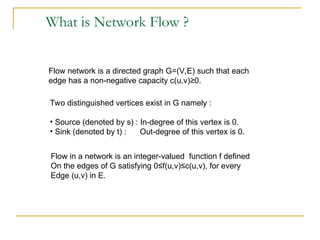
Flow network is a directed graph G=(V,E) such that each
edge has a non-negative capacity c(u,v)≥0.
Two distinguished vertices exist in G namely :
• Source (denoted by s) : In-degree of this vertex is 0.
• Sink (denoted by t) : Out-degree of this vertex is 0.
Flow in a network is an integer-valued function f defined
On the edges of G satisfying 0≤f(u,v)≤c(u,v), for every
Edge (u,v) in E.
What is Network Flow ?
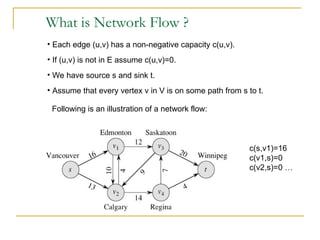
• Each edge (u,v) has a non-negative capacity c(u,v).
• If (u,v) is not in E assume c(u,v)=0.
• We have source s and sink t.
• Assume that every vertex v in V is on some path from s to t.
Following is an illustration of a network flow:
c(s,v1)=16
c(v1,s)=0
c(v2,s)=0 …
Conditions for Network Flow
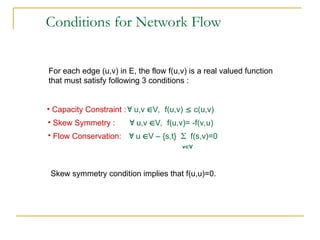
For each edge (u,v) in E, the flow f(u,v) is a real valued function
that must satisfy following 3 conditions :
• Skew Symmetry :  u,v V, f(u,v)= -f(v,u)
• Capacity Constraint : u,v V, f(u,v)  c(u,v)
• Flow Conservation:  u V – {s,t}  f(s,v)=0
vV
Skew symmetry condition implies that f(u,u)=0.
The Value of a Flow.
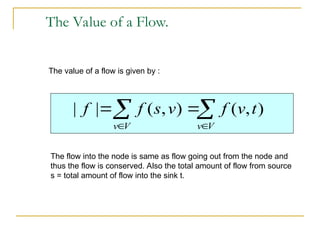
The value of a flow is given by :
The flow into the node is same as flow going out from the node and
thus the flow is conserved. Also the total amount of flow from source
s = total amount of flow into the sink t.

 



V
v
V
v
t
v
f
v
s
f
f )
,
(
)
,
(
|
|
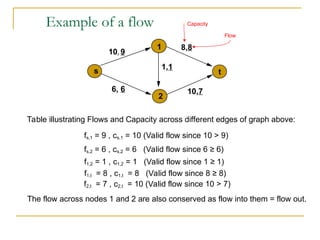
Example of a flow
s
1
2
t
10, 9
8,8
1,1
10,7
6, 6
fs,1 = 9 , cs,1 = 10 (Valid flow since 10 > 9)
fs,2 = 6 , cs,2 = 6 (Valid flow since 6 ≥ 6)
f1,2 = 1 , c1,2 = 1 (Valid flow since 1 ≥ 1)
f1,t = 8 , c1,t = 8 (Valid flow since 8 ≥ 8)
f2,t = 7 , c2,t = 10 (Valid flow since 10 > 7)
Table illustrating Flows and Capacity across different edges of graph above:
The flow across nodes 1 and 2 are also conserved as flow into them = flow out.
Capacity
Flow
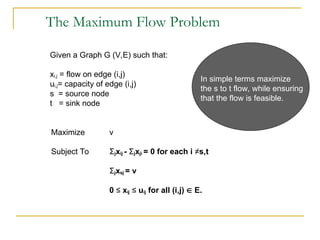
The Maximum Flow Problem
Given a Graph G (V,E) such that:
xi,j = flow on edge (i,j)
ui,j= capacity of edge (i,j)
s = source node
t = sink node
Maximize v
Subject To Σjxij - Σjxji = 0 for each i ≠s,t
Σjxsj = v
0 ≤ xij ≤ uij for all (i,j)  E.
In simple terms maximize
the s to t flow, while ensuring
that the flow is feasible.
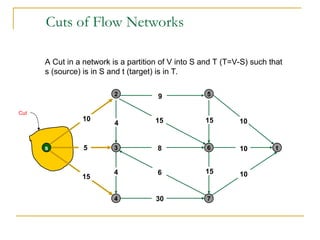
Cuts of Flow Networks
A Cut in a network is a partition of V into S and T (T=V-S) such that
s (source) is in S and t (target) is in T.
s 3
4
6
7
t
15
5
30
15
10
8
15
9
6 10
10
10
15
4
4
2 5
Cut
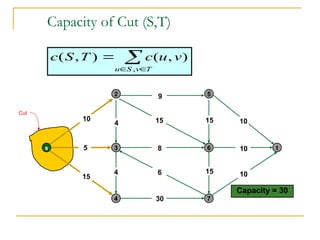
Capacity of Cut (S,T)



T
v
S
u
v
u
c
T
S
c
,
)
,
(
)
,
(
s 3
4
6
7
t
15
5
30
15
10
8
15
9
6 10
10
10
15
4
4
Capacity = 30
2 5
Cut
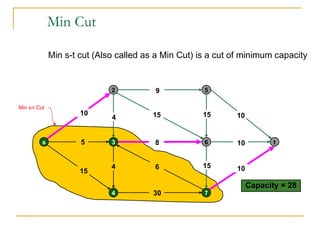
Min Cut
Min s-t Cut
Min s-t cut (Also called as a Min Cut) is a cut of minimum capacity
s
2
3
4
5
6
7
t
15
5
30
15
10
8
15
9
6 10
10
10
15
4
4
Capacity = 28
Flow of Min Cut (Weak Duality)
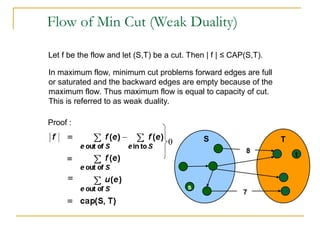
Let f be the flow and let (S,T) be a cut. Then | f | ≤ CAP(S,T).
In maximum flow, minimum cut problems forward edges are full
or saturated and the backward edges are empty because of the
maximum flow. Thus maximum flow is equal to capacity of cut.
This is referred to as weak duality.
0
Proof :
s
t
S T
7
8
Methods
Max-Flow Min-Cut Theorem
• The Ford-Fulkerson Method
• The Preflow-Push Method
The Ford-Fulkerson Method
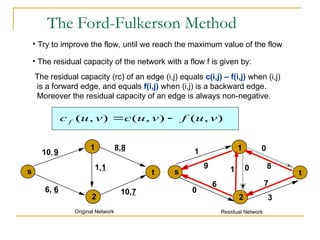
• Try to improve the flow, until we reach the maximum value of the flow
• The residual capacity of the network with a flow f is given by:
The residual capacity (rc) of an edge (i,j) equals c(i,j) – f(i,j) when (i,j)
is a forward edge, and equals f(i,j) when (i,j) is a backward edge.
Moreover the residual capacity of an edge is always non-negative.
)
,
(
)
,
(
)
,
( v
u
f
v
u
c
v
u
c f 

s
1
2
t
10, 9
8,8
1,1
10,7
6, 6
Original Network
s
1
2
t
1 0
0
3
0
8
6
9
7
1
Residual Network
The Ford-Fulkerson Method
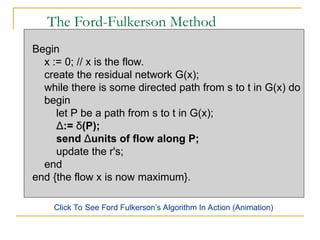
Begin
x := 0; // x is the flow.
create the residual network G(x);
while there is some directed path from s to t in G(x) do
begin
let P be a path from s to t in G(x);
Δ:= δ(P);
send Δunits of flow along P;
update the r's;
end
end {the flow x is now maximum}.
Click To See Ford Fulkerson’s Algorithm In Action (Animation)
Augmenting Paths ( A Useful Concept )
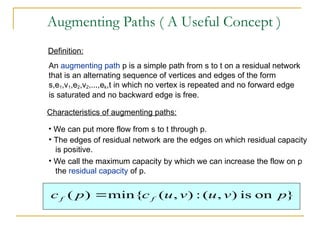
An augmenting path p is a simple path from s to t on a residual network
that is an alternating sequence of vertices and edges of the form
s,e1,v1,e2,v2,...,ek,t in which no vertex is repeated and no forward edge
is saturated and no backward edge is free.
Definition:
• We can put more flow from s to t through p.
Characteristics of augmenting paths:
• The edges of residual network are the edges on which residual capacity
is positive.
• We call the maximum capacity by which we can increase the flow on p
the residual capacity of p.
}
on
is
)
,
(
:
)
,
(
min{
)
( p
v
u
v
u
c
p
c f
f 
FORDFULKERSON(G,E,s,t)
FOREACH e  E
f(e)  0
Gf  residual graph
WHILE (there exists augmenting
path P)
f  augment(f, P)
update Gf
ENDWHILE
RETURN f
AUGMENT(f,P)
b  bottleneck(P)
FOREACH e  P
IF (e  E)
// backwards arc
f(e)  f(e) + b
ELSE
// forward arc
f(eR
)  f(e) - b
RETURN f
The Ford-Fulkerson’s Algorithm
Click To See Ford Fulkerson’s Algorithm In Action (Animation)
Proof of correctness of the algorithm
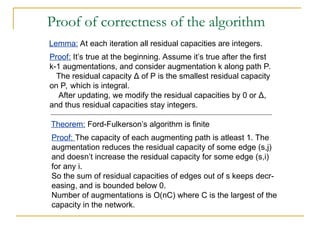
Lemma: At each iteration all residual capacities are integers.
Proof: It’s true at the beginning. Assume it’s true after the first
k-1 augmentations, and consider augmentation k along path P.
The residual capacity Δ of P is the smallest residual capacity
on P, which is integral.
After updating, we modify the residual capacities by 0 or Δ,
and thus residual capacities stay integers.
Theorem: Ford-Fulkerson’s algorithm is finite
Proof: The capacity of each augmenting path is atleast 1. The
augmentation reduces the residual capacity of some edge (s,j)
and doesn’t increase the residual capacity for some edge (s,i)
for any i.
So the sum of residual capacities of edges out of s keeps decr-
easing, and is bounded below 0.
Number of augmentations is O(nC) where C is the largest of the
capacity in the network.
When is the flow optimal ?
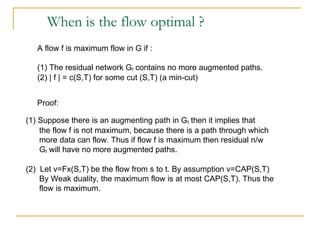
A flow f is maximum flow in G if :
(1) The residual network Gf contains no more augmented paths.
(2) | f | = c(S,T) for some cut (S,T) (a min-cut)
Proof:
(1) Suppose there is an augmenting path in Gf then it implies that
the flow f is not maximum, because there is a path through which
more data can flow. Thus if flow f is maximum then residual n/w
Gf will have no more augmented paths.
(2) Let v=Fx(S,T) be the flow from s to t. By assumption v=CAP(S,T)
By Weak duality, the maximum flow is at most CAP(S,T). Thus the
flow is maximum.
15.082 and 6.855J (MIT OCW)
The Ford-Fulkerson Augmenting
Path Algorithm for the Maximum
Flow Problem
Ford-Fulkerson Max Flow
4
1
1
2
2
1
2
3
3
1
s
2
4
5
3
t
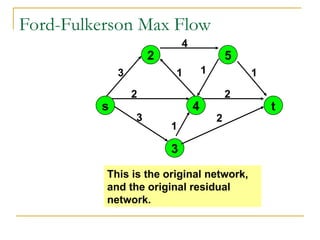
This is the original network,
and the original residual
network.
4
1
1
2
2
1
2
3
3
1
Ford-Fulkerson Max Flow
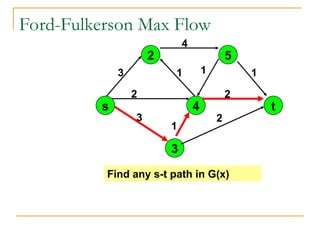
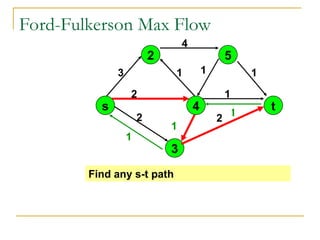
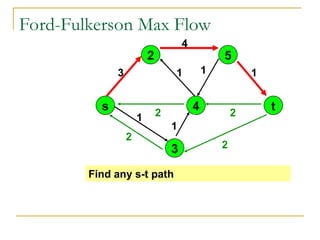
Find any s-t path in G(x)
s
2
4
5
3
t
4
1
1
2
1
3
Ford-Fulkerson Max Flow
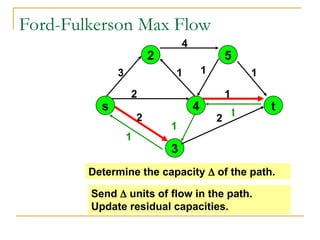
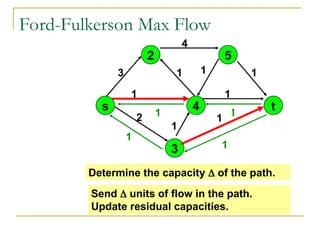
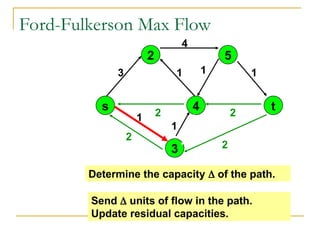
Determine the capacity  of the path.
Send  units of flow in the path.
Update residual capacities.
1
1
1
2
1
2
3
2
1
s
2
4
5
3
t
4
1
1
2
1
3
Ford-Fulkerson Max Flow
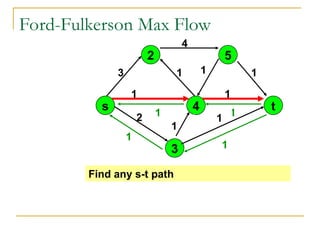
Find any s-t path
1
1
1
2
1
2
3
2
1
s
2
4
5
3
t
4
2
1
1
1
1
2
2
1
1
1
1
3
Ford-Fulkerson Max Flow
1
1
1
1
3
2
1
s
2
4
5
3
t
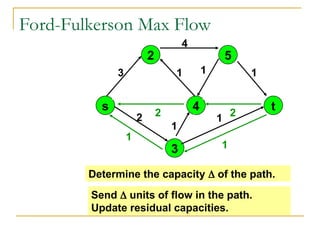
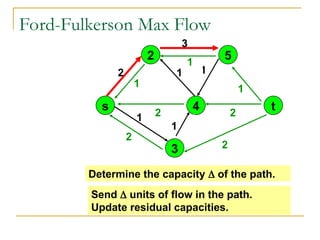
Determine the capacity  of the path.
Send  units of flow in the path.
Update residual capacities.
4
2
1
1
1
1
2
2
1
1
1
1
3
Ford-Fulkerson Max Flow
1
1
1
1
3
2
1
s
2
4
5
3
t
Find any s-t path
1
1 1
1
1
4
1
2
1
1
2
1
1
3
Ford-Fulkerson Max Flow
1
1
3
2
1
s
2
4
5
3
t
Determine the capacity  of the path.
Send  units of flow in the path.
Update residual capacities.
1
1 1
1
1
4
1
2
1
1
2
2
1
1
3
Ford-Fulkerson Max Flow
1
1
3
2
1
s
2
4
5
3
t
Find any s-t path
1
1
1
2
1 1
1
1
4
2
2
1
1
2
2
1
Ford-Fulkerson Max Flow
1
1
3
1
1
s
2
4
5
3
t
Determine the capacity  of the path.
Send  units of flow in the path.
Update residual capacities.
2
1
1
2
1 1
1
1
4
2
2
1
1
2
2
1
Ford-Fulkerson Max Flow
1
1
3
1
1
s
2
4
5
3
t
Find any s-t path
2
1
1
1
1
1
4
1
3
1
1
2
1 1
3
2
2
1
2
1
Ford-Fulkerson Max Flow
2
1
s
2
4
5
3
t
2
Determine the capacity  of the path.
Send  units of flow in the path.
Update residual capacities.
1
1
1
1
1
4
1
3
1
1
2
1 1
3
2
2
1
2
1
Ford-Fulkerson Max Flow
2
1
s
2
4
5
3
t
2
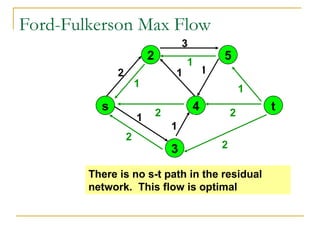
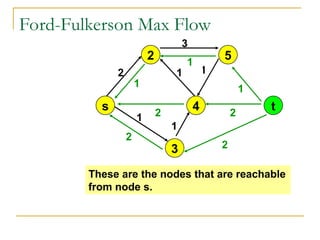
There is no s-t path in the residual
network. This flow is optimal
1
1
1
1
1
4
1
3
1
1
2
1 1
3
2
2
1
2
1
Ford-Fulkerson Max Flow
2
1
s
2
4
5
3
t
2
These are the nodes that are reachable
from node s.
s
2
4
5
3
Ford-Fulkerson Max Flow
1
1
2
2
2
1
2
s
2
4
5
3
t
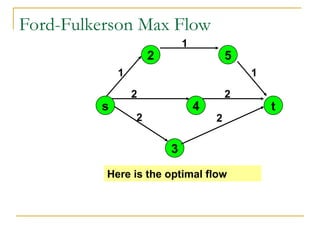
Here is the optimal flow

Ford Fulkerson Algorithm with example .ppt

  • 1.
    MAXIMUM FLOW Max-Flow Min-CutTheorem (Ford Fukerson’s Algorithm)
  • 2.
    What is NetworkFlow ? Flow network is a directed graph G=(V,E) such that each edge has a non-negative capacity c(u,v)≥0. Two distinguished vertices exist in G namely : • Source (denoted by s) : In-degree of this vertex is 0. • Sink (denoted by t) : Out-degree of this vertex is 0. Flow in a network is an integer-valued function f defined On the edges of G satisfying 0≤f(u,v)≤c(u,v), for every Edge (u,v) in E.
  • 3.
    What is NetworkFlow ? • Each edge (u,v) has a non-negative capacity c(u,v). • If (u,v) is not in E assume c(u,v)=0. • We have source s and sink t. • Assume that every vertex v in V is on some path from s to t. Following is an illustration of a network flow: c(s,v1)=16 c(v1,s)=0 c(v2,s)=0 …
  • 4.
    Conditions for NetworkFlow For each edge (u,v) in E, the flow f(u,v) is a real valued function that must satisfy following 3 conditions : • Skew Symmetry :  u,v V, f(u,v)= -f(v,u) • Capacity Constraint : u,v V, f(u,v)  c(u,v) • Flow Conservation:  u V – {s,t}  f(s,v)=0 vV Skew symmetry condition implies that f(u,u)=0.
  • 5.
    The Value ofa Flow. The value of a flow is given by : The flow into the node is same as flow going out from the node and thus the flow is conserved. Also the total amount of flow from source s = total amount of flow into the sink t.       V v V v t v f v s f f ) , ( ) , ( | |
  • 6.
    Example of aflow s 1 2 t 10, 9 8,8 1,1 10,7 6, 6 fs,1 = 9 , cs,1 = 10 (Valid flow since 10 > 9) fs,2 = 6 , cs,2 = 6 (Valid flow since 6 ≥ 6) f1,2 = 1 , c1,2 = 1 (Valid flow since 1 ≥ 1) f1,t = 8 , c1,t = 8 (Valid flow since 8 ≥ 8) f2,t = 7 , c2,t = 10 (Valid flow since 10 > 7) Table illustrating Flows and Capacity across different edges of graph above: The flow across nodes 1 and 2 are also conserved as flow into them = flow out. Capacity Flow
  • 7.
    The Maximum FlowProblem Given a Graph G (V,E) such that: xi,j = flow on edge (i,j) ui,j= capacity of edge (i,j) s = source node t = sink node Maximize v Subject To Σjxij - Σjxji = 0 for each i ≠s,t Σjxsj = v 0 ≤ xij ≤ uij for all (i,j)  E. In simple terms maximize the s to t flow, while ensuring that the flow is feasible.
  • 8.
    Cuts of FlowNetworks A Cut in a network is a partition of V into S and T (T=V-S) such that s (source) is in S and t (target) is in T. s 3 4 6 7 t 15 5 30 15 10 8 15 9 6 10 10 10 15 4 4 2 5 Cut
  • 9.
    Capacity of Cut(S,T)    T v S u v u c T S c , ) , ( ) , ( s 3 4 6 7 t 15 5 30 15 10 8 15 9 6 10 10 10 15 4 4 Capacity = 30 2 5 Cut
  • 10.
    Min Cut Min s-tCut Min s-t cut (Also called as a Min Cut) is a cut of minimum capacity s 2 3 4 5 6 7 t 15 5 30 15 10 8 15 9 6 10 10 10 15 4 4 Capacity = 28
  • 11.
    Flow of MinCut (Weak Duality) Let f be the flow and let (S,T) be a cut. Then | f | ≤ CAP(S,T). In maximum flow, minimum cut problems forward edges are full or saturated and the backward edges are empty because of the maximum flow. Thus maximum flow is equal to capacity of cut. This is referred to as weak duality. 0 Proof : s t S T 7 8
  • 12.
    Methods Max-Flow Min-Cut Theorem •The Ford-Fulkerson Method • The Preflow-Push Method
  • 13.
    The Ford-Fulkerson Method •Try to improve the flow, until we reach the maximum value of the flow • The residual capacity of the network with a flow f is given by: The residual capacity (rc) of an edge (i,j) equals c(i,j) – f(i,j) when (i,j) is a forward edge, and equals f(i,j) when (i,j) is a backward edge. Moreover the residual capacity of an edge is always non-negative. ) , ( ) , ( ) , ( v u f v u c v u c f   s 1 2 t 10, 9 8,8 1,1 10,7 6, 6 Original Network s 1 2 t 1 0 0 3 0 8 6 9 7 1 Residual Network
  • 14.
    The Ford-Fulkerson Method Begin x:= 0; // x is the flow. create the residual network G(x); while there is some directed path from s to t in G(x) do begin let P be a path from s to t in G(x); Δ:= δ(P); send Δunits of flow along P; update the r's; end end {the flow x is now maximum}. Click To See Ford Fulkerson’s Algorithm In Action (Animation)
  • 15.
    Augmenting Paths (A Useful Concept ) An augmenting path p is a simple path from s to t on a residual network that is an alternating sequence of vertices and edges of the form s,e1,v1,e2,v2,...,ek,t in which no vertex is repeated and no forward edge is saturated and no backward edge is free. Definition: • We can put more flow from s to t through p. Characteristics of augmenting paths: • The edges of residual network are the edges on which residual capacity is positive. • We call the maximum capacity by which we can increase the flow on p the residual capacity of p. } on is ) , ( : ) , ( min{ ) ( p v u v u c p c f f 
  • 16.
    FORDFULKERSON(G,E,s,t) FOREACH e E f(e)  0 Gf  residual graph WHILE (there exists augmenting path P) f  augment(f, P) update Gf ENDWHILE RETURN f AUGMENT(f,P) b  bottleneck(P) FOREACH e  P IF (e  E) // backwards arc f(e)  f(e) + b ELSE // forward arc f(eR )  f(e) - b RETURN f The Ford-Fulkerson’s Algorithm Click To See Ford Fulkerson’s Algorithm In Action (Animation)
  • 17.
    Proof of correctnessof the algorithm Lemma: At each iteration all residual capacities are integers. Proof: It’s true at the beginning. Assume it’s true after the first k-1 augmentations, and consider augmentation k along path P. The residual capacity Δ of P is the smallest residual capacity on P, which is integral. After updating, we modify the residual capacities by 0 or Δ, and thus residual capacities stay integers. Theorem: Ford-Fulkerson’s algorithm is finite Proof: The capacity of each augmenting path is atleast 1. The augmentation reduces the residual capacity of some edge (s,j) and doesn’t increase the residual capacity for some edge (s,i) for any i. So the sum of residual capacities of edges out of s keeps decr- easing, and is bounded below 0. Number of augmentations is O(nC) where C is the largest of the capacity in the network.
  • 18.
    When is theflow optimal ? A flow f is maximum flow in G if : (1) The residual network Gf contains no more augmented paths. (2) | f | = c(S,T) for some cut (S,T) (a min-cut) Proof: (1) Suppose there is an augmenting path in Gf then it implies that the flow f is not maximum, because there is a path through which more data can flow. Thus if flow f is maximum then residual n/w Gf will have no more augmented paths. (2) Let v=Fx(S,T) be the flow from s to t. By assumption v=CAP(S,T) By Weak duality, the maximum flow is at most CAP(S,T). Thus the flow is maximum.
  • 19.
    15.082 and 6.855J(MIT OCW) The Ford-Fulkerson Augmenting Path Algorithm for the Maximum Flow Problem

  • 20.
    Ford-Fulkerson Max Flow 4 1 1 2 2 1 2 3 3 1 s 2 4 5 3 t Thisis the original network, and the original residual network.
  • 21.
    4 1 1 2 2 1 2 3 3 1 Ford-Fulkerson Max Flow Findany s-t path in G(x) s 2 4 5 3 t
  • 22.
    4 1 1 2 1 3 Ford-Fulkerson Max Flow Determinethe capacity  of the path. Send  units of flow in the path. Update residual capacities. 1 1 1 2 1 2 3 2 1 s 2 4 5 3 t
  • 23.
    4 1 1 2 1 3 Ford-Fulkerson Max Flow Findany s-t path 1 1 1 2 1 2 3 2 1 s 2 4 5 3 t
  • 24.
    4 2 1 1 1 1 2 2 1 1 1 1 3 Ford-Fulkerson Max Flow 1 1 1 1 3 2 1 s 2 4 5 3 t Determinethe capacity  of the path. Send  units of flow in the path. Update residual capacities.
  • 25.
  • 26.
    1 1 1 1 1 4 1 2 1 1 2 1 1 3 Ford-Fulkerson MaxFlow 1 1 3 2 1 s 2 4 5 3 t Determine the capacity  of the path. Send  units of flow in the path. Update residual capacities.
  • 27.
    1 1 1 1 1 4 1 2 1 1 2 2 1 1 3 Ford-Fulkerson MaxFlow 1 1 3 2 1 s 2 4 5 3 t Find any s-t path
  • 28.
    1 1 1 2 1 1 1 1 4 2 2 1 1 2 2 1 Ford-Fulkerson MaxFlow 1 1 3 1 1 s 2 4 5 3 t Determine the capacity  of the path. Send  units of flow in the path. Update residual capacities. 2
  • 29.
    1 1 2 1 1 1 1 4 2 2 1 1 2 2 1 Ford-Fulkerson MaxFlow 1 1 3 1 1 s 2 4 5 3 t Find any s-t path 2
  • 30.
    1 1 1 1 1 4 1 3 1 1 2 1 1 3 2 2 1 2 1 Ford-Fulkerson MaxFlow 2 1 s 2 4 5 3 t 2 Determine the capacity  of the path. Send  units of flow in the path. Update residual capacities.
  • 31.
    1 1 1 1 1 4 1 3 1 1 2 1 1 3 2 2 1 2 1 Ford-Fulkerson MaxFlow 2 1 s 2 4 5 3 t 2 There is no s-t path in the residual network. This flow is optimal
  • 32.
    1 1 1 1 1 4 1 3 1 1 2 1 1 3 2 2 1 2 1 Ford-Fulkerson MaxFlow 2 1 s 2 4 5 3 t 2 These are the nodes that are reachable from node s. s 2 4 5 3
  • 33.