Interactive Opportunity Assessment Demo and Seminar (Deminar) Series  for Web Labs – Process Control Improvement Primer Sept 8, 2010 Sponsored by Emerson, Experitec, and Mynah Created by Greg McMillan and Jack Ahlers www.processcontrollab.com  Website - Charlie Schliesser (csdesignco.com)
Welcome Gregory K. McMillan  Greg is a retired Senior Fellow from Solutia/Monsanto and an ISA Fellow. Presently, Greg contracts as a consultant in DeltaV R&D via CDI Process & Industrial. Greg received the ISA “Kermit Fischer Environmental” Award for pH control in 1991, the Control Magazine “Engineer of the Year” Award for the Process Industry in 1994, was inducted into the Control “Process Automation Hall of Fame” in 2001, was honored by InTech Magazine in 2003 as one of the most influential innovators in automation, and received the ISA “Life Achievement  Award” in 2010. Greg is the author of numerous books on process control, his most recent being  Essentials of Modern Measurements and Final Elements for the Process Industry.  Greg has been the monthly “Control Talk” columnist for  Control  magazine since 2002. Greg’s expertise is available on the web site:  http://www.modelingandcontrol.com/
“ Top Ten Things You Don’t Want to Hear During Startup” Courtesy of Hunter Vegas (October 2010 Control Talk) (10) We never really could figure out what the old system was doing.   (9) Do I have a system backup?!?  I thought YOU were making backups!  (8) They want to make our startup into a reality show. (7) The displays are fine and dandy but where are the panel boards?  (6) We have changed our mind – we want the old system back.   (5) Can you reprogram it so the wrong valve still works?   (4) Didn’t you get the revised batch sheets?  (3) Is a blue screen bad??  (2) What is that burning smell?   And the Number 1 thing you don’t want to hear :
“ Top Ten Things You Don’t Want to  Hear  During Startup” Courtesy of Hunter Vegas (October 2010 Control Talk) (1) We are out of coffee!
Introduction There is no clear picture of what is the potential source and size of a process control improvement  Practical process control knowledge is detailed, fragmented, and experience driven This seminar will attempt to provide a unified approach and understanding of the impact of the PID, final control element (e.g. valve or variable speed drive), process, disturbance, and measurement on loop performance
Unifying Concepts “ It is all about management of change” 90% of process control improvements involve the following concepts:  Delay Speed Gain Sensitivity-Resolution Backlash-Deadband Nonlinearity Noise Oscillations Resonance Attenuation Optimum Delay, speed, and gain are the most prevalent limiting concepts
Delay “ Without deadtime I would be out of a job” Fundamentals A more descriptive name would be  total loop deadtime . The loop deadtime is the amount of time for the start of a change to completely circle the control loop and end up at the point of origin. For example, an unmeasured disturbance cannot be corrected until the change is seen and the correction arrives in the process at the same point as the disturbance.  While process deadtime offers a continuous train of values whereas digital devices and analyzers offer non continuous data values at discrete intervals, these delays add a phase shift and increase the ultimate period (decrease natural frequency) like process deadtime.  Goals Minimize delay (the loop cannot do anything until it sees and enacts change) Sources Pure delay from deadtimes and discontinuous updates Piping, duct, plug flow reactor, conveyor, extruder, spin-line, and sheet transportation delays Digital devices - scan, update, reporting, and execution times (0.5  T) Analyzers - sample processing and analysis cycle time (1.5  T) Sensitivity-resolution limits Backlash-deadband Equivalent delay from lags Mixing  Column trays  Heat transfer surfaces Thermowells Electrodes  Transmitter damping  Signal filters
Speed (Rate of Change) “ Speed kills - (high speed processes and disturbances and low speed control systems can kill performance)” Fundamentals The rate of change in 4 deadtime intervals is most important. By the end of 4 deadtimes, the control loop should have completed most of its correction. Thus, the short cut tuning method (Deminar #6) is consistent with performance objectives. Goals Make control systems faster and make processes and disturbances slower Sources Control system PID tuning settings (gain, reset, and rate) Slewing rate of control valves and velocity limits of variable speed drives Disturbances Steps - Batch operations, on-off control, manual actions, SIS, startups, and shutdowns Oscillations - limit cycles, interactions, and excessively fast PID tuning Ramps - reset action in PID Process Mixing in volumes due to agitation, boiling, mass transfer, diffusion, and migration
Gain “ All is lost if nothing is gained” Fundamentals Gain is the change in output for a change in input to any part of the control system. Thus there is a gain for the PID, valve, disturbance, process, and measurement. Knowing the disturbance gain (e.g. change in manipulated flow per change in disturbance) is important for sizing valves and feedforward control. Goals Maximize control system gains (maximize control system reaction to change) and minimize process and disturbance gains (minimize process reaction to change). Sources PID controller gain  Inferential measurements (e.g. temperature change for composition change in distillation column)  Slope of control valve or variable speed drive installed characteristic (inherent characteristic & system loss curve) Measurement calibration (100% / span). Important where accuracy is % of span Process design Attenuation by volumes (can be estimated) Attenuation by PID (transfer of variability from controlled to manipulated variables)
Sensitivity-Resolution  “ You cannot control what you cannot see” Fundamentals Minimum change measured or manipulated - once past sensitivity limit full change is seen or used but resolution limit will quantize the change (stair step where the step size is the resolution limit). Both will cause a limit cycle if there is an integrator in the process or control system. Goals Improve sensitivity and resolution  Sources In measurements, minimum change detected and communicated (e.g. sensor threshold and wireless update trigger level) and quantized change (A/D & D/A) Minimum change that can be manipulated (e.g. valve stick-slip sensitivity and speed resolution)
Backlash-Deadband “ No problem if you don’t ever change direction” Fundamentals Minimum change measured or manipulated once the direction is changed - once past backlash-deadband limit full change is seen or used. Both will cause a limit cycle if there are 2 or more integrators in the process or control system. Goals Minimize backlash and deadband Sources Pneumatic instrument flappers, links, and levers (hopefully these are long gone) Rotary valve and damper links, connections, and shaft windup  Variable speed drive setup parameter to eliminate hunting and chasing noise
Nonlinearity “ Not a problem if the process is constant, but then again if the process is constant, you do not need a control system” Fundamentals While normally associated with a process gain that is not constant, in a broader concept, a nonlinear system occurs if a gain, time constant, or delay changes anywhere in the loop. All process control systems are nonlinear to some degree.  Goals Minimize nonlinearity Sources Control valve and variable speed drive installed characteristics (flat at high flows) Process transportation delays (inversely proportional to flow) Digital and analyzer delays (loop delay depends upon when change arrives in discontinuous data value update interval) Inferred measurement (conductivity or temperature vs. composition plot is a curve) Logarithmic relationship (glass pH electrode and zirconium oxide oxygen probe) Process time constants (proportional to volume and density)
Noise “ The best thing you can do is not react to noise” Fundamentals Extraneous fluctuations in measured or manipulated variables  Goals Minimize size and frequency of noise and do not transfer noise to process Sources Bubbles Concentration and temperature non-uniformity from imperfect mixing Electromagnetic interference (EMI) Ground loops Interferences (e.g. sodium ion on pH electrode) Velocity profile non-uniformity  Velocity impact on pressure sensors
Oscillations “ Oscillations are best kept in control theory textbooks” Fundamentals Sine wave, square wave, and saw-tooth periodic disturbances perpetually upset a system and can get amplified by resonance. Goals Minimize source and attenuate by controller tuning and process design Sources Limit cycles from sensitivity-resolution and backlash-deadband On-off control (common for sump level control by switches) Aggressive tuning (common for reactor temperature control) Excessive reset action (common for level and other integrating processes)
Resonance “ Don’t make things worse than they already are” Fundamentals Oscillation period close to ultimate period can be amplified by feedback control. Goals Make oscillation period slower or control loop faster  Sources Control loops in series with similar loop deadtimes (e.g. multiple stage pH control) Control loops in series with similar tuning and valve sticktion and backlash Day to night ambient changes to slow loops (e.g. column temperature control)
Attenuation “ If you had a blend tank big enough you would not need control” Fundamentals Attenuation increases as the volume of the blend tank increases and the ultimate period of the control loop decreases.  Goals Maximize attenuation by increasing volume and mixing and making loops faster Sources Mixed volume size and degree of mixing Control loop speed
Optimum “ Most setpoints are not at their optimum” Fundamentals The primary loop setpoint is offset from the optimum temperature, pressure, or concentration.  Goals Minimize offset from optimum Sources (of non-optimum operation) Process variability Measurement error Sensitivity-resolution  Backlash-deadband Lack of process knowledge Process nonlinearity (e.g. catalyst degradation and production rate changes) Operator preference (e.g. sweet spots) Incorrect SIS settings
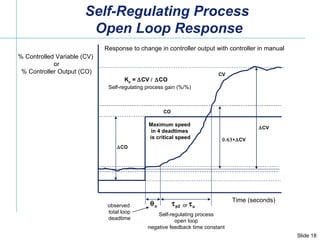
Time (seconds) % Controlled Variable (CV)  or % Controller Output (CO)  CO  CV  o  p2 K p  =   CV   CO   CV CO CV Self-regulating process open loop negative feedback time constant Self-regulating process gain (%/%) Response to change in controller output with controller in manual observed  total loop deadtime Self-Regulating Process  Open Loop Response  o or Maximum speed in 4 deadtimes is critical speed
Integrating Process  Open Loop Response Maximum speed in 4 deadtimes is critical speed Time (seconds)  o K i  =  { [ CV 2    t 2  ]   CV 1    t 1  ] }   CO  CO ramp rate is  CV 1   t 1 ramp rate is  CV 2    t 2 CO CV Integrating process gain (%/sec/%) Response to change in controller output with controller in manual % Controlled Variable (CV)  or % Controller Output (CO) observed  total loop deadtime
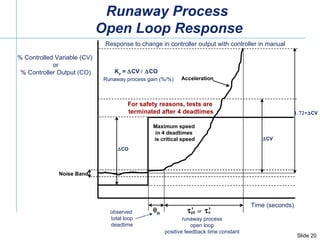
Runaway Process  Open Loop Response Response to change in controller output with controller in manual  o Noise Band Acceleration  CV  CO  CV K p  =   CV   CO  Runaway process gain (%/%) % Controlled Variable (CV)  or % Controller Output (CO) Time (seconds) observed  total loop deadtime runaway process open loop positive feedback time constant For safety reasons, tests are  terminated after 4 deadtimes or Maximum speed in 4 deadtimes is critical speed  ’ p2  ’ o
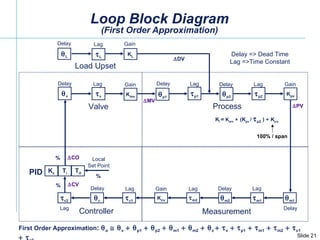
Loop Block Diagram (First Order Approximation)  p1  p2  p2 K pv  p1  c1  m2  m2  m1  m1 K cv  c  c2 Valve Process Controller Measurement K mv  v  v K L  L  L Load Upset  CV  CO  MV  PV PID Delay Lag Delay Delay Delay Delay Delay Delay Lag Lag Lag Lag Lag Lag Lag Gain Gain Gain Gain Local Set Point  DV First Order Approximation :   o  v   p1   p2   m1   m2   c   v  p1  m1  m2  c1   c2 % % % Delay => Dead Time Lag =>Time Constant K i  =  K mv  (K pv  /   p2  )   K cv   100% / span K c T i T d
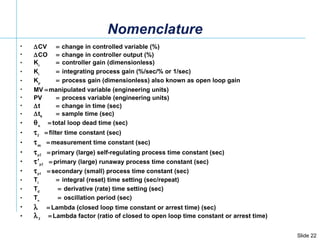
 CV    change in controlled variable (%)  CO    change in controller output (%) K c    controller gain (dimensionless) K i    integrating process gain (%/sec/% or 1/sec) K p    process gain (dimensionless) also known as open loop gain MV   manipulated variable (engineering units) PV  process variable (engineering units)  t    change in time (sec)  t s   sample time (sec)  o  total loop dead time (sec)  f  filter time constant (sec)  m  measurement time constant (sec)   p2  primary (large) self-regulating process time constant (sec)   ’ p2  primary (large) runaway process time constant (sec)   p1  secondary (small) process time constant (sec)  T i    integral (reset) time setting (sec/repeat) T d      derivative (rate) time setting (sec) T o      oscillation period (sec)   Lambda (closed loop time constant or arrest time) (sec)  f   Lambda factor (ratio of closed to open loop time constant or arrest time) Nomenclature
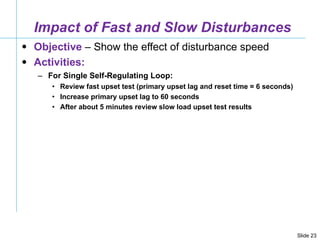
Impact of Fast and Slow Disturbances Objective  – Show the effect of disturbance speed Activities: For Single Self-Regulating Loop: Review fast upset test (primary upset lag and reset time = 6 seconds)  Increase primary upset lag to 60 seconds After about 5 minutes review slow load upset test results
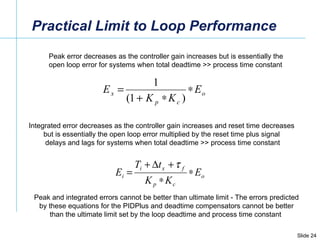
Practical Limit to Loop Performance Peak error decreases as the controller gain increases but is essentially the  open loop error for systems when total deadtime >> process time constant Integrated error decreases as the controller gain increases and reset time decreases  but is essentially the open loop error multiplied by the reset time plus signal  delays and lags for systems when total deadtime >> process time constant Peak and integrated errors cannot be better than ultimate limit - The errors predicted by these equations for the PIDPlus and deadtime compensators cannot be better than the ultimate limit set by the loop deadtime and process time constant
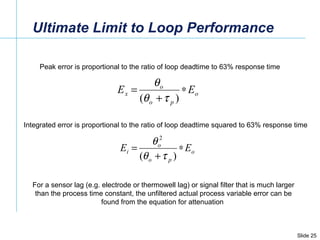
Ultimate Limit to Loop Performance Peak error is proportional to the ratio of loop deadtime to 63% response time Integrated error is proportional to the ratio of loop deadtime squared to 63% response time For a sensor lag (e.g. electrode or thermowell lag) or signal filter that is much larger than the process time constant, the unfiltered actual process variable error can be found from the equation for attenuation
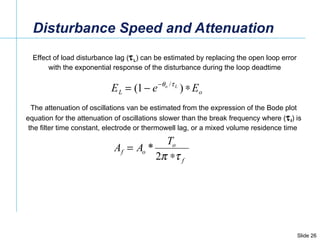
Disturbance Speed and Attenuation Effect of load disturbance lag (  L ) can be estimated by replacing the open loop error with the exponential response of the disturbance during the loop deadtime  The attenuation of oscillations van be estimated from the expression of the Bode plot  equation for the attenuation of oscillations slower than the break frequency where (  f ) is  the filter time constant, electrode or thermowell lag, or a mixed volume residence time
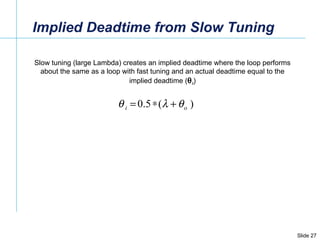
Implied Deadtime from Slow Tuning Slow tuning (large Lambda) creates an implied deadtime where the loop performs about the same as a loop with fast tuning and an actual deadtime equal to the implied deadtime (  i )
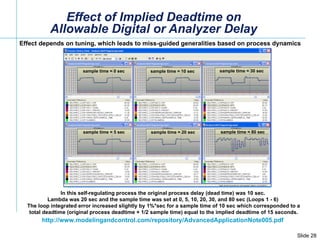
Effect of Implied Deadtime on Allowable Digital or Analyzer Delay In this self-regulating process the original process delay (dead time) was 10 sec.  Lambda was 20 sec and the sample time was set at 0, 5, 10, 20, 30, and 80 sec (Loops 1 - 6)  The loop integrated error increased slightly by 1%*sec for a sample time of 10 sec which corresponded to a total deadtime (original process deadtime + 1/2 sample time) equal to the implied deadtime of 15 seconds. http://www.modelingandcontrol.com/repository/AdvancedApplicationNote005.pdf   sample time = 0 sec sample time = 5 sec sample time = 10 sec sample time = 20 sec sample time = 30 sec sample time = 80 sec Effect depends on tuning, which leads to miss-guided generalities based on process dynamics
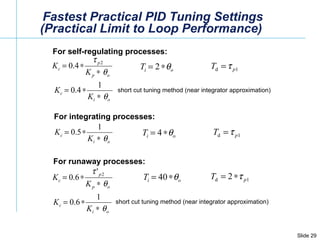
Fastest Practical PID Tuning Settings (Practical Limit to Loop Performance)  For runaway processes: For self-regulating processes:  For integrating processes:  short cut tuning method (near integrator approximation)  short cut tuning method (near integrator approximation)
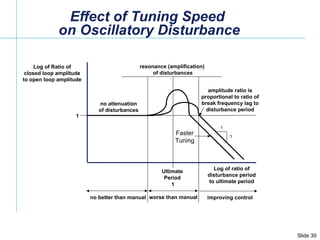
Effect of Tuning Speed  on Oscillatory Disturbance 1 Ultimate Period 1 1 Faster Tuning Log of Ratio of closed loop amplitude to open loop amplitude Log of ratio of disturbance period to ultimate period no attenuation of disturbances resonance (amplification)  of disturbances amplitude ratio is proportional to ratio of break frequency lag to disturbance period 1 no better than manual worse than manual improving control
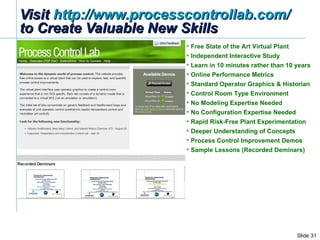
Visit  http://www.processcontrollab.com/   to Create Valuable New Skills Free State of the Art Virtual Plant Independent Interactive Study Learn in 10 minutes rather than 10 years Online Performance Metrics Standard Operator Graphics & Historian Control Room Type Environment  No Modeling Expertise Needed No Configuration Expertise Needed Rapid Risk-Free Plant Experimentation Deeper Understanding of Concepts Process Control Improvement Demos Sample Lessons (Recorded Deminars)
Help Us Improve These Deminars! WouldYouRecommend.Us/105679s21/
Join Us Oct 13, Wednesday  10:00 am  CDT PID Deadtime Compensation  (How to setup and tune a PID for deadtime compensation) Look for a recording of Today’s Deminar later this week at: www.ModelingAndControl.com www.EmersonProcessXperts.com
QUESTIONS?

Process Control Improvement Primer - Greg McMillan Deminar

  • 1.
    Interactive Opportunity AssessmentDemo and Seminar (Deminar) Series for Web Labs – Process Control Improvement Primer Sept 8, 2010 Sponsored by Emerson, Experitec, and Mynah Created by Greg McMillan and Jack Ahlers www.processcontrollab.com Website - Charlie Schliesser (csdesignco.com)
  • 2.
    Welcome Gregory K.McMillan Greg is a retired Senior Fellow from Solutia/Monsanto and an ISA Fellow. Presently, Greg contracts as a consultant in DeltaV R&D via CDI Process & Industrial. Greg received the ISA “Kermit Fischer Environmental” Award for pH control in 1991, the Control Magazine “Engineer of the Year” Award for the Process Industry in 1994, was inducted into the Control “Process Automation Hall of Fame” in 2001, was honored by InTech Magazine in 2003 as one of the most influential innovators in automation, and received the ISA “Life Achievement Award” in 2010. Greg is the author of numerous books on process control, his most recent being Essentials of Modern Measurements and Final Elements for the Process Industry. Greg has been the monthly “Control Talk” columnist for Control magazine since 2002. Greg’s expertise is available on the web site: http://www.modelingandcontrol.com/
  • 3.
    “ Top TenThings You Don’t Want to Hear During Startup” Courtesy of Hunter Vegas (October 2010 Control Talk) (10) We never really could figure out what the old system was doing. (9) Do I have a system backup?!? I thought YOU were making backups! (8) They want to make our startup into a reality show. (7) The displays are fine and dandy but where are the panel boards? (6) We have changed our mind – we want the old system back. (5) Can you reprogram it so the wrong valve still works? (4) Didn’t you get the revised batch sheets? (3) Is a blue screen bad?? (2) What is that burning smell? And the Number 1 thing you don’t want to hear :
  • 4.
    “ Top TenThings You Don’t Want to Hear During Startup” Courtesy of Hunter Vegas (October 2010 Control Talk) (1) We are out of coffee!
  • 5.
    Introduction There isno clear picture of what is the potential source and size of a process control improvement Practical process control knowledge is detailed, fragmented, and experience driven This seminar will attempt to provide a unified approach and understanding of the impact of the PID, final control element (e.g. valve or variable speed drive), process, disturbance, and measurement on loop performance
  • 6.
    Unifying Concepts “It is all about management of change” 90% of process control improvements involve the following concepts: Delay Speed Gain Sensitivity-Resolution Backlash-Deadband Nonlinearity Noise Oscillations Resonance Attenuation Optimum Delay, speed, and gain are the most prevalent limiting concepts
  • 7.
    Delay “ Withoutdeadtime I would be out of a job” Fundamentals A more descriptive name would be total loop deadtime . The loop deadtime is the amount of time for the start of a change to completely circle the control loop and end up at the point of origin. For example, an unmeasured disturbance cannot be corrected until the change is seen and the correction arrives in the process at the same point as the disturbance. While process deadtime offers a continuous train of values whereas digital devices and analyzers offer non continuous data values at discrete intervals, these delays add a phase shift and increase the ultimate period (decrease natural frequency) like process deadtime. Goals Minimize delay (the loop cannot do anything until it sees and enacts change) Sources Pure delay from deadtimes and discontinuous updates Piping, duct, plug flow reactor, conveyor, extruder, spin-line, and sheet transportation delays Digital devices - scan, update, reporting, and execution times (0.5  T) Analyzers - sample processing and analysis cycle time (1.5  T) Sensitivity-resolution limits Backlash-deadband Equivalent delay from lags Mixing Column trays Heat transfer surfaces Thermowells Electrodes Transmitter damping Signal filters
  • 8.
    Speed (Rate ofChange) “ Speed kills - (high speed processes and disturbances and low speed control systems can kill performance)” Fundamentals The rate of change in 4 deadtime intervals is most important. By the end of 4 deadtimes, the control loop should have completed most of its correction. Thus, the short cut tuning method (Deminar #6) is consistent with performance objectives. Goals Make control systems faster and make processes and disturbances slower Sources Control system PID tuning settings (gain, reset, and rate) Slewing rate of control valves and velocity limits of variable speed drives Disturbances Steps - Batch operations, on-off control, manual actions, SIS, startups, and shutdowns Oscillations - limit cycles, interactions, and excessively fast PID tuning Ramps - reset action in PID Process Mixing in volumes due to agitation, boiling, mass transfer, diffusion, and migration
  • 9.
    Gain “ Allis lost if nothing is gained” Fundamentals Gain is the change in output for a change in input to any part of the control system. Thus there is a gain for the PID, valve, disturbance, process, and measurement. Knowing the disturbance gain (e.g. change in manipulated flow per change in disturbance) is important for sizing valves and feedforward control. Goals Maximize control system gains (maximize control system reaction to change) and minimize process and disturbance gains (minimize process reaction to change). Sources PID controller gain Inferential measurements (e.g. temperature change for composition change in distillation column) Slope of control valve or variable speed drive installed characteristic (inherent characteristic & system loss curve) Measurement calibration (100% / span). Important where accuracy is % of span Process design Attenuation by volumes (can be estimated) Attenuation by PID (transfer of variability from controlled to manipulated variables)
  • 10.
    Sensitivity-Resolution “You cannot control what you cannot see” Fundamentals Minimum change measured or manipulated - once past sensitivity limit full change is seen or used but resolution limit will quantize the change (stair step where the step size is the resolution limit). Both will cause a limit cycle if there is an integrator in the process or control system. Goals Improve sensitivity and resolution Sources In measurements, minimum change detected and communicated (e.g. sensor threshold and wireless update trigger level) and quantized change (A/D & D/A) Minimum change that can be manipulated (e.g. valve stick-slip sensitivity and speed resolution)
  • 11.
    Backlash-Deadband “ Noproblem if you don’t ever change direction” Fundamentals Minimum change measured or manipulated once the direction is changed - once past backlash-deadband limit full change is seen or used. Both will cause a limit cycle if there are 2 or more integrators in the process or control system. Goals Minimize backlash and deadband Sources Pneumatic instrument flappers, links, and levers (hopefully these are long gone) Rotary valve and damper links, connections, and shaft windup Variable speed drive setup parameter to eliminate hunting and chasing noise
  • 12.
    Nonlinearity “ Nota problem if the process is constant, but then again if the process is constant, you do not need a control system” Fundamentals While normally associated with a process gain that is not constant, in a broader concept, a nonlinear system occurs if a gain, time constant, or delay changes anywhere in the loop. All process control systems are nonlinear to some degree. Goals Minimize nonlinearity Sources Control valve and variable speed drive installed characteristics (flat at high flows) Process transportation delays (inversely proportional to flow) Digital and analyzer delays (loop delay depends upon when change arrives in discontinuous data value update interval) Inferred measurement (conductivity or temperature vs. composition plot is a curve) Logarithmic relationship (glass pH electrode and zirconium oxide oxygen probe) Process time constants (proportional to volume and density)
  • 13.
    Noise “ Thebest thing you can do is not react to noise” Fundamentals Extraneous fluctuations in measured or manipulated variables Goals Minimize size and frequency of noise and do not transfer noise to process Sources Bubbles Concentration and temperature non-uniformity from imperfect mixing Electromagnetic interference (EMI) Ground loops Interferences (e.g. sodium ion on pH electrode) Velocity profile non-uniformity Velocity impact on pressure sensors
  • 14.
    Oscillations “ Oscillationsare best kept in control theory textbooks” Fundamentals Sine wave, square wave, and saw-tooth periodic disturbances perpetually upset a system and can get amplified by resonance. Goals Minimize source and attenuate by controller tuning and process design Sources Limit cycles from sensitivity-resolution and backlash-deadband On-off control (common for sump level control by switches) Aggressive tuning (common for reactor temperature control) Excessive reset action (common for level and other integrating processes)
  • 15.
    Resonance “ Don’tmake things worse than they already are” Fundamentals Oscillation period close to ultimate period can be amplified by feedback control. Goals Make oscillation period slower or control loop faster Sources Control loops in series with similar loop deadtimes (e.g. multiple stage pH control) Control loops in series with similar tuning and valve sticktion and backlash Day to night ambient changes to slow loops (e.g. column temperature control)
  • 16.
    Attenuation “ Ifyou had a blend tank big enough you would not need control” Fundamentals Attenuation increases as the volume of the blend tank increases and the ultimate period of the control loop decreases. Goals Maximize attenuation by increasing volume and mixing and making loops faster Sources Mixed volume size and degree of mixing Control loop speed
  • 17.
    Optimum “ Mostsetpoints are not at their optimum” Fundamentals The primary loop setpoint is offset from the optimum temperature, pressure, or concentration. Goals Minimize offset from optimum Sources (of non-optimum operation) Process variability Measurement error Sensitivity-resolution Backlash-deadband Lack of process knowledge Process nonlinearity (e.g. catalyst degradation and production rate changes) Operator preference (e.g. sweet spots) Incorrect SIS settings
  • 18.
    Time (seconds) %Controlled Variable (CV) or % Controller Output (CO)  CO  CV  o  p2 K p =  CV  CO  CV CO CV Self-regulating process open loop negative feedback time constant Self-regulating process gain (%/%) Response to change in controller output with controller in manual observed total loop deadtime Self-Regulating Process Open Loop Response  o or Maximum speed in 4 deadtimes is critical speed
  • 19.
    Integrating Process Open Loop Response Maximum speed in 4 deadtimes is critical speed Time (seconds)  o K i = { [ CV 2  t 2 ]  CV 1  t 1 ] }  CO  CO ramp rate is  CV 1  t 1 ramp rate is  CV 2  t 2 CO CV Integrating process gain (%/sec/%) Response to change in controller output with controller in manual % Controlled Variable (CV) or % Controller Output (CO) observed total loop deadtime
  • 20.
    Runaway Process Open Loop Response Response to change in controller output with controller in manual  o Noise Band Acceleration  CV  CO  CV K p =  CV  CO Runaway process gain (%/%) % Controlled Variable (CV) or % Controller Output (CO) Time (seconds) observed total loop deadtime runaway process open loop positive feedback time constant For safety reasons, tests are terminated after 4 deadtimes or Maximum speed in 4 deadtimes is critical speed  ’ p2  ’ o
  • 21.
    Loop Block Diagram(First Order Approximation)  p1  p2  p2 K pv  p1  c1  m2  m2  m1  m1 K cv  c  c2 Valve Process Controller Measurement K mv  v  v K L  L  L Load Upset  CV  CO  MV  PV PID Delay Lag Delay Delay Delay Delay Delay Delay Lag Lag Lag Lag Lag Lag Lag Gain Gain Gain Gain Local Set Point  DV First Order Approximation :  o  v  p1  p2  m1  m2  c  v  p1  m1  m2  c1  c2 % % % Delay => Dead Time Lag =>Time Constant K i = K mv  (K pv /  p2 )  K cv 100% / span K c T i T d
  • 22.
     CV  change in controlled variable (%)  CO  change in controller output (%) K c  controller gain (dimensionless) K i  integrating process gain (%/sec/% or 1/sec) K p  process gain (dimensionless) also known as open loop gain MV  manipulated variable (engineering units) PV  process variable (engineering units)  t  change in time (sec)  t s  sample time (sec)  o  total loop dead time (sec)  f  filter time constant (sec)  m  measurement time constant (sec)  p2  primary (large) self-regulating process time constant (sec)  ’ p2  primary (large) runaway process time constant (sec)  p1  secondary (small) process time constant (sec) T i  integral (reset) time setting (sec/repeat) T d  derivative (rate) time setting (sec) T o  oscillation period (sec)   Lambda (closed loop time constant or arrest time) (sec)  f   Lambda factor (ratio of closed to open loop time constant or arrest time) Nomenclature
  • 23.
    Impact of Fastand Slow Disturbances Objective – Show the effect of disturbance speed Activities: For Single Self-Regulating Loop: Review fast upset test (primary upset lag and reset time = 6 seconds) Increase primary upset lag to 60 seconds After about 5 minutes review slow load upset test results
  • 24.
    Practical Limit toLoop Performance Peak error decreases as the controller gain increases but is essentially the open loop error for systems when total deadtime >> process time constant Integrated error decreases as the controller gain increases and reset time decreases but is essentially the open loop error multiplied by the reset time plus signal delays and lags for systems when total deadtime >> process time constant Peak and integrated errors cannot be better than ultimate limit - The errors predicted by these equations for the PIDPlus and deadtime compensators cannot be better than the ultimate limit set by the loop deadtime and process time constant
  • 25.
    Ultimate Limit toLoop Performance Peak error is proportional to the ratio of loop deadtime to 63% response time Integrated error is proportional to the ratio of loop deadtime squared to 63% response time For a sensor lag (e.g. electrode or thermowell lag) or signal filter that is much larger than the process time constant, the unfiltered actual process variable error can be found from the equation for attenuation
  • 26.
    Disturbance Speed andAttenuation Effect of load disturbance lag (  L ) can be estimated by replacing the open loop error with the exponential response of the disturbance during the loop deadtime The attenuation of oscillations van be estimated from the expression of the Bode plot equation for the attenuation of oscillations slower than the break frequency where (  f ) is the filter time constant, electrode or thermowell lag, or a mixed volume residence time
  • 27.
    Implied Deadtime fromSlow Tuning Slow tuning (large Lambda) creates an implied deadtime where the loop performs about the same as a loop with fast tuning and an actual deadtime equal to the implied deadtime (  i )
  • 28.
    Effect of ImpliedDeadtime on Allowable Digital or Analyzer Delay In this self-regulating process the original process delay (dead time) was 10 sec. Lambda was 20 sec and the sample time was set at 0, 5, 10, 20, 30, and 80 sec (Loops 1 - 6) The loop integrated error increased slightly by 1%*sec for a sample time of 10 sec which corresponded to a total deadtime (original process deadtime + 1/2 sample time) equal to the implied deadtime of 15 seconds. http://www.modelingandcontrol.com/repository/AdvancedApplicationNote005.pdf sample time = 0 sec sample time = 5 sec sample time = 10 sec sample time = 20 sec sample time = 30 sec sample time = 80 sec Effect depends on tuning, which leads to miss-guided generalities based on process dynamics
  • 29.
    Fastest Practical PIDTuning Settings (Practical Limit to Loop Performance) For runaway processes: For self-regulating processes: For integrating processes: short cut tuning method (near integrator approximation) short cut tuning method (near integrator approximation)
  • 30.
    Effect of TuningSpeed on Oscillatory Disturbance 1 Ultimate Period 1 1 Faster Tuning Log of Ratio of closed loop amplitude to open loop amplitude Log of ratio of disturbance period to ultimate period no attenuation of disturbances resonance (amplification) of disturbances amplitude ratio is proportional to ratio of break frequency lag to disturbance period 1 no better than manual worse than manual improving control
  • 31.
    Visit http://www.processcontrollab.com/ to Create Valuable New Skills Free State of the Art Virtual Plant Independent Interactive Study Learn in 10 minutes rather than 10 years Online Performance Metrics Standard Operator Graphics & Historian Control Room Type Environment No Modeling Expertise Needed No Configuration Expertise Needed Rapid Risk-Free Plant Experimentation Deeper Understanding of Concepts Process Control Improvement Demos Sample Lessons (Recorded Deminars)
  • 32.
    Help Us ImproveThese Deminars! WouldYouRecommend.Us/105679s21/
  • 33.
    Join Us Oct13, Wednesday 10:00 am CDT PID Deadtime Compensation (How to setup and tune a PID for deadtime compensation) Look for a recording of Today’s Deminar later this week at: www.ModelingAndControl.com www.EmersonProcessXperts.com
  • 34.