Compound Interest
Reference: Mathematics of Investment, Winston
Sirug

Dianne Tricia M.
Iniego
Patricia Manansala
Kim Lao
Debbie Mendrano
Compound Interest
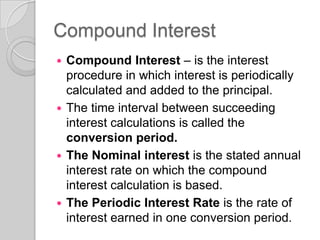
Compound Interest – is the interest
procedure in which interest is periodically
calculated and added to the principal.
 The time interval between succeeding
interest calculations is called the
conversion period.
 The Nominal interest is the stated annual
interest rate on which the compound
interest calculation is based.
 The Periodic Interest Rate is the rate of
interest earned in one conversion period.

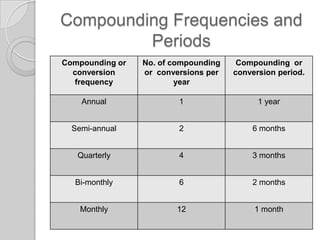
Compounding Frequencies and
Periods
Compounding or
conversion
frequency

No. of compounding
or conversions per
year

Compounding or
conversion period.

Annual

1

1 year

Semi-annual

2

6 months

Quarterly

4

3 months

Bi-monthly

6

2 months

Monthly

12

1 month
P = Principal amount of the loan or
investment
J = Nominal interest rate
m = Number of conversion per year
t = Time period (term) of the loan or
investment
i = Periodic interest rate
I = Amount of interest paid or received
F = Maturity value of the loan or investment
Formulae
F=P(1+i)ˆn
 P = F/(1+i)ˆn
 I = F-P
 j = m(n√F/P-1)


n = tm
i = j/m
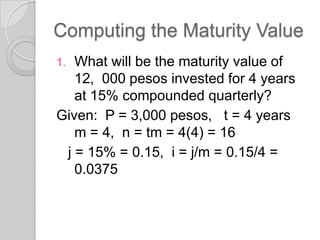
Computing the Maturity Value
What will be the maturity value of
12, 000 pesos invested for 4 years
at 15% compounded quarterly?
Given: P = 3,000 pesos, t = 4 years
m = 4, n = tm = 4(4) = 16
j = 15% = 0.15, i = j/m = 0.15/4 =
0.0375
1.
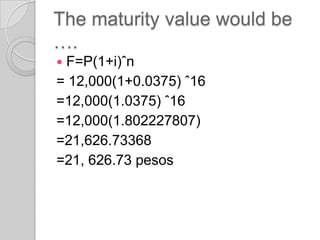
The maturity value would be
….
F=P(1+i)ˆn
= 12,000(1+0.0375) ˆ16
=12,000(1.0375) ˆ16
=12,000(1.802227807)
=21,626.73368
=21, 626.73 pesos

Computing the Principal
Amount
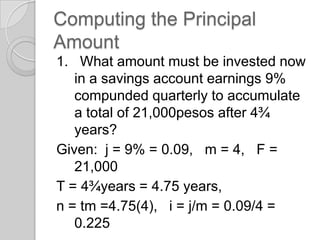
1. What amount must be invested now
in a savings account earnings 9%
compunded quarterly to accumulate
a total of 21,000pesos after 4¾
years?
Given: j = 9% = 0.09, m = 4, F =
21,000
T = 4¾years = 4.75 years,
n = tm =4.75(4), i = j/m = 0.09/4 =
0.225
Solution:
P = F/(1+i)ˆn
=21,000/(1+0.0225)ˆ19
=21,000/(1.0225)ˆ19
=21,000/1.526170367
=13,759.931691
=13,759.93 Pesos
2.

Mrs. Sirug wants to provide a
200,000pesos graduation gift for her
daughter Sofia. She is now 16 years
old, and she would like the fund to be
available by the time she is 20. She
decides on an investment that pays
10% compounded quarterly. How
large must the deposit be?

Given: F = 200,000, t = 4 years, j = 10%0.10
m = 4 , n = tm = 4(4) = 16,
i = j.m = 0.10/4 = 0.025
Solution
P = F(1+i)ˆ-n
=200,000(1+0.025)ˆ-16
=200,000(1.025) ˆ-16
=200,000(0.6736249335)
=134,724.99pesos
(Mrs. Sirug should deposit
134,724.99pesos in order to grow as
much as 200,000pesos after 4 years.)

Computing the Compound
Interest
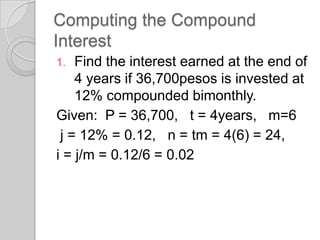
Find the interest earned at the end of
4 years if 36,700pesos is invested at
12% compounded bimonthly.
Given: P = 36,700, t = 4years, m=6
j = 12% = 0.12, n = tm = 4(6) = 24,
i = j/m = 0.12/6 = 0.02
1.
Solution:
F = P(1+i)ˆn
= 36,700(1+0.02)ˆ24
=36,700(1.02)ˆ24
=36,700(1.608437249)
=59,029.65Pesos

I = F-P
= 59,029.65 – 36,700
= 22,329.65 Pesos
The interest earned is 22,329.65
Computing the Compound
Interest Rate
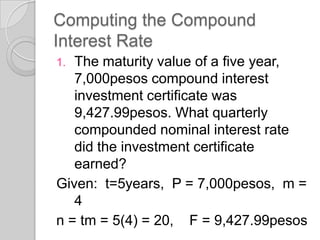
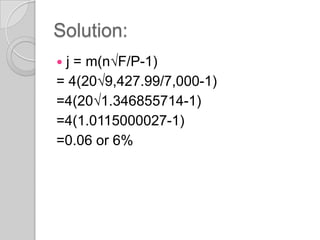
The maturity value of a five year,
7,000pesos compound interest
investment certificate was
9,427.99pesos. What quarterly
compounded nominal interest rate
did the investment certificate
earned?
Given: t=5years, P = 7,000pesos, m =
4
n = tm = 5(4) = 20, F = 9,427.99pesos
1.
Solution:
j = m(n√F/P-1)
= 4(20√9,427.99/7,000-1)
=4(20√1.346855714-1)
=4(1.0115000027-1)
=0.06 or 6%


Compound interest

  • 1.
    Compound Interest Reference: Mathematicsof Investment, Winston Sirug Dianne Tricia M. Iniego Patricia Manansala Kim Lao Debbie Mendrano
  • 2.
    Compound Interest Compound Interest– is the interest procedure in which interest is periodically calculated and added to the principal.  The time interval between succeeding interest calculations is called the conversion period.  The Nominal interest is the stated annual interest rate on which the compound interest calculation is based.  The Periodic Interest Rate is the rate of interest earned in one conversion period. 
  • 3.
    Compounding Frequencies and Periods Compoundingor conversion frequency No. of compounding or conversions per year Compounding or conversion period. Annual 1 1 year Semi-annual 2 6 months Quarterly 4 3 months Bi-monthly 6 2 months Monthly 12 1 month
  • 4.
    P = Principalamount of the loan or investment J = Nominal interest rate m = Number of conversion per year t = Time period (term) of the loan or investment i = Periodic interest rate I = Amount of interest paid or received F = Maturity value of the loan or investment
  • 5.
    Formulae F=P(1+i)ˆn  P =F/(1+i)ˆn  I = F-P  j = m(n√F/P-1)  n = tm i = j/m
  • 6.
    Computing the MaturityValue What will be the maturity value of 12, 000 pesos invested for 4 years at 15% compounded quarterly? Given: P = 3,000 pesos, t = 4 years m = 4, n = tm = 4(4) = 16 j = 15% = 0.15, i = j/m = 0.15/4 = 0.0375 1.
  • 7.
    The maturity valuewould be …. F=P(1+i)ˆn = 12,000(1+0.0375) ˆ16 =12,000(1.0375) ˆ16 =12,000(1.802227807) =21,626.73368 =21, 626.73 pesos 
  • 8.
    Computing the Principal Amount 1.What amount must be invested now in a savings account earnings 9% compunded quarterly to accumulate a total of 21,000pesos after 4¾ years? Given: j = 9% = 0.09, m = 4, F = 21,000 T = 4¾years = 4.75 years, n = tm =4.75(4), i = j/m = 0.09/4 = 0.225
  • 9.
  • 10.
    2. Mrs. Sirug wantsto provide a 200,000pesos graduation gift for her daughter Sofia. She is now 16 years old, and she would like the fund to be available by the time she is 20. She decides on an investment that pays 10% compounded quarterly. How large must the deposit be? Given: F = 200,000, t = 4 years, j = 10%0.10 m = 4 , n = tm = 4(4) = 16, i = j.m = 0.10/4 = 0.025
  • 11.
    Solution P = F(1+i)ˆ-n =200,000(1+0.025)ˆ-16 =200,000(1.025)ˆ-16 =200,000(0.6736249335) =134,724.99pesos (Mrs. Sirug should deposit 134,724.99pesos in order to grow as much as 200,000pesos after 4 years.) 
  • 12.
    Computing the Compound Interest Findthe interest earned at the end of 4 years if 36,700pesos is invested at 12% compounded bimonthly. Given: P = 36,700, t = 4years, m=6 j = 12% = 0.12, n = tm = 4(6) = 24, i = j/m = 0.12/6 = 0.02 1.
  • 13.
    Solution: F = P(1+i)ˆn =36,700(1+0.02)ˆ24 =36,700(1.02)ˆ24 =36,700(1.608437249) =59,029.65Pesos I = F-P = 59,029.65 – 36,700 = 22,329.65 Pesos The interest earned is 22,329.65
  • 14.
    Computing the Compound InterestRate The maturity value of a five year, 7,000pesos compound interest investment certificate was 9,427.99pesos. What quarterly compounded nominal interest rate did the investment certificate earned? Given: t=5years, P = 7,000pesos, m = 4 n = tm = 5(4) = 20, F = 9,427.99pesos 1.
  • 15.
    Solution: j = m(n√F/P-1) =4(20√9,427.99/7,000-1) =4(20√1.346855714-1) =4(1.0115000027-1) =0.06 or 6% 