Operations Research
 Operations Research may be described as
a scientific approach to decision making
that involves the operations of
organizational systems.
Linear Programming
Problems (LPP)
 LPP in general are concerned with the
allocation of resources such as labour,
materials, machinery, capital etc in the best
possible manner, so that costs are minimized
or profits are maximized.
 LP is a mathematical technique for finding the
optimal use for an organization’s scarce
resources.
 The LP model includes 3 basic elements:
 Decision variables that we seek to
determine.
 Objective (goal) that we seek to
optimize.
 Constraints that we need to satisfy.
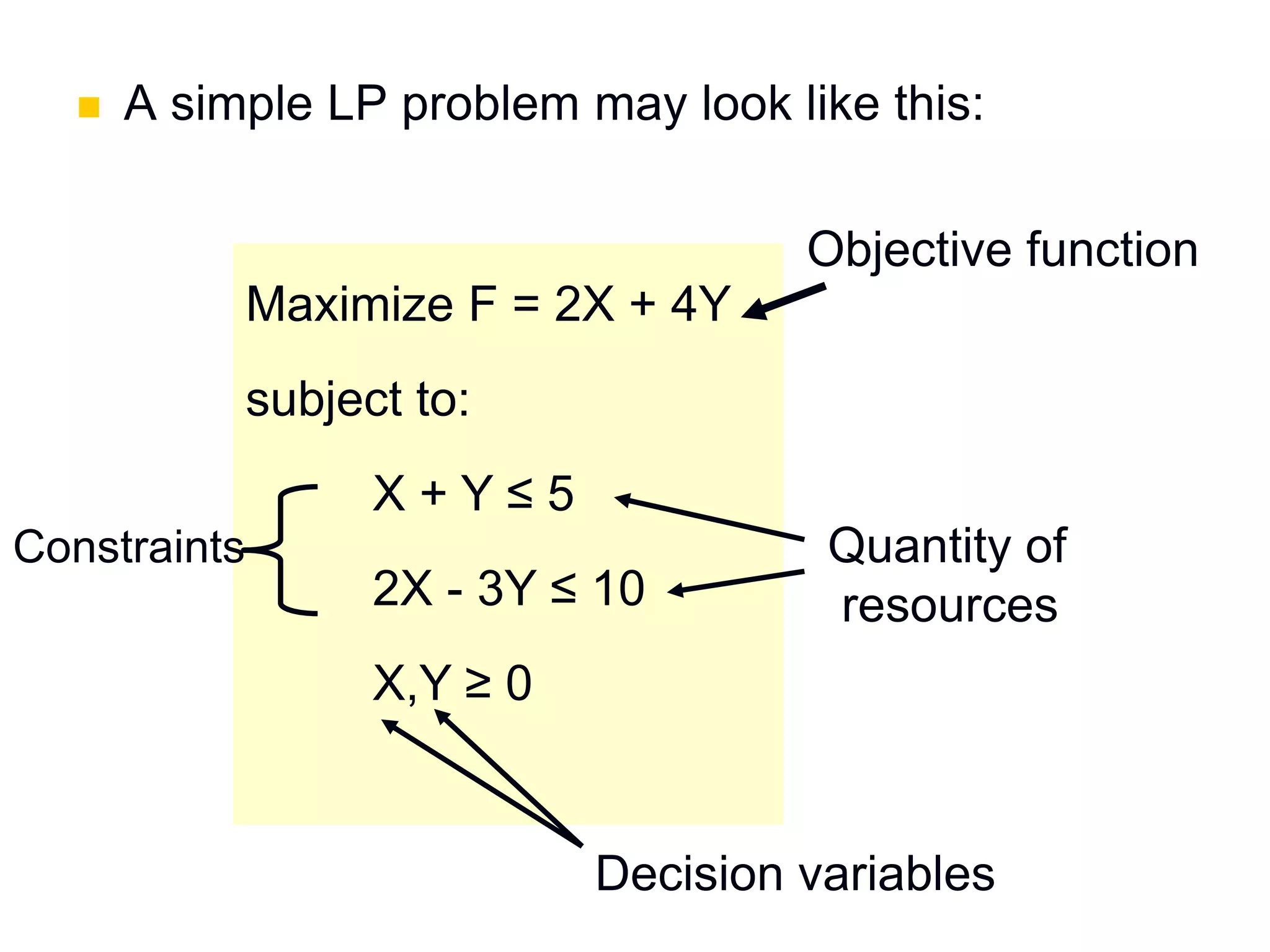
 A simple LP problem may look like this:
Maximize F = 2X + 4Y
subject to:
X + Y ≤ 5
2X - 3Y ≤ 10
X,Y ≥ 0
Objective function
Constraints Quantity of
resources
Decision variables
 Constraints can be labor time, stock of raw
materials, availability of machine time etc.
 A home decorator manufactures two types of
lamps, A and B. Both lamps go through two
technicians, first a cutter and then a finisher.
A lamp of type A requires 2 hours of the
cutter’s time and 1 hour of the finisher’s time.
A lamp of type B requires 1 hour of the
cutter’s time and 2 hours of the finisher’s
Example
1:
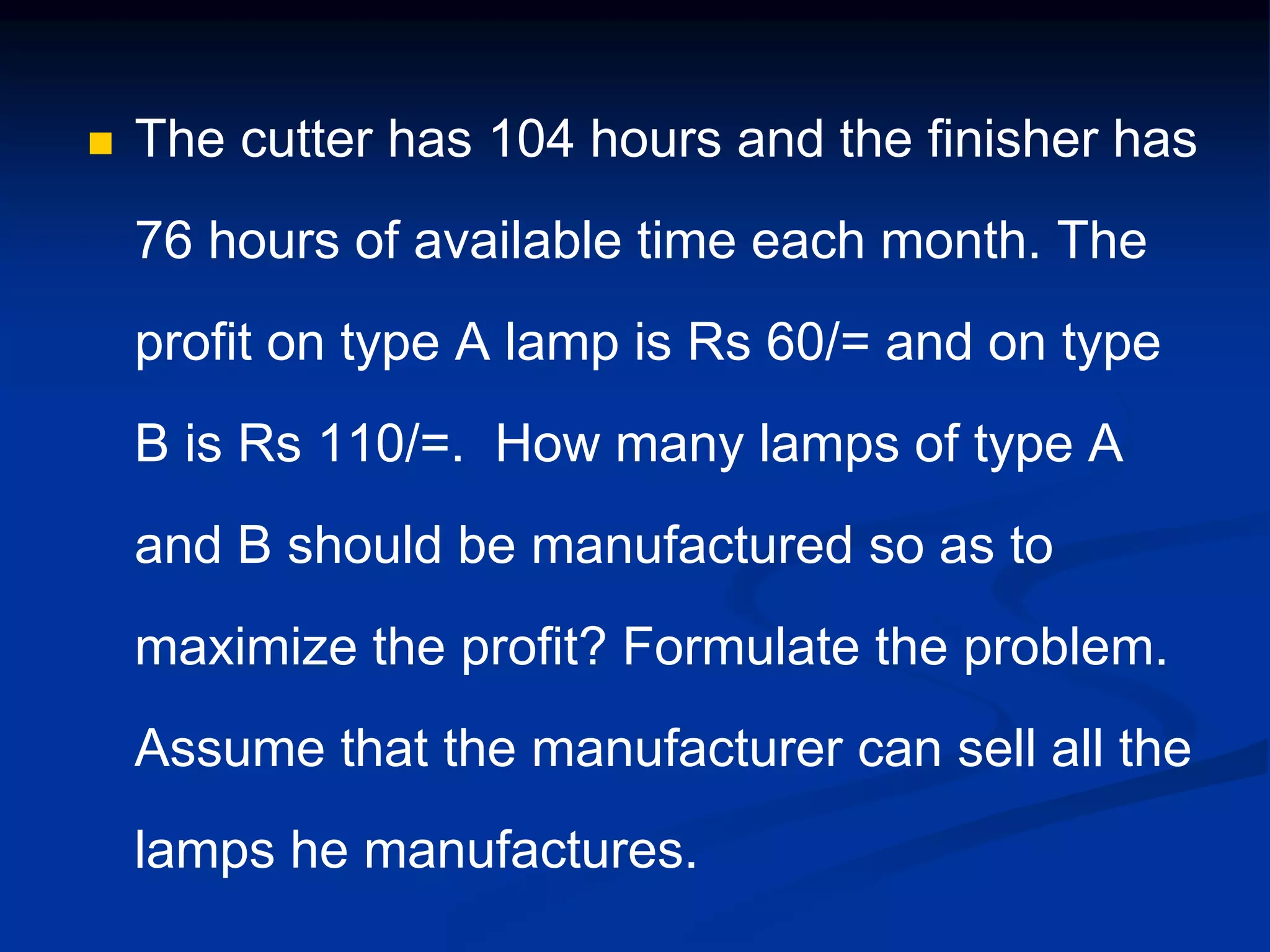
 The cutter has 104 hours and the finisher has
76 hours of available time each month. The
profit on type A lamp is Rs 60/= and on type
B is Rs 110/=. How many lamps of type A
and B should be manufactured so as to
maximize the profit? Formulate the problem.
Assume that the manufacturer can sell all the
lamps he manufactures.
Type of
work
Time reqd.
for type A
Time reqd.
for type B
Available
time
Cutting 2 1 104
Finishing 1 2 76
Profit/unit Rs60/= Rs110/=
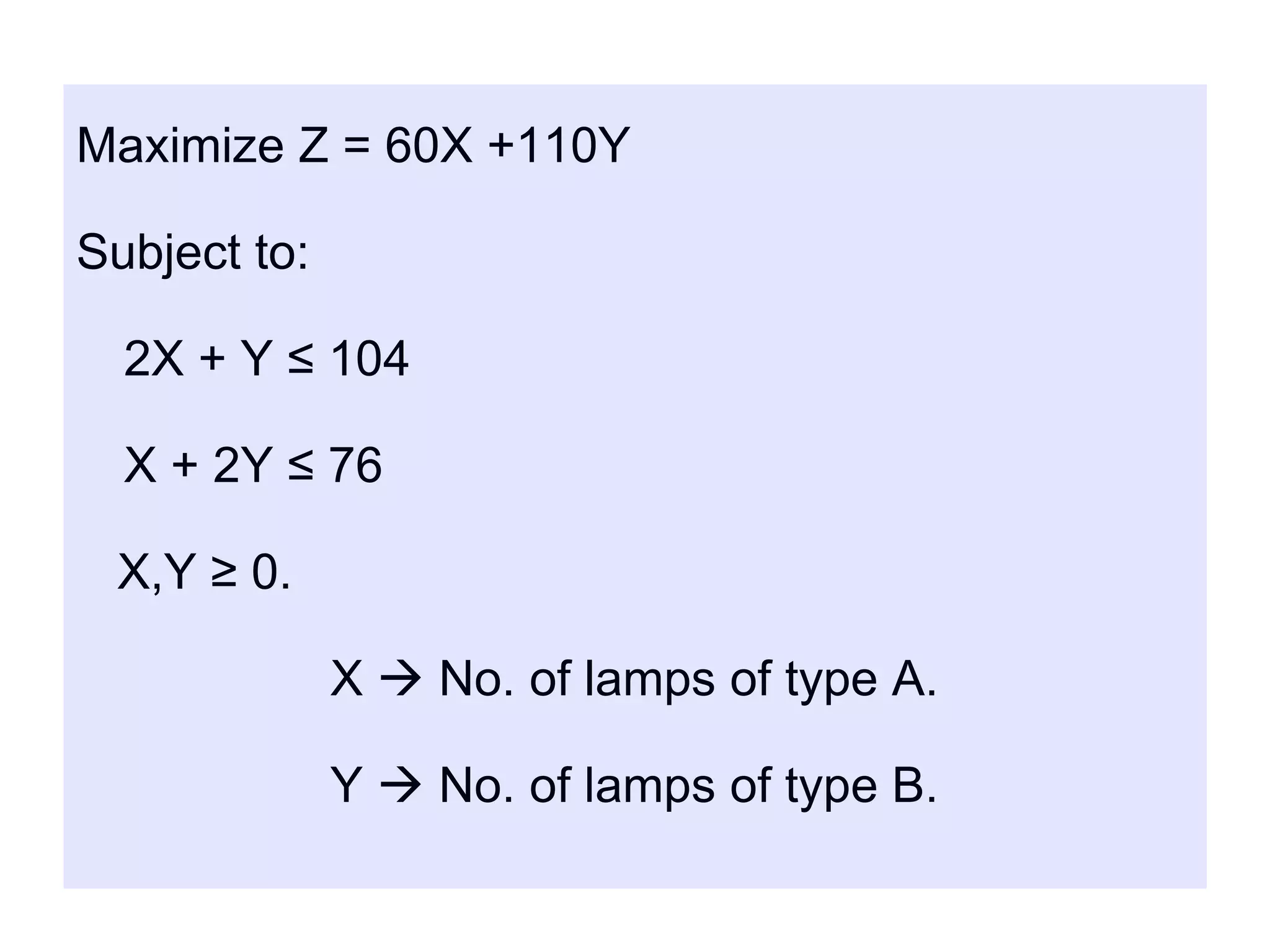
Maximize Z = 60X +110Y
Subject to:
2X + Y ≤ 104
X + 2Y ≤ 76
X,Y ≥ 0.
X  No. of lamps of type A.
Y  No. of lamps of type B.
 A company sells two different products, A
and B. The company makes a profit of
Rs40/= and Rs30/= per unit on product A and
B respectively. The products are produced in
a common production process and sold in
two different markets. The production has a
capacity of 30,000 man hours per month.
Example
2:
 It takes 3 hours to produce one unit of A and
1 hour to produce one unit of B. A market
survey revealed that only a maximum of
8,000 units of A and 12,000 units of B can be
sold per month. How many units of product A
and B should be manufactured so as to
maximize the profit? Formulate the problem.
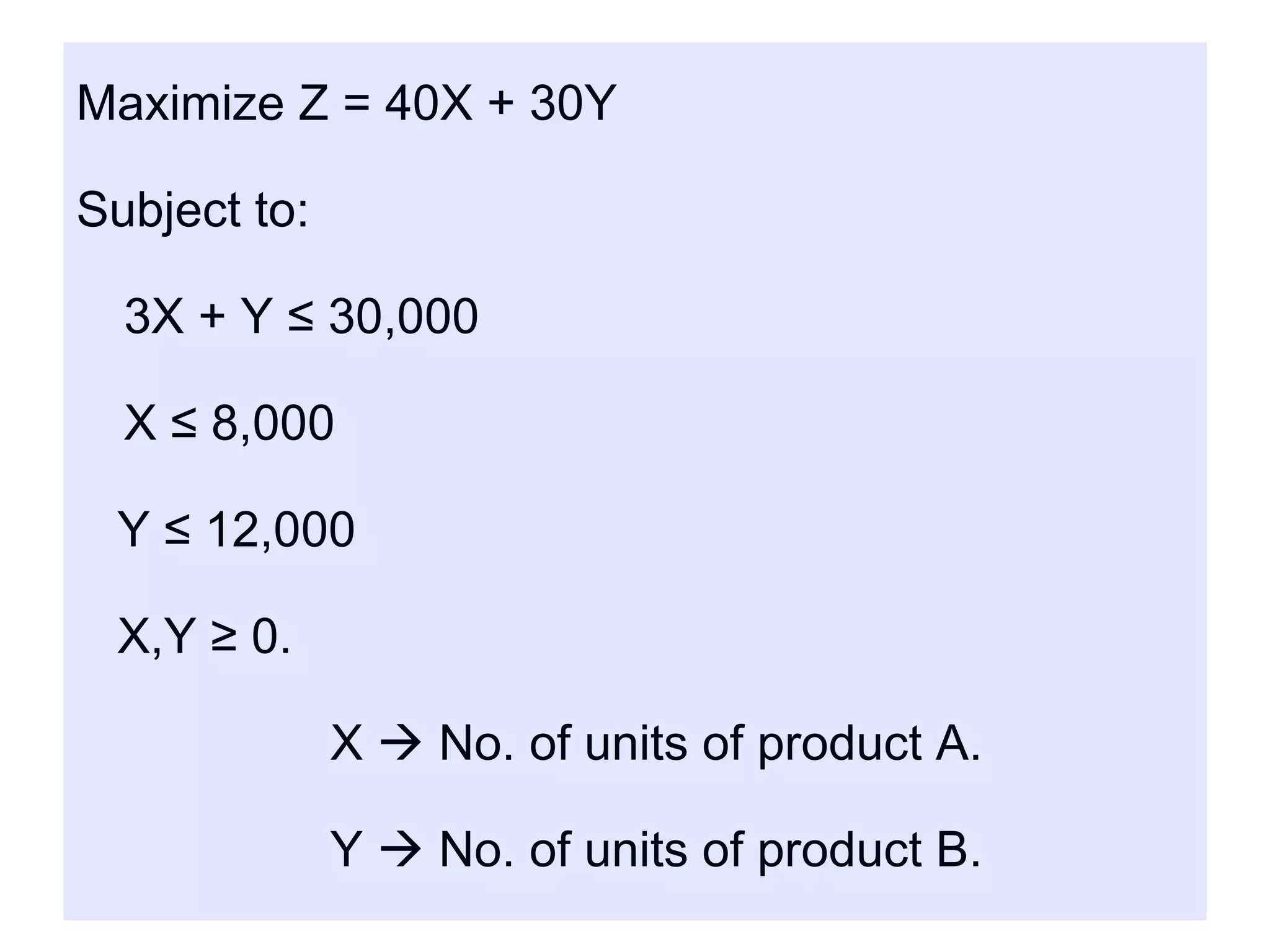
Maximize Z = 40X + 30Y
Subject to:
3X + Y ≤ 30,000
X ≤ 8,000
Y ≤ 12,000
X,Y ≥ 0.
X  No. of units of product A.
Y  No. of units of product B.
 A person requires a minimum of 10, 12 and
12 units of chemicals A, B and C respectively
for his garden. A liquid product contains 5, 2
and 1 units of A,B and C respectively in a jar.
A dry product contains 1, 2 and 4 units of A,
B and C respectively per carton.
Example
3:
 If the liquid product sells at Rs 300/= per jar
and the dry product sells at Rs 200/= per
carton. How much of each should be
purchased to minimize the cost and to meet
the requirements? Formulate the problem.
Type of
chemical
Chemicals
reqd/unit of
liquid prod.
Chemicals
reqd/unit of
dry prod.
Minimum
requirement
of
chemicals
A 5 1 10
B 2 2 12
C 1 4 12
Cost Rs 300/= Rs 200/=
Minimize Z = 300X + 200Y
Subject to:
5X + Y ≥ 10
2X + 2Y ≥ 12
X + 4Y ≥ 12
X,Y ≥ 0.
X  No. of jars of liquid product.
Y  No. of cartons of dry product.
Graphical Method
 Graphical Method can be used to solve a
Linear Programming Problem with two
decision variables.
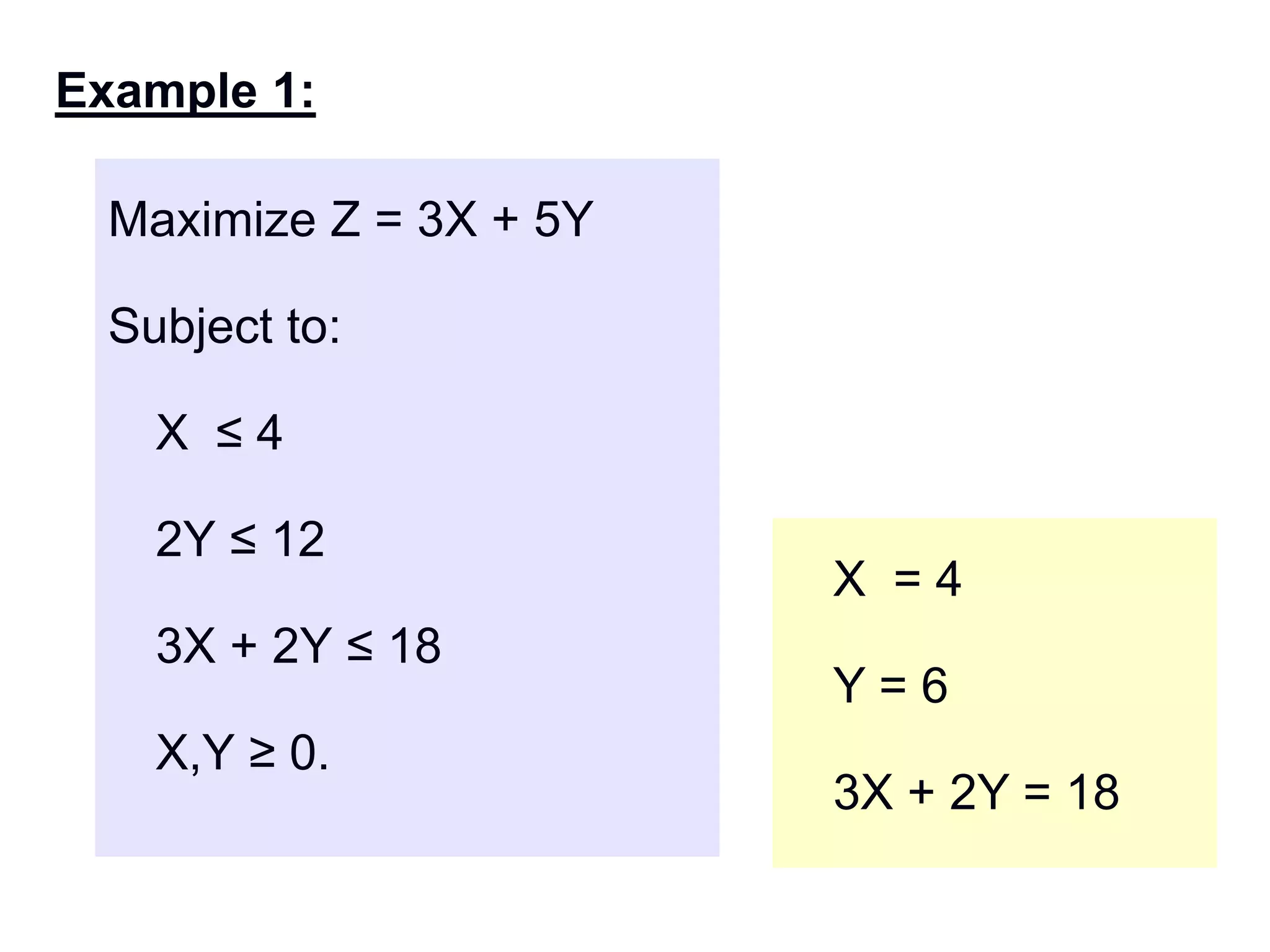
Maximize Z = 3X + 5Y
Subject to:
X ≤ 4
2Y ≤ 12
3X + 2Y ≤ 18
X,Y ≥ 0.
Example 1:
X = 4
Y = 6
3X + 2Y = 18
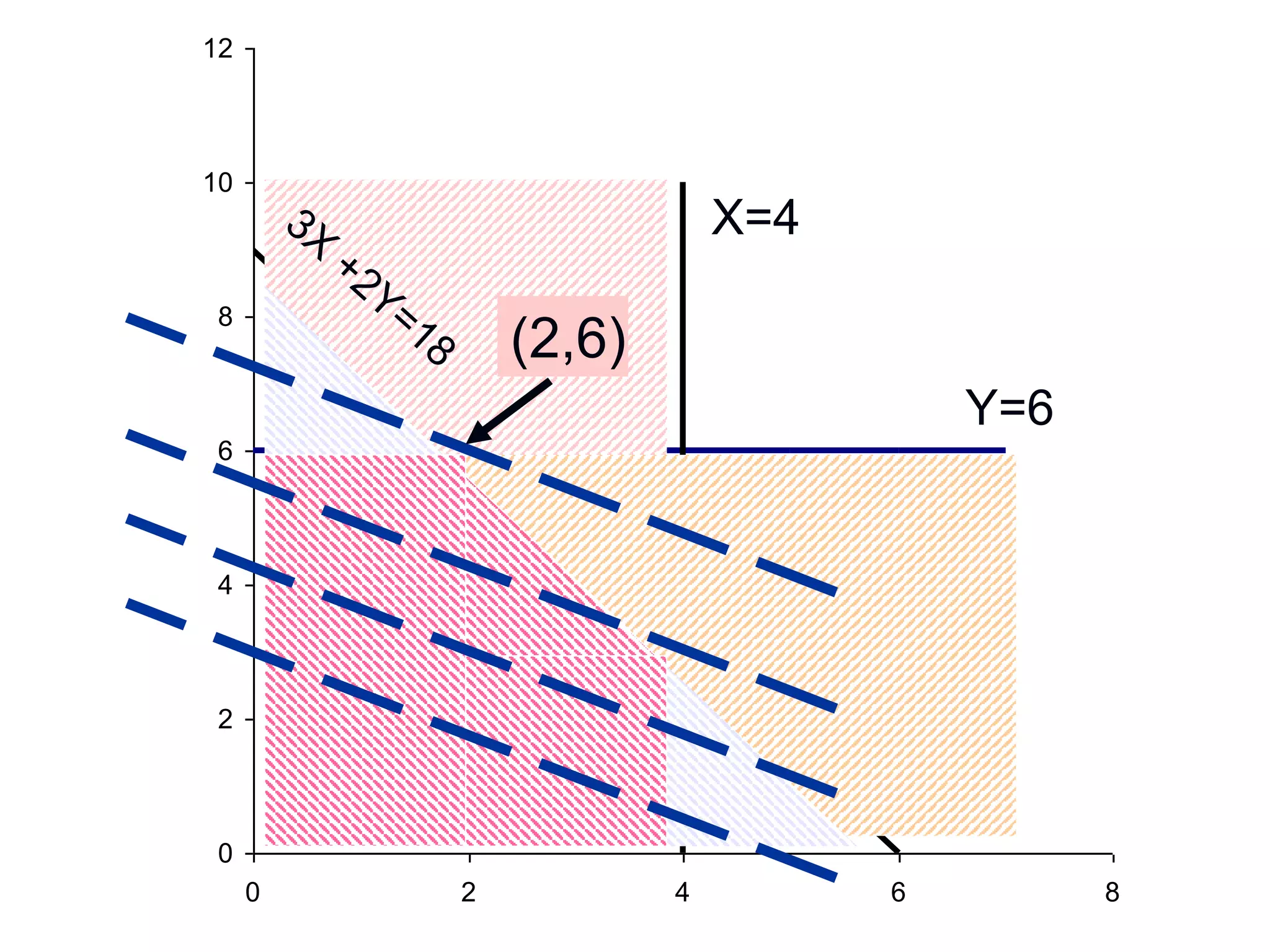
0
2
4
6
8
10
12
0 2 4 6 8
Y=6
X=4
(2,6)
 “Bright Paints” produces interior and exterior
paints from two raw materials M1 and M2.
the following table provides the basic data of
the problem.
Example
2:
Tons of raw materials
per ton.
Max daily
availability
(tons)
Exterior
Paints
Interior
Paints
M1 6 4 24
M2 1 2 6
Profit per ton
(Rs 1000)
5 4
 A market survey restricts the maximum daily
demand of interior paint to 2 tons. Also the
daily demand for interior paint cannot exceed
that of exterior paint by more than 1 ton. The
company wants to determine the optimum
product mix of exterior and interior paints that
maximizes the total daily profit.
X  tons produced of exterior paints
Y  tons produced of interior paints
Maximize Z = 5X + 4Y
Subject to:
6X + 4Y ≤ 24
X + 2Y ≤ 6
-X + Y ≤ 1
Y ≤ 2 X,Y ≥ 0.
0
1
2
3
4
5
6
7
-2 -1 0 1 2 3 4 5 6 7
Y=2
-X +Y=1
3X +2Y=12
X +2Y=6
(3,1.5)
 “New life” farm daily uses at least 800kg of
special feed. The special feed is a mixture of
corn and soybean with the following
quantities.
Example
3:
Kg per kg of feed Cost
(Rs/kg)
Protein Fiber
Corn 0.09 0.02 30
Soybean 0.6 0.06 90
 The dietary requirements of the feed mix
stipulates at least 30% protein and at most 5%
fiber. Find the optimum solution.
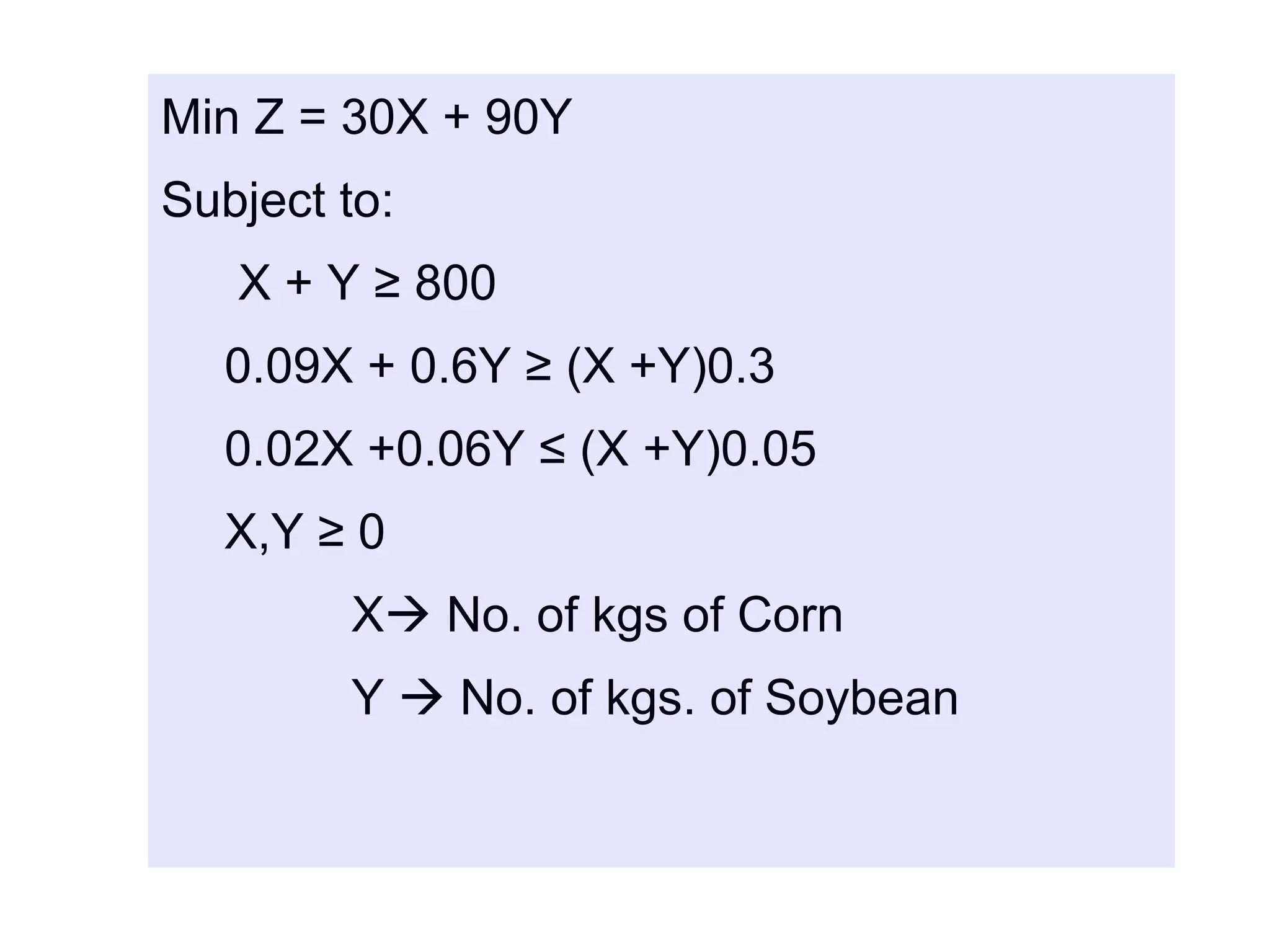
Min Z = 30X + 90Y
Subject to:
X + Y ≥ 800
0.09X + 0.6Y ≥ (X +Y)0.3
0.02X +0.06Y ≤ (X +Y)0.05
X,Y ≥ 0
X No. of kgs of Corn
Y  No. of kgs. of Soybean
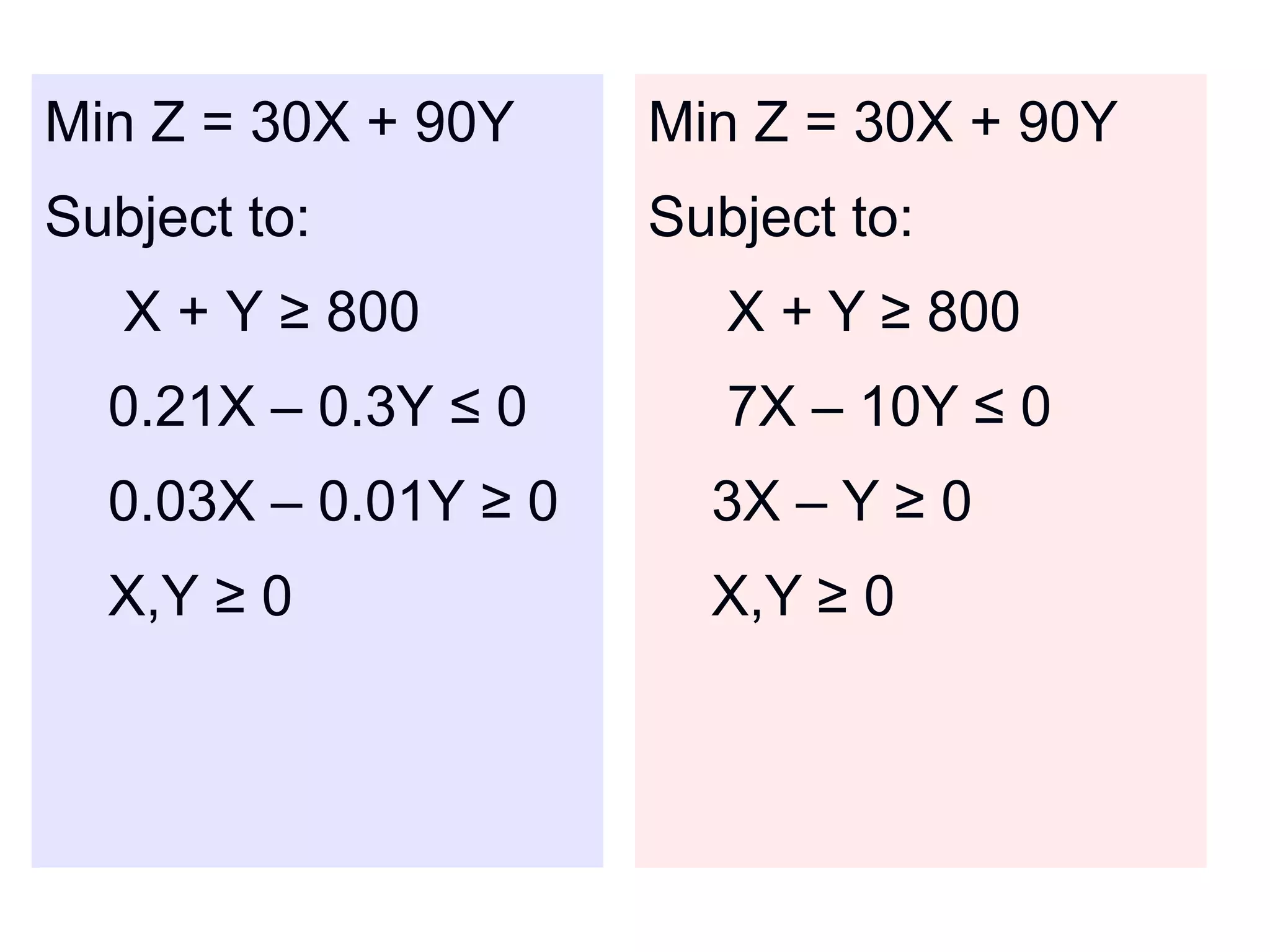
Min Z = 30X + 90Y
Subject to:
X + Y ≥ 800
0.21X – 0.3Y ≤ 0
0.03X – 0.01Y ≥ 0
X,Y ≥ 0
Min Z = 30X + 90Y
Subject to:
X + Y ≥ 800
7X – 10Y ≤ 0
3X – Y ≥ 0
X,Y ≥ 0
0
100
200
300
400
500
600
700
800
900
1000
0 200 400 600 800 1000 1200
X+Y=800
7X-10Y=0
3X-Y=0
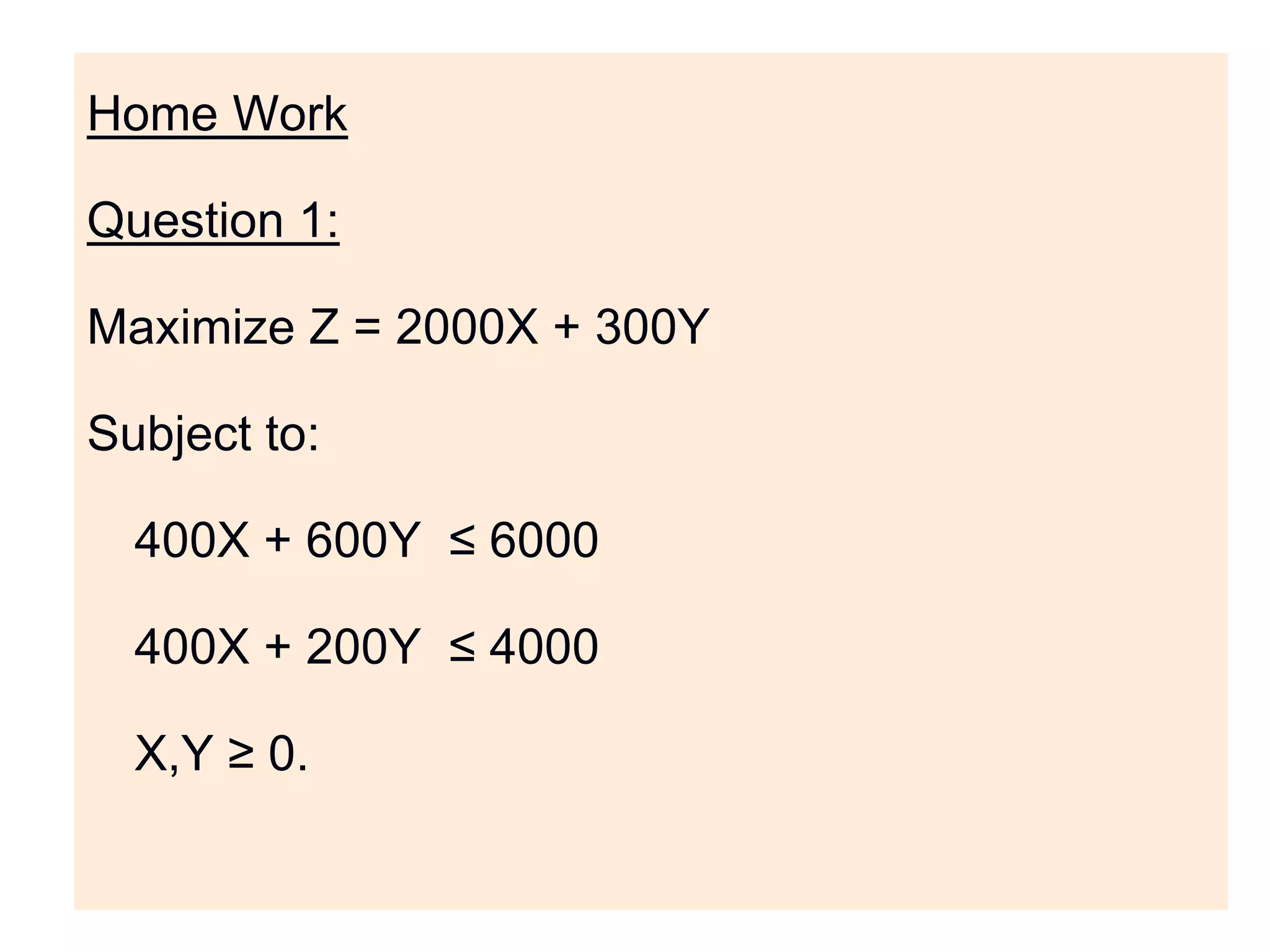
Home Work
Question 1:
Maximize Z = 2000X + 300Y
Subject to:
400X + 600Y ≤ 6000
400X + 200Y ≤ 4000
X,Y ≥ 0.
Question 2:
Maximize Z = X + 2Y
Subject to:
X + Y ≤ 5
X - 2Y ≤ 2
X,Y ≥ 0.
Question 3:
Minimize Z = -4X + 6Y
Subject to:
-X + 6Y ≥ 24
2X - Y ≤ 7
X + 8Y ≤ 80
X,Y ≥ 0.
 In some LP models, the values of the variables
maybe increased indefinitely without violating
any of the constraints. Ie. the solution space is
unbounded in at least one direction. As a result
the objective function value may increase (in a
maximization problem) or decrease (in a
minimization problem) indefinitely.
Unbounded Solution
Example:
Maximize Z = 2X + 3Y
Subject to:
-2X + Y ≤ 1
X - 2Y ≤ 3
X + Y ≥ 2
X,Y ≥ 0.
-3
-2
-1
0
1
2
3
4
5
6
7
8
-3 -2 -1 0 1 2 3 4 5 6
Unbounded
Solution

1.Operations Research.ppt

  • 1.
  • 2.
     Operations Researchmay be described as a scientific approach to decision making that involves the operations of organizational systems.
  • 3.
  • 4.
     LPP ingeneral are concerned with the allocation of resources such as labour, materials, machinery, capital etc in the best possible manner, so that costs are minimized or profits are maximized.  LP is a mathematical technique for finding the optimal use for an organization’s scarce resources.
  • 5.
     The LPmodel includes 3 basic elements:  Decision variables that we seek to determine.  Objective (goal) that we seek to optimize.  Constraints that we need to satisfy.
  • 6.
     A simpleLP problem may look like this: Maximize F = 2X + 4Y subject to: X + Y ≤ 5 2X - 3Y ≤ 10 X,Y ≥ 0 Objective function Constraints Quantity of resources Decision variables
  • 7.
     Constraints canbe labor time, stock of raw materials, availability of machine time etc.
  • 8.
     A homedecorator manufactures two types of lamps, A and B. Both lamps go through two technicians, first a cutter and then a finisher. A lamp of type A requires 2 hours of the cutter’s time and 1 hour of the finisher’s time. A lamp of type B requires 1 hour of the cutter’s time and 2 hours of the finisher’s Example 1:
  • 9.
     The cutterhas 104 hours and the finisher has 76 hours of available time each month. The profit on type A lamp is Rs 60/= and on type B is Rs 110/=. How many lamps of type A and B should be manufactured so as to maximize the profit? Formulate the problem. Assume that the manufacturer can sell all the lamps he manufactures.
  • 10.
    Type of work Time reqd. fortype A Time reqd. for type B Available time Cutting 2 1 104 Finishing 1 2 76 Profit/unit Rs60/= Rs110/=
  • 11.
    Maximize Z =60X +110Y Subject to: 2X + Y ≤ 104 X + 2Y ≤ 76 X,Y ≥ 0. X  No. of lamps of type A. Y  No. of lamps of type B.
  • 12.
     A companysells two different products, A and B. The company makes a profit of Rs40/= and Rs30/= per unit on product A and B respectively. The products are produced in a common production process and sold in two different markets. The production has a capacity of 30,000 man hours per month. Example 2:
  • 13.
     It takes3 hours to produce one unit of A and 1 hour to produce one unit of B. A market survey revealed that only a maximum of 8,000 units of A and 12,000 units of B can be sold per month. How many units of product A and B should be manufactured so as to maximize the profit? Formulate the problem.
  • 14.
    Maximize Z =40X + 30Y Subject to: 3X + Y ≤ 30,000 X ≤ 8,000 Y ≤ 12,000 X,Y ≥ 0. X  No. of units of product A. Y  No. of units of product B.
  • 15.
     A personrequires a minimum of 10, 12 and 12 units of chemicals A, B and C respectively for his garden. A liquid product contains 5, 2 and 1 units of A,B and C respectively in a jar. A dry product contains 1, 2 and 4 units of A, B and C respectively per carton. Example 3:
  • 16.
     If theliquid product sells at Rs 300/= per jar and the dry product sells at Rs 200/= per carton. How much of each should be purchased to minimize the cost and to meet the requirements? Formulate the problem.
  • 17.
    Type of chemical Chemicals reqd/unit of liquidprod. Chemicals reqd/unit of dry prod. Minimum requirement of chemicals A 5 1 10 B 2 2 12 C 1 4 12 Cost Rs 300/= Rs 200/=
  • 18.
    Minimize Z =300X + 200Y Subject to: 5X + Y ≥ 10 2X + 2Y ≥ 12 X + 4Y ≥ 12 X,Y ≥ 0. X  No. of jars of liquid product. Y  No. of cartons of dry product.
  • 19.
  • 20.
     Graphical Methodcan be used to solve a Linear Programming Problem with two decision variables.
  • 21.
    Maximize Z =3X + 5Y Subject to: X ≤ 4 2Y ≤ 12 3X + 2Y ≤ 18 X,Y ≥ 0. Example 1: X = 4 Y = 6 3X + 2Y = 18
  • 22.
    0 2 4 6 8 10 12 0 2 46 8 Y=6 X=4 (2,6)
  • 23.
     “Bright Paints”produces interior and exterior paints from two raw materials M1 and M2. the following table provides the basic data of the problem. Example 2:
  • 24.
    Tons of rawmaterials per ton. Max daily availability (tons) Exterior Paints Interior Paints M1 6 4 24 M2 1 2 6 Profit per ton (Rs 1000) 5 4
  • 25.
     A marketsurvey restricts the maximum daily demand of interior paint to 2 tons. Also the daily demand for interior paint cannot exceed that of exterior paint by more than 1 ton. The company wants to determine the optimum product mix of exterior and interior paints that maximizes the total daily profit.
  • 26.
    X  tonsproduced of exterior paints Y  tons produced of interior paints Maximize Z = 5X + 4Y Subject to: 6X + 4Y ≤ 24 X + 2Y ≤ 6 -X + Y ≤ 1 Y ≤ 2 X,Y ≥ 0.
  • 27.
    0 1 2 3 4 5 6 7 -2 -1 01 2 3 4 5 6 7 Y=2 -X +Y=1 3X +2Y=12 X +2Y=6 (3,1.5)
  • 28.
     “New life”farm daily uses at least 800kg of special feed. The special feed is a mixture of corn and soybean with the following quantities. Example 3:
  • 29.
    Kg per kgof feed Cost (Rs/kg) Protein Fiber Corn 0.09 0.02 30 Soybean 0.6 0.06 90  The dietary requirements of the feed mix stipulates at least 30% protein and at most 5% fiber. Find the optimum solution.
  • 30.
    Min Z =30X + 90Y Subject to: X + Y ≥ 800 0.09X + 0.6Y ≥ (X +Y)0.3 0.02X +0.06Y ≤ (X +Y)0.05 X,Y ≥ 0 X No. of kgs of Corn Y  No. of kgs. of Soybean
  • 31.
    Min Z =30X + 90Y Subject to: X + Y ≥ 800 0.21X – 0.3Y ≤ 0 0.03X – 0.01Y ≥ 0 X,Y ≥ 0 Min Z = 30X + 90Y Subject to: X + Y ≥ 800 7X – 10Y ≤ 0 3X – Y ≥ 0 X,Y ≥ 0
  • 32.
    0 100 200 300 400 500 600 700 800 900 1000 0 200 400600 800 1000 1200 X+Y=800 7X-10Y=0 3X-Y=0
  • 33.
    Home Work Question 1: MaximizeZ = 2000X + 300Y Subject to: 400X + 600Y ≤ 6000 400X + 200Y ≤ 4000 X,Y ≥ 0.
  • 34.
    Question 2: Maximize Z= X + 2Y Subject to: X + Y ≤ 5 X - 2Y ≤ 2 X,Y ≥ 0. Question 3: Minimize Z = -4X + 6Y Subject to: -X + 6Y ≥ 24 2X - Y ≤ 7 X + 8Y ≤ 80 X,Y ≥ 0.
  • 35.
     In someLP models, the values of the variables maybe increased indefinitely without violating any of the constraints. Ie. the solution space is unbounded in at least one direction. As a result the objective function value may increase (in a maximization problem) or decrease (in a minimization problem) indefinitely. Unbounded Solution
  • 36.
    Example: Maximize Z =2X + 3Y Subject to: -2X + Y ≤ 1 X - 2Y ≤ 3 X + Y ≥ 2 X,Y ≥ 0.
  • 37.
    -3 -2 -1 0 1 2 3 4 5 6 7 8 -3 -2 -10 1 2 3 4 5 6 Unbounded Solution