ASSIGNMENT MODELS
PRESENTED BY –
Akriti Sharma
MBA 2nd Semester
2202570036
WHAT IS ASSIGNMENT MODEL?
 Assignment model is a special application of Linear Programming Problem
(LPP), in which the main objective is to assign the work or task to a group of
individuals such that;
 i) There is only one assignment.
 ii) All the assignments should be done in such a way that the overall cost is
minimized (or profit is maximized, incase of maximization).
 In assignment problem, the cost of performing each task by each individual is
known.
o It is desired to find out the best assignments, such that overall cost of
assigning the work is minimized.
USES OF ASSIGNMENT MODEL
 Assignment model is used in the following:
 To decide the assignment of jobs to persons/machines, the assignment model
is used.
 To decide the route a traveling executive has to adopt (dealing with the order
inn which he/she has to visit different places).
 To decide the order in which different activities performed on one and the
same facility be taken up.
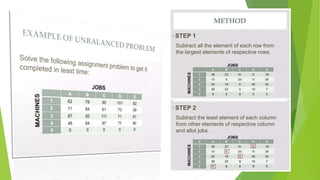
TYPES OF ASSIGNMENT PROBLEMS
(i) Balanced Assignment Problem
 It consist of a square matrix (n x n).
 Number of rows = Number of columns
(ii) Unbalanced Assignment Problem
 It consist of a Non-square matrix.
 Number of rows is not = to Number of columns
.
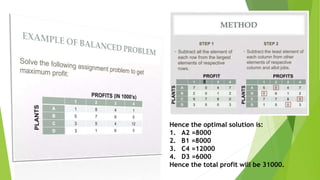
Hence the optimal solution is:
1. A2 =8000
2. B1 =8000
3. C4 =12000
4. D3 =6000
Hence the total profit will be 31000.
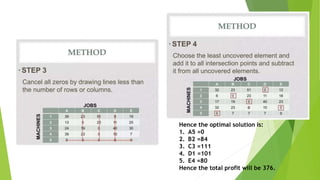
Hence the optimal solution is:
1. A5 =0
2. B2 =84
3. C3 =111
4. D1 =101
5. E4 =80
Hence the total profit will be 376.
LP REPRESENTATION OF ASSIGNMENT
PROBLEM
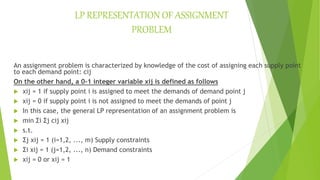
An assignment problem is characterized by knowledge of the cost of assigning each supply point
to each demand point: cij
On the other hand, a 0-1 integer variable xij is defined as follows
 xij = 1 if supply point i is assigned to meet the demands of demand point j
 xij = 0 if supply point i is not assigned to meet the demands of point j
 In this case, the general LP representation of an assignment problem is
 min Σi Σj cij xij
 s.t.
 Σj xij = 1 (i=1,2, ..., m) Supply constraints
 Σi xij = 1 (j=1,2, ..., n) Demand constraints
 xij = 0 or xij = 1
METHODS TO SOLVE ASSIGNMENT MODELS
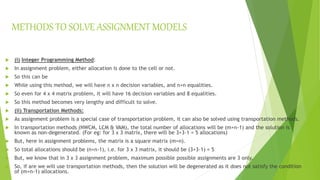
 (i) Integer Programming Method:
 In assignment problem, either allocation is done to the cell or not.
 So this can be formulated using 0 or 1 integer.
 While using this method, we will have n x n decision variables, and n+n equalities.
 So even for 4 x 4 matrix problem, it will have 16 decision variables and 8 equalities.
 So this method becomes very lengthy and difficult to solve.
 (ii) Transportation Methods:
 As assignment problem is a special case of transportation problem, it can also be solved using transportation methods.
 In transportation methods (NWCM, LCM & VAM), the total number of allocations will be (m+n-1) and the solution is
known as non-degenerated. (For eg: for 3 x 3 matrix, there will be 3+3-1 = 5 allocations)
 But, here in assignment problems, the matrix is a square matrix (m=n).
 So total allocations should be (n+n-1), i.e. for 3 x 3 matrix, it should be (3+3-1) = 5
 But, we know that in 3 x 3 assignment problem, maximum possible possible assignments are 3 only.
 So, if are we will use transportation methods, then the solution will be degenerated as it does not satisfy the condition
of (m+n-1) allocations.
 (iii) Enumeration Method:
 It is a simple trail and error type method.
 Consider a 3 x 3 assignment problem. Here the assignments are done randomly and
the total cost is found out.
 For 3 x 3 matrix, the total possible trails are 3!
 So total 3! = 3 x 2 x 1 = 6 trails are possible.
 The assignments which gives minimum cost is selected as optimal solution.
 But, such trail and error becomes very difficult and lengthy.
 If there are more number of rows and columns,
 ( For eg: For 6 x 6 matrix, there will be 6! trails. So 6! = 6 x 5 x 4 x 3 x 2 x 1 = 720
trails possible)
 then such methods can't be applied for solving assignments problems.
 (iv) Hungarian Method:
 It was developed by two mathematicians of Hungary. So, it is known as Hungarian
Method.
 It is also know as Reduced matrix method or Flood's technique.
 There are two main conditions for applying Hungarian Method:
 (1) Square Matrix (n x n).
 (2) Problem should be of minimization type.
THANK YOU

Assignment model

  • 1.
    ASSIGNMENT MODELS PRESENTED BY– Akriti Sharma MBA 2nd Semester 2202570036
  • 2.
    WHAT IS ASSIGNMENTMODEL?  Assignment model is a special application of Linear Programming Problem (LPP), in which the main objective is to assign the work or task to a group of individuals such that;  i) There is only one assignment.  ii) All the assignments should be done in such a way that the overall cost is minimized (or profit is maximized, incase of maximization).  In assignment problem, the cost of performing each task by each individual is known. o It is desired to find out the best assignments, such that overall cost of assigning the work is minimized.
  • 3.
    USES OF ASSIGNMENTMODEL  Assignment model is used in the following:  To decide the assignment of jobs to persons/machines, the assignment model is used.  To decide the route a traveling executive has to adopt (dealing with the order inn which he/she has to visit different places).  To decide the order in which different activities performed on one and the same facility be taken up.
  • 4.
    TYPES OF ASSIGNMENTPROBLEMS (i) Balanced Assignment Problem  It consist of a square matrix (n x n).  Number of rows = Number of columns (ii) Unbalanced Assignment Problem  It consist of a Non-square matrix.  Number of rows is not = to Number of columns
  • 5.
    . Hence the optimalsolution is: 1. A2 =8000 2. B1 =8000 3. C4 =12000 4. D3 =6000 Hence the total profit will be 31000.
  • 7.
    Hence the optimalsolution is: 1. A5 =0 2. B2 =84 3. C3 =111 4. D1 =101 5. E4 =80 Hence the total profit will be 376.
  • 8.
    LP REPRESENTATION OFASSIGNMENT PROBLEM An assignment problem is characterized by knowledge of the cost of assigning each supply point to each demand point: cij On the other hand, a 0-1 integer variable xij is defined as follows  xij = 1 if supply point i is assigned to meet the demands of demand point j  xij = 0 if supply point i is not assigned to meet the demands of point j  In this case, the general LP representation of an assignment problem is  min Σi Σj cij xij  s.t.  Σj xij = 1 (i=1,2, ..., m) Supply constraints  Σi xij = 1 (j=1,2, ..., n) Demand constraints  xij = 0 or xij = 1
  • 9.
    METHODS TO SOLVEASSIGNMENT MODELS  (i) Integer Programming Method:  In assignment problem, either allocation is done to the cell or not.  So this can be formulated using 0 or 1 integer.  While using this method, we will have n x n decision variables, and n+n equalities.  So even for 4 x 4 matrix problem, it will have 16 decision variables and 8 equalities.  So this method becomes very lengthy and difficult to solve.  (ii) Transportation Methods:  As assignment problem is a special case of transportation problem, it can also be solved using transportation methods.  In transportation methods (NWCM, LCM & VAM), the total number of allocations will be (m+n-1) and the solution is known as non-degenerated. (For eg: for 3 x 3 matrix, there will be 3+3-1 = 5 allocations)  But, here in assignment problems, the matrix is a square matrix (m=n).  So total allocations should be (n+n-1), i.e. for 3 x 3 matrix, it should be (3+3-1) = 5  But, we know that in 3 x 3 assignment problem, maximum possible possible assignments are 3 only.  So, if are we will use transportation methods, then the solution will be degenerated as it does not satisfy the condition of (m+n-1) allocations.
  • 10.
     (iii) EnumerationMethod:  It is a simple trail and error type method.  Consider a 3 x 3 assignment problem. Here the assignments are done randomly and the total cost is found out.  For 3 x 3 matrix, the total possible trails are 3!  So total 3! = 3 x 2 x 1 = 6 trails are possible.  The assignments which gives minimum cost is selected as optimal solution.  But, such trail and error becomes very difficult and lengthy.  If there are more number of rows and columns,  ( For eg: For 6 x 6 matrix, there will be 6! trails. So 6! = 6 x 5 x 4 x 3 x 2 x 1 = 720 trails possible)  then such methods can't be applied for solving assignments problems.  (iv) Hungarian Method:  It was developed by two mathematicians of Hungary. So, it is known as Hungarian Method.  It is also know as Reduced matrix method or Flood's technique.  There are two main conditions for applying Hungarian Method:  (1) Square Matrix (n x n).  (2) Problem should be of minimization type.
  • 11.