Transportation Problem
- Stepping Stone Method -
PAMANTASAN NG LUNGSOD NG MAYNILA
GRADUATE SCHOOL OF ENGINEERING
GEM 805 – OPTIMIZATION TECHNIQUES
Stepping Stone Method
>>> This is a one of the methods used to determine optimality of
an initial basic feasible solution (i.e. Northwest Corner Rule, Least
Cost or Vogel’s Approximation)
>>> The method is derived from the analogy of crossing a pond
using stepping stones. This means that the entire transportation
table is assumed to be a pond and the occupied cells are the
stones needed to make certain movements within the pond.
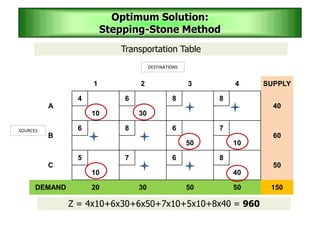
Optimum Solution:
Stepping-Stone Method
1 2 3 4 SUPPLY
A
4 6 8 8
40
10 30
B
6 8 6 7
60
50 10
C
5 7 6 8
50
10 40
DEMAND 20 30 50 50 150
SOURCES
DESTINATIONS
Z = 4x10+6x30+6x50+7x10+5x10+8x40 = 960
Transportation Table
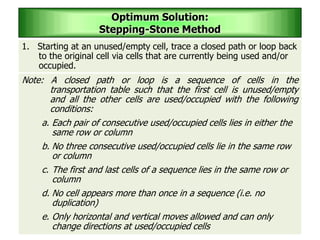
1. Starting at an unused/empty cell, trace a closed path or loop back
to the original cell via cells that are currently being used and/or
occupied.
Note: A closed path or loop is a sequence of cells in the
transportation table such that the first cell is unused/empty
and all the other cells are used/occupied with the following
conditions:
a. Each pair of consecutive used/occupied cells lies in either the
same row or column
b. No three consecutive used/occupied cells lie in the same row
or column
c. The first and last cells of a sequence lies in the same row or
column
d. No cell appears more than once in a sequence (i.e. no
duplication)
e. Only horizontal and vertical moves allowed and can only
change directions at used/occupied cells
Optimum Solution:
Stepping-Stone Method
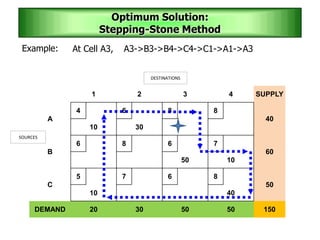
Example:
1 2 3 4 SUPPLY
A
4 6 8 8
40
10 30
B
6 8 6 7
60
50 10
C
5 7 6 8
50
10 40
DEMAND 20 30 50 50 150
SOURCES
DESTINATIONS
Optimum Solution:
Stepping-Stone Method
A3->B3->B4->C4->C1->A1->A3At Cell A3,
Example:
1 2 3 4 SUPPLY
A
4 6 8 8
40
10 30
B
6 8 6 7
60
50 10
C
5 7 6 8
50
10 40
DEMAND 20 30 50 50 150
SOURCES
DESTINATIONS
Optimum Solution:
Stepping-Stone Method
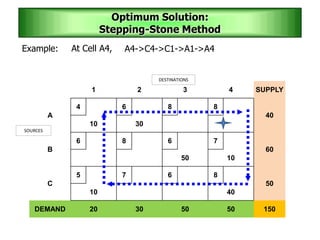
At Cell A4, A4->C4->C1->A1->A4
1 2 3 4 SUPPLY
A
4 6 8 8
40
10 30
B
6 8 6 7
60
50 10
C
5 7 6 8
50
10 40
DEMAND 20 30 50 50 150
Optimum Solution:
Stepping-Stone Method
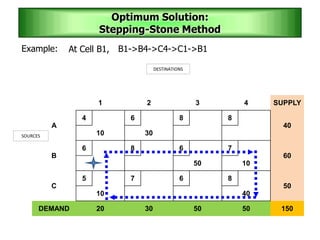
B1->B4->C4->C1->B1
SOURCES
DESTINATIONS
Example: At Cell B1,
Example:
1 2 3 4 SUPPLY
A
4 6 8 8
40
10 30
B
6 8 6 7
60
50 10
C
5 7 6 8
50
10 40
DEMAND 20 30 50 50 150
SOURCES
DESTINATIONS
Optimum Solution:
Stepping-Stone Method
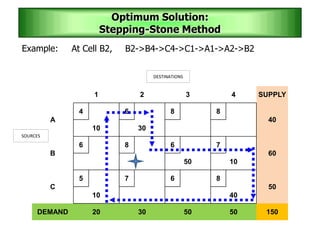
At Cell B2, B2->B4->C4->C1->A1->A2->B2
Example:
1 2 3 4 SUPPLY
A
4 6 8 8
40
10 30
B
6 8 6 7
60
50 10
C
5 7 6 8
50
10 40
DEMAND 20 30 50 50 150
SOURCES
DESTINATIONS
Optimum Solution:
Stepping-Stone Method
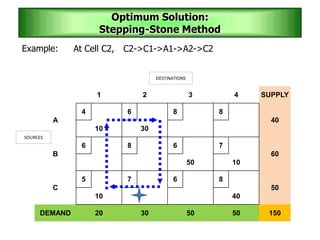
At Cell C2, C2->C1->A1->A2->C2
Example:
1 2 3 4 SUPPLY
A
4 6 8 8
40
10 30
B
6 8 6 7
60
50 10
C
5 7 6 8
50
10 40
DEMAND 20 30 50 50 150
SOURCES
DESTINATIONS
Optimum Solution:
Stepping-Stone Method
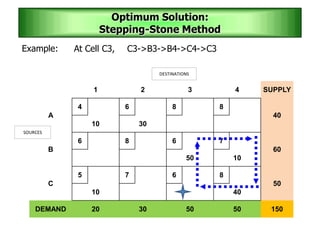
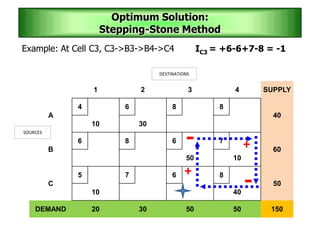
At Cell C3, C3->B3->B4->C4->C3
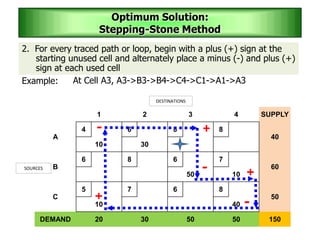
2. For every traced path or loop, begin with a plus (+) sign at the
starting unused cell and alternately place a minus (-) and plus (+)
sign at each used cell
1 2 3 4 SUPPLY
A
4 6 8 8
40
10 30
B
6 8 6 7
60
50 10
C
5 7 6 8
50
10 40
DEMAND 20 30 50 50 150
SOURCES
DESTINATIONS
-
-
-
+
+
+
Example:
Optimum Solution:
Stepping-Stone Method
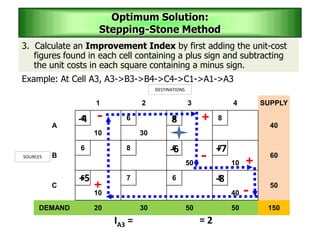
At Cell A3, A3->B3->B4->C4->C1->A1->A3
3. Calculate an Improvement Index by first adding the unit-cost
figures found in each cell containing a plus sign and subtracting
the unit costs in each square containing a minus sign.
1 2 3 4 SUPPLY
A
4 6 8 8
40
10 30
B
6 8 6 7
60
50 10
C
5 7 6 8
50
10 40
DEMAND 20 30 50 50 150
SOURCES
DESTINATIONS
-
-
-
+
+
+
Example: At Cell A3, A3->B3->B4->C4->C1->A1->A3
Optimum Solution:
Stepping-Stone Method
IA3 = 2
-8
-6 +7
+5
-4
=
8
Optimum Solution:
Stepping-Stone Method
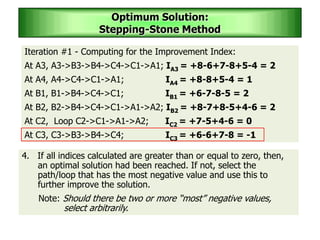
Iteration #1 - Computing for the Improvement Index:
At A3, A3->B3->B4->C4->C1->A1; IA3 = +8-6+7-8+5-4 = 2
At A4, A4->C4->C1->A1; IA4 = +8-8+5-4 = 1
At B1, B1->B4->C4->C1; IB1 = +6-7-8-5 = 2
At B2, B2->B4->C4->C1->A1->A2; IB2 = +8-7+8-5+4-6 = 2
At C2, Loop C2->C1->A1->A2; IC2 = +7-5+4-6 = 0
At C3, C3->B3->B4->C4; IC3 = +6-6+7-8 = -1
4. If all indices calculated are greater than or equal to zero, then,
an optimal solution had been reached. If not, select the
path/loop that has the most negative value and use this to
further improve the solution.
Note: Should there be two or more “most” negative values,
select arbitrarily.
Example: At Cell C3, C3->B3->B4->C4
1 2 3 4 SUPPLY
A
4 6 8 8
40
10 30
B
6 8 6 7
60
50 10
C
5 7 6 8
50
10 40
DEMAND 20 30 50 50 150
SOURCES
DESTINATIONS
Optimum Solution:
Stepping-Stone Method
+
+
-
-
IC3 = +6-6+7-8 = -1
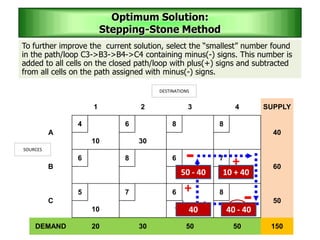
To further improve the current solution, select the “smallest” number found
in the path/loop C3->B3->B4->C4 containing minus(-) signs. This number is
added to all cells on the closed path/loop with plus(+) signs and subtracted
from all cells on the path assigned with minus(-) signs.
Optimum Solution:
Stepping-Stone Method
1 2 3 4 SUPPLY
A
4 6 8 8
40
10 30
B
6 8 6 7
60
50 10
C
5 7 6 8
50
10 40
DEMAND 20 30 50 50 150
SOURCES
DESTINATIONS
+
+
-
-
40
50 - 40 10 + 40
40 - 40
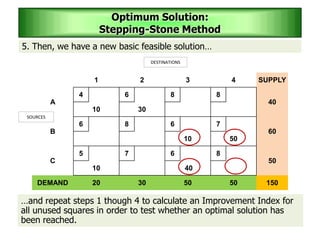
5. Then, we have a new basic feasible solution…
1 2 3 4 SUPPLY
A
4 6 8 8
40
10 30
B
6 8 6 7
60
10 50
C
5 7 6 8
50
10 40
DEMAND 20 30 50 50 150
SOURCES
DESTINATIONS
Optimum Solution:
Stepping-Stone Method
…and repeat steps 1 though 4 to calculate an Improvement Index for
all unused squares in order to test whether an optimal solution has
been reached.

Optimum Solution:
Stepping-Stone Method
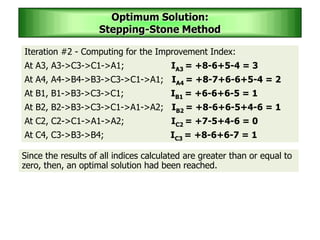
Iteration #2 - Computing for the Improvement Index:
At A3, A3->C3->C1->A1; IA3 = +8-6+5-4 = 3
At A4, A4->B4->B3->C3->C1->A1; IA4 = +8-7+6-6+5-4 = 2
At B1, B1->B3->C3->C1; IB1 = +6-6+6-5 = 1
At B2, B2->B3->C3->C1->A1->A2; IB2 = +8-6+6-5+4-6 = 1
At C2, C2->C1->A1->A2; IC2 = +7-5+4-6 = 0
At C4, C3->B3->B4; IC3 = +8-6+6-7 = 1
Since the results of all indices calculated are greater than or equal to
zero, then, an optimal solution had been reached.
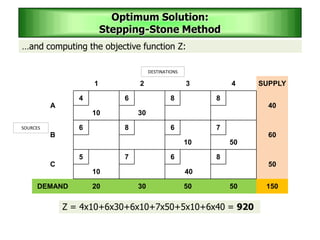
…and computing the objective function Z:
1 2 3 4 SUPPLY
A
4 6 8 8
40
10 30
B
6 8 6 7
60
10 50
C
5 7 6 8
50
10 40
DEMAND 20 30 50 50 150
SOURCES
DESTINATIONS
Optimum Solution:
Stepping-Stone Method
Z = 4x10+6x30+6x10+7x50+5x10+6x40 = 920
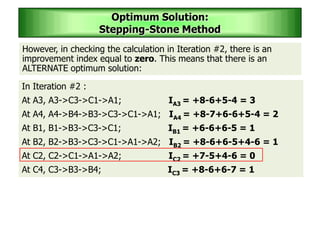
In Iteration #2 :
At A3, A3->C3->C1->A1; IA3 = +8-6+5-4 = 3
At A4, A4->B4->B3->C3->C1->A1; IA4 = +8-7+6-6+5-4 = 2
At B1, B1->B3->C3->C1; IB1 = +6-6+6-5 = 1
At B2, B2->B3->C3->C1->A1->A2; IB2 = +8-6+6-5+4-6 = 1
At C2, C2->C1->A1->A2; IC2 = +7-5+4-6 = 0
At C4, C3->B3->B4; IC3 = +8-6+6-7 = 1
Optimum Solution:
Stepping-Stone Method
However, in checking the calculation in Iteration #2, there is an
improvement index equal to zero. This means that there is an
ALTERNATE optimum solution:
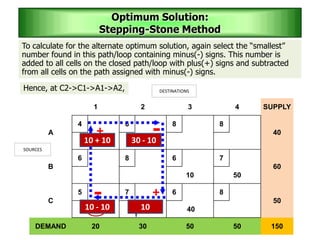
To calculate for the alternate optimum solution, again select the “smallest”
number found in this path/loop containing minus(-) signs. This number is
added to all cells on the closed path/loop with plus(+) signs and subtracted
from all cells on the path assigned with minus(-) signs.
Optimum Solution:
Stepping-Stone Method
1 2 3 4 SUPPLY
A
4 6 8 8
40
10 30
B
6 8 6 7
60
10 50
C
5 7 6 8
50
10 40
DEMAND 20 30 50 50 150
SOURCES
DESTINATIONS
+
+ -
- 10
30 - 1010 + 10
10 - 10
Hence, at C2->C1->A1->A2,
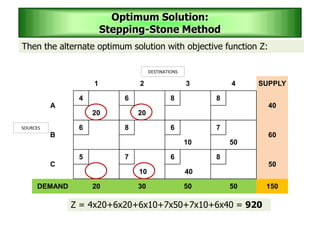
Then the alternate optimum solution with objective function Z:
1 2 3 4 SUPPLY
A
4 6 8 8
40
20 20
B
6 8 6 7
60
10 50
C
5 7 6 8
50
10 40
DEMAND 20 30 50 50 150
SOURCES
DESTINATIONS
Optimum Solution:
Stepping-Stone Method
Z = 4x20+6x20+6x10+7x50+7x10+6x40 = 920
1 2 3 4 SUPPLY
A
4 6 8 8
40
20 20
B
6 8 6 7
60
10 50
C
5 7 6 8
50
50
DEMAND 20 30 50 50 150
SOURCES
DESTINATIONS
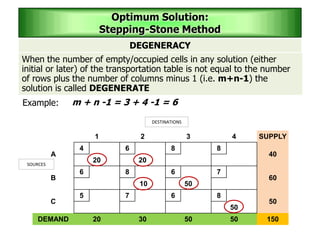
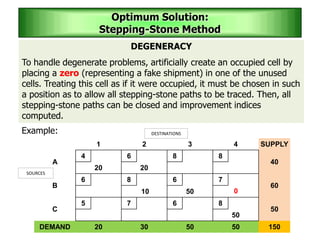
When the number of empty/occupied cells in any solution (either
initial or later) of the transportation table is not equal to the number
of rows plus the number of columns minus 1 (i.e. m+n-1) the
solution is called DEGENERATE
Optimum Solution:
Stepping-Stone Method
Example: m + n -1 = 3 + 4 -1 = 6
DEGENERACY
DEGENERACY
To handle degenerate problems, artificially create an occupied cell by
placing a zero (representing a fake shipment) in one of the unused
cells. Treating this cell as if it were occupied, it must be chosen in such
a position as to allow all stepping-stone paths to be traced. Then, all
stepping-stone paths can be closed and improvement indices
computed.
Optimum Solution:
Stepping-Stone Method
1 2 3 4 SUPPLY
A
4 6 8 8
40
20 20
B
6 8 6 7
60
10 50
C
5 7 6 8
50
50
DEMAND 20 30 50 50 150
SOURCES
0
Example: DESTINATIONS
QUESTIONS?
Optimum Solution:
Stepping-Stone Method
DIOS MABALOS PO!
Cam on !
Shukriya !
ありがとうございます!
Thank you!
Merci!
Gracias!
Obrigado!
謝謝!

transporation problem - stepping stone method

  • 1.
    Transportation Problem - SteppingStone Method - PAMANTASAN NG LUNGSOD NG MAYNILA GRADUATE SCHOOL OF ENGINEERING GEM 805 – OPTIMIZATION TECHNIQUES
  • 2.
    Stepping Stone Method >>>This is a one of the methods used to determine optimality of an initial basic feasible solution (i.e. Northwest Corner Rule, Least Cost or Vogel’s Approximation) >>> The method is derived from the analogy of crossing a pond using stepping stones. This means that the entire transportation table is assumed to be a pond and the occupied cells are the stones needed to make certain movements within the pond.
  • 3.
    Optimum Solution: Stepping-Stone Method 12 3 4 SUPPLY A 4 6 8 8 40 10 30 B 6 8 6 7 60 50 10 C 5 7 6 8 50 10 40 DEMAND 20 30 50 50 150 SOURCES DESTINATIONS Z = 4x10+6x30+6x50+7x10+5x10+8x40 = 960 Transportation Table
  • 4.
    1. Starting atan unused/empty cell, trace a closed path or loop back to the original cell via cells that are currently being used and/or occupied. Note: A closed path or loop is a sequence of cells in the transportation table such that the first cell is unused/empty and all the other cells are used/occupied with the following conditions: a. Each pair of consecutive used/occupied cells lies in either the same row or column b. No three consecutive used/occupied cells lie in the same row or column c. The first and last cells of a sequence lies in the same row or column d. No cell appears more than once in a sequence (i.e. no duplication) e. Only horizontal and vertical moves allowed and can only change directions at used/occupied cells Optimum Solution: Stepping-Stone Method
  • 5.
    Example: 1 2 34 SUPPLY A 4 6 8 8 40 10 30 B 6 8 6 7 60 50 10 C 5 7 6 8 50 10 40 DEMAND 20 30 50 50 150 SOURCES DESTINATIONS Optimum Solution: Stepping-Stone Method A3->B3->B4->C4->C1->A1->A3At Cell A3,
  • 6.
    Example: 1 2 34 SUPPLY A 4 6 8 8 40 10 30 B 6 8 6 7 60 50 10 C 5 7 6 8 50 10 40 DEMAND 20 30 50 50 150 SOURCES DESTINATIONS Optimum Solution: Stepping-Stone Method At Cell A4, A4->C4->C1->A1->A4
  • 7.
    1 2 34 SUPPLY A 4 6 8 8 40 10 30 B 6 8 6 7 60 50 10 C 5 7 6 8 50 10 40 DEMAND 20 30 50 50 150 Optimum Solution: Stepping-Stone Method B1->B4->C4->C1->B1 SOURCES DESTINATIONS Example: At Cell B1,
  • 8.
    Example: 1 2 34 SUPPLY A 4 6 8 8 40 10 30 B 6 8 6 7 60 50 10 C 5 7 6 8 50 10 40 DEMAND 20 30 50 50 150 SOURCES DESTINATIONS Optimum Solution: Stepping-Stone Method At Cell B2, B2->B4->C4->C1->A1->A2->B2
  • 9.
    Example: 1 2 34 SUPPLY A 4 6 8 8 40 10 30 B 6 8 6 7 60 50 10 C 5 7 6 8 50 10 40 DEMAND 20 30 50 50 150 SOURCES DESTINATIONS Optimum Solution: Stepping-Stone Method At Cell C2, C2->C1->A1->A2->C2
  • 10.
    Example: 1 2 34 SUPPLY A 4 6 8 8 40 10 30 B 6 8 6 7 60 50 10 C 5 7 6 8 50 10 40 DEMAND 20 30 50 50 150 SOURCES DESTINATIONS Optimum Solution: Stepping-Stone Method At Cell C3, C3->B3->B4->C4->C3
  • 11.
    2. For everytraced path or loop, begin with a plus (+) sign at the starting unused cell and alternately place a minus (-) and plus (+) sign at each used cell 1 2 3 4 SUPPLY A 4 6 8 8 40 10 30 B 6 8 6 7 60 50 10 C 5 7 6 8 50 10 40 DEMAND 20 30 50 50 150 SOURCES DESTINATIONS - - - + + + Example: Optimum Solution: Stepping-Stone Method At Cell A3, A3->B3->B4->C4->C1->A1->A3
  • 12.
    3. Calculate anImprovement Index by first adding the unit-cost figures found in each cell containing a plus sign and subtracting the unit costs in each square containing a minus sign. 1 2 3 4 SUPPLY A 4 6 8 8 40 10 30 B 6 8 6 7 60 50 10 C 5 7 6 8 50 10 40 DEMAND 20 30 50 50 150 SOURCES DESTINATIONS - - - + + + Example: At Cell A3, A3->B3->B4->C4->C1->A1->A3 Optimum Solution: Stepping-Stone Method IA3 = 2 -8 -6 +7 +5 -4 = 8
  • 13.
    Optimum Solution: Stepping-Stone Method Iteration#1 - Computing for the Improvement Index: At A3, A3->B3->B4->C4->C1->A1; IA3 = +8-6+7-8+5-4 = 2 At A4, A4->C4->C1->A1; IA4 = +8-8+5-4 = 1 At B1, B1->B4->C4->C1; IB1 = +6-7-8-5 = 2 At B2, B2->B4->C4->C1->A1->A2; IB2 = +8-7+8-5+4-6 = 2 At C2, Loop C2->C1->A1->A2; IC2 = +7-5+4-6 = 0 At C3, C3->B3->B4->C4; IC3 = +6-6+7-8 = -1 4. If all indices calculated are greater than or equal to zero, then, an optimal solution had been reached. If not, select the path/loop that has the most negative value and use this to further improve the solution. Note: Should there be two or more “most” negative values, select arbitrarily.
  • 14.
    Example: At CellC3, C3->B3->B4->C4 1 2 3 4 SUPPLY A 4 6 8 8 40 10 30 B 6 8 6 7 60 50 10 C 5 7 6 8 50 10 40 DEMAND 20 30 50 50 150 SOURCES DESTINATIONS Optimum Solution: Stepping-Stone Method + + - - IC3 = +6-6+7-8 = -1
  • 15.
    To further improvethe current solution, select the “smallest” number found in the path/loop C3->B3->B4->C4 containing minus(-) signs. This number is added to all cells on the closed path/loop with plus(+) signs and subtracted from all cells on the path assigned with minus(-) signs. Optimum Solution: Stepping-Stone Method 1 2 3 4 SUPPLY A 4 6 8 8 40 10 30 B 6 8 6 7 60 50 10 C 5 7 6 8 50 10 40 DEMAND 20 30 50 50 150 SOURCES DESTINATIONS + + - - 40 50 - 40 10 + 40 40 - 40
  • 16.
    5. Then, wehave a new basic feasible solution… 1 2 3 4 SUPPLY A 4 6 8 8 40 10 30 B 6 8 6 7 60 10 50 C 5 7 6 8 50 10 40 DEMAND 20 30 50 50 150 SOURCES DESTINATIONS Optimum Solution: Stepping-Stone Method …and repeat steps 1 though 4 to calculate an Improvement Index for all unused squares in order to test whether an optimal solution has been reached.
  • 17.
    Optimum Solution: Stepping-Stone Method Iteration#2 - Computing for the Improvement Index: At A3, A3->C3->C1->A1; IA3 = +8-6+5-4 = 3 At A4, A4->B4->B3->C3->C1->A1; IA4 = +8-7+6-6+5-4 = 2 At B1, B1->B3->C3->C1; IB1 = +6-6+6-5 = 1 At B2, B2->B3->C3->C1->A1->A2; IB2 = +8-6+6-5+4-6 = 1 At C2, C2->C1->A1->A2; IC2 = +7-5+4-6 = 0 At C4, C3->B3->B4; IC3 = +8-6+6-7 = 1 Since the results of all indices calculated are greater than or equal to zero, then, an optimal solution had been reached.

  • 18.
    …and computing theobjective function Z: 1 2 3 4 SUPPLY A 4 6 8 8 40 10 30 B 6 8 6 7 60 10 50 C 5 7 6 8 50 10 40 DEMAND 20 30 50 50 150 SOURCES DESTINATIONS Optimum Solution: Stepping-Stone Method Z = 4x10+6x30+6x10+7x50+5x10+6x40 = 920
  • 19.
    In Iteration #2: At A3, A3->C3->C1->A1; IA3 = +8-6+5-4 = 3 At A4, A4->B4->B3->C3->C1->A1; IA4 = +8-7+6-6+5-4 = 2 At B1, B1->B3->C3->C1; IB1 = +6-6+6-5 = 1 At B2, B2->B3->C3->C1->A1->A2; IB2 = +8-6+6-5+4-6 = 1 At C2, C2->C1->A1->A2; IC2 = +7-5+4-6 = 0 At C4, C3->B3->B4; IC3 = +8-6+6-7 = 1 Optimum Solution: Stepping-Stone Method However, in checking the calculation in Iteration #2, there is an improvement index equal to zero. This means that there is an ALTERNATE optimum solution:
  • 20.
    To calculate forthe alternate optimum solution, again select the “smallest” number found in this path/loop containing minus(-) signs. This number is added to all cells on the closed path/loop with plus(+) signs and subtracted from all cells on the path assigned with minus(-) signs. Optimum Solution: Stepping-Stone Method 1 2 3 4 SUPPLY A 4 6 8 8 40 10 30 B 6 8 6 7 60 10 50 C 5 7 6 8 50 10 40 DEMAND 20 30 50 50 150 SOURCES DESTINATIONS + + - - 10 30 - 1010 + 10 10 - 10 Hence, at C2->C1->A1->A2,
  • 21.
    Then the alternateoptimum solution with objective function Z: 1 2 3 4 SUPPLY A 4 6 8 8 40 20 20 B 6 8 6 7 60 10 50 C 5 7 6 8 50 10 40 DEMAND 20 30 50 50 150 SOURCES DESTINATIONS Optimum Solution: Stepping-Stone Method Z = 4x20+6x20+6x10+7x50+7x10+6x40 = 920
  • 22.
    1 2 34 SUPPLY A 4 6 8 8 40 20 20 B 6 8 6 7 60 10 50 C 5 7 6 8 50 50 DEMAND 20 30 50 50 150 SOURCES DESTINATIONS When the number of empty/occupied cells in any solution (either initial or later) of the transportation table is not equal to the number of rows plus the number of columns minus 1 (i.e. m+n-1) the solution is called DEGENERATE Optimum Solution: Stepping-Stone Method Example: m + n -1 = 3 + 4 -1 = 6 DEGENERACY
  • 23.
    DEGENERACY To handle degenerateproblems, artificially create an occupied cell by placing a zero (representing a fake shipment) in one of the unused cells. Treating this cell as if it were occupied, it must be chosen in such a position as to allow all stepping-stone paths to be traced. Then, all stepping-stone paths can be closed and improvement indices computed. Optimum Solution: Stepping-Stone Method 1 2 3 4 SUPPLY A 4 6 8 8 40 20 20 B 6 8 6 7 60 10 50 C 5 7 6 8 50 50 DEMAND 20 30 50 50 150 SOURCES 0 Example: DESTINATIONS
  • 24.
  • 25.
    DIOS MABALOS PO! Camon ! Shukriya ! ありがとうございます! Thank you! Merci! Gracias! Obrigado! 謝謝!