Surgery of the Temporal Bone
Carcinoma
1
M. Arif Sudianto Utama
Introduction
• Temporal bone carcinoma is a rare disease
• Very aggressive course
• If diagnosis is delayedBad prognosis
• Rapid progression and limited therapeutic success
• Squamous cell carcinoma (SCC) : Most common
primary (80%)
• 0.2% of all head and neck tumours
2
Ishak LN, Goh SB, Saim L, 2014; Beyea AJ, Moberly CA, 2015
Lecture Goals
3
Temporal bone anatomy
Malignant tumors
SCC and other primary tumors
Metastatic tumors
Surgical technic
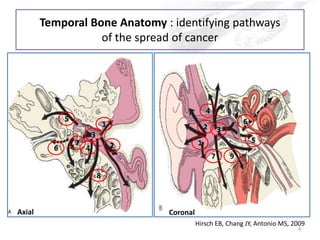
Temporal Bone Anatomy : identifying pathways
of the spread of cancer
4
Axial Coronal
1
2
5
7
3
46
32
7
8
1
6
5
4
9
Hirsch EB, Chang JY, Antonio MS, 2009
1. Anteriorly : cartilaginous ear canal  parotid gland
2. Concha  postauricular sulcus
3. Tympanic membrane  middle ear
4. Posteriorly  mastoid
5. Anterior mesotympanum  carotid artery & eustachian tube
6. Inner ear  round window or otic capsule
7. Along the facial nerve  infratemporal fossa
8. Through the mastoid, posterior fossa dura, & sigmoid sinus
9. Beneath the skull base  jugular fossa, carotid artery &
lower cranial nerves
5
Cancer can spread :
Hirsch EB, Chang JY, Antonio MS, 2009
PRIMARY MALIGNANCIES OF THE TEMPORAL BONE
6
Gustafson LM, Pensak LM, 2003
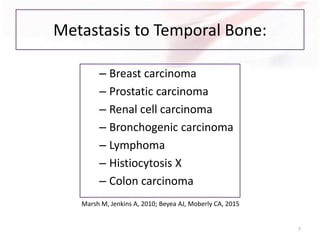
Metastasis to Temporal Bone:
– Breast carcinoma
– Prostatic carcinoma
– Renal cell carcinoma
– Bronchogenic carcinoma
– Lymphoma
– Histiocytosis X
– Colon carcinoma
7
Marsh M, Jenkins A, 2010; Beyea AJ, Moberly CA, 2015
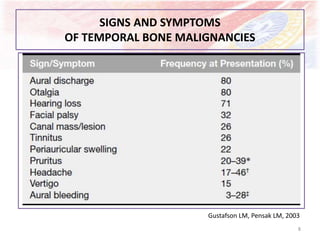
SIGNS AND SYMPTOMS
OF TEMPORAL BONE MALIGNANCIES
8
Gustafson LM, Pensak LM, 2003
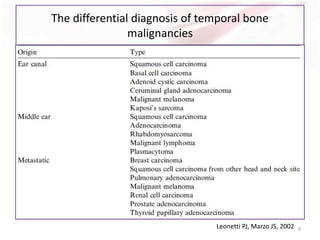
The differential diagnosis of temporal bone
malignancies
9Leonetti PJ, Marzo JS, 2002
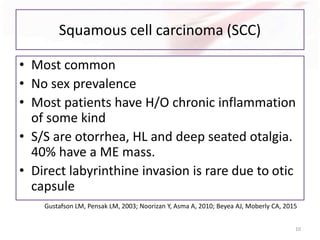
Squamous cell carcinoma (SCC)
• Most common
• No sex prevalence
• Most patients have H/O chronic inflammation
of some kind
• S/S are otorrhea, HL and deep seated otalgia.
40% have a ME mass.
• Direct labyrinthine invasion is rare due to otic
capsule
10
Gustafson LM, Pensak LM, 2003; Noorizan Y, Asma A, 2010; Beyea AJ, Moberly CA, 2015
Extensive recurrence of
a tragal SCC of the left
ear
11
Beyea AJ, Moberly CA, 2015
Squamous cell carcinoma
• Facial nerve involvement = advanced Dz
– CN VII paresis = 30-50% recurrence rate
– Paralysis = >60% recurrence
• Involvement of other CN = “dismal prognosis”
• CT and MRI are complimentary
• Consider angio with embo if surgery is feasible
12
Noorizan Y, Asma A, 2010; Beyea AJ, Moberly CA, 2015
Pittsburgh Staging System:
T classification
T1 : Tumor limited to the EAC; no bone erosion or soft tissue
extension
T2 : Tumor with limited bone erosion to the EAC or <0.5 cm of
soft tissue involvement
T3 : Tumor with full-thickness EAC bone erosion, <0.5-cm soft
tissue involvement, or tumor in the middle ear or mastoid
T4 : Tumor eroding the cochlea, petrous apex, medial wall of the
middle ear, carotid canal, jugular foramen, or dura; or >0.5-
cm soft tissue involvement; or facial nerve paresis
13
Hirsch EB, Chang JY, Antonio MS, 2009
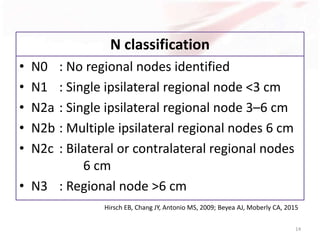
N classification
• N0 : No regional nodes identified
• N1 : Single ipsilateral regional node <3 cm
• N2a : Single ipsilateral regional node 3–6 cm
• N2b : Multiple ipsilateral regional nodes 6 cm
• N2c : Bilateral or contralateral regional nodes
6 cm
• N3 : Regional node >6 cm
14
Hirsch EB, Chang JY, Antonio MS, 2009; Beyea AJ, Moberly CA, 2015
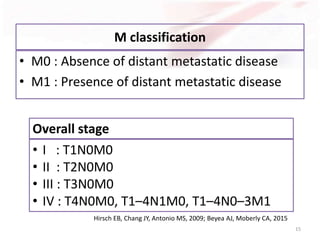
M classification
• M0 : Absence of distant metastatic disease
• M1 : Presence of distant metastatic disease
15
Overall stage
• I : T1N0M0
• II : T2N0M0
• III : T3N0M0
• IV : T4N0M0, T1–4N1M0, T1–4N0–3M1
Hirsch EB, Chang JY, Antonio MS, 2009; Beyea AJ, Moberly CA, 2015
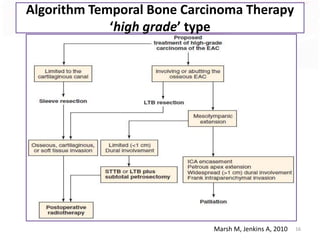
Algorithm Temporal Bone Carcinoma Therapy
‘high grade’ type
16Marsh M, Jenkins A, 2010
Surgical Technic
• T1 : LTBR or primary radiation, consider SP
• T2 : LTBR plus postoperative radiation, consider SP
• T3 : STBR or TTBR plus postoperative radiation,
consider SP
• T4 : STBR or TTBR plus postoperative radiation,
consider SP
• N+ : Add radical parotidectomy and SND to the above
• M1: Palliation
17
Therapeutic guidelines by stage
Hirsch EB, Chang JY, Antonio MS, 2009; Beyea AJ, Moberly CA, 2015
Margins of resection
18
Axial
Coronal
1.LTBR
2.STBR
3.TTBR
1.LTBR
2.STBR
3.TTBR
2.STBR
1.LTBR
3.TTBR
Hirsch EB, Chang JY, Antonio MS, 2009;
Beyea AJ, Moberly CA, 2015
Carotid Management
• T bone resection requires carotid control as
vessel passes thru medial to the Eustachian
tube before entering the cavernous sinus
• CT will show if the tumor is near the carotid
canal.
• 4 vessel angiography will show if vessel is
involved with tumor
19
Hirsch EB, Chang JY, Antonio MS, 2009; Marsh M, Jenkins A, 2010
Carotid BTO
• Balloon occlusion testing with Xenon/CT
– Investigate the collateral blood flow to ipsilateral
hemisphere
• 80% will tolerate ICA sacrifice
• 10% will not – necessitates prior bypass grafting (ECA to
MCA bypass) before T bone resection
• 10% grey zone – intraoperative or preoperative
revascularization
20
Hirsch EB, Chang JY, Antonio MS, 2009; Marsh M, Jenkins A, 2010
Lateral T Bone Resection
• En bloc removal of the entire EAC and TM
• Utilizes the extended facial recess approach
• May also include parotidectomy, ND and
mandibular condylectomy
• Involves resection of concha, may include
variable parts of the pinna and tragus PRN
21
Hirsch EB, Chang JY, Antonio MS, 2009; Marsh M, Jenkins A, 2010; Beyea AJ, Moberly CA, 2015
Lateral T Bone Resection
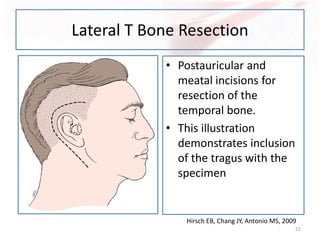
• Postauricular and
meatal incisions for
resection of the
temporal bone.
• This illustration
demonstrates inclusion
of the tragus with the
specimen
22
Hirsch EB, Chang JY, Antonio MS, 2009
Lateral T Bone Resection
23
•Closure of the EAC
•Complete mastoidectomy
•Extended facial recess
(sacrifice the chorda)
•Disarticulate the IS joint
•Fracture the anterior EAC
just lateral to the
Eustachian tube with
osteotome
•Watch out for ICA!
Hypotympanic
dissection
Specimen fractured
with osteotome
Specimen separated
from soft tissue
Marsh M, Jenkins A, 2010
• The anteriorly based
skin flap containing the
pinna is separated from
the core of the external
auditory meatus. The
meatus has been
oversewn to prevent
tumor spillage.
24
Hirsch EB, Chang JY, Antonio MS, 2009
Subtotal T Bone Resection
• Used with CA has penetrated into the ME space or
mastoid cavities
• Requires resection of the otic capsule
• Can be extended toward the ITF, jugular bulb or dura
as prescribed by tumor extent
• Should include monitoring of CN 7, 9, 10, 11
• If possible spare CN 7 by complete mobilization from
geniculate to foramen and transpose the nerve
posteriorly.
25
Hirsch EB, Chang JY, Antonio MS, 2009; Marsh M, Jenkins A, 2010; Beyea AJ, Moberly CA, 2015
Subtotal T Bone Resection
• The tegmen and posterior fossa plates are thinned
and then removed.
• A translab drill out of the IAC and jug bulb then done
– Allows further mobilization of the FN from the porus if
needed.
– The transected end of CN VIII should be sent for frozen
section
• Entire tympanic ring drilled out but leaving
periostium over ICA and lower CNs.
26
Hirsch EB, Chang JY, Antonio MS, 2009; Marsh M, Jenkins A, 2010; Beyea AJ, Moberly CA, 2015
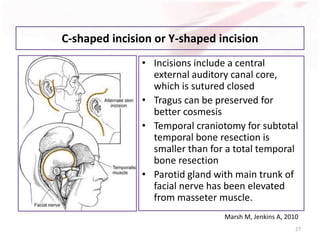
C-shaped incision or Y-shaped incision
• Incisions include a central
external auditory canal core,
which is sutured closed
• Tragus can be preserved for
better cosmesis
• Temporal craniotomy for subtotal
temporal bone resection is
smaller than for a total temporal
bone resection
• Parotid gland with main trunk of
facial nerve has been elevated
from masseter muscle.
27
Marsh M, Jenkins A, 2010
Subtotal T Bone Resection
• Neck dissection
preformed for vascular
control of IJ and ICA
• Involvement of jugular
foramen necessitates IJ
sacrifice and ligation of
the sigmoid
– Avoid injury to vein of
Labbe – drainage of the
temporal lobe and can
result in venous
infarction of temporal
lobeBad!!
28
Marsh M, Jenkins A, 2010
Subtotal T Bone Resection
• Dural extension can be
resected with help of
neurosurgeon to close
the dural defect.
• Extension into the ITF
accomplished by
including a Fisch A ITF
approach
29
Marsh M, Jenkins A, 2010
Total Temporal Bone Resection
30
Marsh M, Jenkins A, 2010
Total T Bone Resection
• Used if tumor involves the petrous apex
• Mandates proximal and DISTAL control of the
ICA
– Distal control accomplished with middle cranial
fossa approach
• Requires division of CN 7, 8, 9, 10 and 11
– Done through a suboccipital crani
31
Hirsch EB, Chang JY, Antonio MS, 2009; Marsh M, Jenkins A, 2010; Beyea AJ, Moberly CA, 2015
• The ICA is completely mobilized or resected if
involved with tumor
• Osteotomy completed posterior to the foramen
ovale
32
Marsh M, Jenkins A, 2010
The temporal and
retrosigmoid portions of the
dura have been opened.
• N. VII through XI have been
transected
• The underlying dura incised as
the posterior border of the en
bloc resection of the petrous
bone
33
Marsh M, Jenkins A, 2010
Postoperative
34
Left Ear, Reconstruction has been performed with a
pectoralis major flap (PM)
Beyea AJ, Moberly CA, 2015
Complication
• Vascular
• Cerebrospinal fluid leak
• Infection
• Intracranial hemmorrhage and hypertension
• Wound
35
Hirsch EB, Chang JY, Antonio MS, 2009
Outcomes
• Tumors limited to the EAC have 50-80% cure rate
after LTBR
• Tumor extending beyond the ME 0-15% survival
>2yrs
• Survival increases with dual modality therapy
• University of Pittsburg staging system
– Increasing T stage is inversely proportional to survival
– T1 and T2 have reported 100% 2 yr survival
– T3 lesions have 2 yr of 56%
– 2 yr survival of T4 tumors at 17%
36
Hirsch EB, Chang JY, Antonio MS, 2009
37

Temporal Bone Carcinoma

  • 1.
    Surgery of theTemporal Bone Carcinoma 1 M. Arif Sudianto Utama
  • 2.
    Introduction • Temporal bonecarcinoma is a rare disease • Very aggressive course • If diagnosis is delayedBad prognosis • Rapid progression and limited therapeutic success • Squamous cell carcinoma (SCC) : Most common primary (80%) • 0.2% of all head and neck tumours 2 Ishak LN, Goh SB, Saim L, 2014; Beyea AJ, Moberly CA, 2015
  • 3.
    Lecture Goals 3 Temporal boneanatomy Malignant tumors SCC and other primary tumors Metastatic tumors Surgical technic
  • 4.
    Temporal Bone Anatomy: identifying pathways of the spread of cancer 4 Axial Coronal 1 2 5 7 3 46 32 7 8 1 6 5 4 9 Hirsch EB, Chang JY, Antonio MS, 2009
  • 5.
    1. Anteriorly :cartilaginous ear canal  parotid gland 2. Concha  postauricular sulcus 3. Tympanic membrane  middle ear 4. Posteriorly  mastoid 5. Anterior mesotympanum  carotid artery & eustachian tube 6. Inner ear  round window or otic capsule 7. Along the facial nerve  infratemporal fossa 8. Through the mastoid, posterior fossa dura, & sigmoid sinus 9. Beneath the skull base  jugular fossa, carotid artery & lower cranial nerves 5 Cancer can spread : Hirsch EB, Chang JY, Antonio MS, 2009
  • 6.
    PRIMARY MALIGNANCIES OFTHE TEMPORAL BONE 6 Gustafson LM, Pensak LM, 2003
  • 7.
    Metastasis to TemporalBone: – Breast carcinoma – Prostatic carcinoma – Renal cell carcinoma – Bronchogenic carcinoma – Lymphoma – Histiocytosis X – Colon carcinoma 7 Marsh M, Jenkins A, 2010; Beyea AJ, Moberly CA, 2015
  • 8.
    SIGNS AND SYMPTOMS OFTEMPORAL BONE MALIGNANCIES 8 Gustafson LM, Pensak LM, 2003
  • 9.
    The differential diagnosisof temporal bone malignancies 9Leonetti PJ, Marzo JS, 2002
  • 10.
    Squamous cell carcinoma(SCC) • Most common • No sex prevalence • Most patients have H/O chronic inflammation of some kind • S/S are otorrhea, HL and deep seated otalgia. 40% have a ME mass. • Direct labyrinthine invasion is rare due to otic capsule 10 Gustafson LM, Pensak LM, 2003; Noorizan Y, Asma A, 2010; Beyea AJ, Moberly CA, 2015
  • 11.
    Extensive recurrence of atragal SCC of the left ear 11 Beyea AJ, Moberly CA, 2015
  • 12.
    Squamous cell carcinoma •Facial nerve involvement = advanced Dz – CN VII paresis = 30-50% recurrence rate – Paralysis = >60% recurrence • Involvement of other CN = “dismal prognosis” • CT and MRI are complimentary • Consider angio with embo if surgery is feasible 12 Noorizan Y, Asma A, 2010; Beyea AJ, Moberly CA, 2015
  • 13.
    Pittsburgh Staging System: Tclassification T1 : Tumor limited to the EAC; no bone erosion or soft tissue extension T2 : Tumor with limited bone erosion to the EAC or <0.5 cm of soft tissue involvement T3 : Tumor with full-thickness EAC bone erosion, <0.5-cm soft tissue involvement, or tumor in the middle ear or mastoid T4 : Tumor eroding the cochlea, petrous apex, medial wall of the middle ear, carotid canal, jugular foramen, or dura; or >0.5- cm soft tissue involvement; or facial nerve paresis 13 Hirsch EB, Chang JY, Antonio MS, 2009
  • 14.
    N classification • N0: No regional nodes identified • N1 : Single ipsilateral regional node <3 cm • N2a : Single ipsilateral regional node 3–6 cm • N2b : Multiple ipsilateral regional nodes 6 cm • N2c : Bilateral or contralateral regional nodes 6 cm • N3 : Regional node >6 cm 14 Hirsch EB, Chang JY, Antonio MS, 2009; Beyea AJ, Moberly CA, 2015
  • 15.
    M classification • M0: Absence of distant metastatic disease • M1 : Presence of distant metastatic disease 15 Overall stage • I : T1N0M0 • II : T2N0M0 • III : T3N0M0 • IV : T4N0M0, T1–4N1M0, T1–4N0–3M1 Hirsch EB, Chang JY, Antonio MS, 2009; Beyea AJ, Moberly CA, 2015
  • 16.
    Algorithm Temporal BoneCarcinoma Therapy ‘high grade’ type 16Marsh M, Jenkins A, 2010
  • 17.
    Surgical Technic • T1: LTBR or primary radiation, consider SP • T2 : LTBR plus postoperative radiation, consider SP • T3 : STBR or TTBR plus postoperative radiation, consider SP • T4 : STBR or TTBR plus postoperative radiation, consider SP • N+ : Add radical parotidectomy and SND to the above • M1: Palliation 17 Therapeutic guidelines by stage Hirsch EB, Chang JY, Antonio MS, 2009; Beyea AJ, Moberly CA, 2015
  • 18.
  • 19.
    Carotid Management • Tbone resection requires carotid control as vessel passes thru medial to the Eustachian tube before entering the cavernous sinus • CT will show if the tumor is near the carotid canal. • 4 vessel angiography will show if vessel is involved with tumor 19 Hirsch EB, Chang JY, Antonio MS, 2009; Marsh M, Jenkins A, 2010
  • 20.
    Carotid BTO • Balloonocclusion testing with Xenon/CT – Investigate the collateral blood flow to ipsilateral hemisphere • 80% will tolerate ICA sacrifice • 10% will not – necessitates prior bypass grafting (ECA to MCA bypass) before T bone resection • 10% grey zone – intraoperative or preoperative revascularization 20 Hirsch EB, Chang JY, Antonio MS, 2009; Marsh M, Jenkins A, 2010
  • 21.
    Lateral T BoneResection • En bloc removal of the entire EAC and TM • Utilizes the extended facial recess approach • May also include parotidectomy, ND and mandibular condylectomy • Involves resection of concha, may include variable parts of the pinna and tragus PRN 21 Hirsch EB, Chang JY, Antonio MS, 2009; Marsh M, Jenkins A, 2010; Beyea AJ, Moberly CA, 2015
  • 22.
    Lateral T BoneResection • Postauricular and meatal incisions for resection of the temporal bone. • This illustration demonstrates inclusion of the tragus with the specimen 22 Hirsch EB, Chang JY, Antonio MS, 2009
  • 23.
    Lateral T BoneResection 23 •Closure of the EAC •Complete mastoidectomy •Extended facial recess (sacrifice the chorda) •Disarticulate the IS joint •Fracture the anterior EAC just lateral to the Eustachian tube with osteotome •Watch out for ICA! Hypotympanic dissection Specimen fractured with osteotome Specimen separated from soft tissue Marsh M, Jenkins A, 2010
  • 24.
    • The anteriorlybased skin flap containing the pinna is separated from the core of the external auditory meatus. The meatus has been oversewn to prevent tumor spillage. 24 Hirsch EB, Chang JY, Antonio MS, 2009
  • 25.
    Subtotal T BoneResection • Used with CA has penetrated into the ME space or mastoid cavities • Requires resection of the otic capsule • Can be extended toward the ITF, jugular bulb or dura as prescribed by tumor extent • Should include monitoring of CN 7, 9, 10, 11 • If possible spare CN 7 by complete mobilization from geniculate to foramen and transpose the nerve posteriorly. 25 Hirsch EB, Chang JY, Antonio MS, 2009; Marsh M, Jenkins A, 2010; Beyea AJ, Moberly CA, 2015
  • 26.
    Subtotal T BoneResection • The tegmen and posterior fossa plates are thinned and then removed. • A translab drill out of the IAC and jug bulb then done – Allows further mobilization of the FN from the porus if needed. – The transected end of CN VIII should be sent for frozen section • Entire tympanic ring drilled out but leaving periostium over ICA and lower CNs. 26 Hirsch EB, Chang JY, Antonio MS, 2009; Marsh M, Jenkins A, 2010; Beyea AJ, Moberly CA, 2015
  • 27.
    C-shaped incision orY-shaped incision • Incisions include a central external auditory canal core, which is sutured closed • Tragus can be preserved for better cosmesis • Temporal craniotomy for subtotal temporal bone resection is smaller than for a total temporal bone resection • Parotid gland with main trunk of facial nerve has been elevated from masseter muscle. 27 Marsh M, Jenkins A, 2010
  • 28.
    Subtotal T BoneResection • Neck dissection preformed for vascular control of IJ and ICA • Involvement of jugular foramen necessitates IJ sacrifice and ligation of the sigmoid – Avoid injury to vein of Labbe – drainage of the temporal lobe and can result in venous infarction of temporal lobeBad!! 28 Marsh M, Jenkins A, 2010
  • 29.
    Subtotal T BoneResection • Dural extension can be resected with help of neurosurgeon to close the dural defect. • Extension into the ITF accomplished by including a Fisch A ITF approach 29 Marsh M, Jenkins A, 2010
  • 30.
    Total Temporal BoneResection 30 Marsh M, Jenkins A, 2010
  • 31.
    Total T BoneResection • Used if tumor involves the petrous apex • Mandates proximal and DISTAL control of the ICA – Distal control accomplished with middle cranial fossa approach • Requires division of CN 7, 8, 9, 10 and 11 – Done through a suboccipital crani 31 Hirsch EB, Chang JY, Antonio MS, 2009; Marsh M, Jenkins A, 2010; Beyea AJ, Moberly CA, 2015
  • 32.
    • The ICAis completely mobilized or resected if involved with tumor • Osteotomy completed posterior to the foramen ovale 32 Marsh M, Jenkins A, 2010
  • 33.
    The temporal and retrosigmoidportions of the dura have been opened. • N. VII through XI have been transected • The underlying dura incised as the posterior border of the en bloc resection of the petrous bone 33 Marsh M, Jenkins A, 2010
  • 34.
    Postoperative 34 Left Ear, Reconstructionhas been performed with a pectoralis major flap (PM) Beyea AJ, Moberly CA, 2015
  • 35.
    Complication • Vascular • Cerebrospinalfluid leak • Infection • Intracranial hemmorrhage and hypertension • Wound 35 Hirsch EB, Chang JY, Antonio MS, 2009
  • 36.
    Outcomes • Tumors limitedto the EAC have 50-80% cure rate after LTBR • Tumor extending beyond the ME 0-15% survival >2yrs • Survival increases with dual modality therapy • University of Pittsburg staging system – Increasing T stage is inversely proportional to survival – T1 and T2 have reported 100% 2 yr survival – T3 lesions have 2 yr of 56% – 2 yr survival of T4 tumors at 17% 36 Hirsch EB, Chang JY, Antonio MS, 2009
  • 37.