ANGLES: NAMING, TYPES,
AND HOW TO MEASURE
THEM
WHAT IS AN ANGLE?
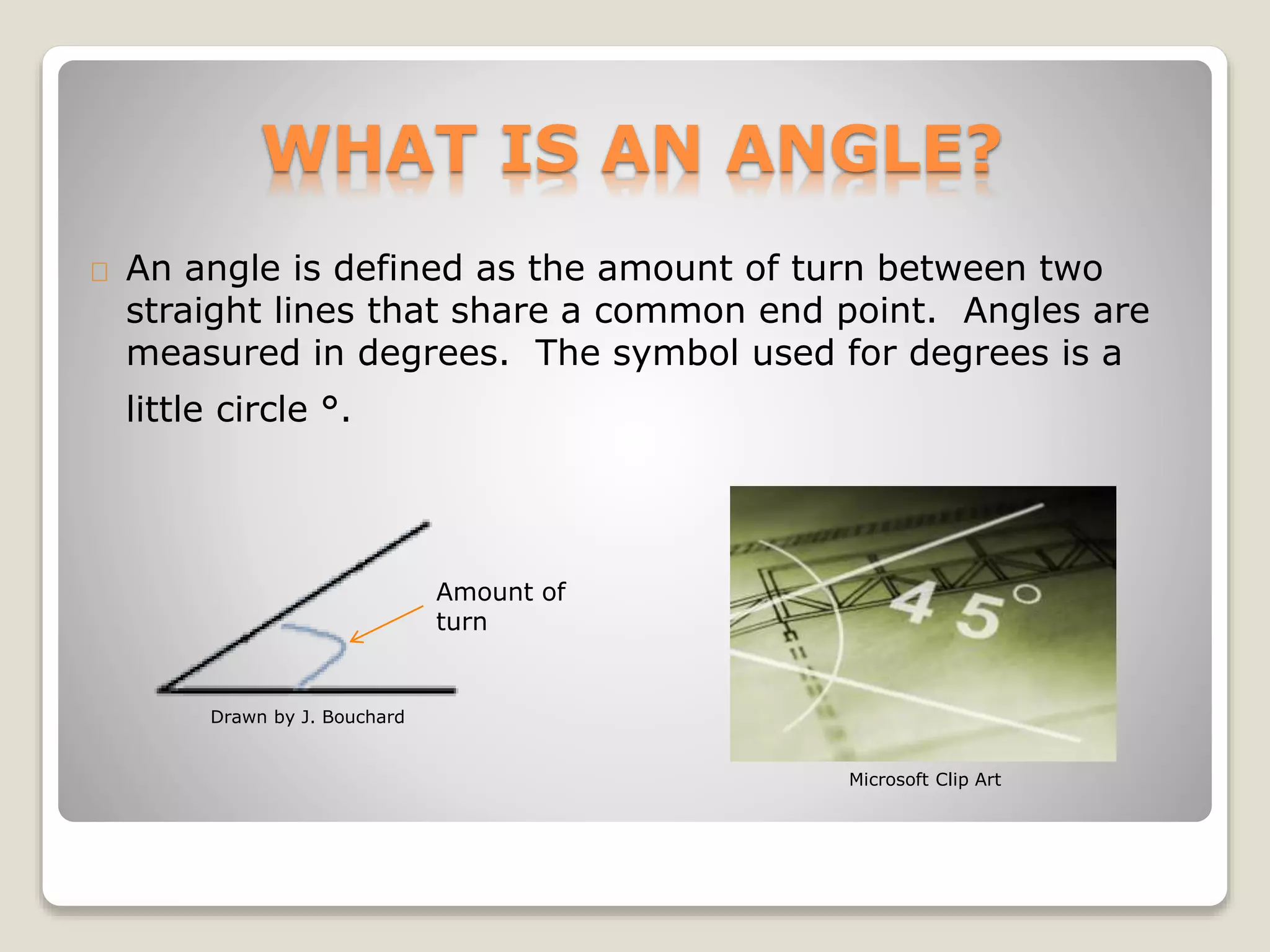
An angle is defined as the amount of turn between two
straight lines that share a common end point. Angles are
measured in degrees. The symbol used for degrees is a
little circle °.
Amount of
turn
Microsoft Clip Art
Drawn by J. Bouchard
TERMS ASSOCIATED WITH
ANGLES
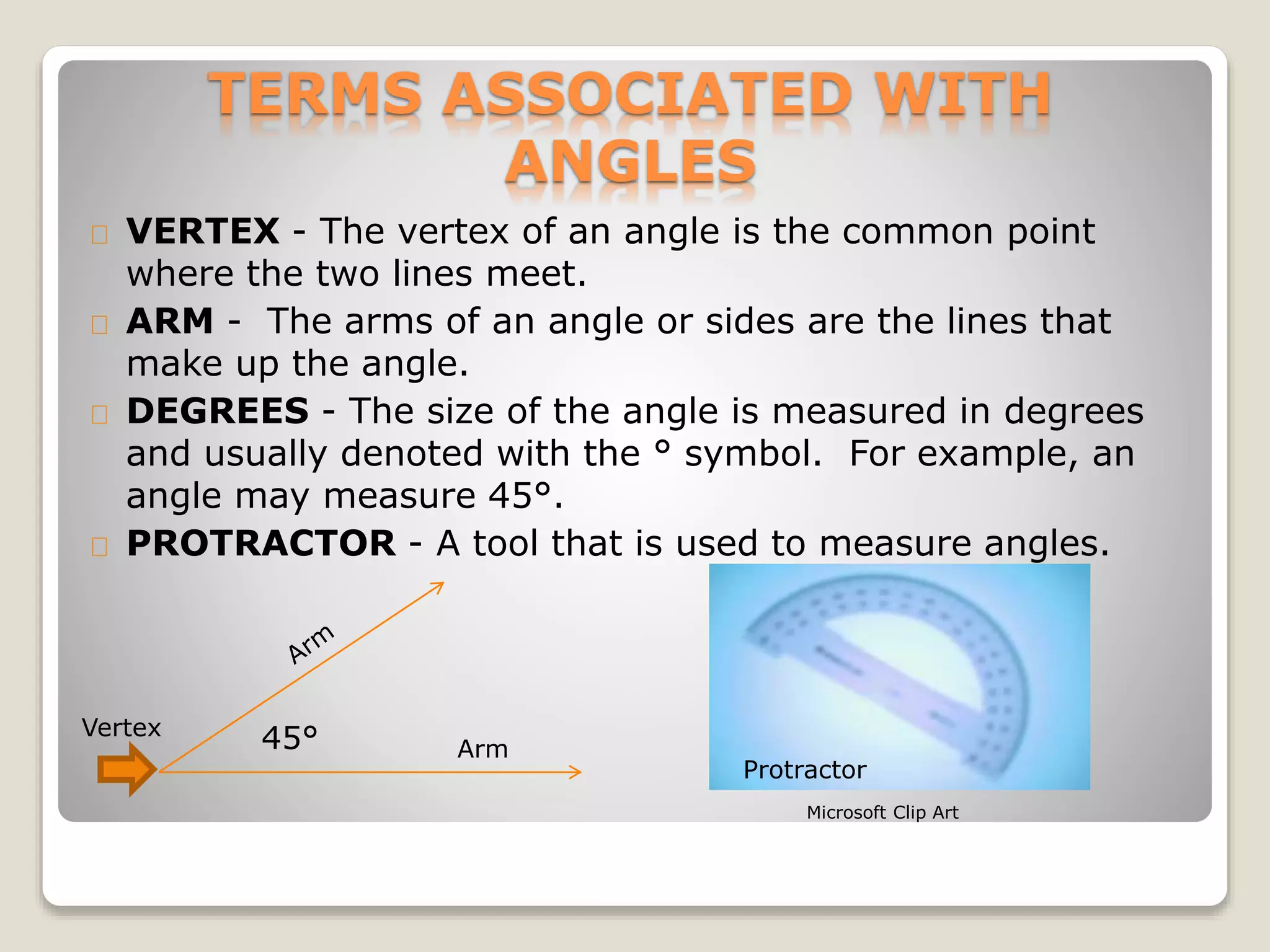
VERTEX - The vertex of an angle is the common point
where the two lines meet.
ARM - The arms of an angle or sides are the lines that
make up the angle.
DEGREES - The size of the angle is measured in degrees
and usually denoted with the ° symbol. For example, an
angle may measure 45°.
PROTRACTOR - A tool that is used to measure angles.
Arm
Vertex
45°
Protractor
Microsoft Clip Art
NAMING ANGLES
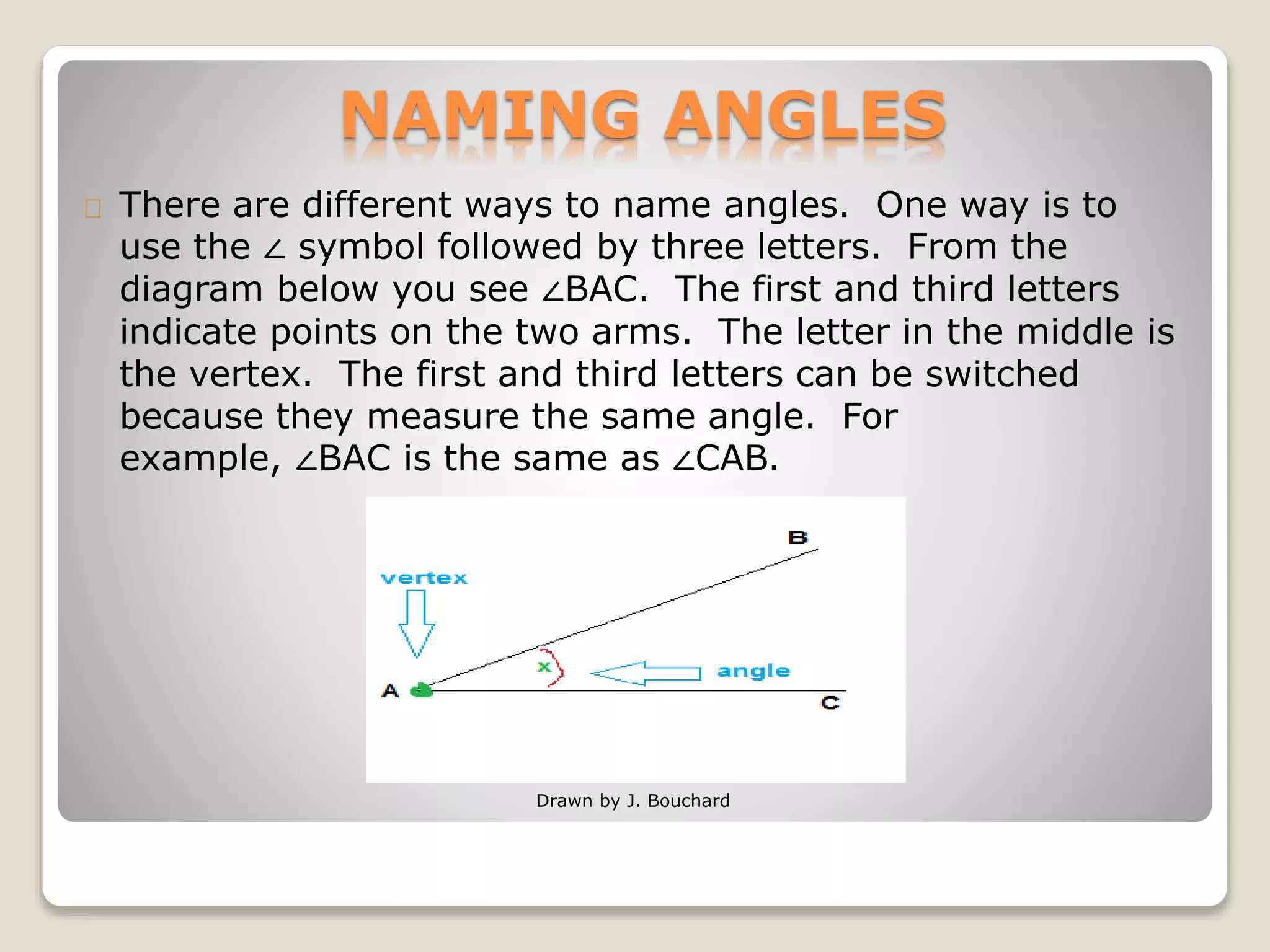
There are different ways to name angles. One way is to
use the ∠ symbol followed by three letters. From the
diagram below you see ∠BAC. The first and third letters
indicate points on the two arms. The letter in the middle is
the vertex. The first and third letters can be switched
because they measure the same angle. For
example, ∠BAC is the same as ∠CAB.
Drawn by J. Bouchard
NAMING ANGLES (continued)
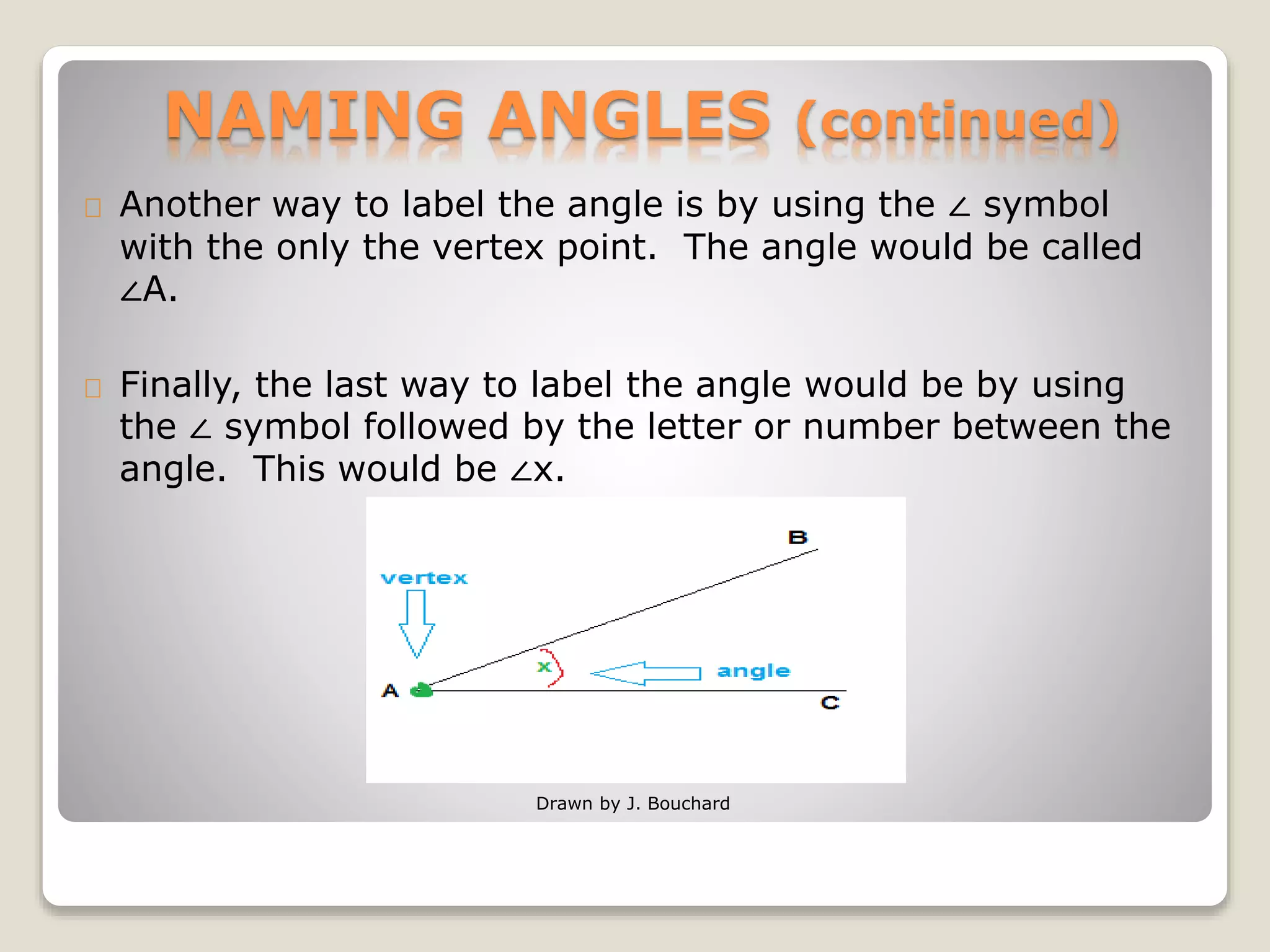
Another way to label the angle is by using the ∠ symbol
with the only the vertex point. The angle would be called
∠A.
Finally, the last way to label the angle would be by using
the ∠ symbol followed by the letter or number between the
angle. This would be ∠x.
Drawn by J. Bouchard
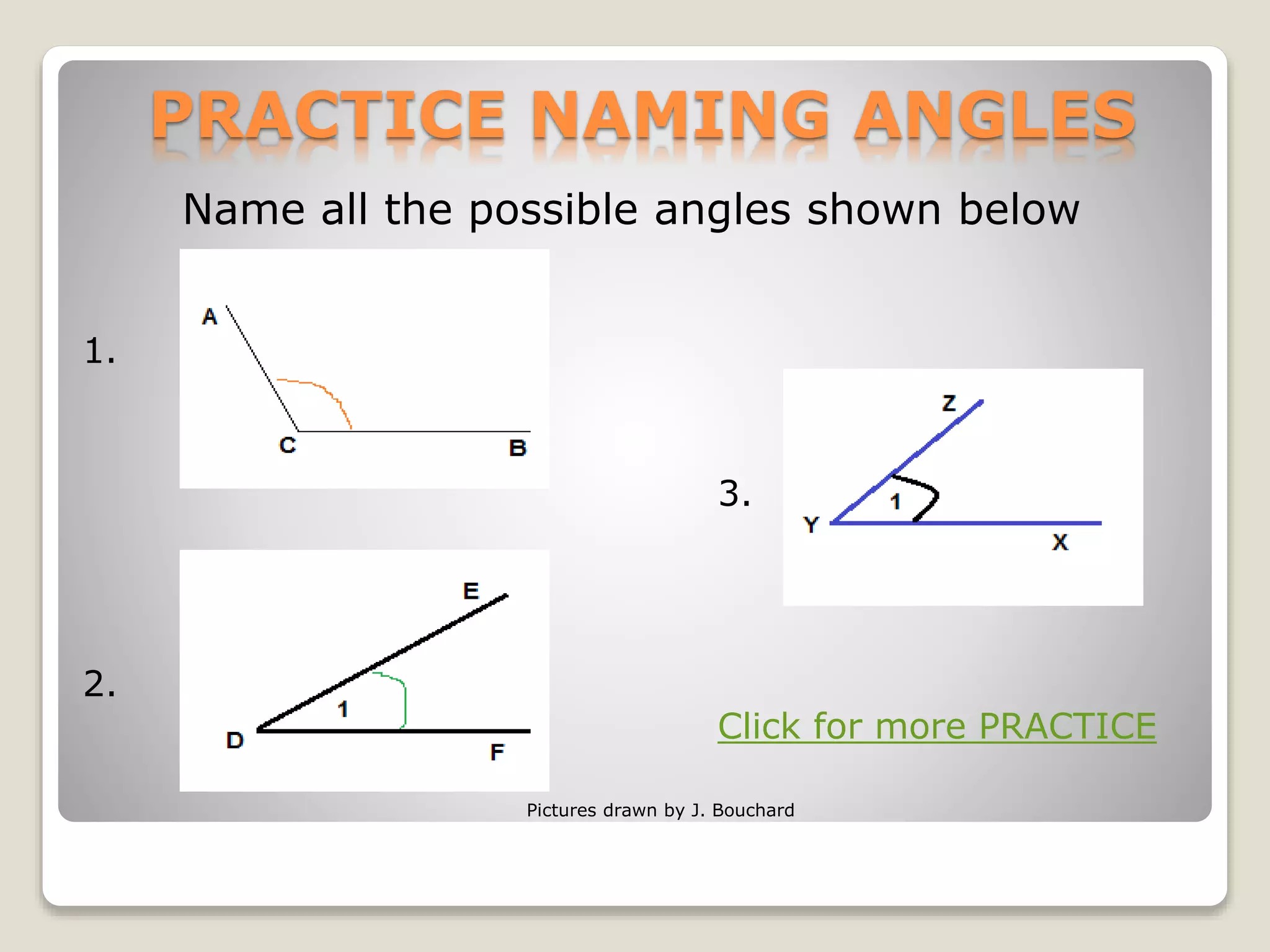
PRACTICE NAMING ANGLES
Name all the possible angles shown below
1.
3.
2.
Click for more PRACTICE
Pictures drawn by J. Bouchard
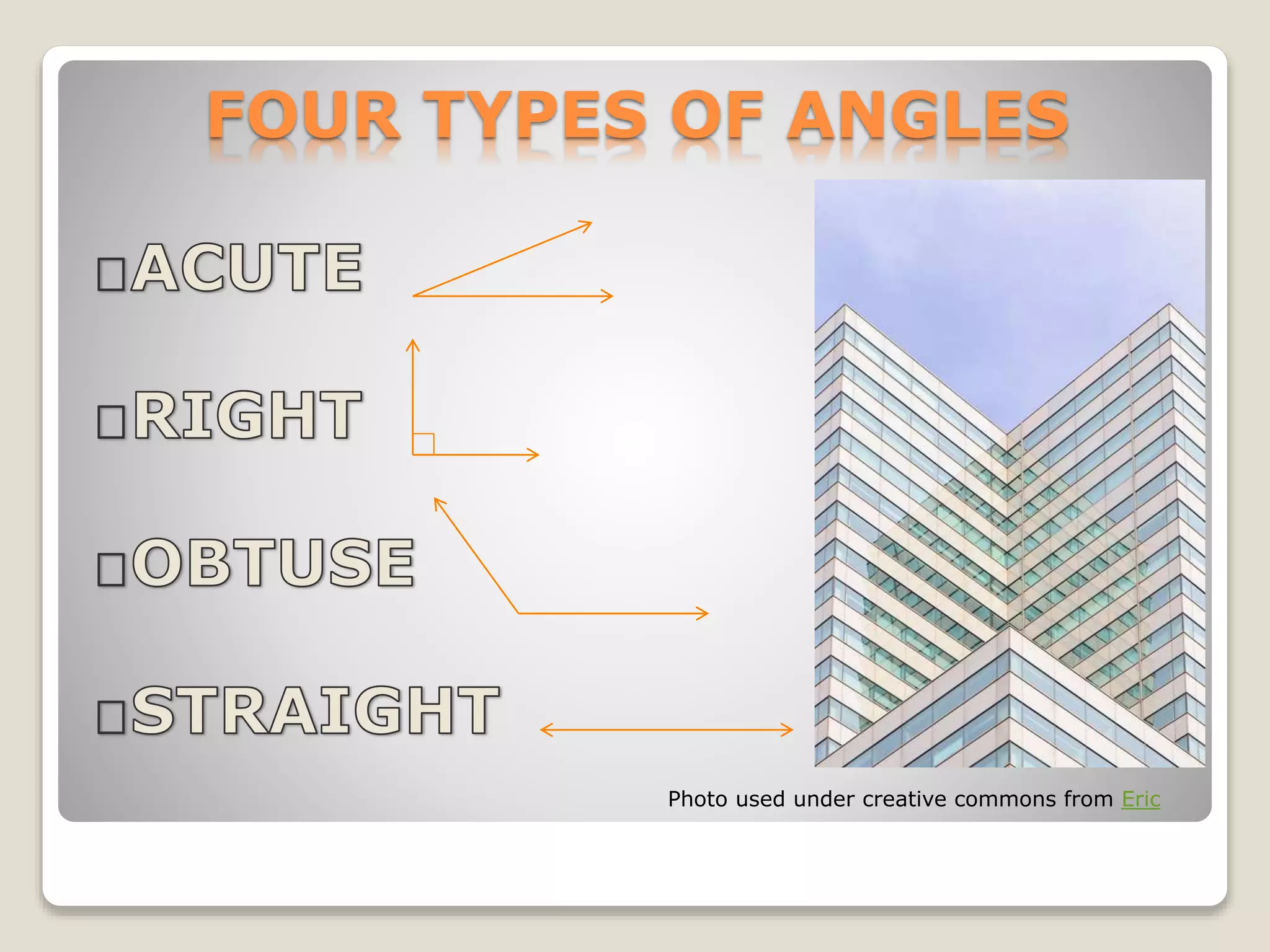
FOUR TYPES OF ANGLES
Photo used under creative commons from Eric
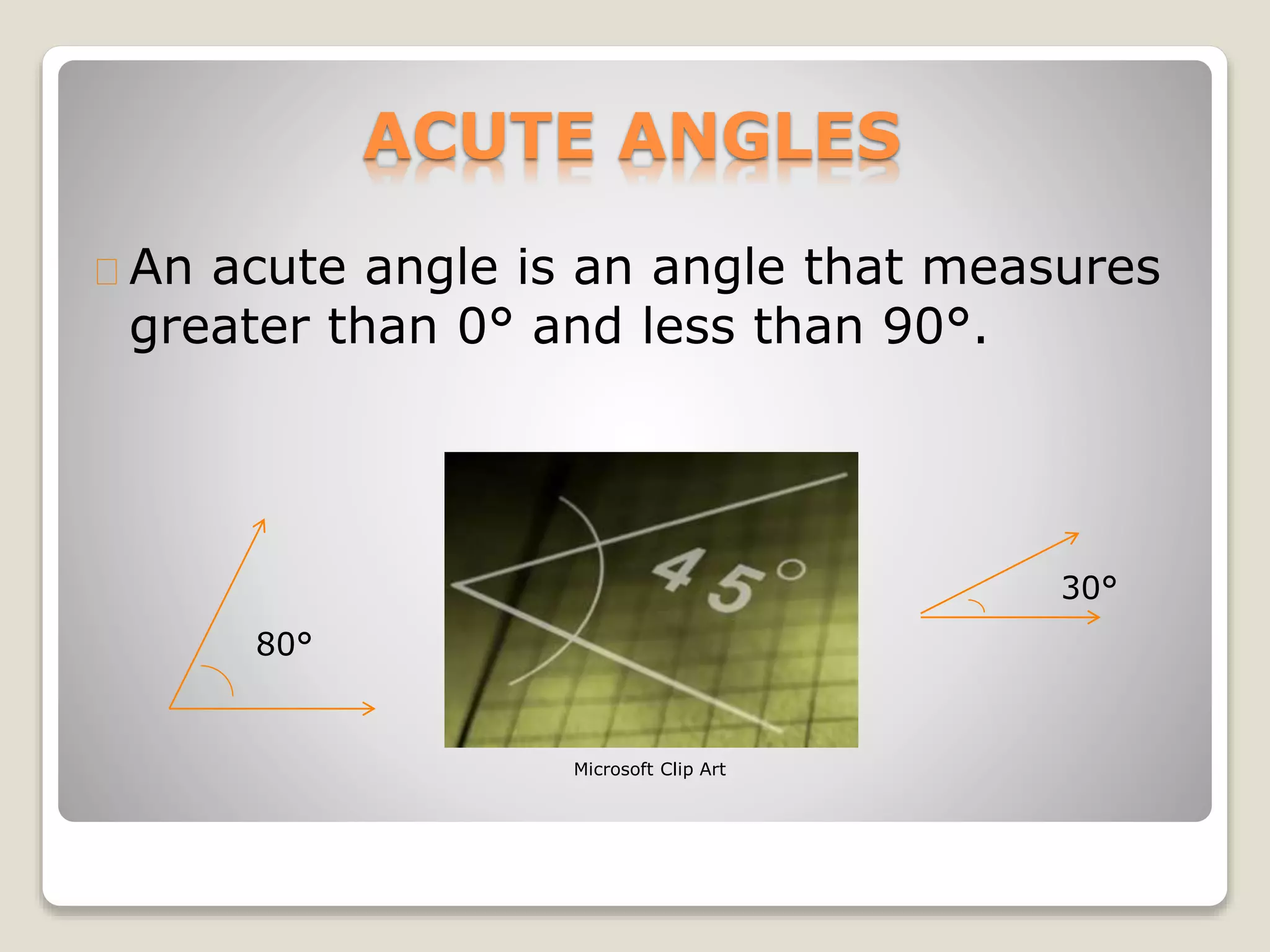
ACUTE ANGLES
An acute angle is an angle that measures
greater than 0° and less than 90°.
80°
30°
Microsoft Clip Art
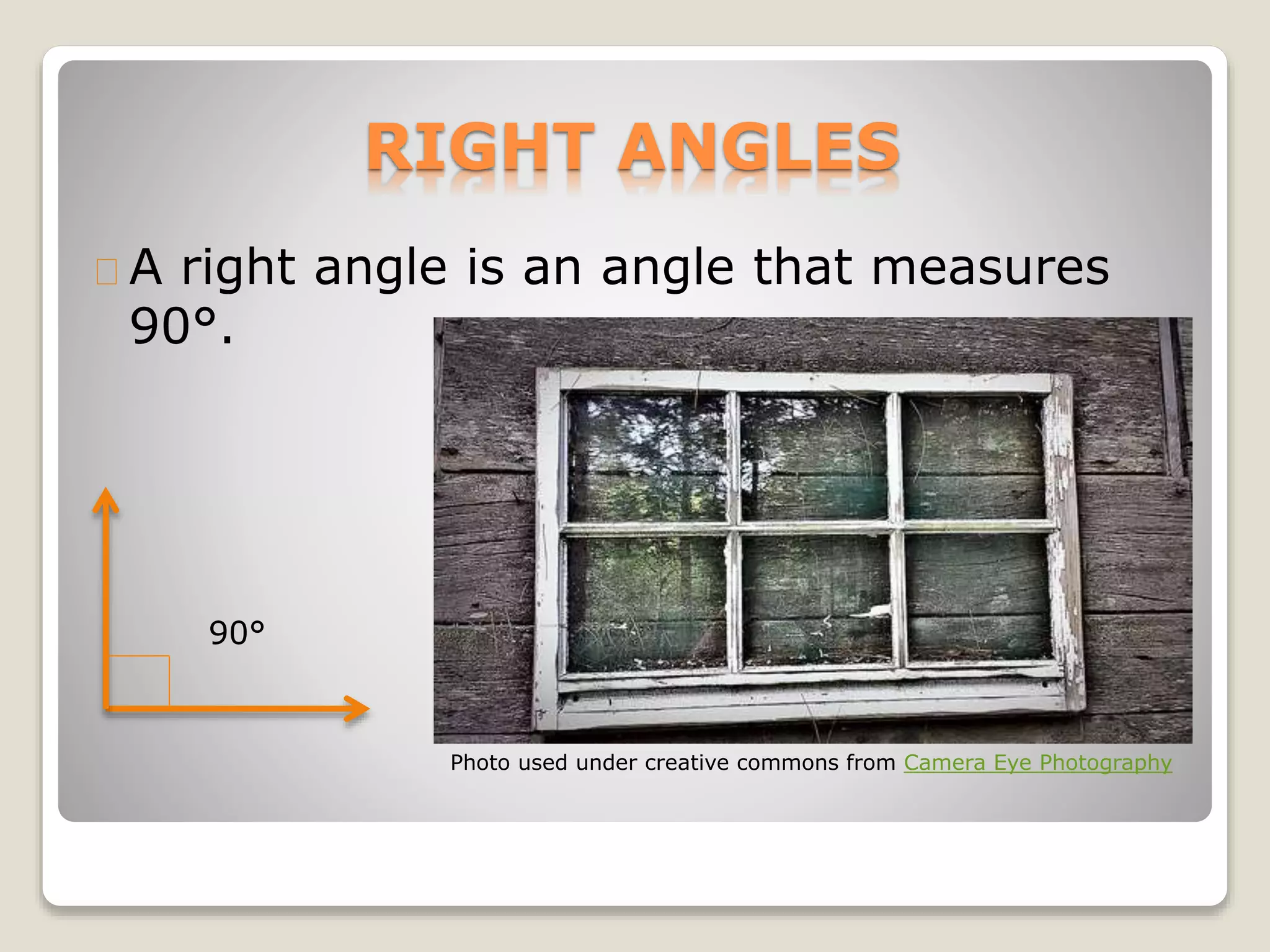
RIGHT ANGLES
A right angle is an angle that measures
90°.
Photo used under creative commons from Camera Eye Photography
90°
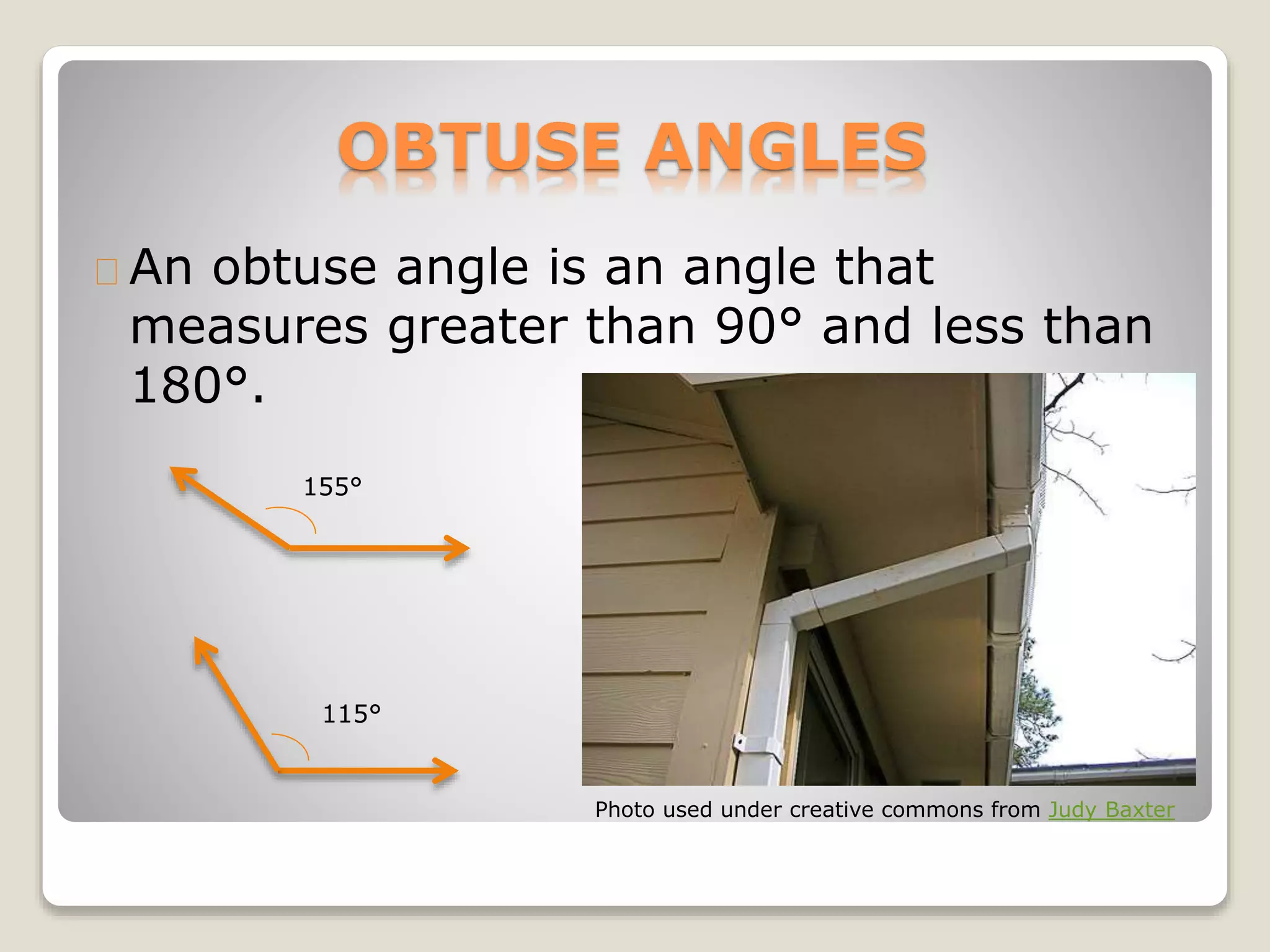
OBTUSE ANGLES
An obtuse angle is an angle that
measures greater than 90° and less than
180°.
Photo used under creative commons from Judy Baxter
115°
155°
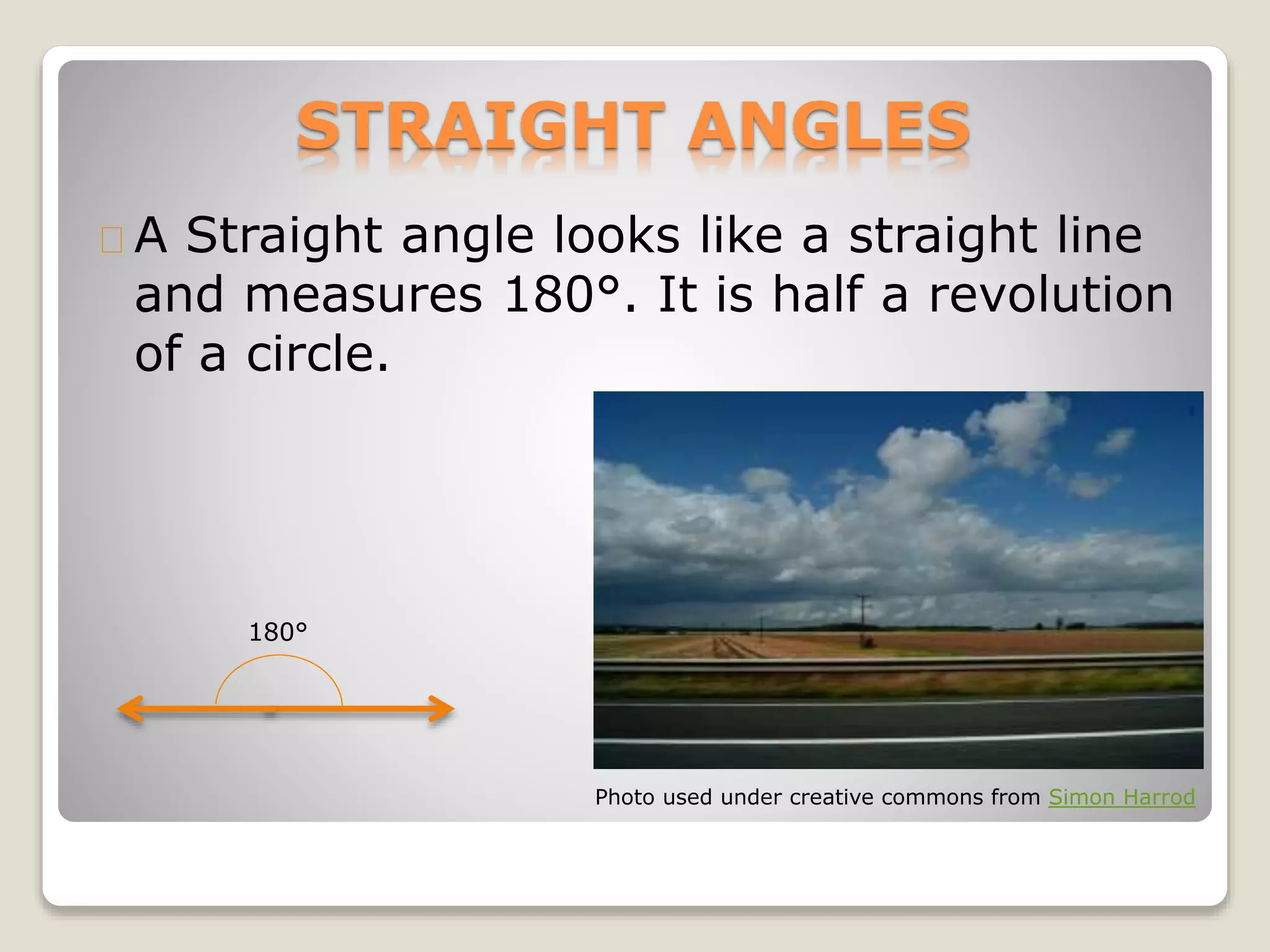
STRAIGHT ANGLES
A Straight angle looks like a straight line
and measures 180°. It is half a revolution
of a circle.
Photo used under creative commons from Simon Harrod
180°
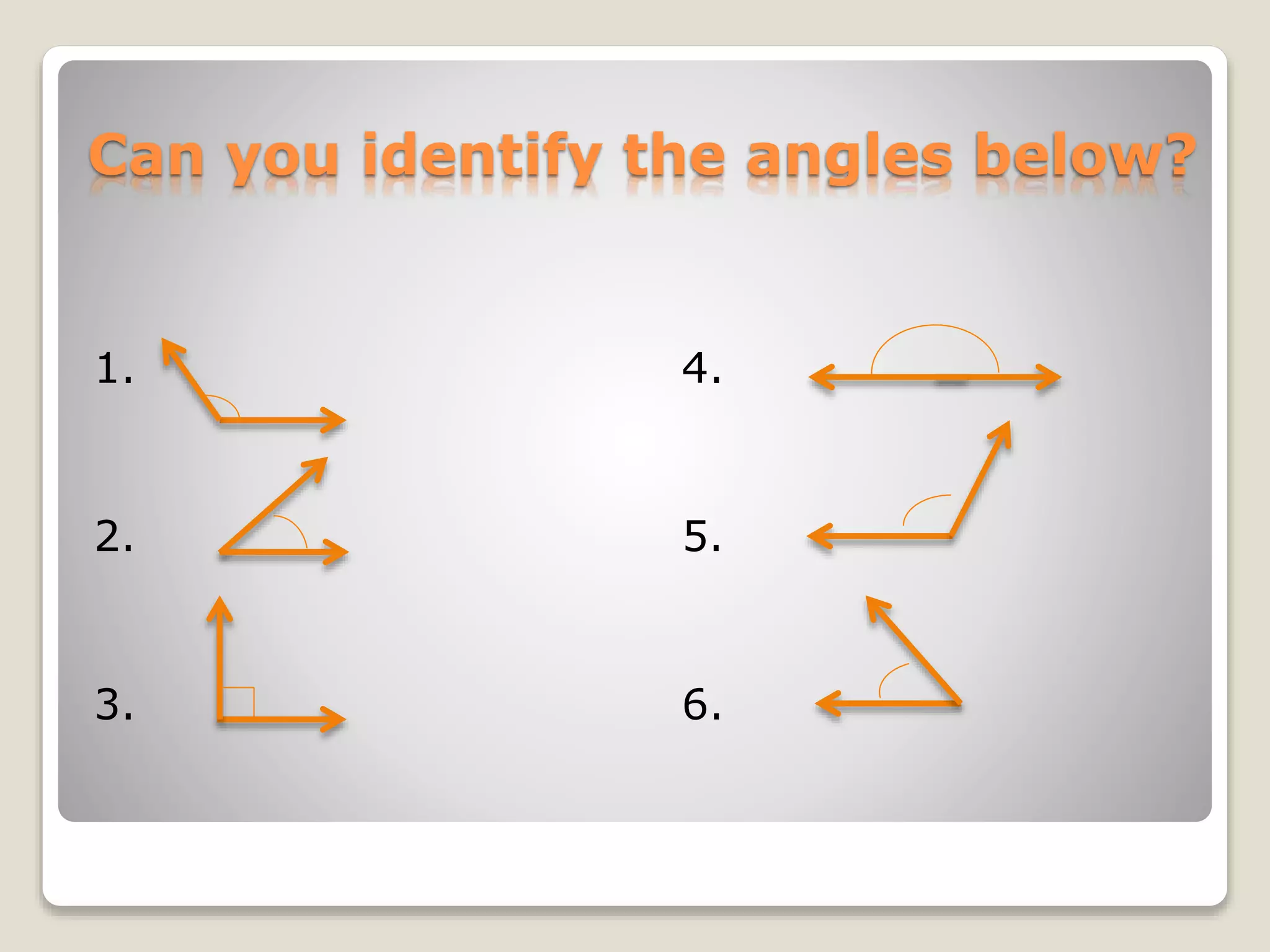
Can you identify the angles below?
1.
2.
3.
4.
5.
6.
Identify the type of angle from the
measure shown below
1. 180° 4. 117°
2. 33° 5. 153°
3. 90° 6. 27°
Click here to practice Photo used under creative commons from Kevin Dooley
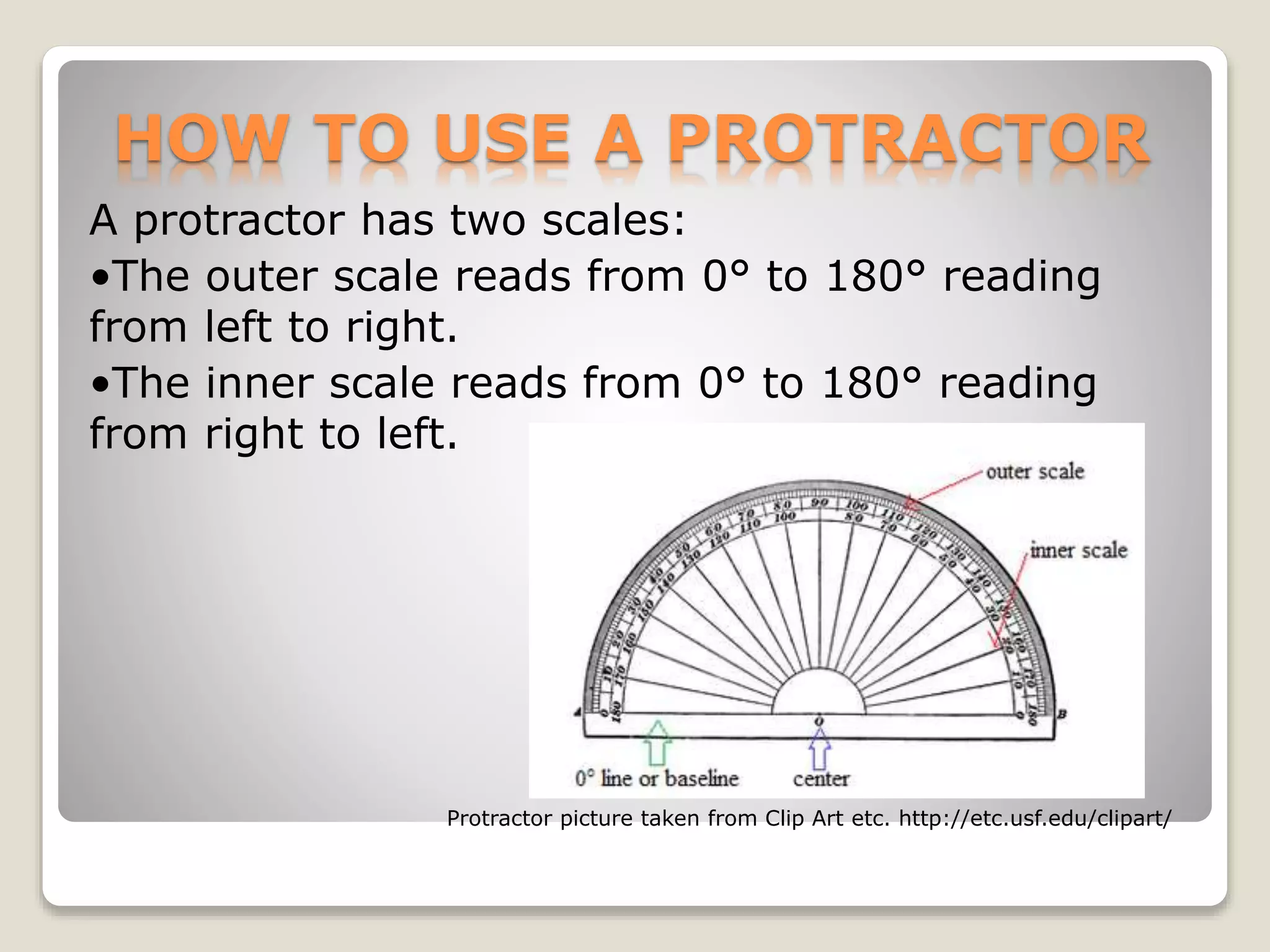
HOW TO USE A PROTRACTOR
A protractor has two scales:
•The outer scale reads from 0° to 180° reading
from left to right.
•The inner scale reads from 0° to 180° reading
from right to left.
Protractor picture taken from Clip Art etc. http://etc.usf.edu/clipart/
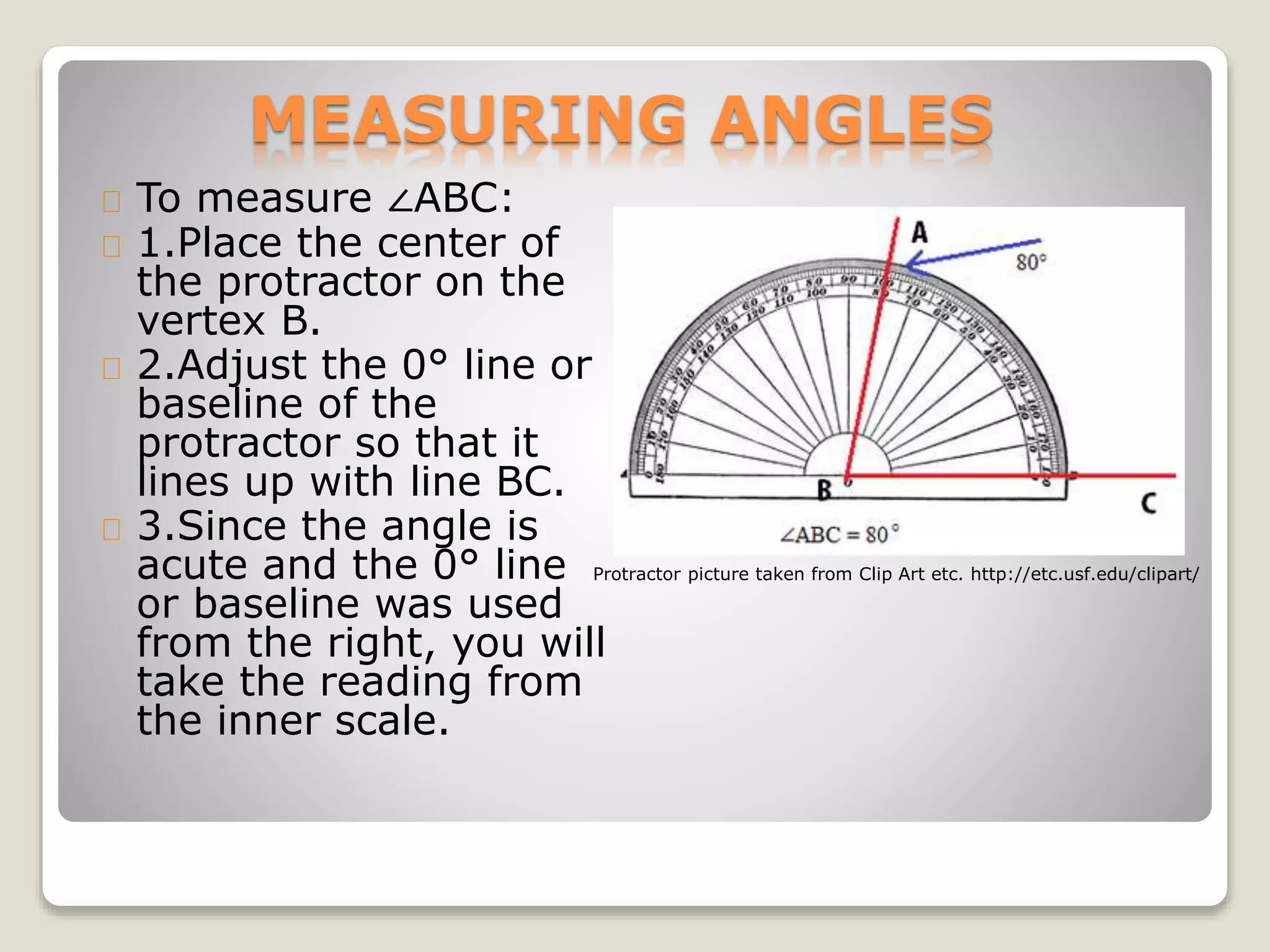
MEASURING ANGLES
To measure ∠ABC:
1.Place the center of
the protractor on the
vertex B.
2.Adjust the 0° line or
baseline of the
protractor so that it
lines up with line BC.
3.Since the angle is
acute and the 0° line
or baseline was used
from the right, you will
take the reading from
the inner scale.
Protractor picture taken from Clip Art etc. http://etc.usf.edu/clipart/
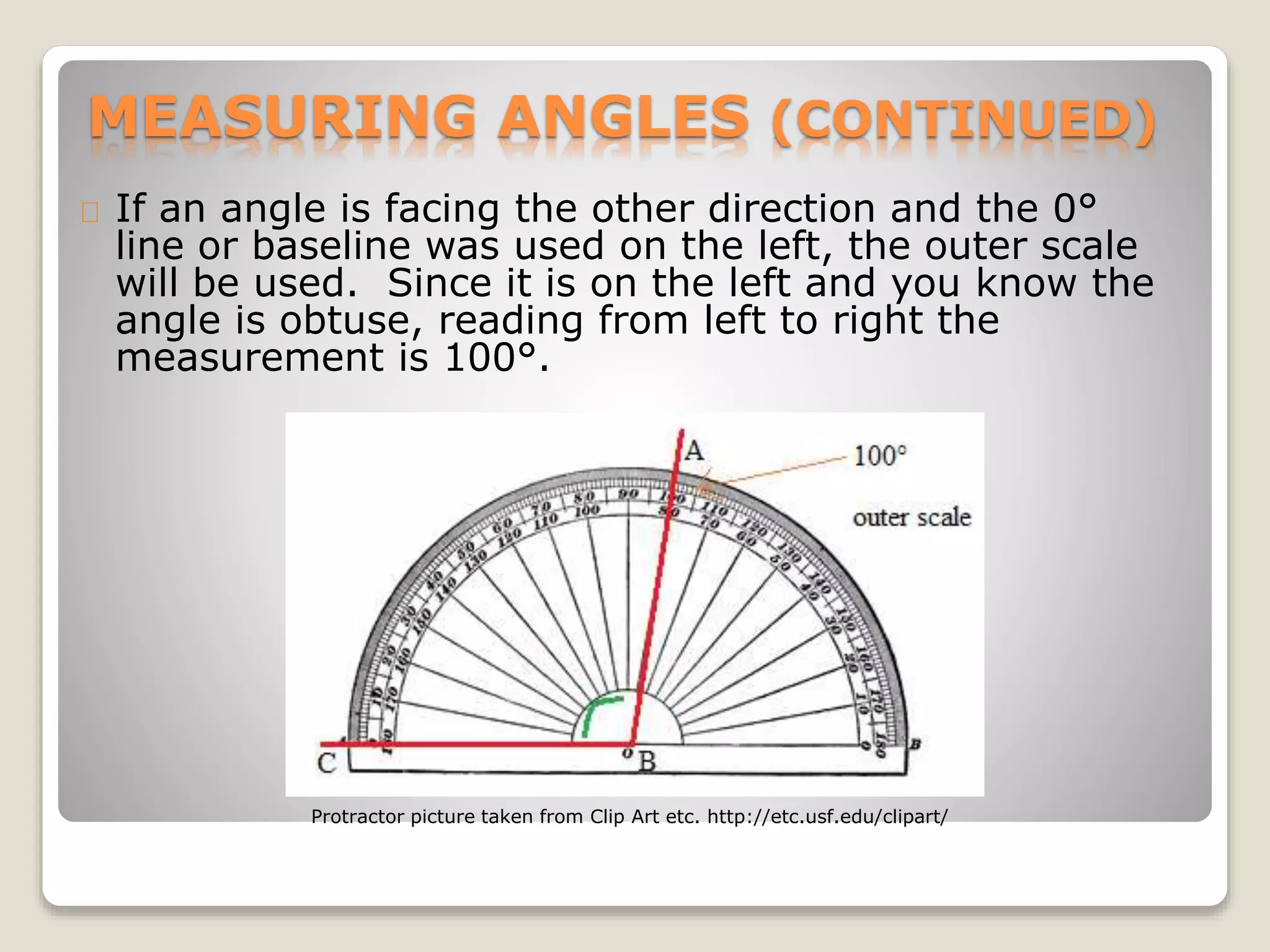
MEASURING ANGLES (CONTINUED)
If an angle is facing the other direction and the 0°
line or baseline was used on the left, the outer scale
will be used. Since it is on the left and you know the
angle is obtuse, reading from left to right the
measurement is 100°.
Protractor picture taken from Clip Art etc. http://etc.usf.edu/clipart/
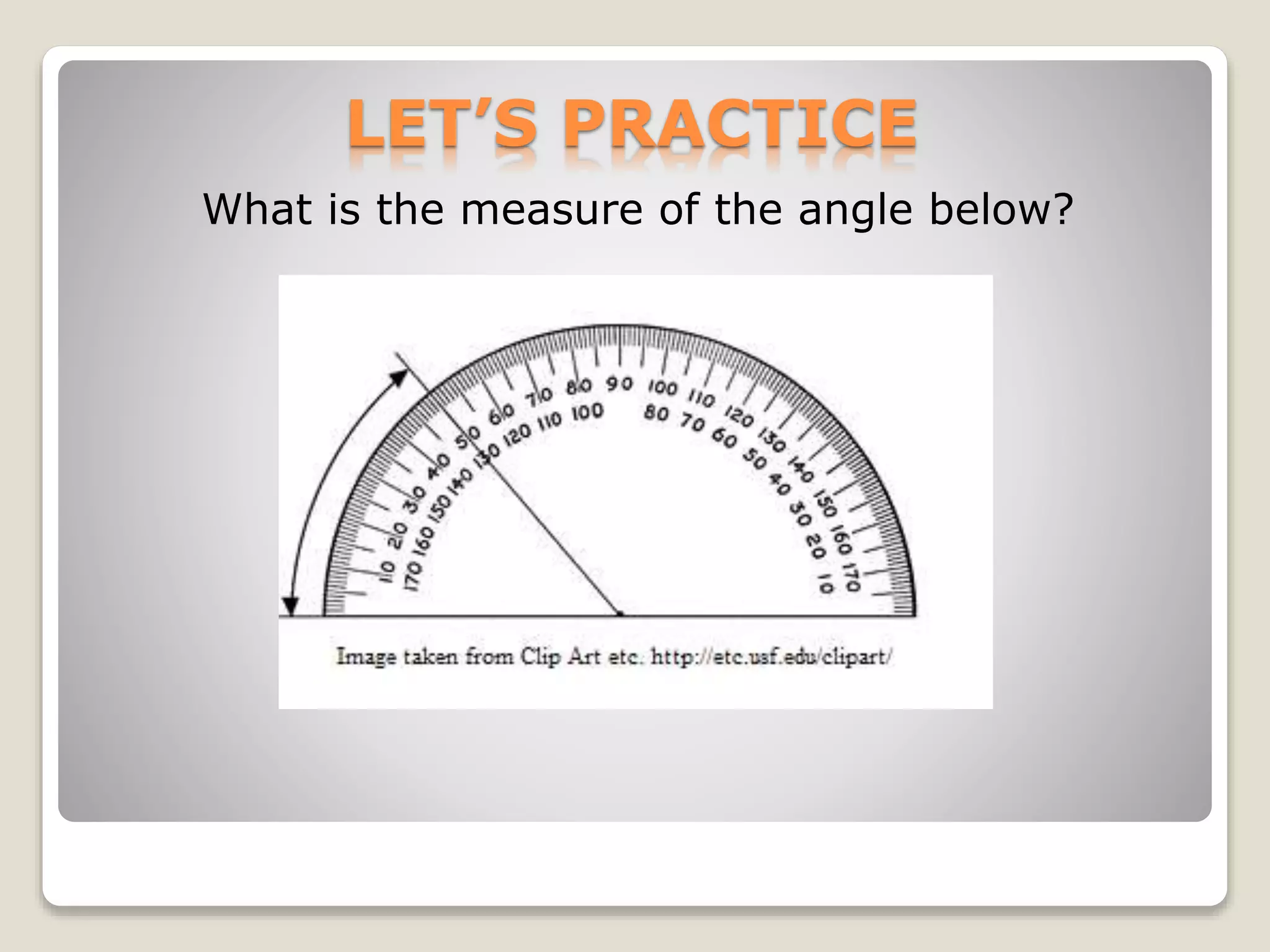
LET’S PRACTICE
What is the measure of the angle below?
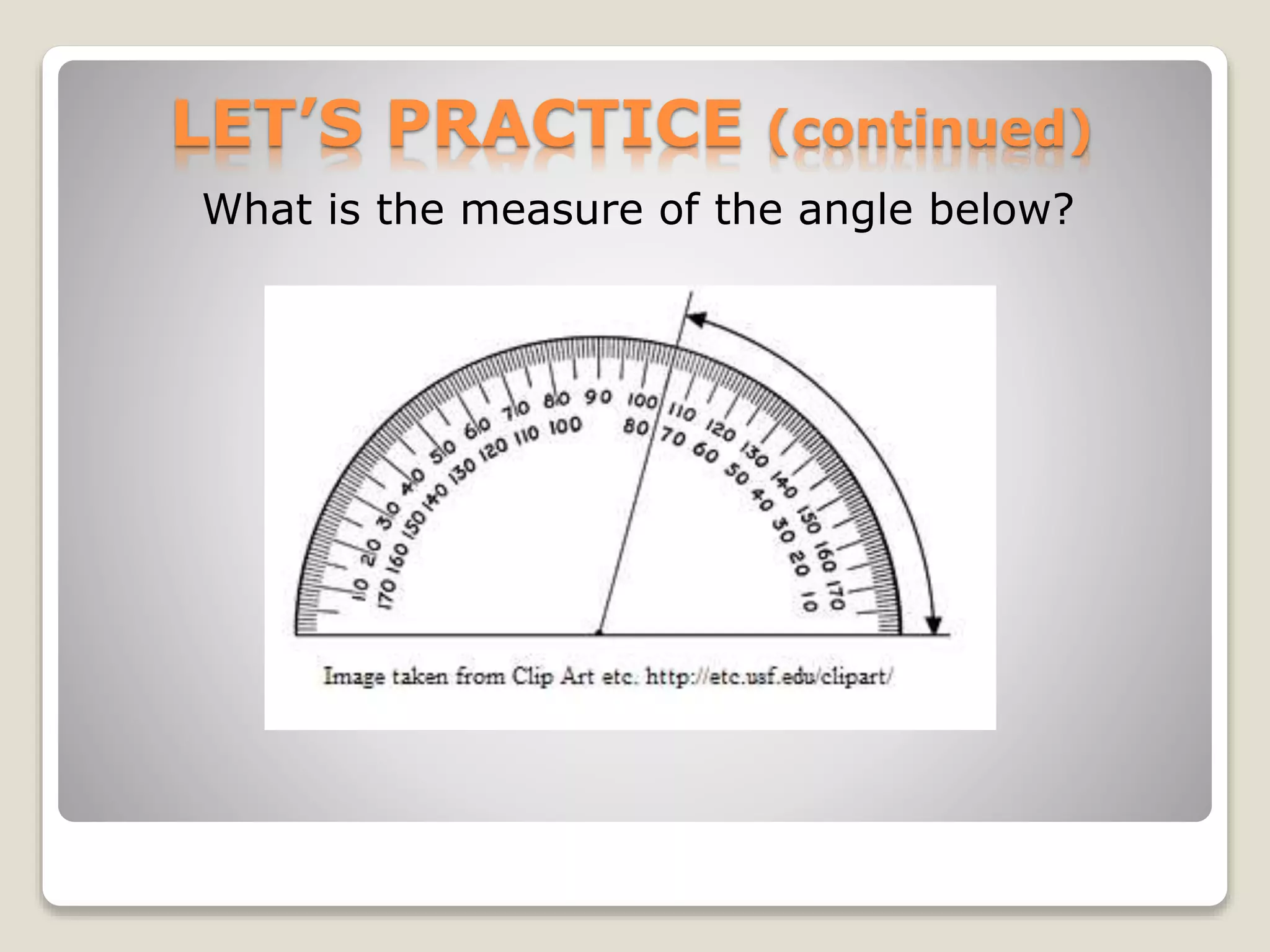
LET’S PRACTICE (continued)
What is the measure of the angle below?
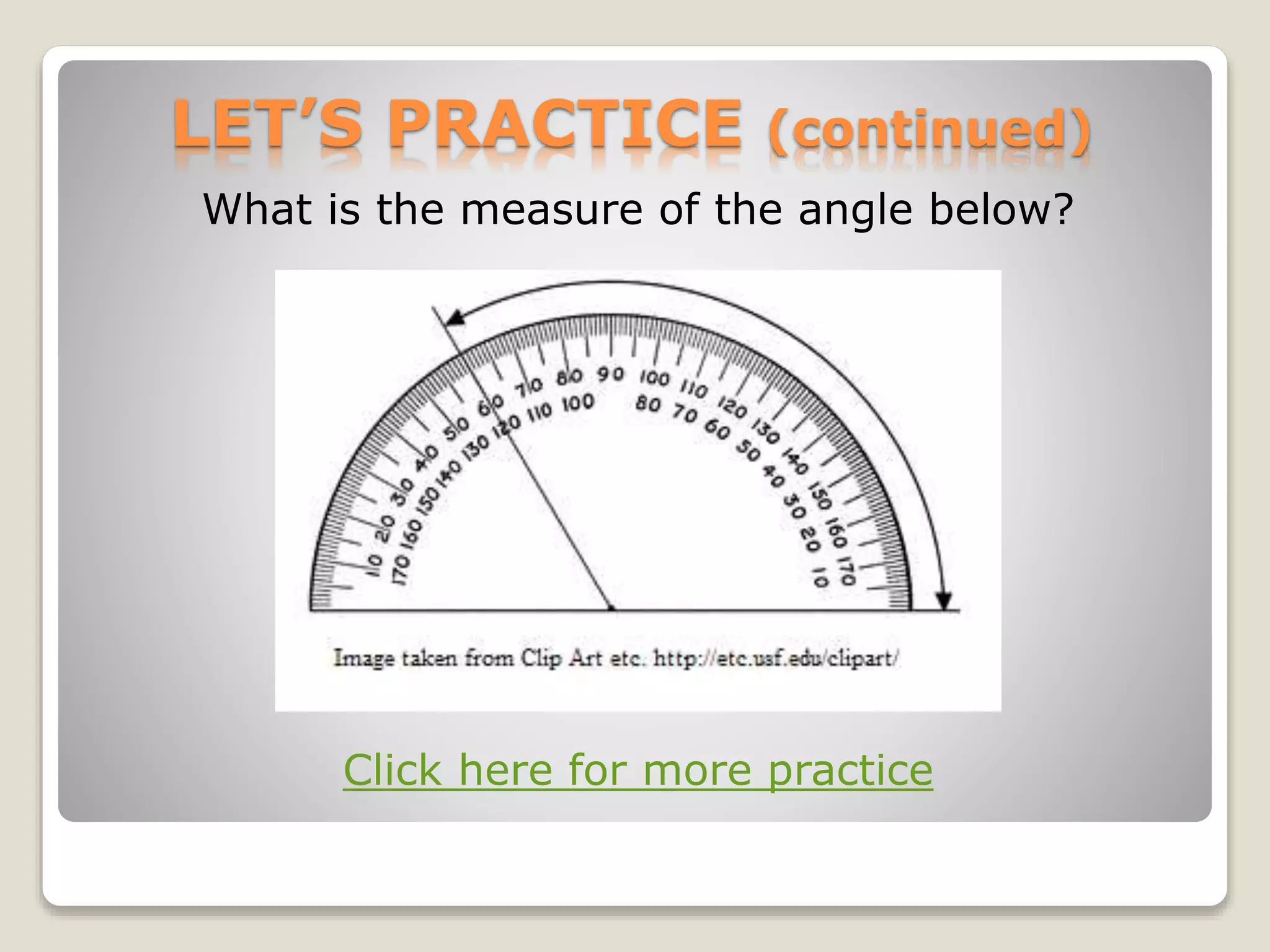
LET’S PRACTICE (continued)
What is the measure of the angle below?
Click here for more practice
REFERENCES
Slide 7: “From Every Angle” Photo used under creative commons
from Eric
Slide 9: “Right Angle…Week #27” Photo used under creative
commons from Camera Eye Photography
Slide 10: “Our Daily Challenge: ANGLES” Photo used under
creative commons from Judy Baxter
Slide 11: “Tangential: M180” Photo used under creative
commons from Simon Harrod
Slide 13: “48 angles” Photo used under creative commons from
Kevin Dooley

Angles: Naming, Types, and How to Measure Them

  • 1.
    ANGLES: NAMING, TYPES, ANDHOW TO MEASURE THEM
  • 2.
    WHAT IS ANANGLE? An angle is defined as the amount of turn between two straight lines that share a common end point. Angles are measured in degrees. The symbol used for degrees is a little circle °. Amount of turn Microsoft Clip Art Drawn by J. Bouchard
  • 3.
    TERMS ASSOCIATED WITH ANGLES VERTEX- The vertex of an angle is the common point where the two lines meet. ARM - The arms of an angle or sides are the lines that make up the angle. DEGREES - The size of the angle is measured in degrees and usually denoted with the ° symbol. For example, an angle may measure 45°. PROTRACTOR - A tool that is used to measure angles. Arm Vertex 45° Protractor Microsoft Clip Art
  • 4.
    NAMING ANGLES There aredifferent ways to name angles. One way is to use the ∠ symbol followed by three letters. From the diagram below you see ∠BAC. The first and third letters indicate points on the two arms. The letter in the middle is the vertex. The first and third letters can be switched because they measure the same angle. For example, ∠BAC is the same as ∠CAB. Drawn by J. Bouchard
  • 5.
    NAMING ANGLES (continued) Anotherway to label the angle is by using the ∠ symbol with the only the vertex point. The angle would be called ∠A. Finally, the last way to label the angle would be by using the ∠ symbol followed by the letter or number between the angle. This would be ∠x. Drawn by J. Bouchard
  • 6.
    PRACTICE NAMING ANGLES Nameall the possible angles shown below 1. 3. 2. Click for more PRACTICE Pictures drawn by J. Bouchard
  • 7.
    FOUR TYPES OFANGLES Photo used under creative commons from Eric
  • 8.
    ACUTE ANGLES An acuteangle is an angle that measures greater than 0° and less than 90°. 80° 30° Microsoft Clip Art
  • 9.
    RIGHT ANGLES A rightangle is an angle that measures 90°. Photo used under creative commons from Camera Eye Photography 90°
  • 10.
    OBTUSE ANGLES An obtuseangle is an angle that measures greater than 90° and less than 180°. Photo used under creative commons from Judy Baxter 115° 155°
  • 11.
    STRAIGHT ANGLES A Straightangle looks like a straight line and measures 180°. It is half a revolution of a circle. Photo used under creative commons from Simon Harrod 180°
  • 12.
    Can you identifythe angles below? 1. 2. 3. 4. 5. 6.
  • 13.
    Identify the typeof angle from the measure shown below 1. 180° 4. 117° 2. 33° 5. 153° 3. 90° 6. 27° Click here to practice Photo used under creative commons from Kevin Dooley
  • 14.
    HOW TO USEA PROTRACTOR A protractor has two scales: •The outer scale reads from 0° to 180° reading from left to right. •The inner scale reads from 0° to 180° reading from right to left. Protractor picture taken from Clip Art etc. http://etc.usf.edu/clipart/
  • 15.
    MEASURING ANGLES To measure∠ABC: 1.Place the center of the protractor on the vertex B. 2.Adjust the 0° line or baseline of the protractor so that it lines up with line BC. 3.Since the angle is acute and the 0° line or baseline was used from the right, you will take the reading from the inner scale. Protractor picture taken from Clip Art etc. http://etc.usf.edu/clipart/
  • 16.
    MEASURING ANGLES (CONTINUED) Ifan angle is facing the other direction and the 0° line or baseline was used on the left, the outer scale will be used. Since it is on the left and you know the angle is obtuse, reading from left to right the measurement is 100°. Protractor picture taken from Clip Art etc. http://etc.usf.edu/clipart/
  • 17.
    LET’S PRACTICE What isthe measure of the angle below?
  • 18.
    LET’S PRACTICE (continued) Whatis the measure of the angle below?
  • 19.
    LET’S PRACTICE (continued) Whatis the measure of the angle below? Click here for more practice
  • 20.
    REFERENCES Slide 7: “FromEvery Angle” Photo used under creative commons from Eric Slide 9: “Right Angle…Week #27” Photo used under creative commons from Camera Eye Photography Slide 10: “Our Daily Challenge: ANGLES” Photo used under creative commons from Judy Baxter Slide 11: “Tangential: M180” Photo used under creative commons from Simon Harrod Slide 13: “48 angles” Photo used under creative commons from Kevin Dooley