8-2 Measuring and
 Classifying Angles
         Math Notes
 Measurement and Geometry 2.1
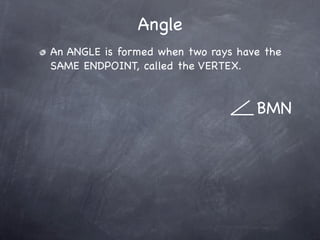
Angle
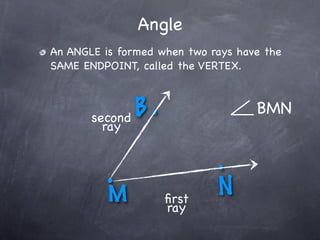
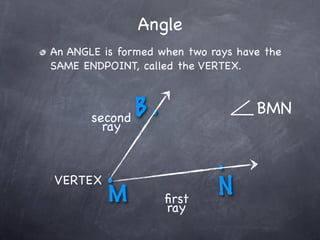
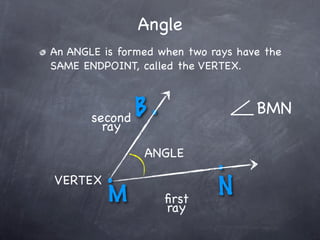
An ANGLE is formed when two rays have the
SAME ENDPOINT, called the VERTEX.


                                    BMN
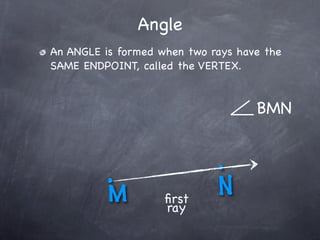
Angle
An ANGLE is formed when two rays have the
SAME ENDPOINT, called the VERTEX.


                                    BMN


          .                  .
          M         first
                             N
                    ray
Angle
An ANGLE is formed when two rays have the
SAME ENDPOINT, called the VERTEX.


       second B.                    BMN
         ray


          .                  .
          M         first
                             N
                    ray
Angle
An ANGLE is formed when two rays have the
SAME ENDPOINT, called the VERTEX.


       second B.                    BMN
         ray


          .                  .
VERTEX
          M         first
                             N
                    ray
Angle
An ANGLE is formed when two rays have the
SAME ENDPOINT, called the VERTEX.


       second B.                    BMN
         ray


          .
                ANGLE
                             .
VERTEX
          M         first
                             N
                    ray
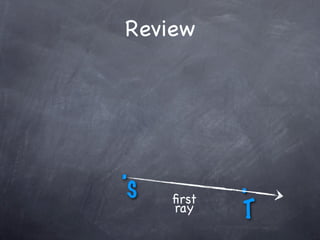
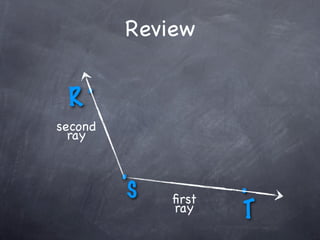
Review
Review


.          .
S   first
    ray    T
Review


 R
   .
second
  ray


         .          .
         S   first
             ray    T
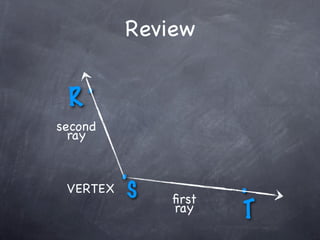
Review


 R
   .
second
  ray


        .           .
 VERTEX  S   first
             ray    T
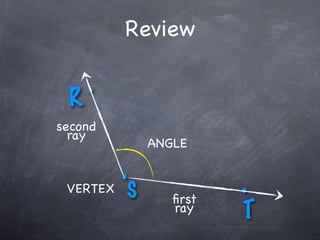
Review


 R
   .
second
  ray
             ANGLE

        .              .
 VERTEX  S      first
                ray    T
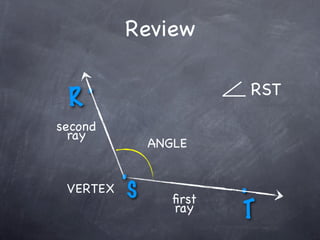
Review


 R
   .                       RST

second
  ray
             ANGLE

        .              .
 VERTEX  S      first
                ray    T
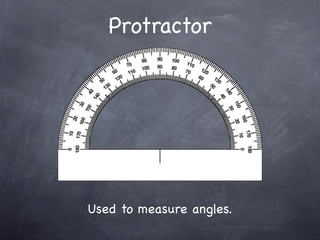
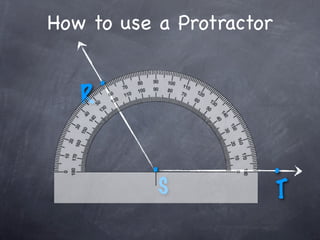
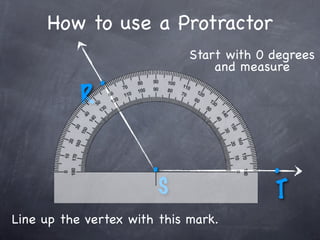
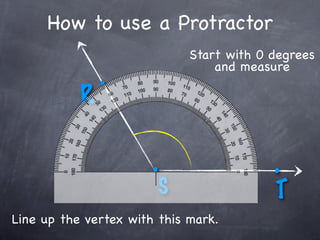
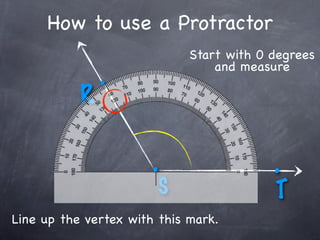
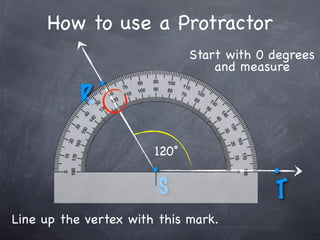
Protractor


Used to measure angles.
Protractor


Used to measure angles.
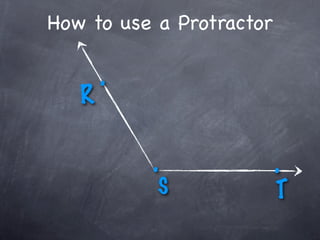
How to use a Protractor

       .
   R

           .              .
           S              T
How to use a Protractor

       .
   R

           .              .
           S              T
How to use a Protractor

               .
           R

                       .             .
                        S            T
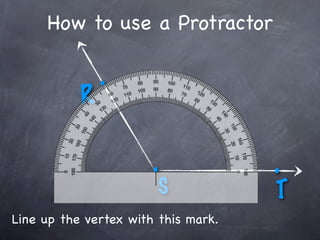
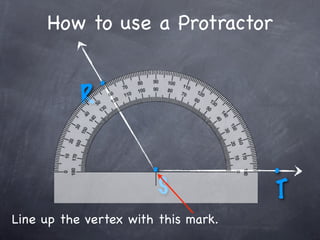
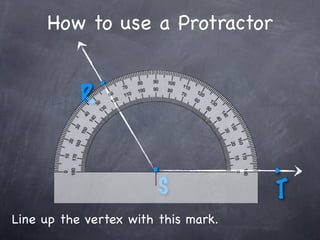
Line up the vertex with this mark.
How to use a Protractor

               .
           R

                       .             .
                        S            T
Line up the vertex with this mark.
How to use a Protractor

               .
           R

                       .             .
                        S            T
Line up the vertex with this mark.
How to use a Protractor
                             Start with 0 degrees
                                 and measure
               .
           R

                       .                  .
                        S                 T
Line up the vertex with this mark.
How to use a Protractor
                             Start with 0 degrees
                                 and measure
               .
           R

                       .                  .
                        S                 T
Line up the vertex with this mark.
How to use a Protractor
                             Start with 0 degrees
                                 and measure
               .
           R

                       .                  .
                        S                 T
Line up the vertex with this mark.
How to use a Protractor
                              Start with 0 degrees
                                  and measure
               .
           R

                       120˚
                       .                   .
                        S                  T
Line up the vertex with this mark.
3 Kinds of Angles
3 Kinds of Angles
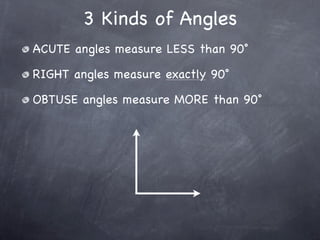
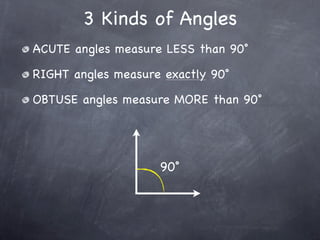
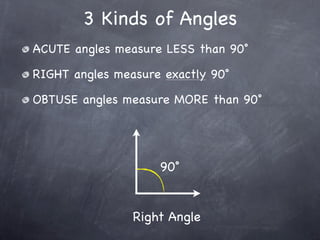
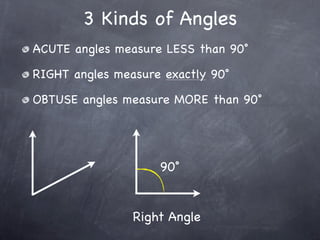
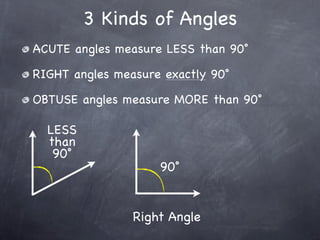
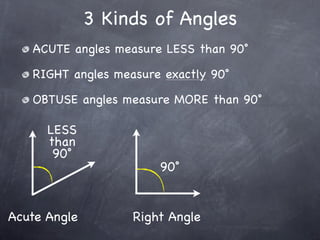
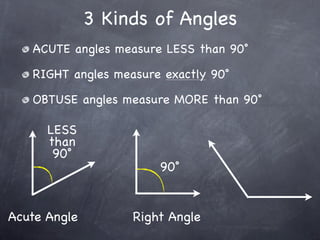
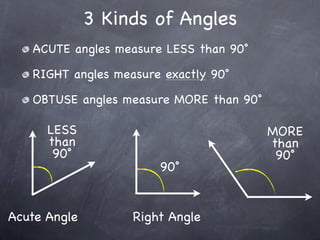
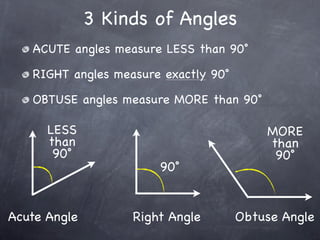
ACUTE angles measure LESS than 90˚
3 Kinds of Angles
ACUTE angles measure LESS than 90˚

RIGHT angles measure exactly 90˚
3 Kinds of Angles
ACUTE angles measure LESS than 90˚

RIGHT angles measure exactly 90˚

OBTUSE angles measure MORE than 90˚
3 Kinds of Angles
ACUTE angles measure LESS than 90˚

RIGHT angles measure exactly 90˚

OBTUSE angles measure MORE than 90˚
3 Kinds of Angles
ACUTE angles measure LESS than 90˚

RIGHT angles measure exactly 90˚

OBTUSE angles measure MORE than 90˚


                    90˚
3 Kinds of Angles
ACUTE angles measure LESS than 90˚

RIGHT angles measure exactly 90˚

OBTUSE angles measure MORE than 90˚


                    90˚


                Right Angle
3 Kinds of Angles
ACUTE angles measure LESS than 90˚

RIGHT angles measure exactly 90˚

OBTUSE angles measure MORE than 90˚


                    90˚


                Right Angle
3 Kinds of Angles
ACUTE angles measure LESS than 90˚

RIGHT angles measure exactly 90˚

OBTUSE angles measure MORE than 90˚

  LESS
  than
   90˚
                    90˚


                Right Angle
3 Kinds of Angles
   ACUTE angles measure LESS than 90˚

   RIGHT angles measure exactly 90˚

   OBTUSE angles measure MORE than 90˚

      LESS
      than
       90˚
                       90˚


Acute Angle        Right Angle
3 Kinds of Angles
   ACUTE angles measure LESS than 90˚

   RIGHT angles measure exactly 90˚

   OBTUSE angles measure MORE than 90˚

      LESS
      than
       90˚
                       90˚


Acute Angle        Right Angle
3 Kinds of Angles
   ACUTE angles measure LESS than 90˚

   RIGHT angles measure exactly 90˚

   OBTUSE angles measure MORE than 90˚

      LESS                               MORE
      than                               than
       90˚                                90˚
                       90˚


Acute Angle        Right Angle
3 Kinds of Angles
   ACUTE angles measure LESS than 90˚

   RIGHT angles measure exactly 90˚

   OBTUSE angles measure MORE than 90˚

      LESS                                MORE
      than                                than
       90˚                                 90˚
                       90˚


Acute Angle        Right Angle        Obtuse Angle

10-2 Measuring/Classifying Angles

  • 1.
    8-2 Measuring and Classifying Angles Math Notes Measurement and Geometry 2.1
  • 2.
    Angle An ANGLE isformed when two rays have the SAME ENDPOINT, called the VERTEX. BMN
  • 3.
    Angle An ANGLE isformed when two rays have the SAME ENDPOINT, called the VERTEX. BMN . . M first N ray
  • 4.
    Angle An ANGLE isformed when two rays have the SAME ENDPOINT, called the VERTEX. second B. BMN ray . . M first N ray
  • 5.
    Angle An ANGLE isformed when two rays have the SAME ENDPOINT, called the VERTEX. second B. BMN ray . . VERTEX M first N ray
  • 6.
    Angle An ANGLE isformed when two rays have the SAME ENDPOINT, called the VERTEX. second B. BMN ray . ANGLE . VERTEX M first N ray
  • 7.
  • 8.
    Review . . S first ray T
  • 9.
    Review R . second ray . . S first ray T
  • 10.
    Review R . second ray . . VERTEX S first ray T
  • 11.
    Review R . second ray ANGLE . . VERTEX S first ray T
  • 12.
    Review R . RST second ray ANGLE . . VERTEX S first ray T
  • 13.
  • 14.
  • 15.
    How to usea Protractor
  • 16.
    How to usea Protractor . R . . S T
  • 17.
    How to usea Protractor . R . . S T
  • 18.
    How to usea Protractor . R . . S T Line up the vertex with this mark.
  • 19.
    How to usea Protractor . R . . S T Line up the vertex with this mark.
  • 20.
    How to usea Protractor . R . . S T Line up the vertex with this mark.
  • 21.
    How to usea Protractor Start with 0 degrees and measure . R . . S T Line up the vertex with this mark.
  • 22.
    How to usea Protractor Start with 0 degrees and measure . R . . S T Line up the vertex with this mark.
  • 23.
    How to usea Protractor Start with 0 degrees and measure . R . . S T Line up the vertex with this mark.
  • 24.
    How to usea Protractor Start with 0 degrees and measure . R 120˚ . . S T Line up the vertex with this mark.
  • 25.
    3 Kinds ofAngles
  • 26.
    3 Kinds ofAngles ACUTE angles measure LESS than 90˚
  • 27.
    3 Kinds ofAngles ACUTE angles measure LESS than 90˚ RIGHT angles measure exactly 90˚
  • 28.
    3 Kinds ofAngles ACUTE angles measure LESS than 90˚ RIGHT angles measure exactly 90˚ OBTUSE angles measure MORE than 90˚
  • 29.
    3 Kinds ofAngles ACUTE angles measure LESS than 90˚ RIGHT angles measure exactly 90˚ OBTUSE angles measure MORE than 90˚
  • 30.
    3 Kinds ofAngles ACUTE angles measure LESS than 90˚ RIGHT angles measure exactly 90˚ OBTUSE angles measure MORE than 90˚ 90˚
  • 31.
    3 Kinds ofAngles ACUTE angles measure LESS than 90˚ RIGHT angles measure exactly 90˚ OBTUSE angles measure MORE than 90˚ 90˚ Right Angle
  • 32.
    3 Kinds ofAngles ACUTE angles measure LESS than 90˚ RIGHT angles measure exactly 90˚ OBTUSE angles measure MORE than 90˚ 90˚ Right Angle
  • 33.
    3 Kinds ofAngles ACUTE angles measure LESS than 90˚ RIGHT angles measure exactly 90˚ OBTUSE angles measure MORE than 90˚ LESS than 90˚ 90˚ Right Angle
  • 34.
    3 Kinds ofAngles ACUTE angles measure LESS than 90˚ RIGHT angles measure exactly 90˚ OBTUSE angles measure MORE than 90˚ LESS than 90˚ 90˚ Acute Angle Right Angle
  • 35.
    3 Kinds ofAngles ACUTE angles measure LESS than 90˚ RIGHT angles measure exactly 90˚ OBTUSE angles measure MORE than 90˚ LESS than 90˚ 90˚ Acute Angle Right Angle
  • 36.
    3 Kinds ofAngles ACUTE angles measure LESS than 90˚ RIGHT angles measure exactly 90˚ OBTUSE angles measure MORE than 90˚ LESS MORE than than 90˚ 90˚ 90˚ Acute Angle Right Angle
  • 37.
    3 Kinds ofAngles ACUTE angles measure LESS than 90˚ RIGHT angles measure exactly 90˚ OBTUSE angles measure MORE than 90˚ LESS MORE than than 90˚ 90˚ 90˚ Acute Angle Right Angle Obtuse Angle